



California passed the first law that prohibited “aliens ineligible to citizenship” from owning or leasing land, a law that targeted Americans of Japanese descent. From this point on until 1923, many states (Arizona, Arkansas, Florida, Idaho, Louisiana, Minnesota, Montana, Nebraska, New Mexico, Oregon, Texas, Utah, Washington, and Wyoming) across the US passed similar laws and restrictions.
Used in reliance on fair use
This in-copyright item is presented here in accordance with the authors’ fair use rights. Its use in other contexts may require permission from the copyright holder.
No Known Copyright
The organization that has made the Item available believes that the Item is in the Public Domain under the laws of the United States, but a determination was not made as to its copyright status under the copyright laws of other countries. The Item may not be in the Public Domain under the laws of other countries. Please refer to the organization that has made the Item available for more information.
NOTICES
Unless expressly stated otherwise, the organization that has made this Item available makes no warranties about the Item and cannot guarantee the accuracy of this Rights Statement. You are responsible for your own use.
You may find additional information about the copyright status of the Item on the website of the organization that has made the Item available.
You may need to obtain other permissions for your intended use. For example, other rights such as publicity, privacy or moral rights may limit how you may use the material.
The person who associated a work with this deed has dedicated the work to the public domain by waiving all of his or her rights to the work worldwide under copyright law, including all related and neighboring rights, to the extent allowed by law.
You can copy, modify, distribute and perform the work, even for commercial purposes, all without asking permission. See Other Information below.
Other Information
In no way are the patent or trademark rights of any person affected by CC0, nor are the rights that other persons may have in the work or in how the work is used, such as publicity or privacy rights.
Unless expressly stated otherwise, the person who associated a work with this deed makes no warranties about the work, and disclaims liability for all uses of the work, to the fullest extent permitted by applicable law.
When using or citing the work, you should not imply endorsement by the author or the affirmer.
This license enables reusers to distribute, remix, adapt, and build upon the material in any medium or format, so long as attribution is given to the creator. The license allows for commercial use. CC BY includes the following elements:
Attribution – Credit must be given to you, the creator.
CC BY-SA 4.0 Attribution-ShareAlike 4.0 International
CC BY-SA 3.0 Attribution-ShareAlike 3.0 Unported
CC BY-SA 2.0 Attribution-ShareAlike 2.0 Generic
This license enables reusers to distribute, remix, adapt, and build upon the material in any medium or format, so long as attribution is given to the creator. The license allows for commercial use. If you remix, adapt, or build upon the material, you must license the modified material under the same or a compatible license. CC BY-SA includes the following elements:
Attribution – Credit must be given to you, the creator.
ShareAlike – Adaptations must be shared under the same terms.
CC BY-ND 4.0 Attribution-NoDerivatives 4.0 International
CC BY-ND 3.0 Attribution-NoDerivatives 3.0 Unported
CC BY-ND 2.0 Attribution-NoDerivatives 2.0 Generic
This license enables reusers to copy and distribute the material in any medium or format in unadapted form only, and only so long as attribution is given to the creator. The license allows for commercial use. CC BY-ND includes the following elements:
Attribution – Credit must be given to you, the creator.
NoDerivatives – No derivatives or adaptations of your work are permitted.
CC BY-NC 4.0 Attribution-NonCommercial 4.0 International
CC BY-NC 3.0 Attribution-NonCommercial 3.0 Unported
CC BY-NC 2.0 Attribution-NonCommercial 2.0 Generic
This license enables reusers to distribute, remix, adapt, and build upon the material in any medium or format for noncommercial purposes only, and only so long as attribution is given to the creator. CC BY-NC includes the following elements:
Attribution – Credit must be given to you, the creator.
NonCommercial – Only noncommercial use of your work is permitted. Noncommercial means not primarily intended for or directed towards commercial advantage or monetary compensation.
CC BY-NC-SA 4.0 Attribution-NonCommercial-ShareAlike 4.0 International
CC BY-NC-SA 3.0 Attribution-NonCommercial-ShareAlike 3.0 Unported
CC BY-NC-SA 2.0 Attribution-NonCommercial-ShareAlike 2.0 Generic
This license enables reusers to distribute, remix, adapt, and build upon the material in any medium or format for noncommercial purposes only ifattribution is given to the creator. If you remix, adapt, or build upon the material, you must license the modified material under the same or a compatible license. CC BY-NC-SA includes the following elements:
Attribution – Credit must be given to you, the creator.
NonCommercial – Only noncommercial use of your work is permitted. Noncommercial means not primarily intended for or directed towards commercial advantage or monetary compensation.
ShareAlike – Adaptations must be shared under the same terms.
CC BY-NC-ND 4.0 Attribution-NonCommercial-NoDerivatives 4.0 International
CC BY-NC-ND 3.0 Attribution-NonCommercial-NoDerivatives 3.0 Unported
CC BY-NC-ND 2.0 Attribution-NonCommercial-NoDerivatives 2.0 Generic
This license enables reusers to copy and distribute the material in any medium or format in unadapted form only, for noncommercial purposes only, and only if attribution is given to the creator. CC BY-NC-ND includes the following elements:
Attribution – Credit must be given to you, the creator.
NonCommercial – Only noncommercial use of your work is permitted. Noncommercial means not primarily intended for or directed towards commercial advantage or monetary compensation.
NoDerivatives – No derivatives or adaptations of your work are permitted.
This Item is protected by copyright and/or related rights. You are free to use this Item in any way that is permitted by the copyright and related rights legislation that applies to your use. For other uses you need to obtain permission from the rights-holder(s).
NOTICES
Unless expressly stated otherwise, the organization that has made this Item available makes no warranties about the Item and cannot guarantee the accuracy of this Rights Statement. You are responsible for your own use.
You may find additional information about the copyright status of the Item on the website of the organization that has made the Item available.
You may need to obtain other permissions for your intended use. For example, other rights such as publicity, privacy or moral rights may limit how you may use the material.
This Item is protected by copyright and/or related rights. However, for this Item, either (a) no rights-holder(s) have been identified or (b) one or more rights-holder(s) have been identified but none have been located. You are free to use this Item in any way that is permitted by the copyright and related rights legislation that applies to your use.
NOTICES
If you have any information that can contribute to identifying or locating the rights-holder(s) please notify the organization that has made the Item available.
Unless expressly stated otherwise, the organization that has made this Item available makes no warranties about the Item and cannot guarantee the accuracy of this Rights Statement. You are responsible for your own use.
You may find additional information about the copyright status of the Item on the website of the organization that has made the Item available.
You may need to obtain other permissions for your intended use. For example, other rights such as publicity, privacy or moral rights may limit how you may use the material.
This Item is protected by copyright and/or related rights. You are free to use this Item in any way that is permitted by the copyright and related rights legislation that applies to your use. In addition, no permission is required from the rights-holder(s) for educational uses. For other uses, you need to obtain permission from the rights-holder(s).
NOTICES
Unless expressly stated otherwise, the organization that has made this Item available makes no warranties about the Item and cannot guarantee the accuracy of this Rights Statement. You are responsible for your own use.
You may find additional information about the copyright status of the Item on the website of the organization that has made the Item available.
You may need to obtain other permissions for your intended use. For example, other rights such as publicity, privacy or moral rights may limit how you may use the material.
Thuy Vo Dang is a professor of Information Studies and Asian American Studies at UCLA where she co-directs the Community Archives Lab. She holds a Ph.D. in Ethnic Studies from the University of California, San Diego. Her previous role was Curator for the UCI Libraries Southeast Asian Archive and Research Librarian for Asian American Studies. Her research and community-engaged scholarship center “refugee archival praxis” in the Vietnamese diaspora. She is coauthor of the books A People’s Guide to Orange County (2022) and Vietnamese in Orange County (2015) and has published in Amerasia Journal, AAPI Nexus: Policy, Practice and Community, Health Promotion Practice, History Now: the Journal, Journal of Contemporary Archival Studies, Journal of Education for Library and Information Science, Ethnic Studies in Academic and Research Libraries, and Toward a Framework for Vietnamese American Studies. Thuy serves on the board of directors for Arts Orange County and the Vietnamese American Arts and Letters Association.
Has leaving Vietnam as refugees impacted what it means to be Vietnamese American?
100/100
This module introduces what has been known as the Vietnam War in the United States and the American War in Vietnam, covering the period from 1954 to 1975. This period has also been referred to as the Second Indochina War. While mainstream histories and chronologies often center the American perspective and highlight well-known events such as the Mỹ Lai Massacre or the Tết Offensive (both occurring in 1968), this module considers the perspectives of the South Vietnamese who fled their homeland after the war, and whose stories are often distorted or erased in Vietnam and the United States.
We will engage with the “ordinary” experiences of people who lived through extraordinary times. This “bottom-up” approach to learning about a major world event will foster critical thinking and analytical skills. We will also examine how official archives are partial and incomplete, often reflecting the priorities of those in positions of power and privilege. This will prepare us for exploring how people who are left out of official history can construct their own community archives.
Who gets to tell the story of the Vietnam-American War?
How are people turned into enemies during wartime?
What sources can we explore for a more nuanced understanding of the Vietnam-American War from the Vietnamese perspective?
Perseverance: A Voice from South Vietnam
Born in the era of French colonialism, Nguyễn Thị Hạnh Nhơn’s life overlapped with different periods of political upheaval and war in Vietnam. Her perspective helps us understand more about the experiences of refugees from South Vietnam.
Nguyễn Thị Hạnh Nhơn was born in Huế, the former imperial capital city located in the central region. Her father was a high-ranking official under Emperor Bảo Đại of the last ruling dynasty, the Nguyễn. While some parts of Nguyễn’s life were filled with privilege due to her family’s ties to the royals, she also suffered tremendous losses each time the regime changed. “After successive waves of evacuations, my family became extremely poor,” 1 she recalled.
Video 19.02.01 — Nguyễn Thị Hạnh Nhơn describes her life through periods of French colonial rule, Japanese occupation and the Vietnam-American War.
In the 1950s, Nguyễn served in the corps of female assistants under the French regime fighting against Việt Minh forces, the Communist Vietnamese that had fought for independence from French rule. This group of female assistants later became the corps of female soldiers under the Army of the Republic of Vietnam (ARVN) after the country was divided into North Vietnam and South Vietnam in 1954.
In the ARVN, Nguyễn was responsible for training female soldiers for the South during the Vietnam-American War. Recalling the fateful day of April 30, 1975, when the southern capital of Saigon (Sài Gòn in Vietnamese) fell to North Vietnamese Communist forces, she shared: “That morning while at home I received the news of surrendering, I burst out crying. Suddenly, all was at a loss and that was a deep sorrow that we had to undergo but could not do anything because the last President [Nguyễn Văn Thiệu] already surrendered. What could we do?”2
Nguyễn was imprisoned in a reeducation camp due to her involvement in the South Vietnamese armed forces. The reeducation camps of postwar Vietnam have also been called concentration camps, hard labor camps, or prisons because of the inhumane conditions of forced detention. Her imprisonment lasted nearly five years. After her release from prison, one of her nine sons sponsored her to come to the United States under the Humanitarian Operation (HO) resettlement category of the Orderly Departure Program. After resettling in the United States, she got involved in community work and served as president of the HO Society, assisting wounded veterans and war widows.
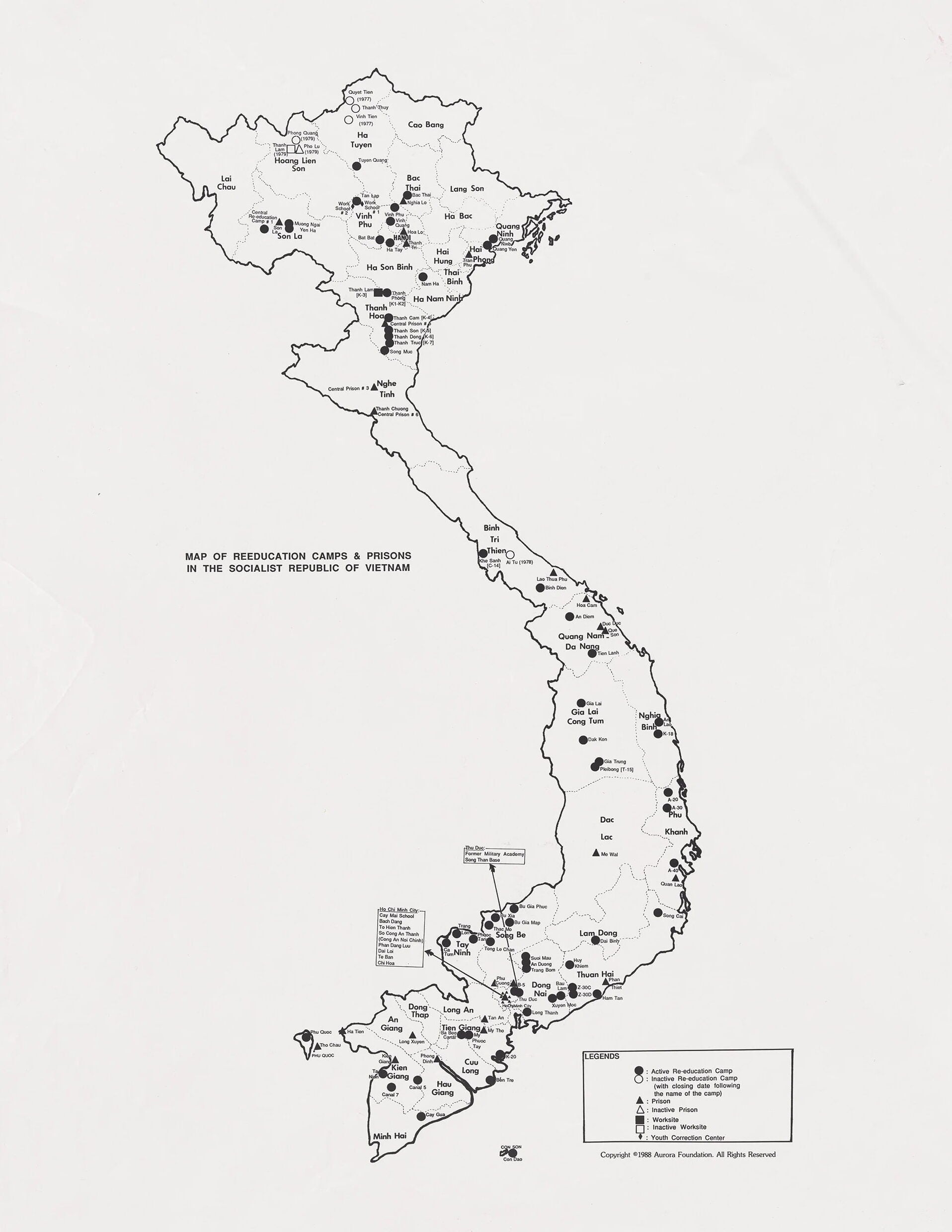
Image 19.02.02 — Due to her involvement in the South Vietnamese armed forces, Nguyễn Thị Hạnh Nhơn was imprisoned after the war ended. This map locates sites of reeducation camps and prisons in the Socialist Republic of Vietnam.
At the time Nguyễn Thị Hạnh Nhơn recounted her story for the Vietnamese American Heritage Foundation’s 500 Oral Histories project, she was eighty-three years old. She lived until the age of ninety-one. In her lifetime, Nguyễn demonstrated how the Vietnamese people persisted through war, their spirits indomitable, despite overwhelming hardships:
“I was Group Chief of Women’s Group in the Air Force. As female soldiers, we did our best to contribute to Vietnamese Armed Forces. At that time the ARVN ranked second or third in the world, so we tried our best in our work. We were also proud of our contributions to serve in the armed forces in serving the country… We were proud because we were equal to the male soldiers, and our ability was not inferior to theirs. They treated us very well as among sisters and brothers. We respected one another as comrades, so whenever there was a reunion of military units of the armed services, we always joined them. Despite being defamed as losers, we still found ourselves not losing. We lost because that [was] the fate of the country in that period. But we were also very proud to have brought together our best to protect the South so that the people could live in peace. And in here we could inhabit in a free country, our children could contribute in the mainstream of the US or of other countries. Female soldiers were now getting here either by escaping by sea or by land, or through the H.O. program or by family reunion or by any other means. Whether we were settling either in France, in Australia, in Canada, or in all the states of the United States, we always offered our ability to do useful things.” 3
Nguyễn Thị Hạnh Nhơn’s story is only one of the millions of Vietnamese whose lives were impacted by the Vietnam-American War, a war that resulted in the deaths of three million Vietnamese and fifty-eight thousand Americans. The death toll alone is horrendous, but millions more also suffered from the ongoing effects of war: displacement, fractured families, physical disabilities, trauma and mental distress.
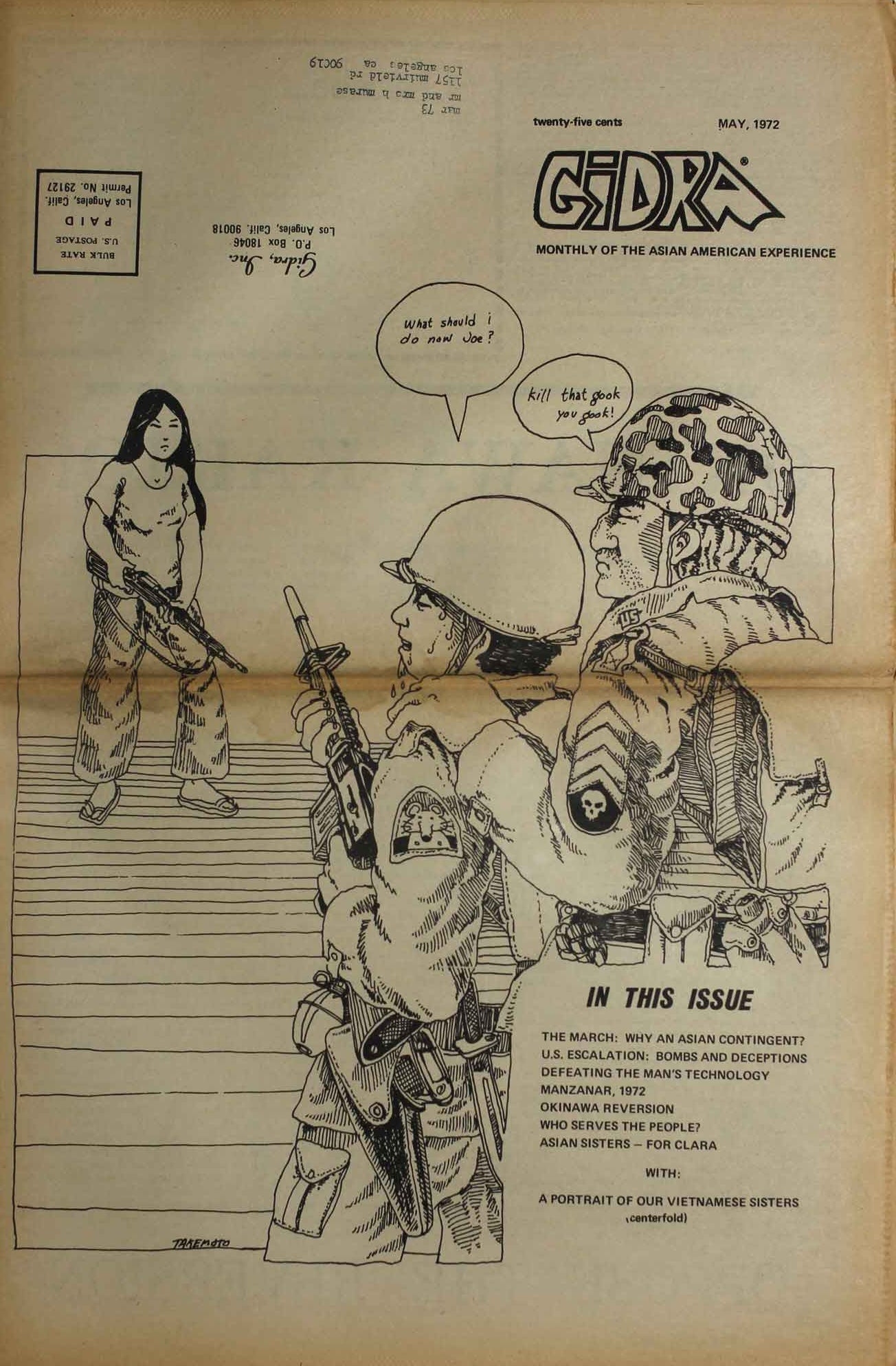
Image 19.02.03 — This May 1972 cover art of Gidra, an Asian American Movement publication, critiques how people are turned into enemies during wartime. The word “gook” is a derogatory term and was used to dehumanize Asian people during the Vietnam-American War.
A song performed by the Temptations and Edwin Starr in 1970 has served as an anthem for the antiwar movement, and remixed by later generations. Called “War,” the song has the following verse:
War, I despise ’Cause it means destruction of innocent lives War means tears to thousands of mother’s eyes When their sons go off to fight And lose their lives 4
The song was a number one hit upon its release in the United States. It captured many of the anxieties Americans were experiencing as the Vietnam-American War escalated and became very visible to them through television screens. From newspapers and photographic images to radio broadcasting and television reports, the Vietnam-American War entered the lives of Americans as no other war had done at the time.
The antiwar movement, sometimes called the peace movement, kicked off in 1965 with a series of protests against US involvement in Vietnam and lasted for a decade. It intersected with other major social movements of the era, including the African American civil rights movement, second wave feminism, ethnic studies strikes, the Chicano movement, and anticolonial struggles around the world.
Video 19.02.04 — American singer Edwin Starr’s version of “War” captured the anxieties that many Americans were experiencing as they watched the Vietnam-American War unfolding on their home television screens. Starr’s “War” continues to be a popular protest song.
Significantly, it was Motown Records, a Black-owned label, and Edwin Starr, a Black veteran of the US military, that brought this antiwar hit song to the American public. While Black people were still fighting for civil rights in the shadow of centuries of enslavement and Jim Crow segregation, they were also being drafted by the military and sent to Vietnam “to die for their country” under the government’s rationale of stopping the international spread of Communism.
Dr. Martin Luther King Jr. referred to the Vietnam-American War as “a white man’s war,” but “a Black man’s fight,” due to the disproportionately higher percentage of combat casualties of African Americans compared to whites. “We were taking the Black young men who had been crippled by our society and sending them eight thousand miles away to guarantee liberties in Southeast Asia which they had not found in southwest Georgia and East Harlem,”5 he said.
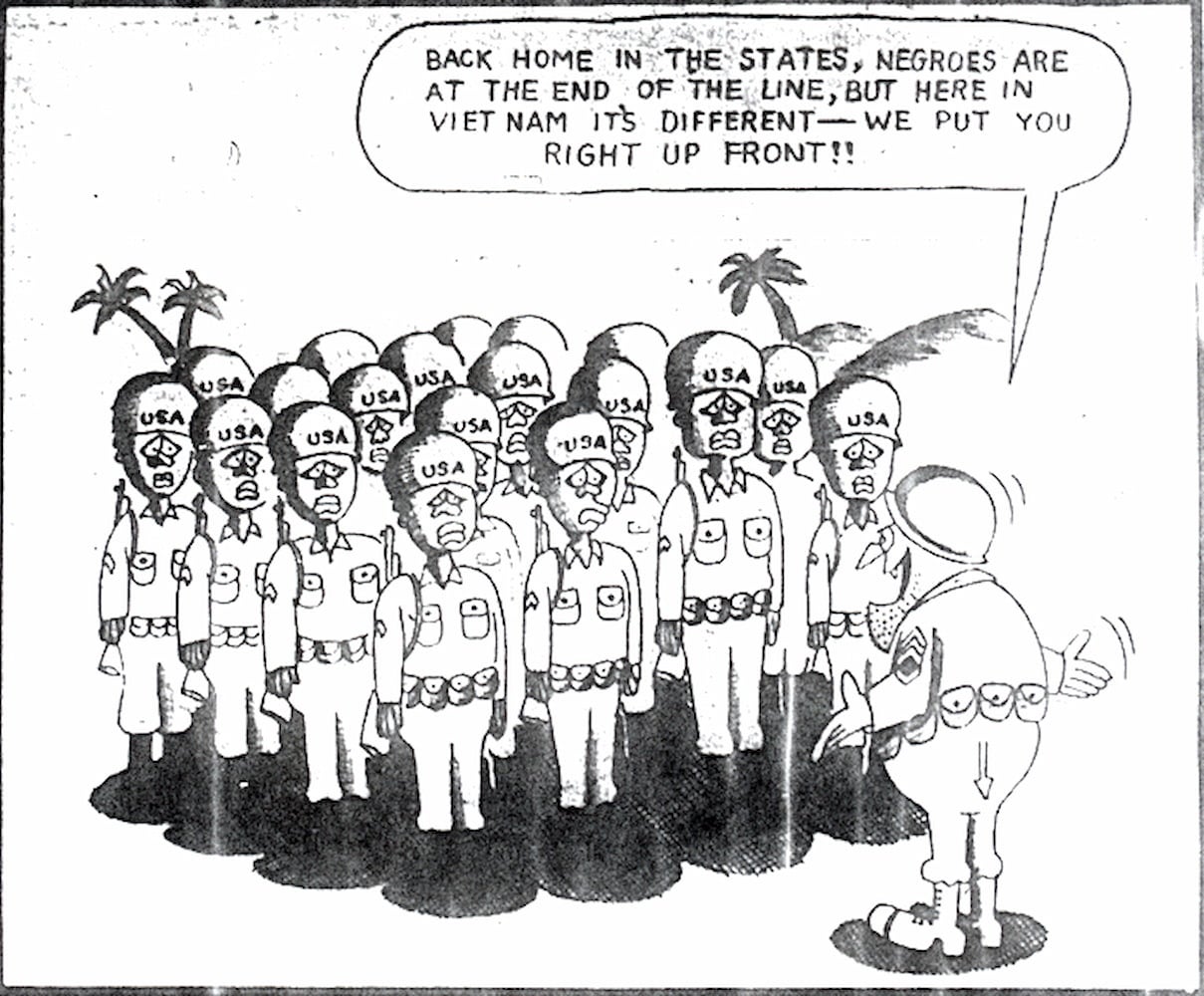
Image 19.02.05 — This cartoon highlights the contradiction of Black soldiers sent overseas to fight for a country that continued to deny their civil rights back home. The term “Negro” was commonly used in the 1960s. It is not an acceptable term today.
Among those most critical of US militarism at the time were Asian Americans, the majority being of Chinese, Japanese, or Filipino ancestry. They pointed out how the Communist “enemies” of the United States in Vietnam looked like Asians here, and the similarities between US war policy and how Japanese people were demonized and targeted during World War II.
In that time period, mainstream magazines like Time and Life portrayed Japanese people as the racialized enemy, caricatured as yellow, ape-like, and emotionless. Dehumanizing the enemy “other” has always been part of wartime propaganda, but during the 1960s and 1970s, antiwar activists made a clear connection between the historical injustices long suffered by Asian Americans—at the hands of the US government—and what was happening in Southeast Asia.
Beginning in the 1960s, violence towards Asians became visible through the work of wartime photojournalists. They captured iconic images, such as the execution of a suspected Communist soldier in South Vietnam—who was part of the armed forces referred to as the Việt Cong—and the photo of a naked child, Kim Phúc, running from a misdirected US napalm bombing of a village. This violence toward Asians also appeared on television and in films. Few of the early Vietnam War films such as Platoon, Full Metal Jacket, and Apocalypse Now told the stories of soldiers of color, or of Vietnamese people. When appearing in these popular culture representations, Vietnamese people were often shown as either the enemy or as helpless victims.
Efforts to counter these negative perspectives often come from within these reflected communities. In 1989, writer Le Ly Hayslip published her memoir, When Heaven and Earth Changed Places: A Vietnamese Woman’s Journey from War to Peace, which was later adapted into a film. Her story of growing up in a small village, being caught between the North and South, and making difficult choices for her and her family’s survival captures the complex lived experiences of the Vietnamese people during and after the war.
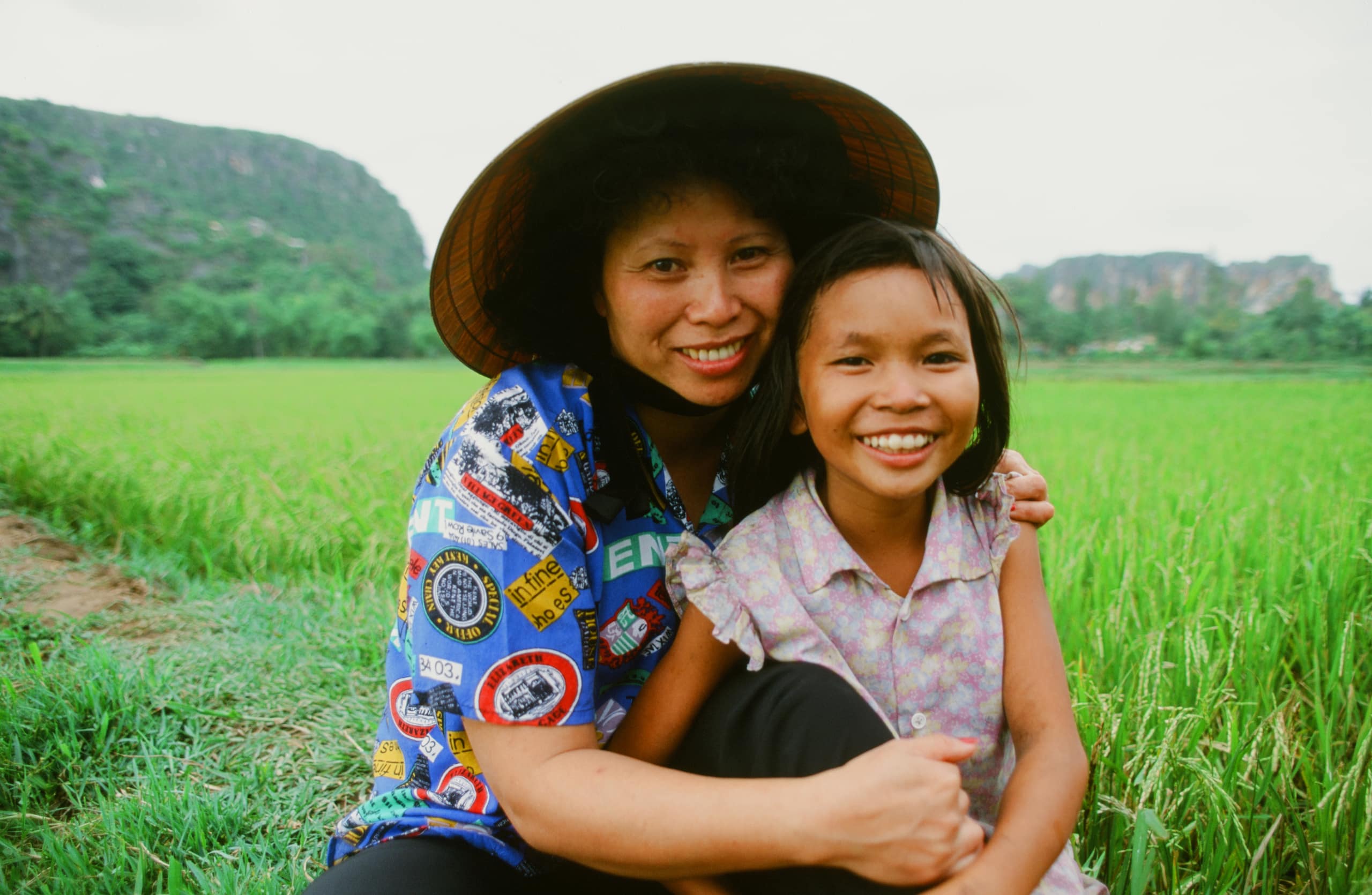
Image 19.02.06 — Le Ly Hayslip (left), humanitarian and author of When Heaven and Earth Changed Places (1989) and Child of War, Woman of Peace (1992). Her writings re-center narratives about the Vietnam-American War with stories by and about Vietnamese people.
Other writers have also provided alternative perspectives that connect the Vietnam-American War to liberation struggles experienced by people of color. Anthony Grooms’s novel Bombingham follows the life of a Black man, from a childhood filled with racial violence to his time as a soldier experiencing more racial violence in the rice fields of Vietnam.
Even when official history records do not include their stories, marginalized people leave archives in the form of oral history, music, literature, and political speeches. In this way, they are able to tell their version of the story of the Vietnam-American War.
The End and the Beginning
South Vietnam collapsed in 1975, marking the official end of the Vietnam-American War that spanned more than two decades. Many Americans and Vietnamese refugees still refer to the collapse of the South Vietnamese capital as the Fall of Saigon, while to the Vietnamese who remained and supported the revolutionary movement see it as a signified victory and Liberation Day. The Communist government later renamed the city as Hồ Chí Minh City.
Leading up to this moment, and after decades of military intervention, the United States withdrew its support of South Vietnam in 1973. Subsequently, North Vietnamese Communist forces advanced on the South, taking control of major cities outside of Saigon such as Đà Nẵng, Nha Trang, and Cam Ranh. Vietnamese people, starting with those who held high-profile positions in the South and had connections to Americans, evacuated the country in the thousands, many fearing for their lives under the new regime. Among the high priority evacuations of government and military personnel and their families, Vietnamese orphans were also made into objects of US rescue. In April 1975, the US government collaborated with international adoption and humanitarian agencies to airlift children out of the country. In the postwar years, many other groups of Vietnamese people resettled in the United States and other countries as well.
When one country takes partial or complete control over another country economically and politically, which can include exploiting its natural resources for profit. The colonizer imposes their belief system and way of life onto the colonized.
Refers to the collapse of the South Vietnamese capital on April 30, 1975, marking the end of the Vietnam-American War. For Vietnamese people who remained after the war, this date is often referred to as “Liberation Day.”
Prison or hard labor camps under the Communist government of Vietnam where approximately 200,000 to 300,000 former South Vietnam military officers, government workers, and affiliates were sent for months to years following the Vietnam-American War.
A person who has been forced to leave their country in order to escape war, persecution, or natural disaster.

Endnotes
1 Nguyễn Thị Hạnh Nhơn, interviewed by Nancy Bui, November 9, 2010, Vietnamese American Heritage Foundation 500 Oral Histories Project, Vietnamese in the Diaspora Digital Archive, https://calisphere.org/item/ark:/81235/d8gv99/.
4 “War,” track 1 on Edwin Starr, War & Peace, Motown Record, 1970.
5 Martin Luther King, Jr. “Beyond Vietnam—A Time to Break Silence,” (speech, New York, NY, April 2, 1967), American Rhetoric, https://www.americanrhetoric.com/speeches/mlkatimetobreaksilence.htm.
When one country takes partial or complete control over another country economically and politically, which can include exploiting its natural resources for profit. The colonizer imposes their belief system and way of life onto the colonized.
Refers to the collapse of the South Vietnamese capital on April 30, 1975, marking the end of the Vietnam-American War. For Vietnamese people who remained after the war, this date is often referred to as “Liberation Day.”
Prison or hard labor camps under the Communist government of Vietnam where approximately 200,000 to 300,000 former South Vietnam military officers, government workers, and affiliates were sent for months to years following the Vietnam-American War.
A person who has been forced to leave their country in order to escape war, persecution, or natural disaster.

archives
[ ahr-kyvz ]
A collection of historical documents, records, or ephemera providing information about a place, institution, or group of people.
colonialism
[ kuh-loh-nee-uh-liz-uhm ]
When one country takes partial or complete control over another country economically and politically, which can include exploiting its natural resources for profit. The colonizer imposes their belief system and ways of life onto the colonized.
Fall of Saigon
[ fall uhv sigh-gahn ]
Refers to the collapse of the South Vietnamese capital on April 30, 1975, marking the end of the Vietnam-American War. For Vietnamese people who remained after the war, this date is often referred to as “Liberation Day.”
militarism
[ mil-i-tuh-riz-uhm ]
The belief in and use of force, including full-scale war, to assert power, authority, and control over a nation or people.
reeducation camp (trại cải tạo)
[ ree-eh–kay-shuhn kamp ]
Prison or hard labor camps under the Communist government of Vietnam where approximately 200,000 to 300,000 former South Vietnam military officers, government workers, and affiliates were sent for months to years following the Vietnam-American War.
refugee
[ ref-yoo-jee ]
A person who has been forced to leave their country in order to escape war, persecution, or natural disaster.
