


ASIAN AMERICAN COMMUNITIES
Hmong Americans
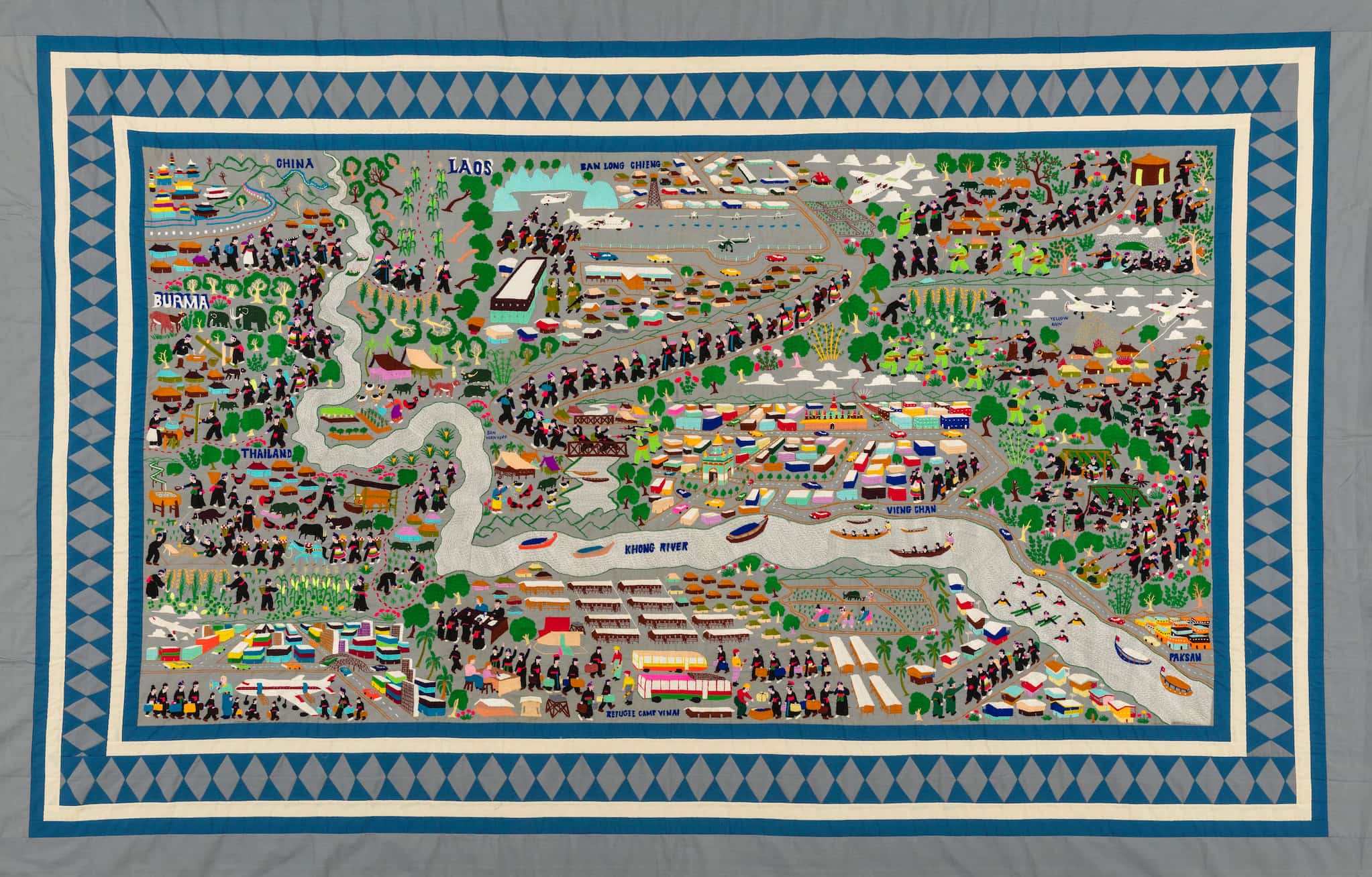
Have Hmong Americans found home in the United States?
Chapter objectives
- Learn about key historical events and current issues and experiences that Hmong Americans must navigate as they sought to make homes in the different places they have lived.
- Understand that Hmong Americans have a complex history and set of experiences that are unique to the group’s stateless refugee condition, but that are related to Asian American, Black, Latinx, and Indigenous peoples’ experiences of colonialism, immigration, and policing.
- Explore the different ways Hmong Americans resist colonial and state power and build community.
This chapter explores the history and experiences of Hmong Americans. It discusses topics of concern for Hmong Americans, such as the deep ancestral knowledge they carried in their long history of displacement, and their experiences with war, state violence, organizing, activism, education, well-being, and health care. Hmong Americans are a diverse community whose experiences differ based on class, gender, clan affiliation, and geography, and they may not experience war, education, or health disparities in the same way. The chapter also introduces readers to complicated questions about home and belonging for Hmong Americans that are shaped by their history of being rooted to place but not having a country. The concept of home is further complicated by their historical involvement with the United States in the Secret War during the Vietnam War, and the simultaneous erasure of their experiences from records and public knowledge. Finally, the chapter explores Hmong community building in the form of organizing and activism after Hmong refugees who were displaced by the war resettled in the United States.
Modules in this chapter
Overview
Hmong American Experiences with War and State Violence
Hmong American Activism
Hmong Americans and Education
Hmong Americans and Health
Overview
Hmong American Experiences with War and State Violence
Hmong American Activism
Hmong Americans and Education
Hmong Americans and Health
Chapter Sources
10thirtysix. “The Secret War: Hmong Soldiers Who Served Alongside Americans in Vietnam.” Milwaukee PBS. September 25, 2017, video, 16 min., 55 sec. https://www.youtube.com/watch?v=1_0WbPq2lhs&t=144s.
Asian Pacific Institute on Gender-Based Violence. “Domestic and Family Violence in Hmong Communities, 2019.”. Accessed on April 29, 2024. https://api-gbv.org/wp-content/uploads/2019/10/DVFactSheet-Hmong-July-2019.pdf.
Danis, Marion, Yolonda Wilson, and Amina White. “Bioethicists can and should contribute to addressing racism.” The American Journal of Bioethics 16, no. 4 (2016): 3-12. https://doi.org/10.1080/15265161.2016.1145283.
Eldred, Sheila Mulrooney. “Mental health treatment is a difficult subject for many Hmong Americans. A new podcast wants to make it easier to get help.” Sahan Journal, June 19, 2023. https://sahanjournal.com/health/hmong-mental-health-podcast-minnesota/.
Hmong Museum. “Choua Thao.” Collection: Hmong Women Pioneer. Accessed April 1, 2024. https://hmongmuseummn.org/collection/hmong-women-pioneers/choua-thao/.
Kaba, Mariame. We Do This ‘Til We Free Us. Haymarket Books, 2021.
Keuh, Joshua. “Asia, Texts, and Textiles at the Library of Congress, Part II: Hmong Story Cloths.” Library of Congress Blogs, July 23, 2020. https://blogs.loc.gov/international-collections/2020/07/asia-texts-and-textiles-at-the-library-of-congress-part-ii-hmong-story-cloths/.
Kikuchi, Yoko. “Japanese Involvement in Laos: From the Invasion of the Japanese Army in Northern French Indochina in 1940 to the End of World War Two.” PhD diss., Waseda University, 2017.
The kNOw Youth Media. “Choua Thao: Female Hmong Veteran Reflects on Secret War.” April 30, 2015. https://theknowfresno.org/04/30/2015/choua-thao-female-hmong-veteran-reflects-on-secret-war/.
Lee, Mai Na M. Dreams of the Hmong Kingdom: The Quest for Legitimation in French Indochina, 1850–1960. University of Wisconsin Press, 2015.