





PEOPLE AND EVERYDAY LIFE
Asian American and Pacific Islander Women Representations and Voices
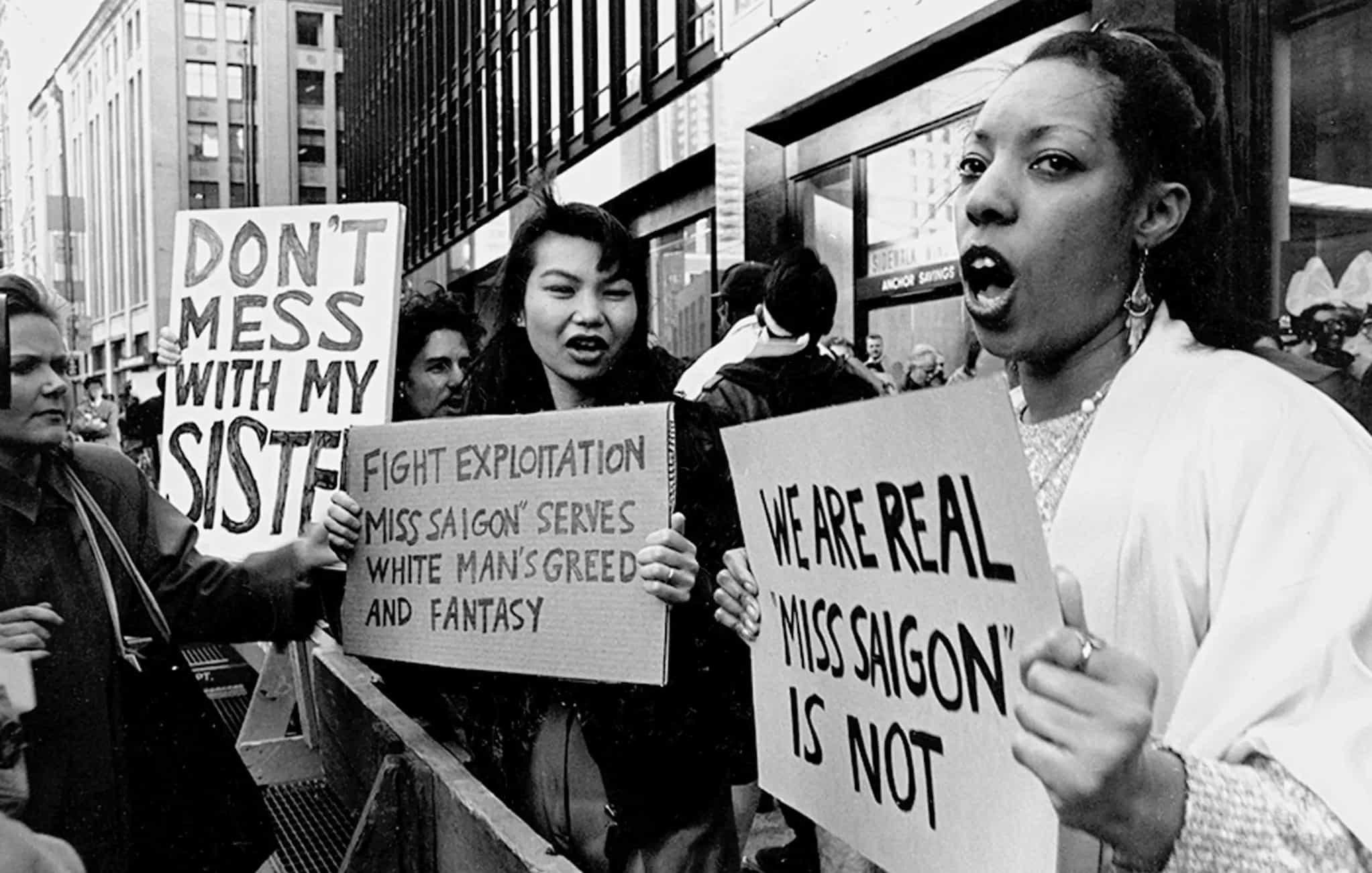
Does the media portrayals of Asian American and Pacific Islander women’s stories change the way they are treated in society?
Chapter objectives
- Learn examples of Asian American and Pacific Islander women’s collective actions, including their activism and “artivism.”
- Understand the ways in which Asian American and Pacific Islander women have been depicted in the media and how they challenge or reclaim those depictions.
- Explore lessons about storytelling to critique the media’s depiction of various Asian American and Pacific Islander women’s identities.
This chapter discusses the historical events and policies that created harmful stereotypes about Asian American and Pacific Islander women. It specifically looks at early immigration policies discriminating against Asian American and Pacific Islander women and how American involvement in wars in Asia further intensified harmful attitudes towards them. It looks at media examples in film, theater, and music that helped to transform these misperceptions into mainstream stereotypes. The chapter then turns to Asian American and Pacific Islander women artists and artist organizations that are creating artistic means to change these narratives and using collective action to combat issues affecting Asian American and Pacific Islander women and US society at large.
Modules in this chapter
Asian American and Pacific Islander Women Stereotypes and Counternarratives
Misrepresentations of Women in War and Empire
Women Reclaiming their Lands and Stories
Women’s Solidarity for Labor Rights
Art and Social Change
Asian American and Pacific Islander Women Stereotypes and Counternarratives
Misrepresentations of Women in War and Empire
Women Reclaiming their Lands and Stories
Women’s Solidarity for Labor Rights
Art and Social Change
Chapter Sources
Clark, Rebekah. “Lucy Liu says her role in ‘Charlie’s Angels’ has ‘normalized Asian identity’ on screen.” Grazia Magazine, accessed October 4, 2025. https://graziamagazine.com/us/articles/lucy-liu-charlies-angels-normalised-asian-identity/.
Dandelion, River. “How Chinese American Women Changed US Labor History.” Asian American Writers’ Workshop, May 1, 2019. https://aaww.org/chinatown-garment-strike-1982/#:~:text=By%201980%2C%20four%20years%20after,they%20were%20paid%20by%20piece.
Gee, Deborah, dir. Slaying the Dragon. Pacific Productions. 1988.
“Hawaii State Commission on the Status of Women Launches Anti-Trafficking Campaign.” State of Hawaiʻi Department of Human Services, July 2, 2018. https://humanservices.hawaii.gov/hawaii-state-commission-on-the-status-of-women-launches-anti-trafficking-campaign/.
Hussain, Aliya. “Trouble at Home: Domestic Workers Speak Out Against Exploitation and Abuse.” American Civil Liberties Union,” April 1, 2010. https://www.aclu.org/news/smart-justice/trouble-home-domestic-workers-speak-out-against-exploitation.
Lee, Kimber. “‘Untitled f*ck m*ss s**gon play’: An Interview with Playwright Kimber Lee.” The Spill, September 6, 2023. https://www.thespillmag.com/article/untitled-f-ck-m-ss-s-gon-play-an-interview-with-playwright-kimber-lee/.
Leonen, M. F. “Etiquette for Activists.” YES! Magazine, May 21, 2004. https://www.yesmagazine.org/issue/hope-conspiracy/2004/05/21/etiquette-for-activists.
Liu, Lucy. “My Success Has Helped Move the Needle. But It’ll Take More to End 200 Years of Asian Stereotypes.” The Washington Post, April 29, 2021. https://www.washingtonpost.com/opinions/2021/04/29/lucy-liu-asian-stereotypes-hollywood/.
Miller, Chanel. “I Thought Anonymity Was a Shield After My Sexual Assault. But Coming Forward Brought Me Back to Myself.” Time, August 14, 2020. https://time.com/5879561/chanel-miller-on-coming-forward-know-my-name/.
Nair, Mira. “A Conversation with Mira Nair.” Interviewed by Gareth Higgins, Image Journal 93 (2017). https://imagejournal.org/article/conversation-mira-nair/.


