



ASIAN AMERICAN COMMUNITIES
Laotian Americans
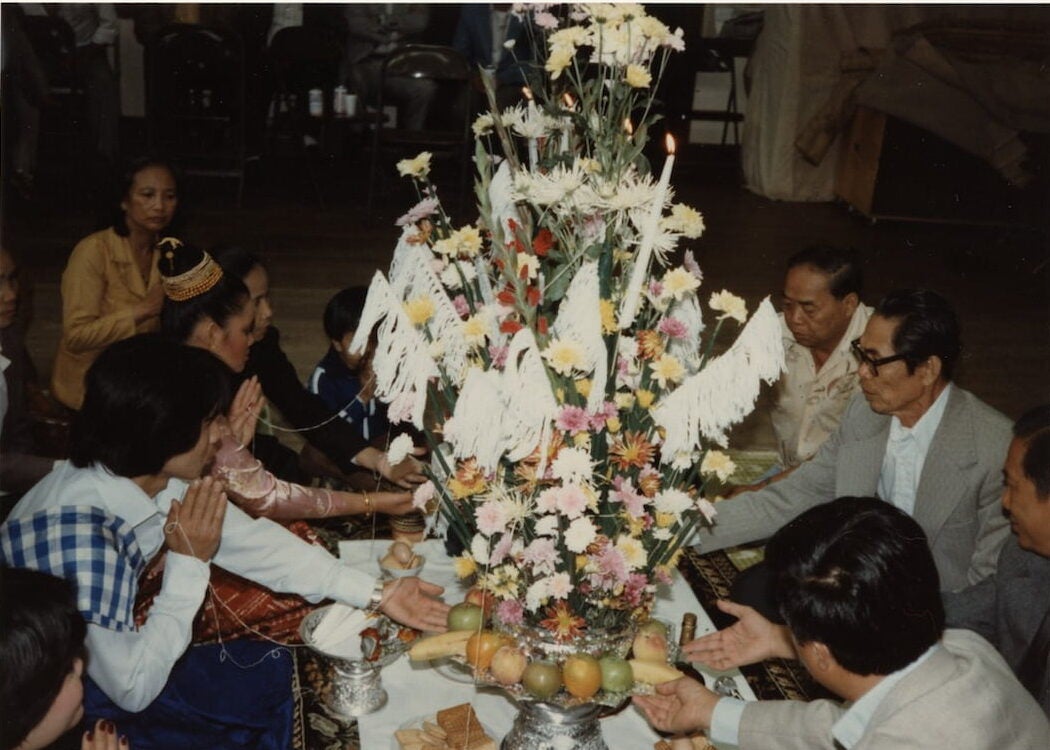
Despite the US Secret War in Laos, have Laotian Americans found home in the United States?
Chapter objectives
- Learn that for Laotian Americans, rebuilding a home in the United States is an ongoing process representing their pursuit of belonging.
- Understand the untold history of US militarism in Laos and its impact on Laotian Americans in the United States.
- Explore the advocacy work, performances, and stories by 1.5 and second-generation Laotian Americans as both narratives and counternarratives of belonging.
This chapter centers on the evolving concept of home within the Laotian American experience, asking whether home is ever truly found or continuously forged. It situates this question within the history of the US Secret War in Laos and their resettlement in America, tracing how Laotian Americans create new forms of belonging. Each module examines the experiences and memories of war, displacement, belonging, and community building through archival work, oral histories, and the perspectives of first and second-generation Laotian Americans. In their active process of belonging and reclaiming their narratives through storytelling and other creative forms, Laotian Americans also stood in stark contrast to US government policies that often treated them as a burden on society, from resettlement and welfare dependency to criminalization and deportation. Even after decades of living and rebuilding their lives in America, the promise of safety and freedom remains uncertain, revealing how belonging for many has always been and continues to be tenuous. By exploring how Laotian Americans articulate belonging and identity across generations, each chapter invites readers and students to reflect on what it means to create and perhaps reimagine home after displacement on their own terms.
Modules in this chapter
Introduction: Laotian Americans
America’s Secret War in Laos (1954-1973)
Laotian American Activism and Advocacy
Making Laos in America: Lanexang Village
Storytelling as Resistance: Cultural Expression
Introduction: Laotian Americans
America’s Secret War in Laos (1954-1973)
Laotian American Activism and Advocacy
Making Laos in America: Lanexang Village
Storytelling as Resistance: Cultural Expression
Chapter Sources
Adkisson, Knowles. “Non-profit Lao Family celebrates 35 years helping immigrants achieve self-sufficiency.” Richmond Confidential. April 27, 2015. https://richmondconfidential.org/2015/04/27/non-profit-lao-family-celebrates-35-years-helping-immigrants-achieve-self-sufficiency/.
Aguilar-San Juan, Karin. Little Saigons: Staying Vietnamese in America. University of Minnesota Press, 2009.
Asian Law Caucus. “Resources for Southeast Asian Refugees Facing Deportation.” October 9, 2025. https://www.asianlawcaucus.org/news-resources/guides-reports/resources-southeast-asian-refugees-facing-deportation.
Associated Press. “Lao Buddhist community in Louisiana opens hall for monks.” DeseretNews, July 14, 2012. https://www.deseret.com/2012/7/14/20423942/lao-buddhist-community-in-louisiana-opens-hall-for-monks/.
Avalon Project. “Indochina – Agreement on the Cessation of Hostilities in Laos, July 20, 1954.” Lillian Goldman Law Library, Yale Law School. https://avalon.law.yale.edu/20th_century/inch004.asp.
Bassette, Ann. “Exhibit Shows Untold Stories of Laotian Refugees.” The Contra Costa Pulse. https://ccpulse.org/2020/03/12/exhibit-shows-untold-stories-of-laotian-refugees/.
Branfman, Fred, and Alfred W McCoy. Voices from the Plain of Jars: Life under an Air War. 2nd ed. University of Wisconsin Press, 2013.
Chan, Leilani and Ova Saopeng (TeAda Productions). “Lao Fighters/Refugee Nation.” In California Dreaming: Movement and Place in the Asian American Imaginary. Eds. Christine Bacazera Balance and Lucy Mae San Pablo Burns. University of Hawaiʻi Press, 2020.
Chanthabouly, Boua, Interviewee, and Susan Boot Caolo. Interview session with Boua Chanthabouly conducted by Susan Caolo. 2022. Manuscript/Mixed Material. https://www.loc.gov/item/2024655549/.
Clune, Kathryn Ann. “Home in a New Place: Making Laos in Morganton, North Carolina.” Master’s Thesis, University of North Carolina at Chapel Hill. 2015.
Espiritu, Yến Lê. Body Counts: The Vietnam War and Militarized Refuge(es). University of California Press, 2014.