



ASIAN AMERICAN COMMUNITIES
South Asian Americans Before 1965
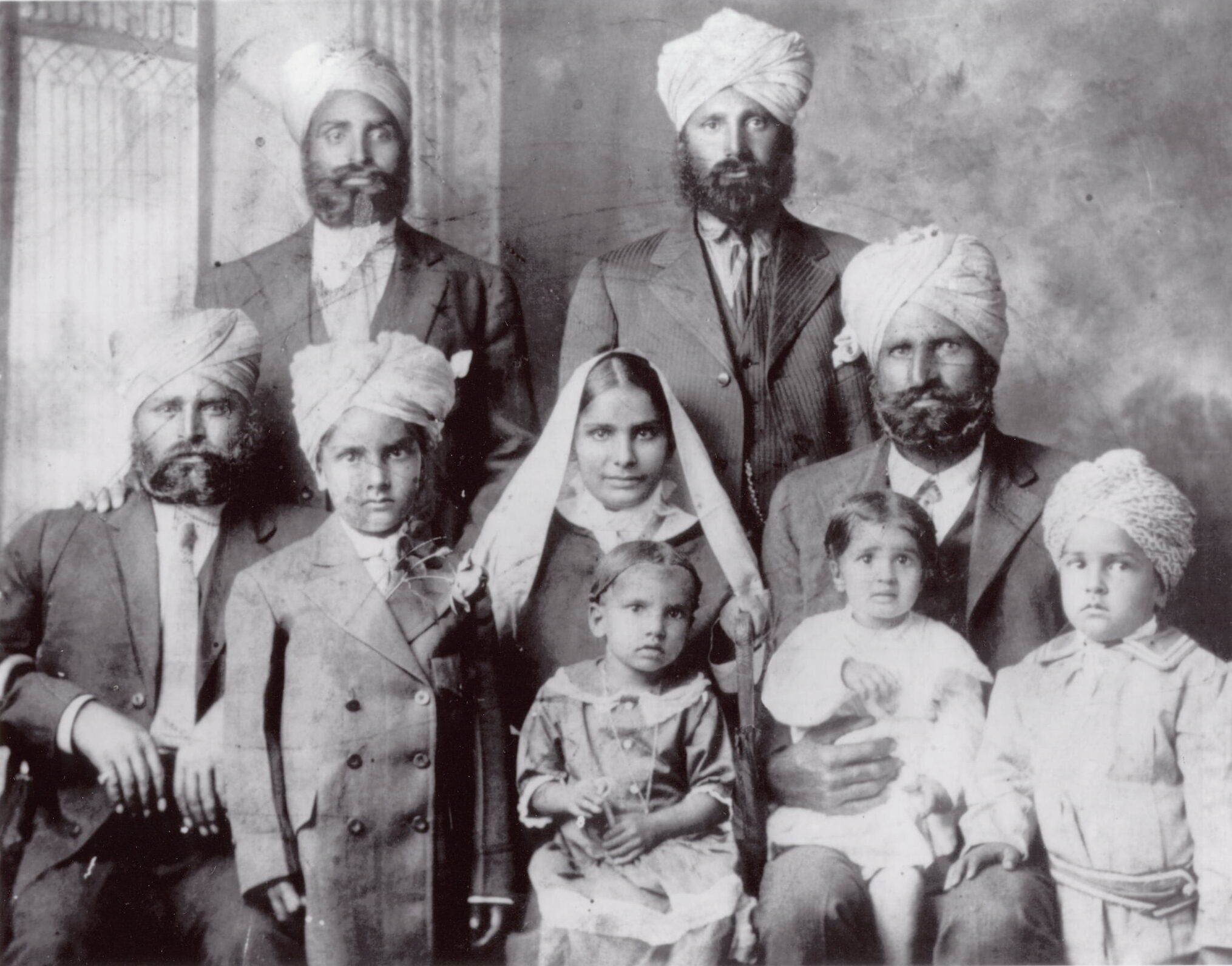
Was life in the United States worth the hardships faced by early South Asian immigrants?
Chapter objectives
- Learn about the experiences and lives of South Asian immigrants pre-1965.
- Understand the social and political environment that South Asian Americans faced pre-1965.
- Explore the creative and resilient ways that South Asian Americans navigated various hardships while living in the United States pre-1965.
South Asian Americans—the over 6.1 million Americans who trace their heritage to India, Pakistan, Bangladesh, Afghanistan, Nepal, Sri Lanka, Bhutan, and Maldives—have been a presence in the United States for more than two hundred years. Early South Asian immigrants worked on farms and in factories, built railroads, advocated for India’s freedom from British rule, and struggled for equal rights at home. Despite facing exclusionary laws and a US Supreme Court decision that revoked their citizenship, South Asian Americans have managed to make significant contributions to the United States through community-building, commerce, arts and creativity, politics, and so on. This chapter describes the journeys of South Asian immigrants in the United States before the Immigration Act of 1965. Weaving together their stories of perseverance, activism, and cultural exchange, these narratives shed light on a rarely discussed yet compelling part of American history.
Modules in this chapter
Overview
Early Immigration and Citizenship
Early Pioneer South Asian American Women
Arts and Culture
Connections
Overview
Early Immigration and Citizenship
Early Pioneer South Asian American Women
Arts and Culture
Connections
Chapter Sources
Agarwal, Kritika. “Bhagat Singh Thind”; “Denaturalization”; and “Kala Bagai.” In Our Stories: An Introduction to South Asian America, 52–70. South Asian American Digital Archive, 2021.
Agarwal, Kritika. “Living in a Gilded Cage: Vaishno Das Bagai’s Disillusionment with America.” Tides magazine, SAADA, August 6, 2014.
Ambedkar, B.R.. “Letter from B.R. Ambedkar to W.E.B. Du Bois.” circa 1946. South Asian American Digital Archive. https://www.saada.org/item/20140415-3544.
Arora, Anupama. “Visitors and Travelers.” In Our Stories: An Introduction to South Asian America, 16–23. South Asian American Digital Archive, 2021.
Bagai, Ram. “Letter to Martin Luther King, Jr. and Ralph Abernathy.” March 18, 1965. South Asian American Digital Archive. https://www.saada.org/item/20150118-4031.
Bagai, Rani. “Opinion: Berkeley Might Name a Street After Kala Bagai. This Is Her Story.” Berkeleyside, March 12, 2020. https://www.berkeleyside.org/2020/03/12/opinion-berkeley-might-name-a-street-after-kala-bagai-this-is-her-story.
Bates, Josiah. “The Man Who Gave Shelter to Those in Need.” Time Magazine. December 10, 2020. https://time.com/collection/heroes-of-2020/5916454/rahul-dubey/#:~:text=%E2%80%9CI%20open%20my%20door%2C%20and%20I%20start,pouring%20milk%20into%20strangers’%20eyes%2C%E2%80%9D%20Dubey%20says.
Bahadur, Gaiutra. “Notes Toward a Prehistory.” Tides magazine, SAADA, July 16, 2020.
Bradner, Liesl. “How a Black Man From Missouri Transformed Himself Into the Indian Liberace.” The New Republic, September 12, 2015. https://newrepublic.com/article/122797/how-black-man-missouri-transformed-indian-liberace. Accessed March 15, 2024.
Brockell, Gillian. “‘To India I Come as a Pilgrim’: Martin Luther King Jr’s Remarkable Trip to Honor His Hero.” Washington Post. January 20, 2020. https://www.washingtonpost.com/history/2020/01/20/martin-luther-king-india-gandhi/.