







Can the rights of an entire group of people be violated in a democracy? link
Between 1942 and 1946, the U.S. government imprisoned 120,000 Japanese Americans in camps throughout the United States. None of them had committed any crime. About two-thirds were American citizens. The government justified this unprecedented denial of constitutional rights on “military necessity” because the United States was at war with Japan. But in the 1980s, researchers found evidence that during World War II, government officials forced Japanese Americans to leave the West Coast because of racist ideas about them, not military need.
For decades prior to World War II, Japanese immigrants (known as Issei) and their American-born children (known as Nisei) were the targets of intense discrimination. That history set the stage for the government to incarcerate Japanese Americans after Japan attacked the U.S. naval base at Pearl Harbor, Hawaiʻi.
Why did the United States government decide to mass incarcerate Japanese Americans during World War II?
What constitutional rights were violated in the forced removal and mass incarceration?
How did the fight for redress and reparations aim to prevent other constitutional violations and foster allyship with targeted groups?
Unwelcome Immigrants in the United States link
Anti-Chinese racism, particularly in California, resulted in the Chinese Exclusion Act of 1882, which legally barred most immigrants from China. Agricultural, mining, and lumber business owners in the western United States recruited Japanese men to fill the labor vacuum that Chinese immigrants previously occupied. But Japanese immigrants were soon unwelcome.

Masuo Yasui immigrated to the U.S. from Japan when he was sixteen years old. He settled in Oregon’s Hood River Valley, where he became a successful farmer and businessman.
Portrait of Masuo Yasui. Courtesy of Densho, the Yasui Family Collection

He married Shidzuyo Miyake, and the couple raised a large family. White farmers in Hood River lobbied state legislators to bar Issei from owning land. The Yasui children were treated differently than their white peers. Owners of their town’s movie theater, for example, made them sit on the balcony.
c. 1924, Issei mother and children. Densho. Courtesy of the Yasui Family Collection

In the decades before World War II, Japanese Americans along the West Coast faced discrimination in their daily lives: Restaurants denied them service. Barbers refused to cut their hair. Landlords would not rent to them. This woman in Hollywood, California, made clear that Japanese Americans were unwelcome.
Created date, created by Name, Title Italicized. Credit line indicating where the image is from
Racism sparked fears that Japanese would settle in the United States. Starting in 1913, Oregon, California, Washington, and twelve other states passed “Alien Land Laws” denying Japanese immigrants the right to own or lease land. A 1923 U.S. Supreme Court ruling, Ozawa v. U.S., upheld a law barring Japanese and other Asians from becoming naturalized citizens.
A growing movement of anti-Japanese exclusionists persuaded Congress to pass the Immigration Act of 1924, which barred all Japanese immigrants and legally ended immigration from Asian countries. The Philippines, which was then a U.S. colony, was an exception.
Communities Thrive Despite Discrimination link
Despite rampant anti-Japanese sentiments, vibrant Japanese American communities thrived along the West Coast. During the 1920s and 1930s, Japanese American-owned businesses clustered in “Japantowns” in Los Angeles, San Francisco, San Jose, Sacramento, Seattle, and elsewhere. Issei were successful farmers, flower growers, and fishermen. Issei and Nisei formed cultural, social, professional, and political organizations. Pre-World War II Japanese American communities flourished with organizations, classes for youth, festivals, and celebrations.
New generations of Japanese Americans grew. American-born children were U.S. citizens under the 14th Amendment, which gave citizenship to those born in the United States. They had the right to life, liberty, and property with equal protection of the laws. This amendment is especially significant in showing how Japanese Americans’ constitutional rights were violated.

Masuo Yasui led a successful effort to create a Japanese Community Hall in Hood River, Oregon, where local Issei held cultural events, holiday gatherings, and Japanese language classes for children.
c. 1928, “Hood River Japanese community welcoming dignitaries”. Densho. Courtesy of the Yasui Family Collection.
The Road to Mass Incarceration link
Long before the Japanese military attacked the U.S. base at Pearl Harbor on December 7, 1941, unsubstantiated rumors circulated about Japanese Americans engaging in sabotage. U.S. officials compiled lists of Issei they considered suspect because of their leadership in community and cultural organizations. Immediately after the Pearl Harbor attack, FBI agents imprisoned Issei leaders indefinitely without charges. The government froze all Issei bank accounts and instituted an 8 a.m. to 6 a.m. curfew on German and Italian immigrants and all people of Japanese ancestry, even American citizens.
On February 19, 1942, President Franklin Roosevelt issued Executive Order 9066, which empowered the Secretary of War and designated Military Commanders to prevent anyone from entering or remaining in locations designated as “military areas.” Soon, the military commander of the West Coast ordered the western portions of Washington and Oregon, the southern part of Arizona, and all of California off-limits to Japanese Americans.
In the days after the bombing, government agents searched Japanese American homes for contraband. Agents took cameras, weapons, and any evidence of a connection with Japan. As news spread within Japanese American communities about these searches, many people destroyed books and letters written in Japanese, photos of relatives, and priceless art and artifacts from Japan. FBI agents searched the Yasui family home and arrested Masuo Yasui days after the bombing of Pearl Harbor. White farmers and businesspeople in Hood River speculated that government officials took him away because he was a spy. Japanese Americans feared the government would shoot or deport Issei leaders, like Masuo, who had been arrested yet had done nothing wrong.
Officials instituted these policies despite government-commissioned reports which concluded that Japanese Americans were overwhelmingly loyal to the United States and that mass exclusion was unnecessary.

An FBI agent searches the home of a Japanese American family
Created date, created by Name, Title Italicized. Credit line indicating where the image is from

The government imprisoned Masuo Yasui and hundreds of other Issei community leaders at a camp in Missoula, Montana, pictured here.
c. 1942, Fort Missoula internment camp, Montana. Densho. Courtesy of the K. Ross Toole Archives, University of Montana at Missoula (Number 84-295, Pierce Coll.)
Forced to Leave Home link
In the spring of 1942, the government forced all Japanese Americans living on the West Coast to leave their homes. Frantic families had weeks, sometimes only days, to decide how to close businesses and farms, what to sell, and what to take with them. They could only take what they could carry.

Signs like this appeared in Japanese American communities along the West Coast in the spring of 1942 ordering them to leave their homes.
April 1, 1942. Department of Social Welfare – War Services Bureau. “Instructions to All Persons of Japanese Ancestry”. California State Archives, a division of the California Secretary of State’s Office

Japanese Americans on the West Coast had to sell most of their possessions at rock-bottom prices to unscrupulous buyers. This painting, “Junkshop Man Took Our Icebox Away,” by Henry Sugimoto, captures the emotions of a mother and daughter who must get rid of the family’s belongings.
ca. 1942, Sugimoto, Henry. Documentary, Junkshop Man Took Away Our Icebox. Japanese American National Museum (Los Angeles, Calif.)

Young Kimiko Kitagaki waits in Oakland for a bus to transport her to a government camp. Like all other Japanese Americans, the Kitagaki family attached tags with their names and government-assigned family numbers to their suitcases. They tied the same tags to the clothing they wore.
May 6, 1942, Lange, Dorothea, Kimiko Kitagaki waits for an “evacuation” bus. Franklin D. Roosevelt Presidential Library and Museum of the National Archives and Records Administration
More to explore

Image
American Yellow
Video
6:59
Leaving Home
Temporary Homes link
The government sent Japanese Americans to fifteen temporary camps, euphemistically called “assembly centers,” hurriedly built on fairgrounds, livestock pavilions, and horse racing tracks. Japanese Americans lived in horse stalls and barracks. The only furnishings were iron cots and a single light bulb. They ate in mess halls and used communal latrines. The military forced Shidzuyo Yasui and several of her children from their home in Hood River, Oregon, and sent them to an “assembly center” called Pinedale in Fresno, California.
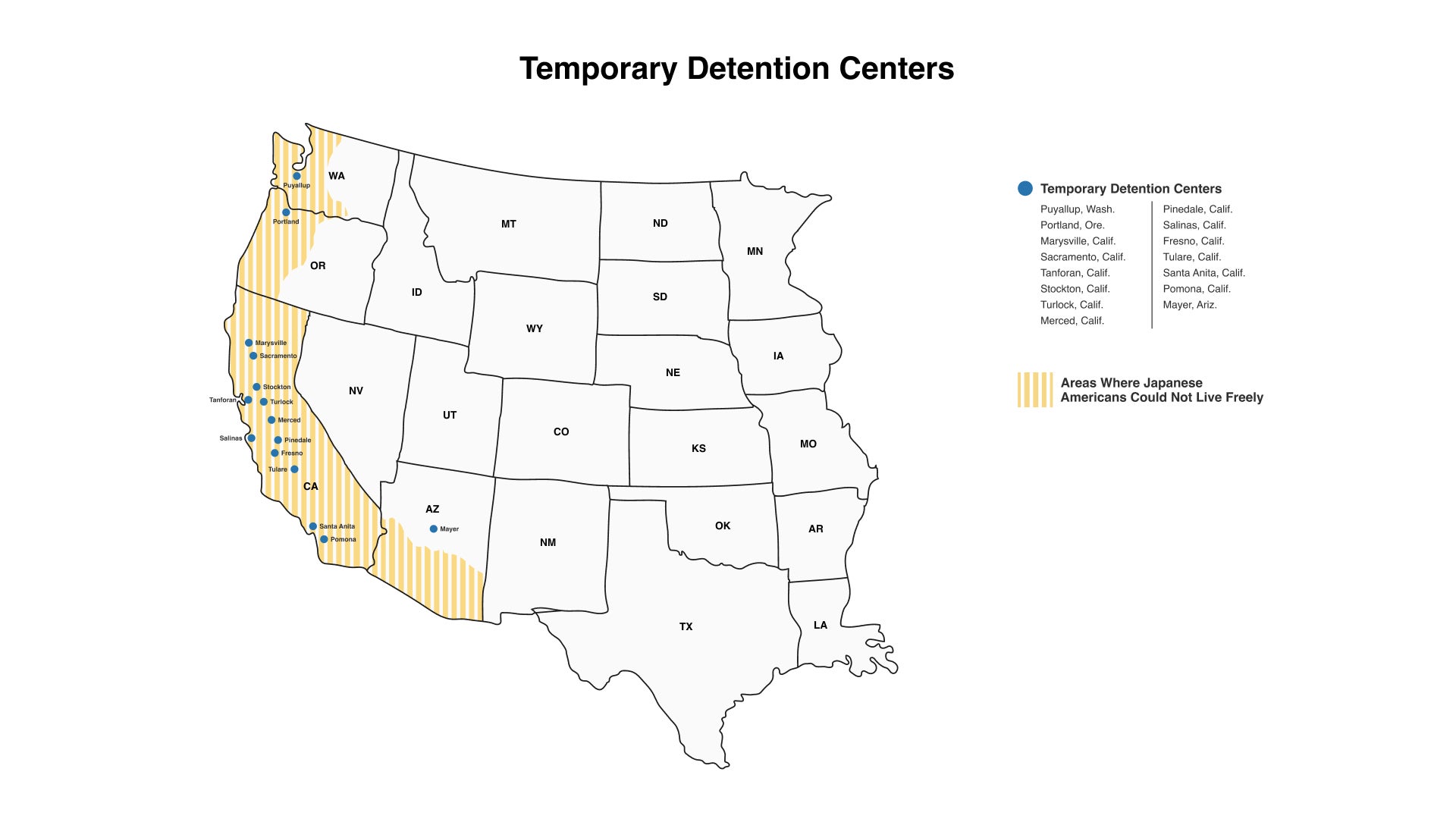
Map of Assembly Centers
Created date, created by Name, Title Italicized. Credit line indicating where the image is from
One of the first things Japanese Americans did upon arriving at “assembly centers” was to stuff bags with straw to make their mattresses.
1942, May 21, Clark, Fred, Poston, Arizona. Evacuees of Japanese ancestry are filling straw ticks for mattresses upon arrival . . . Department of the Interior. War Relocation Authority
This drawing by artist Mine Okubo documents a communal bathroom at the Tanforan Assembly Center. Initially, no partitions separated toilets in camp latrines. This lack of privacy upset people.
1942-1944, Okubo, Miné, Community toilets, Tanforan Assembly Center, San Bruno, California, 1942. Japanese American National Museum. Gift of Mine Okubo Estate
Moved Once Again link
In the summer of 1942, the government transferred Japanese Americans from the “assembly centers” to ten more permanent camps, administered by a federal agency called the War Relocation Authority (WRA), mostly in deserts and swamps throughout the United States.
The WRA camps replicated the structure of the “assembly centers,” with barracks divided typically into four to six rooms. Barracks were grouped into “blocks,” each with a mess hall and communal latrine. Barbed wire fencing ringed the camps, punctuated by guard towers staffed by armed soldiers.
The government sent the Yasui family to a camp called Tule Lake in California. Yuka Yasui started attending the camp’s high school as soon as it opened in the fall of 1942. But there were no desks, chairs, books or supplies yet. Japanese American teachers and instructors from outside the camps taught at the schools.
Families or other groupings occupied a single barrack room. Inmates often hung blankets from the rafters, as shown here at the Manzanar camp, to create some semblance of privacy.
1942, June 30, Lange, Dorothea, A typical interior scene in one of the barrack apartments at this center. Note the cloth partition which lends a small amount of privacy. Department of the Interior. UC Berkeley, Bancroft Library.
Given wartime food rationing and labor shortages, Japanese Americans, like these Tule Lake inmates, labored in nearby agricultural fields to raise crops to feed themselves.
Men Working in Field.
Schools in the camps, like those shown here at Tule Lake, ran the gamut from nursery programs to high schools.
2/16/1944 – 6/30/1946, Stewart, Francis Leroy, Nursery school children singing Twinkle, Twinkle, Little Star. Department of the Interior. War Relocation Authority.
The WRA set up the camps to be as self-sufficient as possible. Inmates worked in mess halls, hospitals, schools, administrative offices, and other locales within the camps.
More to explore
Video
5:05
Camp Life From Those Who Lived It
Who’s “Loyal”? link
In early 1943, the U.S. Department of War decided to form an all-Nisei combat team recruited from Hawaiʻi and the WRA camps. At the same time, the WRA wanted to disperse Japanese Americans in colleges and jobs throughout the country so that they would assimilate. The two government entities collaborated to create a questionnaire to determine the loyalty of potential soldiers and inmates who would be allowed to leave the camps.
WRA officials required all inmates, both men and women, older than seventeen to complete a questionnaire called an “Application for Leave Clearance.” Two questions generated confusion and resentment among many inmates: One asked about willingness to serve in the armed forces. The second asked respondents to forswear allegiance to Japan and to swear unqualified allegiance to the United States. Many men were wary of answering “yes” to the first question, unsure whether a positive response would mean automatic induction into the army. Answering “yes” to the second question could imply that people had been loyal to Japan. Issei, who were not allowed to become U.S. citizens, feared that answering “yes” might mean renouncing their Japanese citizenship, leaving them stateless.
In early 1943, military recruiters visited the ten WRA camps. About 1,500 Nisei men volunteered. They joined nearly ten thousand Japanese American volunteers from Hawaiʻi to form the 442nd Regimental Combat Team which fought in Europe. Many of its members served and died while their families were imprisoned in the U.S.
Created date, created by Name, Title Italicized. Credit line indicating where the image is from
The vast majority of inmates answered “yes” to both questions. Beginning in May 1942, the government granted seasonal leaves to Japanese Americans who answered the loyalty questions positively. Labor shortages compelled farmers to ask the government to give Japanese Americans temporary leaves for agricultural work in Utah, Montana, Idaho, and other states.
Aided by the National Japanese American Student Relocation Council, some Nisei left camps to attend colleges outside the exclusion zone. Homer Yasui was one of them. He left Tule Lake for the University of Denver. Later, his younger sister, Yuka, left Tule Lake bound for Denver to attend high school.
A significant fraction of Japanese Americans answered “no” or refused to answer the loyalty questions. Some were frustrated that the government questioned their loyalty while imprisoned. Others answered negatively because they were disillusioned about losing their constitutional rights. Some wanted to explain that they would answer “yes” to both questions if freed. But the government only allowed “yes” or “no” responses, and considered all “no” answers as proof of disloyalty.
In June 1943, WRA officials designated the Tule Lake camp as a “segregation center” for inmates who had answered the problematic loyalty questions negatively.
Challenging Forced Removal and Incarceration link
In 1942, four Japanese Americans (including Min Yasui, who was part of the Yasui family from Hood River, Oregon) filed lawsuits challenging the constitutionality of wartime policies targeting Japanese Americans. Their cases reached the U.S. Supreme Court, which ruled that the curfew and forced removal orders for Japanese Americans were constitutional, but that indefinitely incarcerating loyal Japanese Americans was not.
More to explore
Video
6:18
Reactions to the Draft
Closing the Camps: Where’s Home Now? link
On December 17, 1944, the U.S. Department of War announced that Japanese Americans could return to the West Coast effective January 2, 1945. The WRA then announced that all the camps under its jurisdiction would close by the end of 1945, more than three years after the first Japanese Americans were imprisoned.
More than two-thirds of the eighty thousand Japanese Americans still living in the WRA camps returned to the West Coast. But most had no homes or jobs awaiting them.
Returning Japanese Americans, especially in rural areas, encountered vigilante violence and threats meant to terrorize them to leave. In Hood River, Oregon, where the Yasui family had previously lived, the American Legion post removed the names of all Japanese American soldiers from a local war memorial. The action drew national condemnation. Even the American Legion’s National Commander was critical. After several months, the Hood River post added back the Japanese Americans’ names.
Japanese Americans returning to urban areas faced housing challenges. Many of them initially lived in hostels, often set up in Japanese American Christian churches and Buddhist temples. Eventually, the federal government established emergency housing in army facilities and trailer parks.

This family returned to their home in Seattle from a camp at Minidoka, Idaho to find their garage vandalized.
Created date, created by Name, Title Italicized. Credit line indicating where the image is from
These children lived in a Burbank, California trailer park that served as temporary housing in 1946 for Japanese Americans who returned to Southern California after incarceration in concentration camps.
Created date, created by Name, Title Italicized. Credit line indicating where the image is from
Because of continued racial discrimination and anti-Japanese prejudice, returning Japanese Americans also had difficulty finding employment. Having lost their prewar businesses, and without capital to restart, many took low-wage jobs as janitors, domestic servants, and caretakers.
The Fight for Redress and Reparations link
Edison Uno, an activist with the Japanese American Citizens League (JACL), advocated in 1970 that Japanese Americans demand reparations from the U.S. government for their unjust imprisonment. But most Issei and Nisei did not want to discuss the war years even within their families.
Nevertheless, support for redress grew steadily throughout the 1970s and 1980s from within the Japanese American community and from allies, including African American members of Congress. The movement for redress and reparations advanced when Congress authorized a commission to study the wartime incarceration of Japanese Americans, and to recommend remedies.
President Jimmy Carter in 1980 signing legislation to establish the Commission on the Wartime Relocation and Internment of Civilians to study the forced removal and mass incarceration of Japanese Americans during World War II. The Commission held hearings in ten cities.
Created date, created by Name, Title Italicized. Credit line indicating where the image is from
Japanese Americans and their allies across the country held marches and lobbied Congressional representatives for nearly ten years to gain support for redress legislation.
Created date, created by Name, Title Italicized. Credit line indicating where the image is from
Japanese Americans who had been imprisoned during World War II received this formal apology from the U.S. government.
1990, Written apology which accompanied reparations checks. Densho Encylopedia. Courtesy of Marjorie Matsushita.
After hearing testimony from hundreds of individuals, the Commission issued a report titled Personal Justice Denied, which concluded that the wartime incarceration resulted not from military necessity, as the government argued at the time, but from racism, wartime hysteria, and a failure of political leadership. The Commission recommended monetary reparations and a formal government apology to all Japanese Americans who had been incarcerated.
For nearly a decade, hundreds of Japanese Americans and their allies of all races educated Congress about the wartime incarceration of Japanese Americans and advocated for redress legislation. Finally, on August 10, 1988, President Ronald Reagan approved the Civil Liberties Act of 1988 authorizing a formal government apology to Japanese Americans who had been wrongfully incarcerated during World War II, along with payments of twenty thousand dollars each.
More to explore
Video
5:39
Repairing a Wrong
Reopening Cases link
At the same time that the redress movement gained momentum, Min Yasui, Gordon Hirabayashi, and Fred Korematsu reopened their cases, challenging their criminal convictions for violating the government’s orders. They based their lawsuits on recently-discovered documents proving that during World War II government attorneys had intentionally suppressed evidence of Japanese American loyalty to the United States and had misled the Supreme Court into believing there was a military need to force them from their West Coast homes.
Federal judges overturned the criminal convictions of all three men.
Forty years after the U.S. Supreme Court ruled against Gordon Hirabayashi, Min Yasui, and Fred Korematsu, pictured here, federal judges in the 1980s overturned their criminal convictions. All three men subsequently received the Presidential Medal of Freedom, the highest honor for civilians in the U.S.
Created date, created by Name, Title Italicized. Credit line indicating where the image is from
More to explore
Video
3:06
Government Deception
Remembering Incarceration Spurs Solidarity link
Japanese Americans continue to fight for civil liberties, especially for other targeted groups during times of crisis.

To ensure that this history is not forgotten, Japanese Americans have organized pilgrimages to former campsites, and they have advocated for preservation of some as educational centers. Pictured here are participants in the first pilgrimage, in 1969, to the site of the Manzanar camp.
1969, December, Johnson, Evan, Pilgrimage ceremony in front of the Manzanar Cemetery Monument. Courtesy of Manzanar National Historic Site and the Evan Johnson Collection
In 2017, President Trump issued an executive order banning people from several Muslim-majority countries from entering the U.S. Karen Korematsu, Holly Yasui, and Jay Hirabayashi, children of three men who filed lawsuits challenging the violation of their rights during World War II, submitted a legal brief to the U.S. Supreme Court in a lawsuit challenging President Trump’s travel ban.
Tracy Kumono Photography
Japanese Americans protesting at the Los Angeles International Airport against the Trump administration’s ban on travelers from several Muslim-majority countries.
Created date, created by Name, Title Italicized. Credit line indicating where the image is from
Remembering the discrimination that they and their families experienced, many Japanese Americans have connected their community’s history with the prejudice and hatred directed at other groups, including Muslims, immigrants, and asylum seekers.
Many Japanese Americans, informed by knowledge of their families’ and community’s history, continue to speak out for the rights of people that the U.S. government is targeting because of their religious beliefs, ethnic backgrounds, or immigration status. In doing so, they are carrying on the legacy of Japanese American activism during World War II and in the fight for redress.
Key terms in this module
14th Amendment Where it’s used
Those born in the U.S. are naturalized U.S. citizens and have the right to life, liberty, and property with equal protection of the laws. This amendment is especially significant in showing how Japanese Americans’ constitutional rights were violated.
Alien Land Law of 1913 Where it’s used
California passed the first law that prohibited Americans of Japanese descent from owning or leasing land. From this point on until 1923, many states (Arizona, Arkansas, Florida, Idaho, Louisiana, Minnesota, Montana, Nebraska, New Mexico, Oregon, Texas, Utah, Washington, and Wyoming) across the U.S. passed similar laws or restrictions within other laws.
Civil Liberties Act of 1988 Where it’s used
This federal law was formed as a result of the many activist efforts of Japanese American groups. All surviving American citizens and legal resident immigrants of Japanese ancestry who were incarcerated during WWII were given $20,000 and a formal presidential apology.
democracy Where it’s used
A way of governing by all people of a nation or state. The people have a voice in deciding laws or electing officials to create laws for them. Democracy is a fundamental principle of the U.S. government, influenced by the Iroquois indigenous peoples in what is now known as New York, and European philosophers.
Executive Order 9066 Where it’s used
On February 19, 1942, President Franklin D. Roosevelt gave the U.S. military the power to exclude anyone they saw as a military threat into special military areas. Although Americans of Japanese descent were not specifically mentioned, this led to them to be mass incarcerated.
Immigration Act of 1924 Where it’s used
Federal law denying any Asian person to immigrate to the U.S.
Ozawa v. U.S. (1922) Where it’s used
The U.S. Supreme Court decision determining that Japanese people and other Asians were not allowed to become citizens.