





Betty Tom Chu, wearing a suit and glasses, smiles at camera as she sits with her arms folded on desk in front of her. A large credenza is behind her.
Module 2: Asian Americans in Banking and Finance
Have Asian Americans who are successful at business achieved the “American Dream?”
In the nineteenth century, Asian American merchants, a relatively small sector, provided some limited financial services to their communities. However, as a working class population, Asian Americans still faced barriers to commercial banks, which could provide the capital needed to own a home or start a business. These communities either relied on personal savings or family resources, or they created rotating credit associations.
Starting in the twentieth century, Asian American entrepreneurs founded the first formal Asian American commercial banks. Ethnic banks of this kind became known as “minority-owned banks.” Black people led the way: One of the earliest minority-owned banks was the United Order of True Reformers, a Black-owned bank with a state charter founded in 1889 in Richmond, Virginia.
Bankers rely on relationships and reputation to maintain customers, and they rely on access to capital. When racial and ethnic communities cannot get loans or other important financial services from large commercial banks, minority-owned banks become a lifeline.
In this module, we learn about the importance of finance in a capitalist economy, the history of Asian American banks, and how one minority-owned bank became the scapegoat of the 2008 global financial crisis.
What is the history of Asian Americans in banking and finance?
Why was Abacus Federal Savings Bank singled out during the 2008 financial crisis?
How does the glass ceiling that Asian Americans face in achieving leadership positions reveal another side of the limits and realities of economic success?
Asian Americans in Banking
Starting in the early twentieth century, Asian Americans began founding banks to address the specific needs of their communities. For example, when an earthquake destroyed much of San Francisco in 1906, brothers Look Tin Eli and Look Poong-shan wanted to help the Chinese community rebuild. A year later, they founded Canton Bank, the first known Chinese American bank with a formal state charter. That same year, Furuya Masahiro founded the Japanese Commercial Bank in Seattle, likely the first Japanese American bank in the United States. By 1914, Furuya bought smaller banks and combined them to create Pacific Commercial Bank, which lasted until the Great Depression.

Image 28.02.01a — Brothers Look Tin Eli (left) and Look Poong-shan, circa 1900. Together, they established the Canton Bank of San Francisco in 1907.

Image 28.02.01b — Look Tin Eli (right) with his mother (center) and siblings, circa 1877, before the birth of Look Poong-shan. As American-born sons of a Chinese merchant, their bank supported the rebuilding of the Chinese community following the 1906 San Francisco earthquake.
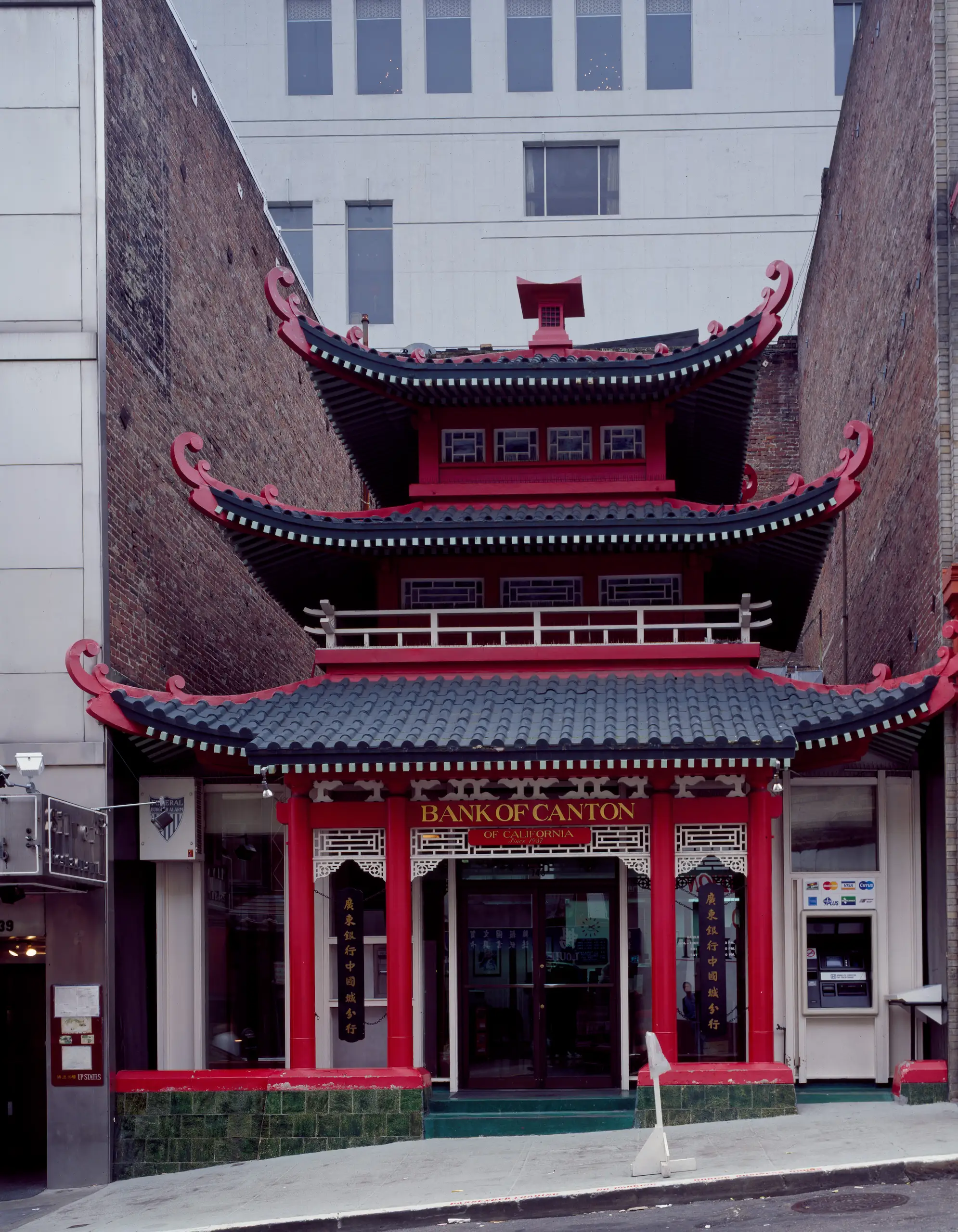
Image 28.02.01c — While the Look brothers’ bank closed in 1926, the institution paved the way for others to assist the Chinese community, including the Bank of Canton of California in 1937. Pictured is the Bank of Canton’s San Francisco branch in 1980.



In 1938, soon after arriving in Los Angeles, California, from Guangdong, China, Fung Chow Chan opened Phoenix Bakery in the city’s Chinatown. Although the bakery was a success, Chan was denied a home loan because he was an immigrant. He partnered with other Chinese Americans to establish the Cathay Bank in 1962. Cathay remains the oldest Chinese American–founded commercial bank today. In 1973, Chan joined Betty Tom Chu to establish East West Federal Bank of California (now called East West Bank). This bank served the rapidly growing Chinese American community as a savings and loan, primarily aiding in home ownership.

Image 28.02.02 — Betty Tom Chu, the first Asian American woman to run a savings and loan. Together with Fung Chow Chan, Gilbert Leong, and others, their savings and loans served growing numbers of Chinese American homeowners.
In 1984, Thomas Sung, a Chinese American attorney, founded Abacus Federal Savings Bank, a bank for New York’s Chinatown community. Rather than deny loans to low-income Asian immigrants, Abacus adapted to their needs and limits, enabling them to take out home mortgages. Between 1996 and 2021, Abacus made twelve thousand loans with a default rate (0.6 percent) well below the banking average (2–3 percent). Despite its legitimate record, Abacus became the only bank to face criminal prosecution during the fallout from the subprime financial crisis of 2008.
The Subprime Financial Crisis of 2008
In 2008, a major crash in the US housing market spurred a global financial crisis. Millions of people lost their jobs and businesses, and a long economic recession ensued. Big banks, government regulators, credit agencies, and other institutions acted irresponsibly to cause this crisis.
Traditionally, banks offer mortgages (loans for the specific purpose of buying property) to home buyers. Home buyers pay off their debt to the bank, and banks make a profit off the interest of the debt. Banks only benefit when people can make consistent payments, so they usually offer loans only to people they consider likely to do so. People with low credit scores often face difficulty obtaining mortgages because they are considered “high risk.” Banks assume these individuals will not be able to pay off the loan in the long-term, leaving the bank to carry the debt.
However, in the early 2000s, banks began to relax their mortgage lending rules. They found they could still make profit by packaging homebuyers’ loans together and selling the debt to bigger banks, who would in turn sell those packages again to another investor. They began marketing loan offers to “high risk” people, who tended to be poor, at unpredictable, inconsistent interest rates.
This approach to mortgage approvals caused a sharp increase in housing prices, or a “housing bubble.” Such rapid increases in value are called “bubbles” because they are based on fragile justifications, and eventually burst. The housing bubble in the 2000s was a cycle: housing prices increased, so the need for mortgage loans increased, so banks made more high-risk loans. At every stage, each participant had less reasons to consider the credit risk of the borrower. When mortgage payers could no longer pay their loans, some banks encouraged them to borrow more.
The lack of federal regulation, the negligence of credit rating agencies to monitor these products, the deregulation of mortgage lending in the 1980s, and other serious failures came to a head. In 2007, the number of people who could no longer pay their mortgages quickly increased. Banks foreclosed on properties, taking ownership away from delinquent homebuyers. Poor people, Black people, and Latinx people suffered the biggest losses. The most powerful Wall Street banks started declaring bankruptcy. This chain of events resulted in mass unemployment in the United States and spread into a global economic crisis.
Abacus Bank
Powerful, longstanding institutions fueled this global crisis, including some of the biggest banks at that time, such as Lehman Brothers and Wells Fargo. However, the only bank the federal government criminally prosecuted in the end was Abacus Bank. The trial of Abacus Bank is the story of how a small, minority-owned bank became the scapegoat for larger, more powerful institutions that had made billions of dollars from the housing bubble and had targeted many vulnerable populations with predatory lending.
In 2012, New York prosecutors charged Abacus with fraud, claiming that employees created false documents for loan applicants so they would qualify for mortgages. Those bad mortgages, worth millions of dollars, were then packaged and sold to an investor. Abacus responded that it had already fired the employee who had committed this fraud. The bank also emphasized that its low default rate was well below that of bigger banks.
Thomas Sung and his family paid millions of dollars to defend Abacus in court. Eventually, in 2015, Abacus was exonerated. However, none of the most powerful Wall Street lenders were ever brought to court for mismanagement or fraud. In fact, the government approved a bailout to protect major financial institutions, saving them from bankruptcy.
Abacus, a much smaller bank, became a scapegoat for the global financial crisis. The Abacus Bank trial fits in a long history of anti-Asian racism and long-standing stereotypes about Chinese people as being untrustworthy. This all served to distract the public from paying attention to the other actors who had behaved poorly and who actually caused the crisis.
More to explore
Audio
02:14
Inside Wall Street’s Investment Banks
In an interview with National Public Radio (NPR), Charles Ferguson, director of Inside Job (2010), a documentary about the downfall of Wall Street, reveals the shocking level of unethical and fraudulent behavior observed during filming. Despite these large scale schemes involving tens of billions of dollars, none of the investment banks involved were prosecuted.
The Glass Ceiling
Asian Americans began to enter the white-dominated world of finance in the mid-twentieth century. However, as they entered Wall Street banks and firms, only a small number of Asian Americans rose to become corporate heads of the largest US financial institutions. Many once again faced structural barriers, finding that such institutions barred entry to non-white professionals in the most powerful positions. This barrier to career mobility is typically called the “glass ceiling,” because it is often not obvious or visible to most people.
According to the Association of Asian American Investment Managers, Asian Americans “account for 14% of students attending top 25 US business schools and 15.6% of financial analysts in the United States” in 2020. 1 Yet the number of Asian American leaders who rise to become corporate heads of the largest US financial institutions is very small, a trend that has been the case in every industry.
Some Asian Americans choose to strike out on their own for more control of their businesses. But in the field of finance, where capital begets capital and size matters, it is no small decision to be an independent entrepreneur. Even when Asian American financiers obtain substantial economic wealth in relation to their peers, some are aware of the significant structural disadvantages they face. This became especially apparent in the rise of anti-Asian violence at the beginning of the COVID-19 pandemic in 2020.
In 2021, Asian American bankers began talking to each other about the issues they faced in the finance world. Many found solace in collaboration and joined groups such as the Association of Asian American Investment Managers (AAAIM). AAAIM has offered mentorship to emerging entrepreneurs, hosted networking events, and written reports on inequities in the finance industry.
Collective Success
While individual economic success is important, collective action must be taken to ensure everyone can achieve it. Many Asian Americans have taken different types of action to either remedy disparities or to change systems, including attempts to take positions of power in finance in order to change policies and practices for more equitable access. Others have looked to alternative business systems, such as worker-owned cooperatives or credit unions where workers or members have a say in what a business does, or mutual aid groups, where a community works together to ensure everyone’s basic needs are met.
The symbiotic and problematic link between state and capital has a very long history. As historian Peter Hudson has demonstrated, Citigroup’s predecessor, National City Bank of New York (established in 1812), has a long record of supporting the American government’s economic and political imperial goals abroad. These historical conditions and economic and political realities suggest that the financial success of the US-capitalist system is more vulnerable and illusory than it appears. They also suggest that if having a seat at the table in the largest US capitalist institutions is a measure of success, Asian Americans need to ask who and what interests are being served.
Glossary terms in this module
capital Where it’s used
Money or possessions that are valuable and beneficial to its owner, typically used to generate more wealth.
collective action Where it’s used
A group of people coming together to organize and mobilize towards a common goal.
cooperative Where it’s used
An enterprise or organization owned and operated by a group of people in order to attain their economic, social, and cultural needs and desires.
credit union Where it’s used
A not-for-profit, member-owned financial cooperative that provides banking services such as savings and loans to its members. Unlike banks, credit unions are run for the benefit of their members rather than for generating profit, and surplus earnings are returned to members in the form of better rates and lower fees.
economic wealth Where it’s used
Abundant possession of assets such as property, money or other types of resources that can be used, exchanged or sold.
entrepreneur Where it’s used
A person who takes a financial risk and makes money from starting a business.
finance Where it’s used
The management of money, capital, assets, and other resources by an individual, the government, or a corporation.
glass ceiling Where it’s used
A metaphorical and intangible barrier that prevents certain groups from obtaining executive and high-level positions at a workplace, organization, or institution. Typically, this term is used in reference to the barriers women and minorities face when trying to obtain a promotion or certain achievement.
income Where it’s used
Money received on a regular basis from one’s labor or capital possessions.
rotating credit association Where it’s used
A method of saving and lending money where members collectively contribute money and take turns withdrawing it.
Endnotes
1 Association of Asian American Investment Managers, “Representation of AAPIs in Asset Management: Analysis and Strategic Response,” November 2020, https://aaaim.org/wp-content/uploads/2021/01/AAAIM-Bella-Research.pdf.


