




Large, wooden sign with white lettering reads “Howland Island National Wildlife Refuge.” Sign is posted outside on flat ground covered in vegetation.
Module 2: US Territories in the Pacific
Is there still a need to fight for decolonization in the Pacific today?
When you think of the map of the US, what comes to mind? For most, an image of the continental US appears. Others may remember that Hawaiʻi and Alaska exist. Very few, however, would also include islands such as Guåhan (Guam), the US Virgin Islands, or the Commonwealth of the Northern Mariana Islands into their mental image. Yet, these are all islands that fall under US control and whose residents are US citizens.
Even political leaders in the US forget about these places. In 2017, President Donald Trump told the media that he met with the “President” of the US Virgin Islands, although the Virgin Islands is a US territory. This is life in the US territories. These territories and their populations live at the margins of American consciousness, if they are remembered at all. Many wonder, “If these places are not states, then what are they?”
In this module, we investigate this very question. We will explore what the US territories are, how they were acquired, how being a territory differs from being a state, and how Pacific Islanders are fighting for political change.
What are the US territories in the Pacific Islands and how were they acquired?
What is an unincorporated territory and how does it differ from a state?
How are Pacific Islanders fighting to change their political status?
US Expansion into the Pacific Islands
The US currently has fourteen territories (twelve of which are in the Pacific Islands). Of these, five are permanently inhabited: Guåhan, the Commonwealth of the Northern Mariana Islands, American Sāmoa in the Pacific Islands, the US Virgin Islands, and Puerto Rico in the Caribbean. Their combined population is roughly 4.1 million people (most of whom are in Puerto Rico). The remaining territories have no permanent population and are mainly located in the Central Pacific Islands (with the exception of Navassa in the Caribbean).
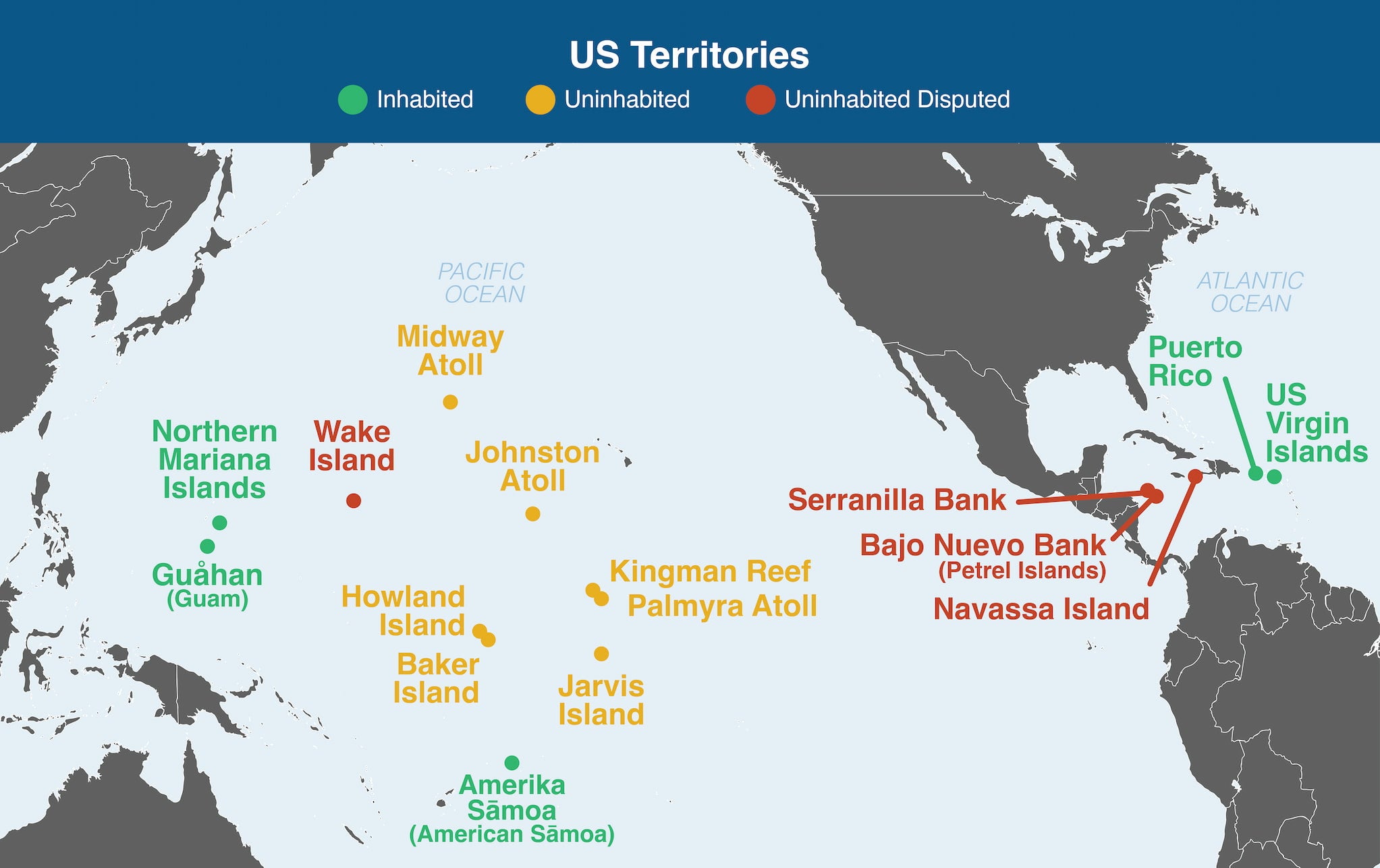
Image 20.02.01 — This map shows the fourteen territories currently controlled by the United States, most of which are located in the Pacific.
The story of the US in the Pacific Islands, oddly enough, begins with bird poop. In the mid-1800s the accumulation of bird excrement, named guano, was heavily sought after for its value as a fertilizer. Guano often accumulated in islands. To acquire this guano, the US Congress passed the Guano Islands Act in 1856, which gave US citizens permission to take control of any islets containing guano deposits as long as they were not already claimed or inhabited.
At its peak, there were nearly one hundred islands claimed under this Act. As part of the Guano Islands Act, the President was authorized to use military force to help protect the rights of the discoverer. The US still controls some of these uninhabited islands, such as Howland Island, Baker Island, and Jarvis Island.
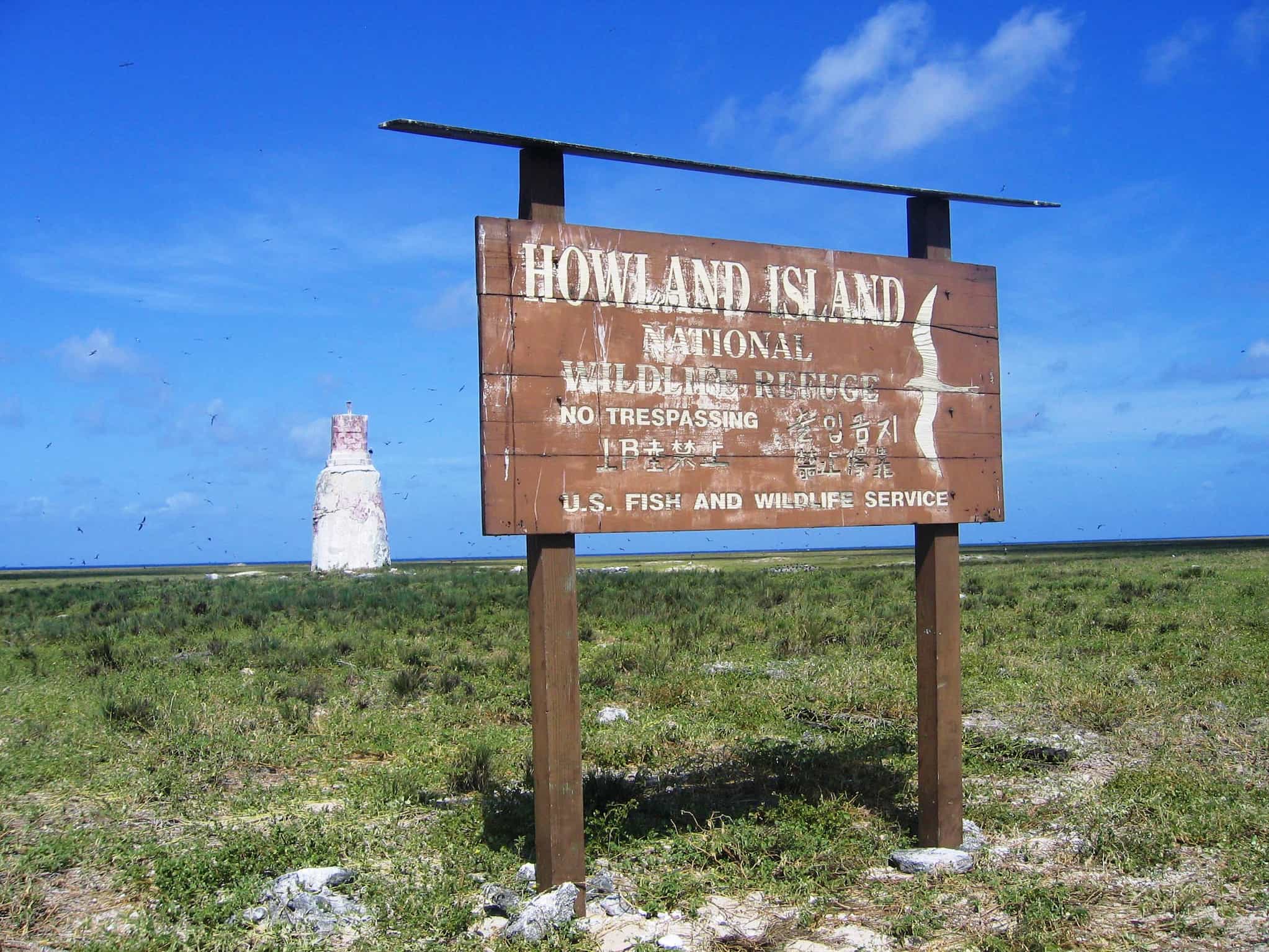
Image 20.02.02 — This sign stands at Howland Island. Today, the island is left abandoned by the US. Similar signs can be found in Baker Island and Jarvis Island. Currently, these islands are overseen by the US Fish and Wildlife Service.
In the late 1890s and early 1900s, the US would acquire most of its other territories (with the exception of the US Virgin Islands, which were bought from Denmark in 1917, and the Commonwealth of the Northern Mariana Islands, which would fall under the US in the 1970s).
In 1898, the US illegally annexed the Kingdom of Hawaiʻi, after white businessmen in the Kingdom overthrew Queen Liliuokalani in 1893. They formed the Republic of Hawaiʻi and asked to become a part of the US, first becoming the Territory of Hawaiʻi, and then becoming a US state in 1959. Hawaiʻi statehood is still contested, and Kanaka Maoli, or Native Hawaiians, continue to fight against the illegal occupation of Hawaiʻi today.
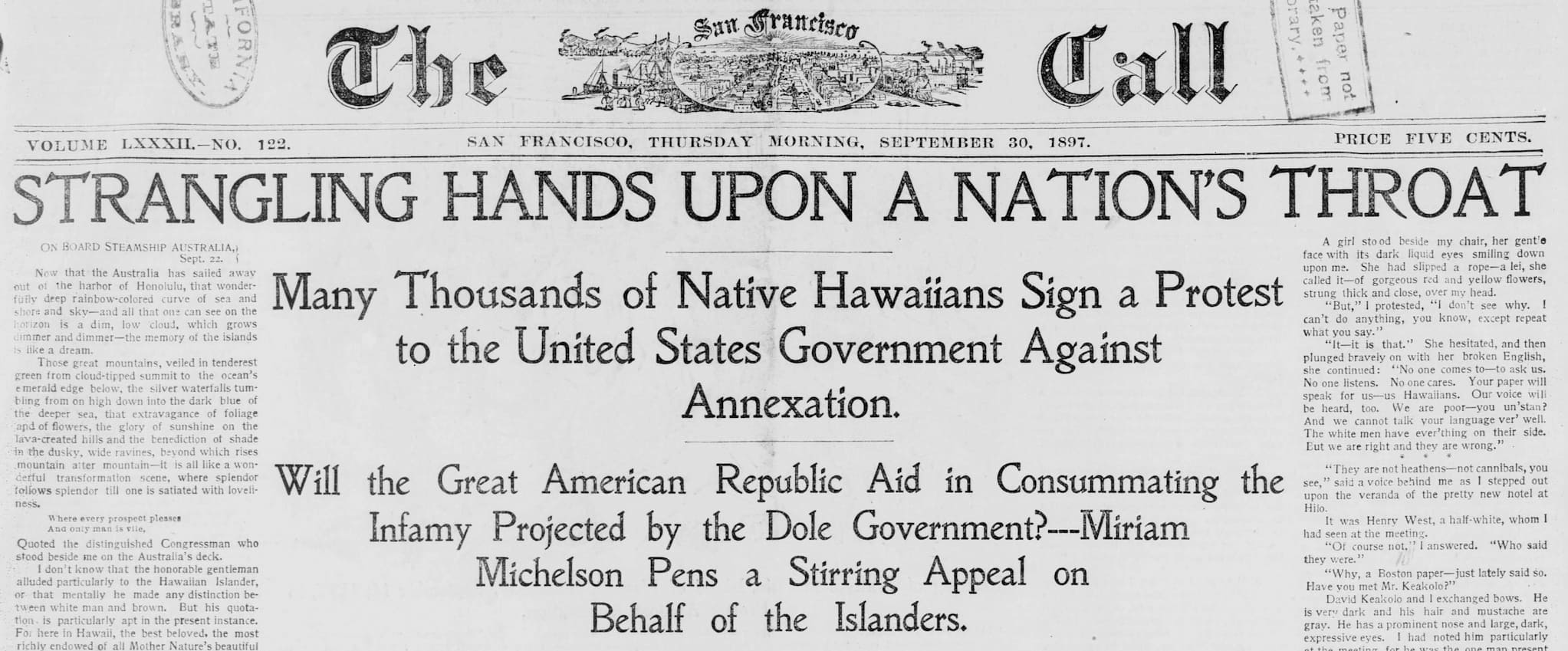
Text 20.02.03 — In an 1897 article published in The San Francisco Call, journalist Miriam Michelson’s headline, “Strangling Hands Upon A Nation’s Throat,” sheds light on the thousands of Hawaiians who protested against the United States’ illegal annexation of the Kingdom of Hawaiʻi.
In 1900, chiefs in American Sāmoa and the US signed the Treaty of Cession of Tutuila and Aunu’u, which transferred control of the main island to the US. In 1904, the Treaty of Cession of Manuʻa was also signed, which gave the US Navy control over the islands of American Sāmoa.
Yet perhaps the most consequential event of the late 1890s for US imperial expansion was the Spanish-American War. On February 15, 1898, the US battleship Maine was sunk in Havana, Cuba (which was a Spanish territory). The US blamed the Spanish for sinking the ship and declared war on Spain on April 25, 1898.
It is important to note that Cubans were fighting against the Spanish prior to the war, and many Americans called for US intervention into the island. In December of 1898, the Treaty of Paris was signed, ending the war. As a result, the US gained control of the Spanish territories of the Philippines, Puerto Rico, and Guåhan for 20 million dollars, ultimately cementing American imperial expansion outside of its borders.
Many do not know that the Philippines, an independent country today, was a US territory from the signing of the Treaty of Paris until 1946. From 1899 to 1902, the Filipinos, led by figures like Emilio Aguinaldo, fought a war with the Americans for their independence. Just like the Puerto Ricans, the Filipinos were also fighting against Spanish colonization before the Spanish-American War.
When they were transferred to US governance, the Filipinos soon discovered that the US was essentially going to recolonize the islands. This made the first few years of American colonialism brutal. In fact, the Colt 45 automatic pistol was in-part created as a result of US experiences fighting Filipinos in Mindanao, who were engaging in warfare against the US military. Thus, the Phillipines’ transfer from the Spanish to the Americans was anything but a smooth transition.
What Is an Unincorporated Territory?
The Spanish-American War ultimately transformed what being a US territory meant. Being a US territory was not something new in the 1890s, and most of the fifty states were originally territories until the US Congress admitted them fully into the Union as states. Essentially, being a territory meant being on the path to statehood.
This all changed with the acquisition of the Philippines, Puerto Rico, and Guåhan after the Spanish-American War. The US deliberated how to treat these newly acquired territories. The urgent question was “Does the Constitution follow the flag?” To put it another way, does the Constitution and its laws have to apply to a place just because a place is considered US soil?
From 1901 to 1922, issues like these were debated in the US Supreme Court in a series of cases collectively called the Insular Cases. It is important to note that questions of justice and the rightful status of the local populations of these places were not the primary issues animating these debates. Rather, it was things like oranges.
In one of the first Insular Cases, Downes v. Bidwell, the main point of contention was whether or not an import tax could be placed on goods brought from Puerto Rico. If Puerto Rico had the same political status as a state, then no import tax could be placed. However, the Supreme Court ruled that when it comes to places like these newly acquired territories, they were not fully subject to the Constitution, but rather to the decisions of the US Congress.
This is because the US Constitution declares that the US Congress is given control over the territories. Article IV, Section III, Clause II (or what is known as the “Territorial Clause”) states, “The Congress shall have power to dispose of and make all needful rules and regulations respecting the territory or other property belonging to the United States; and nothing in this Constitution shall be so construed as to prejudice any claims of the United States, or of any particular state.”
Ultimately, Congress has what is called “plenary” or “absolute” power over US territories, and this continues to this day. For example, if Congress dislikes a law passed by a US territory legislature, it can declare that law null and void (however, Congress does not routinely exercise this power).
As a result of the Insular Cases, we see what is called the “Doctrine of Territorial Incorporation.” Essentially, these rulings created a distinction among territories. There were now going to be two categories of territories: incorporated territories and the newly created unincorporated territory. Incorporated territories (like Hawaiʻi and Alaska) were meant to become states, while unincorporated territories held no promise of ever transitioning to statehood. Today, Guåhan’s political status is an unincorporated territory of the US.
The reasons for the creation of this distinction are multi-faceted, but one factor was race. Many in the US did not believe that these newly acquired, far-flung places, whose population is majority native or Indigenous peoples, will ever be ready for statehood.
As one oft-cited quote from the Insular Case Downes vs. Bidwell reads, “If those possessions are inhabited by alien races, differing from us in religion, customs, laws, methods of taxation, and modes of thought, the administration of government and justice according to Anglo-Saxon principles may for a time be impossible.” 1 Thus, it is hard to disentangle race from US imperial expansion into the Pacific.
At their core, unincorporated territories today do not fully participate in and benefit from American democracy. While states have voting representatives (the number of which is determined by a state’s population) in the lower chamber of the US Congress, the House of Representatives, the territories each only have one non-voting delegate. These delegates can participate in debates and help in the policy process but are unable to vote on the floor.
While states each have two senators in the upper chamber, the Senate, the territories have no representation. This is the predicament of the US territories. As mentioned above, the US Congress exercises plenary power over the territories, yet the people of the territories have no voting representation whatsoever in the body that exercises this plenary power over them.
When it comes to the executive branch of the US, we also see a difference between the territories and states. Whereas states get to have electors in the Electoral College (which elects the President), territories get no electors. This means that those in the territories are not involved in the selection of their President and Commander-in-Chief.
The only caveat to this is that the two primary political parties, the Democratic Party and the Republican Party, both allow the territories to participate in the party primary elections. Yet, this is a decision of the political parties themselves.
There is nothing in US law or the Constitution stating that territories need to be involved in the selection of the President. In some territories like Guåhan, the ballots ask for their vote for US President, but this is simply a straw poll and does not actually count.
These differences between territories and states contribute to many US citizens in the territories feeling like “second class citizens.” They are technically American citizens but do not participate fully in the democracy to which they belong at the moment. This is in line with the Insular Case ruling that territories “belong to but are not an integral part of” the US. Correcting these issues by fighting for representation is an important aspect of empowerment and decolonization, but it is only one part of decolonization (which is largely rooted in allowing a people to choose their future political destiny).
Yet not all US territories are even comprised of US citizens, as we see in American Sāmoa, whose people are considered US nationals, not US citizens. As a result, many of those in American Sāmoa who move to the states cannot hold certain jobs, such as being a police officer or teacher, because many states have laws that require US citizenship as a condition of employment by the government.
Breaking the Status Quo?
Since being acquired, the people of the territories have constantly fought for improvements in their political situation. To put it another way, those in the territories do not simply accept the status quo. If one were to look at the territories today, one may think that the way they are governed has always been that way. One may think that this was the way that the territories were governed immediately upon being acquired by the US. However, this is not the case. Things like voting for their own governor in the territories were issues that people within the territories had to fight for. Examples like this show the agency of Pacific Islanders themselves.
For example, when the island of Guåhan officially became an unincorporated territory in 1950 (prior to this, it was just referred to as a possession of the US) via the Organic Act of Guam (legislation passed by Congress), the governor of the island was meant to be appointed by the federal government. It would take lobbying the US Congress for nearly twenty years before the people of Guåhan were finally able to elect their own governor. Even getting a non-voting Congressional delegate for Guåhan was a struggle; indeed, the island did not get a non-voting delegate until the 1970s.
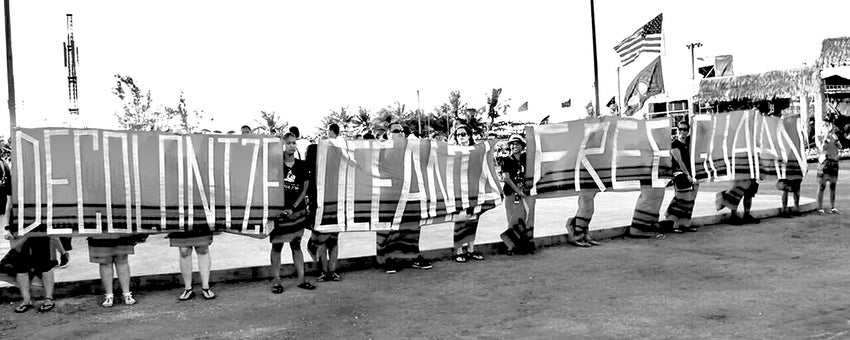
Image 20.02.06 — At the 2016 Festival of the Pacific Arts, held in Guåhan (Guam), twelve delegates from Guåhan revealed banners that read “Decolonize Oceania, Free Guahan” as a message and a reminder that parts of the Pacific are still under colonial rule.
These two examples help to show that islanders themselves have fought for improvements within their territorial status. While these improvements did not lead to the resolution of their political statuses, each of these incremental changes helped to offer the people a little more agency and freedom. Now, the islands continue their struggle to resolve their political status issues and to transform their relationships with the US, which we will explore in the following modules.
Glossary terms in this module
colonialism Where it’s used
The process in which one country or people controls another place or people through partial or full political control for an extended period. Colonialism has lasting economic, social, and cultural effects even after the period of formal colonization is over.
Insular Cases Where it’s used
A series of legal cases in the US Supreme Court that created the distinction between incorporated and unincorporated territories.
Guano Islands Act Where it’s used
A law passed by the US Congress in 1856 that gave US citizens permission to take control of any islets containing guano deposits as long as the islands were not already claimed or inhabited. At its peak, there were nearly one hundred islands claimed. Today, some of these uninhabited islands are still under US control.
occupation Where it’s used
The act of taking control of a territory, region, or state through military means. In Hawaiʻi, the US overthrew the Hawaiian Kingdom in 1893 and illegally annexed the islands. Today, the US military continues to have a strong presence in Hawaiʻi, and Kanaka Maoli (Native Hawaiians) do not have sovereignty.
unincorporated territory Where it’s used
A US political status in which a territory has no promise of formally becoming a state of the United States. In the US, people from unincorporated territories such as Guåhan (Guam) and Puerto Rico cannot fully participate in American democracy even though they are US citizens.