





Module 5: Art and Social Change
Does the media portrayals of Asian American and Pacific Islander women’s stories change the way they are treated in society?
Renowned Indian American filmmaker Mira Nair has made a career of taking viewers into intimate and unexpected worlds. She has woven together remarkable stories, including a scrutinized romance between a Black Southern man and an Indian refugee from Uganda in Mississippi Masala. She has filmed the lives of stigmatized cabaret dancers in India whose money supports their families yet who are rejected by their community because of their work.
Listen to
Mira Nair on her origins as a filmmaker
Audio 26.05.01 — Mira Nair discusses her origins as a filmmaker. Her first film, Salaam Bombay! (1988), highlighted the true stories of “street children” and brought to light child welfare issues in India.
Through these compelling stories, Nair aims both to help people open their minds to those who live different lives, and also to connect to all of the human experiences they go through. She has often said that her films are not about politics, but they are political in that they strive to create understanding. She said in a 2017 interview in Image Journal:
“I think now more than ever is the time to transcend our boundaries with the other. That is what I like to do in my films, by going into prickly and specific worlds, which I hope in their truth, fun, or joy make you see yourself, so that you see that a person in Katwe is not removed from you.” 1
This chapter has tried to exemplify the women, groups, organizations, and communities telling their own stories, using their own voices, and how such work has empowered Asian American and Pacific Islander women and countered narratives in their portrayal. When mainstream media and dominant powers tell the story, it often does not reflect the lived experiences or three-dimensions of the reality of these women.
In this module, these stories of empowerment illustrate how social change can be accomplished through art and storytelling as counternarratives.
How can art be an effective conduit for social change?
What are some pieces of art or storytelling that have enriched people’s understanding of Asian American and Pacific Islander women’s experiences?
In what ways do artists and their artistic practices transform narratives about Asian American and Pacific Islander women?
Chanel Miller and Her Art
Many Asian American and Pacific Islander women’s stories have been absent from mainstream media or depicted in harmful ways. One strategy to address this has been for Asian American and Pacific Islander women to create works that offer alternative narratives that reflect their own experiences. Chanel Miller’s memoir, Know Her Name (2019) is one powerful example.
Miller is a Chinese American woman who was known for years in the press as “Emily Doe.” She is a survivor of a high-profile rape on the campus of Stanford University in 2015. She submitted an anonymous testimony that was published following the trial. Her words moved millions and were read in front of Congress to press the need to address violence against women. Despite a guilty conviction, her rapist only served a six month sentence. In 2019, she revealed her identity through her memoir to describe her experience as a survivor of sexual violence and the grueling legal case she endured in search for justice.
In sharing her decision to reveal her identity, Miller told Time magazine in 2020:
I decided that for as long as they [defense attorneys for her rapist] are out there, I will be out there too. I will appear on every television screen across the nation and I will not question my being there…because I know that from the very beginning, the defense attorney had it wrong. To be known is to be loved. 2
Her brave decision dovetailed with her decision to be an advocate for new laws that would protect survivors of assault. Her continued activism led to a change in California’s law that mandated a minimum three-year prison sentence for defendants who sexually assault unconscious victims.
Miller uses art as a form of activism. She creates murals that have been displayed in the San Francisco Asian Art Museum and in Manhattan Chinatown restaurants. She connects her desire to create with an intentional decision to reclaim her story. Miller refuses to be known to the world as only a victim, and her art practice of mural making shows her whole personhood as an artist. Miller told the Asian Art Museum in 2021, “Art requires imagination. Imagination is the key ingredient to empathy.” 3 In telling her story in her own voice, she allows others to see from her perspective and connect with her experiences.
Kimber Lee Talks Back to Miss Saigon
Asian American and Pacific Islander women and their allies can create a direct response to the stories that misrepresent their community. Kimber Lee, an Asian American woman, created her own narrative after seeing the 2017 Broadway revival of Miss Saigon. She started to write her own play, explaining that “seeing those racial stereotypes and misogynist images and ideas trotted out so brazenly on stage was clarifying. It distilled into sharp focus so many of my experiences as an East Asian woman growing up in the US.” 4
Like others, seeing this play written decades ago showed Lee just how entrenched these stereotypes were that led people in the present-day to assume she was a sexual object or a helpless, passive woman.
Miss Saigon became the impetus for Lee to understand the context of the racist and sexist experiences in her life. She wrote a play called Untitled F*ck M*ss S**gon Play (2023) to express her own artistic vision and not to just be reactionary or angry. The irreverent title reflects the satirical piece that borrows the tropes from Miss Saigon. Lee also told The Spill, “I believe that rage, especially from a woman, can be a clarifying fire. And my personal quirk is that my rage works itself out as comedy. Humor is one of my primary tools for dealing with pain.” 5 The Royal Manchester Theater produced her play, and it has won international awards and acclaim for creating conversations about problematic depictions of Asian American and Pacific Islander women.
Collective “Artivism”
Art practices do not have to be a solo project. Artivism, collective storytelling, and artmaking highlights the hardships and humanity of people whom society often makes invisible. One example is the Massage Parlor Worker Outreach Program (MPOP) in Seattle. In addition to providing supportive services to massage parlor workers and sex workers during their outreach events, MPOP also gathers their stories through an oral history project that is shared throughout the community. It eliminates language and literacy barriers to capture the personalities and stories of women who are absent from mainstream stories. These narratives capture their strength in the face of life’s struggles and demonstrate how their community can be harmed by policies that criminalize or stigmatize their work.
Just as crucial as the art itself are the collective spaces that allow artivists to showcase their work. As artists and artivists found a lack of mainstream venues for their art, they created galleries, festivals, and workshops to nurture and support works by and about Asian American and Pacific Islander women. The East West Players, a playhouse established in 1965, is the oldest theater organization producing works by and for Asian American and Pacific Islander communities.
The formation of this playhouse dovetailed with the Asian American student movement and anti-war movement of the 1960s and 1970s. As tropes about Asian American and Pacific Islander women reinforced old stereotypes, such local playhouses and community centers worked to reframe and counter these narratives. The East West Players has produced over 228 plays and musicals as of 2025. They have also hosted over a thousand diverse readings and workshops for actors, writers, and directors.
Another group called the Asian American Women Artists Association was formed in 1989 to promote the contributions and visions of Asian American and Pacific Islander women. The South Asian Womxn’s Creative Collective was established in 1997 with a similar goal to provide supportive spaces for South Asian women to create and circulate written, visual, and performance art in New York City. Organizations such as the Center for Asian American Media (CAAM) in San Francisco, Pacific Islands Film Festival NYC, Hawaiʻi International Film Festival, and Chicago South Asian Festival have been pivotal for Asian American and Pacific Islander women filmmakers to showcase their work to a broader community.
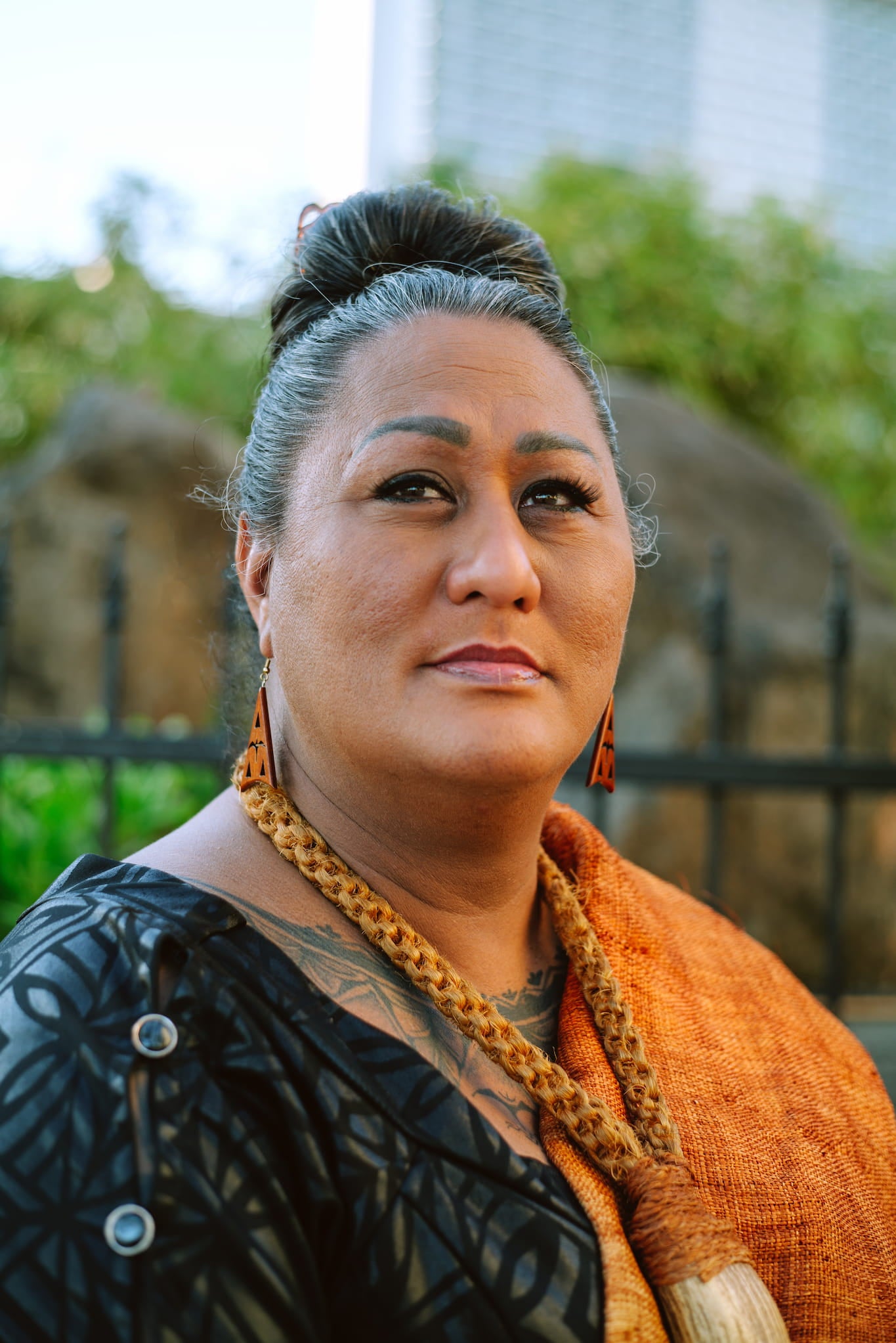
Other stories also would not have made an impact without forums that focus on Asian American and Pacific Islander voices. Kumu Hina is a film that documents a Native Hawaiian transgender woman named Hinaleimoana Wong-Kalu, a cultural leader and teacher in her community. Wong-Kalu narrates her experiences as she seeks to keep her culture alive in modern-day Honolulu. Through the story of this one individual, the film connects the legacy of colonization to Native Hawaiian resilience in the present day. The film won over a dozen awards in international and domestic film festivals. Still, without the Asian American and Pacific Islander film and LGBTQ+ film festival circuits, its distribution would have been limited.
Image 26.05.05a — Portrait of Hina Wong-Kalu, a cultural leader keeping ancestral arts and stories alive within her Native Hawaiian community.

Does it Need to Be Artivism to Have Impact?
Art that is not created from an activist perspective can still hold great value to Asian American and Pacific Islander women. We see this when actors are cast in mainstream stories and given a character that is multi-dimensional and complex, rather than being built on limiting stereotypes. For instance, Kelly Marie Tran, born Loan Tran, is an actress who broke down barriers for her leading role as Rose Tico in The Last Jedi (2017) and Rise of the Skywalker (2019). She was the first Asian American woman to play a lead role in the Star Wars franchise and subsequently the first Asian American woman to appear on the cover of Vanity Fair magazine.
As Rose Tico, Tran played a character who was a noble and steadfast resistance fighter. There was nothing about her role that emphasized her cultural heritage. Instead, she was given a backstory that made sense in this fictional world. In doing so, it demonstrated that Asian American and Pacific Islander women could be compelling in any kind of narrative, including a longstanding, mainstream franchise.
Breaking down these barriers can still be subversive by disrupting conventional ideas of what a hero should look and sound like. Tran faced racist and sexist online harassment from people who thought an Asian American woman in her role diminished the Star Wars franchise. The attacks caused a severe decline in Tran’s mental health. She sought therapy and left social media before publicly sharing her experience and renewing her commitment to acting.
Her tenacity in an industry with over a hundred years of discrimination towards Asian American and Pacific Islander women makes a difference for other current and future artists in the film industry. She expressed her commitment in 2018 in The New York Times saying, “I know that I now belong to a small group of privileged people who get to tell stories for a living, stories that are heard and seen and digested by a world that for so long has tasted only one thing. I know how important that is. And I am not giving up.” 6
Reflection Question
Is Tran’s role in the Star Wars franchise an example of artivism?
Conclusion
Storytelling has the power to shape ideas and perspectives. In retelling these storied histories about Asian American and Pacific Islander women, one can see new possibilities to change perceptions and, subsequently, counter the harmful stereotypes that have held down and harmed so many women. If stories have the power to shape old narratives, then artivism has the ability to change them. To engage in artivism is to create art that shifts our current reality into something better. As artivists create music, visual arts, and dance, they pave the way for new alternatives in the way we treat and understand communities as well as ourselves.
Glossary terms in this module
artivism Where it’s used
A distinct category of activism that intentionally seeks to fight against injustice or oppression, highlighting contradictions, spotlighting an issue, or offering solutions that bring about social awareness and action through art.
Endnotes
1 G. Higgins, “A Conversation with Mira Nair,” Image, Issue 93 (Summer 2017).
2 C. Miller, “I thought anonymity was a shield after my sexual assault. But coming forward brought me back to myself.” Time, August 14, 2020, https://time.com/5879561/chanel-miller-on-coming-forward-know-my-name/.
3 “Chanel Miller at the Asian Art Museum: ‘I was, I am, I will be,’” American Academy of Arts & Sciences, accessed October 5, 2025, https://www.amacad.org/mixtape/chanel-miller-asian-art-museum.
4 “‘Untitled f*ck m*ss s**gon play’: An Interview with Playwright Kimber Lee,” The Spill, September 6, 2023, https://www.thespillmag.com/article/untitled-f-ck-m-ss-s-gon-play-an-interview-with-playwright-kimber-lee/.
5 “‘Untitled f*ck m*ss s**gon play,’” The Spill.
6 K. M. Tran, “Kelly Marie Tran: I won’t be marginalized by online harassment,” The New York Times, August 21, 2018, https://www.nytimes.com/2018/08/21/movies/kelly-marie-tran.html.