





Module 3: Women Reclaiming their Lands and Stories
Does the media portrayals of Asian American and Pacific Islander women’s stories change the way they are treated in society?
This module highlights Asian American and Pacific Islander women’s organization and mobilization efforts, including their efforts in demilitarization, media and theater, and local community organizations. Together, such organizing work focuses on advocacy for workplace rights, bodily autonomy, and fair representation in media. In contrast to the mainstream depictions of Asian American and Pacific Islander women, these stories show how their strength and resilience counter stereotypical portrayals in history.
To what extent have Asian American and Pacific Islander women-led organizations changed perspectives and imaging of Asian American and Pacific Islander women?
How have collective organizing and actions elevated the voices of Asian American and Pacific Islander women?
How have Asian American and Pacific Islander women used various media platforms to transform cultural stereotypes?
Hawaiian Women in the Fight to Demilitarize
The island of Kahoʻolawe in Hawaiʻi is a site of sacred religious and cultural history that has been off limits to Kānaka Maoli (Native Hawaiians) since 1941. After the bombing of Pearl Harbor, the US government declared it a military site for weapons testing and military training. Fighter jets dropped bombs on the island for target practice for decades. Between 1968 and 1970, these jets dropped 2,500 tons of bombs on the seven-mile long island. These explosives destroyed natural habitats and sacred cultural sites. Most importantly, not one person, including Hawaiians whose ancestors had settled on the island as early as 1027, was allowed to be present on the land.
In 1976, Native Hawaiian Loretta Ritte, her husband Walter Ritte, and several community members boarded small boats under the cover of darkness and headed for Kahoʻolawe. Their plan was to occupy the island as a political statement to protect land from militarization. Ritte believed so much in the cause that she had legal paperwork drawn to entrust her children to her mother-in-law in the event that she and her husband were killed during this act of protest.
Other Hawaiian women activists joined Ritte over the next few weeks, including Moanikeala Akaka, Maxine Kahaulelio, and Terrilee Kekoʻolani-Raymond. They took great risks to make a political statement. They faced bombings that continued even when their occupation of the island was known to the US Navy authorities. Two members of their group, George Helm and Kimo Mitchell, died at sea in an effort to try to aid the larger group. The protest put the struggle of the island and Hawaiians’ call for autonomy in the public eye. The role of these women is a testament to their commitment to regain governance control of their land and waters.

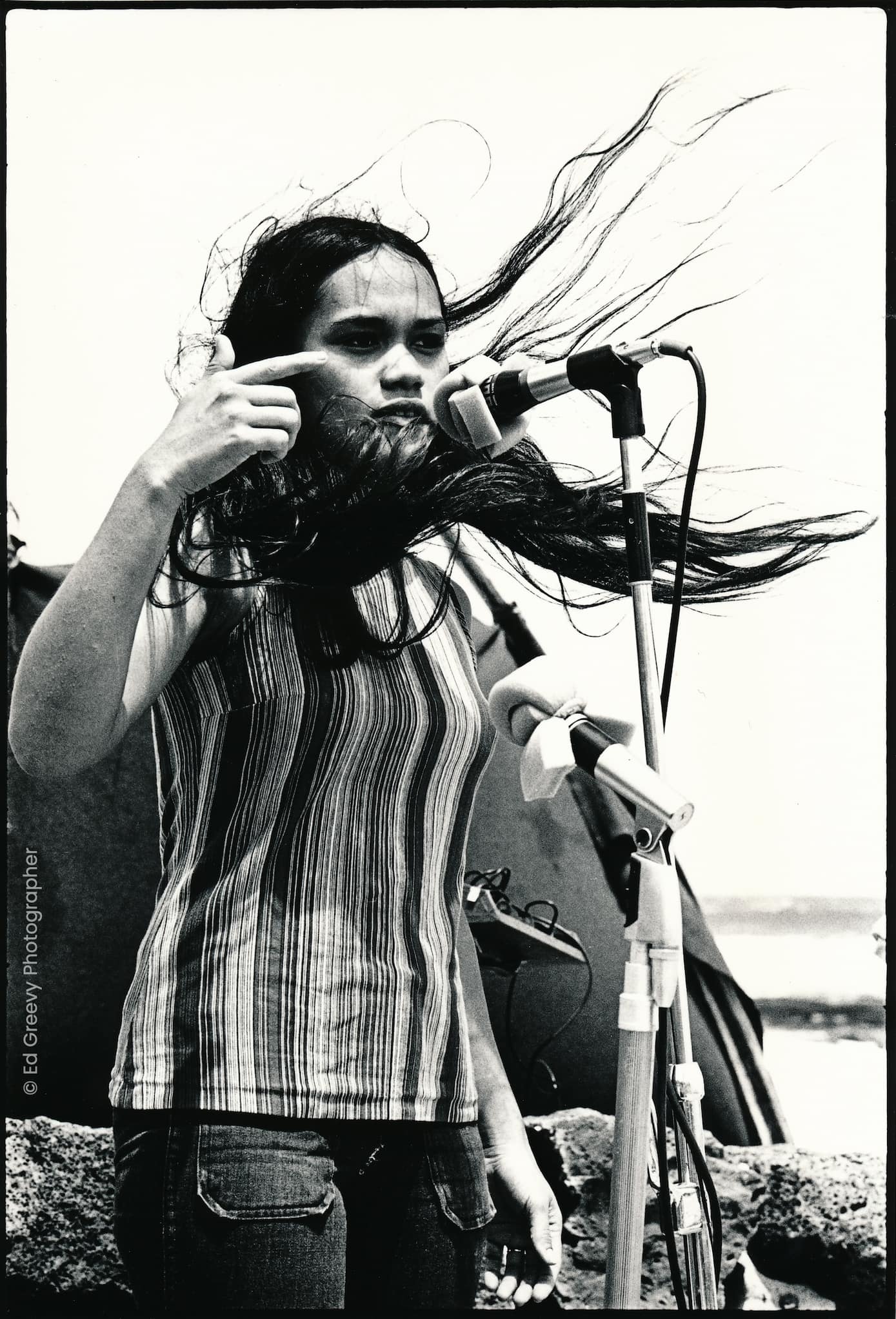
Image 26.03.01 — Native Hawaiian activist Terrilee Kekoʻolani-Raymond addressing the impact of the US military’s nuclear waste on the environment and Hawaiian community at a 1972 rally.
The group eventually formed the organization Protect Kahoʻolawe ʻOhana (PKO), which filed a legal case against the US government. Legal battles and activism for decades resulted in President George H. W. Bush halting bombing on the island in 1990. In 1993, legislation designated funds to clear the island of hazardous waste caused by the bombing and returned access rights to the state of Hawaiʻi in 2003.
Between the initial protest and final outcome, these women leaders were engaged in many actions and campaigns to demilitarize Hawaiʻi and return sovereignty to Native Hawaiians. They engaged in efforts to return sacred sites to Pōhakuloa, another culturally significant Hawaiian region that was confiscated for US military training use. Kahaulelio’s work prevented the eviction of Hawaiians in buildings that were marked to be converted into private resorts. Kekoolani-Raymond launched DeTours in 2004, a program that takes locals and visitors to see key historical sites and sites of hazardous waste caused by US military activities in Oʻahu. They tell their stories in their book Nā Wāhine Koa: Hawaiian Women for Sovereignty and Demilitarization (2018). These tours offer a counternarrative that most tourists do not see when they visit Hawaiʻi.
Organizing against Sex Trafficking and War Games
Women of Hawaiʻi have actively organized against sex trafficking. Since 1971, the United States has hosted the world’s largest maritime military exercise every two years in Honolulu, Hawaiʻi. The Rim of the Pacific (RIMPAC) military exercise includes up to thirty countries and lasts six weeks. The participants respond to fictional war scenarios including an imaginary North Korean siege. Dozens of naval vessels and hundreds of aircrafts devise responses that include detonating bombs, testing new weaponry, and deploying live artillery at sea. Entire ships have been sunk as a part of the exercise.
Sexual violence, prostitution, and sex trafficking crimes spike during RIMPAC. Khara Jabola-Carolus, the Executive Director of the Hawaiʻi State Commission on the Status of Women, states that gatherings surrounding RIMPAC increase demand for sex work by nearly 40 percent. Jabola-Carolus acknowledges that more has to be done than simply ending RIMPAC. She said in 2018, “RIMPAC is a symptom, not the disease. From western intervention to the present, a system of prostitution has sexualized and exploited poor, Native, and vulnerable women’s lower social power in Hawaiʻi.” 1
From an environmental perspective, six weeks of sustained bombing and use of sonar for military drills have also had harmful impacts on marine life. The Natural Resources Defense Council filed a lawsuit against the military, citing reports that the military’s use of sonar interferes with mammals’ ability to navigate, find food, and mate. Brain and ear bleeding and extreme disorientation has harmed forty-three sea mammal species, including several endangered whale species. The bombing and other large-scale exercises also destroy coral reefs and their ecosystems, which are crucial to biodiversity, erosion prevention, and the islands’ protection against storms.
Scholar and activist Dr. Emalani Case has been fighting alongside international groups to end RIMPAC’s social and environmental harms. In a 2024 interview with Te Ao Māori News, Dr. Case shared, “I grew up hearing and feeling bombs all the time, and it’s a kind of pain you don’t ever want to experience, because you know what’s happening…to your family. We view land, mountains, rivers, and the ocean as family.” 2
The coalition she works with to end RIMPAC is far-reaching, spanning states, countries, and ages. They include the national Filipino college student organization called Anakbayan, the international Filipino group Bayan, and other international groups like the Resist US-Led War Movement and International Women’s Alliance. These groups understand that the impacts of militarism go beyond nations’ borders and impact the planet as a whole.
Miss Saigon Protests: Fight against False Narratives
More Asian American and Pacific Islander women have spoken out in recent decades about the harmful depictions of them in mainstream culture. The conversations spurred by these activists have called into question the practice of yellowface, sexualizing and exoticizing Asian American and Pacific Islander women, and tropes such as Dragon Lady and Lotus Blossom.
One example of Asian American women’s action against false narratives is the case of Miss Saigon. Since its debut in 1989, communities around the world have protested the popular Miss Saigon stage musical. While Philipina actress Lea Salonga played the original role on Broadway of Kim, a Vietnamese woman, the play did face some backlash for casting a few white actors in Asian roles through yellowface casting.
Actors’ organizations like Actors’ Equity held public protests against Miss Saigon’s use of yellowface, marking the first time there was mainstream public discussion of yellowface and inequitable casting in theater. The outcry led to casting Asian actors for Asian roles by 1991. For many Asian American actors, the eventual end of yellowface casting provided some big breaks during a time when there were still limited roles for them on Broadway.
The controversy went deeper than hiring practices. Asian American men and women organized their communities to reject a narrative that romanticized prostitution during the war. What is presented as a love story is far from the lived experiences of the women and girls in bars and brothels who were often abused and violated. In the play, the main character, Kim, is portrayed as passive and naive while the native Vietnamese male characters are depicted as the opportunistic and abusive traffickers. Throughout, the white American soldier is depicted as worthy and admirable.
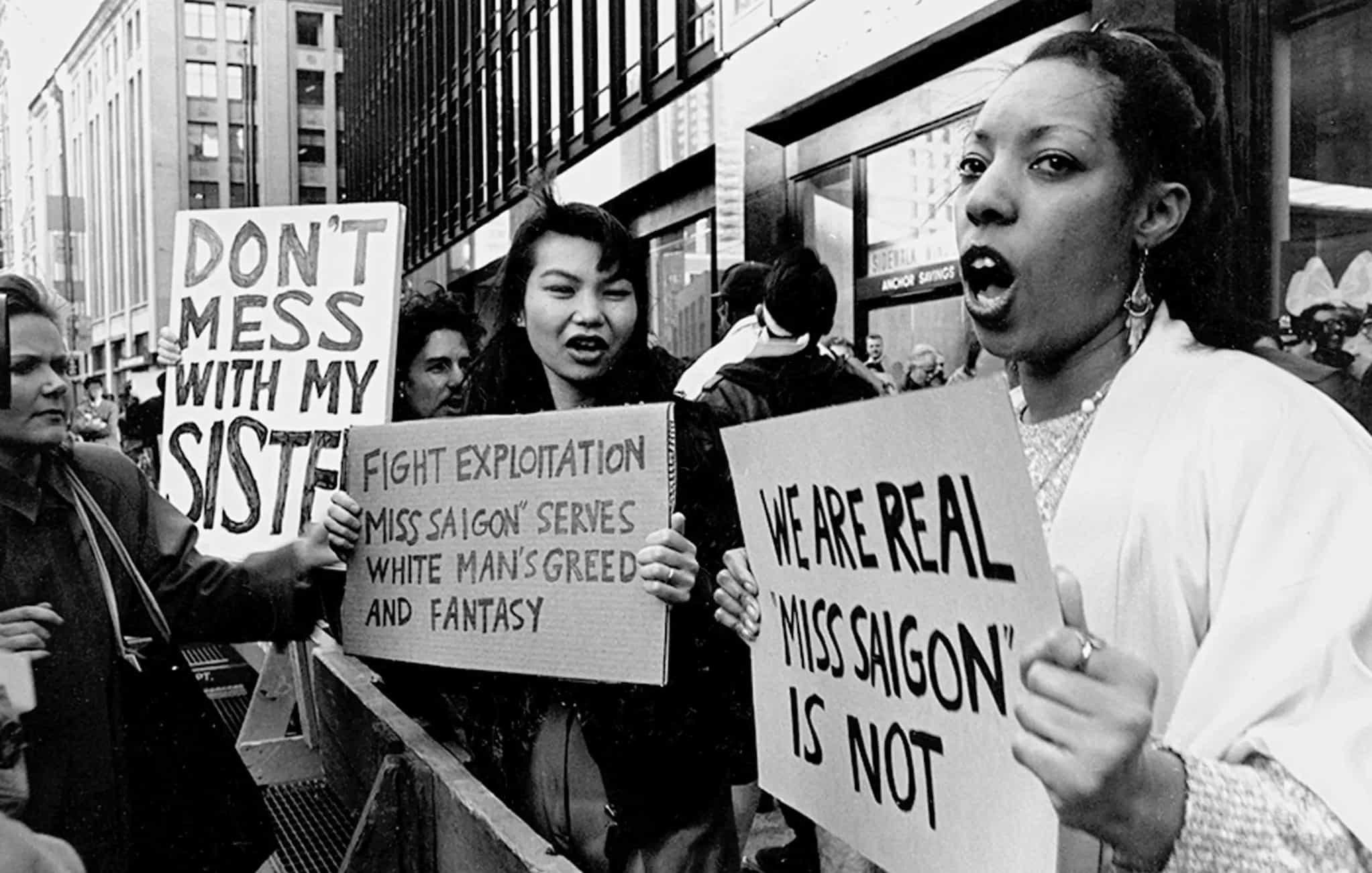
Image 26.03.03 — Activists protesting the Broadway production Miss Saigon on opening night in 1991. Protestors of all backgrounds came together in solidarity to demand an end to the play’s false narrative about Asian American and Pacific Islander women.
In 2017, Playbill’s Editor-in-Chief, Diep Tran, reflected:
“If the show was trying to tell the story of Vietnamese people, we did not recognize ourselves or our parents in any of the faces we were seeing on that stage. Instead, all we could see were desperate, pathetic victims, people who were completely different from the resilient, courageous, multifaceted men and women of Little Saigon.” 3
She went on to say that it is not enough that the play creates roles for Asian American actors if the story continues to perpetuate bygone stereotypes and partial stories. Around the country, people have participated in the Don’t Buy Miss Saigon Coalition to share their own narrative about how the play has harmed them and their community.
Women Cross DMZ
Asian American women have been instrumental in advocating for peace in countries where US military forces are still active today. Women Cross DMZ is an organization led by Korean American women who organized an international symbolic crossing between South Korea and North Korea in 2015 to call for a permanent peace agreement between the US and North Korea. To realize this event, the group had to gain permission from the US, South Korea, and North Korea, a monumental accomplishment in itself.
The Korean War (1950–1953) has never officially ended. The 1953 Armistice Agreement put a temporary ceasefire on the war between the Soviet Union-backed North Korea and the US-supported South Korea, and while peace talks have continued, an official peace treaty is yet to be signed.
The agreement divided North and South Korea with a Demilitarized Zone (DMZ), 260 miles long and 2.5 miles wide to guard their respective borders and prevent any flow of people between the two regions. Families have been physically separated for decades because of this division. As such, the DMZ has become a symbolic and physical reminder of the political limbo and suffering created at the expense of families.
While Women Cross DMZ were not the first to cross that border, they did so in a way that demonstrated global unity centering women’s voices. The delegation was intentionally women-led because women are often the largest human collateral for warfare and, yet, are historically left out of peace talks and diplomatic efforts. This is despite the Council of Foreign Relations’ data that women’s involvement in diplomacy efforts results in a lasting peace agreement.
The group included two Nobel Peace laureates, Mairead Maguire from Northern Ireland and Leymah Gbowee from Liberia. Other members of the delegation included US feminist leader Gloria Steinem, retired US Army Colonel Ann Wright, humanitarian aid workers, faith leaders, academics, and others from twelve nations. While the action was very specific to Korea, it called attention to the impact of all wars especially on women and children.
Press coverage of the crossing helped millions of people worldwide become educated on this issue. Women Cross DMZ has continued to meet with high-level diplomats and officials to work towards a sustainable peace agreement. This has included federal legislation in the US Congress called the Peace on the Korean Peninsula Act.
As Women Cross DMZ founder and former co-director Christine Ahn said in 2024, “It’s time to move forward and finally bring closure to seven decades of war. A brighter future for Koreans, Americans and the world depends on it.” 4 Today Women Cross DMZ has launched the Feminist Peace Initiative with other women-led organizations to reorient US foreign policy away from militarism and towards interdependence and diplomacy.
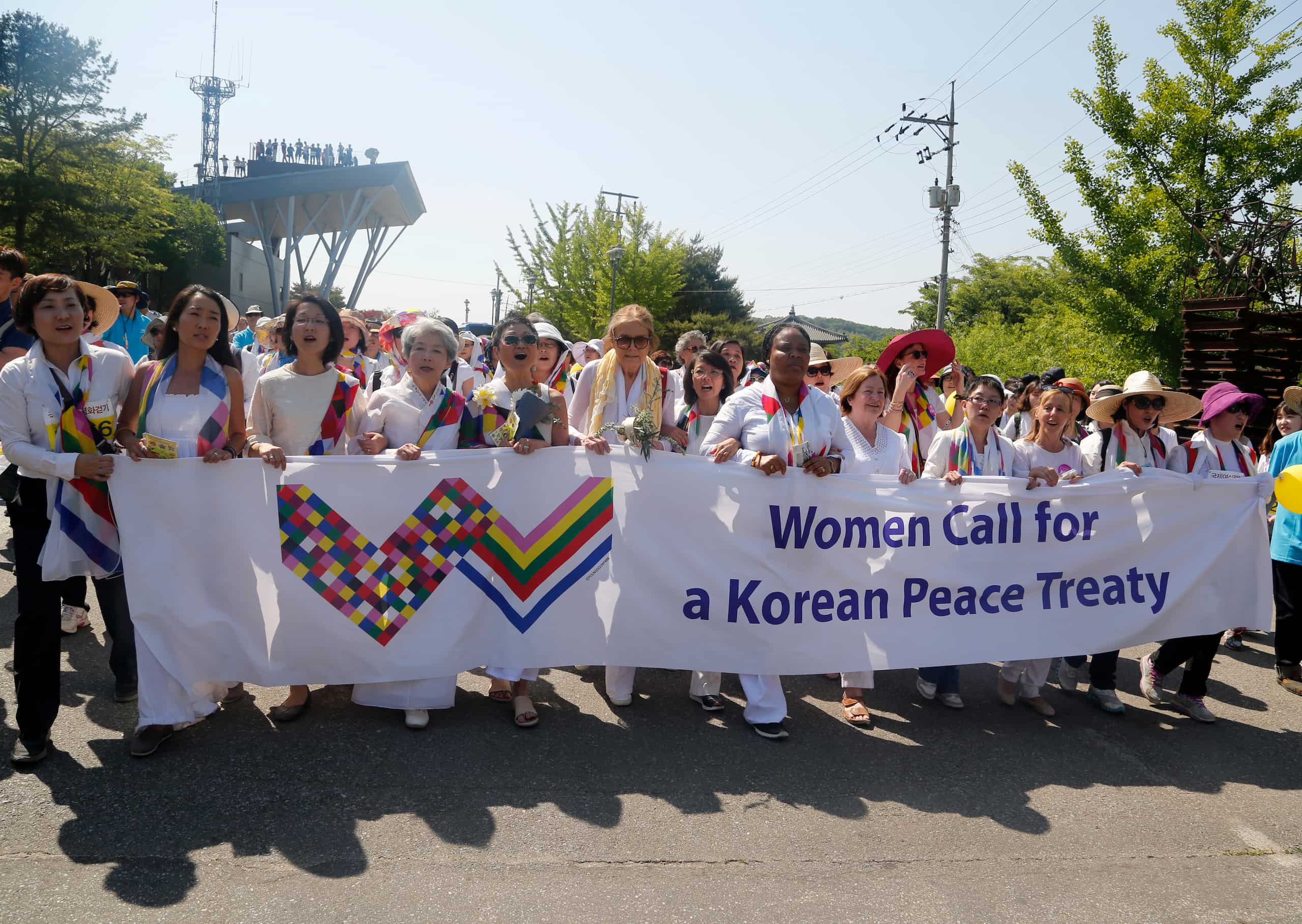
Image 26.03.05a — On May 24, 2015, activists from Women Cross DMZ successfully crossed the Demilitarized Zone (DMZ) that separates North and South Korea.
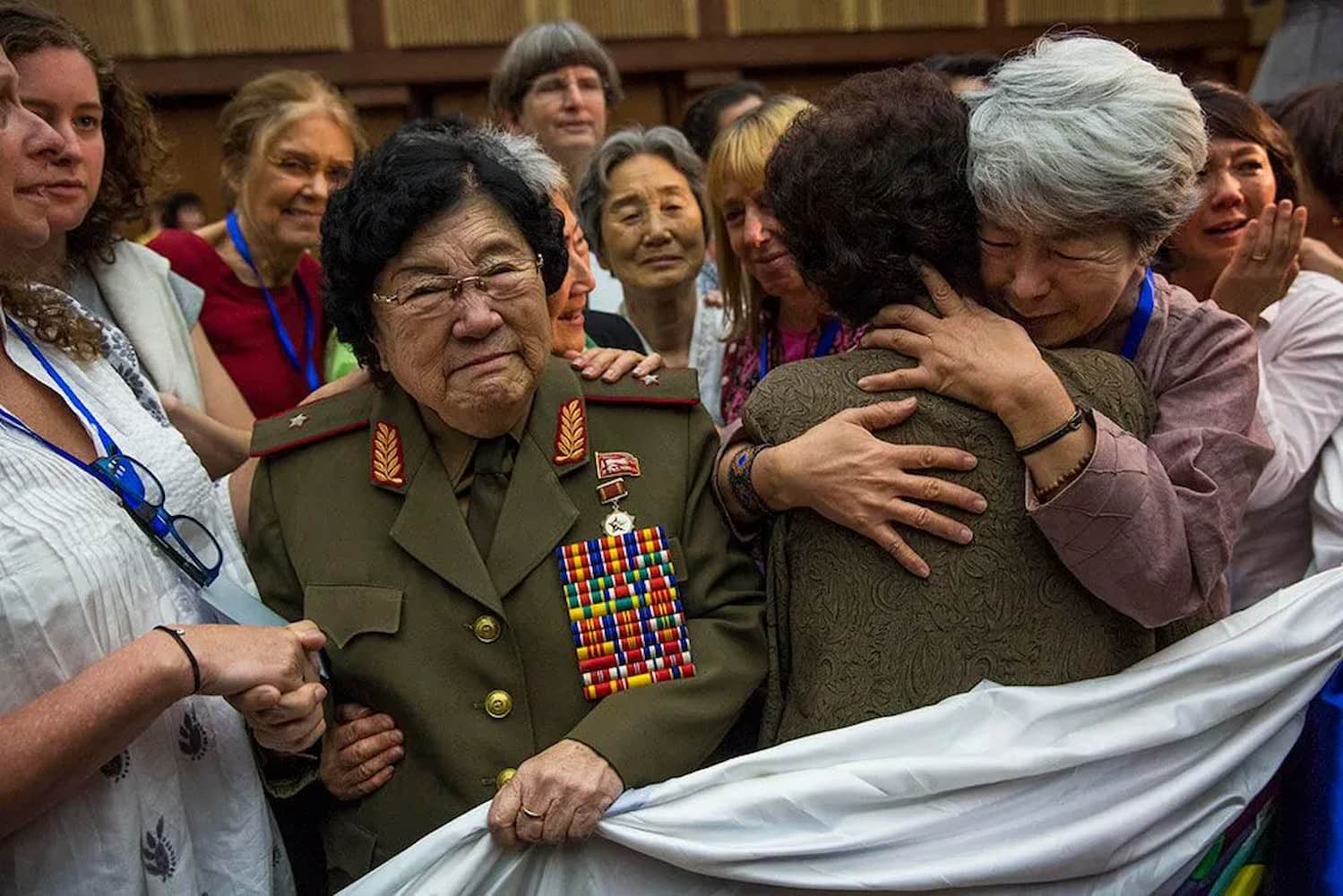
Image 26.03.05b — Starting in North Korea, Women Cross DMZ campaigned for peace across the Korean Peninsula—meeting with officials and organizing two Women’s Peace Symposiums. In this photo of the symposium in Pyongyang, North and South Korean women embrace.


Conclusion
Asian American and Pacific Islander women are empowered through community organizations, calls for representation, and political actions for local, state, and federal policy changes. By rejecting harmful narratives about Asian American and Pacific Islander women, they are working to counter conventional narratives. Some do this through art performances or strategic protests. Others address injustices through policy, media campaigns, and legal actions. No matter the form, these organizations and individuals rely on the power of community to secure a better future for all women and girls.
Glossary terms in this module
counternarrative Where it’s used
An account that challenges a mainstream portrayal of history or peoples.
Endnotes
1 “Hawaii State Commission on the Status of Women Launches Anti-trafficking Campaign,” State of Hawaiʻi Department of Human Services, Jul 10, 2018, https://humanservices.hawaii.gov/hawaii-state-commission-on-the-status-of-women-launches-anti-trafficking-campaign/#:~:text=Jabola%2DCarolus%20also%20stated%2C%20%E2%80%9C,adjust%20their%20perception%20of%20women.
2 T. A. Paterson, “Rimpac war game begins—Hawaiian academic calls it out as ‘how to invade’,” Te Ao, June 26, 2024.