



LANDMARK MOVEMENTS AND MOMENTS
Asian American Activism
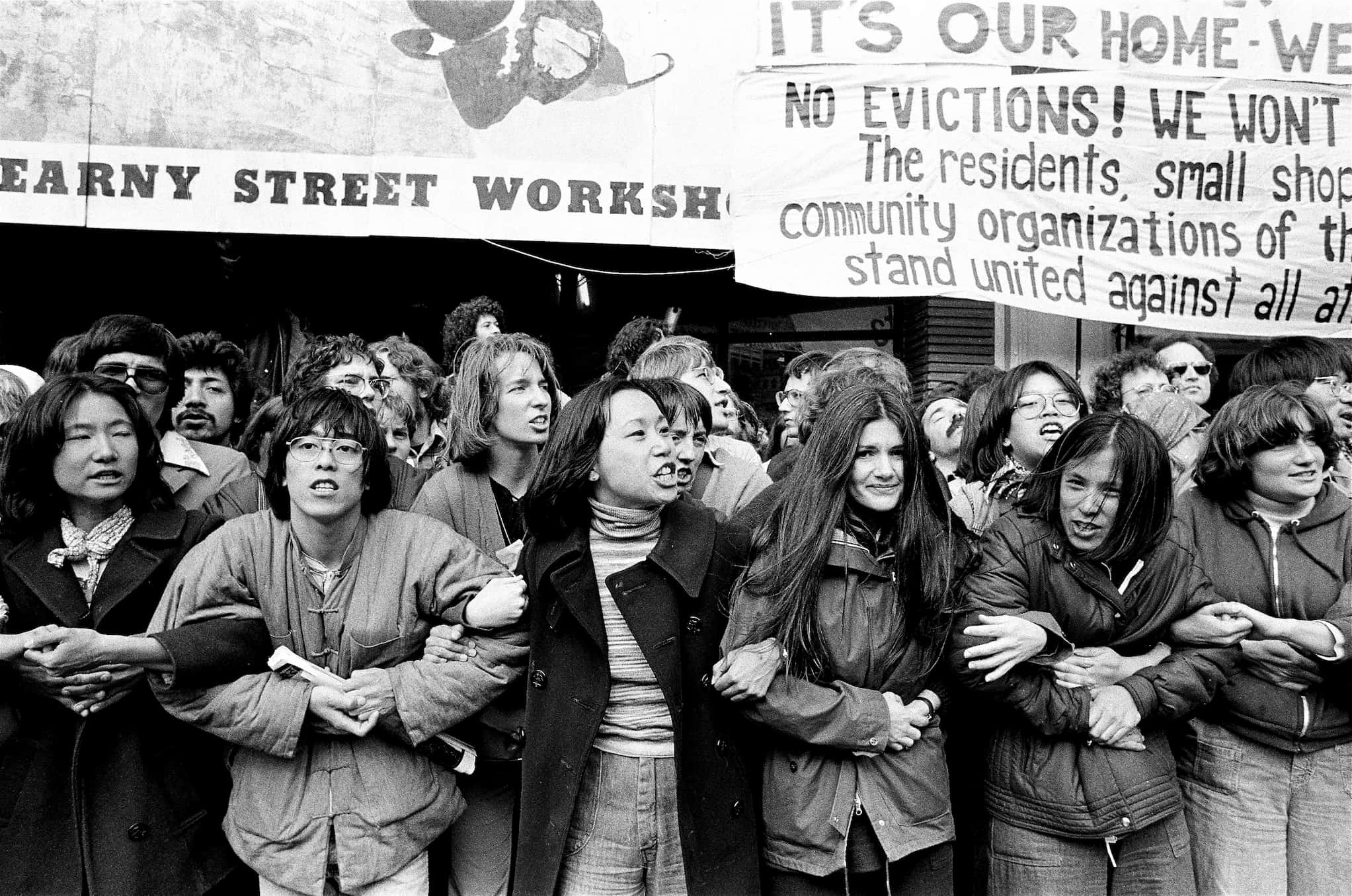
Was Asian American activism successful in improving the lives of Asian Americans?
Chapter objectives
- Learn about the key aspects of the history of Asian American activism that have transformed the lives of everyday people, from the 1960s to today.
- Understand how the strength of solidarity and community organizing for marginalized communities has attained better living conditions.
- Explore how everyday people can contribute to a social movement to create change in their communities.
Asian Americans have a rich history of engaging in activist movements, but these histories of resistance are largely overlooked. Despite this, Asian Americans continue to be at the forefront of confronting social issues such as education, affordable housing, labor organizing, and community safety. From the San Francisco Bay Area to New York City, Asian Americans have fought for better conditions in their communities and beyond. This chapter looks at the two most intensive periods of Asian American social organizing: the late 1960s to the 1970s and the 2010s into the 2020s. By exploring the history, ideas, and practices of Asian American activism, this chapter illustrates how Asian Americans have mobilized to challenge social injustices in their communities to build a better future for everyone.
Modules in this chapter
Overview of Asian American Activism
Education for Liberation: Asian Americans and Third World Studies
Housing as a Fundamental Human Right
Part I: The Price of Gentrification
Housing as a Fundamental Human Right
Part II: Save the International Hotel
Labor Organizing: The New York Taxi Workers Alliance (NYTWA)
Overview of Asian American Activism
Education for Liberation: Asian Americans and Third World Studies
Housing as a Fundamental Human Right
Part I: The Price of Gentrification
Housing as a Fundamental Human Right
Part II: Save the International Hotel
Labor Organizing: The New York Taxi Workers Alliance (NYTWA)
Chapter Sources
Boggs, Grace Lee. Living for Change: An Autobiography. University of Minnesota Press, 2016. Originally published 1998.
Desai, Bhairavi. “Gig Economy Drivers Strike: Uber Has Built Its $90 Billion Empire on an Anti-Worker Model.” Democracy Now!, May 9, 2019. https://www.democracynow.org/2019/5/9/gig_economy_drivers_strike_uber_has.
Dong, Harvey. “Third World Liberation Comes to San Francisco State and UC Berkeley.” Chinese America: History and Perspectives (2009): 95–106.
Fu, May. “Keeping Close to the Ground: Politics and Coalition in Asian American Community Organizing, 1969–1977.” PhD diss., University of California, San Diego, 2005.
Fujino, Diane C. “Drivers on the Frontlines: The New York Taxi Workers Alliance, Neoliberalism, and Global Pandemic—An Interview with Javaid Tariq.” In Contemporary Asian American Activism: Building Movements for Liberation, edited by Diane C. Fujino and Robyn Magalit Rodriguez. University of Washington Press, 2022.
Fujino, Diane C. “Political Asian America: Afro-Asian Solidarity, Third World Internationalism, and the Origins of the Asian American Movement.” Ethnic Studies Review 47 (2024): 60–97.
Habal, Estella. “How I Became a Revolutionary.” In Legacy to Liberation: Politics and Culture of Revolutionary Asian Pacific America, edited by Fred Ho. AK Press, 2000.,
Habal, Estella. San Francisco’s International Hotel: Mobilizing the Filipino American Community in the Anti-Eviction Movement. Temple University Press, 2007.
Hom, Nancy. “Keeping the Story Alive: An Art History of the I-Hotel.” In Visions and Voices of the I-Hotel, edited by Julianne P. Gavino, Nancy Hom, and Johanna Poethig. Maryland Institute College of Art Community Arts Journal, n.d. https://www.mica.edu/research/hurwitz-center/community-arts-journal/visions-and-voices-of-the-i-hotel/.
Kearny Street Workshop. Kearny Street Workshop Calendar 1978. The Freedom Archives. http://freedomarchives.org/Documents/Finder/DOC63_scans/63.Ihotel.calender.full.pdf.