





Lease Drivers Coalition members gather in street for protest. Several people stand behind banner reading “Justice. Respect. Dignity.”
Module 5: Labor Organizing: The New York Taxi Workers Alliance (NYTWA)
Was Asian American Activism successful in improving the lives of Asian Americans?
In New York City, most people use the subway, taxis, or app-based ride-share services (like Uber and Lyft) rather than driving their own cars to get around.
Taxi drivers thus offer a crucial service to the city and keep it moving. However, while taxi drivers used to be able to make a decent living, today, they can barely put food on the table, despite working twelve hours a day, six days a week. Taxi driver Mohammed Hoque stated: “It’s an unhuman life. I drive and drive and drive. But I don’t know what my destination is.” 1
Hoque found hope in the extraordinary activism of the New York Taxi Workers Alliance (NYTWA), which united and organized taxi and app-based drivers in the city. Notably, almost all taxi drivers in NYC are immigrants and people of color. As of 2025, about 60 percent of drivers were South Asian who trace their ancestry back to India, Pakistan, Sri Lanka, or Bangladesh.
This module presents a key example of Asian American activism by describing how the New York Taxi Workers Alliance (NYTWA) fought to improve the working conditions of taxi drivers around the city.
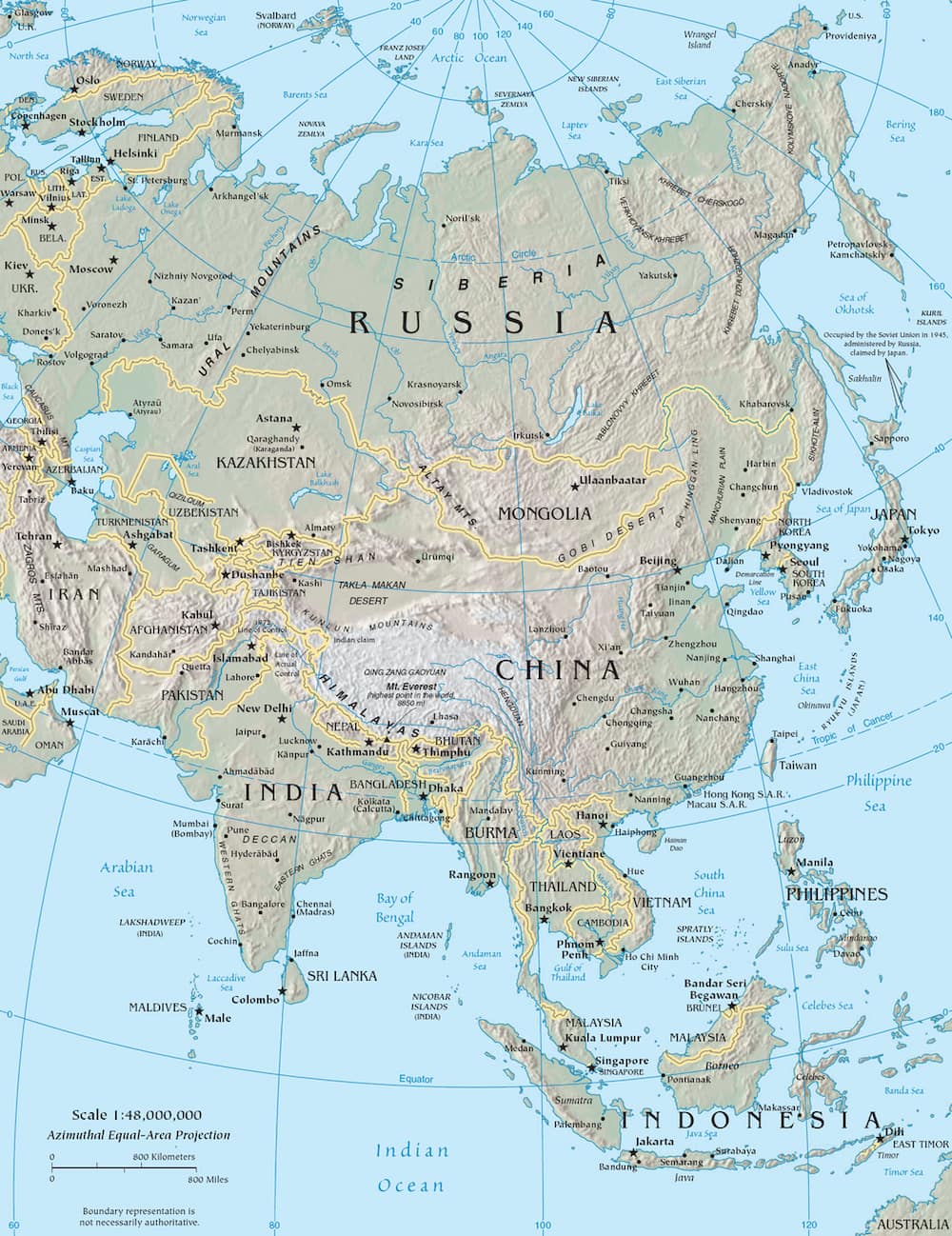
Image 41.05.01 — When the New York Taxi Workers Alliance started, about 60 to 70 percent of cab drivers were South Asian, mainly of Indian, Pakistani, and Bangladeshi heritages. In the 2020s, drivers also included many people of Nepalese, Tibetan, Burmese, Malaysian, and Chinese backgrounds. This map by the Nations Online Project shows the region of Asia where many drivers have come from.
Who are the New York Taxi Workers Alliance (NYTWA) and what are their goals?
How has the gig economy impacted taxi and app-based drivers, and how has the NYTWA organized for workers’ rights?
During the COVID-19 pandemic, how did the NYTWA work to provide support for taxi drivers as front-line workers?
Historical Context for Asian American Labor
In 2020 when the COVID-19 pandemic hit New York City, taxi and app-based ride-share drivers faced additional risks. Serving as frontline workers, these drivers risked exposure to COVID-19, for example, when picking up passengers coming to New York airports from around the world. Thousands of drivers reached out to the New York Taxi Workers Alliance (NYTWA) for guidance and information. The NYTWA stepped up to help while government officials often failed to respond.
The NYTWA formed in the late 1990s in response to the realization that being a taxi driver was one of the most dangerous jobs in the city, as many drivers regularly faced violence and threats of violence. Over the decades, the NYTWA organized labor strikes, supported workers, and organized for better working conditions.
Asian American workers have been crucial to the US economy since they first immigrated to this country in the mid-1800s. Like other workers, they have struggled for better work conditions and higher pay. Additionally, Asian Americans and other workers of color have faced the burden of racism in the US. Asian American workers have long experienced legal discrimination, racism, exploitation, and violence, and they have continued to fight back.
Asian Americans have a long history of organizing as farmworkers, cannery workers, domestic workers, garment workers, and more. Notable campaigns include the Japanese-Filipino sugar strike in Hawaiʻi in 1920; Japanese American dock workers organizing in the International Longshore and Warehouse Union in postwar Hawaiʻi; Filipino and Mexican farm workers establishing the United Farmworkers of America in Delano, California, in the 1960s; and the Asian Immigrant Women Advocates in Oakland, California. There are many other organizations across the US, the national Asian Pacific American Labor Alliance (APALA) was founded in 1992.
Case Study: New York Taxi Workers Alliance (NYTWA)
The New York Taxi Workers Alliance (NYTWA) is a twenty-one thousand-member union that fights for the labor rights, human rights, respect, and dignity of different kinds of drivers. NYTWA’s victories include wage increases, the first regulations of taxi companies, a health and disability fund, and a debt forgiveness program for drivers. In 2011, the NYTWA was chartered (given the official responsibility) to build the National Taxi Workers Alliance as an American Federation of Labor and Congress of Industrial Organizations (AFL-CIO) affiliated union.
The NYTWA was founded in NYC in 1998. They grew out of the Committee Against Anti-Asian Violence (now CAAAV: Organizing Asian Communities), a community organization that formed to respond to anti-Asian violence. CAAAV recognized taxi driving as a dangerous job, so they formed the Lease Drivers Coalition (LDC) in 1992 to organize against the violence drivers faced daily. However, drivers wanted a worker-led independent organization. And so from the LDC, a committee of eighteen people, mostly South Asian drivers, formed the NYTWA.
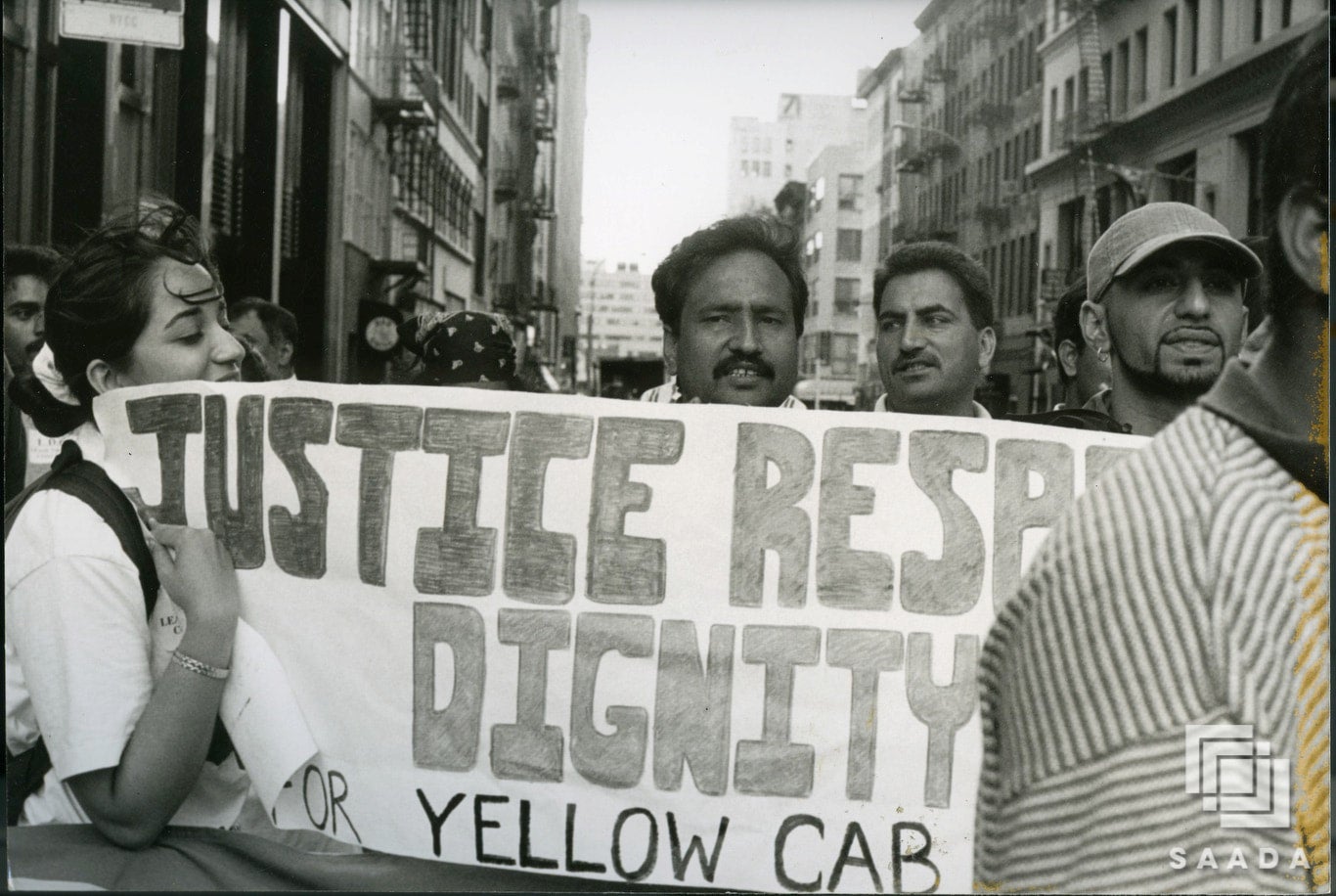
Image 41.05.02 — Taxi drivers holding a banner for “Justice, Respect, Dignity” at the Lease Drivers Coalition’s major motorcade in August 1997 in New York City. An estimated two thousand drivers participated in the protest.
In May 1998 the NYTWA organized a historic one-day strike of twelve thousand taxi drivers in a city that relied heavily on taxis. The strike took place to protest a plan proposed by the New York City mayor that would regulate taxis and increase the costs to drive a cab. This plan would make it easier to suspend taxi drivers’ licenses for minor violations, such as failing to pay a parking ticket. These proposed changes would push drivers out of work. The one-day labor strike established the NYTWA as a powerful union and demonstrated how they could bring the city to a halt by withholding their labor as taxi drivers.
In a remarkable way, the NYTWA was able to unify people across many differences, including a wide range of languages and cultures. While 60 percent of taxi drivers as of 2025 were South Asian, primarily Indian, Pakistani, and Bangladeshi, other cab drivers were Nepalese, Tibetan, Burmese, Malaysian, and Chinese, as well as Caribbean and West African. Ninety percent of all drivers have been immigrants. At the time of the 1998 strike, India and Pakistan were on the brink of nuclear war. Even though many drivers were from these two conflicting countries, the NYTWA was able to unify and organize workers of diverse backgrounds in support of the strike.
More to explore
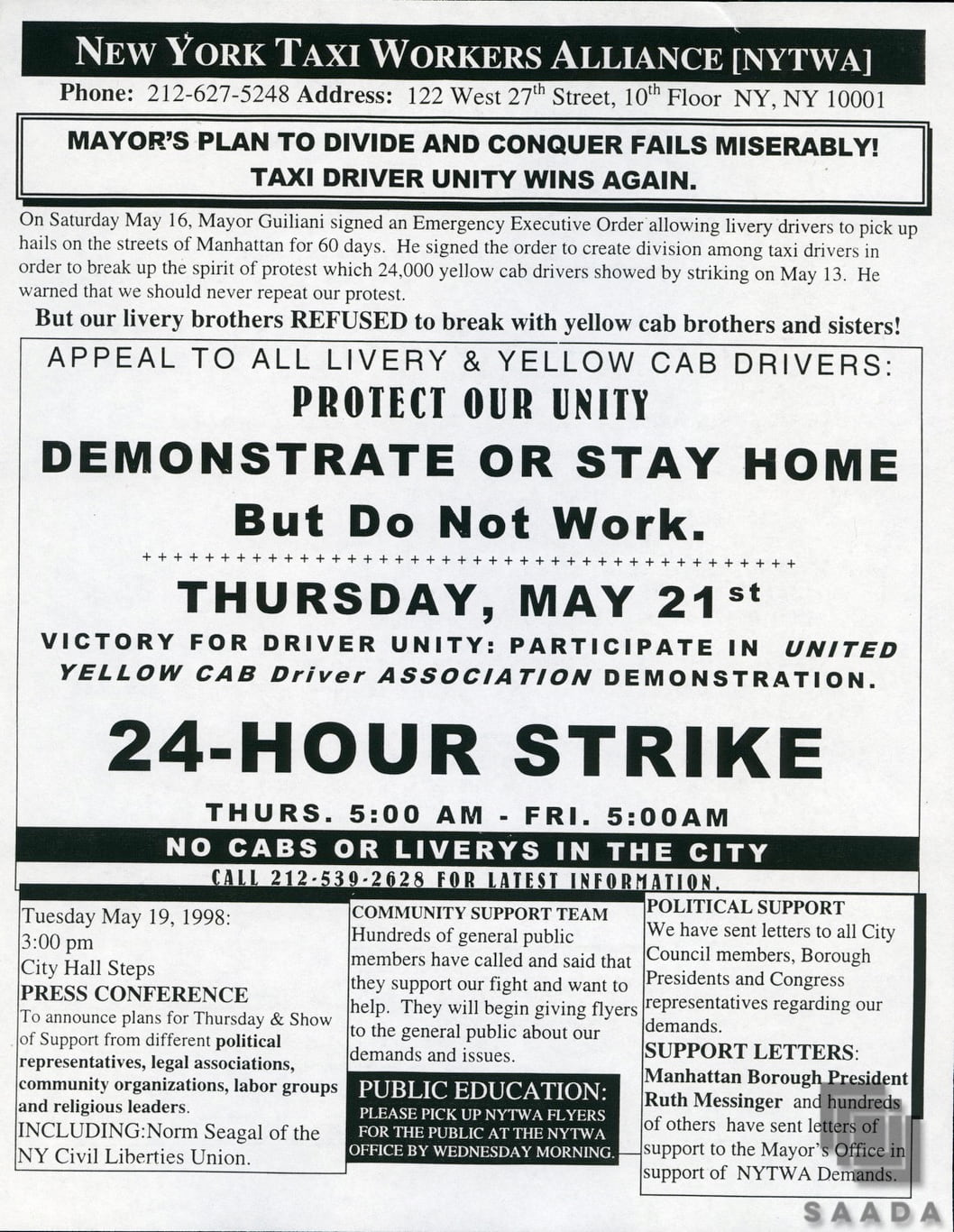
Text 41.05.03a — This flyer, passed out to cab drivers around New York City, announced the second of three The New York Taxi Workers Alliance strikes in 1998. Though the flyers were in English, the word spread in many other languages as well.
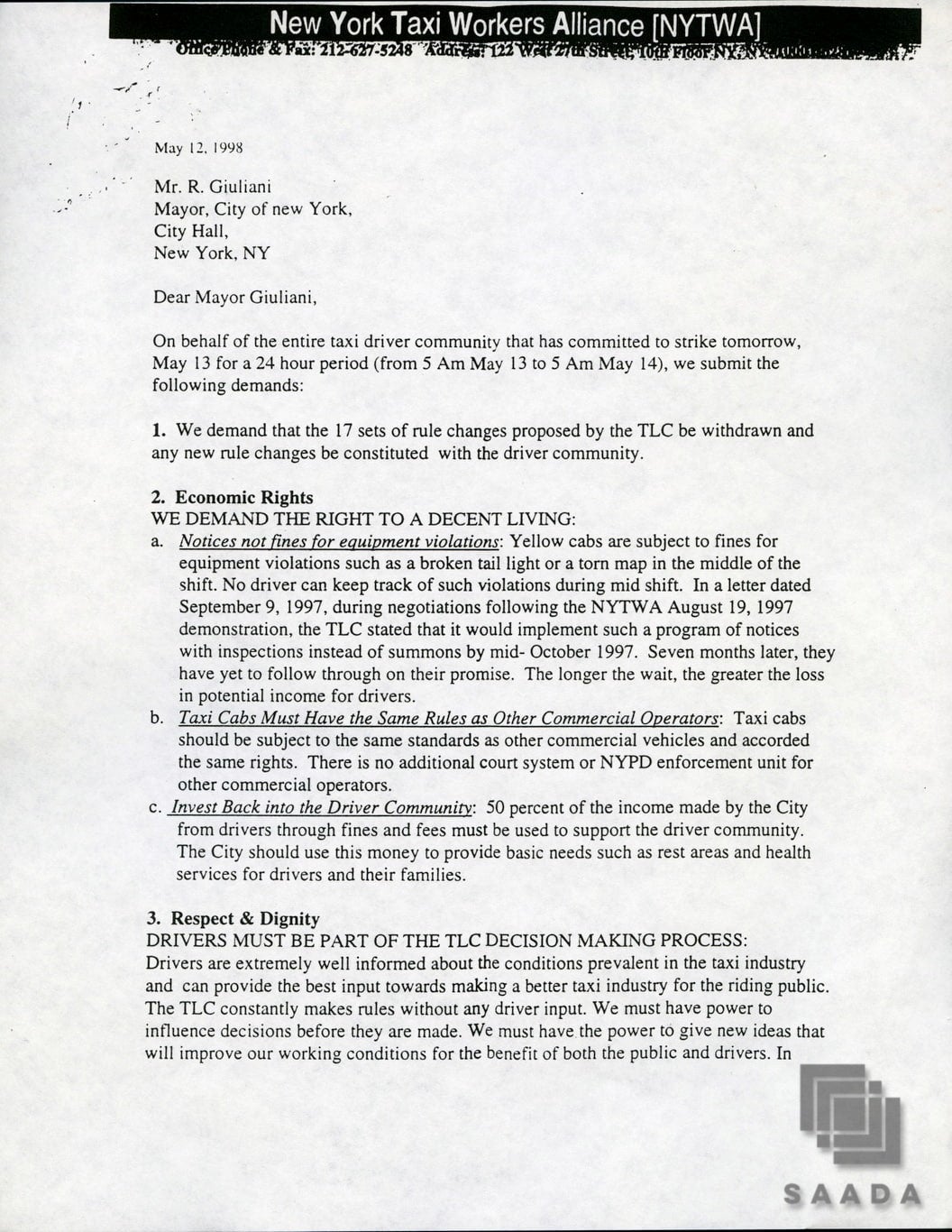
Text 41.05.03b — (Page 1 of 2) This letter to Mayor Rudolph Giuliani from the New York Taxi Workers Alliance (NYTWA) announces the organization’s first strike and list of demands in 1998 from Bhairavi Desai on behalf of the NYTWA.

Text 41.05.03c — (Page 2 of 2) his letter to Mayor Rudolph Giuliani from the New York Taxi Workers Alliance (NYTWA) announces the organization’s first strike and list of demands in 1998 from Bhairavi Desai on behalf of the NYTWA.


Text 41.05.03a — This flyer, passed out to cab drivers around New York City, announced the second of three The New York Taxi Workers Alliance strikes in 1998. Though the flyers were in English, the word spread in many other languages as well.
Text 41.05.03b — This page from a letter to Mayor Rudy Giuliani from the NYTWA announces the organization’s first strike and list of demands in 1998 from Bhairavi Desai on behalf of the New York Taxi Workers Alliance.
Labor Organizing in the Gig Economy
When Uber came to New York City in 2011, the company initially seemed to be a good opportunity for app-based ride-share drivers. Uber drivers were making thirty-eight dollars an hour, before taxes. However, as more app-based drivers joined, it became harder to earn a living as an Uber or Lyft driver. After adding up the costs for the car, gas, insurance, and driving violations–including parking tickets–it turned out that Uber or Lyft drivers took home very little pay.
Moreover, when Uber and Lyft drivers flooded NYC streets, earnings began to decrease for traditional taxi drivers. The yellow cab has long been a symbol of the city, and for years taxi drivers made an adequate income. By the 2020s, most taxi drivers struggled to pay rent and put food on the table, even though they work twelve hour days, six days a week.
Javaid Tariq, NYTWA organizer and founding member, explains:
[when] there were about 13,000 Yellow Cabs, 20,000 for-hire-vehicles (FHVs), and 7,000 plain cabs, [it] was more or less working. But as they kept adding more cars, drivers were making less money, but the company was making the same profit. When the number reached around 120,000 cars in 2014, we [NYTWA] went to the city and introduced a bill to protect the cab drivers. 3
This example shows one way the NYTWA responded to the problems facing drivers. Additionally, the huge rise in the cost of “medallion” licenses (city permits that give drivers the right to operate a taxi cab) created a major problem for taxi drivers. The cost of a taxi medallion rose from two hundred thousand dollars in 2002 to about one million dollars by 2014. A New York Times investigation found that some powerful industry leaders artificially inflated the price of taxi medallions.
Due to the inflation in prices, taxi drivers found their incomes dropping and their debt growing. Meanwhile, bankers, brokers, investors, debt collectors, and some officials in the city government were making millions. Mohammed Hoque worked very long hours every day, yet earned only thirty thousand dollars that year and owed 1.7 million dollars for his taxi medallion.
How could he pay off his debt when he earned so little? How could he make more money driving when he already worked twelve hours a day? More than 950 medallion owners have filed for bankruptcy and lost their medallion licenses. New York Times journalist Brian Rosenthal observed that, “[Mr. Hoque’s] cab was supposed to be his ticket to money and freedom, but it felt more like a prison cell.” 4
Reflection questions
How can ordinary people fight back to improve the conditions of their work? What does labor organizing look like?
In response to these growing problems faced by taxi drivers, the NYTWA could have opposed Uber and Lyft drivers but instead refused to divide workers against each other. It decided to employ a unified approach. As NYTWA’s Executive Director Bhairavi Desai says: “Uber [meaning the company executives] starves the Uber drivers so they can starve the taxi driver. So both groups of drivers need to stand together against this business model.” In 2019 the NYTWA had twenty-one thousand members, and about ten thousand of them were Uber or Lyft drivers. 5
The problems facing drivers did not just happen by chance. The larger economic and political system called “neoliberalism” produced these labor problems
More to explore
The NYTWA has organized many types of campaigns to improve working conditions for drivers. In 2021, for example, the NYTWA had two big victories—one for taxi drivers and another for app-based ride-share drivers.
First, taxi drivers went on a hunger strike (refusing to eat) in order to demand debt relief from the City of New York. For Richard Chow, a Chinese American driver, it was personal. His brother Kenny Chow was one of several drivers who died by suicide because he saw no way out of the massive debt he had accumulated by purchasing an over-priced medallion license. On the fifteenth day of the hunger strike, the NYTWA won a major loan forgiveness program. Taxi medallion owners would now have to pay back far less than before, a maximum of 170,000 dollars, and the balance “forgiven” or canceled. The average loan debt at the time was six hundred thousand dollars.
Second, the NYTWA worked with New York City politicians to secure a 5.3 percent pay raise for all Uber and Lyft drivers. This raise resulted in an annual salary increase of about 3,800 dollars.
Responding to the COVID-19 Pandemic: Drivers as Frontline Workers
Javaid Tariq describes the early days of the pandemic for taxi drivers while New York was one of the epicenters of the disease in the US:
Early in the pandemic, one driver in New York picked up a passenger from the airport. That passenger was coughing. The pandemic was on everyone’s mind. The driver worried he might have COVID and quarantined in his home. …[After a week], he went to the hospital and two days later, he died. 6
The NYTWA moved quickly to respond to the pandemic. They had to figure out how to address the urgent and enormous problems facing drivers as frontline workers across the entire city. Many members risked getting sick from COVID-19. Drivers also lost work and their source of income as nearly everyone turned to shelter in place during the height of the pandemic. The NYTWA started to alert all the drivers: “We did e-blasts, phone calls—you need protection, gloves, hand sanitizer, masks. There was no protection for the drivers. 7
Tariq recalled: “In the first two to three months, we got over ten thousand calls from members. Every two to three days, another driver died. We got information from our members and found that sixty-two drivers died from COVID. We asked the city for the number of drivers who died of COVID in New York City. They couldn’t tell us. We started our own survey and worked with ACLU California on this project.” 8
When the city did not provide clear information and guidance, NYTWA’s Executive Director Bhairavi Desai wrote a thirty-page “Resources Guide for Drivers and Families to Get Through Covid-19 Pandemic.” The guide provided detailed information on accessing health care, rental assistance, and food. It also provided information about health safety while driving, unemployment insurance, and stimulus checks. It also addressed immigration rights and race discrimination since the vast majority of drivers were immigrants from Asia, Africa, and other countries.
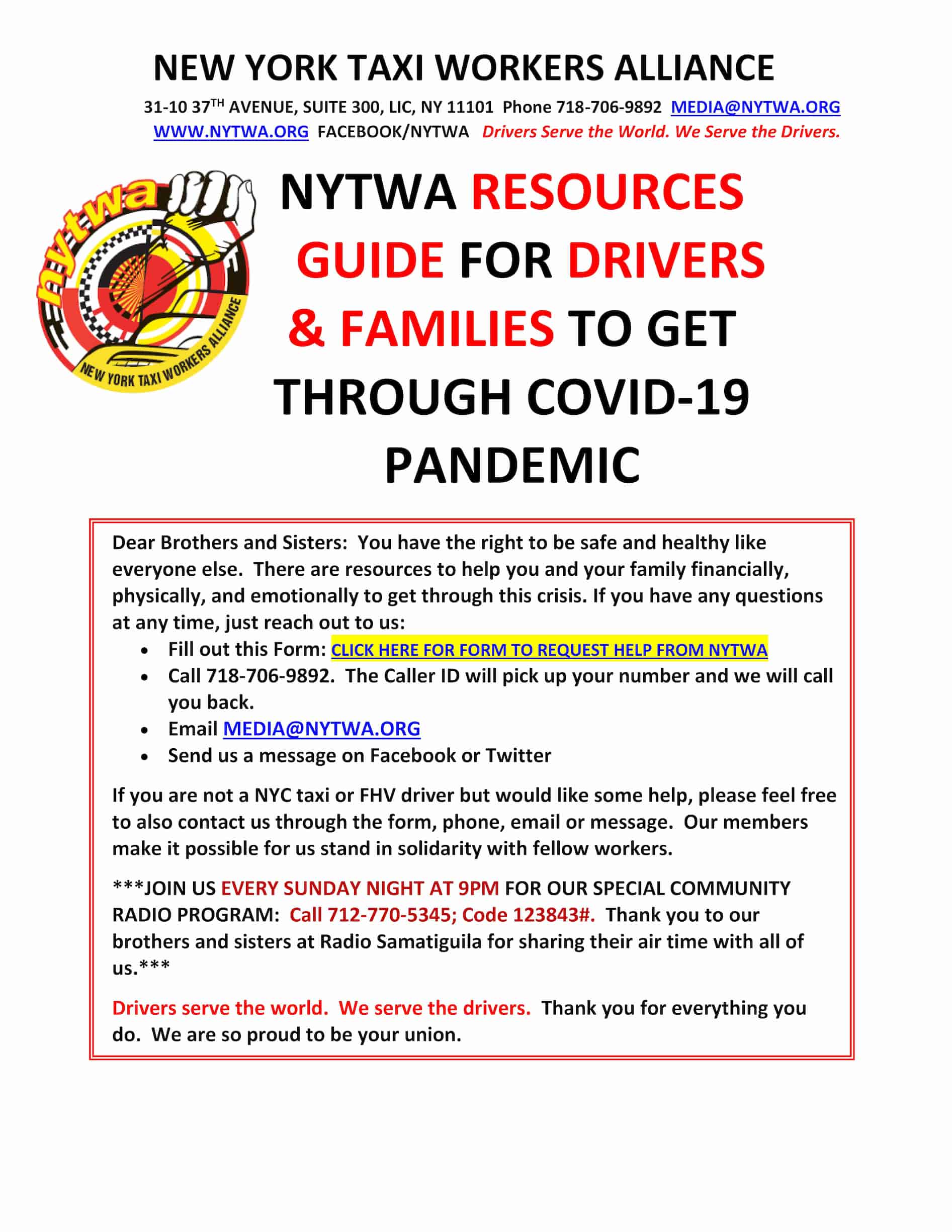
Text 41.05.05 — During COVID-19, thousands of taxi drivers turned to the New York Taxi Workers Alliance (NYTWA) for help. In response, the NYTWA created this Resource Guide to provide information on accessing health care, rental assistance, food, unemployment insurance, stimulus checks, and ways to deal with discrimination.
The NYTWA also made themselves available via email, phone, and a Google Forms link. They offered a weekly community radio program every Sunday night and provided virtual workshops with lawyers twice weekly. What difference do you think the resource guide, workshops, and drop-in helplines had on drivers?
Learning about the New York Taxi Workers Alliance teaches us about the remarkable work of one organization to resist the gig economy’s harmful impact on workers. It also helps us to better understand the past and present struggles facing Asian American workers. By learning about how fighting for economic and racial justice can make important improvements for workers, we can then apply these lessons to our own communities.
Glossary terms in this module
frontline workers Where it’s used
Workers who directly serve the public.
strike Where it’s used
Traditionally, a strike is when workers collectively refuse to work to achieve certain goals. In the context of the student strike, students refused to go to class, held educational workshops, and organized demonstrations.
Endnotes
1 Brian M. Rosenthal, “‘They Were Conned’: How Reckless Loans Devastated a Generation of Taxi Drivers,” The New York Times, May 19, 2019, https://www.nytimes.com/2019/05/19/nyregion/nyc-taxis-medallions-suicides.html.
2 Diane C. Fujino, “Drivers on the Frontlines: The New York Taxi Workers Alliance, Neoliberalism, and Global Pandemic—An Interview with Javaid Tariq,” in Contemporary Asian American Activism: Building Movements for Liberation, edited by Diane C. Fujino and Robyn Magalit Rodriguez (University of Washington Press, 2022), 138–139.
3 Fujino, “Drivers on the Frontlines,” 134.
4 Rosenthal, “‘They Were Conned’.”
5 Bhairavi Desai, “Gig Economy Drivers Strike: Uber Has Built its $90 Billion Empire on an Anti-Worker Model,” Democracy Now!, May 9, 2019, https://www.democracynow.org/2019/5/9/gig_economy_drivers_strike_uber_has.
6 Fujino, “Drivers on the Frontlines,” 142.
7 Fujino, “Drivers on the Frontlines,” 142.
8 Fujino, “Drivers on the Frontlines,” 142–143.