





Man in suit jacket stands with raised fist before group of Asian Americans. They stand behind “It’s Not Fair” banner and carry signs and U.S. flags.
Module 3: To Do Something or Nothing: The Decision to Take Action
Did the killing of Vincent Chin and the activism it sparked change what it means to be Asian American?
Before the terrible murder of Vincent Chin and the minor sentence of probation for the two white men who killed him, Asian Americans were rarely mentioned in schools, media, business, or government, especially not in relation to anything remotely considered “American.” Because they were so unseen, Asian Americans were even invisible to each other. The different Asian American ethnic groups and their cultures were disconnected except for one annual “Far Eastern Festival” sponsored by the City of Detroit to highlight the food and cultures of different communities. However, at the time, there was no history of joint advocacy or standing together against racism.
All that changed after the injustice of Vincent Chin’s murder. This module explores how the case brought together previously unconnected people to form an organized movement to seek justice for Vincent Chin.
What prompted people to come together when they did not know each other, knew little about each other’s backgrounds and cultures, and did not even speak the same language at home?
What steps did these previously unconnected people take in order to form an organization, and what were they able to accomplish?
How did people in Vincent Chin’s family and community respond to the perceived injustice of his death? What fears and concerns did people have?
Asian Americans: Invisibly Present
In 1982, when Vincent Chin was killed, the racial climate in the US and Detroit in particular was intensely anti-Japanese. Nearly every Asian American sensed that what happened to Vincent could have happened to themselves or their loved ones. The 1980 US Census counted 814,000 Chinese Americans, making up the largest Asian ethnicity, yet they did not comprise even 0.5 percent of the US population.
As a combined group, Asian Americans totaled 3.8 million, or 1.6 percent of all Americans, but they were concentrated in ethnic communities such as in Chinatowns and Little Tokyos, or the state of Hawaiʻi. In most of America, including in Detroit and the industrial Midwest, Asian Americans were disregarded and unrecognized by other Americans.
In spite of their small numerical presence, Asian Americans had a long but much ignored history in the United States. Detroit’s Chinese Americans had been part of city life since the late 1800s, and by the time of the industrial revolution and the rise of auto assembly lines in the early 1900s, more than three hundred Chinese-owned laundries were recorded.
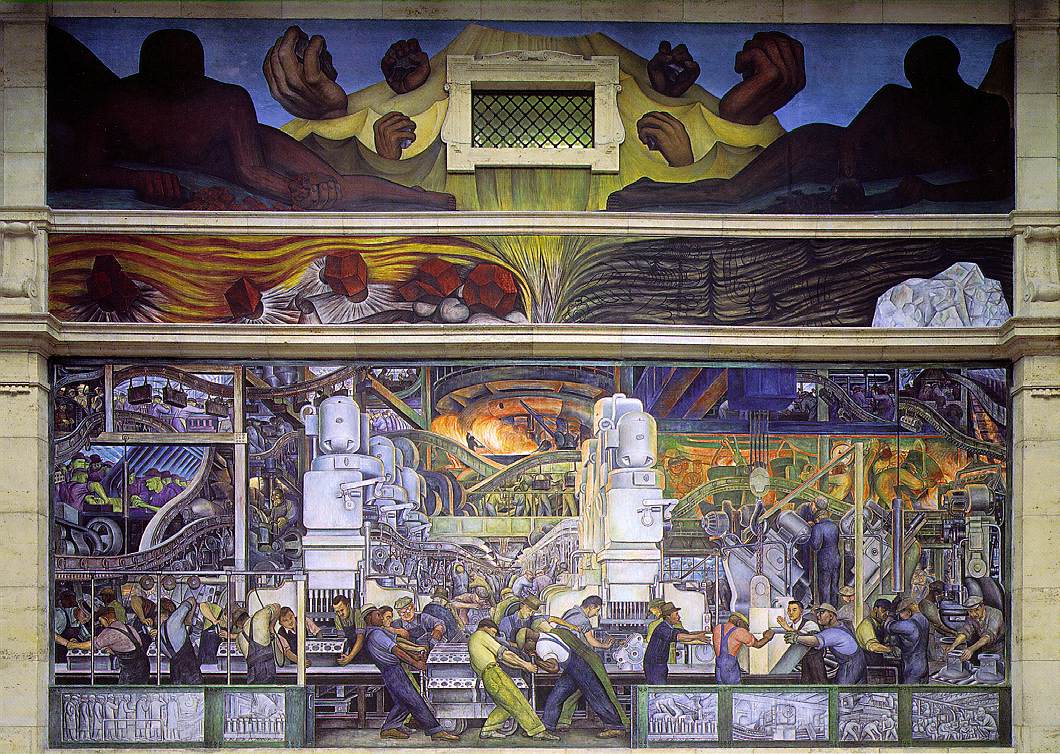
Image 43.03.01 — Diego Rivera’s iconic 1930s Detroit Industry Murals depict the evolution of Detroit’s industry and labor. Though few Asians worked in Detroit’s high-paying auto industry, a sole Asian American is depicted (lower right) working for Ford Motor Company.
Detroit also had a small, but established Japanese American community. In fact, one of the first and only Asians to work in the well-paying auto industry in its early boom years was a Japanese American engineer who had boldly knocked on the door of Henry Ford’s home seeking employment. By the latter half of the twentieth century, Filipino, Korean, Indian, Vietnamese, and other Asian ethnicities made the Detroit area their home as well.
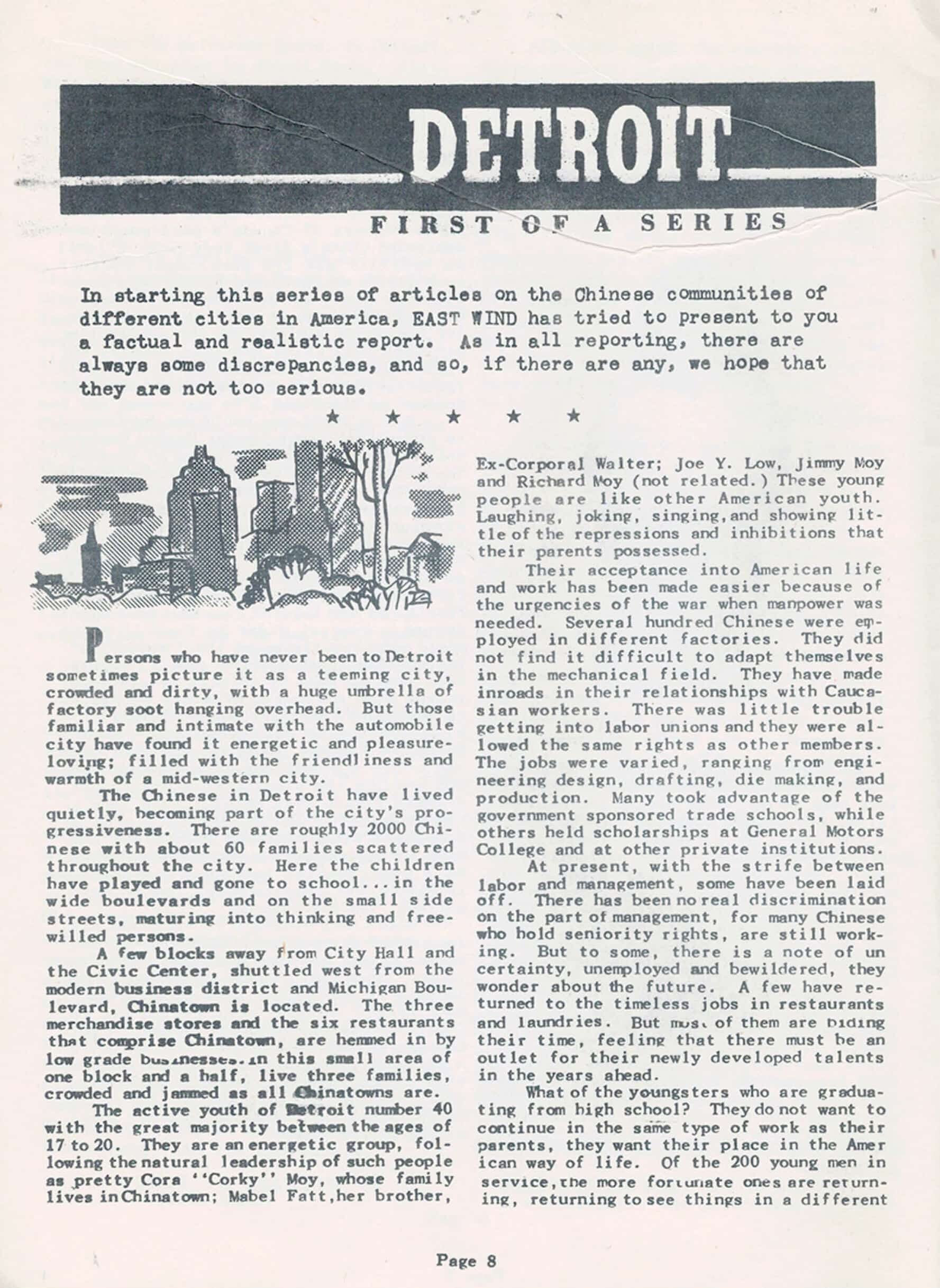
Text 43.03.02 — Second-generation Detroiter Mabel (Fatt) Lim, wrote this article in the late 1940s for her church newsletter, describing the dynamic Chinese American community. Mabel and Ray Lim, her husband, were active volunteers with the 1980s Justice for Vincent Chin campaign.
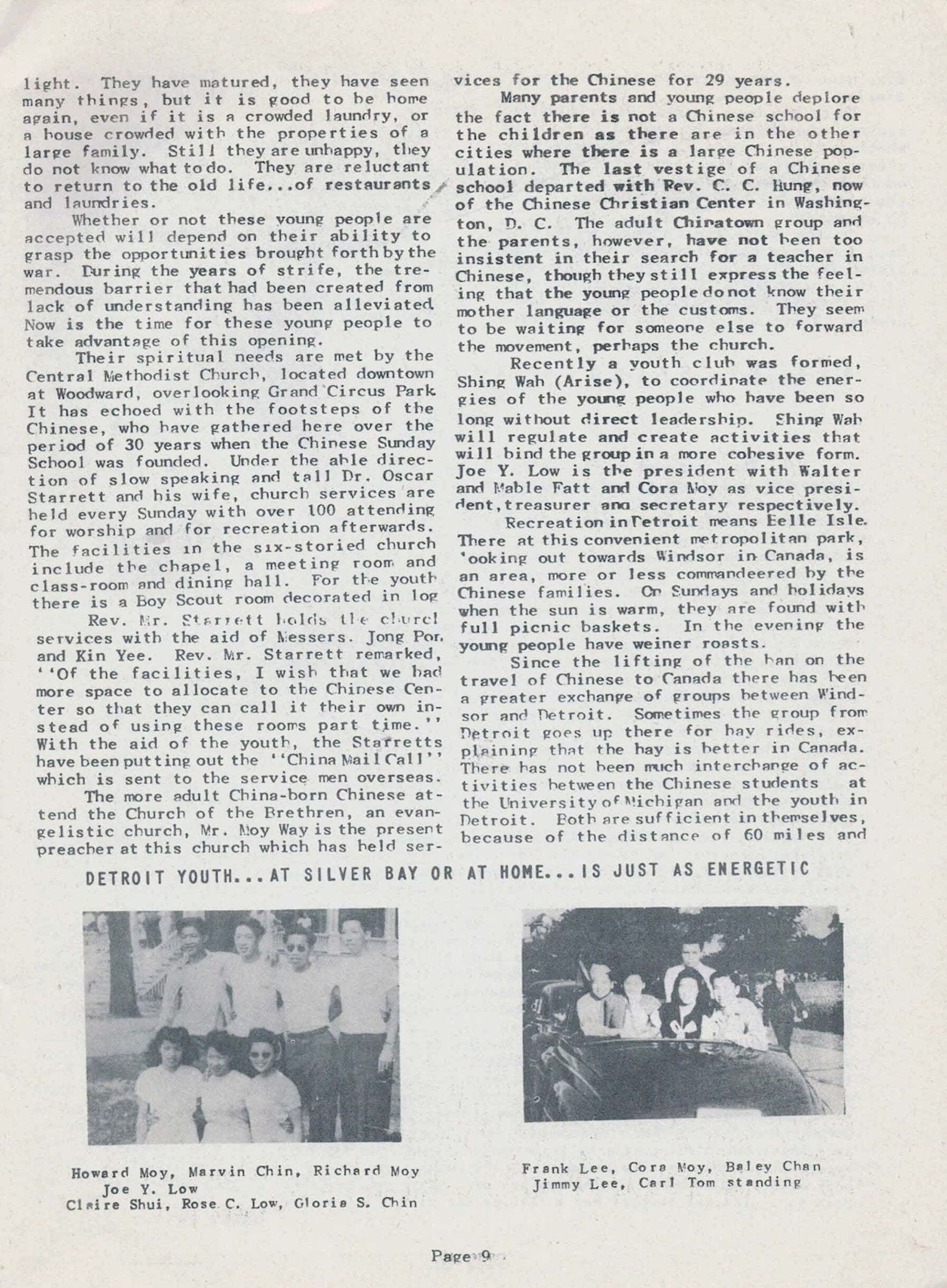
Text 43.03.02 — Second-generation Detroiter Mabel (Fatt) Lim, wrote this article in the late 1940s for her church newsletter, describing the dynamic Chinese American community. Mabel and Ray Lim, her husband, were active volunteers with the 1980s Justice for Vincent Chin campaign.
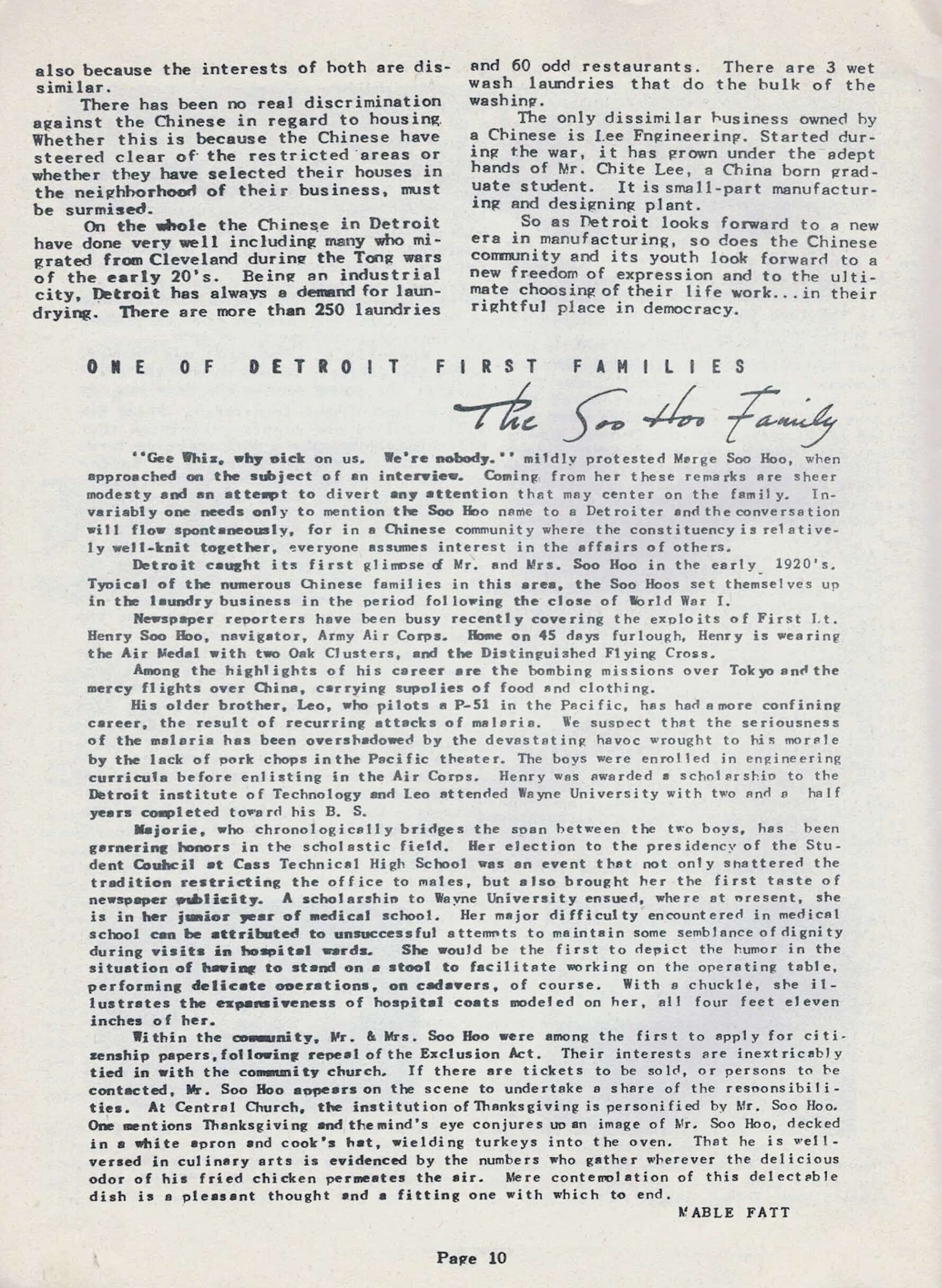
Text 43.03.02 — Second-generation Detroiter Mabel (Fatt) Lim, wrote this article in the late 1940s for her church newsletter, describing the dynamic Chinese American community. Mabel and Ray Lim, her husband, were active volunteers with the 1980s Justice for Vincent Chin campaign.



Building Pan-Asian Solidarity
After Vincent Chin’s killers were sentenced to probation, the loosely-connected and numerically-small Asian American ethnic groups recognized that if they stayed separate, they would continue to be ignored. But if they united in solidarity, their voices would be louder and stronger, amplifying their outcries against injustice. Then they would have a greater chance of breaking free from their invisibility.
The first pan-Asian community meeting in Detroit had three people; thirty came to the next; then one hundred; a few meetings later, two hundred. In attendance were liberals, conservatives, and radicals, youths and seniors, scientists and businessmen, office workers and cooks, waiters and laundry workers.
Initially, there were Chinese, Japanese, Filipinos, and Koreans; Christians and Buddhists; Cantonese- and Mandarin-speakers; American-born and immigrants; as well as people from many other walks of life. Many meetings were held at the Golden Star restaurant in Ferndale, where Vincent had been working part-time as a waiter on the night he was attacked.
Lily Chin, Vincent’s grieving mother, often attended the meetings. Sometimes her sobs echoed through the room. When some of the lawyers at an early meeting said there was nothing that could be done to change the sentence, one community member asserted that, regardless, Asian Americans must tell the world that it was wrong to give the killers a free pass for killing an Asian person.
After this remark, Lily Chin stopped sobbing, stood up, and spoke in a shaky but clear voice: “We must speak up. These men killed my son like killing an animal. But they go free. We must tell the people, this is wrong.” 1
In those days, when few Asian Americans spoke up about anything because they assumed they would be ignored, Vincent’s mother, in her grief, wanted the world to know that what happened to her son was wrong. Lily Chin spoke out in a way that few Asian Americans did.
Her courageous stand prompted Detroit-area Asian Americans to create a new organization that could advocate for Americans of Asian ancestry and coordinate a community response, which would include issuing petitions and legal actions, raising money, and organizing a campaign to show the world the injustice of Vincent Chin’s murder.
Redefining Inclusivity and Justice in America
On the night of March 31, 1983, two weeks after Vincent’s killers were sentenced to probation, more than one hundred individuals and representatives of numerous pan-Asian organizations from the greater Detroit area came together and met almost until midnight, and they planned on creating a new organization to fight for civil rights.
American Citizens for Justice, also known as ACJ, marked the formation of an Asian American grass-roots advocacy effort with a national scope, bringing together Chinese, Taiwanese, Japanese, Filipino, and Korean groups, as well as professional associations, cultural groups, church organizations, and women’s groups.
The community of Asian Americans overwhelmingly voted for an inclusive vision that would stand up for justice for all Americans, not solely Asians, and they therefore chose the name “American Citizens for Justice.”
The new pan-Asian American organization drafted its statement of principles.
ACJ believes that:
- All citizens are guaranteed the right to equal treatment by our judicial and governmental system.
- When the rights of one individual are violated, all of society suffers.
- Asian Americans, along with many other groups of people, have historically been given less than equal treatment by the American judicial and governmental system. Only through cooperative efforts with all people will society progress and be a better place for all citizens.
With ACJ’s inclusive principles of equal justice for all, especially marginalized people, the more established civil rights organizations of the majority Black city of Detroit welcomed the new voice of Asian Americans. The Detroit Area Black Organizations (DABO) headed by Horace Sheffield II, a leading civil rights and labor leader, helped ACJ get meetings with the judge and prosecutor, who had both been postponing meetings for weeks.
A number of other prominent groups joined to support the brand new Asian American organization, including the Detroit NAACP, Urban League, Anti Defamation League of B’nai B’rith, members of the Detroit City Council, the Detroit Roundtable of Christians and Jews, Arab Americans of Michigan (who comprised the largest population of Arab people outside of the Middle East), Latinx communities, and the West Indian Association.
ACJ’s first mandate was to obtain justice for Vincent Chin. In the weeks and months that followed, many people stepped forward to volunteer to assist in the effort.
The newly formed ACJ immediately had to address three major areas: 1) legal strategy, to obtain a reconsideration of the sentence of probation; 2) organizing local and national actions, from petition drives, letter-writing campaigns, and pickets in front of the courthouse to raising money; and 3) communications outreach to the media, other Asian Americans, and the general public in order to bring the issues surrounding Vincent Chin’s case to officials and to make a dent in the nonexistent awareness about Asians in America.
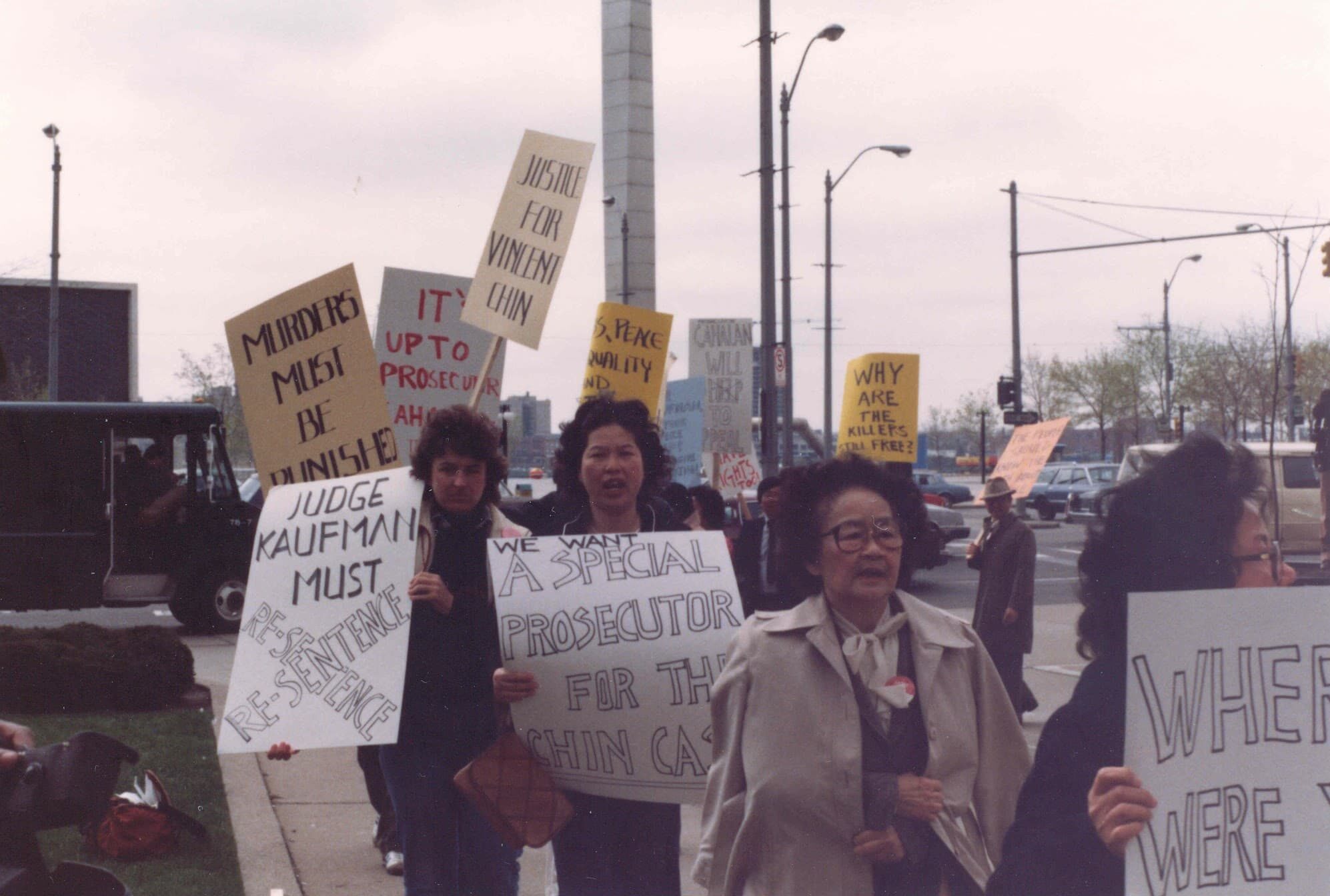
Image 43.03.03 — Throughout the Asian American community’s multipronged legal efforts, American Citizens for Justice (ACJ) organized outspoken, out-and-proud pickets in front of the courthouse to draw attention to the devaluation of Vincent Chin’s life and to call for a fair rehearing.
Legal Strategy
First, ACJ, through its attorney Liza Chan, attempted to persuade the sentencing judge, Charles Kaufman, to reconsider his sentence of probation and fines. ACJ argued that the judge did not have important facts and was misled by defense attorneys who falsely blamed Vincent Chin for the fight that resulted in his death. Chan presented a number of briefs for the judge, for example, pointing out that no prosecutors were present at the sentencing to refute this misrepresentation. But the judge only further justified his sentence, again telling reporters, “These were not the kind of men you send to jail, you fit the punishment to the criminal, not to the crime.” 2
Second, ACJ also explored the long-shot possibility of appealing the sentence to the Michigan Court of Appeals in order to overturn Kaufman’s sentence.
As ACJ’s legal team obtained police and court records to reconstruct the events leading to Vincent Chin’s death, it soon became apparent that the police, prosecutors, and courts had made numerous errors and omissions at every level of the criminal proceedings in this case. For example, the police had never interviewed eyewitnesses. Officials seemed eager to cover up their blunders and incompetence. The sentencing judge, Charles Kaufman, even skipped out on a scheduled meeting by slipping out a back door and sending his clerk out to say he had left for a vacation.
Even though many Asian Americans suspected that racism played a role in Vincent Chin’s murder and the sentencing, ACJ initially refrained from calling out racism because mainstream American society was so unaware of the existence of Asian Americans, let alone anti-Asian racism. However, ACJ’s attorneys and news reporters located witnesses who testified under oath that they overheard insults that one of the white perpetrators made to Chin, such as, “It’s because of you motherf***ers that we’re out of work.” 3 Witnesses also recalled that the two white men had hired a man in the neighborhood to help them “get the Chinese.” 4
Lastly, ACJ looked into seeking a federal civil rights investigation by the US Department of Justice. With new eyewitness accounts in hand, the FBI began to take an interest in the case, and many in ACJ concluded that Vincent Chin’s civil rights had been violated because of his race. As part of its legal strategy, ACJ called for a new, federal review of Vincent’s case.
Organizing Strategy
To capture the mounting frustration of the community and to bring attention to the campaign for Vincent Chin, the ACJ decided to hold a citywide demonstration on May 9, 1983, in downtown Detroit, the site of many historic protests. ACJ had conducted a number of noisy picket lines by city hall, but there had never before been a protest in Detroit organized by the Asian American community.
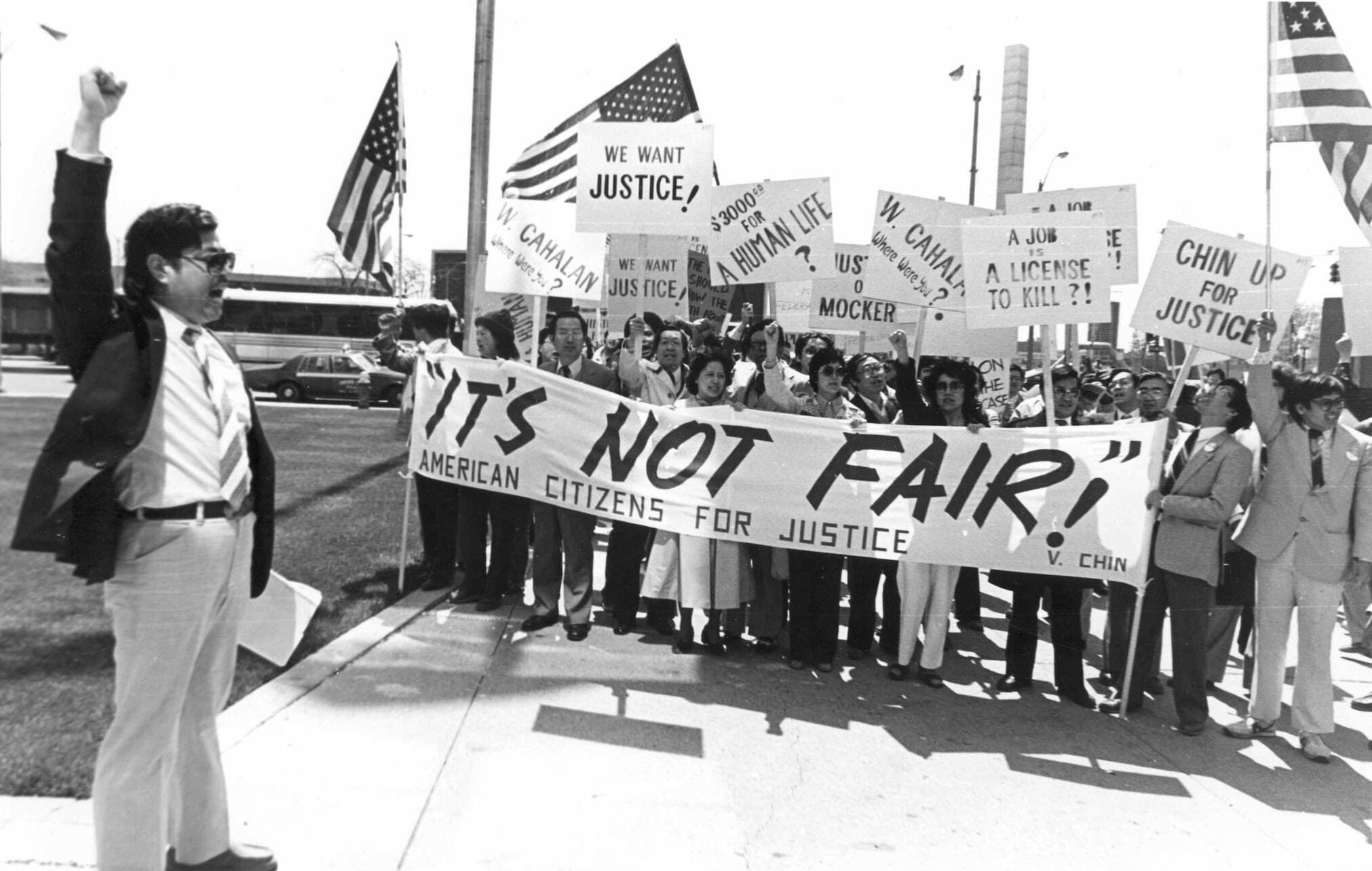
Image 43.03.04 — On May 9, 1983, with raised fists, Detroit’s Asian Americans led a region-wide demonstration, declaring, “It’s not fair,” the last words of Vincent Chin, to protest the probationary sentence for the two white assailants who killed him with a baseball bat.
The demonstration committee was headed by three senior scientists at the General Motors Tech Center. The rally events were timed to the minute, and the outpouring of support was unprecedented. Waving American flags and placards that demanded equal justice, hundreds of professionals and housewives marched alongside waiters and cooks from Chinese restaurants across the region. Restaurant owners closed down during the busy weekday lunch rush to allow everyone, including their own families, to join the protest. Children in strollers and seniors in wheelchairs participated. Chinese, Japanese, Koreans, and Filipinos marched in pan-Asian unity.
The city’s major African American and religious organizations, local politicians, and even the UAW gave statements of support. At the rally’s emotional end, Lily Chin appealed to the nation. Through her tears, she said haltingly, “I want justice for my son. Please help me so no other mother must do this.” 5 Overcome with her grief, she fainted and an ambulance was called.
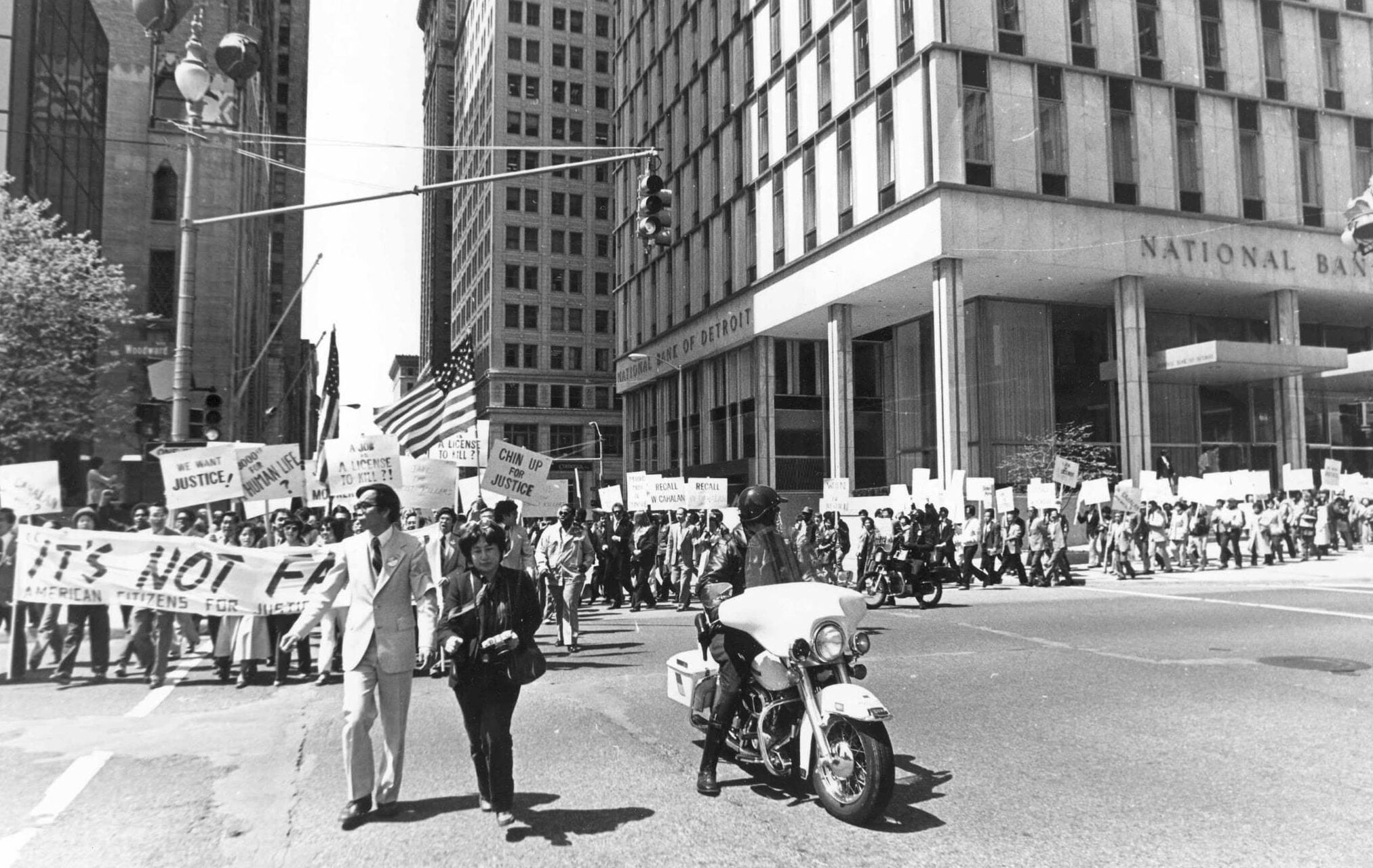
Image 43.03.05 — Detroit-area Asian Americans lead a historic civil rights protest march through downtown to the Federal building to condemn the probation sentences of Vincent Chin’s killers and to demand a federal civil rights investigation.
The May demonstration launched ACJ’s national call for a federal, public prosecution of Vincent Chin’s killers for violating Chin’s civil rights. The demonstrators hand-delivered a petition with three thousand signatures seeking a federal civil rights investigation to US Attorney Leonard Gilman. In mid-June, Lily Chin went to Washington, DC, with ACJ representatives to meet with officials at the US Department of Justice (DOJ) Civil Rights division to discuss the possibility of a federal civil rights prosecution.
Congressman Norman Mineta, a Japanese American from San Jose, California, and Black representatives George Crockett and John Conyers from greater Detroit, all supported ACJ’s call for a civil rights prosecution. In July 1983, the Justice department announced that the FBI would begin its investigation to determine if Vincent Chin’s civil rights were violated. It marked the first time the US DOJ took up a civil rights case brought forward by the Asian American community.
Communications, Media, and Public Education
With each step of the legal process, ACJ consulted first with Lily Chin and then kept the community, the media, and the public informed. One of the challenges was how little most Americans knew about Asian Americans. The mission became urgent: educate the media and public quickly, in clear sound bites, about the existence and humanity of Asian Americans as part of this democracy. This would help the general public unlearn what they thought they knew about “Orientals”—an outdated term for Asian Americans.
When ACJ called its first news media conference, hand-delivering press releases that were written on a typewriter, every major local news outlet came because it was exciting news to see Asian Americans coming together to protest injustice. The reporters’ questions revealed the depths of their ignorance: Who are you people? Where are you from? Are you all new arrivals to America? Do you know how to speak English?
Most communication with the media and government officials started with “Asian Americans 101” to disrupt the stereotypes and lack of fundamental knowledge about Asian American communities, providing basic information, narrative, and context so that they could accurately convey the pain and outrage felt by Lily Chin and Detroit’s Asian Americans against the climate of hate.
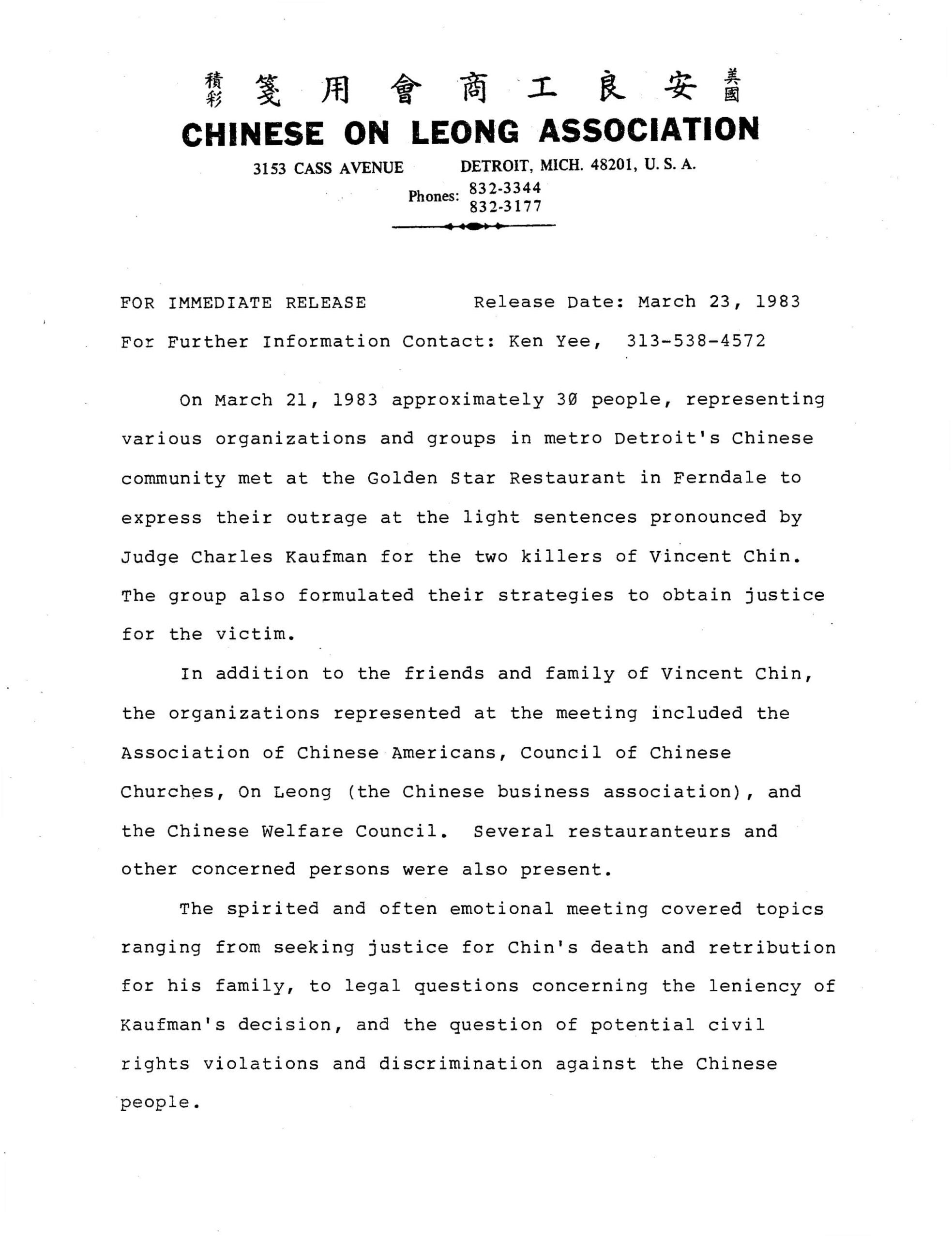
Text 43.03.06 — This first press release from the Asian American community protested the injustice to Vincent Chin when his killers received probation was issued before American Citizens for Justice was established, but that did not stop the community from speaking out.
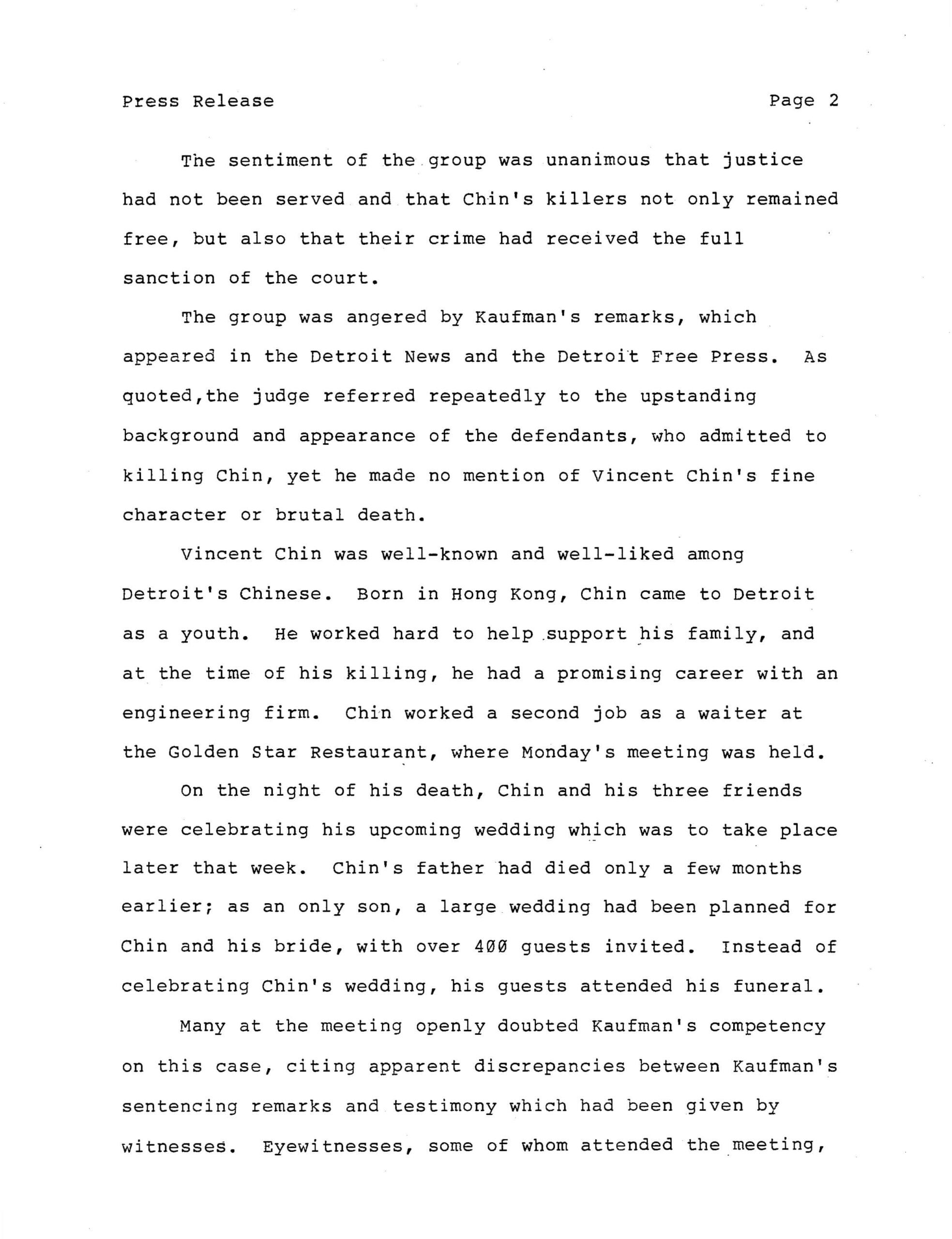
Text 43.03.06 — This first press release from the Asian American community protested the injustice to Vincent Chin when his killers received probation was issued before American Citizens for Justice was established, but that did not stop the community from speaking out.
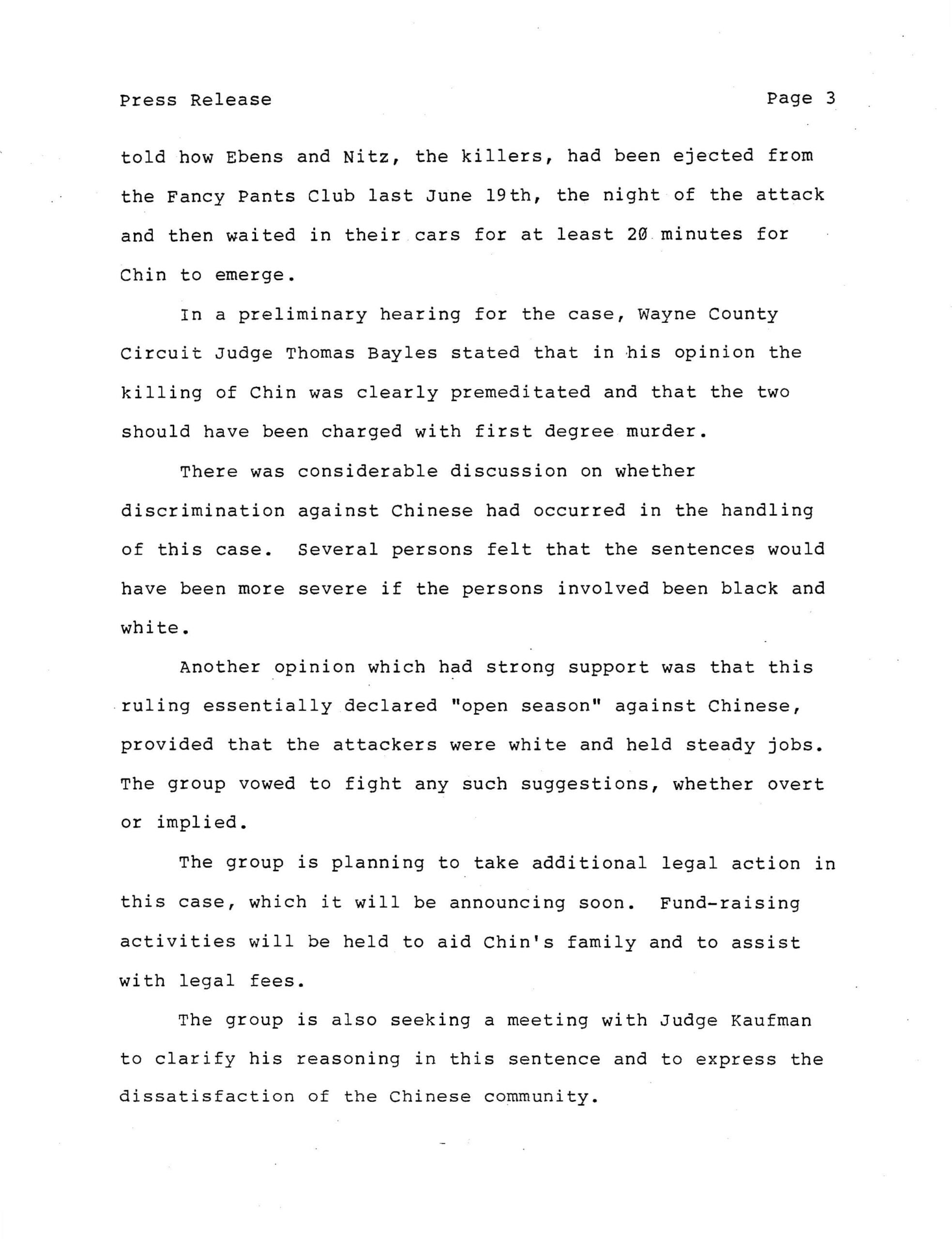
Text 43.03.06 — This first press release from the Asian American community protested the injustice to Vincent Chin when his killers received probation was issued before American Citizens for Justice was established, but that did not stop the community from speaking out.



Conclusion
Through its community outreach, media, and public education efforts, ACJ offered an analysis of anti-Japanese and anti-Asian hate. In doing so, the Vincent Chin movement first articulated how Asian Americans were being racially targeted, blamed for the ills of the modern American economy, and how this was part of a larger pattern and history. ACJ gave a name to anti-Asian violence, linking it to the same pattern of scapegoating, exclusion, and ethnic cleansing that was integrated into federal law more than one hundred years earlier. ACJ made clear that such violence was a present-day phenomenon that should concern all people. ACJ set the framework for Asian American organizing nationally, and it took the first step toward making Asian Americans visible in domestic and international economic, political, and social policy contexts.
Glossary terms in this module
civil rights Where it’s used
Personal rights guaranteed and protected by the US Constitution and laws, which include protection from unlawful discrimination, including on the basis of race, national origin, disability, age, religion, gender, or sexuality.
pan-Asian Where it’s used
A term used to describe the political alliance of people and groups from different Asian ethnic backgrounds.
probation Where it’s used
The release of an offender from detention, followed by a period of supervision. Probation is given as an alternative to prison.
scapegoating Where it’s used
The act of wrongly assigning blame to a person or group of people, typically those whose social status makes them vulnerable to violence and makes addressing or correcting the error very challenging.
solidarity Where it’s used
A political, cultural, and collective stance that recognizes the mutual responsibility and support that is necessary to achieve change. Solidarity taps into the power in numbers and considers the collective interests of communities.