





Footage of people standing around yellow car. Men take turns swinging sledgehammer at car. News anchor reports domestic anger at Japanese car makers.
Module 2: Economic Crises, the Politics of Blame, and 1980s Detroit
Did the killing of Vincent Chin and the activism it sparked change what it means to be Asian American?
Children are often taught at a young age that it is wrong to blame others for their mistakes and misdeeds, that they should shoulder responsibility for their actions. Yet the murder of Chinese American Vincent Chin in 1982 was caused precisely because many Americans, including influential leaders, actively blamed Japan and Japanese people for America’s economic problems.
This module explores how for more than a decade, the anger and hostility toward Japan transformed into the blaming, targeting, and scapegoating of Asian Americans in general, which at times resulted in violence and even death.
What social and economic conditions in the US (and world) in 1982 contributed to scapegoating people like Vincent Chin?
Why do you think some people in the US blamed only Japanese people, not Germans, when both Japan and Germany produced popular fuel-efficient cars?
What leads someone to hate and want to hurt, even kill, an entire group of people because of differences in appearance, language, or culture?
America’s Economics and Manufacturing Crisis
In the 1970s, the US was hit by two significant economic problems: high inflation and unemployment, as well as major oil crises that sent oil prices skyrocketing. Because of oil crises, gasoline became scarce and prices at the pump suddenly spiked from under 50 cents per gallon to nearly ten times that. Many families simply couldn’t afford to drive their heavy, American-made gas-guzzlers that only got ten miles per gallon. People stopped buying American-made cars; fuel efficient cars, produced only by German or Japanese companies, were the only cars in demand.
As a result, the US auto industry came to a near standstill and factories shut down. Millions of formerly well-paid, unionized workers from automotive and allied industries lost their jobs as well. The entire manufacturing sector of America was in crisis, with massive, prolonged layoffs setting hundreds of thousands of workers into financial disaster as the economic recession spiraled downward with no end in sight. Families that had once owned their homes, summer cottages, cars, and recreational vehicles, and who had health insurance, pensions, and secure jobs for a lifetime—thanks to their strong unions—suddenly lost everything, with seemingly no prospects of ever working for decent wages again.
At the time, political leaders, such as President Ronald Reagan, were intent on shrinking “Big Government” and government programs like public housing, food stamps, Medicaid, and unemployment assistance—the exact kinds of programs that people with little or no income would need, including working people who suddenly found themselves without jobs for a period that was stretching into years. In addition, some corporate and political leaders felt that unions had become too strong and were hurting companies’ profitability by demanding too much for employee wages, benefits, and work conditions.
In this perfect storm of unemployment, inflation, the dismantling of unions, and the removal of government “safety nets,” people in America’s factory towns, cities, and states were suffering terribly, especially in the Midwest and Northeast, which were built around manufacturing during the industrial revolution.
Detroit, known as Motor City, home of the automobile, was at the center of the economic crisis. It seemed that the entire city was facing imminent collapse when every family had someone, perhaps everyone, out of work and without hope or prospects for the foreseeable future. Houses and other buildings throughout Detroit were abandoned as people could no longer afford to pay their mortgages. Cars were stripped down to sell for parts, and their hulking carcasses littered the streets.
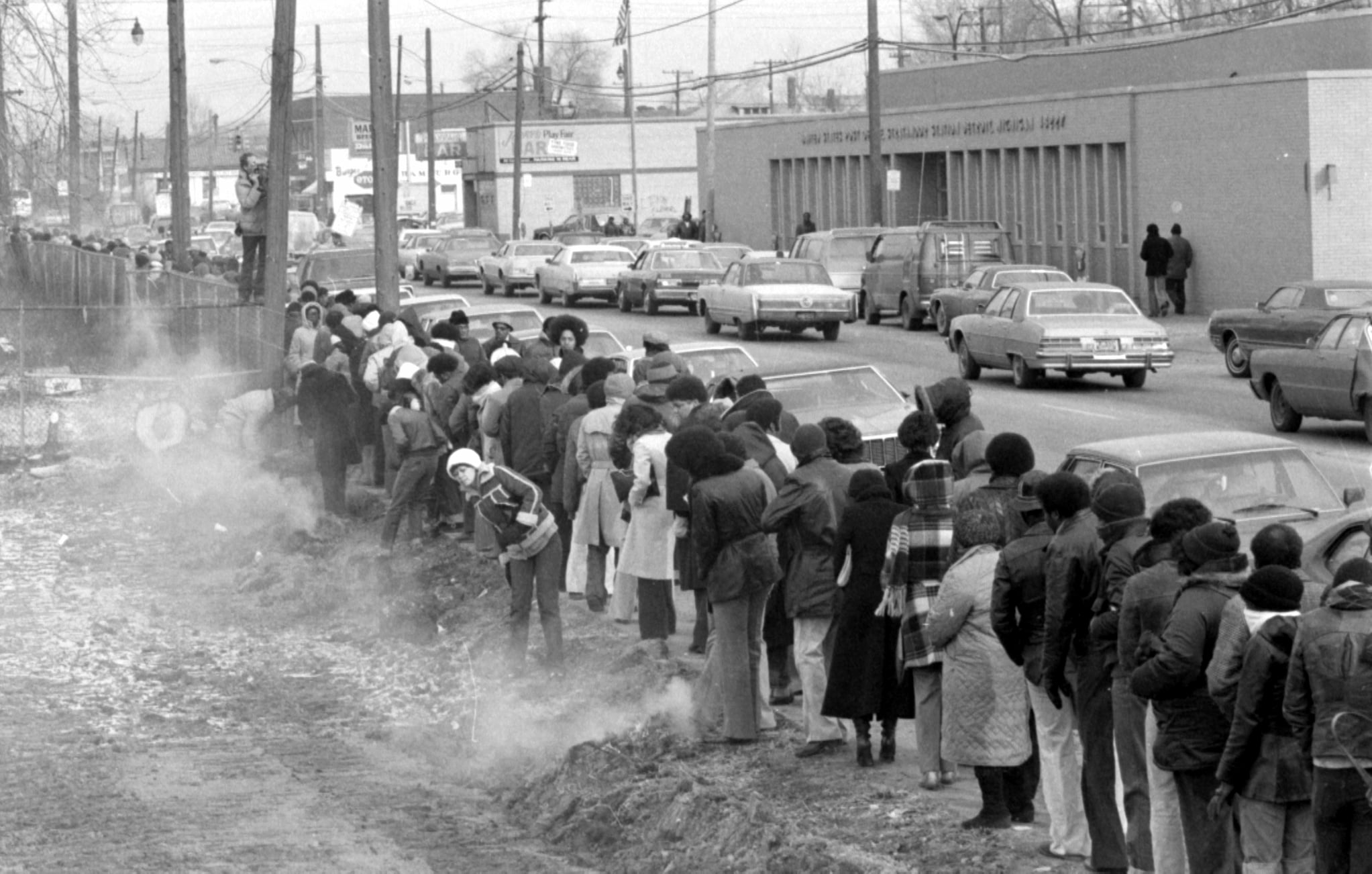
Image 43.02.02 — When the US industrial sector and the auto industry collapsed in the 1980s, after oil crises in the Middle East, workers across the US experienced massive, long-term unemployment, especially in the industrial Midwest.
Long lines of misery and despair snaked around unemployment offices, union halls, welfare offices, and soup kitchens. News commentators labeled them as the “new poor” to distinguish these formerly hardworking people from the “old” poor who were seen as incapable or unwilling to work. Economists explained that the US economy was restructuring, abandoning its former manufacturing base for a new service and information base. For many of these newly impoverished people, gloom turned to anger as they searched for someone or something to blame for their misery.
At first, the companies blamed the workers for incompetence for wanting too much in exchange for too little effort. The workers, in turn, pointed to deteriorating factories and machines that hadn’t been upgraded since World War II and towards profits that had been squandered and not reinvested in facilities and people. They initially blamed the government for not doing enough to prevent or fix the economic catastrophe. Before long, however, they all found a common enemy to blame: the Japanese.
Japan as the Scapegoat
While Detroit’s corporate and political leadership had once ridiculed the idea of creating fuel-efficient cars for environmental reasons, which would reduce reliance on fossil fuels, automakers in Japan and Germany were busily meeting this demand.
In 1978, a new oil crisis killed the market for the heavy, eight-cylinder dinosaurs made in Detroit, leading to the massive layoffs and economic crises throughout the industrial Midwest. The foreign auto imports were everything the gas-guzzlers were not—cheap to buy, cheap to run, well-made, and dependable. These types of cars and their manufacturers became despised by Detroit automakers and autoworkers.
Anything Japanese, or presumed to be Japanese, became a potential target. All the while, people who looked German were spared in spite of the fuel-efficient German cars; racism only works when people can be identified and portrayed as different. Unions even sponsored sledge-hammer events, giving frustrated workers a chance to smash Japanese cars for a dollar a swing. Japanese cars were vandalized, and their drivers were even shot at while driving on the freeways all because of their choice in car.
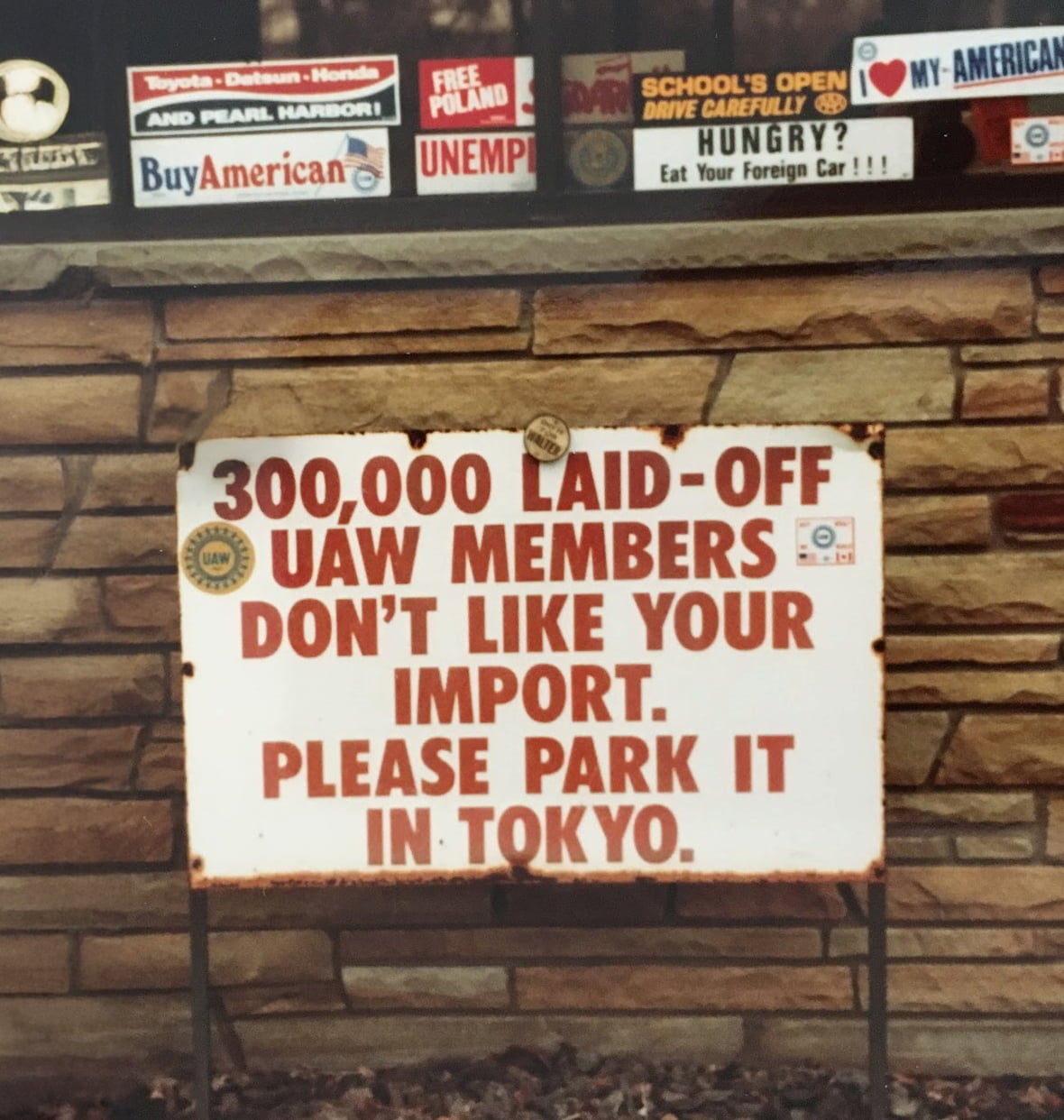
Image 43.02.03 — Bumper stickers declared Japan to be America’s enemy; these were displayed at the UAW International Headquarters in Detroit in 1983. Japan’s fuel-efficient cars, not Germany and its pioneering Volkswagen Beetle, were blamed for the decline of Detroit’s huge gas-guzzlers.
On television, radio, and street corners, anti-Japanese slurs were commonplace. UAW bumper stickers declared: “Datsun, Honda, Toyota—Pearl Harbor” and “Real Americans buy American.” 1 By using a metaphor of war to describe the situation, the frustration, and misery of the unemployed were channeled into patriotic fervor. Eager to exploit this metaphor and flag-waving themes, leaders and community members alike began to use and spread racially-charged statements. Politicians like Congressman John Dingell (D-MI), chair of the House Energy and Commerce Committee, railed against “the little yellow people.” 2 Lee Iacocca, chair of the failing Chrysler Corporation and one-time presidential candidate, casually suggested dropping nuclear bombs on Japan.
It felt dangerous to have an Asian face. Asian American employees of auto companies were warned not to go onto the factory floor; they were told that angry workers might hurt them because they “looked Japanese.” Even in California, home to long-established Asian American communities, a third-generation Japanese American television reporter in San Jose was threatened by an autoworker who pulled a knife and yelled, “I don’t like Jap food…I only like American food.” 3
Yet, anger and resentment were not reserved only for Japan. In the 1980s, the US economic powerhouse, so dominant in the post-World War II decades, began to falter. The US share of global production dropped from 34 percent in 1950 to 23 percent in 1980. Meanwhile, the economies of the Pacific Rim were only growing, particularly those of Japan, South Korea, Taiwan, Singapore, and Hong Kong.
The rising anger towards Japan and other Asian places that were unfamiliar to most Americans was a sinister reminder of dangerous times in the past. The pattern of anti-Asian prejudice from earlier periods of US history was re-emerging. Asians and Asian Americans were blamed and scapegoated for domestic economic problems, and frustrated American workers began turning to violence.
For example, in the 1800s, Chinese laborers were attacked repeatedly and viewed as “Yellow hordes” intent on taking jobs from “real” Americans. The fear and hatred of Chinese and other immigrants from Asia fueled a white-led movement to drive out and erase all Asians from American soil. This ethnic cleansing movement led to the Chinese Exclusion Act of 1882, and various other policies and laws that forbade Asians from owning property, voting, testifying in court (even to defend themselves), and from having interracial marriages. By the 1940s, these discriminatory attitudes were so ingrained in American society that a Presidential executive order authorized the forced removal and incarceration of more than 120,000 Japanese Americans during World War II.
Asian American Growth in the United States
It was in the 1960s that the myth of the “model minority” was introduced to portray Asian Americans as the “good” and “model” minority, creating a wedge between Asian and Black communities and further stigmatizing Black people, whose national movement for civil rights had swept the country. Ironically, it was the Black-led civil rights movement that led to the more equitable Immigration Act of 1965, which allowed more people of color to immigrate to the US, including millions of immigrants from Asia.
In the two decades after the 1960s, the Asian American population more than quadrupled, and the visible growth of the Asian American population ultimately led to the anti-Asian hostilities of the 1980s. As the fastest growing racial minority in the United States, new groups of Asian Americans were emerging—Koreans, Filipinos, Asian Indians, Vietnamese, Laotians, Thais, Cambodians, Pakistanis, Indonesians, Hmong, Samoans, Tongans, and many others.
Asians were moving into geographic areas in the US where people had only seen Asian faces in the movies or battlefields as the enemy. Asian Americans were also entering more fields of work—as lawyers, health professionals, journalists, educators, business leaders, scientists, and engineers. Many of these Asian professionals were permitted to immigrate to the US precisely because the country had a shortage of such professionals and expertise.
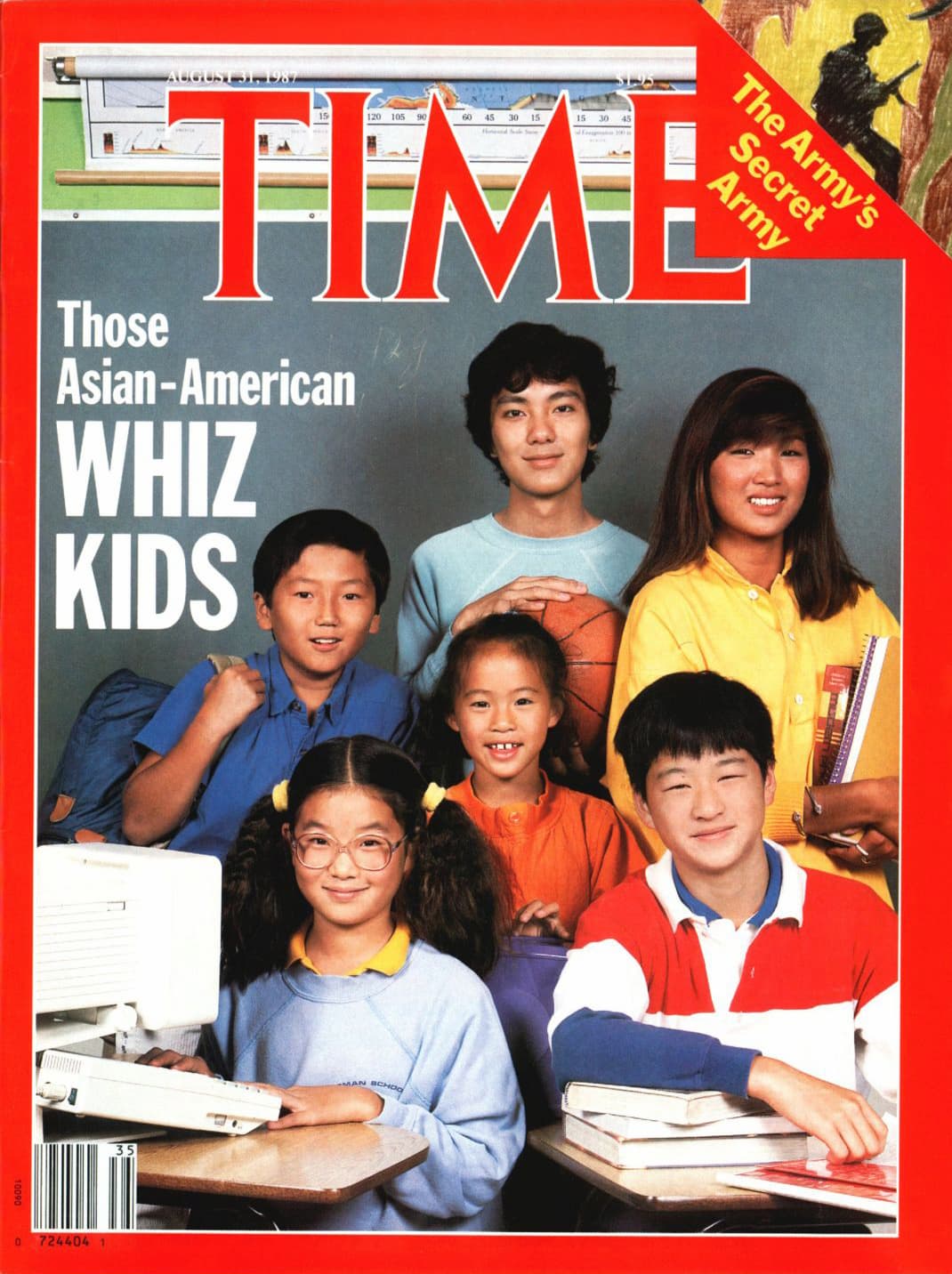
Image 43.02.04 — TIME magazine cover, August 31, 1987. News media, books, industry, and government leaders often perpetuate the harmful “model minority” myth, which falsely portrays all Asians as the “good” minority that has no problems and never speaks up for community needs.
As the numbers and visibility of highly educated Asians increased, so did the wrongful stereotype that all Asians are “rich model minorities”—a falsehood that obscures the fact that many Asian Americans are living in poverty or, like Vincent Chin’s family, working in low-wage service jobs. The myth of an Asian population that is genetically expected to succeed also paved the way towards hate and violence.
In the 1980s, these various factors converged into an unstable and volatile situation for Asian Americans. The rapidly growing Asian American population—with diverse ethnicities, languages, cultures, and educational and ethnic backgrounds—was unfamiliar to most Americans. Even as these newer immigrants and refugees moved into all corners of the American landscape, the centuries-old stereotype of the “Yellow Peril” (Asians as perpetual foreign invaders) was swirling into a toxic mix with the increasingly held view of the “model minority” (Asian Americans as rich and successful).
These two dehumanizing and dangerous stereotypes of Asians combined to further fuel resentment from other Americans during a time of great economic hardship, unemployment, and misery—problems that were especially bad in the industrial Midwest, leading local leaders and influencers to look for scapegoats who could be blamed for their unsuccessful policies.
Glossary terms in this module
civil rights Where it’s used
Personal rights guaranteed and protected by the US Constitution and laws, which include protection from unlawful discrimination, including on the basis of race, national origin, disability, age, religion, gender or sexuality.
scapegoating Where it’s used
The act of wrongly assigning blame to a person or group of people, typically those whose social status makes them vulnerable to violence and makes addressing or correcting the error very challenging.
unions Where it’s used
An organization formed by workers, typically from the same industry or company, for the purpose of maintaining and improving the conditions of their workplace. It is important to understand that while unions are important for ensuring better working conditions for workers, American unions have historically been anti-immigrant.