




A portrait of the Japanese American Uno family. Four children and eight adults dressed in dark colors pose outside for picture.
Module 1: Still Here After Five Generations and Counting
Why did many Japanese Americans retain a strong sense of ethnic identity and community after being in the United States for multiple generations?
Little Tokyo, a historic Japanese American community in downtown Los Angeles, California, has roots that go back well over one hundred years when Japanese immigrants lived and worked there as a haven from racism and a place where they could find companionship and camaraderie. Though few Japanese Americans live there today, it retains a strong Japanese American character even after three or four American-born generations, and even though the majority of Japanese Americans share other ancestries as well.
In Little Tokyo, one finds a handful of businesses that date back to the pre-World War II era, as well as many run by post-war immigrants from Japan. There are also Japanese American cultural institutions, ranging from churches to a museum and a theater company. It is a gathering place that draws diverse groups of Japanese Americans from throughout Southern California.
Separated by generation, by racial/ethnic ancestry, religion, geography, and other measures, what holds this diverse ethnic community together today? This module helps answer this question by offering a general overview of Japanese Americans in the United States, spanning from their arrival to today.
How did Japanese immigrants respond to the racism they faced?
How does the history of anti-Japanese legislation and wartime mass incarceration still influence the Japanese American community today?
What are the limitations if you do not have the rights and privileges of being a citizen?
Immigrant Communities
In 1906, as Kumemaro “George” Uno stepped off the boat in Seattle, Washington, he was both excited and a little scared. Just nineteen years old, he had come to America in search of greater opportunity at the urging of Christian missionaries. He was one of thousands of migrants from Japan. These migrants had come to both the continental United States and to Hawaiʻi—both before and after its annexation by the United States—since 1885, drawn by stories of riches to be had and to escape poverty and limited opportunity in a rapidly changing Japan. By 1924, their numbers had reached some 270,000. They came to the US at the same time that millions of migrants from Europe were arriving on the East Coast of the country.
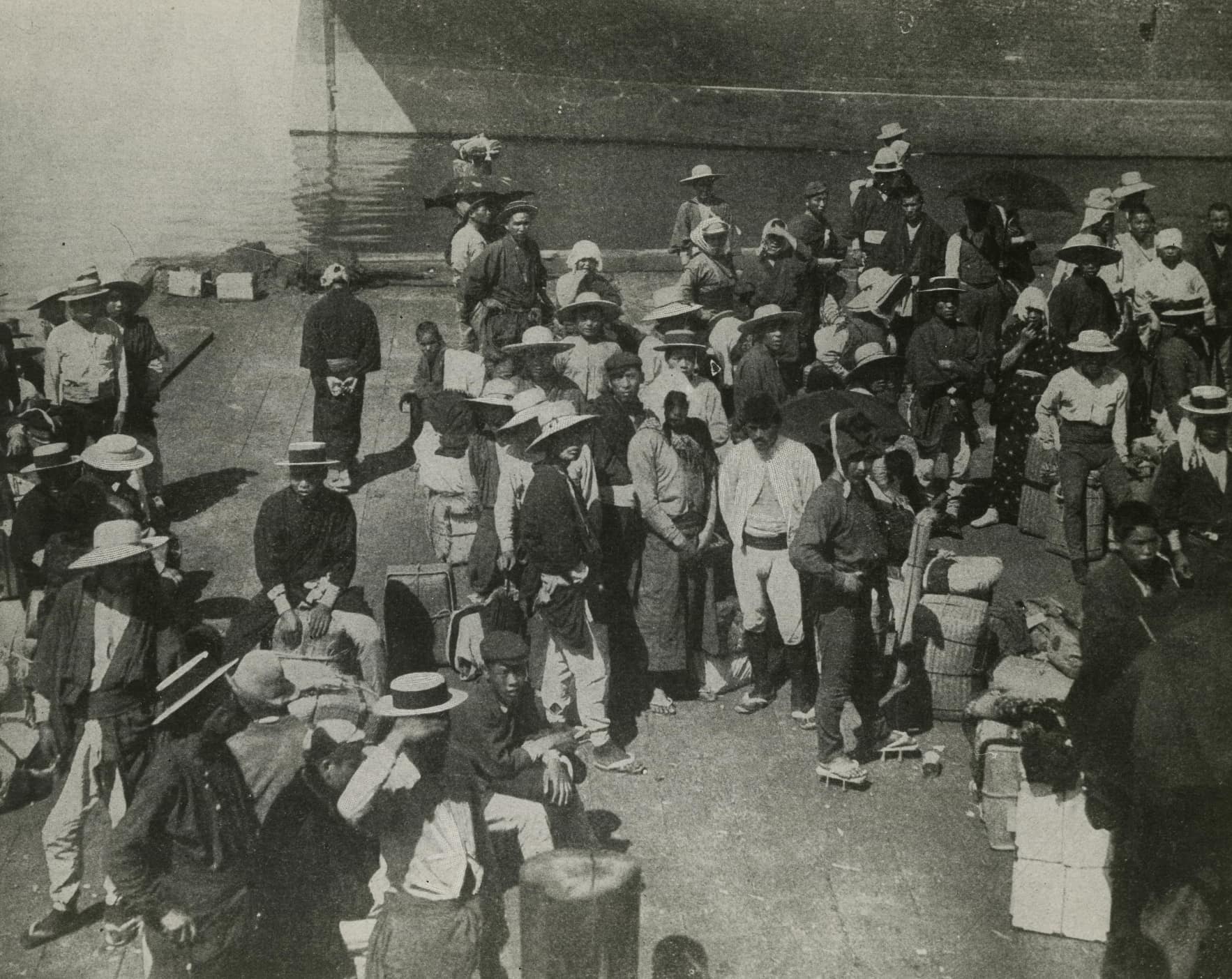
Image 13.01.01 — Drawn by stories of riches and opportunities in a rapidly changing Japan, Japanese contract laborers often came first to the sugar plantations of Hawaiʻi, then to the Western region of the United States.
The migrants from Japan were typically young men like George who initially sought to go abroad and to work for a few years before returning to Japan. They came first to the sugar plantations of Hawaiʻi, then to the Western region of the United States, where they worked on railroads, sawmills, mines, and farms, often sending a good part of their meager wages back to their families in Japan.
Like Chinese immigrants before them, the new arrivals from Japan encountered rampant anti-Asian and anti-immigrant sentiment in the continental US in particular, as a group that looked different and spoke a different language than the majority of the population. An organized anti-Japanese movement was in full swing by 1905, and before long, a combination of state and federal laws and legal decisions left Japanese immigrants prohibited from becoming naturalized US citizens and banned from purchasing land or marrying whites in most western states. Immigrants from Europe or other parts of the world were not subject to such measures. The crowning blow was the Immigration Act of 1924, which banned all further immigration from Japan.
Despite such discriminatory treatment, Japanese immigrants began to settle in the US and build communities. While many of the young male migrants did return to Japan after a few years, many stayed on. Many of them brought over wives from Japan or returned to Japan to marry, while others had their families in Japan arrange a marriage with a woman they had never met. This practice was known as “picture marriage” due to the exchange of photographs that preceded the union.
Although this practice contributed to anti-Japanese stereotypes, it was a variation of traditional Japanese marriage customs of the time. Tens of thousands of women migrated in the 1900s and 1910s, and families and children soon followed. George Uno married Riki Kita in 1911, and the couple went on to have ten children between 1913 and 1932. Unlike their parents, the American-born children—known as Nisei (Japanese for “second generation”)—were US citizens by birth. Japan-born immigrants—known as Issei (“first generation”)—had high hopes that their American citizen children would not face the same barriers they had faced.
Japanese American communities—colloquially known as “Little Tokyos” or “Nihonmachis”—formed up and down the West Coast and in Hawaiʻi. Most Japanese Americans on the continent derived their income from agriculture. Farm laborers worked their way up to becoming sharecroppers, then farm owners, getting around prohibitions on purchasing land by buying land in the name of their citizen children. Others worked in wholesale or retail produce markets, or started businesses—restaurants, stores, barbershops—that served the farmers and other Japanese Americans. Newspapers, churches, Japanese language schools, and other community organizations formed as well.
Most Nisei children attended American schools and pursued the same interests as other American youth, even as they spoke Japanese at home with their parents. They also participated in sports leagues, Boy or Girl Scout troops, or churches that were segregated. This segregation was due to both discrimination that often banned them from mainstream organizations and the comfort of being with others like themselves.
The Unos settled in Los Angeles, California, near the largest of the Little Tokyos, where George worked as a florist and traveling salesman. To supplement his meager earnings, the older girls worked as live-in maids, and the boys sold magazines and worked in produce markets.
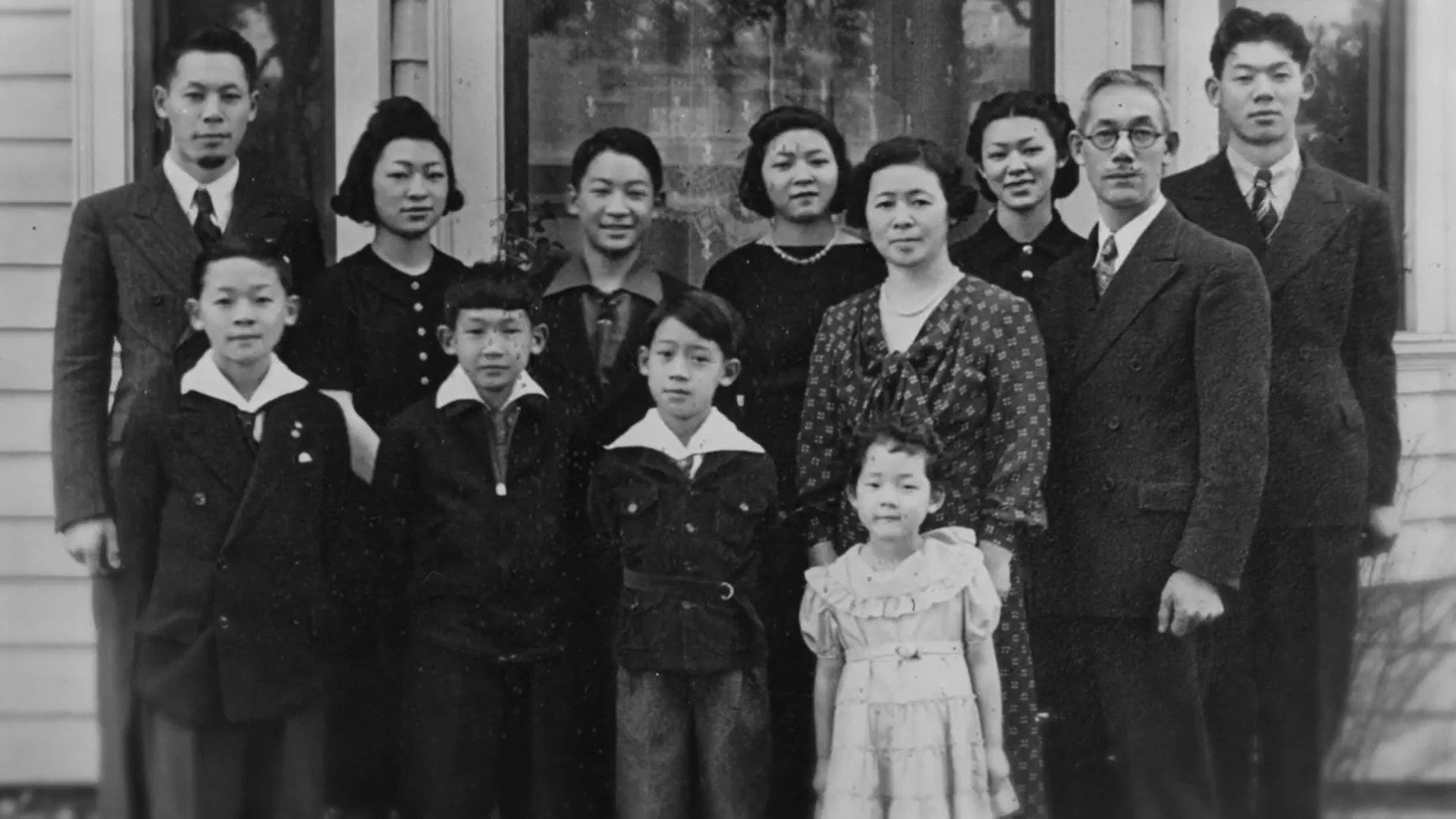
Image 13.01.02 — Raised as an American family, the Unos settled in Los Angeles, California, with their ten children. Segregation banned them from mainstream organizations and they sought the comfort of being with others like themselves.
Forcibly Removed and Incarcerated
The Japanese attack on Pearl Harbor, Hawaiʻi, on December 7, 1941, led the United States to declare war on Japan and resulted in grave consequences for Japanese Americans. Based on prewar surveillance of Japanese American communities, the federal government began to arrest and imprison Issei community leaders. Kumemaro “George” Uno was among those arrested, taken to an incarceration camp in New Mexico. By February of 1942, several thousand Issei men—along with a handful of women—had been imprisoned. But West Coast political and business leaders pushed to remove all Japanese Americans from the West Coast.
Bending to political pressure, President Franklin D. Roosevelt issued Executive Order 9066 on February 19, 1942, giving the army the power to do this. In the spring and summer of 1942, essentially every man, woman, and child of Japanese descent was forcibly removed from an area along the West Coast that included all of California, the western halves of Washington and Oregon, and the southern third of Arizona—a total of about 110,000 people, about 90 percent of all Japanese Americans living in the continental US.
Almost two-thirds of those removed were American citizens by birth. There were no charges, no trials, no findings of guilt. The federal government set up ten concentration camps located in isolated areas of the country to imprison the Japanese Americans excluded from the West Coast. Most of the rest of the Uno family was sent to a camp in southern Colorado called Amache.
By contrast, Japanese Americans in the US occupied Kingdom of Hawaiʻi were not forcibly removed as a group. There, less than 2 percent of Japanese Americans were incarcerated, mostly Issei male community leaders and their families. Other Japanese Americans there, whom authorities felt lived too close to military installations, were excluded from their homes and businesses, but not interned or incarcerated. Hawaiʻi was placed under martial law after the Pearl Harbor attack by the Japanese military in 1941. The attack led to the closure of Japanese cultural institutions, such as Buddhist temples and Japanese language schools. However, most Japanese Americans in Hawaiʻi were able to remain in their homes and jobs and continue with their lives.
Living conditions at these camps were rudimentary at best. The camps were hastily built and often unfinished when Japanese Americans arrived at them. Incarcerees were housed in military style barracks with communal bathroom and meal facilities. To add insult to injury, the camps were surrounded by barbed wire fences and guard towers manned by armed military police.
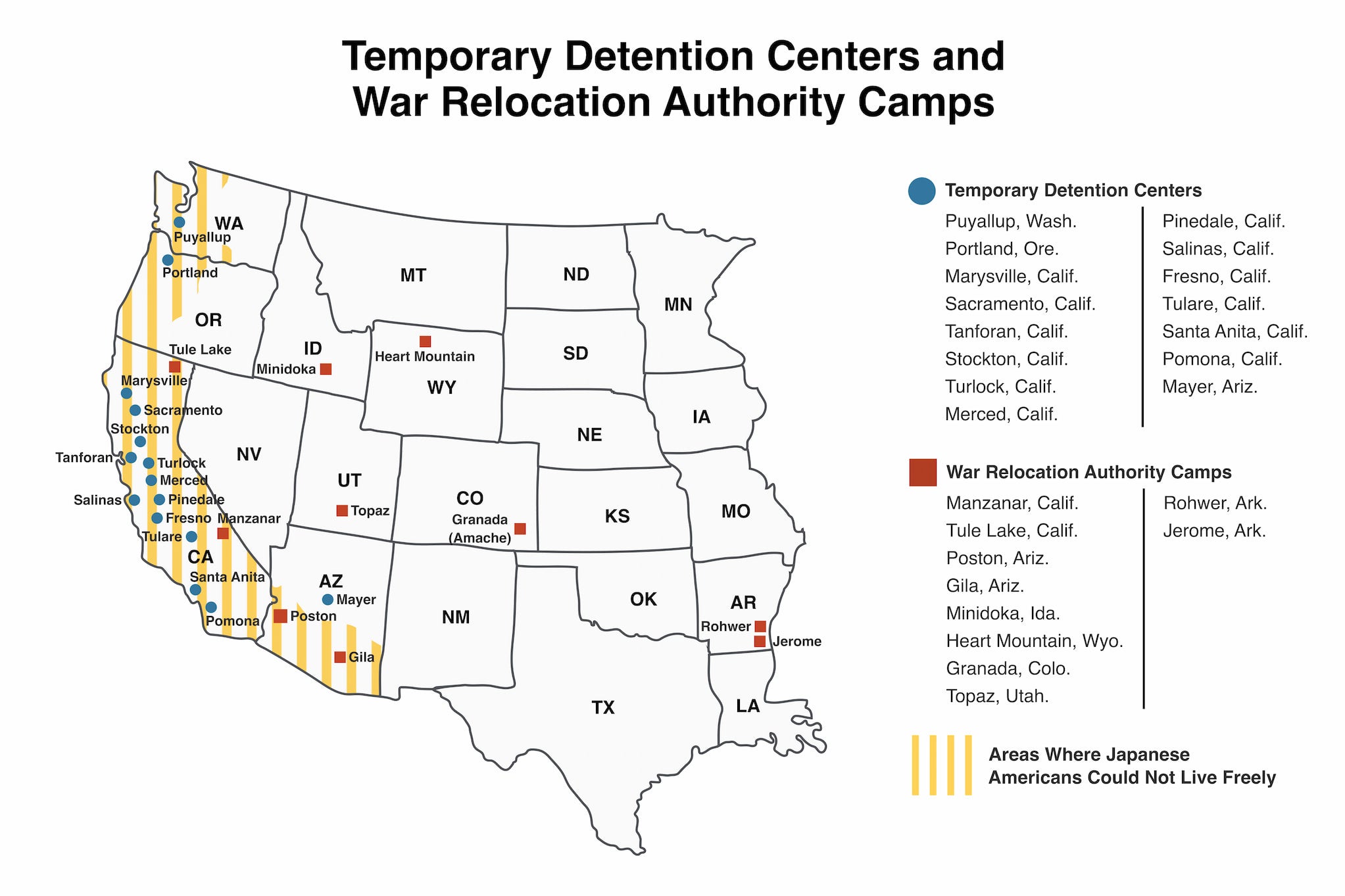
Image 13.01.04a — A total of about 110,000 Japanese Americans in the continental US were forcibly removed from their homes and sent to ten government concentration camps located in isolated areas of the country. By contrast, Japanese Americans from Hawaiʻi were not forcibly removed but surveilled.
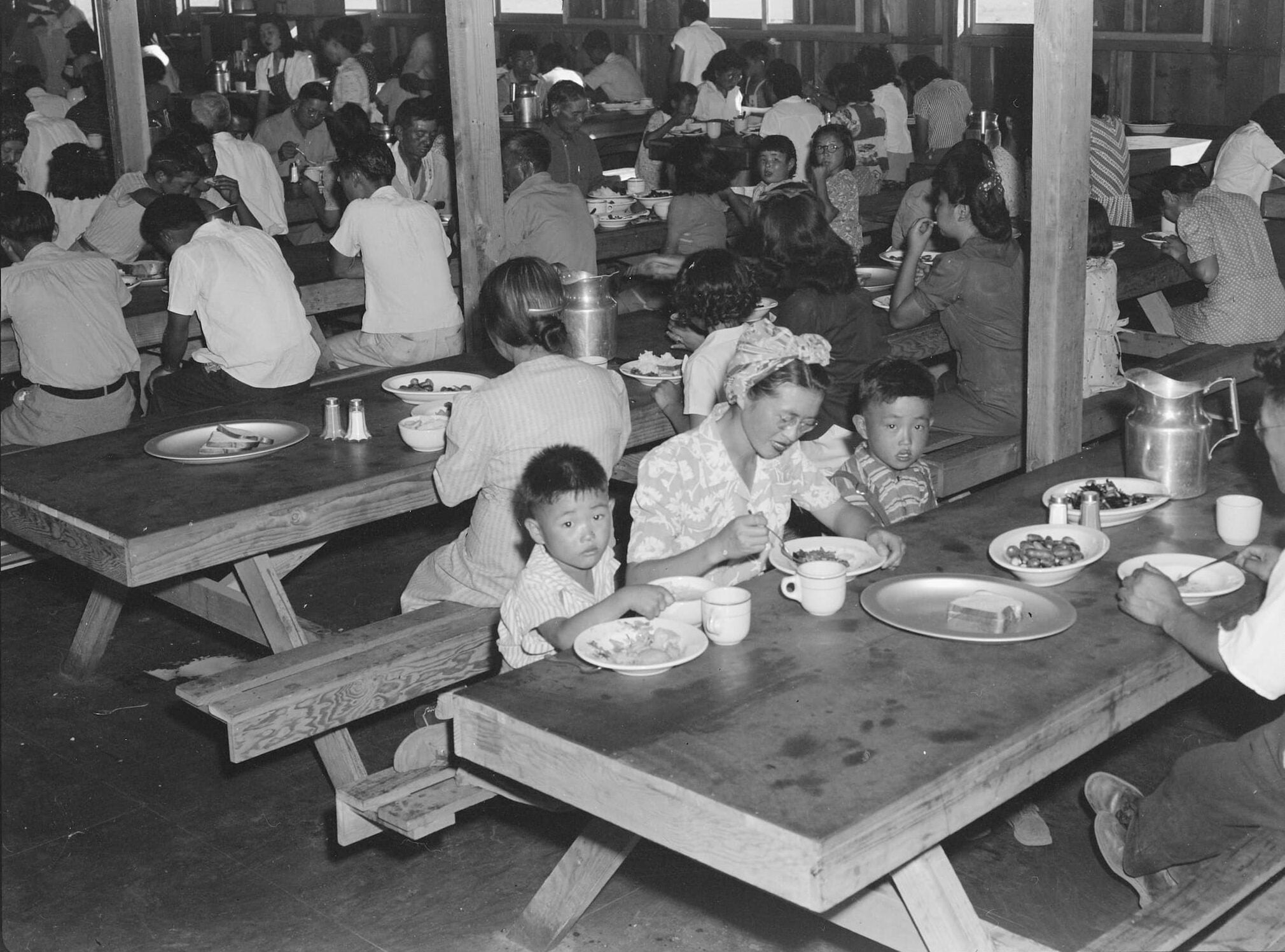
Image/Text 13.01.04b — Manzanar, California, 1942. Japanese Americans were housed in military style barracks with communal bathroom and meal facilities. Because much of concentration camp life was communal, leading everyone to be with friends rather than family, this weakened their own immediate family bonds.
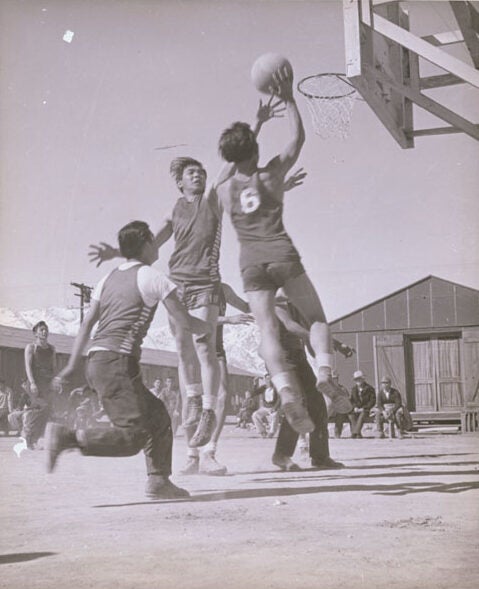
Image 13.01.04c — Sports and other recreational activities played an important role in making concentration camp life bearable for the Japanese American incarcerated population. In order for them to play, the incarcerees had to build the courts, fields, and stages themselves. This photo takes place at Manzanar, California.
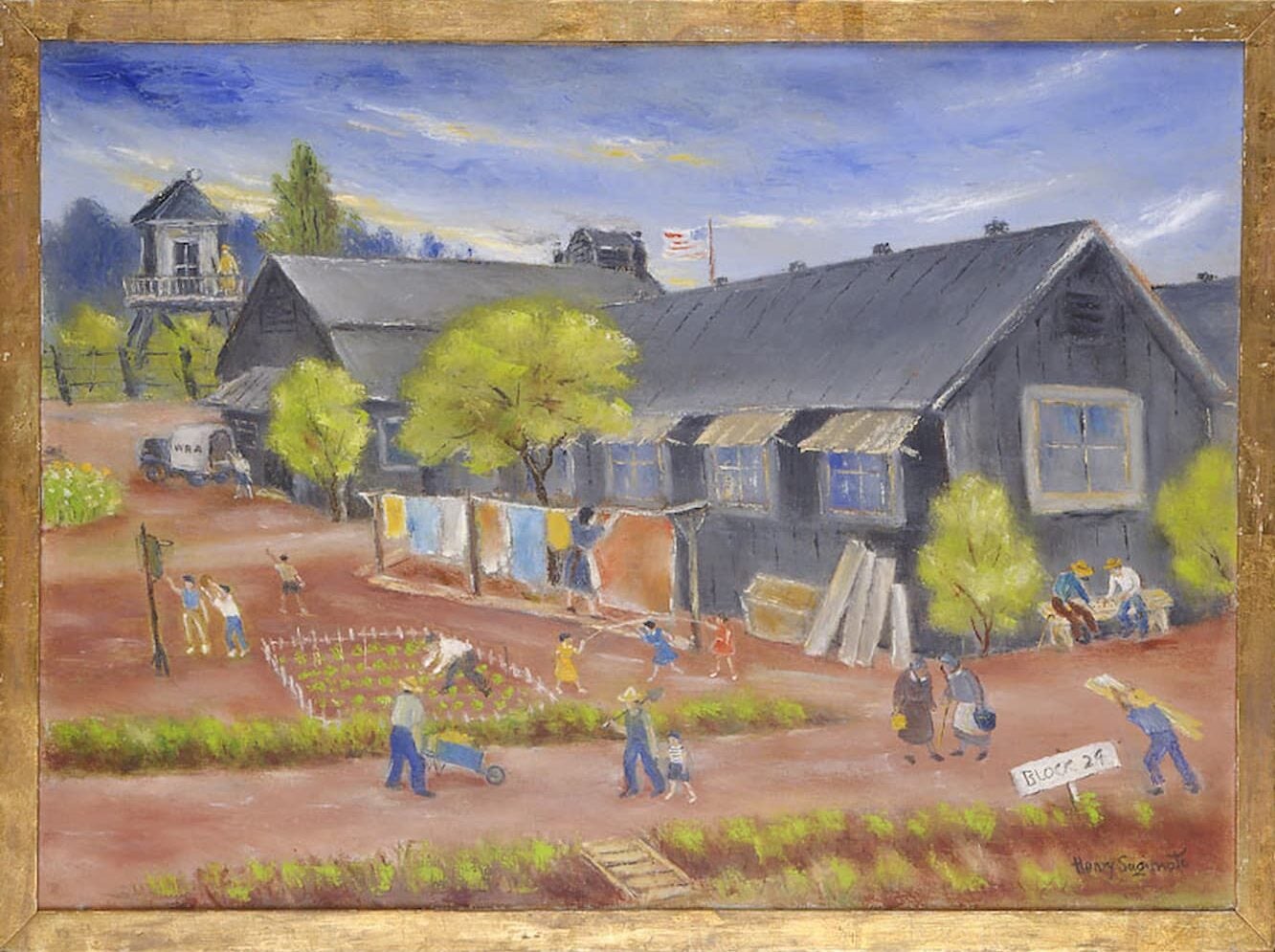
Image 13.01.04d — Artists like Henry Sugimoto, Dick Sata, and Doris Ota Saito documented camp conditions. This painting by Sugimoto depicts the camp in Jerome, Arkansas, showcasing the contradiction between gardens created by inmates and the barracks, guard towers, and an American flag in the background.

The War Relocation Authority (WRA)—a new federal agency formed to run the camps—tried to run the camps as if they were small towns. They set up schools and churches, movie screenings and dances, farms and hospitals. Japanese American inmates provided most of the labor for these endeavors and were paid a meager wage of 19 dollars, 16 dollars, or 12 dollars per month, around 10 percent of what such jobs paid on the outside.
While most Japanese Americans did comply with exclusion orders, there were some who resisted the mass roundup and challenged its legality in court. Three of those cases made it all the way to the US Supreme Court, which ultimately ruled that the racially-based expulsion of Japanese Americans was legal.
Not wanting a long-term incarceration, the WRA encouraged “loyal” Japanese Americans to leave the camps as soon as possible. While prohibited from returning to the West Coast, they could leave for other parts of the country, provided that they had a job (or had been accepted by a college) and a place to live. By the end of 1944, about one-third of incarcerated Japanese Americans had left, with cities such as Chicago, Illinois, and Denver, Colorado, the most popular destinations.
For the first year of the war, Japanese American men were not allowed to join the armed forces. But in early 1943, the government decided to allow Nisei men to enlist, forming the segregated 442nd Regimental Combat Team, made up almost entirely of Japanese Americans. Nisei men with Japanese language skills were also allowed to serve in the Pacific as interpreters and translators as part of the Military Intelligence Service.
Nisei in Hawaiʻi, where there was no mass incarceration, enthusiastically volunteered, while the response from those in the mainland concentration camps was more muted. The 442nd served with valor in Europe, while taking heavy casualties, and became well known as one of the most decorated units in the US Army. Three of the Uno sons volunteered for the army and served with distinction.
“Model Minorities” and the Fight for Redress
While World War II ended with Japan’s surrender in August 1945, the WRA camps did not all close until March of 1946. But the enemy alien detention camp in Crystal City, Texas, which held George and Riki Uno and their three youngest children, did not close until early 1948. George and his youngest son, Edison, did not leave for Los Angeles, California, until the fall of 1947. The three older daughters had resettled in the Midwest, but all eventually returned to Los Angeles.
The immediate aftermath of the incarceration was very difficult for many Japanese Americans due, in particular, to housing shortages in West Coast cities such as Los Angeles. Some recall this period as being worse than their incarceration. At the same time, perceptions of Japanese Americans changed dramatically in the decade after the war, due in large part to the widely publicized exploits of the Nisei veterans, as well as geopolitical changes that turned Japan into America’s ally in the fights against communism.
Many of the earlier discriminatory laws that targeted Japanese Americans were overturned by the courts, and new immigration legislation in 1952, finally made Issei eligible to become naturalized American citizens. Though too late for Riki Uno, who had died in 1949, George became a US citizen in 1954. In Hawaiʻi, many returning Japanese American veterans won elections to state and national offices, helping to reshape politics in Hawaiʻi to center and be more inclusive of Japanese American perspectives and experiences.
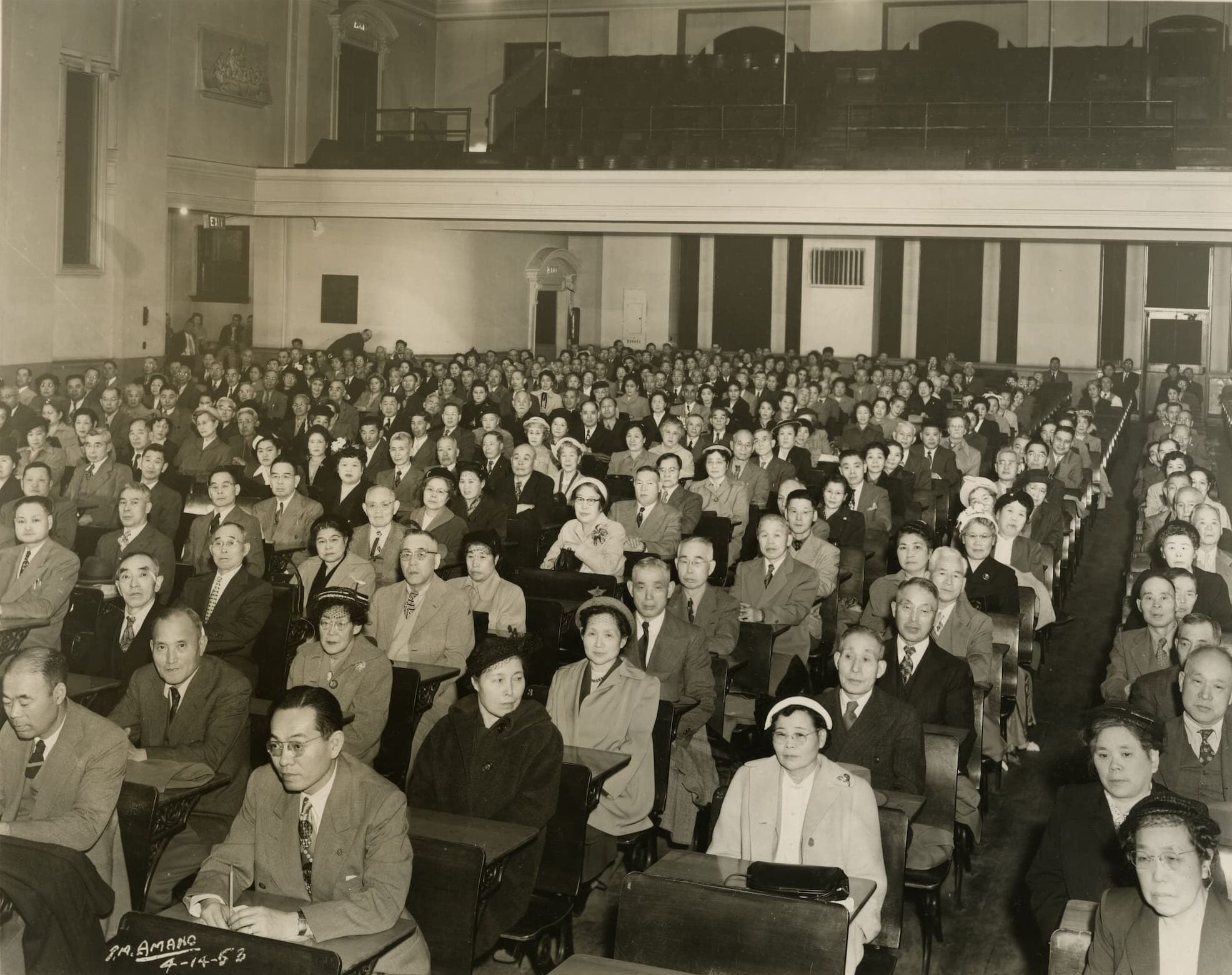
Image 13.01.05 — Despite the travails of World War II, many Issei opted to become United States citizens once the ban on naturalization was lifted in 1952. This photograph captures a mass naturalization ceremony for Issei in Seattle, Washington, on April 14, 1953.
Two decades after their incarceration, there was a new stereotype for Japanese Americans, that of a “model minority,” which, as one overzealous magazine article claimed, was now “outwhiting the whites.” While meant to be a compliment, the stereotype glossed over problems Japanese Americans still faced and impeded cooperation between ethnic groups by pitting them against each other.
Traumatized by the incarceration, most Japanese Americans refused to talk about it in the decades after the war. But inspired by the civil rights and Black Power Movements, young Japanese Americans started asking questions about the incarceration in the 1960s. One of them was Edison Uno, who began studying and teaching college classes about the incarceration of Japanese Americans. He later became one of the first to propose seeking monetary reparations for the wartime imprisonment. Japanese American activists led an unlikely fight for reparations in the 1980s that eventually culminated in the Civil Liberties Act of 1988, which included a presidential apology and monetary redress of 20,000 dollars per person for surviving incarcerees.
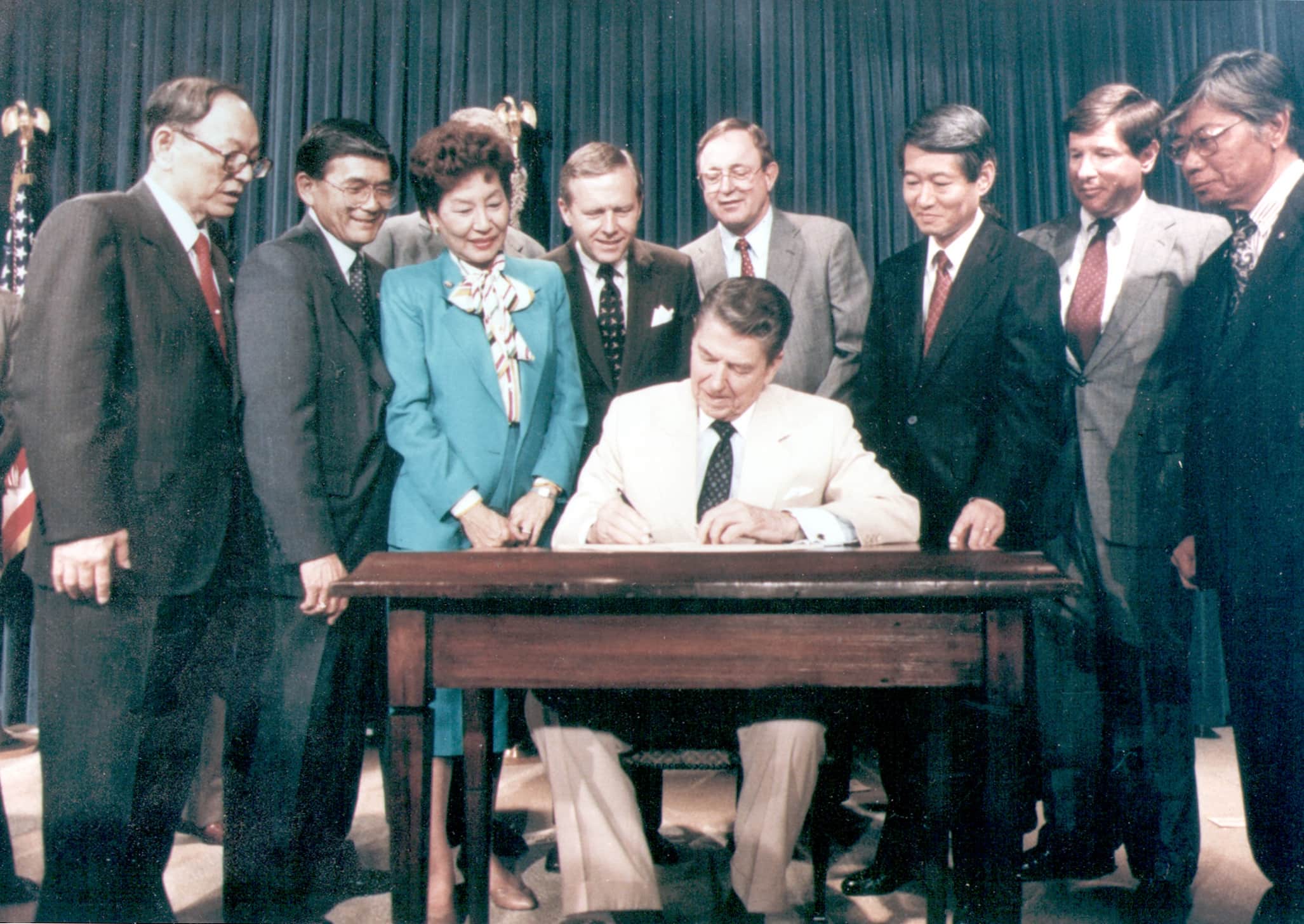
Image 13.01.06 — President Ronald Reagan signs the Civil Liberties Act of 1988 into law, the culmination of more than forty years of the movement for redress and reparations. This included a presidential apology and monetary redress of 20,000 dollars per person for surviving incarcerees.
Diverse Communities
Today, if you go to Little Tokyo on a particular Saturday in February, you will encounter a large crowd at the Day of Remembrance, held at the Japanese American National Museum. Since the 1970s Japanese American communities across the country have been holding these events to commemorate the issuing of Executive Order 9066 on February 19. First planned in the context of the redress movement, the events in recent years have focused on applying the lessons of Japanese American incarceration to combat similar injustices faced by other groups today. You will find a diverse Japanese American community attending this event and similar ones.
As with other Asian American groups, the 1965 Immigration Act opened the door for new immigration from Japan. Though fewer Japanese immigrated than those from many other Asian countries, it was still significant, numbering about 350,000. Today, about 40 percent of the 1.3 million Japanese Americans are postwar immigrants and their descendants. While few Issei and Nisei married non-Japanese, that changed in the 1960s. Today, many more of those who identify as Japanese American are of mixed ancestry.
Days of Remembrance are a microcosm of the Japanese American community today: diverse, nation wide, and both forward and backward looking. This commemorative event unites those who identify with and are linked by a common history, and who are all too often seen by others through stereotypical lenses.
More to explore
Image
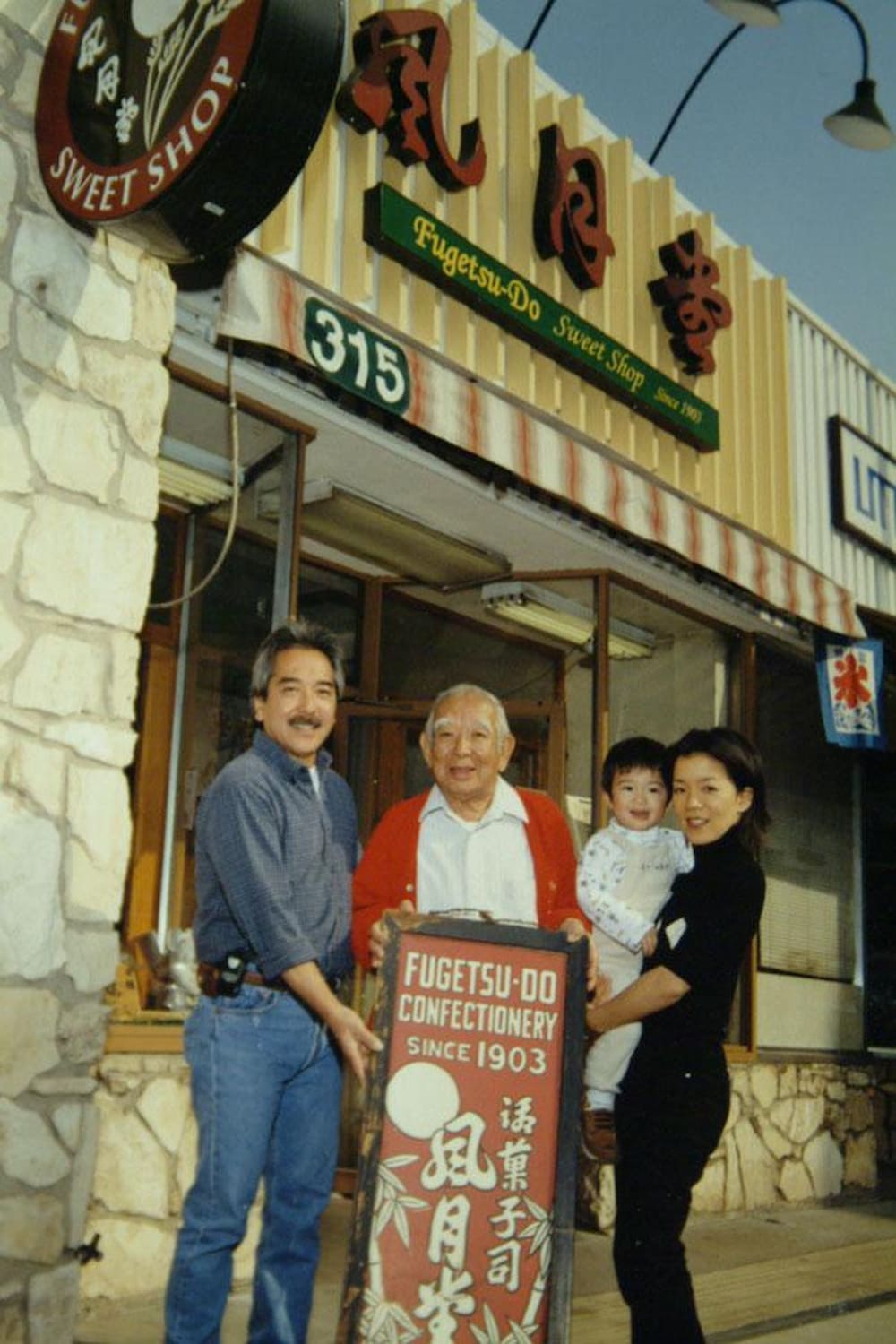
Fugetsu-do Confectionery led by four generations of the Kito Family
In 1903, soon after Seiichi Kito arrived in Los Angeles, California, from Japan, he helped start a confectionery known as Fugetsu-do in the neighborhood of Little Tokyo. Kito delivered Japanese snacks and sweets—arare (rice crackers), senbei (another type of rice crackers), mochi (rice cakes), and manju (small, sweet-filled buns)—to fellow Issei (first-generation Japanese immigrants) who craved a taste of home.
Glossary terms in this module
Civil Liberties Act of 1988 Where it’s used
A federal law that granted all surviving Japanese American citizens and legal residents who were wrongfully incarcerated during World War II 20,000 dollars each and a formal presidential apology. The Civil Liberties Act of 1988 was passed as a result of the findings in the federal report Personal Justice Denied and the activism of Japanese American groups.
Days of Remembrance Where it’s used
A day of commemoration for Japanese Americans held on February 19, the anniversary of Executive Order 9066. Initiated during the Redress Movement, Days of Remembrance often highlight the parallels between injustices of the present day and those that led to the mass incarceration of Japanese Americans.
Executive Order 9066 Where it’s used
On February 19, 1942, President Franklin D. Roosevelt gave the US military the power to exclude anyone they saw as a threat from special “military areas.” Although Japanese Americans were not specifically mentioned, this led to their mass incarceration.
Immigration Act of 1924 Where it’s used
A federal law that denied immigration to the US from Japan, Eastern and Southern Europe, and other Asian countries except the Philippines, which was then a US colony. The ban on Japanese immigration would last until after World War II.
martial law Where it’s used
A form of government under military control where constitutional rights are suspended.
naturalization Where it’s used
The process of becoming a citizen for immigrants.
redress movement Where it’s used
The term “redress” means to right a wrong or injustice, often through compensation. During the redress movement, many activist groups fought to gain reparations for Japanese Americans who were wrongfully incarcerated during World War II. These activists sought the restoration of Japanese Americans’ civil rights, compensation for lost property, and a formal national apology.
War Relocation Authority (WRA) Where it’s used
The federal agency that managed the imprisonment of Japanese Americans. The word “relocation” inaccurately describes the action as simply moving or relocating to a new home. In reality, Japanese Americans did not have a choice and were forcibly removed from their homes.