





Hmong community members hold signs demanding the release of General Vang Pao during outdoor rally.
Module 3: Hmong American Activism
Have Hmong Americans found home in the United States?
Hmong people have a history of organizing to build strong communities based on their history of displacement from different imperialist powers. They have responded to the challenges of navigating different forms of state governance by organizing structures of self-governance to collectively provide mutual assistance such as food and other resources to each other and to practice their cultural traditions. Hmong families or clans also organized community gatherings and formed community organizations to address community-based issues. While Hmong women are at the forefront of providing mutual assistance and practicing traditions, these efforts have been attributed to men as the decision-makers.
In the United States, Hmong Americans face structural challenges like other Asian American groups—as well as concerns similar to those of Black and Latinx communities. They face issues of poverty, employment, racism, and lack of access to education, health care, and social services. Domestic and gendered violence is also a prevalent issue. Hmong Americans have maintained some forms of collectivity and organized against challenges around the clan structure. However, during instances in which the clan structure fails to include women and LGBTQ+ individuals or is unable to effectively challenge institutional racism, the organizing efforts have been taken up by women- and queer-led groups.
This module focuses on organizing as a form of community building and knowledge formation. It shows how Hmong organize themselves to resist structural inequalities and focuses on their fight for self-determination in solidarity with other communities of color, revealing how Hmong American organizers work both transnationally and at a local level. Hmong American organizing is intergenerational, even though they are led by specific segments of Hmong communities.
What are some of the issues that impact Hmong American communities, and what forms of organizing have been practiced?
How have Hmong American women organized?
What outcomes have been achieved through Hmong American activism?
Refugee Mobilization Against Terrorism
One form of organizing that strengthened community identity around refugee history was fighting the legal charges alleging General Vang Pao of terrorism and the narratives about Hmong people as his army. On June 4, 2007, US federal agents arrested Vang at his home in Santa Ana, California. The General was seventy-seven years old at the time and had been living in the United States since he and his family were airlifted from Long Cheng in 1975. Federal agents also arrested ten other Hmong community leaders and one white man, a former lieutenant in the US National Guard. The warrant for their arrest alleged that the group had plotted to overthrow the government of Laos by purchasing 9.8-million-dollars worth of illegal weapons.
The arrests were warranted based on a report by an undercover agent from the Bureau of Alcohol, Tobacco, Firearms, and Explosives (ATF) claiming that the group was on the verge of launching a sophisticated plan to destroy Laotian government facilities, which would be reminiscent of the 9/11 attacks in New York City. The alleged plot, titled Operation Popcorn (Political Opposition Party’s Coup Operation to Rescue the Nation), also involved a plan to install an American-style democracy in Laos that would include Hmong and other ethnic minorities. The group faced charges of violating the US Neutrality Act, which prohibits Americans from planning or acting on American soil to overthrow a foreign government with which the country is at peace.
Although Hmong Americans have not always been outwardly critical of the United States as an imperialist and racist state, they took the opportunity to organize in order to highlight the Secret War as part of the Cold War and show how it is entangled with the War on Terror. In addition, because many Hmong were unaware of or were not critical of General Vang Pao’s war crimes as a military leader, they wanted to emphasize his role in leading Hmong people to the United States. Many celebrated his military role and valorized him for opening the path for Hmong migration to the US.
Although the mobilization against terrorism was an intergenerational movement, it was led by the first-generation (non-US-born) Hmong Americans who believed the charging of Hmong as terrorists to be an affront to their role as allies of the United States. They also argued that Hmong’s historical allyship, voices, and voting power should matter to Americans, and they expressed the refusal to use their taxpayers’ money to further US legal cases against the eleven Hmong men.
Hmong American Ad Hoc, an organization that was created to track the case and organize protest rallies, also coordinated Hmong appearances at court hearings and produced press releases. Although Hmong communities across the country, such as in Minneapolis, Minnesota, organized public demonstrations, the largest demonstrations organized by Hmong American Ad Hoc occurred at the capitol steps of Sacramento, California, and at the nearby courthouse where the defendants would appear for their arraignment. Protest rallies in Sacramento drew up to eight thousand people at their peak, and many Hmong American youth also participated in these rallies.
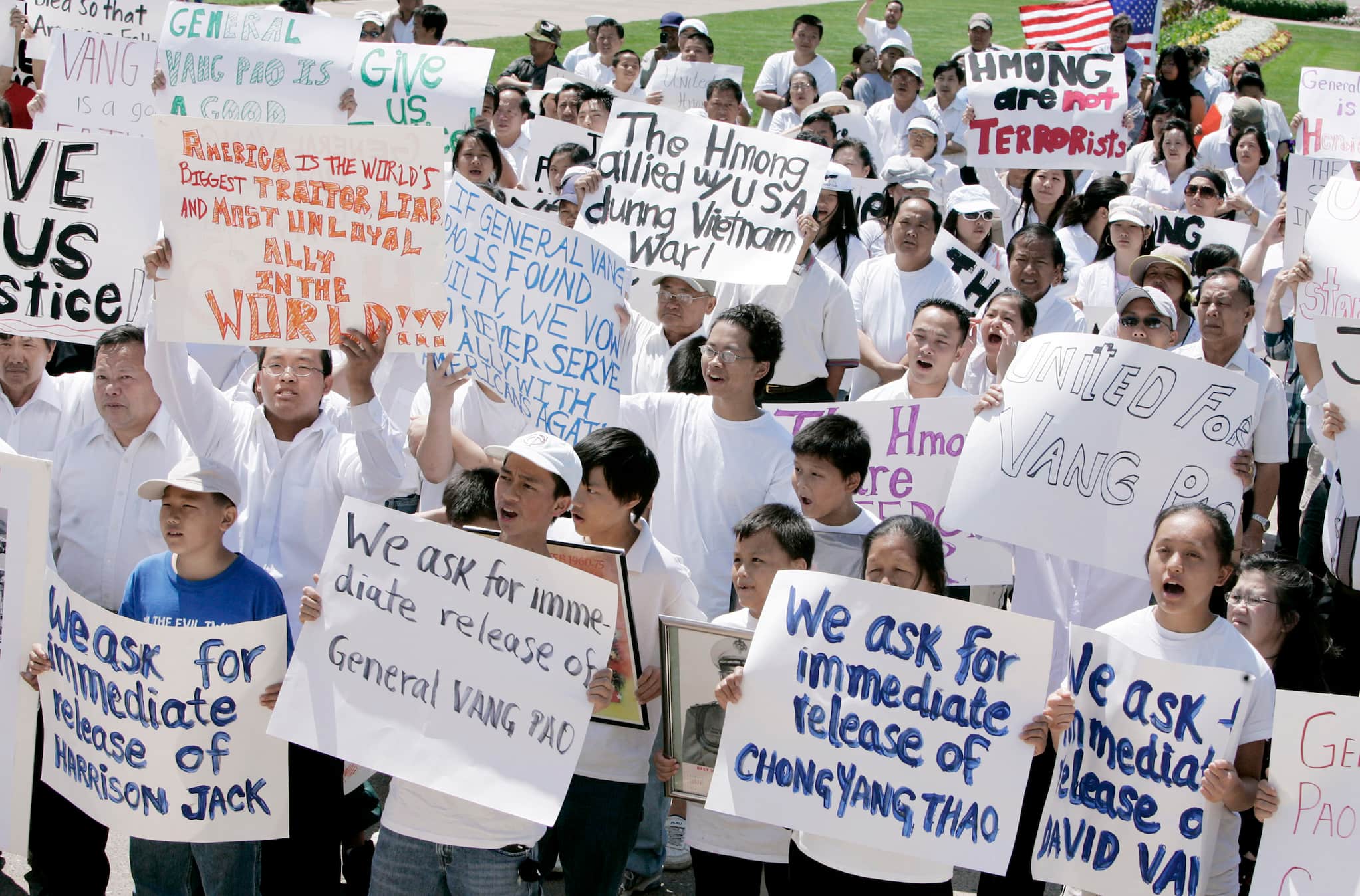
Image 11.03.02 — Hmong community members at a 2007 rally in Minneapolis, Minnesota, demanding the release of General Vang Pao.
During the four years of mobilization, Hmong Americans advocated for the terrorism charges to be dropped, connecting the case with multiple histories related to the United States’ Cold War policies, the War on Terror, and Hmong people’s place as a global ally.
First, activists claimed that if General Vang and the other men were to have carried out the alleged plot, it would have been because they were doing essentially the same thing that then-President George W. Bush was doing by combating terrorism. They were trying to save the Hmong people who were still on the run from Communist persecution in the jungles of Laos. Because the US government abandoned Hmong people in 1975, it was General Vang Pao’s responsibility to rescue them from ongoing Communist aggression.
Second, Hmong Americans used protests and the news media to demonstrate how the US government had shifted their War on Terror toward Hmong people after failing to capture Osama bin Laden. Thus General Vang served as a proxy for the former ally turned terrorist, even though General Vang was the product of US imperialist Cold War policies. In addition, the charges filed against the General involved essentially the same criminal acts that were being exercised by the United States, which had catalyzed atrocities around the world. Using these arguments, Hmong Americans contested and effectively reassigned the terrorist label to the United States government.
After two years of mobilizing, all charges against General Vang Pao were dropped, while the other ten defendants remained under indictment; after the General passed away on January 6, 2011, those charges were also dropped. This closed a case that had put the Hmong community on edge and cast doubt on hopes that the United States could be home for Hmong Americans.
CHAN-BOF’s Activism
In California, two organizations that began separately in 2013 with the goal of addressing domestic violence in Hmong communities joined forces in 2018 as California HMong Advocates Network-Building Our Future (CHAN-BOF). As a collaborative, CHAN-BOF works in response to the high murder and murder-suicide rates within the Hmong community due to gender-based violence. Focusing its work in the cities of Sacramento, Merced, and Fresno, the collaborative explores culturally responsive ways to unearth the root causes of gender-based violence in order to mitigate it and to support survivors.
Some of the key challenges to advocacy and change include a lack of specific language to refer to domestic violence. The collaborative has used the phrase “kev tsim txom” to refer to domestic violence even though the Hmong phrase literally means “torture.” Trust, capacity, and perceptions of advocates and shelters also present challenges to addressing domestic violence.
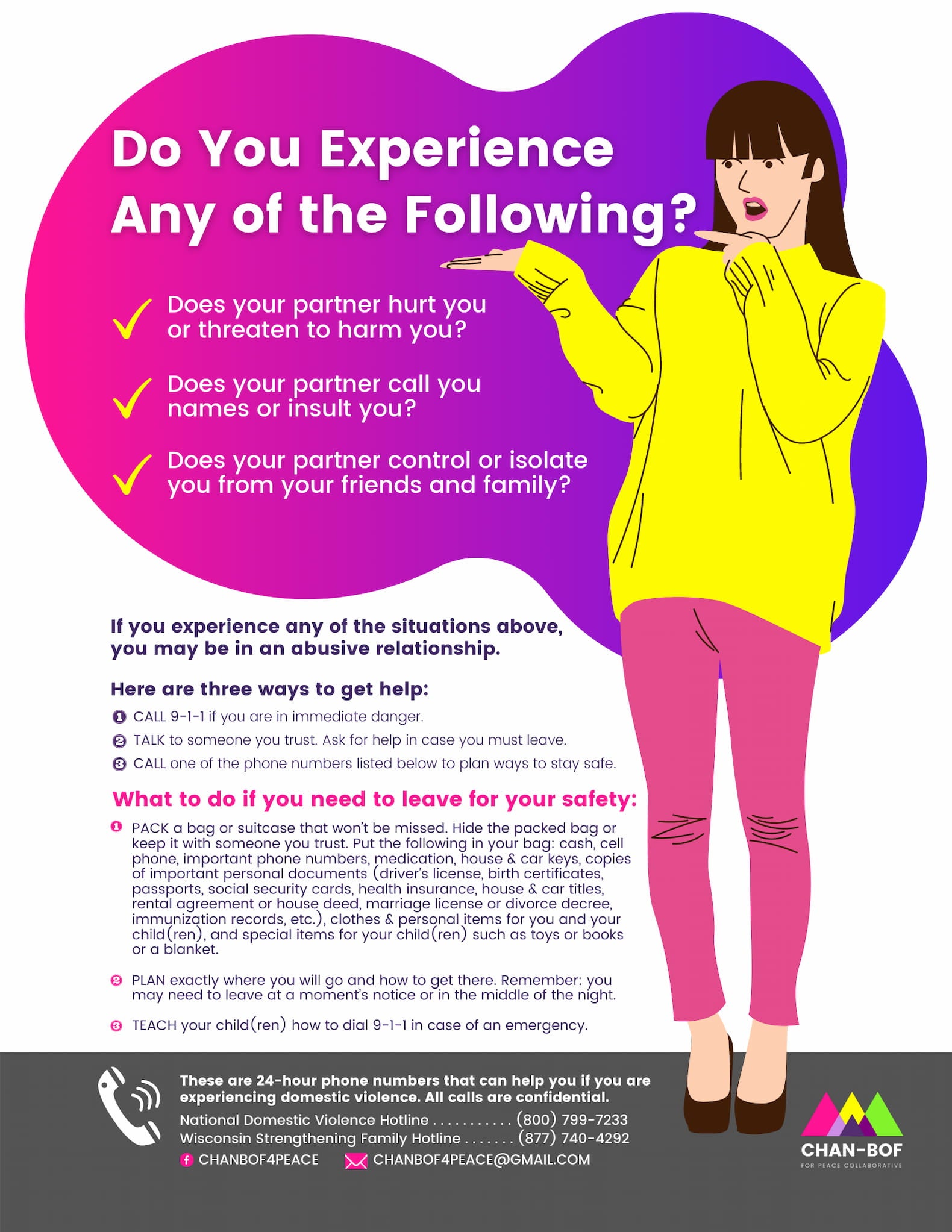
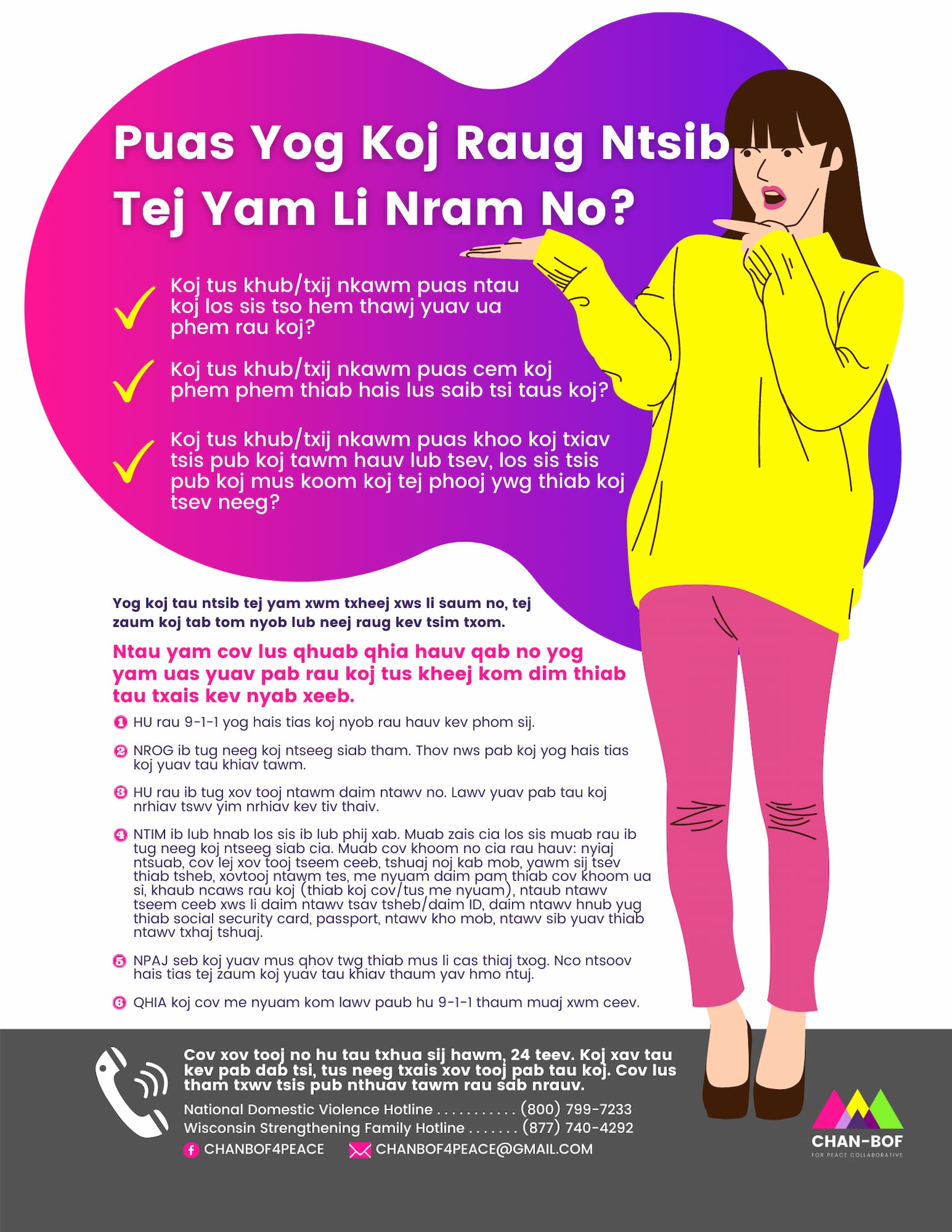
Image 11.03.04 — Chan-BOF published this graphic in both English (left) and Hmong (right) to identify signs of abusive relationships and provide resources for support.
Metadata ↗ (English) Metadata ↗ (Hmong)
The collective has identified some key patriarchal cultural norms that contribute to gender-based violence. Examples include:
- The bride price exchanged in the traditional Hmong marriage ceremony
- The tethering of women’s spirituality to the male figure (her father or husband)
- The valuing of boys and men as carrying the lineage
- The idea of “ua siab ntev” [to be patient], which is used to discipline Hmong women to return to their abusive partners
CHAN-BOF’s organizing and advocacy work centers Hmong youth, women, and queer folks. It conducted a survivor-informed community research project using storytelling as a method to learn from Hmong survivors about their domestic violence experiences and about the individuals or factors that did or did not help them. This research will help to identify cultural norms that are helpful and harmful and to uplift survivors’ voices.
CHAN-BOF also advances a cultural change prevention model to educate community members about gender-based violence, develop a shared language, engage with shamans and cultural experts to understand cultural norms and shed harmful practices, and shift away from victim-blaming toward a culture that supports Hmong women and girls. In addition, CHAN-BOF collaborates with domestic violence organizations to create systemic change.
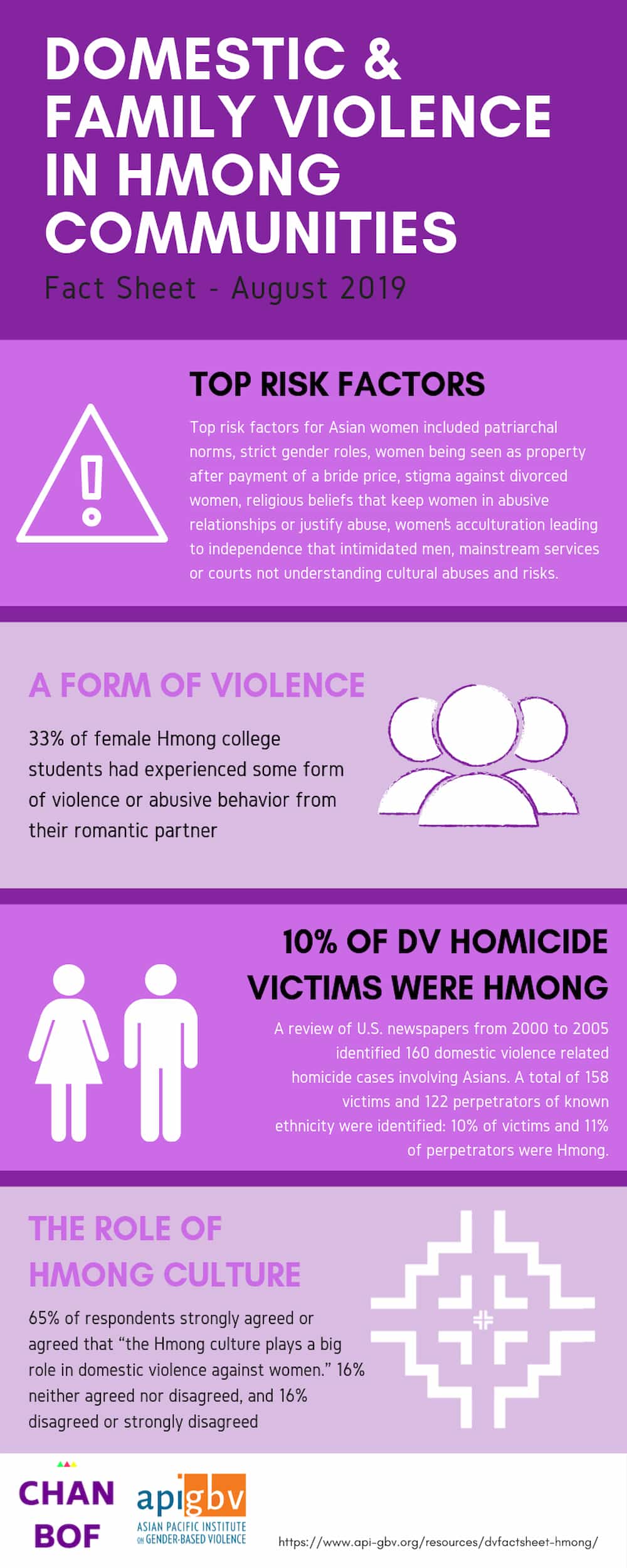
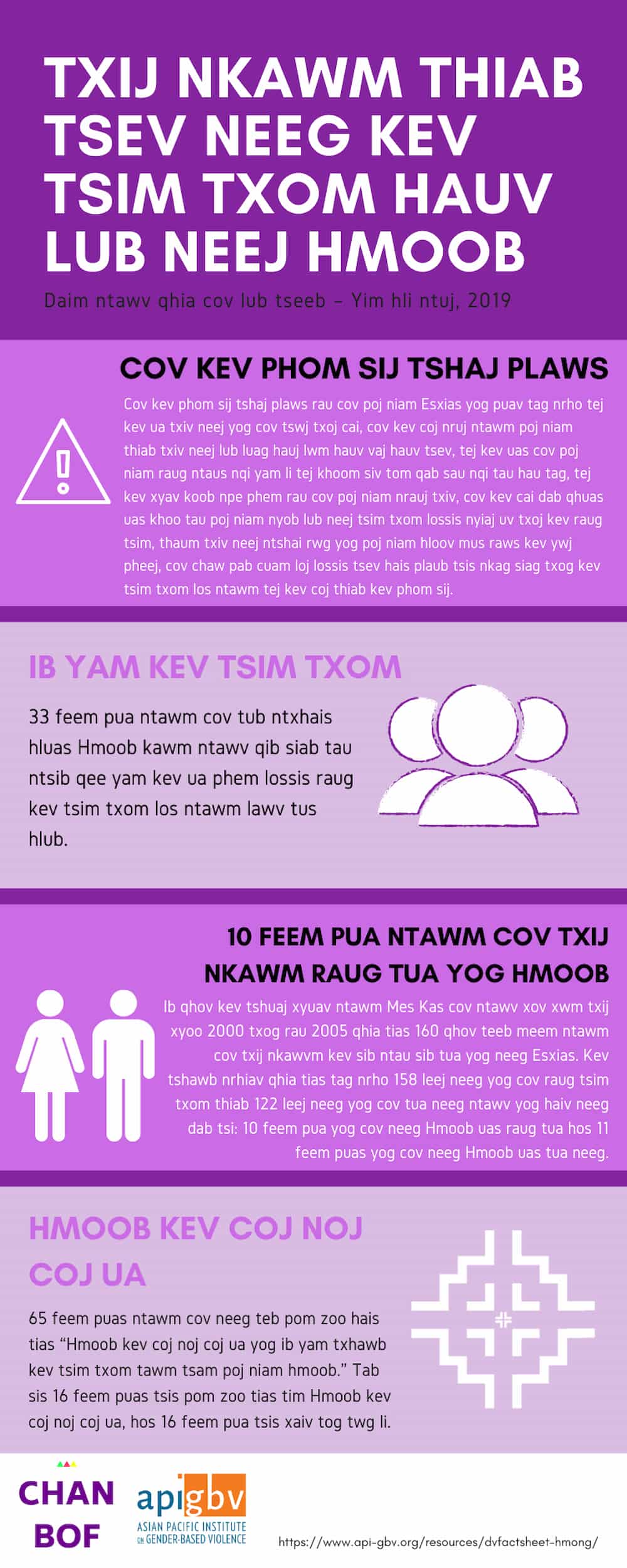
Image 11.03.05 — Chan-BOF created this fact sheet in partnership with the Asian Pacific Institute of Gender-Based Violence, summarizing their findings on domestic and family violence within the Hmong Community. The fact sheet is available in both English (left) and Hmong (right).
Metadata ↗ (English) Metadata ↗ (Hmong)
Hmong American women, nonbinary, and transgender activists know that addressing gender-based violence within Hmong communities is only one aspect of their work. Gender-based violence is interwoven with other experiences of systemic violence, trauma, and oppression. Often, barriers exist to accessing existing resources for survivors based on language and nonculturally sensitive approaches that might further isolate survivors.
Hmong American women activists have also organized alongside African American activists to demand justice for Black lives, stating that Hmong liberation is tied to Black liberation. Consequently, some activists have suggested that systemic changes to valuing Black lives would also benefit Hmong Americans as another racial minority in the United States. After the murder of George Floyd, for example, Hmong women actively engaged in rallying and shifting the conversation within Hmong communities around anti-Blackness and building solidarity.
Youa Lee, the mother of Fong Lee, the teenager who was murdered by Minneapolis police in 2006, along with hundreds of individuals from the Hmong community, attended a “Justice for George Floyd” protest on May 31, 2020. There, she expressed her pain as a mother who had lost her son to police murder, and she urged her community to stand on the side of justice.
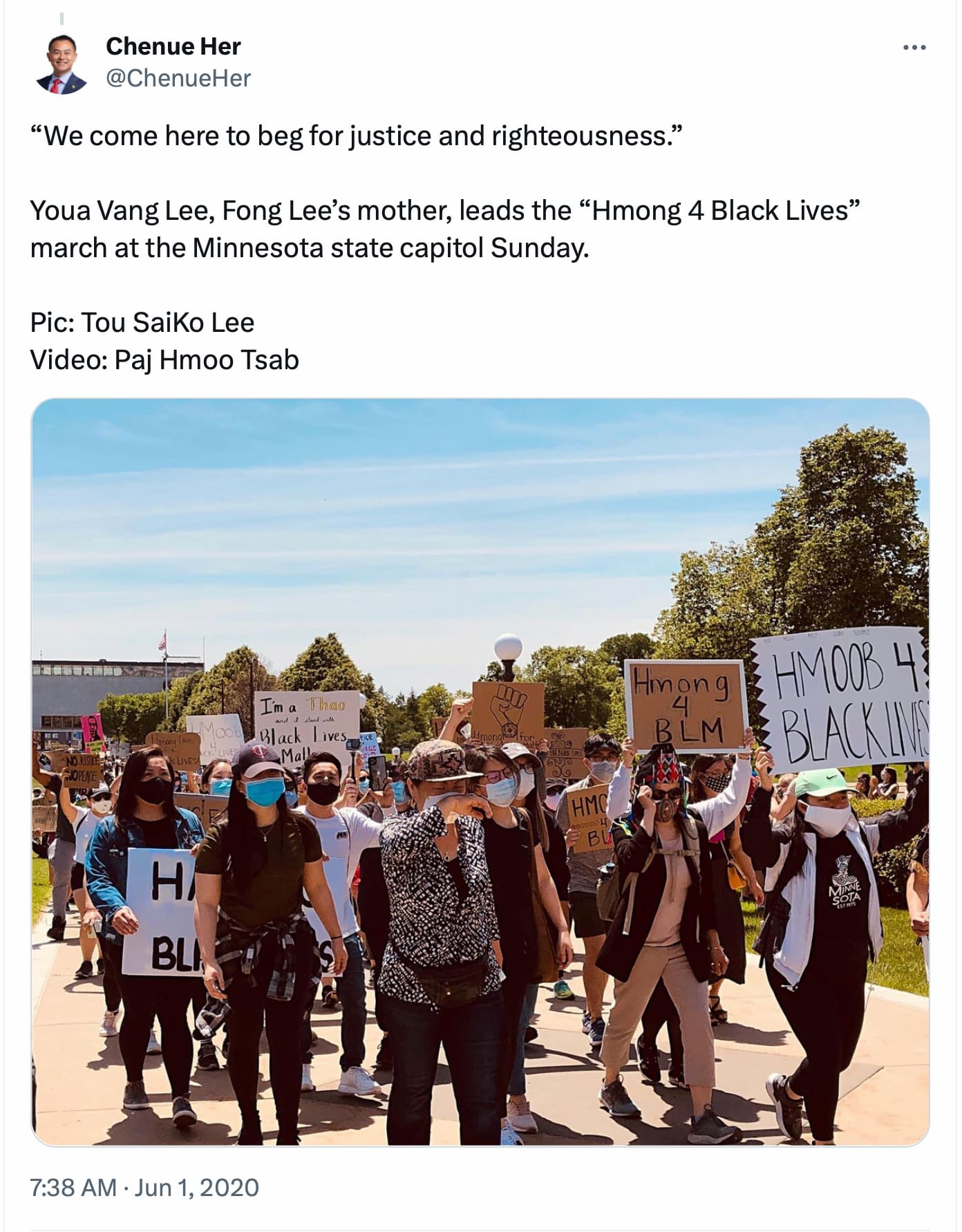
Image 11.03.06 — Youa Lee (center), mother of Fong Lee who was murdered by Minneapolis police in 2006, leads a march at a Justice for George Floyd protest in 2020. This tweet by @ChenueHer illustrates the organizing power of Hmong American women and their active role in demanding justice for Black lives.
In addition to individuals, organizations like the Milwaukee, Wisconsin-based Hmong American Women’s Association (HAWA) and Madison, Wisconsin-based Freedom, Inc. have called for Hmong American solidarity with African Americans, especially with Black women. In the context of heightened anti-Asian racism during the COVID-19 pandemic, Hmong American women and queer organizers made it clear that community building for collective liberation must refuse alliance with state-sanctioned violence and be intersectional and across communities.
This module has discussed Hmong American community building through organizing around issues of global politics, gender-based violence, and racism. By specifically showing Hmong American women and queer-led organizing, it has highlighted how community activism bridges communities.
Glossary terms in this module
displacement Where it’s used
The forced removal of a group of people from the place they live, often due to circumstances such as war, famine, natural disasters, or other forms of political persecution.
Indigenous Where it’s used
Refers to people who were the original inhabitants of the land, predating colonialism, for whom land is a source of knowledge, resource, and cultural and spiritual connection. Indigenous peoples maintain sovereignty by resisting colonial power.
intergenerational Where it’s used
Involves or refers to something that occurs across two or more generations.
intersectional Where it’s used
Conceptualized by legal scholar Kimberlé Crenshaw in 1989 as a way of understanding how various forms of inequality operate together and exacerbate each other. The term refers to overlapping systems of oppression that were not addressed adequately in the law or dominant ways of thinking about inequalities.
Secret War Where it’s used
During the Vietnam War, the US Central Intelligence Agency conducted a covert operation, where the US militarily-supported Hmong and other ethnic groups in Laos to combat North Vietnamese forces and the Communist Pathet Lao. From 1964 to 1973 the United States dropped more than two million tons of bombs, which the American public did not learn about until the 1990s and 2000s.
self-determination Where it’s used
The right of a people to freely determine their political status and freely pursue their economic, social, and cultural development without external interference. This right is recognized by the United Nations and is an important aspect of human rights.