




Module 4: Hmong Americans and Education
Have Hmong Americans found home in the United States?
This module discusses Hmong educational experiences, including schooling during the war in Laos, in refugee camps, and in the United States. It highlights Hmong people’s relationships to education as a process of struggle that includes the challenges of learning within a Eurocentric system, and how knowledge empowers students to imagine a just future.
How is education a site of struggle for culture and identity for Hmong Americans?
How have Hmong American students experienced deficit thinking and criminalization in schools?
How are Hmong Americans transforming their own educational experiences through community knowledge?
Hmong Access to Education Historically
Based on the belief that soldiering is seen as a virtuous status or act, noncitizens and allies around the world who became soldiers for the United States are viewed as protocitizens, meaning first citizens or citizens-in-progress whose sacrifice can make them citizens. Yet for noncitizens and allies, soldiering for the US is also connected to the US military’s aim to harm their people and other marginalized peoples.
Historian Mai Na Lee explained that literacy—meaning the ability to read and write in the languages of both the Lao state and the French colonizer—enabled Hmong political leaders like Touby Lyfoung to gain access to political power because they could communicate with state and colonial entities. This allowed them to bypass Hmong community tensions and gain legitimacy with French colonial administrators. Education was a privilege, and it meant gaining access to political power to uplift Hmong communities and seek self-determination by engaging with state and colonial authorities.
It was not until the United States’ initiative in Laos to recruit Hmong as soldiers through the CIA that expanded education opportunities became available. Within the turmoil of war were also opportunities for education and health care. According to historian Chia Youyee Vang, the American war in Laos made available paid positions in “quasi-military, economic aid, and rural development areas, including the clandestine army, health care, education, refugee relief, and psychological warfare.” 1
The war time, internal displacement of people from their villages as refugees to “cities” like Long Cheng and Sam Thong changed Hmong lives. Vang has further explained that “the prestige that came with obtaining an education resulted in General Vang Pao’s request for USAID to construct schools near the refugee-relocation centers.” 2 Choua Thao’s story is unique because it preceded the numerous village schools that were built around Long Cheng and Sam Thong in the early 1960s through the early 1970s. It was estimated that these schools educated nearly ten thousand Hmong children in primary education; some of these students received additional schooling by attending high school in Laos’s capital of Vientiane or other specialized training. 3

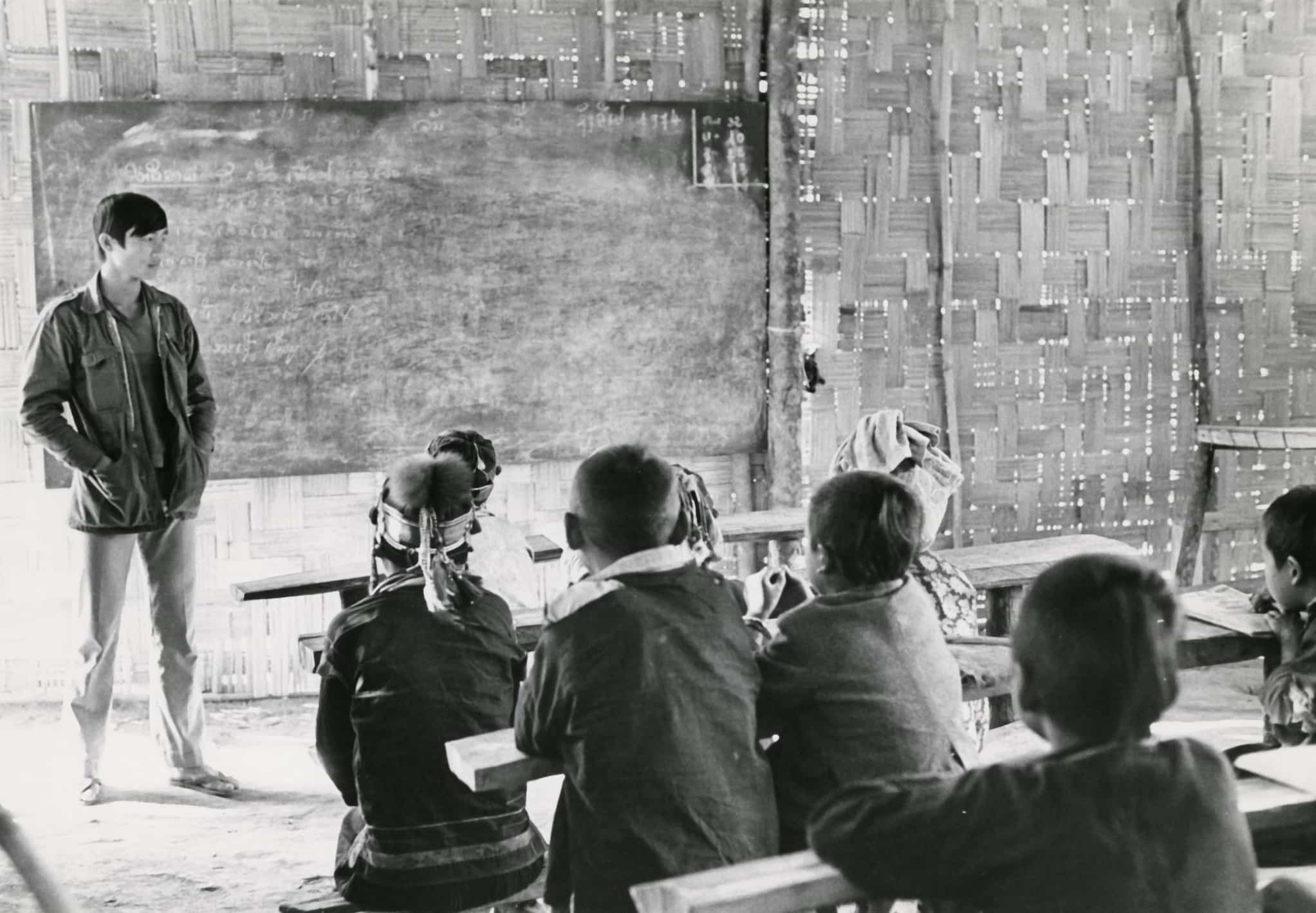
Image 11.04.02 — Hmong children attend a summer school program operated by the International Voluntary Service (IVS) in Laos, 1972.
Even though the US-funded schools in villages opened opportunities for Hmong boys and girls, only some school-aged children could enroll. Those students were primarily boys, especially if they were the youngest son, and some girls. Many more Hmong youth were needed to farm and provide for their families. Hmong girls were expected to learn how to be “good” Hmong women and future wives through domestic work and caretaking. But the escalation of the war—beginning in 1964 with the US bombings in Laos through 1974—meant that many of those who attended school could not finish their education.
Many Hmong boys were drafted to join the “secret” clandestine army as young as age eleven, even if they were attending school. Meanwhile, some Hmong girls who could stay in school received training as nurses and medics to care for the wounded soldiers. Choua Thao’s story demonstrates how opportunities to attend school were particularly intertwined with the colonial project of the war.
A few highly educated Hmong individuals emerged from this period. Dr. Yang Dao was one of the first Hmong individuals to pursue his education beyond elementary and secondary schooling. He went on to earn his PhD in France and authored an early pathbreaking book about Hmong people, Hmong at the Turning Point (1993).
In this book, Dao coined the phrase “Hmong means free” to shift attention away from the derogatory naming of Hmong as “Meo” and the deficit thinking or focus on perceived shortcomings about Hmong people. “Hmong means free” had connotations of self-determination, and it pushed others to understand Hmong as a people with a long history and complex cosmology and experiences. Even though the phrase has since been adapted as a cultural descriptor for Hmong people, it was originally an attempt to depart from the colonial depictions of Hmong people as uncivilized.
Education in the Refugee Camps
If the war opened schools in villages for some young Hmong people, life in refugee camps after Hmong families escaped from Laos provided opportunities for schooling as part of the humanitarian services. Young children could attend schools that were set up by the United Nations High Commissioner for Refugees (UNHCR). Hmong people living in Thailand’s refugee camps learned the Thai language. Furthermore, the refugee camps, even as overcrowded and low-resourced places, provided Hmong people opportunities to live together and to teach and learn from each other.
Because villages in Laos were situated farther from each other and interactions between clans or extended family were few, camp life changed the distant connections as people lived, waited, and dreamed together. Hmong people shared their skills and knowledge. They set up organizations called “koom haum” to organize and share knowledge, and also to mobilize young people and build intergenerational knowledge.
One such organization, Vaaj Sab Swb Sau, organized elders and young people to teach Hmong cosmological beliefs and cultural practices (kev cai), Hmong language classes, and music and dance. These were spaces where Hmong individuals who did not have an opportunity to attend school and who were already young adults with children by the time they had arrived in the camps could learn how to read and write in Hmong.
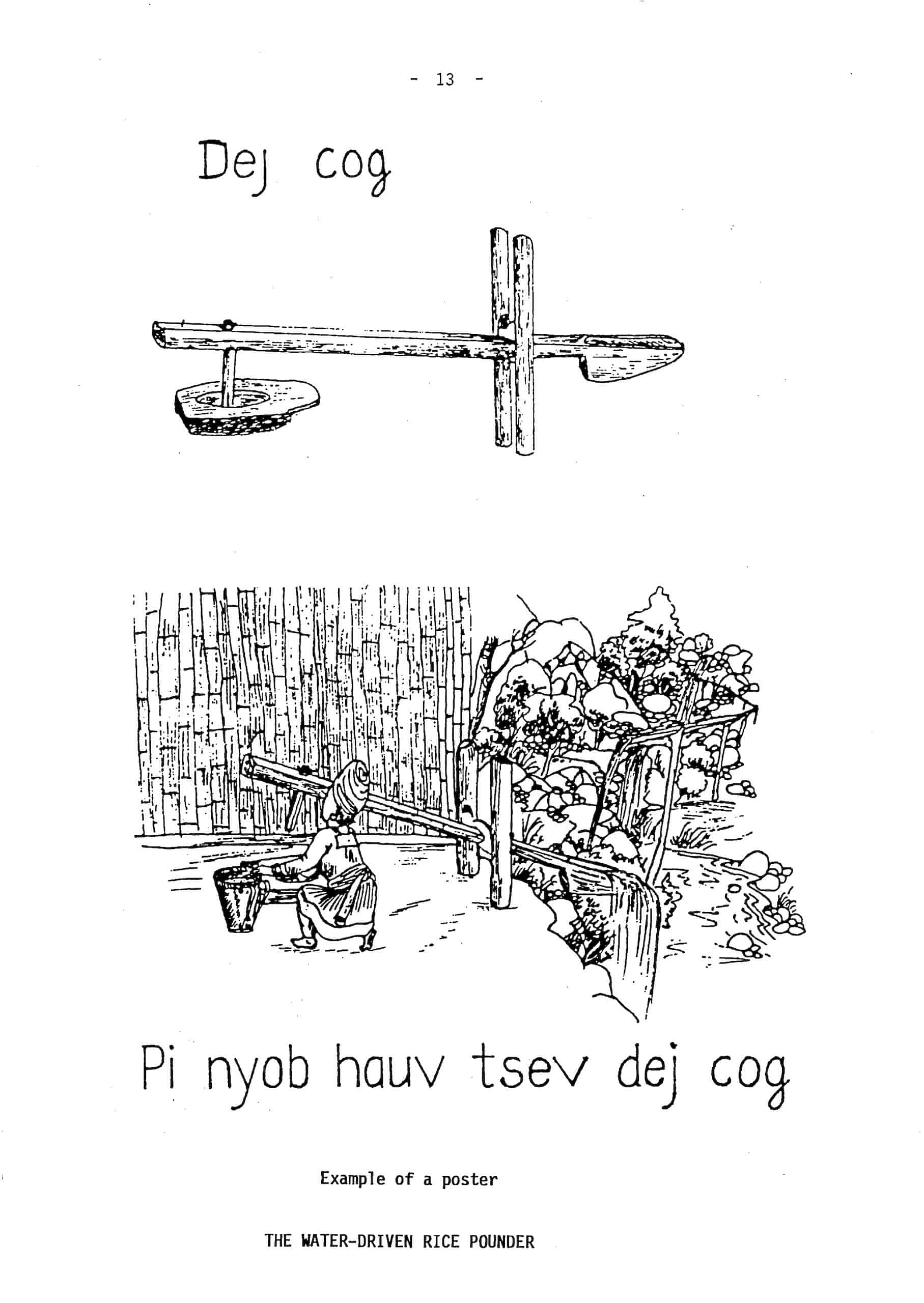
Image 11.04.04 — This is a poster for teaching literacy to Hmong refugees. Écoles Sans Frontières (ESF), a French voluntary agency designed and implemented a program in 1983 for Hmong refugees in Ban Vinai refugee camp to promote literacy among the adult population.
Hmong American Education in the United States
While migration to the United States opened up access to education, Hmong American experiences with the US education system have been filled with barriers to educational attainment. Compared to other Asian American groups and to all Americans, Hmong Americans are behind in educational attainment. According to a 2021 PEW Research Center report on educational attainment among the Hmong population in 2019, the statistics are as follows:
- 46 percent have a high school degree or less
- 31 percent have some college education
- 17 percent have a bachelor’s degree
- 6 percent have a master’s or PhD degree
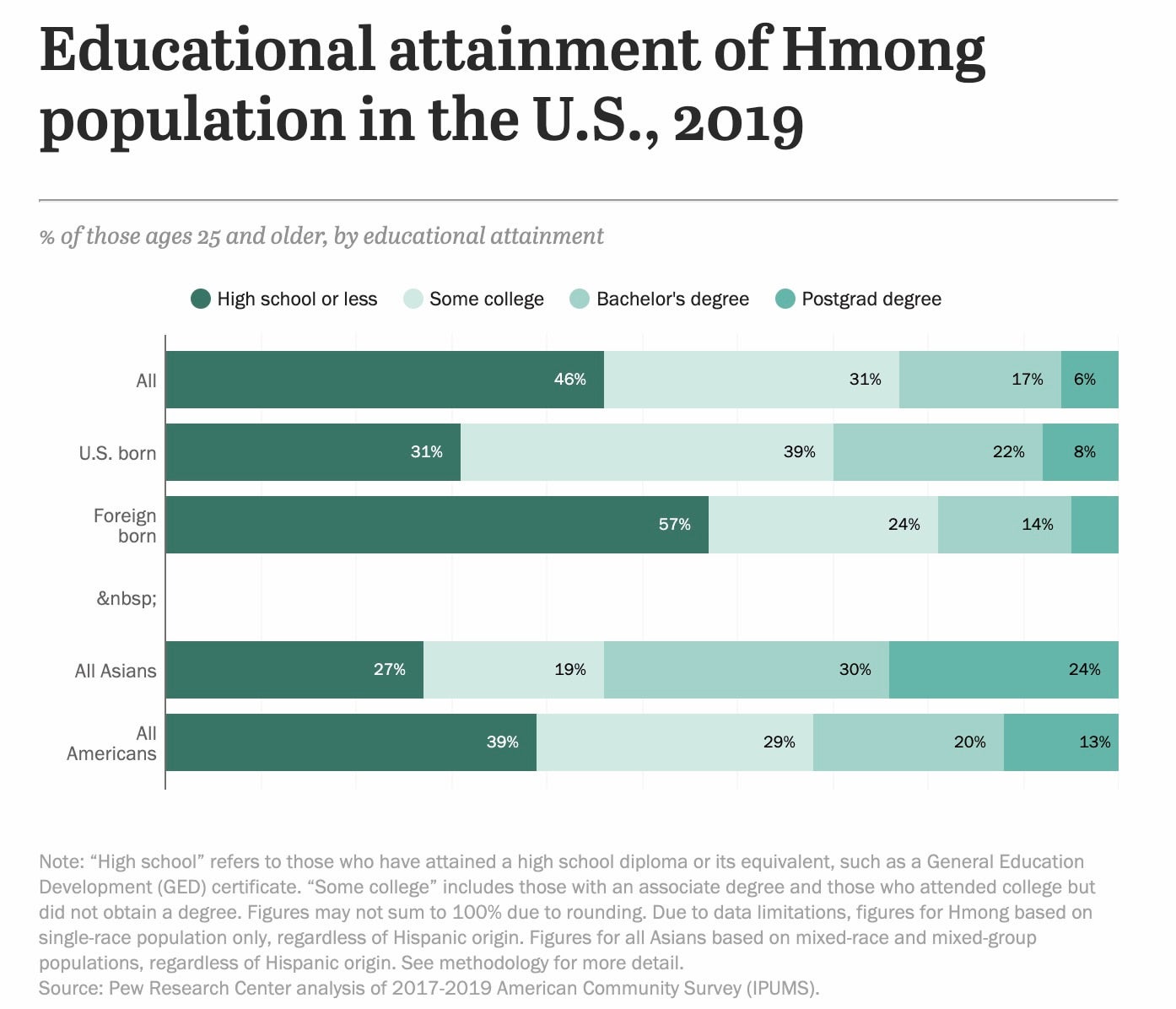
Image 11.04.05 — This chart highlights the disparity of Hmong American educational attainment compared to other Asian American groups in the US in 2019. Source: Pew Research Center analysis of 2017-2019 American Community Survey (IPUMS).
While this research clearly depicts a state of low educational success for Hmong Americans, it does not explain the many barriers Hmong American students encounter in schooling today. These barriers, broadly speaking, include the following:
- First, Hmong American students are subject to a cultural deficit framework where their community and cultural background are deemed harmful to educational success such as the lack of historical access to education and the perceived lack of parental involvement.
- Second, Hmong American students are tracked in school as English as a Second Language (ESL) or English Language Learner (ELL) students because Hmong language is spoken at home, even though the students primarily speak English and were born in the United States.
- Third, Hmong American boys often experience criminalization in schools, which track them as potential troublemakers. As a result, they may be surveilled by police or receive higher incidents of suspensions.
- Fourth, the aggregated data in K-12 and higher education lumps Hmong American students with other Asian American students, which creates a misrecognition that they are already doing well and do not need additional resources or support.
- Fifth, Hmong American parents, many of whom have a high school degree or less, typically do not have the resources to create additional learning opportunities such as tutoring or education enrichment programs that would further prepare their children to do well in the classroom.
Support Groups, Clubs, and Other Student Organizations
Considering these multiple barriers, many Hmong Americans today are striving to finish high school and attend colleges and universities. Students find mentors and support resources by trial and error or through student-led support groups. At high schools with larger populations of Hmong American students in cities like Fresno and Sacramento, California, Madison, Wisconsin, and St. Paul, Minnesota, students have created Hmong or Asian clubs where they create a sense of belonging in school through social and cultural activities. Hmong American students build on this organizing at universities to support each other, especially when they are away from home.
In California, Hmong American students at the different University of California (UC) and California State University (CSU) campuses formed their own Hmong American Student Association (HmSA or HSA) in the early 2000s. In the UC system, Davis and Merced have larger Hmong student populations; therefore, their student organizations are more robust. At these two campuses, Hmong student organizations organize an education conference where they bring high school students to visit the university and host workshops on financial aid and career options, among many other initiatives.
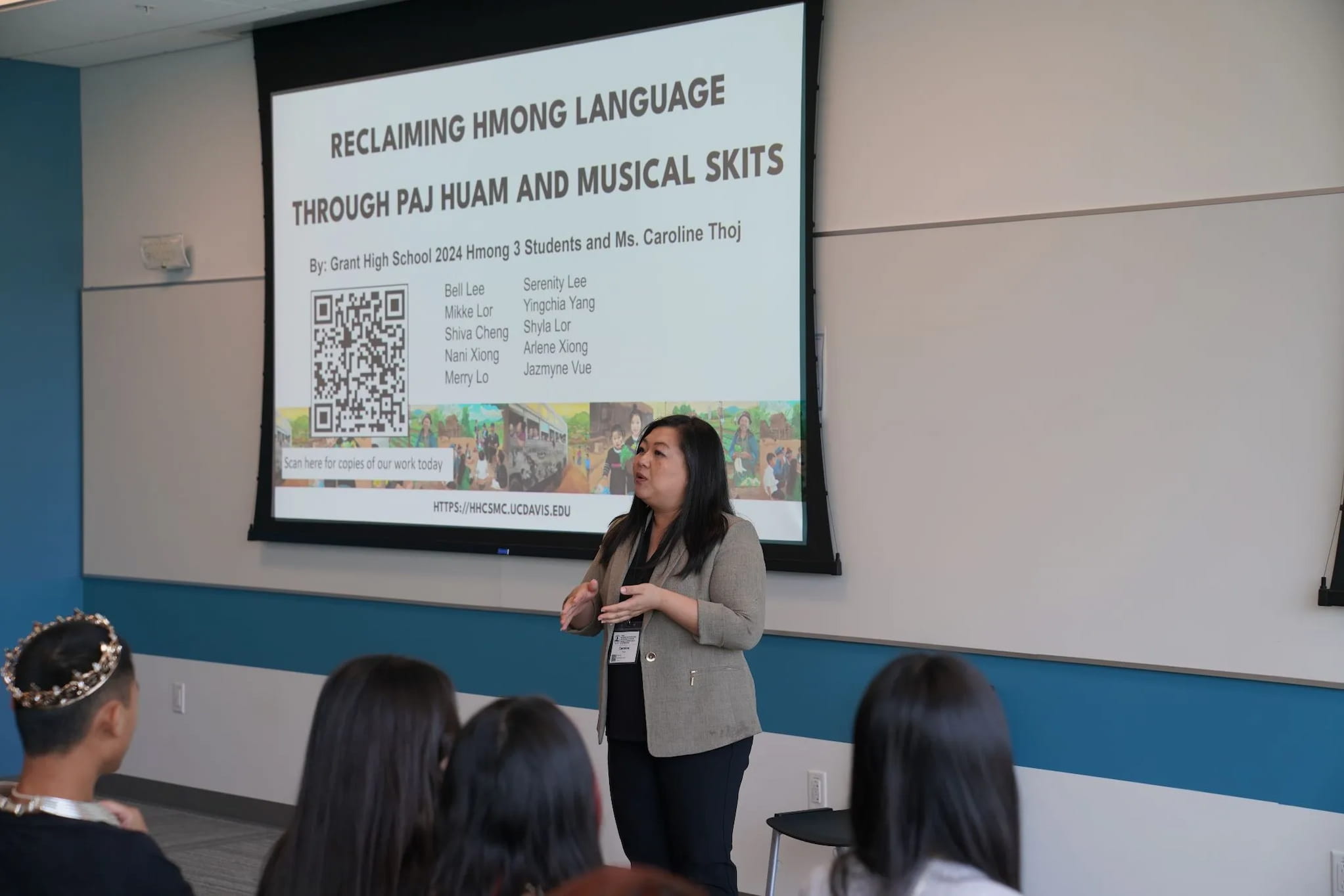
Image 11.04.06 — Caroline Thao from Grant High School in Sacramento presents at the inaugural Hmong History and Cultural Studies Conference at the University of California, Merced, in 2025.
These conferences feature Hmong American keynote speakers who have achieved success in their careers. For example, the Hmong American students at UC Merced proposed to feature Mai Lee Chang, a Hmong American engineer who works at the National Aeronautics and Space Administration (NASA). They even asked the engineering department for funding support to invite Chang. Although it did not work out for Chang to speak, the student organization’s efforts demonstrate the labor and thought of Hmong college students to serve as and to seek out role models to inspire younger students to attend college. Often, these organizations do the work of their universities to provide recruitment and retention services. Because college student data is aggregated, they also find their own ways to identify incoming Hmong American students through informal networks.
In addition to student efforts to uplift each other through schooling, Hmong American educators have worked to build curricula and programs to enrich student learning and to prepare them to navigate a diverse and complex world. For example, educators in the Fresno Unified School District have built a Hmong Dual Language Immersion program to develop students who are bilingual, biliterate, and culturally competent. The program was launched in the 2017–2018 academic year at Vang Pao Elementary in Fresno. Hmong American educators Doua Vu, Zer Lee, Thae Xiong, and Sasah Xiong continue to grow the only Hmong program that implements a 50:50 model where students learn to read and write in Hmong and English from kindergarten.
In April 2025, Misty Her, a Hmong American woman, was appointed superintendent of Fresno Unified School District, the third largest school district in the State of California. As the first woman to hold the position in the school district’s history, Superintendent Her’s educational leadership is a testament to the advancements Hmong Americans have made in education despite their struggles against systemic barriers. It also shows the ways that Hmong Americans make a difference in the educational experiences for all students. She serves as a role model for students.
Education is a site of struggle for identity and belonging. But Hmong American students and educators are creating change to enrich students’ experiences and curriculum, and they are also making a systemic impact through educational leadership.
Glossary terms in this module
intergenerational Where it’s used
Involves or refers to something that occurs across two or more generations.
Secret War Where it’s used
During the Vietnam War, the US Central Intelligence Agency conducted a covert operation, where the US militarily-supported Hmong and other ethnic groups in Laos to combat North Vietnamese forces and the Communist Pathet Lao. From 1964 to 1973 the United States dropped more than two million tons of bombs, which the American public did not learn about until the 1990s and 2000s.
self-determination Where it’s used
The right of a people to freely determine their political status and freely pursue their economic, social, and cultural development without external interference. This right is recognized by the United Nations and is an important aspect of human rights.