




A man plays an acoustic guitar on a backlit stage while two women in red flower headbands sing in CHamoru.
Module 1: Overview: Emergent Voices and Activism of Micronesians
Have colonialism and migration impacted the way Micronesians maintain their various cultures?
Micronesia, a vast and culturally rich subregion of Oceania, encompasses more than 2,100 islands spread across 4.2 million square miles of the Pacific Ocean—an expanse nearly equal in size to the continental United States. Despite its name, meaning “small islands,” which was a colonial imposition by a nineteenth-century French explorer, Micronesia is anything but small. Micronesia’s land area measures 1,700 miles and its water area is about 46,000 miles in size.
This chapter explores the histories, geographies, and Indigenous stories of this oceanic region, with a focus on the Federated States of Micronesia (FSM), the Mariana Islands (including Guåhan, widely known as Guam, and the Northern Mariana Islands), Belau (Republic of Palau), Kiribati, the Marshall Islands, Nauru, and Wake Island. The chapter also examines how US imperialism shaped and continues to influence the region’s political and cultural landscapes.
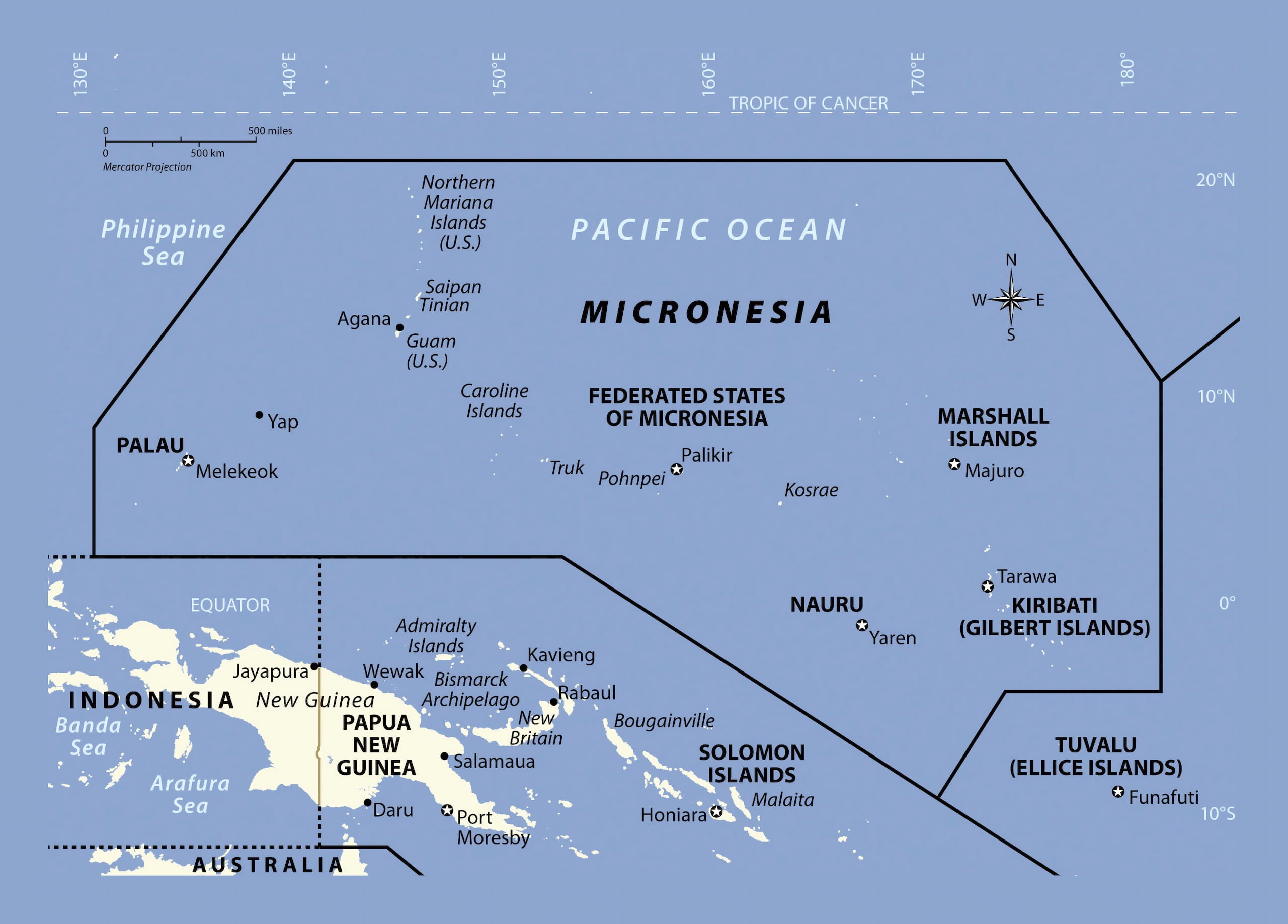
Image 23.01.01 — Map of Micronesia, a subregion in the Pacific Ocean that includes: Belau (Palau), Yap, Guåhan (Guam), and the Northern Mariana Islands, Federated States of Micronesia (FSM), Marshall Islands, Nauru, and Kiribati. Not included in the map is Wake Island.
At the heart of Micronesia’s identity are its oral traditions and original place names that reflect Indigenous values and worldviews. One creation story of the CHamoru people from the Mariana Islands, for instance, tells of the siblings Pontan and Fo’na, whose sacrifices gave rise to land, sea, and life—highlighting the deep interconnectedness among the people, nature, and the waters.
From the word “Guåhan” (Guam), which means “we have” in the CHamoru language, to “Pohnpei,” meaning “upon a stone altar,” the recovery of native names signals cultural resilience and resistance to colonial erasure.
This module explores Micronesian origins stories, its linguistic entanglements with global powers, ancient matrilineal systems of power, and new colonial relationships that reckon with the ways that Micronesian peoples have long negotiated their presence and belonging in the Pacific Rim.
Who are the peoples of Micronesia?
What attributes of the history and culture of the peoples of Micronesia are important in Indigenous movements?
What challenges do Micronesians face in the United States?
Origins of Micronesia
As a culture born from an oral tradition, Micronesians highlight one creation story of the Indigenous CHamoru people of the Mariana Islands archipelago with a story of the siblings named Pontan and Fo’na whose sacrifices created the world. When Pontan knew that he was dying, he called upon Fo’na to use parts of his body to make the world.
As his body was magically transformed to create the world, Fo’na mourned her brother’s passing, and her tears formed the world’s oceans. She then decided to use her own body to create life. Fo’na threw herself into the ocean, and her body became a rock from which the first people were born. This story of Pontan and Fo’na reflects the impermanence of humans and the organic relations among land, ocean, skies, and peoples that value care, love, and connections.
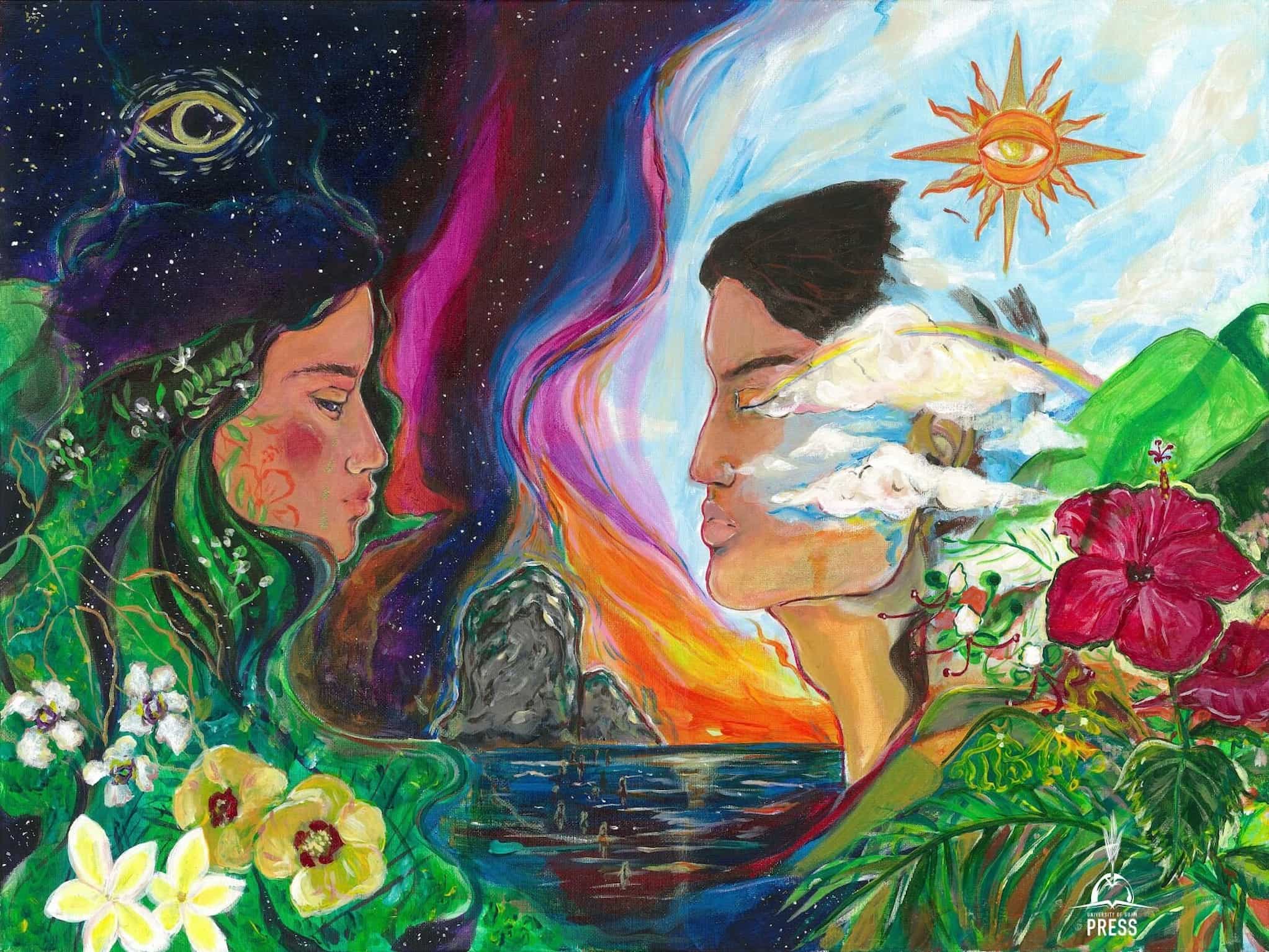
Image 23.01.02 — This illustration by artist Dorathina Herrero and from University of Guam Press depicts Pontan and Fo’na, two powerful siblings from a creation story of the Indigenous CHamoru people of the Mariana Islands archipelago.
Original place names reflect Indigenous values and cultures. Learning the native languages and local histories helps protect Indigenous understanding of the subregion. The languages of Micronesia are included in the Austronesian language family, as part of the Oceanic branch and also are part of the Polynesian subgroup. In recognition of its abundance, the word Guåhan (Guam) means “we have.”
The CHamoru people refer to themselves as Taotao Tåno, or people of the land. Yap means “canoe paddle,” and its people are the Remathau, or people of the ocean. The name Belau comes from beluu, meaning “village,” and relates to the island’s creation story. Pohnpei means “upon a stone altar,” and the people refer to themselves as Mehn Pohnpei, of Pohnpei. The act of reclaiming Indigenous place names in one’s native tongue provides a way to express cultural identity and take action against the names imposed by foreign rulers.
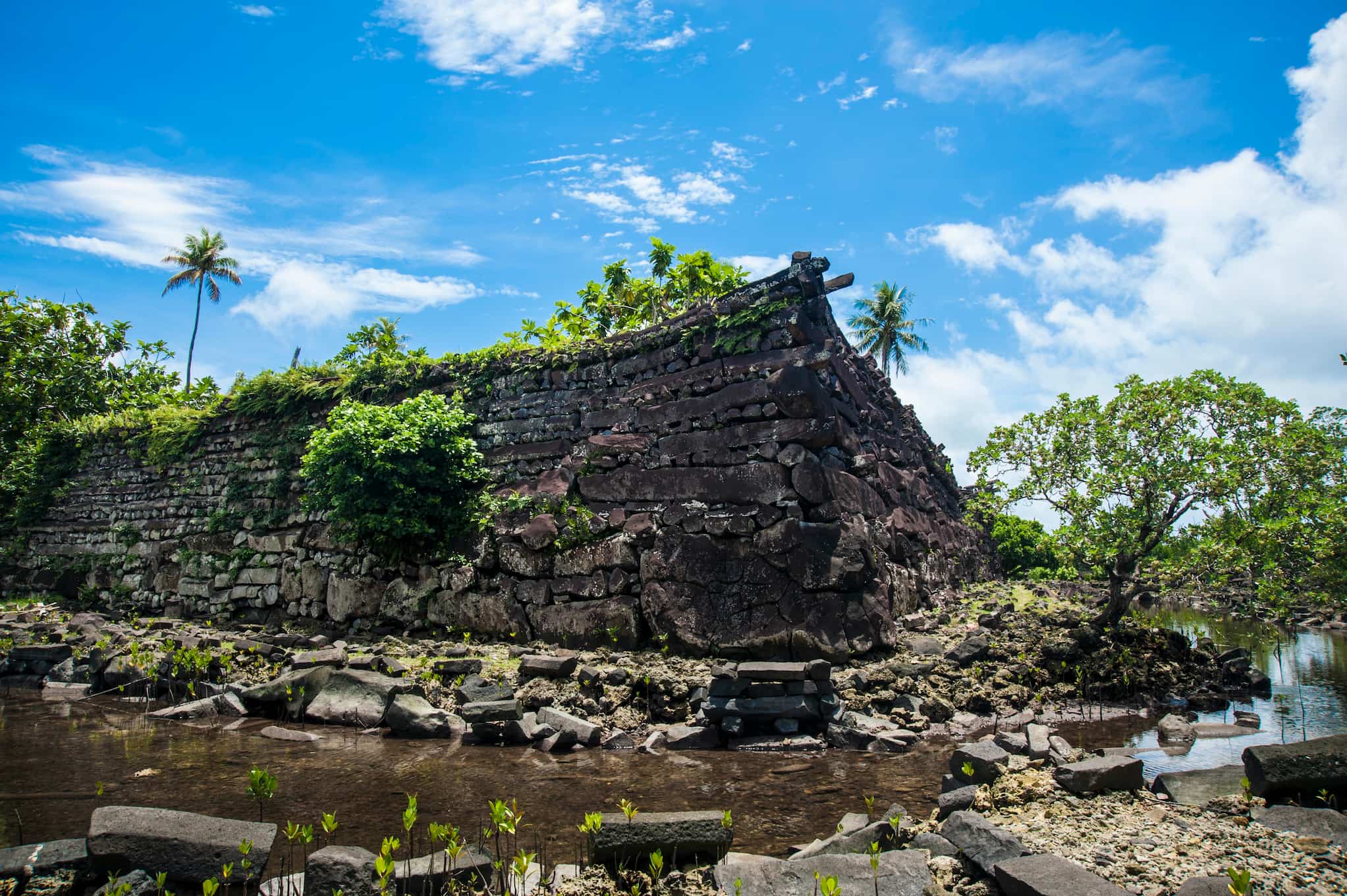
Image 23.01.03 — The island of Pohnpei, meaning “upon a stone altar,” is part of Pohnpei State, one of the four states of the Federated States of Micronesia (FSM). Nan Madol (pictured), an ancient city on Temwen Island, was designated a UNESCO World Heritage Site in 2016.
Beyond its geographic expanse and mythical origins, this subregion also has impressive marine biomes. The Mariana Trench is the deepest measured place on the Earth and is an oceanic trench located near the Mariana Islands archipelago. For comparison, the deepest point in the Mariana Trench is deeper underwater from sea level than the peak of Mount Everest. The region also contains abundant life forms, including nearly 4 percent of the world’s coral reefs and 480 species of coral. In light of Micronesia’s splendor and richness, the wide, deep, and abundant archipelagos, atolls, and islands provide a sense of how the peoples belonging to this region recognize themselves and the world around them.
Oral Traditions and Revitalization of Micronesian Languages
Throughout Oceania, oral and performative traditions remain vital tools for transmitting history, culture, and environmental knowledge. In Micronesia, these oral traditions continue to express Indigenous values and ways of understanding the world well into the twenty-first century. While colonial records have often sought to map, measure, and rationalize Micronesian space primarily in terms of its strategic and extractive value, such as for naval bases and military outposts, oral histories offer a different lens. Traditions like the Marshallese bwebwenato preserve and share cultural memory through storytelling, poetry, spoken-word performance, literature, and creative writing, ensuring that Indigenous perspectives endure and evolve across generations.
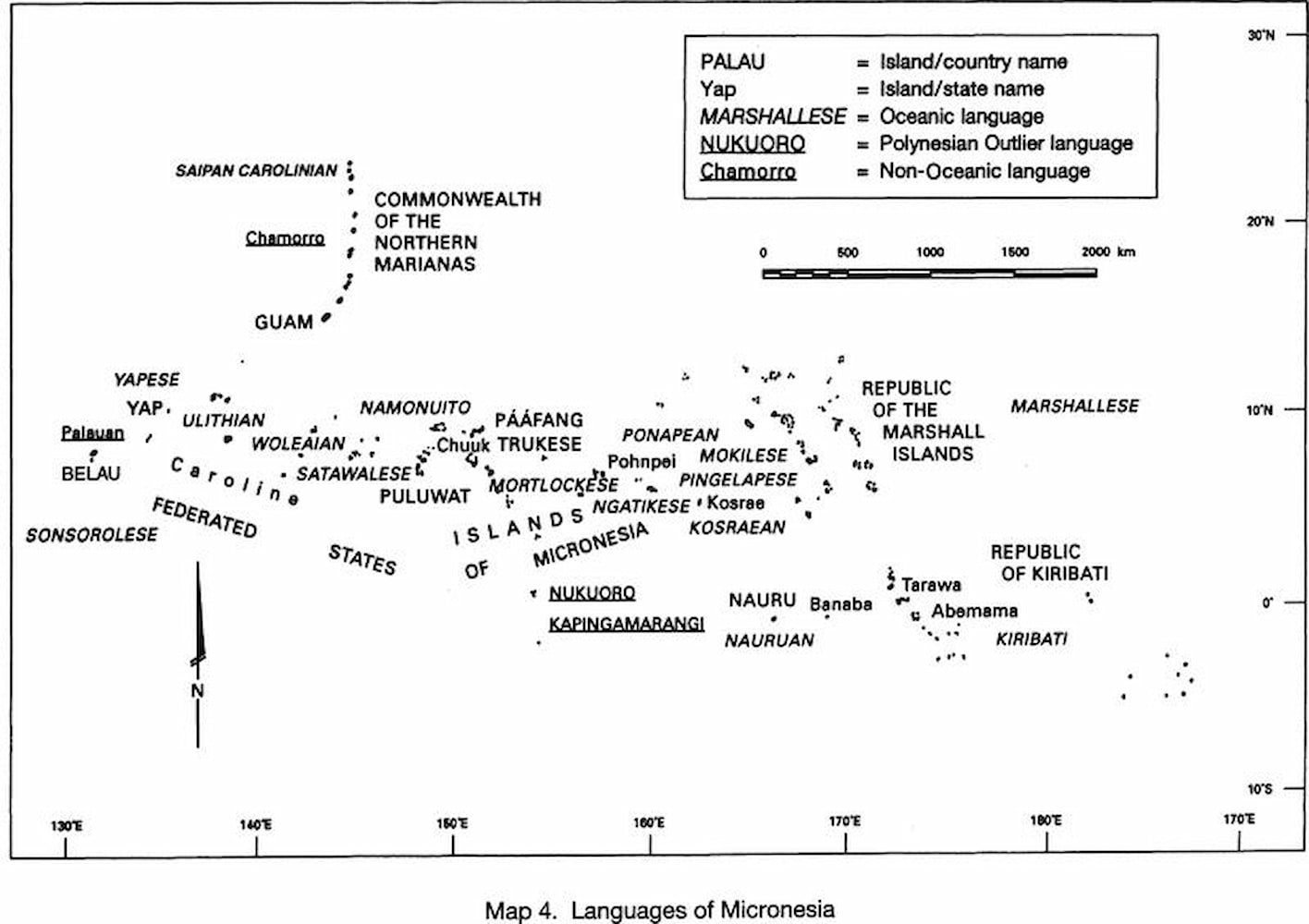
Image 23.01.04a — Map identifying the diversity of languages in the Micronesia subregion, featured in linguist John Lynch’s book, Pacific Languages: An Introduction (1998).
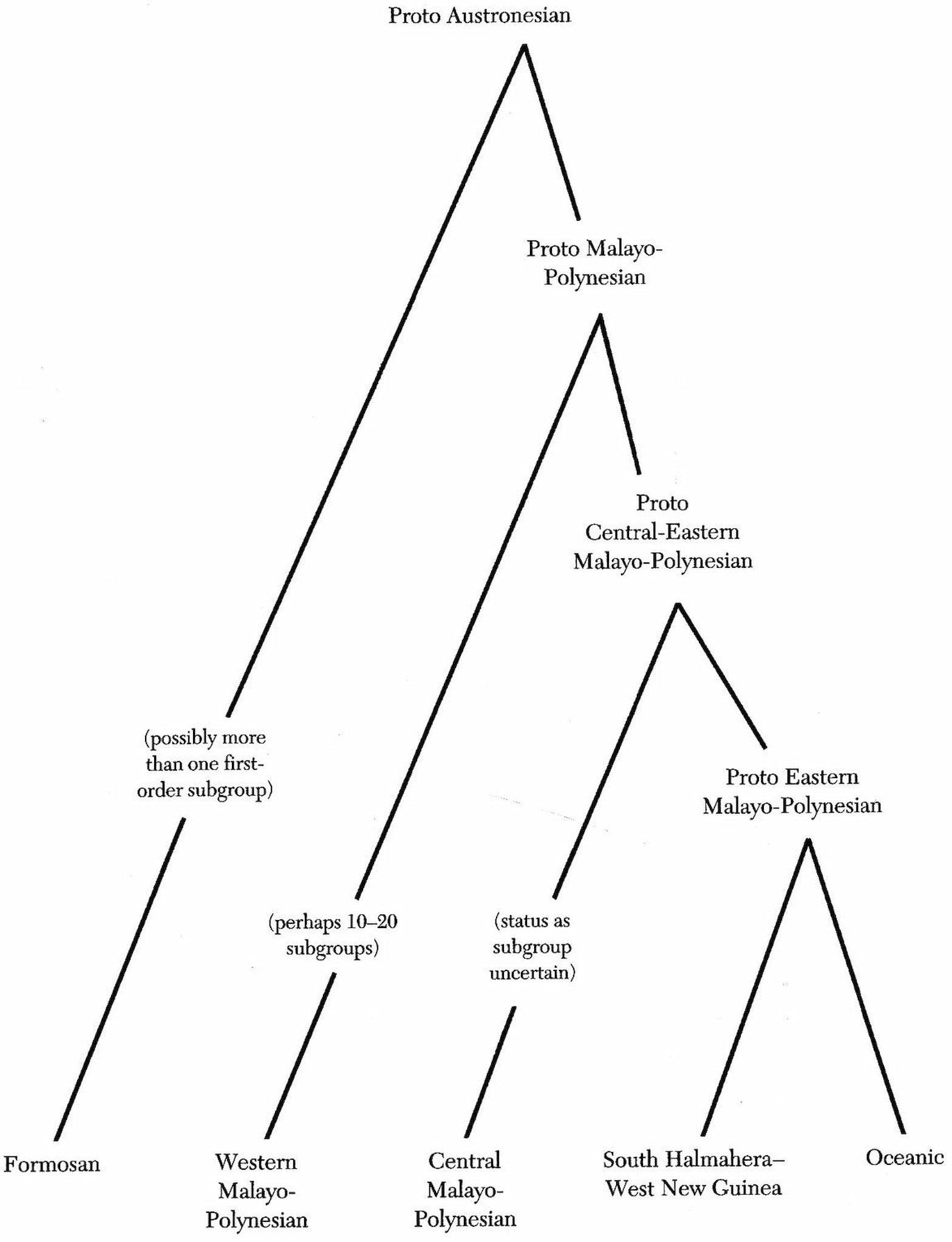
Image 23.01.04b — A tree diagram from linguist John Lynch’s book, Pacific Languages: An Introduction (1998), tracing Oceanic languages to an ancestral Proto Austronesian language. Apart from Belauan (Palauan) and CHamoru (Western Malayo-Polynesian subgroups), all other Micronesian languages are part of the Oceanic group.


Language revitalization is key for the Micronesian speakers and activists who are working to maintain the language throughout the world. Efforts to promote and proliferate Indigenous languages and culture is part of the larger commitment to create a sustainable future for the CHamoru people.
For example, given the large concentration of CHamorus living in California, volunteers from the Long Beach non-profit Kutturan CHamoru Foundation (KCF) established the first-ever CHamoru Language Program in 2010. The program called Ta Hita – Ta Håtsa I Tinigo’ Åntigu, meaning “To uplift ancient knowledge,” advocates for early childhood dual language education in order to continue to build connections between the past and present.
In 2015, KCF also launched the first annual Ta Fan Apåtte CHamoru Immersion Camp for youth ages ten and older. This camp was the first of its kind in the continental US and provides one example of how language-learning can carry forward oral traditions. Additionally, in 2023, the University of Guam received a grant to create a CHamoru Studies Center and to support other projects revitalizing CHamoru language and culture.
These funds help to reverse the decline in the number of CHamoru language speakers, which dipped from 34,598 in 1990 to 21,390 in 2020. These efforts exist through digital channels and online platforms with online classes, podcasts, and social media assets available in the CHamoru language with speakers offering educational resources that are accessible from wherever Micronesians reside.
Artists living beyond Micronesia often grapple with issues of Micronesian identity, language, home, and experiences living away from the islands. CHamoru spoken word and rapper/performer Dakota Alcantara-Camacho and Guåhan-born musical artist Micah “Manaitai” Garrido are two examples. Richie “Lagoon” Engichy, a Chuukese rapper and singer whose music shares the Chuukese stories and culture, details his experiences as a Chuukese person born and raised in Guåhan and currently living in Oregon. Most Chuukese songs are sung in different dialects of the FSM, including the English language. Musicians use multiple languages, such as Chuukese, English, Refaluwasch or Carolinian, and Pohnpeian, and even alternate verses in more than one native language.
In these ways, music and performing arts help further important Indigenous movements for justice and decolonization. Micronesian music is featured at events like Na’lå’la’: Songs of Freedom, a free annual event held in Guåhan to provide conscious and empowering messages for social change and decolonization through music, art, poetry, and dance. The popular local band, Microchild, uses CHamoru and Belauan languages in their songs, and a quartet called The Kids from Chuuk began as an acapella group to share positive messages about Micronesian culture and values.
Matrilineal Societies of Micronesia
Traditional Micronesian societies were based on matrilineal kinship, meaning that women played central roles in determining family identity, inheritance, and land ownership. In matrilineal systems, women were responsible for land stewardship, agriculture, child-rearing, and education. They made decisions about land distribution within families and led community planning and political policy-making.
Clan membership and inheritance are passed through the mother’s line. Though some aspects of matrilineal culture are sacred and therefore, not intended for public knowledge, the practices reflect shared power and cooperative governance. These systems continue to influence Micronesian culture today, shaping how communities care for land, organize leadership, and pass down knowledge.
However, colonialism disrupted many matrilineal traditions. Foreign powers—including Spain, Germany, Japan, and the United States—imposed new governments and missionary-led assimilation policies that forcibly replaced Indigenous systems. These violent changes weakened traditional gender roles and kinship-based cooperation. Furthermore, as more Micronesians live abroad, some cultural practices forwarded by collective living such as weaving or canoe-building are at risk of being lost. Maintaining matrilineal traditions in the face of migration and modern challenges remains an important issue for Micronesian communities.
Political Status and US Relations in Micronesia
Micronesia is unique for its variety of political arrangements, shaped by colonial history and ongoing ties to the United States. There is a long history of foreign aggressions in the land and the atolls including Spain from the sixteenth to the late nineteenth centuries, Germany from 1899-1914, and Japan from 1914-1945. But the US’s presence following WWII from 1947-1994 as part of UN Trusteeship drastically shifted military presence on Micronesia.
Finally, even as Micronesia becomes an amalgam of independent states and US territories post-1994, the devastation on the land, oceans, and peoples continue unabated. These complex political relationships help explain why large numbers of Micronesians live in the US today, why some are US citizens while others are not, and most importantly, why US interest in Micronesia reflects a web of direct and indirect forms of contemporary colonial rule over the territories.
Currently, the subregion includes:
- Two independent nations: Nauru and Kiribati
- Three Freely Associated States (FAS): Federated States of Micronesia (FSM), Republic of the Marshall Islands (RMI), and Belau (Republic of Palau)
- Three Unincorporated US Territories: Guåhan (Guam), Commonwealth of the Northern Mariana Islands, and Wake Island
The Compact of Free Association (COFA) are international agreements between the US and each of the FAS. These agreements grant the US military access and control over defense, while allowing the FAS to remain self-governing on domestic matters. In return, the US provides financial aid and allows citizens of these nations to live, work, and study in the US without visas. However, COFA migrants often face challenges such as limited access to healthcare, especially Medicaid and Children’s Health Insurance Program (CHIP); cultural displacement and difficulty maintaining Indigenous traditions for those moving to the continental US; and racial discrimination in education, housing, and employment.
The US territories of Micronesia include the Commonwealth of the Northern Mariana Islands (CNMI), Guåhan, and Wake Island. CNMI is a self-governing territory under US jurisdiction. Those born in the CNMI are US citizens, have self-rule, and can send a non-voting delegate to Congress. They do not pay federal income taxes. Guåhan is a non-self-governing territory under US control via the Organic Act of Guam. Residents are US citizens but cannot vote in presidential elections and have only limited representation in Congress. Indigenous CHamoru people continue to fight for self-determination to choose their own political status. Wake Island is an uninhabited US military possession, under joint jurisdiction of the US Air Force and Department of the Interior. US jurisdiction on the island reflects the ongoing militarization of the region.
Political Statuses of Micronesian States and Territories
|
State/Territory |
Legal Relationship to US |
Rights Granted to Citizens |
|---|---|---|
|
Federated States of Micronesia (FSM) |
Compact of Free Association (COFA) – sovereign, free association; US responsible for defense; financial assistance |
FSM citizens may live, work, and study in the US without a visa; can serve in US Armed Forces; eligible for certain federal benefits (as of COFA 2024); no US voting rights |
|
Republic of the Marshall Islands (RMI) |
Compact of Free Association (COFA) – sovereign, free association; US responsible for defense; financial assistance |
RMI citizens may live, work, and study in the US without a visa; can serve in US Armed Forces; eligible for certain federal benefits (as of COFA 2024); no US voting rights |
|
Republic of Belau (Palau) |
Compact of Free Association (COFA) – sovereign, free association; US responsible for defense; financial assistance |
Belauan citizens may live, work, and study in the US without a visa; can serve in US Armed Forces; eligible for certain federal benefits (as of COFA 2024); no US voting rights |
|
Guåhan (Guam) |
Unincorporated, organized US territory; governed under Guam Organic Act of 1950; US citizenship conferred |
Guåhan (Guam) citizens have US citizenship; can live and work anywhere in the US; can serve in US Armed Forces; no vote for US President; one non-voting delegate in the US House of Representatives (since 1972) |
|
Commonwealth of the Northern Mariana Islands (CNMI) |
Commonwealth in political union with the US by Covenant agreement (1976); self-governing for internal affairs; US responsible for defense and foreign affairs |
US citizenship; can live and work anywhere in the US; can serve in US Armed Forces; no vote for US President; one non-voting delegate in the US House of Representatives (since 2009) |
These varied political statuses illustrate forms of contemporary colonialism with overlapping influences of self-rule, dependence, and military presence. The existence of these island places as quasi-independent states, as US unincorporated territories with different designations such as the Freely Associated States (FAS) itself tells some of the complicated story of the colonial experiences in Micronesia. The story is quite complex, with islands having simultaneous connections and disconnections with the US. Despite different designations, all of these political relationships reflect the legacy of foreign control and continue to affect daily life, migration, and activism among Micronesian peoples worldwide.
After 1986 when the Compact of Free Association was approved, there was a significant exodus of Micronesians who immigrated to various parts of the US. The experiences of Micronesians abroad, including in Hawaiʻi, are painfully poignant when we consider that, “First we nuked their islands and then we took control of the whole region. In exchange, Micronesians can move to the US without restriction. And they are coming — by the tens of thousands — for health care, education and jobs.” 1 These experiences are also conveyed in the images and stories emerging from the community of Micronesian migrants who have experienced discrimination.
Let me Live as my ancestors did.
Give your grandchildren a life
Different from that which you had.
Stars of national awareness
Are now shining on our door steps.
“Calls of Youth,” Lines 17-21, by Hermana Ramarui, (Belauan poet)
Migration and Population
Seafaring and migration are interwoven into the fabric of Micronesian life, historically shaped by four thousand years of voyaging networks, kinship ties, and seafaring technology across two-thirds of the Pacific Ocean. They engaged in inter-island travel by canoe, sharing navigational knowledge and techniques, as well as canoe design. Inter-island voyaging continues today with efforts to revitalize and maintain the practice, regardless of where Micronesians live.
Today, environmental disruptions, including sea-level rise, health problems that trace back to US nuclear testing in the islands, limited infrastructure, and a search for economic, educational, and medical opportunities drive Micronesian movement across the Pacific and into the US. Migration accelerated under the COFA that allowed citizens of the FSM, Marshall Islands, and Belau to live and work stateside in the US, visa-free. Especially as subsidies to their islands waned, many relocated to Hawaiʻi, California, Oregon, Texas, Washington, and parts of the Midwest, including large Chuukese and Marshallese communities.
More to explore
Image
United States Nuclear Testing in Micronesia
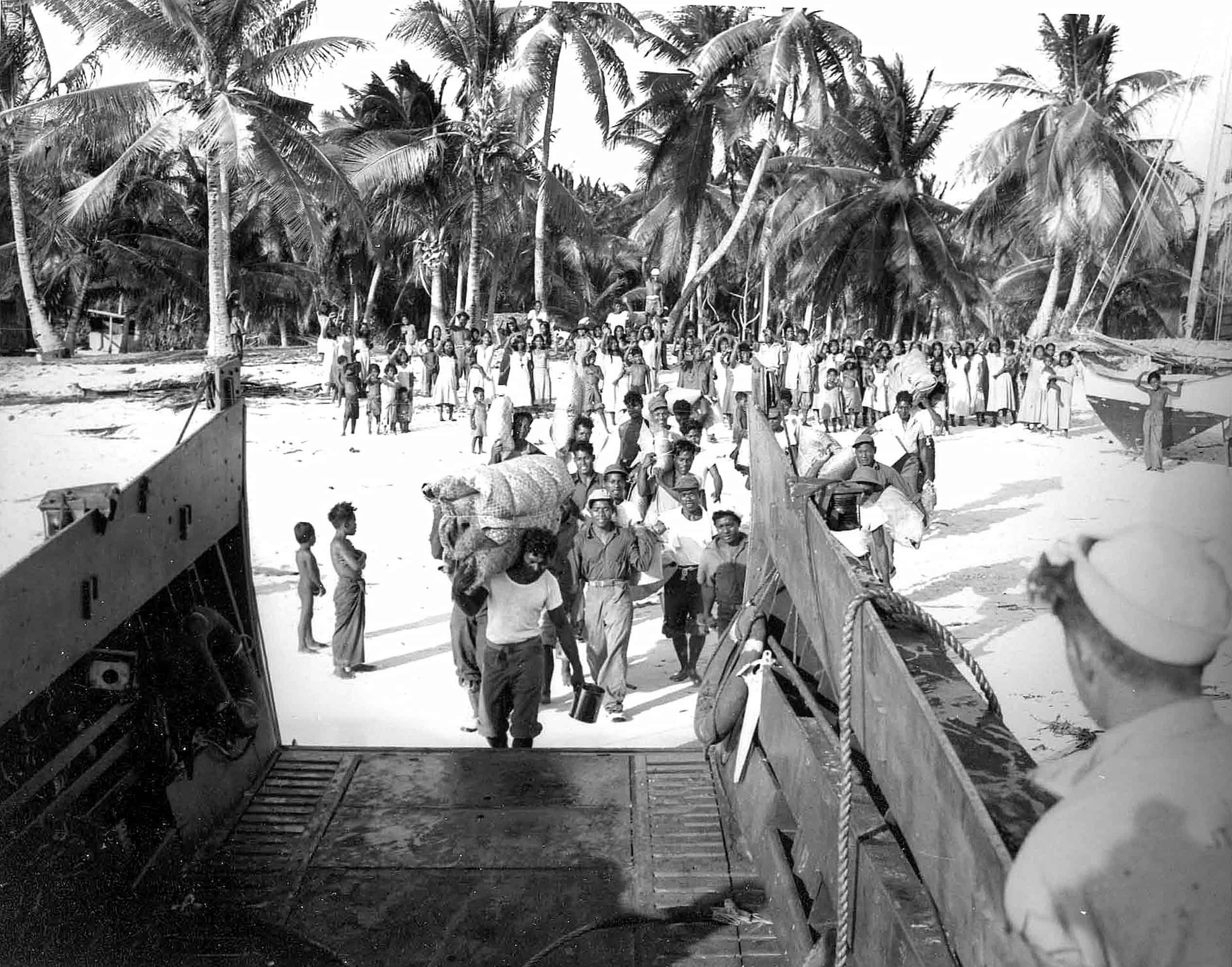
US nuclear testing in Micronesia forced the relocation of many communities across the Marshall Islands, such as the people of Bikini Atoll. Pictured: Bikinians leaving their home in 1946.
In the small town of Milan, Minnesota, the Micronesian community from Chuuk of the FSM connects their outrigger canoe traditions with the local Indigenous Dakota communities. Together, these communities are revitalizing and maintaining knowledge by carving traditional canoes, both the Micronesian outrigger canoe and the Dakota dugout canoe. They launch their vessels just south of Milan on Lac qui Parle Lake, Minnesota.
By the mid‑2020s, more Micronesians resided outside their home islands than within them. The islands do not have enough resources and infrastructure to address the broad needs of the people. The outmigration has formed dynamic diaspora populations across the US states and Pacific territories. These communities, particularly the Marshallese in Springdale, Arkansas, who are often referred to as “Springdale atoll,” have grown into one of the largest diaspora hubs, originally drawn by jobs at poultry plants like Tyson Foods.
There is also a concentrated population of Marshallese living in or near Costa Mesa, California. The Marshallese in Orange County represent a booming trend in migration from the late 1970s to the early 1990s. Present-day groups such as the Marshallese Youth of Orange County (MYOC) advocate for education, health, and cultural connections of the Marshall Islands. Their work includes activism to amplify stories of Pacific Islanders living in the continental US.
Migration is often born of necessity, but many diaspora members also choose to return, or cycle back, to their home islands. Motivations include fulfilling residency requirements for education or jobs, since citizens of the Federated States of Micronesia, Marshall Islands, and Belau may work and live in the US indefinitely under the COFA, but their COFA status does not provide a direct path to permanent residency or US citizenship. People are motivated about contributing to climate resilience and development initiatives, or upholding a deep-rooted sense of belonging in their native islands. These return flows reaffirm community ties and revive traditional knowledge at home.
Anti-Micronesian Discrimination
Micronesians face significant prejudice in the United States. While they include peoples from across Oceania, the term “Micronesian” commonly (and inaccurately) refers to migrants from the Federated States of Micronesia, the Marshall Islands, and Belau. Misuse of the label reinforces negative stereotypes and misidentifies individuals. They face mistreatment that often results in educational inequities, health disparities and neglect, and cultural denigration.
Many Micronesians have migrated to Hawaiʻi where they are one of the fastest-growing populations. Many are young and attend public schools. But for various reasons related to implicit bias, cultural misunderstanding, and insufficient English‑language support, they face more frequent school disciplinary actions than other groups. Many schools struggle with inadequate English Language Learner (ELL) resources. Students often repeat grades or are socially promoted before mastering language and academic skills, increasing dropout risk. Lack of reliable internet access adds further challenges.
Equally, Micronesian communities are also disproportionately affected by health neglect and mistreatment. During the COVID-19 pandemic, for example, the Marshallese population accounted for half of all COVID-19 cases in northwest Arkansas. The lack of access to healthcare was a contributing factor to the high rates of deaths and hospitalizations resulting from the infection.
The discrimination exacerbated by the COVID-19 pandemic prompted the Micronesian community to respond to the health crisis by addressing the gaps left by such disparate treatment. Micronesian community leaders across the US created the FSM COVID-19 Task Force in 2020 to provide COVID-19 information and services needed among the FSM diaspora. The network included members from all FSM states and provided accurate health and education information to the FSM people.
Equally, civic groups in California are focusing on culturally responsive approaches to healthcare among Micronesians living in the US. Groups such as the Pacific Islander Health Partnership (PIHP) address problems of colonial control by providing direct services, outreach and education to build healthier communities. They also show how Micronesian leadership offers many useful models of collaboration at the local, state, and government levels.
Conclusion
Indigenous peoples of Micronesia continue to challenge the history of colonial erasure and contemporary forms of colonial domination of the islands. They rely upon their vast waters and Indigenous lands to maintain practices, whether it is through cultural awareness and activism living in diaspora, storytelling its long oral history by incorporating native CHamoru and Micronesian languages, or bringing attention and voices to anti-Micronesian discrimination faced by the growing populations of Pacific Islanders from Hawaiʻi and California to Minnesota and Arkansas.
Resistance to domination is a strong characteristic of Micronesians in the US, and they take many forms. Indeed, Micronesian peoples in the US are mobilizing and revitalizing through their Indigenous literary, artistic, discursive, and cultural practices to be agents of their own narratives against the colonial erasures and military domination of the subregion.
Glossary terms in this module
atoll Where it’s used
A ring-shaped series of islands, coral reefs, or islets surrounding a body water called a lagoon.
bwebwenato Where it’s used
A Marshallese word for stories including oral traditions, conversation, and history. It refers to the stories themselves that help preserve and share cultural memory.
Chuukese Where it’s used
This term refers to the Indigenous people and language of the Chuuk Islands, it is also the dominant language within the Federated States of Micronesia.
colonialism Where it’s used
When one country takes partial or complete control over another country economically and politically, exploiting its natural resources for profit. The colonizer forces their beliefs and way of life onto the colonized.
Compact of Free Association (COFA) Where it’s used
A series of treaties between the Federated States of Micronesia, the Republic of Belau (Palau), and the Republic of the Marshall Islands with the US, granting citizens of Micronesia to join the US military without requirements of residency or US citizenship, live and legally work in the US without a visa, and access to social and health programs. In exchange, the US has exclusive access to these islands, and significant military and veto power.
Freely Associated States Where it’s used
Sovereign states of the Marshall Islands, Federated States of Micronesia, and Belau (Palau) that receive economic aid from the US as part of a bilateral relationship outlined in the Compact of Free Association.
Indigenous Where it’s used
Refers to someone or something that originates from a region, predating colonialism.
land stewardship Where it’s used
The land management and conservation of natural resources in order to maintain ecological processes necessary to preserve and support natural communities.
Mehn Pohnpei Where it’s used
Refers to being “of Pohnpei,” for the people from the island of Pohnpei, which is the largest state within the Federated States of Micronesia (FSM).
oral traditions Where it’s used
The knowledge, culture, art, and history that are passed down through speech from one generation to the other.
Pacific Ocean Where it’s used
The largest of the Earth’s oceans, Pacific Islanders often refer to this area as “Oceania” which is a vast geographical region that encompasses the islands, cultures, and peoples of Melanesia, Micronesia, and Polynesia.
Pohnpeian Where it’s used
Refers to both the people and language of the Indigenous people of the island of Pohnpei, which is located within the Federated States of Micronesia.
Pontan and Fo’na Where it’s used
CHamoru creation gods who are siblings. Pontan is the brother and Fo’na is the sister. Their creation of the world is one of the most important oral histories of the CHamoru people passed down through oral traditions.
Refaluwasch or Carolinian Where it’s used
Refers to both the language and the Indigenous people of the Caroline Islands, a group that migrated from the Caroline Islands to the Northern Mariana Islands in the nineteenth century.
Remathau Where it’s used
Refers to “people of the ocean,” who are people from the island of Yap, an island state within the Federated States of Micronesia (FSM).
Unincorporated US Territories Where it’s used
A political status in which a territory is owned by a colonizing power and there is no promise of an eventual transition into formally joining that power or becoming a state. In the US, people from the three unincorporated territories in Oceania: Guåhan (Guam), the Commonwealth of the Northern Mariana Islands (CNMI), and Wake Island cannot fully participate in American democracy, even if they are US citizens.