





Large group of people stand behind large banners as they gather in street for climate march.
Module 3: Land Stewardship and Revitalization
Have colonialism and migration impacted the way Micronesians maintain their various cultures?
Micronesians consider the environment paramount to their existence. Their ancient traditions call upon their surroundings as protection. Their cultural habits are built within and around their environment in their daily lives, and they incorporate land and ocean stewardship against environmental harm and damage.
In Micronesian belief systems, the environment is connected both to animate and inanimate objects. The wisdom of the region’s creation stories and cultural values considers the environment as interwoven with the human experience. The idea that the past determines the future is also a commonly shared belief that teaches the importance of honoring sacred stories, traditions and history, respect for all planetary creation, and learning from the past to live in harmony in the present. The vast land and the ocean are treasures that sustain life and instill obligations to protect the environment to keep balance for a healthy planet. Micronesian languages even reflect these views, where the words for people are linked to the environment, such as Remathau, “people of the ocean” from the islands of Yap, and Taotao Tåno’, “people of the land” from the Mariana Islands.
This module focuses on Micronesian connection to—not domination of—the environment including the waters surrounding the atolls, the trees that provide protection, and the values of native Indigenous Oceania.
Reflection Questions
Who are the ancestral peoples of the lands where you live? What do their knowledge and stories teach you about caring for the environment?
Organic relationships with natural and built environments are part and parcel of ongoing efforts to care and protect the land and sea in order to mobilize Indigenous peoples of Micronesia. Again, the matrilineal structure of the community means women are traditionally the producers of culture, values, and cultural paraphernalia, including native plant-based medicine and remedies, loom-woven lavalavas, and mats made from the pandanus tree or coconut tree. In Yap, women still weave the lavalava cloth, as it continues to be an essential component of cultural traditions and community building among Remathau.
In addition to Yap women’s role in textiles and weaving, the men also take on laborious roles typically connected to seafaring and navigation. Traditionally, men serve as caretakers of the land by cultivating trees such as breadfruit and coconut, but they equally manage and build boats and canoes in order to oversee their responsibilities related to the ocean. The organic process starting with the tropical plants and trees to weave, build, navigate and sell altogether serve Micronesians’ cultural, medicinal, infrastructural, and economic needs throughout the Pacific Ocean.
Plants are named in various Micronesian native tongues in order to reflect the importance of the land and sea. The pandanus tree is also known as “bõb,” or “divine tree” in the Marshall Islands due to its key role it serves in everyday life. The coconut tree is known as “I Trongkon Na’lå’la,” or “the tree of life” in the Mariana Islands. These trees and other native plants are used to make traditional medicines, rope, body oils, and utilized in weaving baskets, blankets, mats, sails, and thatching. These trees, thus, serve cultural, industrial, and spiritual community needs. Stories about how the trees provided food, protection, and goods during times of famine and struggle highlight further the importance of continuing to protect the environment.
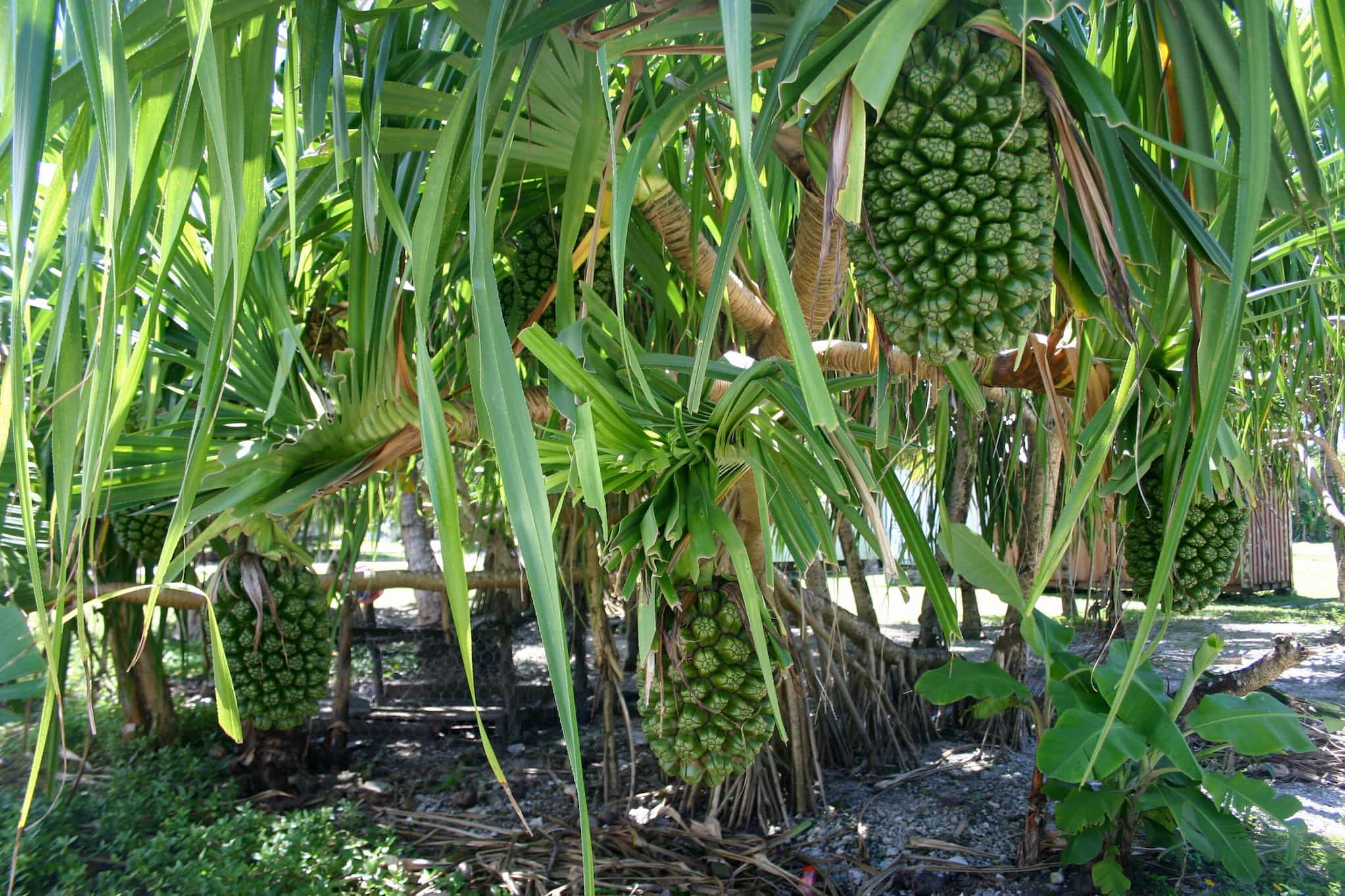
Image 23.03.01a — A pandanus tree in Jaluit Atoll of the Marshall Islands in Micronesia. The Pandanus tree grows long, slender leaves and bears large fruit with an appearance similar to pineapple. In this picture, aerial roots anchor the Pandanus tree into the ground.
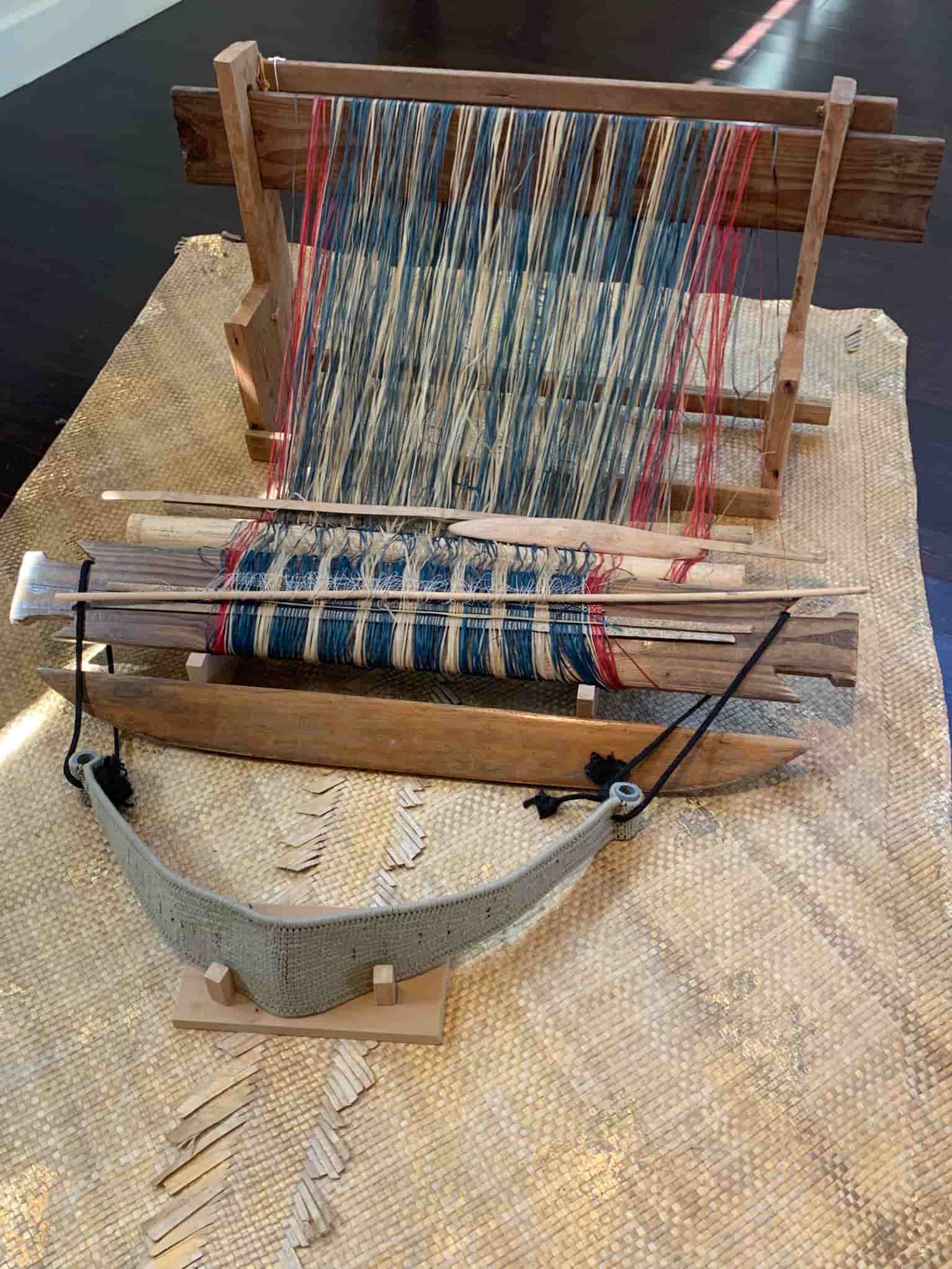
Image 23.03.01c — A backstrap loom with fibers ready to weave holds traditional knowledge and marks the Pacific Islander diaspora that is renewing connection to traditions, culture, and place-based environments. On display at the Pacific Island Ethnic Art Museum (PIEAM) in Long Beach, California (September 2022).


How do Micronesians interact with the environment?
In what ways are Micronesians participating in the environmental justice movement?
How have climate events affected Micronesia and Pacific Islanders in their everyday lives, cultural habits, and mobilization efforts?
Micronesian Culture and Diaspora Populations
Given the large numbers of island populations who have migrated away from Micronesia, there are programs to preserve, teach, and sustain traditions among migrants in the US. Micronesians who live away from these islands and atolls continue to uphold respect for the important ancestors and value protecting the land. For example, Belauans and other Micronesians living in the US who are separated from their original ancestral lands continue the oral traditions of storytelling and safeguarding the environment for the future of their human and non-human descendants.
In another example, there are efforts to help Micronesian communities construct backstrap looms, a mobile loom with a strap that can be worn around one’s back, and find materials from their local environments that can act as substitutes for native plants and traditional sources. Breadfruit, coconut, and pandanus trees are not widely cultivated or available in places such as California and Arkansas.
Diasporic Micronesian movements in the US embrace land-based practices—like community gardening, seed sharing, and storytelling—as forms of cultural reclamation. These efforts affirm ancestral relationships with the land and sea in new contexts.
CHamoru women of the Bay Area’s Pulan Collective created a multimedia cookbook titled 13 Moons 13 Meals that weaves matrilineal culinary traditions into art, poetry, and storytelling. The cookbook symbolizes resistance through cultural and environmental nourishment. Thus, even as Micronesians continue to live in the US, they contribute on a daily basis to the movement for environmental justice.
Belau (Palau) is the first nation to adopt an immigration policy that is globally focused on education to benefit future generations. In 2015, four activists including Nicolle Fagan, Nanae Singeo, Jennifer Gibbons, and Laura Clarke collaborated to form the Palau Legacy Project as a campaign to protect the island from environmental destruction. They convinced the island’s government to require visitors to commit to a special pledge to gain access to the island. The “Palau Pledge” was written with the help of Belau’s children and is a declaration rooted in the tradition of bul, a practice that has been used for thousands of years where traditional chiefs close off fishing or harvesting areas to allow for regeneration of marine life. Visitors agree to act in a culturally and ecologically responsible way to protect the environment for future generations. The pledge states:
Children of Palau, I take this pledge as your guest,
to preserve and protect your beautiful and unique island home.
I vow to tread lightly, act kindly, and explore mindfully.
I shall not take what is not given.
I shall not harm what does not harm me.
The only footprints I shall leave are those that will wash away.
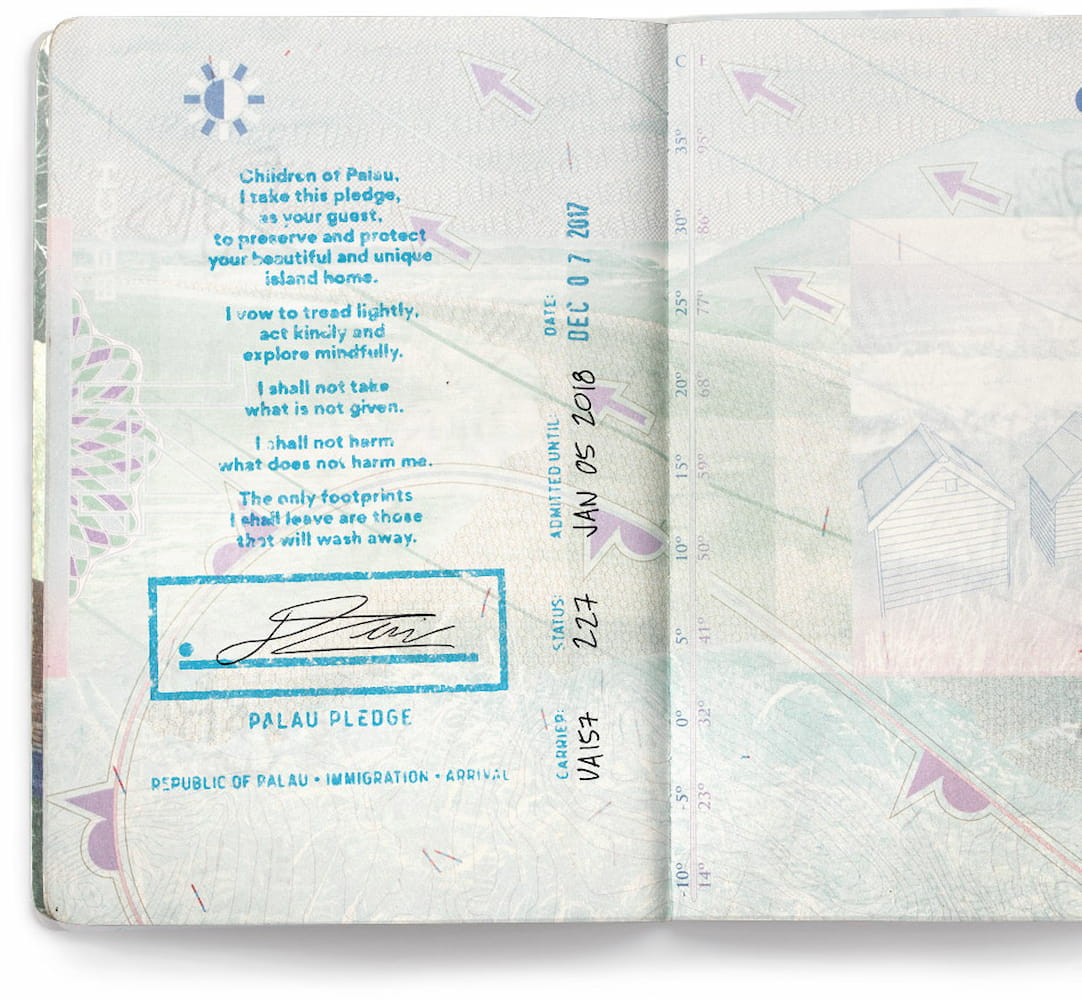
Image 23.03.02 — As part of the Palau Legacy Project, Belau (Palau) launched the Palau Pledge in 2017. Upon arrival to Belau, the pledge is stamped on passports and requires signature, a promise to Belau’s children to respect the environment.
Land Stewardship: Micronesian Agency and Adaptation
Indigenous Micronesian cultures universally regard land and ocean as ancestral relatives, not mere resources. Many communities, particularly in the Marshall Islands, Belau, Chuuk, Pohnpei, and Kosrae, inherit land and rank through maternal lines, reinforcing connections between people, place, and identity through an alternative framework.
The US emphasis on controlling land as property contrasts sharply with Indigenous land stewardship models. US colonialism introduced private property frameworks, undermining fluid, clan-based land use tied to matrilineal inheritance. Such systems replaced oral traditions with rigid legal titles, disrupting traditional governance and access to lands, waters, and natural resources. Moreover, nuclear testing on Marshallese atolls from 1946 to 1958 resulted in extreme environmental contamination. At Bikini, Enewetak, Rongelap, and Utrik Atolls, fallout left many islands uninhabitable, permanently uprooting communities and severing relationships with ancestral lands and waters.
Marshallese communities have sought legal redress through US environmental laws like the National Environmental Policy Act (NEPA) and the Nuclear Claims Tribunal. Though they won major rulings, full compensation remains unfunded. The resilience efforts of activists and groups such as the Micronesia Climate Change Alliance include focusing on community care and just recovery, while also resisting the continued and ongoing militarization. By rooting responses in local community knowledge, the group works to strengthen collective responses to climate emergencies and to educate learners about the profound impact that US militarism has had on the land, identity, health, and ways of being.
Rising sea levels and climate impacts, compounded by nuclear legacies, continue forcing migration and disrupting cultural continuity. Young Pacific leaders now challenge the doomsday “drowning islands” narratives by highlighting community resilience and Indigenous knowledge as central to climate advocacy and adaptation.
Conclusion
Micronesians continue to rely on Indigenous knowledge that challenges the hazards and erasures resulting from colonial control over the environment. While living in the US, these peoples uphold responsibilities to protect the environment, recognizing that land and ocean are interconnected treasures that sustain all life. Respect for ancestors protects the waters and lands as spiritual resources that anchor all connections among peoples of Micronesia.
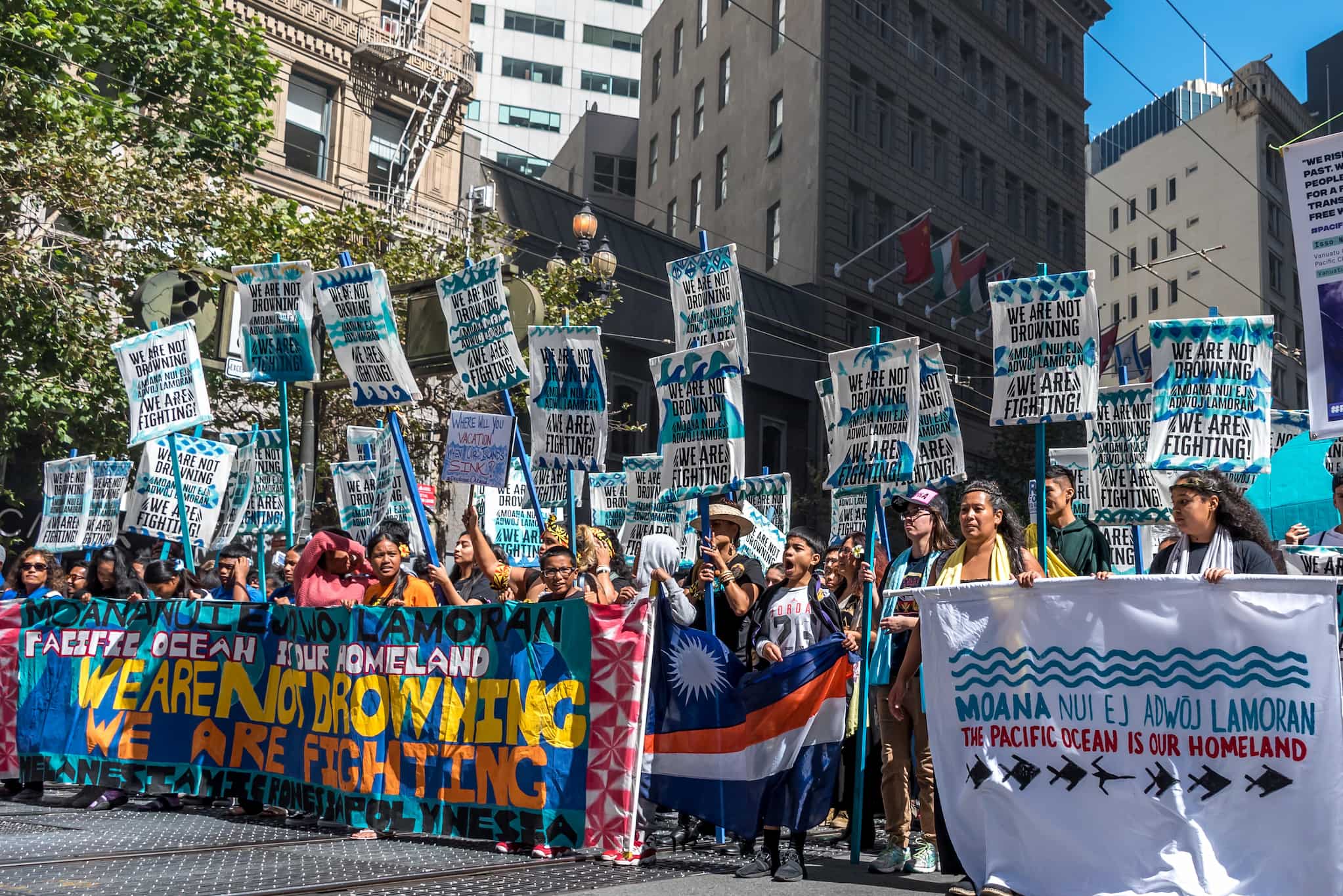
Image 23.03.04b — Participants at the Rise for Climate march in San Francisco, California, on September 8, 2018, join together to hold up signs that counter the “drowning islands” narratives of the Pacific, demonstrating active stewardship of their homeland—the Pacific Ocean.

Glossary terms in this module
atoll Where it’s used
A ring-shaped series of islands, coral reefs, or islets surrounding a body water called a lagoon.
colonialism Where it’s used
When one country takes partial or complete control over another country economically and politically, exploiting its natural resources for profit. The colonizer forces their beliefs and way of life onto the colonized.
environmental justice Where it’s used
A term that recognizes that certain communities (people of color, Indigenous peoples, and those who are economically disadvantaged) tend to be disproportionately impacted by environmental hazards. Because of where these communities tend to live and work, they are exposed to a greater degree to pollution, toxic wastes, pesticides, and/or extreme weather and temperatures. Seeking environmental justice means recognizing and addressing these disproportionate harms.
Indigenous Where it’s used
Refers to someone or something that originates from a region, predating colonialism.
land stewardship Where it’s used
The land management and conservation of natural resources in order to maintain ecological processes necessary to preserve and support natural communities.
militarism Where it’s used
The ideology that a country should maintain a strong military power and be prepared to use it aggressively to secure its interests.
oral traditions Where it’s used
The knowledge, culture, art, and history that are passed down through speech from one generation to the other.
Pacific Ocean Where it’s used
The largest of the Earth’s oceans, Pacific Islanders often refer to this area as “Oceania” which is a vast geographical region that encompasses the islands, cultures, and peoples of Melanesia, Micronesia, and Polynesia.