





Los Angeles map shows redlining. Sections of the city are shaded in yellow, red, or teal to signify their “desirability.”
Module 1: “Los Angeles On Edge”
Is the 1992 Los Angeles civil unrest relevant to today and has there been progress since?
“How can you sit there and not do anything?”
Edward “Eddie” Jae Song Lee was furious as he asked himself this question. It was Thursday, April 30, 1992, and Koreatown, where the Lee family lived, was on fire. Los Angeles County boasts the largest Korean American population of 326,000 people in the US, and this 2.9-square-mile Koreatown sits at its center.
The Lee family was listening to Radio Korea 1540 reporters as Korean immigrant store owners, who could not speak English, begged the reporters in Korean for help.
“Oh my God, that’s my store burning.”
“I run a small sewing business. The shoe store right beneath us is completely destroyed.”
“Can someone come and help guard our store? We’re being broken into.”
Listen to
Radio Korea Callers Seeking Help
Audio 48.01.01 — Amid the violence of April 30, 1992, Korean immigrant store owners, who could not speak fluent English, begged Radio Korea 1540 AM reporters in Korean to call 911.
Twenty-four hours earlier, a jury had acquitted the four Los Angeles Police Department officers charged with excessive abuse in the previous year’s beating of Rodney Glen King. On March 3, 1991, police pulled King over for speeding and suspected drunk driving. Under the orders of Sergeant Stacey Koon, Los Angeles Police Department (LAPD) officers Laurence Powell, Timothy Wind, and Theodore Briseno beat King with their batons, claiming he was resisting arrest, even as King was unarmed and lying listless on the ground. King suffered multiple injuries, including eleven fractures of his skull, broken bones, shattered teeth, and memory loss.
A bystander across the street recorded the entire beating on his camcorder that would later be seen by millions throughout the world. It was not just the brutal violence of the video that shocked people. It was also the brutal image of an unarmed Black man being beaten by four LAPD police officers.
This module provides an overview of the two high profile trials that sparked the initial protests in late April 1992 in Los Angeles, and the context in which the civil unrest emerged.
What were the two high profile trials that sparked the initial protests on April 29, 1992?
Why did Black people and Korean immigrants move to California in the twentieth century?
How did racial segregation and the history of policing in Black communities set the foundation for the 1992 Los Angeles civil unrest?
“Everything Is Now In Flames”
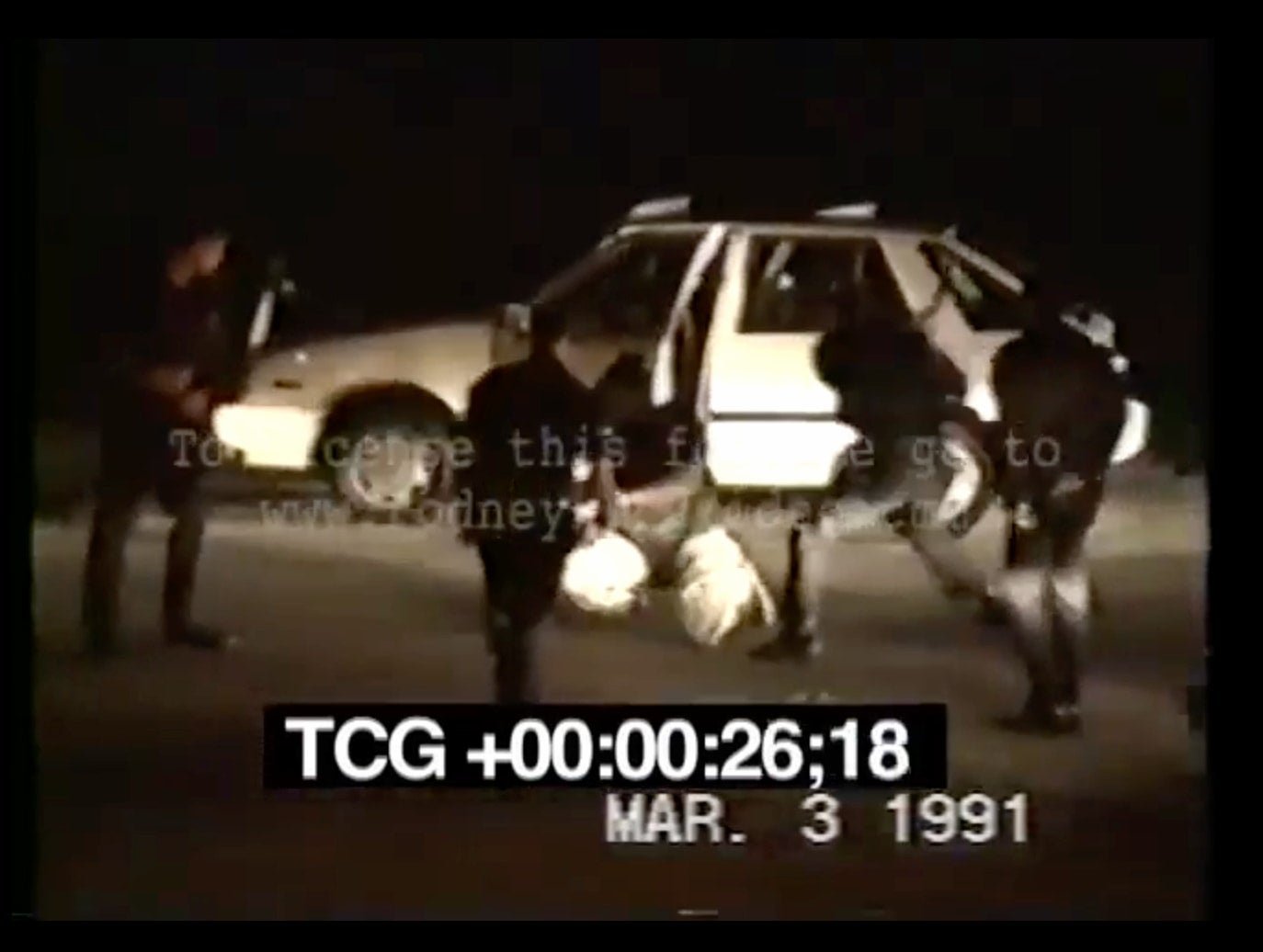
Image 48.01.02 — A still from the March 31, 1991, video shot by George Holliday from the balcony of his apartment showing LAPD officers beating an unarmed Rodney Glen King with batons while other officers stand and watch.
After the verdicts were announced, angry protesters gathered. The first fire broke out at around 7:30 p.m. By the next morning, eight people had been killed, and hundreds injured. Police blocked off major freeways. Mail service was suspended. Concerts and sports games were canceled. Mayor Tom Bradley declared a state of emergency and Governor Pete Wilson activated two thousand National Guard Troops. But the fires kept burning. A citywide curfew was imposed, and the Los Angeles Unified School District closed its schools, including Fairfax High School which was where Eddie’s younger sister attended.
“And the agony continued long after the sun came up” declared one TV news reporter, “a full twenty-four hours after the stunning verdicts, Los Angeles is still on edge.”
“Everything we have worked for is now in flames,” a frustrated Eddie told his family, who owned a luggage store in Koreatown. “How can we sit here and watch it happen? We Koreans should go out and protect our own.” Despite his mother’s protests, Eddie stormed out.
Two Sparks that Lit the Fire
If the verdict in the Rodney King case was the first spark that lit the city on fire, then, Latasha Harlins’ wrongful death was the second spark that kept this fire burning. Protesters who destroyed Korean-owned stores during the 1992 Los Angeles Uprising also shouted, “This is for Latasha!”
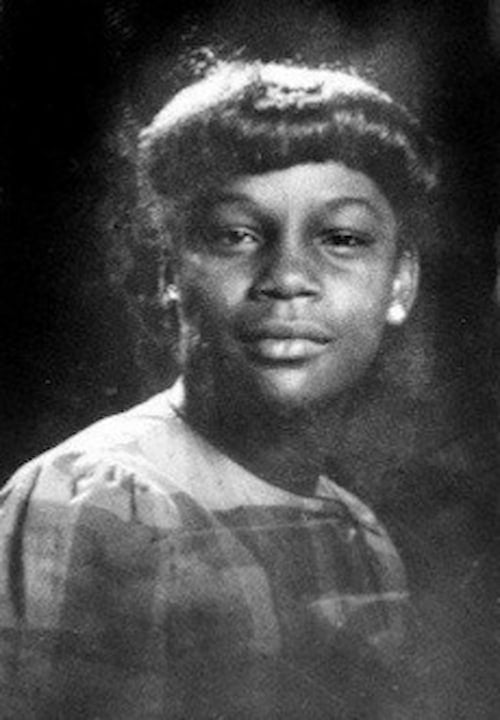
Image 48.01.03 — Latasha Harlins was a fifteen-year-old African American girl who was shot and killed by Soon Ja Du, a Korean store owner, in 1991.
On March 16, 1991, just two weeks after the beating of Rodney King, store owner Soon Ja Du accused Latasha Harlins of shoplifting a bottle of orange juice. Du shot Harlins as she turned to leave the store. The fifteen-year-old girl died instantly, holding money in her hand. Du was found guilty of voluntary manslaughter, not murder, and Judge Joyce Karlin shocked the city by sentencing Du to only five years probation and a five-hundred-dollar fine. This verdict brought public outrage, backlash against the storeowner by local residents and became a lightning rod for racialized conflict in Los Angeles and the country. Judge Karlin was white and gave leniency to Du who was Korean American in the fatal shooting of Harlins, who was Black. At the time of the King verdict in 1992, Harlins’ death was still fresh in people’s minds when the jury announced the LAPD officers were not guilty.
We Came Here with Dreams
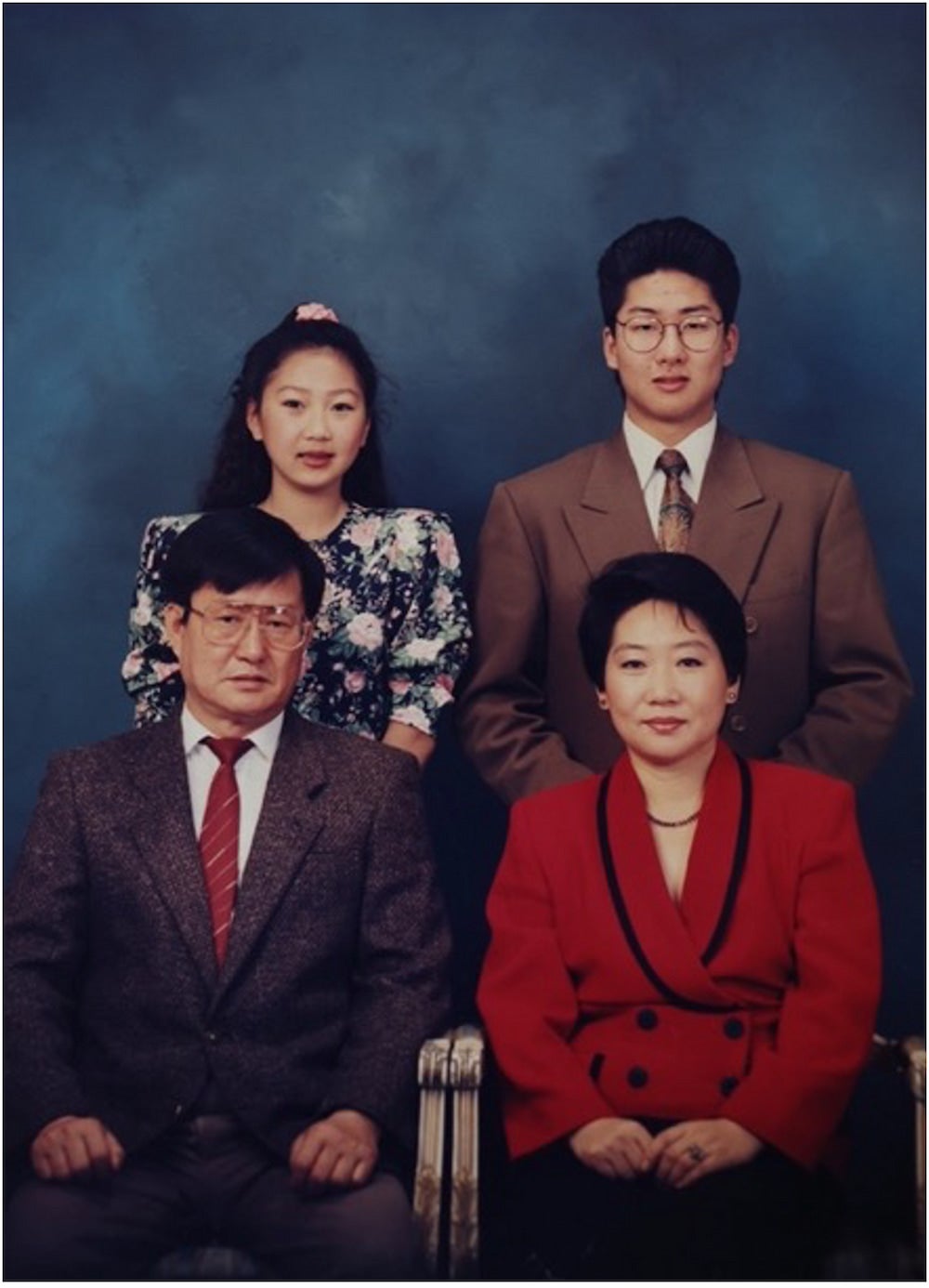
Image 48.01.04 — A portrait of the Lee family in happier days. (Clockwise from the top left) Jenny, Eddie, Young Hi, and Jung Hui.
Eddie Lee was one of those killed in the civil unrest. The irony was that Eddie was mistakenly hit by a bullet of an Asian American—someone either Korean American or Japanese American—defending their property in the void of police protection. Eddie’s story highlights the difficult circumstances that Korean Americans found themselves in at this turning point in history.
Like many Korean immigrants who moved to Los Angeles in the 1970s, Eddie’s family opened a small business, a luggage store named Ed Trading Company, named after Eddie. They worked twelve-hour days and drove to weekend swap meets to sell more wares. Eddie’s mother, Jung Hui Lee, also worked part-time at a sewing factory. The family worked around the clock, seven days a week, with their children helping with the labor. Such conditions were the lived reality for many Korean immigrant families in America.
Jung Hui had high hopes for her ambitious son. For Eddie’s first birthday (called dol in Korean), they held the traditional Korean first-birthday fortune-telling ceremony called doljabi during which his parents laid out several symbolic objects. Whatever object Eddie would pick up would determine his future. If Eddie picked up a book, he would become a scholar. A paintbrush? An artist. Money? Rich. And so on.
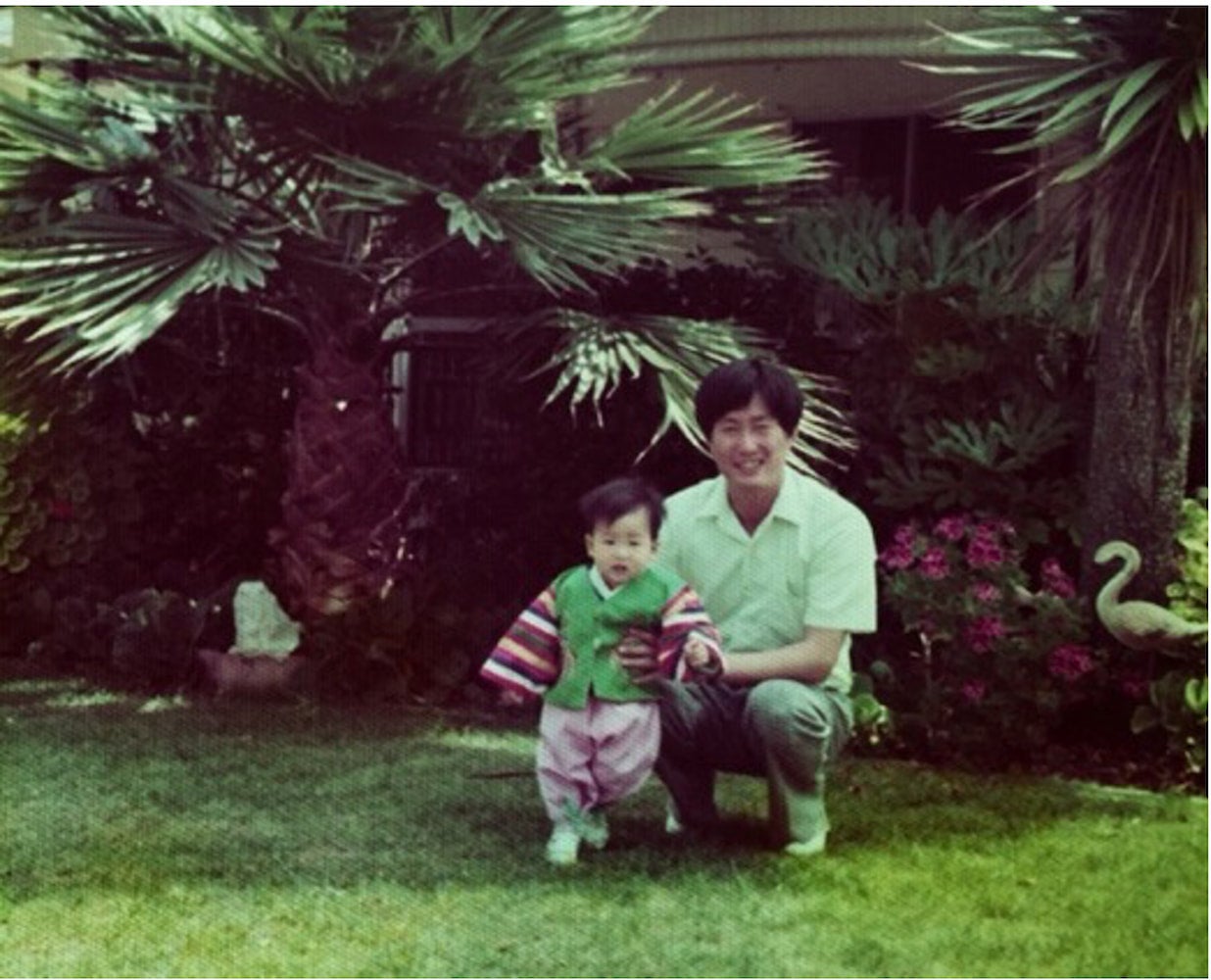
Image 48.01.05 — Eddie Lee, wearing his traditional Korean dol (first birthday) hanbok (traditional Korean outfit), with his father.
Eddie wore a traditional Korean outfit (called hanbok in Korean) on that day with pink silk trousers and a green jacket with wide, rainbow-striped sleeves. To his parents’ delight, Eddie grabbed a handful of dried noodles (or ssalguksu) from a bowl. Noodles symbolize a long life. Eddie’s future was looking bright. After all, anything was possible in America, and his long life was promised as part of his fortune on his first birthday in the US.
The Three Waves
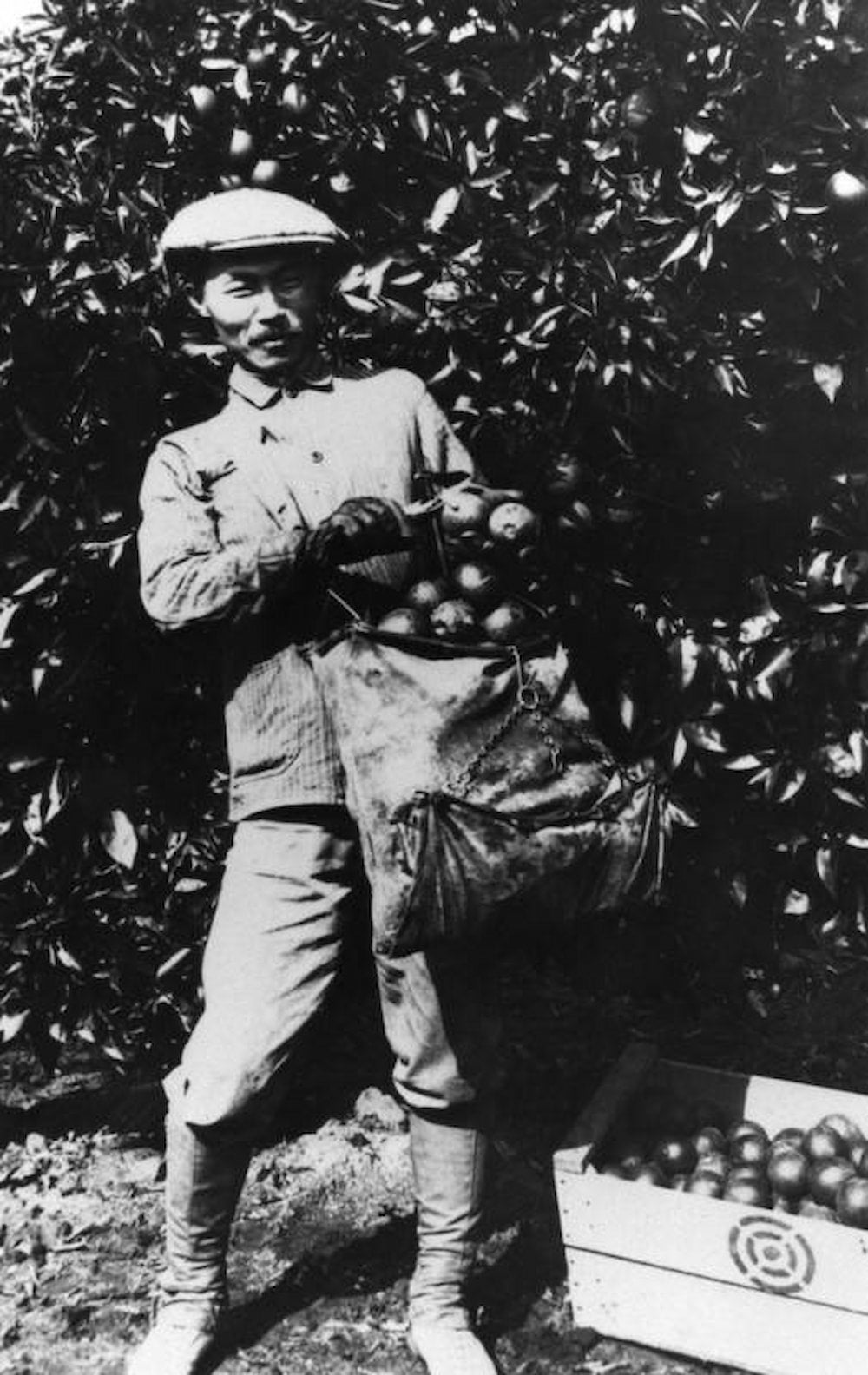
Image 48.01.06 — Dosan Ahn Chang Ho, who established what some believe to be the first Korean American immigrant community in Riverside, California, in the early 1900s.
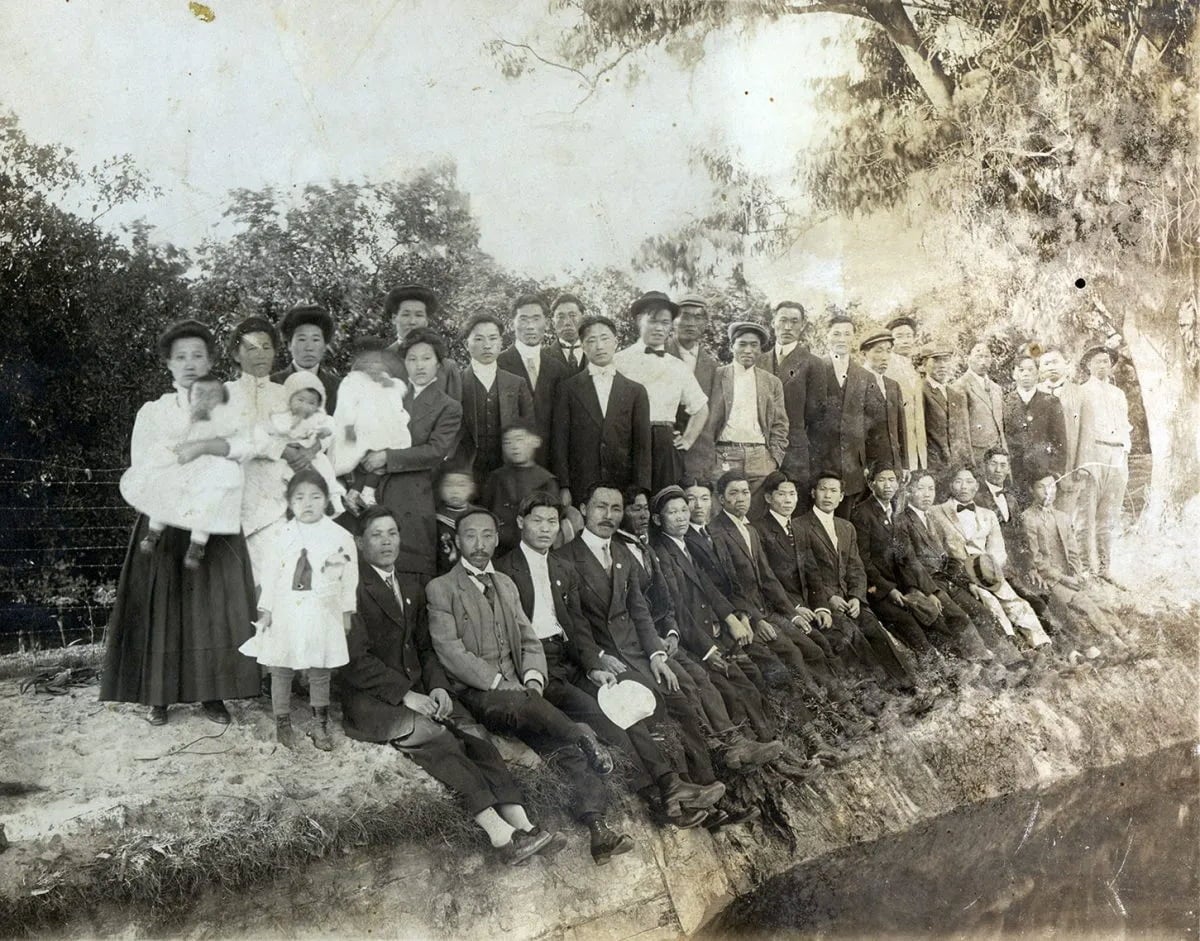
Image 48.01.07 — Members of the Riverside Koreatown community.
Generally speaking, the history of Korean immigration can be divided into Three Waves. The First Wave from 1903 to 1949 saw the arrival of laborers. Until 1903, official Korean migrations to the US were solely for education and diplomacy. On January 13, 1903, the SS Gaelic arrived in Honolulu, Hawaiʻi, with 102 Korean men, women, and children to work on sugarcane plantations. The month and day of their arrival (January 13) is now known as Korean American Day to commemorate the arrival of these first families.
The second wave came as the Korean War served as a proxy war in the Cold War, where the US backed the south and Russia and China backed the north. Eventually, the conflict split the country in two—North Korea and South Korea—at the 38th parallel. The War Brides Act of 1945 allowed Korean war brides to immigrate to the US. This was followed by smaller numbers of war orphans adopted by American families, along with students and professionals. This Second Wave of Korean immigrants entered America between 1950 and 1964.
As of 1960, 84 percent of immigrants to the United States were born in Europe or Canada. Only about 4 percent were from Asia, and this low percentage was similar for non-white immigrants from Mexico, Latin America, Africa, and other parts of the world. The Immigration and Nationality Act of 1965 signed by President Lyndon B. Johnson overhauled the restrictive and racially discriminatory federal quota systems for Asian immigrants.
As a result, almost three hundred thousand Koreans immigrated to the United States between 1965 and 1980, including Eddie’s parents, Jung Hui and her husband Young Hi Lee, in 1971. They were, therefore, part of the Third Wave of Korean immigration to the US. By 1970, 63 percent had settled in Southern California, creating one of the largest Korean communities in the US. A decade later, “Koreatown” was designated as an official neighborhood in Los Angeles County.
As Jung Hui and Young Hi’s flight was landing at the Los Angeles International Airport on April 14, 1971, Jung Hui stared out the airplane window in awe of the massive sprawl of freeways. “When I left Korea, everything was destroyed after the war,” she explained:
So the highways in America were very impressive to me. It was amazing. What was most beautiful to me was the clean and orderly cities because Korea was still in shambles. Everything there was still a mess. America was very different. When I look back, this was probably the happiest time.
But Jung Hui and other Korean immigrants soon learned that like the border that divided their country into North Korea and South Korea, the Los Angeles freeways were their own borders, separating the city into separate—and unequal—worlds.
Redlining
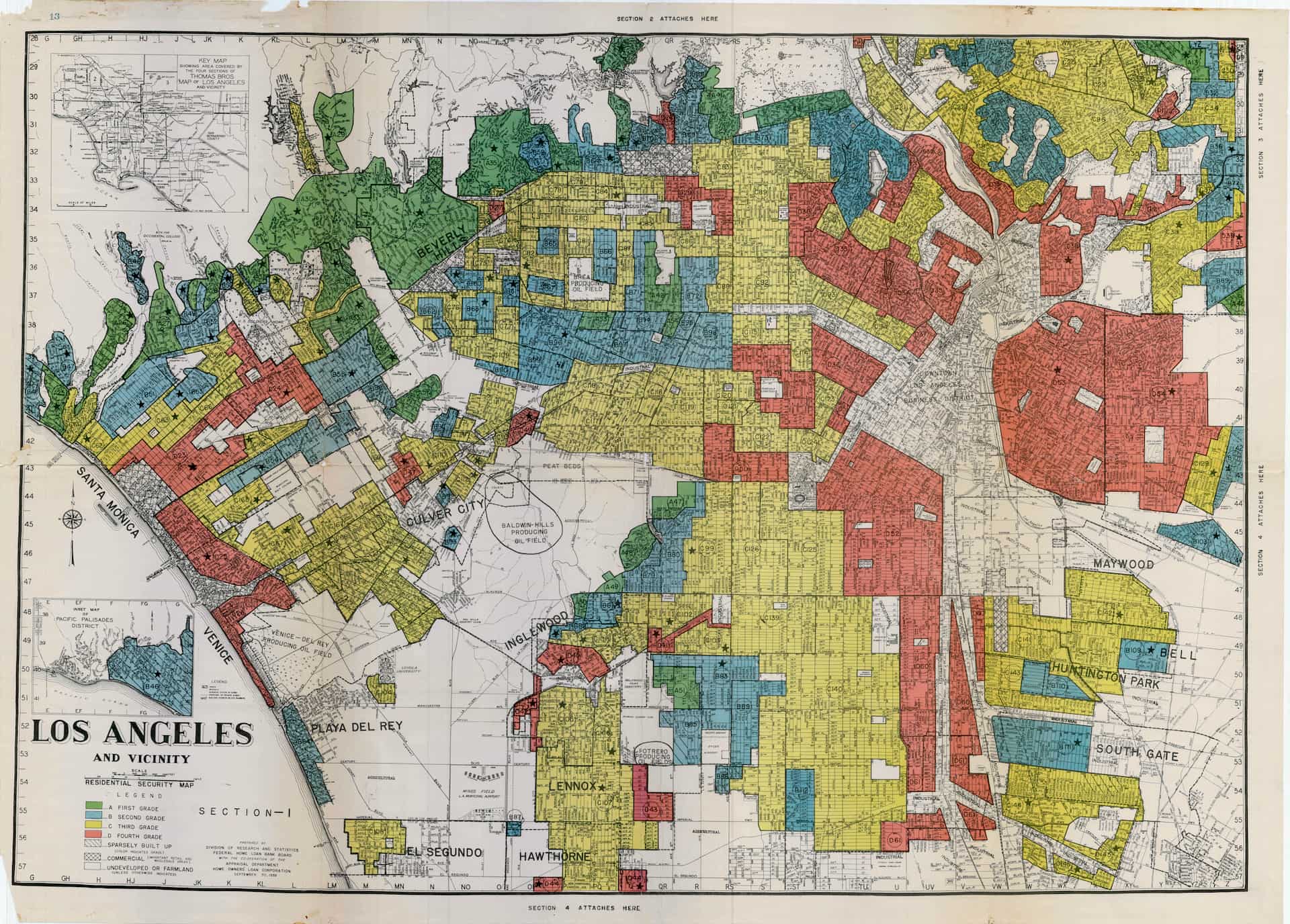
Image 48.01.08 — A typical redlining map of Los Angeles from 1939. Colored grids signified a neighborhood’s “desirability” and led to racial segregation.
Los Angeles County is a seemingly endless maze of more than 515 miles of freeway. But many Los Angeles residents do not know about its deep history of racial discrimination. If one looks at a map of Los Angeles from the 1940s, chances are that one could accurately predict where non-white communities lived, especially where the Black and Brown families resided: the red zones.
Colorful maps of Los Angeles reveal this picture of racial and class segregation and discriminatory privilege. The zones were drawn following the passage of the National Housing Act of 1934. Each colored grid reflects a certain rating of safety and desirability. The green, blue, and yellow zones were considered the best areas, with green representing the most desirable neighborhoods.
The red areas were considered the least desirable. The availability of federally-backed mortgage loans were interdependent on the zone color. Banks provided few loans in the red zones, a discriminatory practice known as redlining. Additionally, exclusionary clauses in property deeds called racial covenants prohibited certain groups of people from owning, renting, or occupying the property. These practices contributed to residential segregation by maintaining exclusive white neighborhoods and limiting the neighborhoods that nonwhites could live in.
From 1910 to 1970, six million Black people left the American South to escape Jim Crow segregation laws, for the promise of a better and equal life elsewhere. This is known as the Great Migration. Due to a shortage of workers during World War II, California’s steel and iron works plants hired Black workers for the first time. LA’s Black population boomed from 63,000 in 1940 to 350,000 by 1965, making up 14 percent of the city’s population.
But Black residents soon discovered the Ku Klux Klan (KKK) existed even in sunny California. During the 1920s, the state was home to the second largest number of KKK chapters in the country whose official members included law enforcement officers, police chiefs, and judges.
Redlining and housing covenants forced many new Black residents to the city’s “red” zones. As Black families moved in, white families moved out. This “white flight” turned the neighborhoods of Watts, Compton, and other areas in South Los Angeles (originally called South Central) into mostly Black neighborhoods.
Housing covenants were ruled unenforceable in 1948 through the US Supreme Court decision Shelley v. Kraemer; it was also ruled completely illegal with the passage of the Fair Housing Act of 1968. Down went the “Whites Only” property signs, but de facto segregation due to personal choices resulted in racially segregated neighborhoods. Redlining and restrictive covenants reinforced segregation.
Two additional developments exacerbated disinvestment and economic hardship in Black Los Angeles: one was the construction of massive freeways. This included the Santa Monica or “the 10,” the San Diego or “the 405,” and the Harbor or “the 110” Freeways. This led to the destruction of thousands of homes and businesses and divided many established communities. The second was the decline in manufacturing industries through the 1980s. Many Black workers lost jobs in manufacturing companies as many relocated their factories overseas or to other states with cheaper, non-union labor. Communities like South Los Angeles saw a big decline of the middle class.
Connected Lives
The 1992 Los Angeles Uprising lasted five days, causing sixty-three deaths across color lines. Of the fatalities, twenty-eight were Black, nineteen Latino, fourteen white, and two Asian. The city suffered a record amount of property loss at a billion dollars in damages. This included 2,300 Korean-owned stores that were destroyed. At the heart of these losses were the stories of three people who had much in common:
Rodney Glen King, twenty-five, grew up fishing along the Sacramento River with his father, had a passion for music, and was a devoted Los Angeles Dodgers baseball fan.
Latasha Lavon Harlins, fifteen, was a high school honor roll student who wrote poetry, ran track, and dreamed of becoming a lawyer.
Edward Jae Song Lee, eighteen, was a college freshman who loved cars, rock and roll music, and camping under the stars with his family.
Although they never met, their lives would forever be connected after the fires cooled. On Friday, May 1, 1992, a heartbroken King came out of seclusion to issue a public statement calling for peace and asked: “Can we all get along?” It was a simple question that did not have a simple answer.
Their lives, both individually and collectively, help tell the story of the tragic events of April 29, 1992 (known among Korean Americans as “Sa I Gu,” literally meaning “Four Two Nine” in Korean to commemorate the date), and the lessons we might learn from the most damaging urban uprising in US history.
Glossary terms in this module
covenant Where it’s used
An agreement in a real estate contract that documents certain promises that go with the land, such as beach access or a use of a common driveway. Racial covenants are clauses in housing deeds that prohibit certain groups of people (most commonly non-white) from owning, renting, or occupying property. Racial covenants contributed to residential segregation by maintaining exclusive white neighborhoods and were not declared illegal until 1968.
Immigration and Nationality Act of 1965 Where it’s used
Also known as the Hart-Celler Act, this law ended the immigration quota system and exclusion-era policies, replacing it with a system of preference for applicants with certain skills, advanced education, and family already in the United States. This law significantly changed American demographics, especially within the Asian American community.
National Housing Act of 1934 Where it’s used
This law created the Federal Housing Administration, a federal agency that identified what the insurance industry determined to be “high risk” neighborhoods, which limited the availability of insurance for mortgages. The agency’s work called these “red” zones in the insurance business, resulting in the “redlining” of Black and Brown neighborhoods.
probation Where it’s used
A sentencing option available to the court after considering characteristics of an offense and individual defendant. Often offered in first time offender cases, even in the context of homicides. In felonies, the defendant who receives a probationary sentence also is required to comply with terms that may include fines, restitution, community service, and regular check-ins with a probation officer. Probation can also be mandated upon release from incarceration.
redlining Where it’s used
A discriminatory practice where banks deny mortgages and financial services–such as home loans and insurance coverage for assets–to certain neighborhoods zoned “red” or undesirable, particularly following the National Housing Act of 1934. These neighborhoods were usually where Black and Brown residents lived. Redlining contributed to poverty, underdevelopment, and food deserts in racially segregated neighborhoods.
uprising Where it’s used
A collective fight against an oppressive system of injustice. The term “uprising” is one of several labels used in place of the word “riot” to describe civil unrest in response to a felt injustice. Several other terms were used to describe this event, including civil disturbance, rebellion, implosion, riot, war zone. The label a person uses can reveal one’s understanding of what took place.A collective fight against an oppressive system of injustice. The term “uprising” is one of several labels used in place of the word “riot” to describe civil unrest in response to a felt injustice. Several other terms were used to describe this event, including civil disturbance, rebellion, implosion, riot, war zone. The label a person uses can reveal one’s understanding of what took place.
voluntary manslaughter Where it’s used
In California, the felony of voluntary manslaughter is defined as the unlawful killing of a person during an argument that escalates suddenly, in the heat of passion, or when a person has an honest but unreasonable belief in the need to defend oneself.