




Three boys walk on sidewalk alongside barbed-wire fence. Behind them is building marked with graffiti with a sign reading “Empire Liquor Market Deli.”
Module 2: Latasha Harlins and Soon Ja Du
Is the 1992 Los Angeles civil unrest relevant to today and has there been progress since?
Before the 1992 Los Angeles Uprising, both Black and Korean American communities in South Los Angeles faced challenges due to systemic neglect, segregation, and racial tensions. This module examines the life and death of Latasha Harlins and the hopes and dreams her story embodied for Black Los Angeles, alongside the life of Soon Ja Du, whose story personified the struggles and sacrifices of Korean immigrants.
This module shows how the fatal shooting of Harlins by Du and the light sentence Du received from the presiding judge deepened the divide between Black and Korean communities, ultimately contributing to the anger and frustration that fueled the Uprising following the Rodney King verdict.
What led to the high number of liquor stores in South Central Los Angeles, and why did Korean immigrants enter that business?
What did the lives of Latasha Harlins and Soon Ja Du represent for their communities?
To what extent did the shooting and trial outcome inflame racial tensions and contribute to the LA Uprising?
Food Deserts and Liquor Stores
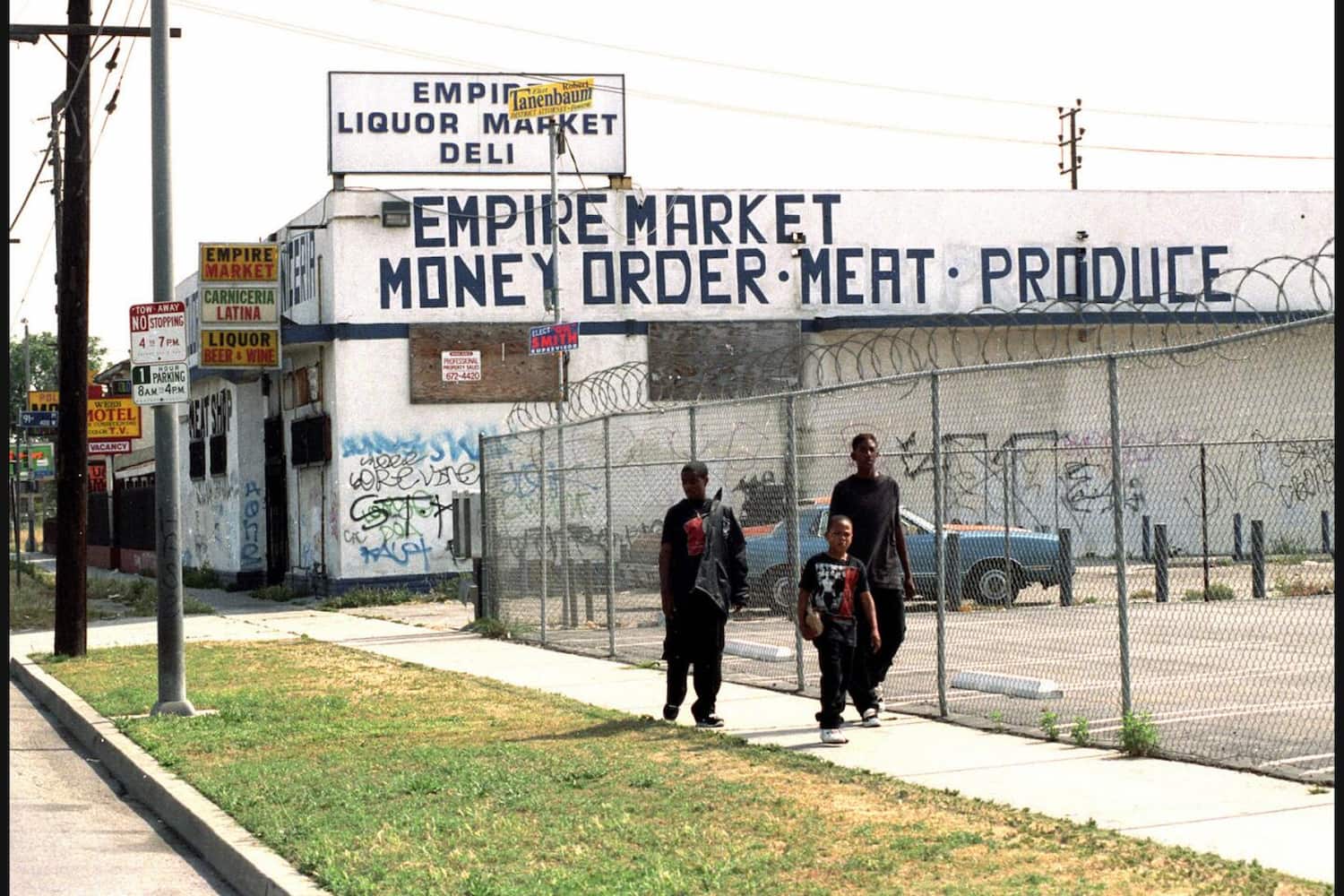
Image 48.02.01 — This photo by Al Seib in The Los Angeles Times shows a rare image of Empire Liquor Mart immediately after the civil unrest in Los Angeles following Natasha Harlins’ fatal shooting. The photo documents a cityscape that was soon to vanish due to development.
The South Los Angeles neighborhood where Latasha Harlins lived changed drastically over time. Once vibrant with manufacturing jobs, it lost much of its industry as factories moved overseas. By 1990, the community suffered from severe unemployment, poverty, and rising crime. These problems were compounded by redlining and government neglect, which made it difficult for residents to buy homes and start businesses. Most chain supermarkets had moved out of these largely Black and Latinx residential neighborhoods, creating “food deserts.” In their place, small stores like the Empire Liquor Market Deli sprang up, often run by Korean immigrant families.
Korean immigrants, unable to obtain regular bank loans, used their community’s traditional “rotating credit system” called gye to pool resources and buy businesses in areas abandoned by previous owners after the 1965 Watts Uprising. By the early 1990s, Korean-owned stores dominated retail in South Los Angeles. Liquor store regulations in California allowed for a concentration of liquor stores that filled these food deserts. Owners struggled to meet local needs while keeping prices competitive. These shops were family-run and often charged higher prices to survive, therefore some Black residents believed Koreans were exploiting their neighborhoods. Cultural and communication differences between some owners and customers added to strained relations. These conditions set the stage for a tragic confrontation between a Korean immigrant store owner and a young Black customer.
Latasha and Soon Ja Du: Symbols of Hope and Struggle
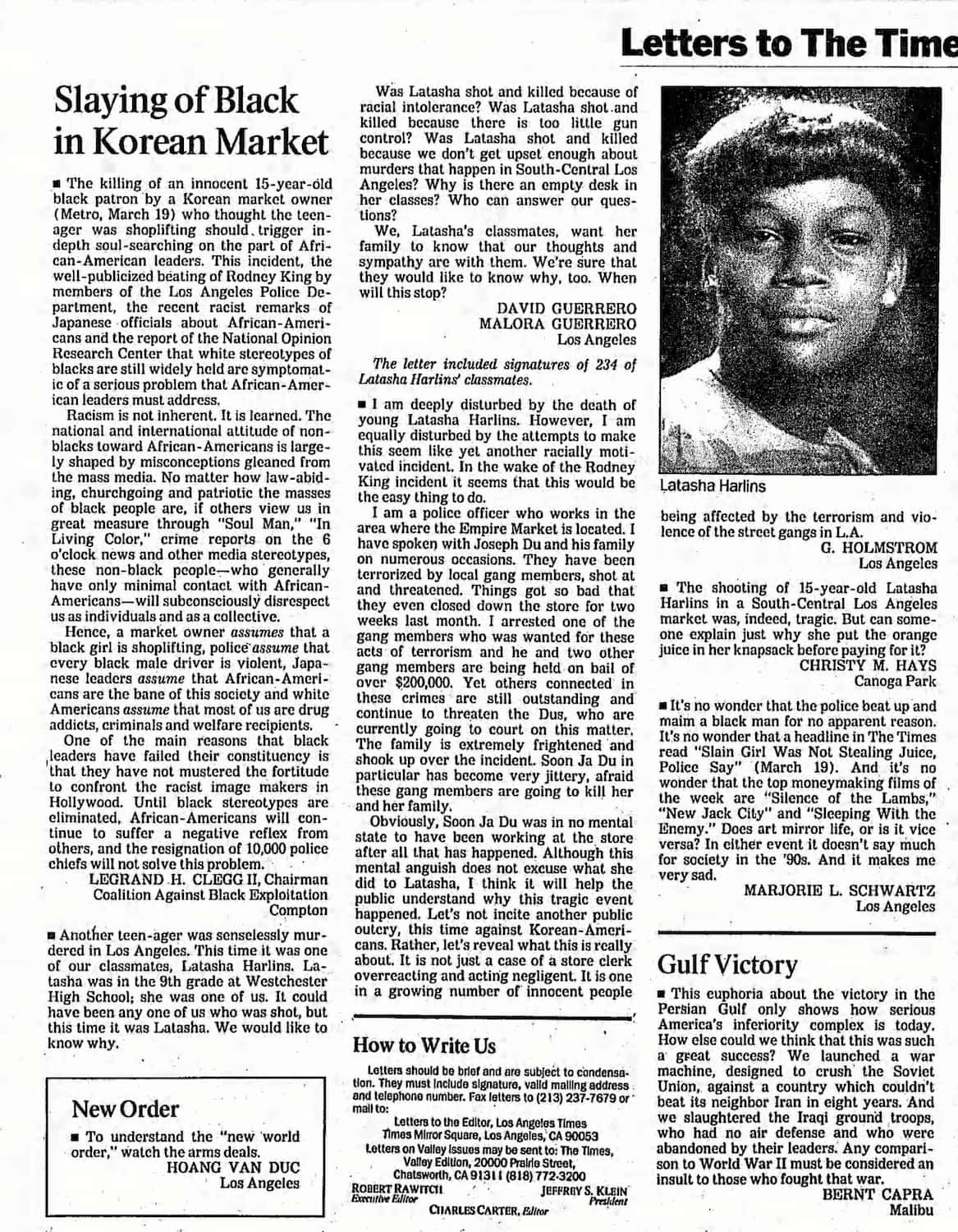
Text 48.02.02 — Two weeks after Latasha Harlins was shot and killed, The Los Angeles Times posted a letter written and signed by 234 of her classmates.
Latasha Harlins was a bright, driven teenager, hoping to become a criminal attorney and “find justice for others.” However, Tasha’s drive for success was rooted in tragedy. In 1985, her mother, twenty-five years old at the time, was shot to death in an argument at her boss’s birthday party at a nearby club.
Known to her family and friends as “Tasha,” Latasha was born on January 1, 1976, in East St. Louis, Illinois, the first child of Crystal Harlins and Sylvester Acoff. In 1980, Tasha’s grandmother Ruth found a job as a clerk for the Los Angeles County Department of Public Social Services and relocated their family to California. Tasha dedicated herself to her studies, making the honor roll and excelling in track and field. Tasha, her two siblings, and her parents lived with Ruth along with Tasha’s aunt Denise and cousin Shinese, in a three-bedroom home in South Los Angeles (South LA). As the oldest child, Tasha was very protective of her siblings and cousin. “She was a caretaker,” Vester said. “She cooked. She made sure we did our chores, did our homework.”
Around the same period, Soon Ja Du, alongside her husband Billy Du, immigrated from Korea in hopes of providing a better education for their three children. The Du family saved up their wages from various factory jobs, and in 1989 they bought the Empire Liquor Market Deli located in South LA. Like other Korean immigrants, their limited English language ability–despite their education in Korea–restricted the types of jobs they could get once in the US. Many turned to small businesses in places like South LA.
Violent crime in South LA, however, had been rising steeply throughout the 1980s and shoplifting was a regular occurrence at their store. Billy Du and his son Joseph were held up at gunpoint in three separate gang-related robberies. The Dus reported the armed robberies to the police. In retaliation, gang members threatened to kill them. Fearing for their safety, Billy Du bought a gun for self-defense and hid it under the counter. Du’s son Joseph also educated his mother to understand visual cues of gang members wearing certain colors like blue, red, and gold to identify their allegiances.
The Shooting: A Tragedy of Misunderstandings
On March 16, 1991, Latasha walked into the Empire Liquor Market Deli to buy orange juice. Exhausted and afraid after a string of violent incidents, Soon Ja Du mistook Latasha’s actions for an attempted theft. When Tasha entered the store, Soon Ja noticed her blue and gold cap, which later turned out to be a UCLA Bruins hat. She remembered her son’s warnings about gang colors. Tasha picked up a bottle of orange juice priced at a dollar and seventy-nine cents and placed it in her backpack.
Soon Ja Du grabbed Tasha’s backpack thinking she was shoplifting. During the tussle, Tasha hit Du, trying to make her let go. Soon Ja stumbled back behind the counter. “After she hit me, I thought she was a gang member, and I thought she was going to kill me,” Soon Ja Du later testified. “And I thought that she had some kind of weapon in that satchel.”
Soon Ja found her husband’s gun under the counter and aimed it at the unarmed Tasha. Tasha placed the bottle of orange juice on the counter and turned to leave, her back facing the storeowner. Soon Ja fumbled with the gun. “And as she was walking away, she shot her,” testified one witness later at the court trial. Tasha collapsed to the floor, dead. Her cousin’s backpack lay nearby, containing Tasha’s extra clothes for the sleepover along with her notebook. Police later found the two dollars Tasha was planning to pay for the orange juice still in her left hand.
The entire incident was captured on video, and its repeated airing changed how both families were seen by LA and the nation.
Immediate Aftermath and Activism
The Harlins family’s grief was deep and lasting. Latasha’s grandmother insisted her surviving relatives attend counseling, knowing the trauma would not fade quickly. Denise Harlins, Latasha’s aunt, became an activist almost overnight, founding the Latasha Harlins Justice Committee, drawing support from leaders like California US Congresswoman Maxine Waters, Reverend Jesse Jackson, and LA City Councilman Mark Ridley-Thomas.
On Thursday, March 21, 1991, the Latasha Harlins Justice Committee, activist Danny Joseph Bakewell, and more than 150 protesters held a press conference outside Empire Liquor Market Deli. Community anger continued to simmer, manifesting in boycotts and protests against the store and, more broadly, against perceived disrespect towards Black customers at Korean establishments.
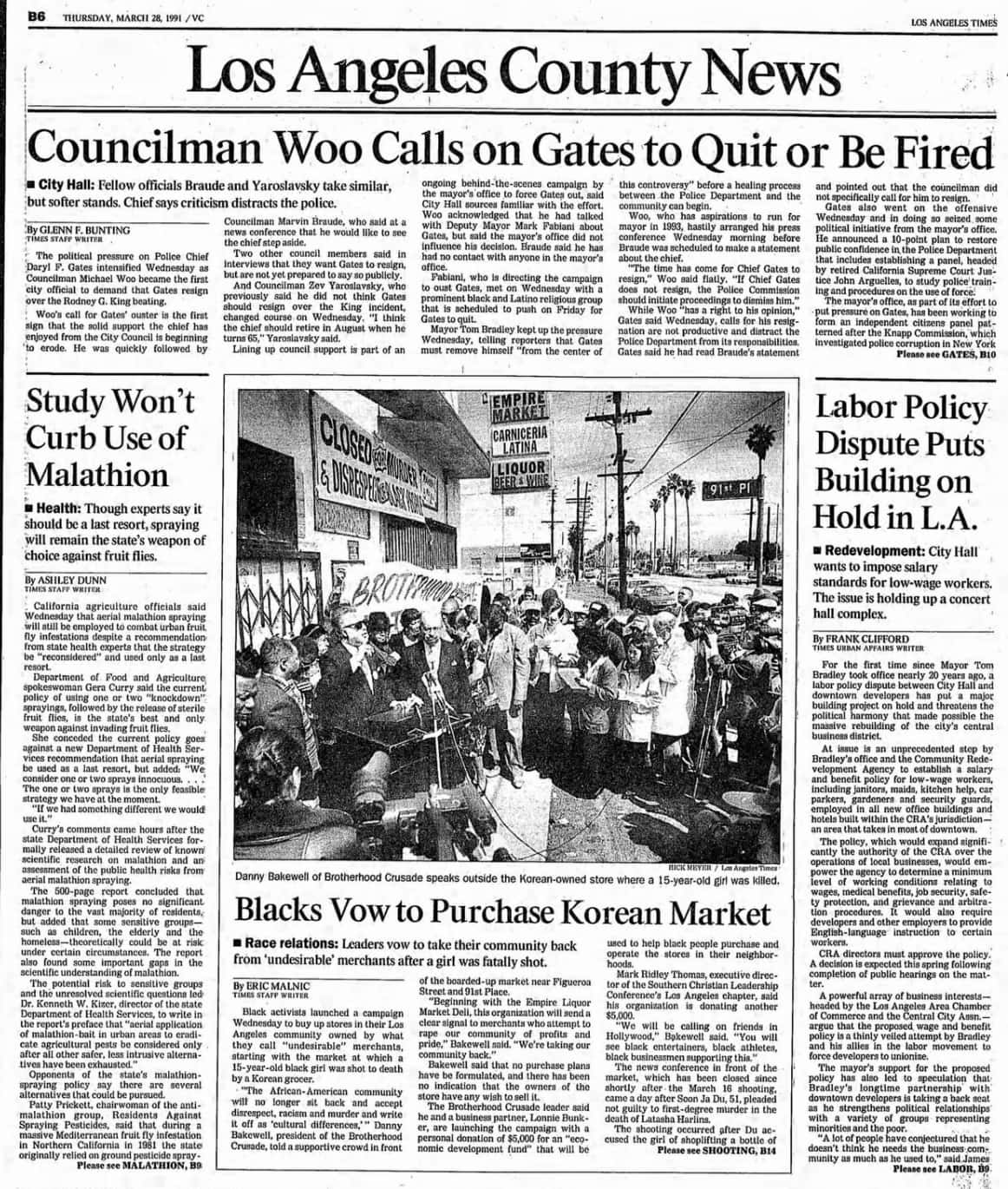
Image 48.02.03a — Five days after Latasha Harlins was killed, a crowd of more than 150 protesters held a press conference with activist Danny Bakewell outside Empire Liquor Market Deli, declaring a boycott of the store.
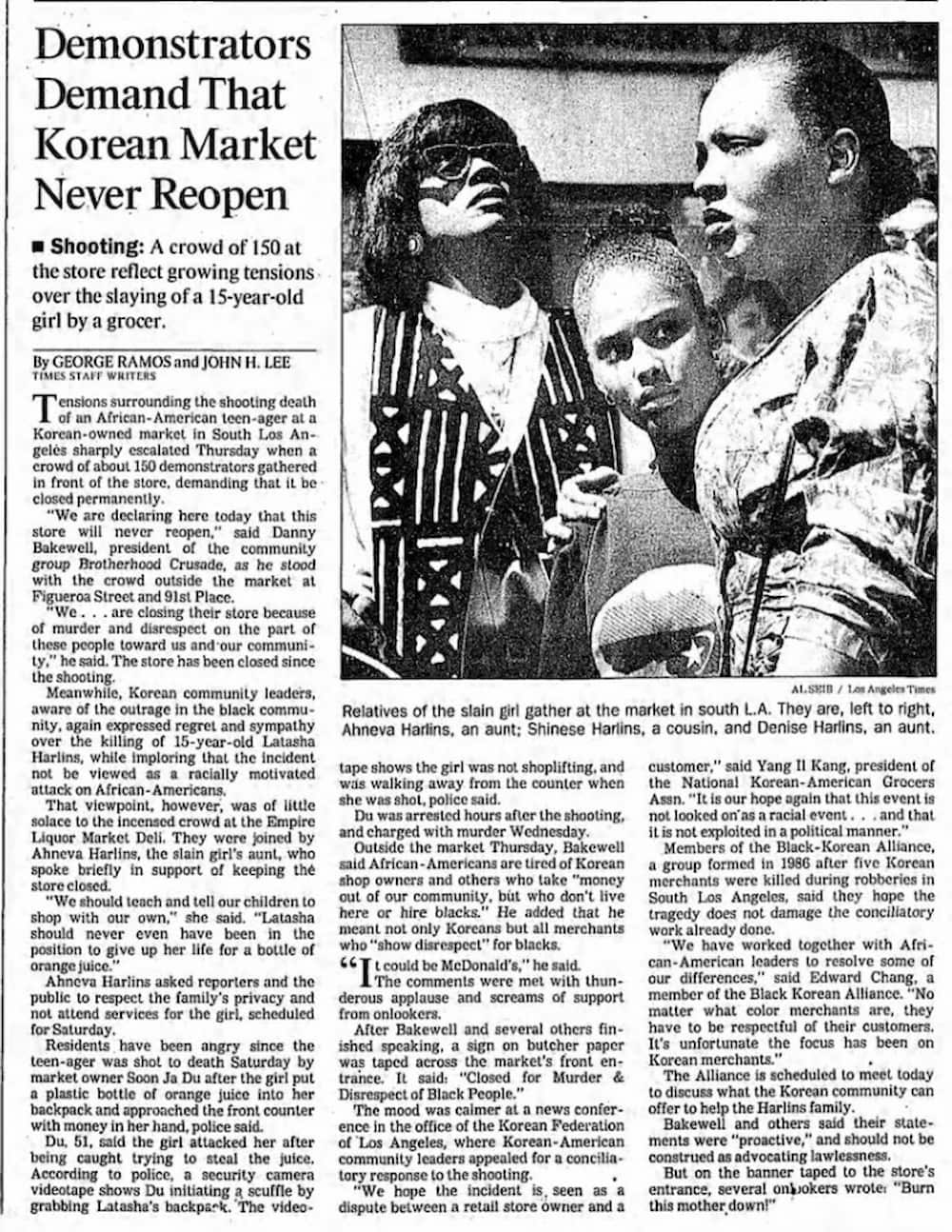
Image 48.02.03b — Denise Harlins (right), her daughter Shinese (center), and 150 protesters attend a protest at Empire Liquor store six days after Denise’s niece, Latasha, was shot and killed by store owner Soon Ja Du in a dispute over a bottle of orange juice.


Professor Edward Taehan Chang of the Black-Korean Alliance (BKA) argued Los Angeles was a “ticking time bomb,” set to explode over its long history of race relations. The BKA consisted of several activists, educators, business owners, and leaders from both communities. The group held many social and educational events such as Thanksgiving barbecues and fundraisers for families in need to provide student scholarships for both communities. They arranged diplomatic trips to Seoul for Mayor Tom Bradley and members of the Black Business Association. They drafted a code of ethics and served as mediators to resolve conflicts between Korean American store owners and their customers.
Chang wrote an official statement on behalf of the BKA about the Latasha Harlins tragedy:
We, Korean American community leaders, would like to express our deepest regret and sympathy to Latasha Harlins’ family and friends. Tragic incidents such as this often focus on differences rather than the commonalities between the two communities. Both Korean Americans and African Americans share a history of oppression. As racial minorities in this country, we have and will continue to work together toward greater political and economic equality. In order to strengthen our bonds, we will actively join hands with the African American community to promote peace and harmony.
Despite these efforts, headlines demonized each side, reinforcing dangerous stereotypes. Hip-hop artist Ice Cube’s song “Black Korea” gave voice to Black frustration, accusing Korean shop owners of surveillance and disrespect. Korean businesses saw a dramatic increase in assaults, robberies, and even arson in the wake of Latasha’s death. Some Black Americans felt they were unwanted and targeted, while Korean owners interpreted their own behaviors—such as avoiding eye contact—as a simple cultural difference.
Occasionally, moments of solidarity emerged. When a Korean American child was shot in a robbery, Black community leaders lent support, showing empathy and condemning violence. Even so, media coverage mostly highlighted division and conflict, ignoring nuance and the genuine efforts at bridge-building by groups like the BKA.
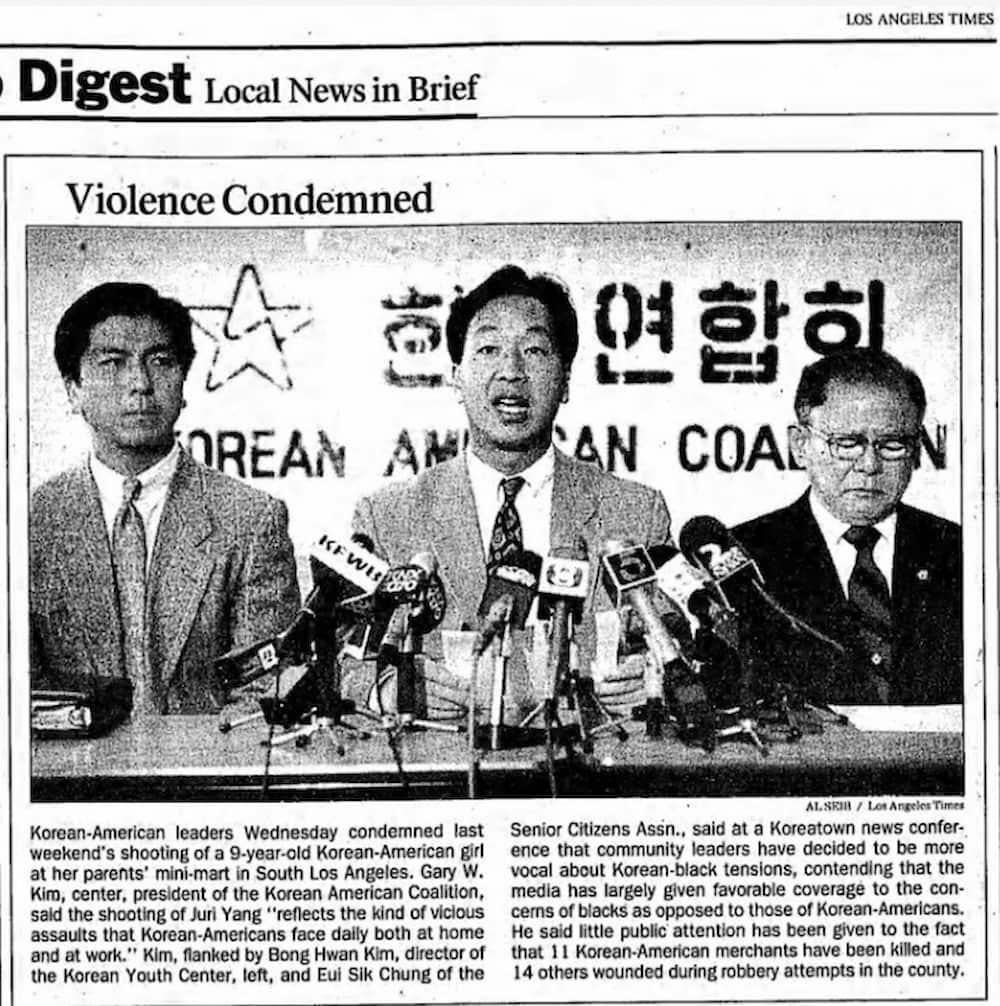
Image 48.02.05 — When a Korean American child was shot and wounded during an armed robbery of her parents’ gas station in South Los Angeles, the Korean American Council and Los Angeles Brotherhood Crusade condemned the violence, offering aid to the family.
The Trial: People v. Soon Ja Du
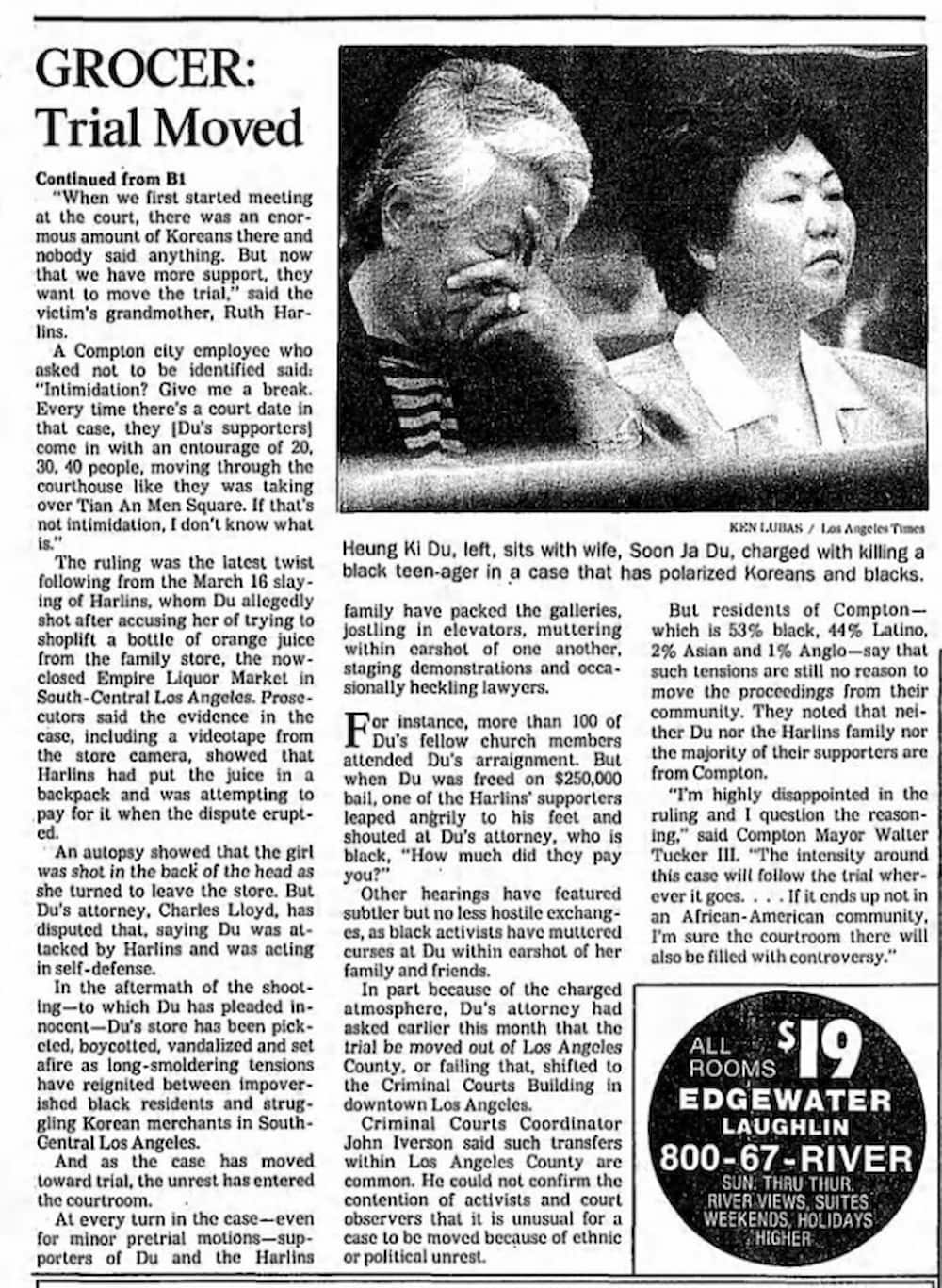
Text 48.02.06 —Billy Hongki Du weeps as he and his wife Soon Ja Du attend a hearing in the summer of 1991, after Soon Ja Du shot and killed Latasha Harlins in a dispute at their store.
Soon Ja Du was arrested and charged with murder. Her trial began on September 30, 1991, drawing emotional crowds. Judge Joyce Karlin presided as thirteen witnesses testified, including Latasha’s family, police officers, and experts. Debate centered not on race but on fear: Soon Ja Du believed she mistook Latasha for a gang member trying to kill her, while the prosecution argued Latasha was defenseless and not a threat.
Judge Karlin reduced the charge from first-degree murder to second-degree, citing impulse and heightened emotion rather than premeditation. For many in the Black community, this was further proof of systemic bias—another example of justice failing the vulnerable. Activist and community leader Danny Bakewell cited Judge Karlin’s decision as another example of systemic anti-Black racism. “It’s the kind of thing that I feel causes the African American community to feel that it is getting railroaded by the justice system,” he said.
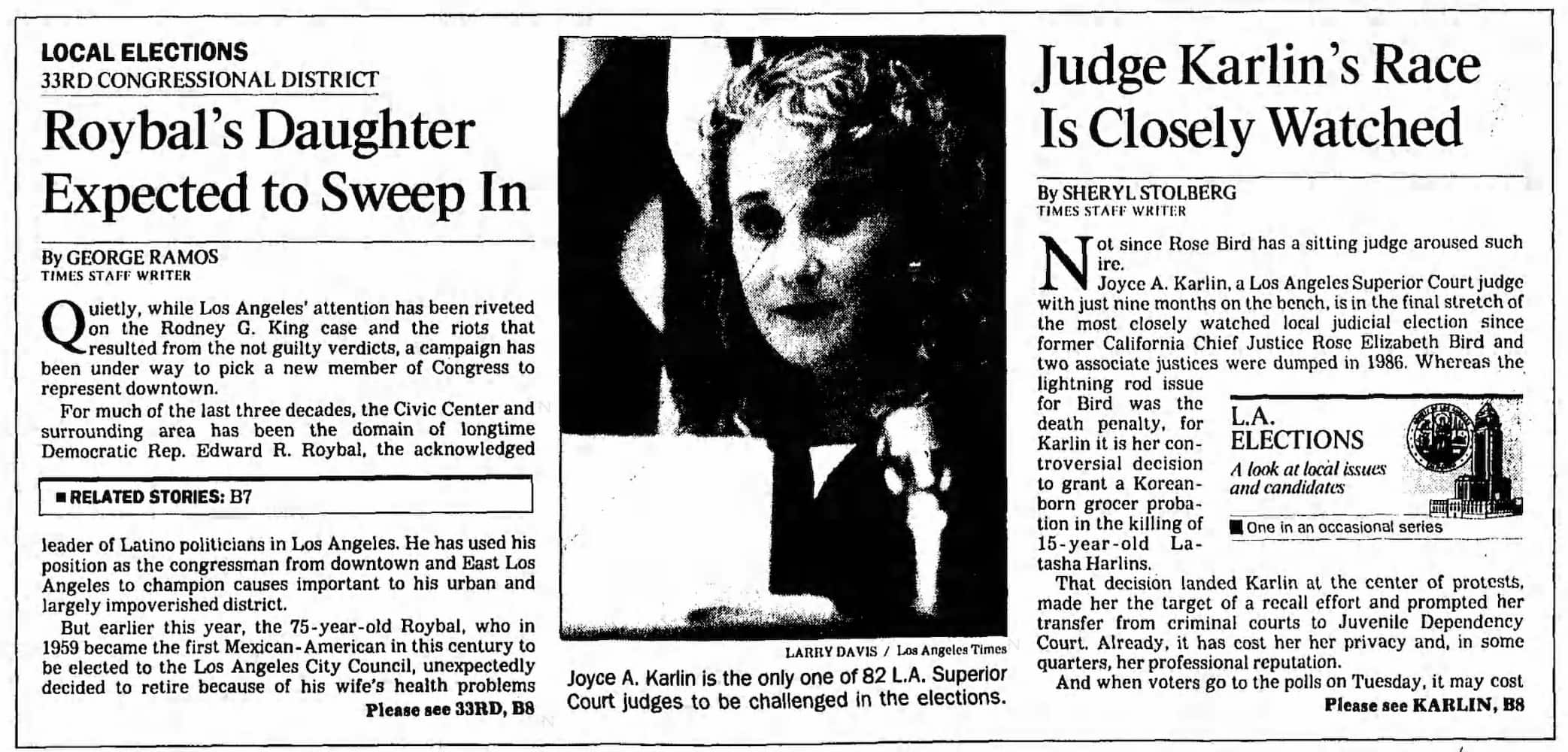
Text 48.02.07 — Judge Joyce Karlin’s probation sentencing of Soon Ja Du in the shooting death of Latasha Harlins caused controversy and divided the city. Despite efforts to recall her, Karlin was elected to California’s Superior court in 1992 before retiring in 1997.
Meanwhile, Joseph Du insisted to the media that the shooting was an accident and had nothing to do with race, saying, “My mother is made a scapegoat of Korean-Black tensions. She was merely trying to protect herself. Why is it they never publicize all the Koreans who were killed?”
But Jerry Yu, executive director of the Korean American Coalition, believed compassion and justice were not mutually exclusive. He said although many Korean Americans felt compassion for the Du family, they also supported the Harlins family and wanted justice for their dead child.
“We can relate to [Soon Ja Du] as a Korean, and we can pray for her that she does not suffer,” he said. “But, on the other hand, just because we are Korean, that doesn’t mean we wanted her to get off. There has to be justice.”
On October 11, 1991, the jury ultimately convicted Soon Ja Du of voluntary manslaughter, not murder. Instead of a possible sixteen-year sentence, she was released on a two-hundred-fifty-thousand-dollar bond pending sentencing.
Sentencing and Community Reaction
On November 15, 1991, Judge Karlin decided Soon Ja Du’s fate. Prosecutors and Latasha’s family argued passionately for the maximum penalty, insisting any leniency sent a dangerous message—that killing a Black child would be met with little consequence. Judge Karlin disagreed, criticizing the call for revenge and framing her role as mediator rather than avenger. She handed down a sentence of five years on probation, four hundred hours of community service, and a five-hundred-dollar fine.
During the trial, Soon Ja Du testified that the gun might have had a faulty trigger. She wrote a letter of apology to the Harlins family, expressing remorse. In July 1992, an estimated three-hundred-thousand-dollar wrongful death settlement was reached with the Harlins family.
Immediately after the initial verdict, supporters on both sides erupted in outrage and grief. To Black Angelenos, the light sentence reaffirmed deep suspicion that their lives were undervalued in the eyes of the justice system. Ruth Harlins called the result “an injustice,” echoing the pain of many. Protests targeted Judge Karlin herself, demanding accountability.
Soon Ja Du herself expressed remorse and presented a letter she wrote on October 25, 1991, to the family, translated by her daughter.
“I feel like I am suffering in a nightmare,” Soon Ja Du wrote. “I am sad and overwhelmed by this incident. I would never intentionally harm anyone, let alone kill her. I’m struggling with unbelievable guilt feelings. Through this incident, I empathize with Latasha Harlins’ family and friends. Being a mother myself, I fully share in the sorrow.”
Many in the Korean American community were similarly disturbed. Some questioned whether a Black defendant would have received probation, while others feared Judge Karlin’s compassion was misplaced and predicted tensions would worsen. In the press, leaders like K. W. Lee urged soul-searching among Korean Americans, challenging them to be better neighbors and helping heal a wounded city.
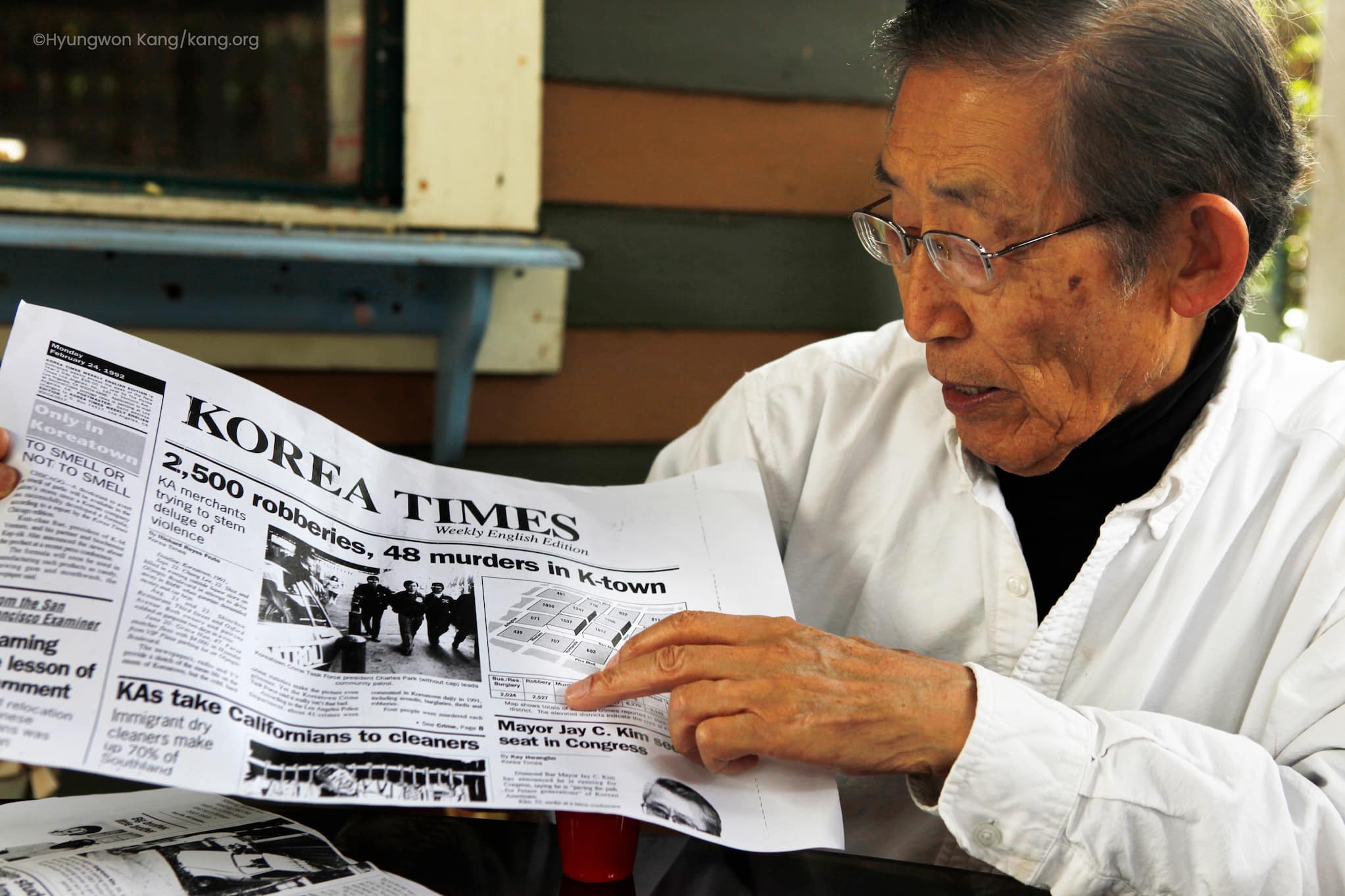
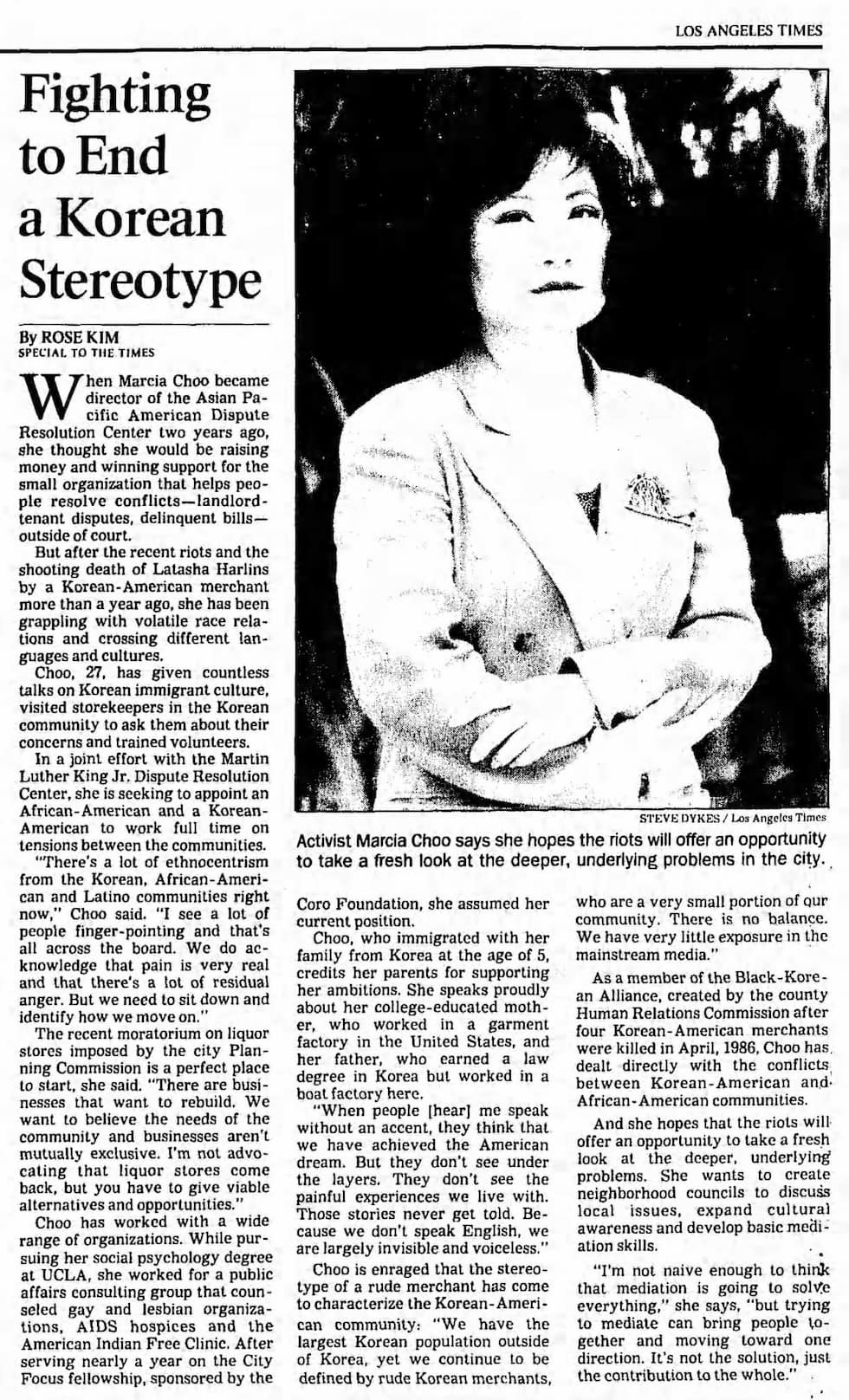
Image 48.02.09 — On April 23, 2012, during an interview in Fullerton, California, K. W. Lee, former editor of The Korea Times English Edition, showed the issue (from February 24, 1992) featuring the Los Angeles Police Department’s 1991 crime reports for the Koreatown police district.
Deputy District Attorney Roxane Carvajal acknowledged the “great emotional burden” suffered by the Du family but added, “that does not outweigh the fact that Latasha Harlins was killed, a fifteen-year-old girl who had no reason to die, who should not have died but for Mrs. Du’s actions.”
More to explore
Text
Korean Americans Reaction to the Sentencing
Many in the Korean American community were also disheartened by the sentence. Criminal defense attorney Angela Oh wondered if Soon Ja Du would have received probation if she were not Korean. “I don’t believe an African American defendant found guilty of voluntary manslaughter would have got straight probation,” she said. Oh also “cringed” whenever people praised Judge Karlin’s decision as “just.” “It was compassionate, and it was extremely lenient, but I don’t agree it was just.”
Personifying Dreams and Disappointment
Latasha Harlins and Soon Ja Du came to embody more than themselves—they became symbols for entire communities. Latasha personified Black hopes for fairness, dignity, and escape from cycles of violence and poverty. Her story, dreams, and untimely death inspired activism, sorrow, and resolve among Black Los Angeles.
Soon Ja Du, meanwhile, represented the immigrant striving to create opportunity and safety in an unforgiving environment not of their making. Her actions sprang from fear, shaped by daily threats and cultural misunderstandings. Yet, her light sentencing left many Black residents feeling invisible, excluded, and disposable.
Instead of closing wounds, the trial and sentencing deepened the rift. Black Angelenos saw a system that protected others while failing them, fueling outrage and despair. Korean shop owners became targets for retribution, fearful and isolated. Despite efforts by bridge-builders on both sides, mutual suspicion grew as minor incidents became flashpoints. Boycotts, arson, and street violence became increasingly common, with neither community able to escape the shadow of Latasha Harlins’ death.
Media sensationalism emphasized conflict, rarely reporting the moments of solidarity or the nuanced efforts at peaceful coexistence. The underlying economic hardship and cultural misunderstandings were lost in the noise.
Conclusion: The Road to the Los Angeles Uprising
When the verdict in the Rodney King case was announced in 1992, the city combusted. The rage that erupted was not just about police violence—it was the accumulated pain, distrust, and division stoked by cases like Latasha’s. The lives of Latasha Harlins and Soon Ja Du, both reaching for the American Dream but derailed by systemic injustice and mutual misunderstanding, personified the wounded aspirations of their respective communities.
Judge Karlin’s lenient sentence for Soon Ja Du was an especially bitter pill. Black Angelenos felt their security and worth had been publicly dismissed; Korean merchants, meanwhile, faced the wrath born of this alienation. “I think Koreans are a target right now,” warned Angela Oh: “We have to recognize that Judge Joyce Karlin did not do anything to quell tensions. The easiest targets are individual merchants that are sitting out there.” Her warning would soon become a reality as yet another high-profile trial would soon throw gasoline onto this fire.
Ultimately, the tragedy of Latasha Harlins’ death and the verdict that followed became a catalyst for the city’s upheaval, a painful reminder of the need for true justice and solidarity between communities who too often found themselves on opposite sides of the same struggle.
Glossary terms in this module
1965 Watts Uprising Where it’s used
Between August 11 and 16, 1965, civil unrest broke out in the Watts neighborhood of South Los Angeles. Sparked by a traffic stop of Marquette Frye for drunk driving, it escalated from an exchange of words to physical force that attracted a crowd in the neighborhood where police/community relations were poor.
flashpoint Where it’s used
A critical point, event or set of circumstances where a situation erupts into violence.
food desert Where it’s used
A neighborhood that lacks nearby access to affordable and quality groceries.
probation Where it’s used
A sentencing option available to the court after considering characteristics of an offense and individual defendant. Often offered in first time offender cases, even in the context of homicides. In felonies, the defendant who receives a probationary sentence also is required to comply with terms that may include fines, restitution, community service, and regular check-ins with a probation officer. Probation can also be mandated upon release from incarceration.
redlining Where it’s used
A discriminatory practice where banks deny mortgages and financial services–such as home loans and insurance coverage for assets–to certain neighborhoods zoned “red” or undesirable, particularly following the National Housing Act of 1934. These neighborhoods were usually where Black and Brown residents lived. Redlining contributed to poverty, underdevelopment, and food deserts in racially segregated neighborhoods.
scapegoat Where it’s used
An informal group savings arrangement where members contribute a set amount regularly to a pool, and each takes turns receiving the lump sum until everyone has benefited. This is called a “gye” in the Korean language.
rotating credit system Where it’s used
A set of people who are wrongly assigned blame for a problem, typically those whose social status makes them vulnerable to violence and makes addressing or correcting the error very challenging.
solidarity Where it’s used
A political, cultural, and collective stance that recognizes the mutual responsibility and support that is necessary to achieve change. Solidarity taps into the power in numbers and considers the collective interests of communities.
uprising Where it’s used
A collective fight against an oppressive system of injustice. The term “uprising” is one of several labels used in place of the word “riot” to describe civil unrest in response to a felt injustice. Several other terms were used to describe this event, including civil disturbance, rebellion, implosion, riot, war zone. The label a person uses can reveal one’s understanding of what took place.