





A shopping mall on the left billows out black smoke as it is engulfed in flames. A multi-tenant sign on the right displays business names.
Module 4: “Flashpoints” From Florence and Normandie to Koreatown”
Is the 1992 Los Angeles civil unrest relevant to today and has there been progress since?
When the not-guilty verdicts were announced at 3:15 p.m., there were only 838 Los Angeles Police Department (LAPD) police officers on duty in a city of over 3.48 million people.
Mayor Tom Bradley and former LAPD Lieutenant, condemned the verdicts, stating “the system failed us” at a press conference.
“Today, the jury told the world that what we all saw with our own eyes was not a crime,” he said. “Today that jury said we should tolerate such conduct by those who are sworn to protect and serve. My friends, I am here to tell the jury . . . our eyes did not deceive us. We saw what we saw, and what we saw was a crime. No, we will not tolerate the savage beating of our citizens by a few renegade cops.”
Mayor Bradley pleaded for calm, reminding everyone of the destructive legacy of the 1965 Watts Uprising. “We must not bury the gains we have made in the rubble caused by destructive behavior,” he said. Barely two-and-a-half hours later, about three dozen of the 838 LAPD Police officers on duty found themselves surrounded by more than two hundred demonstrators, some of them armed members of local gangs, at the intersection of Florence and Normandie Avenues in South Los Angeles. People were smashing bricks into windshields of cars passing by, causing terrified drivers to abandon their vehicles. They also threw rocks at nearby LAPD patrol cars.
This module presents the unfolding of civil unrest following the verdict of The People of the State of California v. Laurence Powell, Timothy E. Wind, Theodore Briseno, and Stacey Koon. It discusses the significance of the LAPD’s inaction and how community members tried to protect Koreatown during the civil unrest.
Why did the police abandon the chaos that broke out at Florence and Normandie Avenues in South Los Angeles after the “Not Guilty” verdicts were announced?
What took place during the first few days of the 1992 Los Angeles Uprising?
What did Korean business owners and their families experience during the civil unrest?
“Get Out!”
Anger at the verdict opened the floodgates of anger at the law enforcement system. “F*** the police!” they screamed.
LAPD lieutenant Mike Moulin knew they were in trouble. The highest-ranking officer on the scene, the twenty-one-year police force veteran, had just driven from the 77th Street police station to the intersection of Florence and Normandie. What he saw was utter chaos. “Anarchy was occurring before our very eyes,” he said. “The officers were being subjected to bricks, to huge pieces of concrete, to boards, to flying objects.”
His officers were completely unprepared. They had no helmets. No face shields. No bulletproof vests. No tear gas–but they did have guns. Lieutenant Moulin feared they might have to resort to lethal force if the violence did not stop. There were only twenty-five to thirty-five cops present among a crowd of hundreds. “We could have a massacre here,” he realized.
At 5:43 p.m., Lieutenant Moulin made an announcement through the LAPD patrol-car public address system. “I want everybody out of the area of Florence and Normandie,” he said. “Everybody get out of the area.” Moulin’s officers were shocked. Get out? But they all had sworn to the LAPD oath, “To Protect and to Serve.” But they had no choice but to obey their orders. “All units, all units, evacuate Florence and Normandie immediately.”
“There was no correct decision to make,” Moulin later told reporters, defending his decision to pull out. “We would have had twenty-five dead police officers and several hundred dead citizens, and you would have been talking about real chaos.”
Meanwhile, Police Chief Daryl F. Gates had just left Parker Center for a political fundraiser in Brentwood. As the violence erupted at the intersection of Florence and Normandie, he was stuck in rush-hour traffic. Gates later regretted leaving for the fundraiser. There, he confirmed to guests during his speech that the police had been forced to evacuate Florence and Normandie where the last black-and-white patrol car had left the intersection by 6:25 p.m. The people in the neighborhood were on their own now.
Florence and Normandie
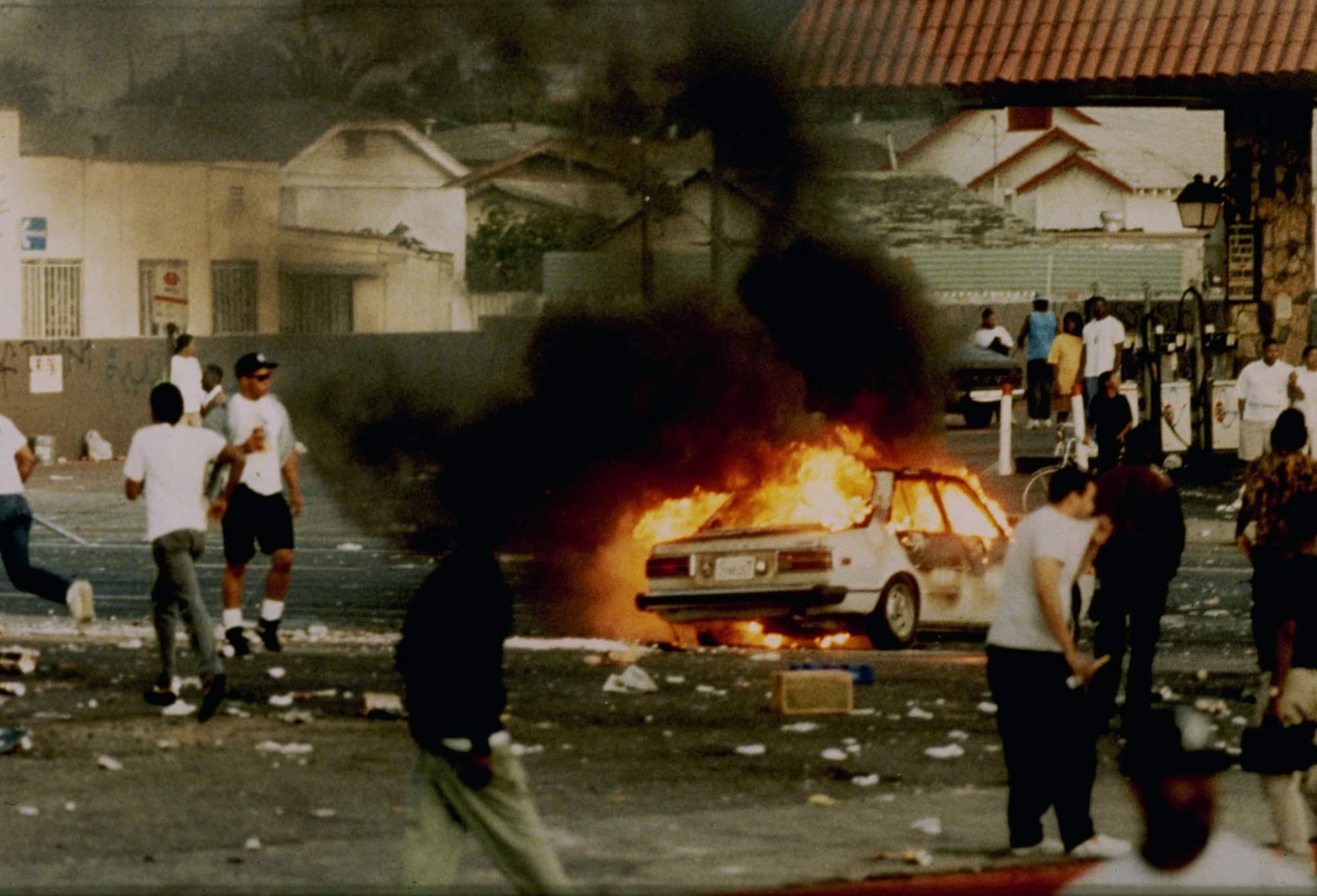
Image 48.04.02 — April 29, 1992. Demonstrators throw rocks and bottles at cars at the Florence and Normandie intersection in reaction to the not-guilty verdicts in the LAPD beating case of Rodney King. Drivers were forced to abandon their cars to escape.
Like George Holliday, Timothy Goldman had recently bought his first camcorder. When he heard about an angry crowd protesting the cops near where they lived, Goldman grabbed his camcorder and headed over. As he approached the crowd, Goldman hit the “record” button, unaware that he was capturing the first live moments and a flashpoint that would erupt into the 1992 Los Angeles Uprising. Goldman, who was Black, was also angry about the verdicts. At the corner of Florence and Normandie, Goldman’s heart grew heavy at the sight of a crowd throwing rocks and bottles at passing cars and breaking into nearby stores.
“All of a sudden, it was transformed into a war zone,” he said. “Everything that happened in the riots happened at that intersection. You had the looting, you had the arson, you had the beatings, you had shootings.”
Goldman kept recording for three more hours. He captured other pivotal moments that police would later confiscate as evidence. Like the George Holliday video of the LAPD beating of Rodney King, Goldman’s video of the Florence and Normandie intersection would also become a part of history.
“I didn’t know it would escalate like it did,” Goldman later said. “I was just probably in the wrong place at the right time.” Right time or not, Goldman could no longer handle the violence. “I was just too sick to go see more,” he said. “I turned the camera off, and I just walked home.”
The Rescuer
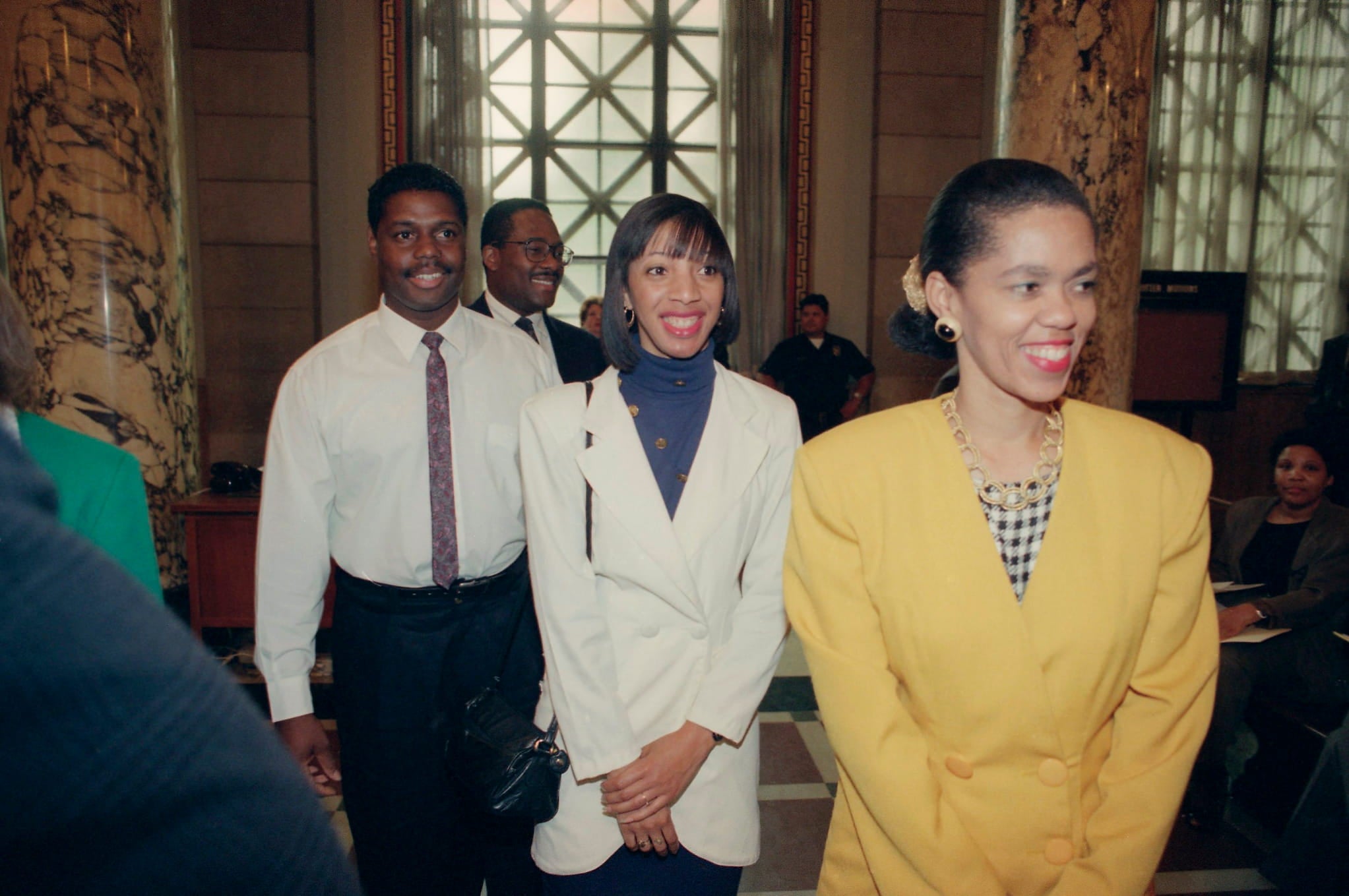
Image 48.04.03 — On May 5, 1992, the Los Angeles City Council honored the actions of trucker Reginald Denny’s rescuers, Lee Yuille, Terri Barnett, and Titus Murphy (front to back) and Gregory Alan Williams, who saved the life of motorist Takao Hirata.
Although the police had evacuated the intersection of Florence and Normandie, many civilians stepped in. Neighbors who lived near Florence and Normandie rushed out of their homes after seeing live TV news footage of people being attacked just a few blocks away. These rescuers did not consider themselves heroes. Although they were just as outraged over the verdicts as everyone else, they would also do anything to protect their community. Their actions defied the media’s coverage of a city divided by race. Many of these rescuers were later dubbed the “Good Samaritans” and honored by the Los Angeles City Council for their heroic efforts.
“I didn’t think at the time that I did something heroic,” said one rescuer, who was Black and had saved the life of an immigrant from Belize. “I would just hope someone would do the same for me that I did for him.”
Even a Hollywood actor who played a cop on TV found himself playing a hero in real life. Actor Gregory Alan “Greg Alan” Williams, a cast member of the popular NBC series Baywatch, rescued Takao Hirata, a Japanese American motorist who had been beaten unconscious. The actor took Hirata to the hospital and contacted his family. Afterwards, as Williams headed home, people saw Hirata’s blood on his shirt and assumed the actor, who was Black, had been attacked. “It dawned on me that they could not tell his blood from mine,” Williams said. “And so ultimately, when it comes down to it, we are the same.”
Over one thousand fires erupted throughout the city. By May 1, 1992, almost six hundred people were injured and twenty-five people killed.
Mayor Bradley addressed the city in a live TV address in which he warned Angelenos to stay off the streets. There was now a citywide sunset-to-sunrise curfew. Sales of ammunition were temporarily banned. The 110 Harbor and 10 Santa Monica Freeways were closed, and the National Guard was called.
“We believe that the situation is now simmering down, pretty much under control,” Mayor Bradley said. But the mayor was wrong. The situation was far from being under control. The fires did not stop desperate residents from raiding stores for basic supplies, including food staples, goods, and diapers, during the six days of civil unrest and nightly curfews.
Meanwhile, bus service was canceled. Employers locked their offices and told employees to work from home. The US Postal Service was suspended. All major sporting events and music concerts were canceled. Schools closed. By noon, the first two thousand National Guard troops were deployed, followed by the Marines.
President George H. W. Bush officially deployed three thousand soldiers of the Seventh Infantry, fifteen hundred Marines, sixty-five hundred National Guard troops, and a thousand FBI, SWAT, Border Patrol, and US Marshal’s Service law enforcement officers to Los Angeles. The 1992 Los Angeles Uprising also sparked similar demonstrations and acts of violence in cities across the country, including San Francisco, California; New York City; Atlanta, Georgia; Toledo, Ohio; Denver, Colorado; and Las Vegas, Nevada.
The civil unrest lasted for six days. In the end, 12,111 people were arrested. 2,383 people were injured. 10,072 National Guard and five thousand federal troops were deployed. There were over thirty-six hundred fires. Over a thousand buildings burned to the ground. Twenty-three hundred Korean-owned businesses were destroyed. A total of sixty-three people died. Altogether, the Los Angeles Uprising caused a billion dollars in damage. A disproportionate amount of that damage—47 percent or almost half—happened in the 2.9-square-mile-radius of Koreatown in Los Angeles.
Why?
Radio Korea
RADIO KOREA HOST [in Korean]: “What’s the address of your store? Could you repeat that?”
CALLER [in Korean]: “84th and Vermont . . .”
HOST: “Johnny’s clothing store?”
CALLER: “That’s a men’s clothing store. Is that store being burned?”
HOST: “Yes, it is burning.”
CALLER: “Oh my God. That’s our store.” (sobbing)
– Live calls to Radio Korea, April 29 to May 4, 1992
Listen to
Radio Korea Call
Caller: 저희 가게는 유리창만 다 깨지고 밤새도록 일하는 사람들이 지쳤어요.
그래 갖고 밤에, 어저께 밤에 shotgun 세 발이나 쐈다 그러더라고요.
저기 유리를 뚫고 들어오는 거를…
My store windows are all shattered, and the employees who were working through the night are exhausted. And then last night, three rounds were fired from a shotgun [into the store] through the glass.
Caller: 이거를 너무나…이걸로 끝나는 게 아니라 경찰의 말을 의하면은.
이번 주말이 또 문제라고.. 그러거든요.
감히 이거를 어떻게 지켜야 되는 건지.. 참..
This is too… this isn’t even the end, according to what the police say.
They say this weekend is going to be a problem, too.
I don’t know how to protect my store.
Audio 48.04.04 — On this recorded call to Radio Korea 1540 AM, a store owner reports her windows shattered by shotgun blasts, and laments that this is only the beginning of the violence.
As afternoon turned to evening on Wednesday, April 29, Jin Ho Lee, a twenty-nine-year-old reporter at Radio Korea 1540 AM watched the station’s switchboard light up.
Two miles north of Florence and Normandie, Koreatown was becoming a second flashpoint. Cosmos Appliance on Vermont Avenue was the first Korean-owned store set on fire. Owner Michael Kim and his family and friends hid in the back, frantically calling the police. “Nobody showed up,” Kim said. “There was a fire burning across the street for three hours, and nobody came.” Although no one was hurt, the Kims lost everything. “It took fifteen years to build up our business, and in two days, it is gone,” his wife, J. Kim later told reporters.
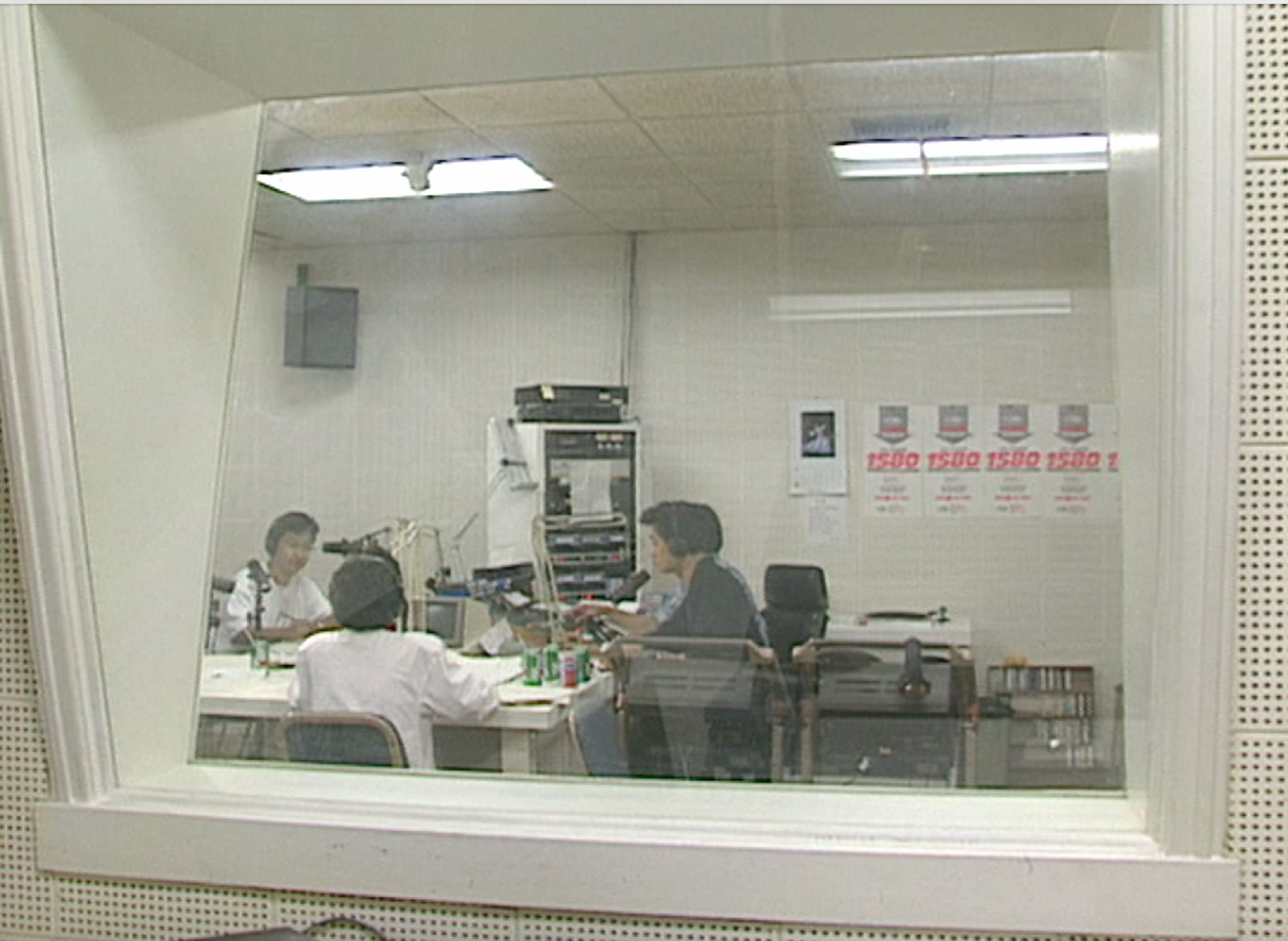
Image 48.04.05a — Over seventy-two hours, Radio Korea became an alternate 911 call center and is credited with helping save many stores in Koreatown from burning down completely.
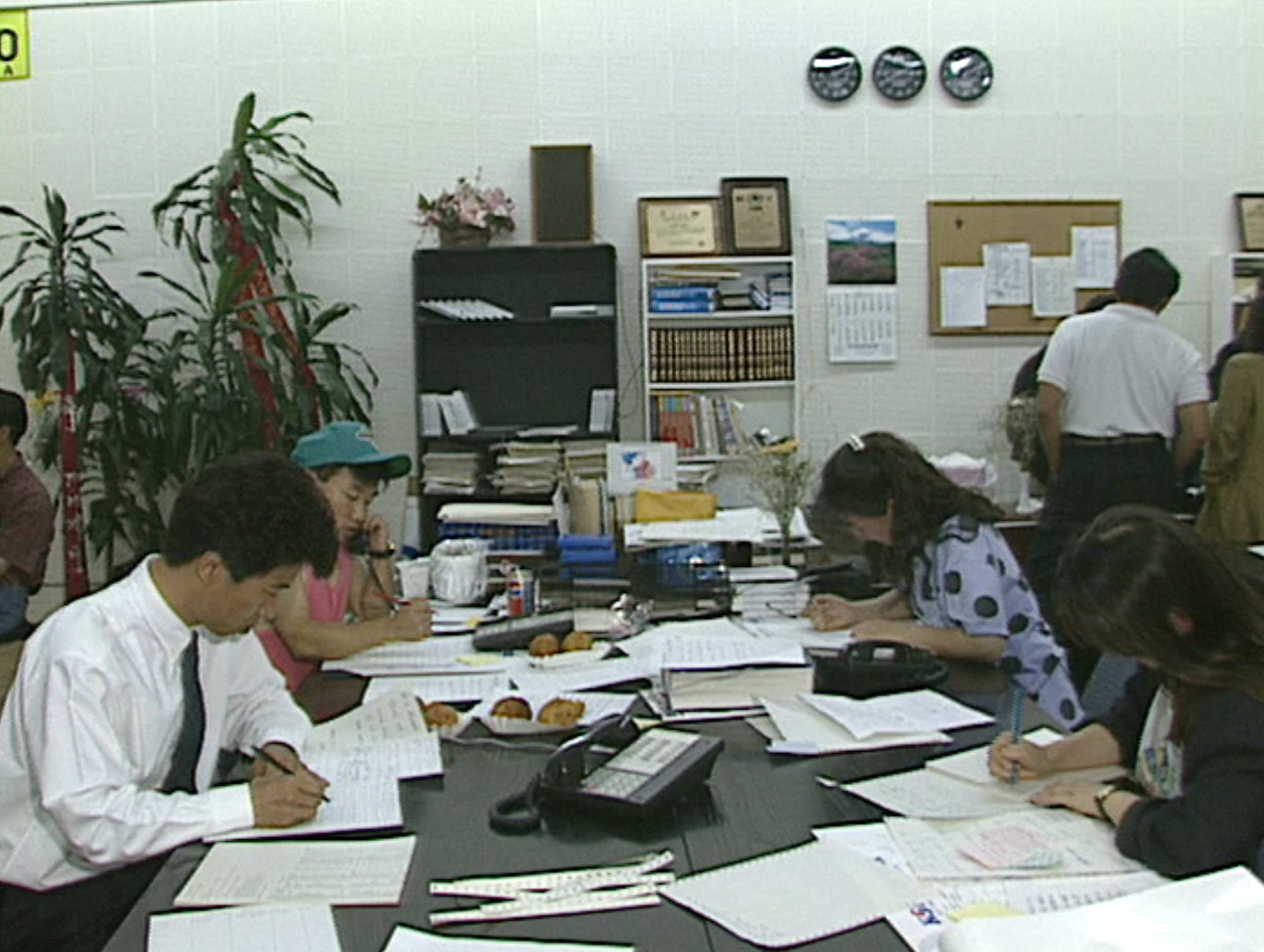
Image 48.04.05b — Radio Korea staffers slept overnight in the office as they worked twenty-four hours a day to field calls.
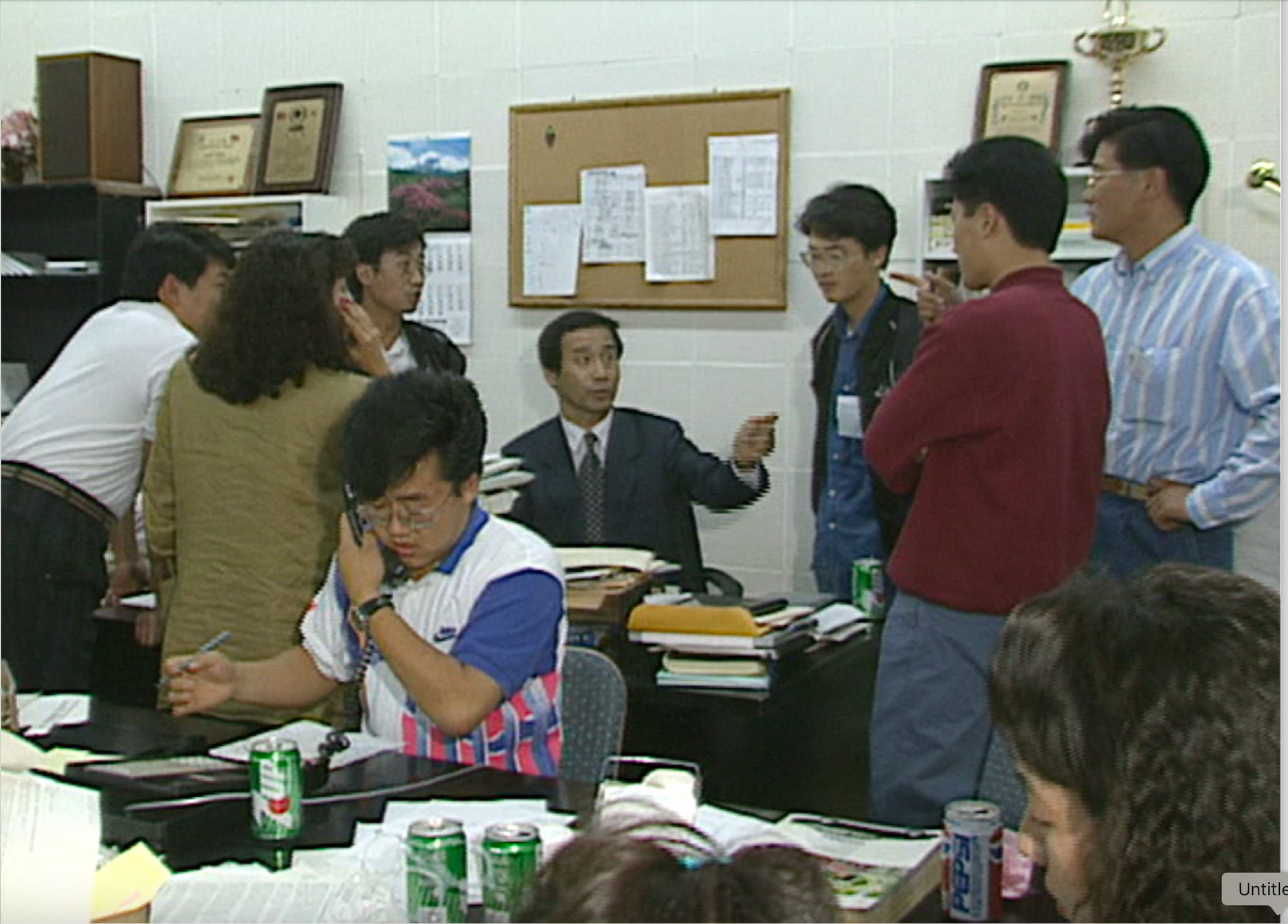
Image 48.04.05c — Korean restaurant owners delivered bowls of seolleongtang ( bone broth) to feed Radio Korea reporters working nonstop. Radio Korea set up emergency supplies in the parking lot to help storeowners in need.



In the first few hours after the not-guilty verdicts, hundreds of calls from concerned Koreatown store owners flooded Radio Korea. Because of language barriers, they begged the radio station to call the police for them. Jin Ho Lee and the other staffers called 911, only to find a busy signal.
“The police weren’t reachable,” Jin Ho Lee said. “The fire department was not reachable. We sensed something was very serious, so we opened up and spread the information because if we don’t spread the information in real time and help people to safety, then who’s going to do that?”
There were so many stores in danger that the staff put together a giant board filled with store names and addresses. “Our station quickly transformed into a disaster call center,” Jin Ho Lee said. “We tallied the stores—liquor stores, swap meets, and others, counting how many burned, and found their owners’ names.” The accounting was more than just numbers. “I cried several times interviewing people,” Jin Ho Lee said. He never forgot one caller, a Korean woman, who called in to report seeing smoke and fire in her neighborhood, only to find out it was her own store on fire.
“Oh, my God, that’s my store,” she said, bursting into tears. “That’s everything I had here in America.”
For over seventy-two hours, Radio Korea became an alternate 911 call center and is credited with helping save many stores in Koreatown from burning down completely. Jin Ho Lee is proud of the role Radio Korea played. “A community radio station acted as a command center during the civil unrest,” he said. “We feel proud that we did something for our community.”
“Let’s Protect Koreatown!”
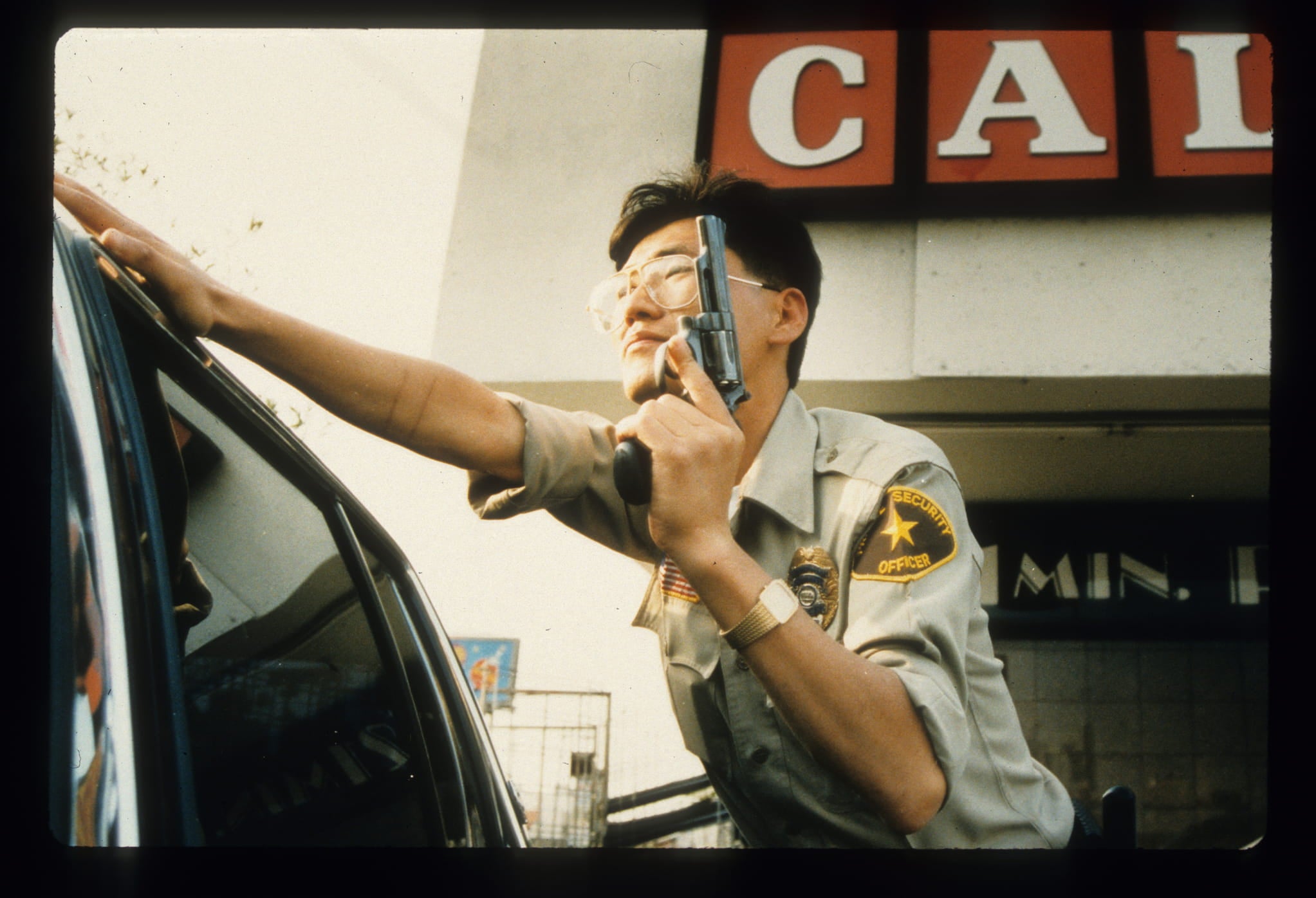
Image 48.04.07a — An armed security guard keeps watch outside of a mini-mall in Koreatown.
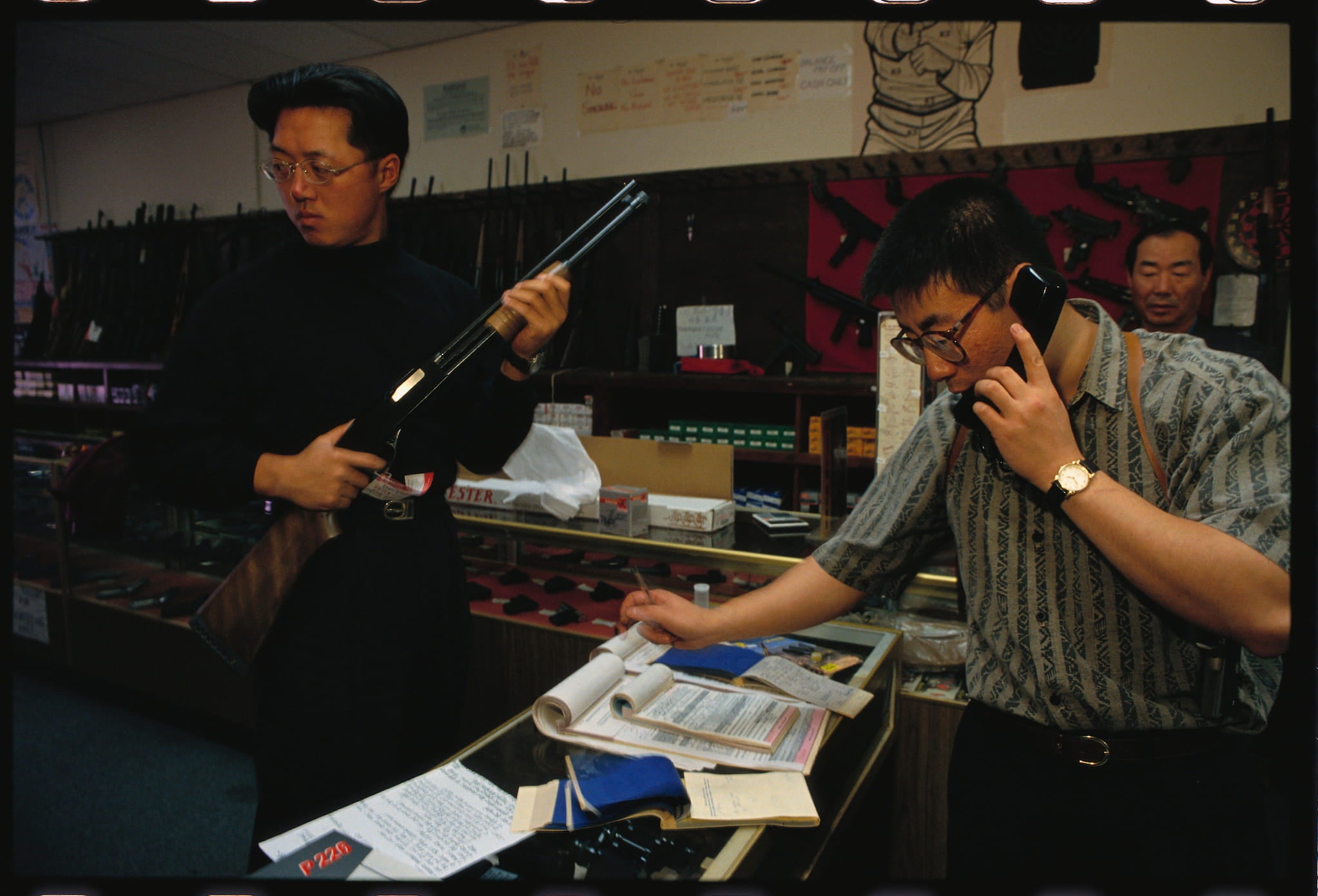
Image 48.04.07b — After the police were unable to contain the violence in Koreatown, Korean American store owners armed themselves to protect their stores. Above, a man purchases a gun at a shop on Western Avenue.
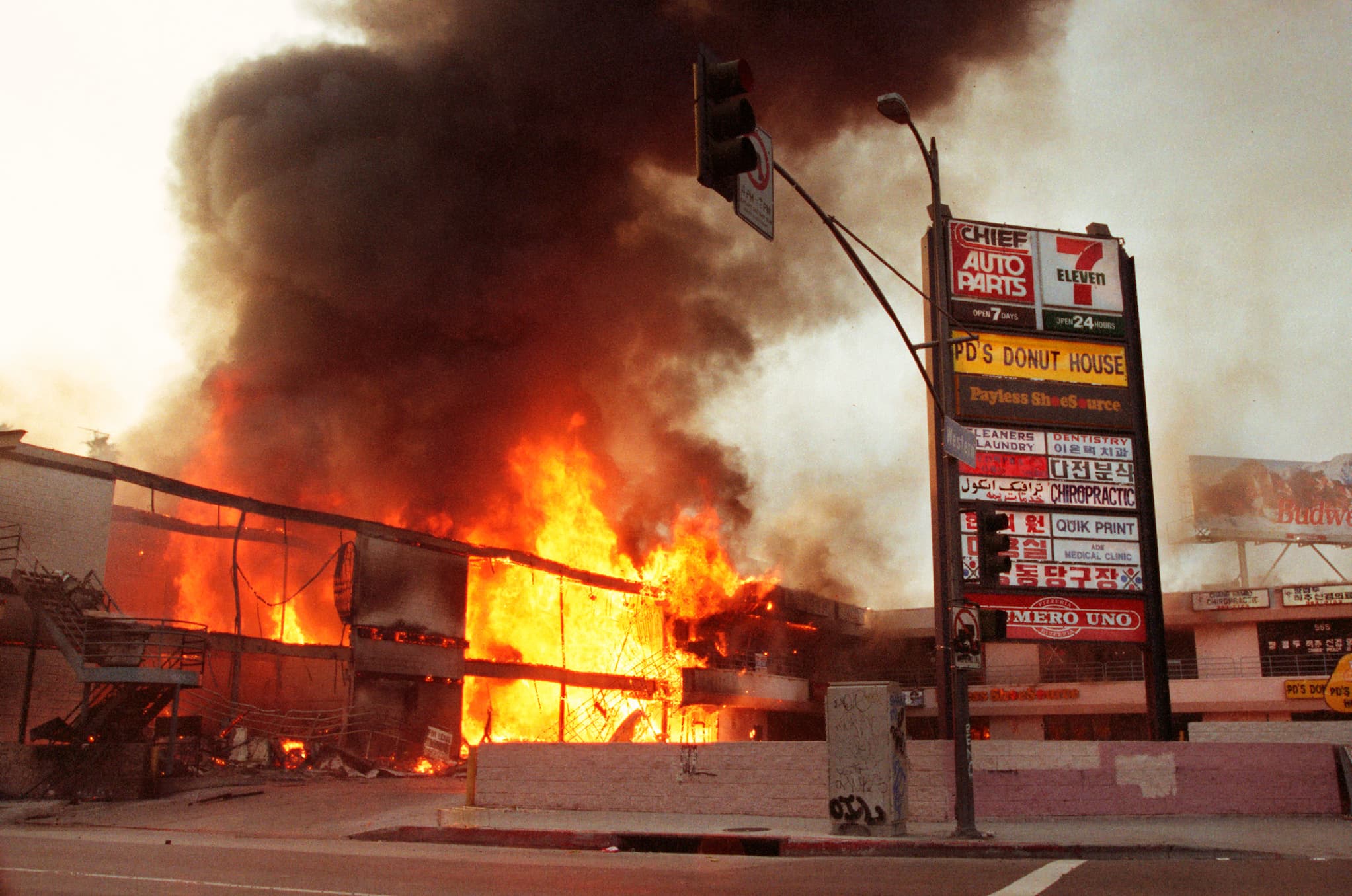
Image 48.04.07c — An out-of-control fire destroys a Koreatown shopping mall on the corner of 6th Street and Western Avenue, leaving nothing but a skeletal frame.



Meanwhile, for the past forty-eight hours, Edward “Eddie” Jae Song Lee sat glued to the radio and TV. “He sat there, listening to Korean radio and watching Korean television and getting madder and madder,” his sister Jenny remembered.
“Everything we have worked for is now in flames,” Eddie told his family. “How can we just sit here and watch it happen? We Koreans should go out and protect our own.” Eddie and his friends heard Jong Min Kang of the Korean Young Adult Team call Radio Korea, begging for reinforcements.
Jong Min Kang, the thirty-three-year-old president of the Korean American Business Association, had started this group in December 1991 because of increased attacks on Korean American businesses. During the 1992 Los Angeles Uprising, its volunteers guarded stores and escorted store owners to their cars. The Korean Young Adult Teams stand guard outside vulnerable storefronts and restaurants, using walkie-talkies to communicate with each other.
Despite his mother’s protests, Eddie and his friends were inspired to join the team to protect Koreatown. For the next several hours, they followed another car of Korean Young Adult Team members to patrol the area.
Around 10:00 p.m., Eddie decided they should go home. He felt bad for having argued with his mom. He did not want her to be scared. Just then, they heard a store owner on Radio Korea report that a crowd had gathered outside Kang Seo Myun Oak, a popular Korean noodle restaurant located on the corner of Hobart Avenue and Third Street. The restaurant was near Eddie’s house, so he instinctively decided to swing by on their way home.
Angry demonstrators filled the street. Some people in the crowd had guns. So did the Korean American store owners and volunteers perched on a nearby rooftop. No one knows who shot first, but police described the scene as a “combat zone.”
Eddie stuck his head out of the window for a clearer view. A bullet struck him in the throat. Two of Eddie’s friends were also shot and wounded. John Kim, the youngest, was the only one to escape unscathed. He dragged Eddie across the street. The four men collapsed outside another restaurant called Pizza Go.
“He was alive for another 30 minutes,” said Eddie’s friend James, who lay bleeding next to him. “He was a fighter. He didn’t want to die. I know Eddie. You could tell he was fighting for his life.”
At 10:30 p.m. on Thursday, April 30, 1992, Edward Jae Song Lee died as he laid on his back in the parking lot of the Pizza Go restaurant, just half a mile from his house.
Later that same night, police detained and questioned three men—two Korean American and one Japanese American— in connection with the shooting of Edward Jae Song Lee and his friends. Two of the suspects admitted shooting in the direction of their car, which led to legal action by the Lees and the families of Eddie’s friends.
Although Jung Hui wanted justice for her son, she decided to withdraw from the wrongful death civil case because it had become too painful for her. Afterward, one of the suspects, a Korean American college student who was only two years older than Eddie, knelt before her, weeping.
“He had a lifetime ahead of him,” Jung Hui reflected of this young man. “I cared about his future.”
Glossary terms in this module
1965 Watts Uprising Where it’s used
Between August 11 and 16, 1965, civil unrest broke out in the Watts neighborhood of South Los Angeles. Sparked by a traffic stop of Marquette Frye for drunk driving, it escalated from an exchange of words to physical force that attracted a crowd in the neighborhood where police/community relations were poor.
flashpoint Where it’s used
A critical point, event or set of circumstances where a situation erupts into violence.
uprising Where it’s used
A collective fight against an oppressive system of injustice. The term “uprising” is one of several labels used in place of the word “riot” to describe civil unrest in response to a felt injustice. Several other terms were used to describe this event, including civil disturbance, rebellion, implosion, riot, war zone. The label a person uses can reveal one’s understanding of what took place.