





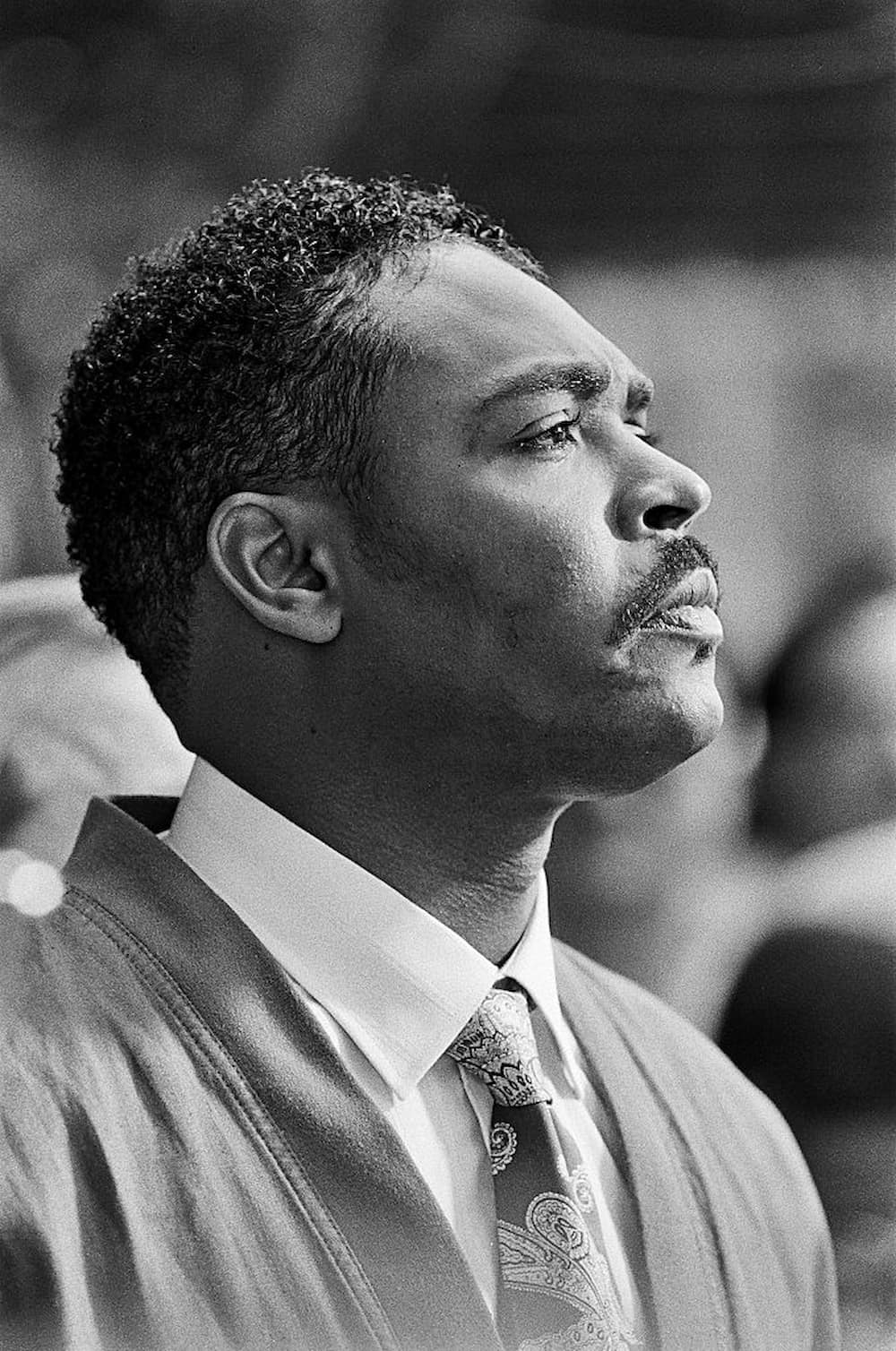
Module 3: Rodney King: A Story of Justice, Race and Unrest
Is the 1992 Los Angeles civil unrest relevant to today and has there been progress since?
Rodney King’s story begins on a quiet night in Los Angeles, March 2, 1991. It was two weeks before Latasha Harlins was killed at Empire Liquor Deli Market by Soon Ja Du. Twenty-five-year-old Rodney Glen King was driving west on Interstate 210 with two friends, blasting music, excited about starting a construction job the following week. King had hopes for turning his life around—he’d been released from prison on parole after a robbery conviction, was newly remarried, and determined to provide for his family. His new job was to start the next day.
But as he sped along the freeway, he attracted the attention of officers Melanie and Timothy Singer from the California Highway Patrol. They saw King’s car speeding and swerving. When King finally noticed the flashing lights, panic set in. “I was scared of going back to prison,” he later explained. Instead of slowing down, King pressed the gas, hoping the problem would somehow disappear.
This module explores the chain of events that would not only change King’s life—but also shape the way the United States viewed police, race, and the accountability of justice.
Who was Rodney King and what did his beating by the Los Angeles Police Department (LAPD) raise into public view?
Why did George Holliday’s video of the LAPD’s beating of Rodney cause such controversy and international attention?
What was the verdict in the trial of the LAPD officers and why did it unleash such a furor similar to the 1965 Watts Uprising?
The Thin Blue Line
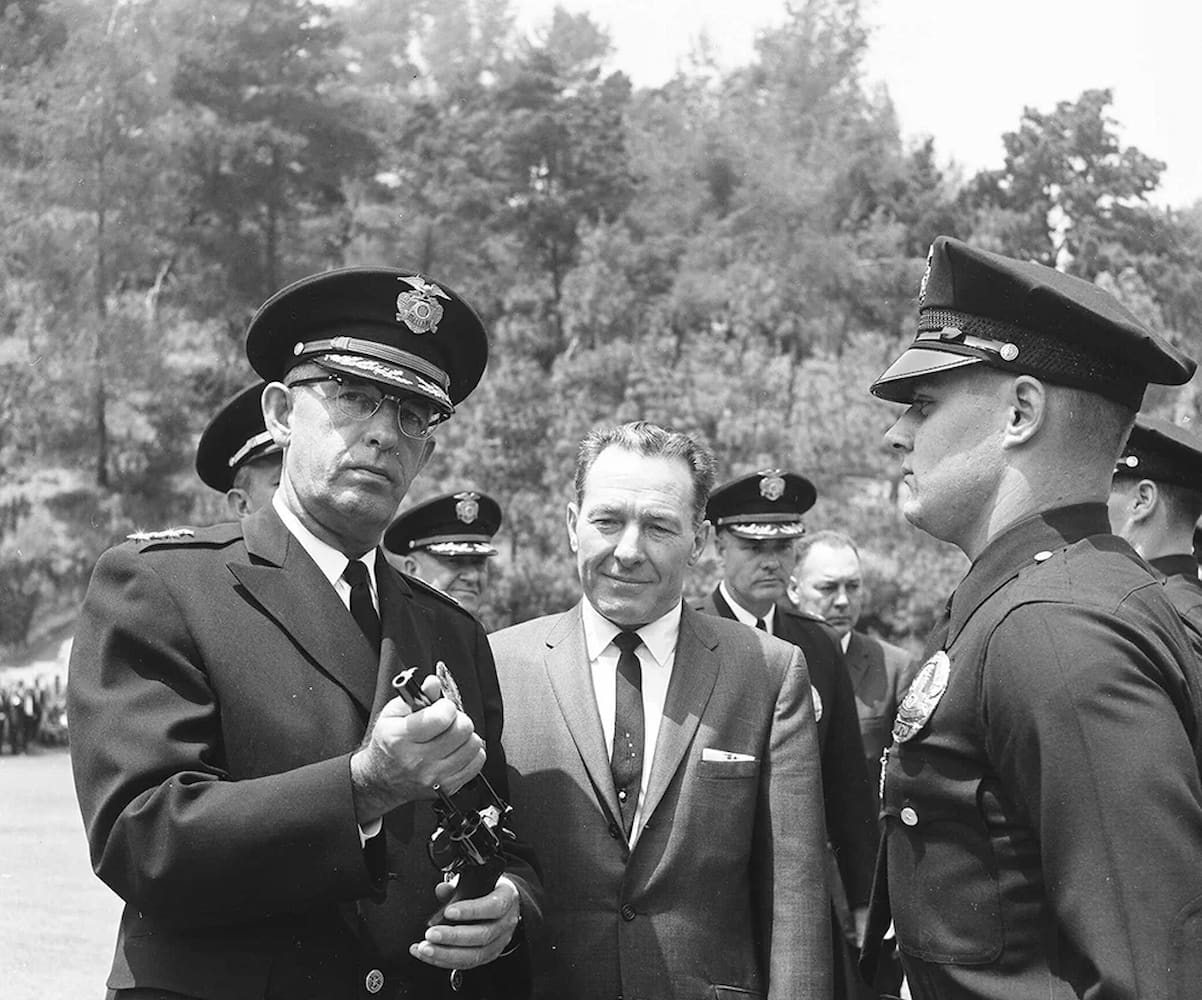
Image 48.03.01 — LAPD chief William H. Parker (left) and Mayor Sam Yorty (center) at the 1962 Los Angeles Police Academy graduation ceremony.
King’s fear of police wasn’t unique. In Los Angeles, especially in communities of color, the police had earned a reputation for harshness and racial bias. Chief William H. Parker served as the leader of the Los Angeles Police Department (LAPD) for much of the mid-twentieth century. He tried to improve LAPD’s image with TV shows like The Thin Blue Line (1952) and Dragnet (1951–1959), programs that presented officers as heroes. He also started publicity campaigns, public information offices, and colorful brochures to earn public trust. “There is no segregation or integration problem in this community,” Parker testified.
Yet, beneath this media-friendly image, problems persisted. Black, Latino, and Asian American citizens often felt excluded or targeted by the police. Even as Parker boasted about hiring the first Black and Asian American officers in the country and starting language programs for Spanish-speaking communities, accusations of racism and brutality continued. Black suspects were arrested far more often than white suspects, fueling anger and protest.
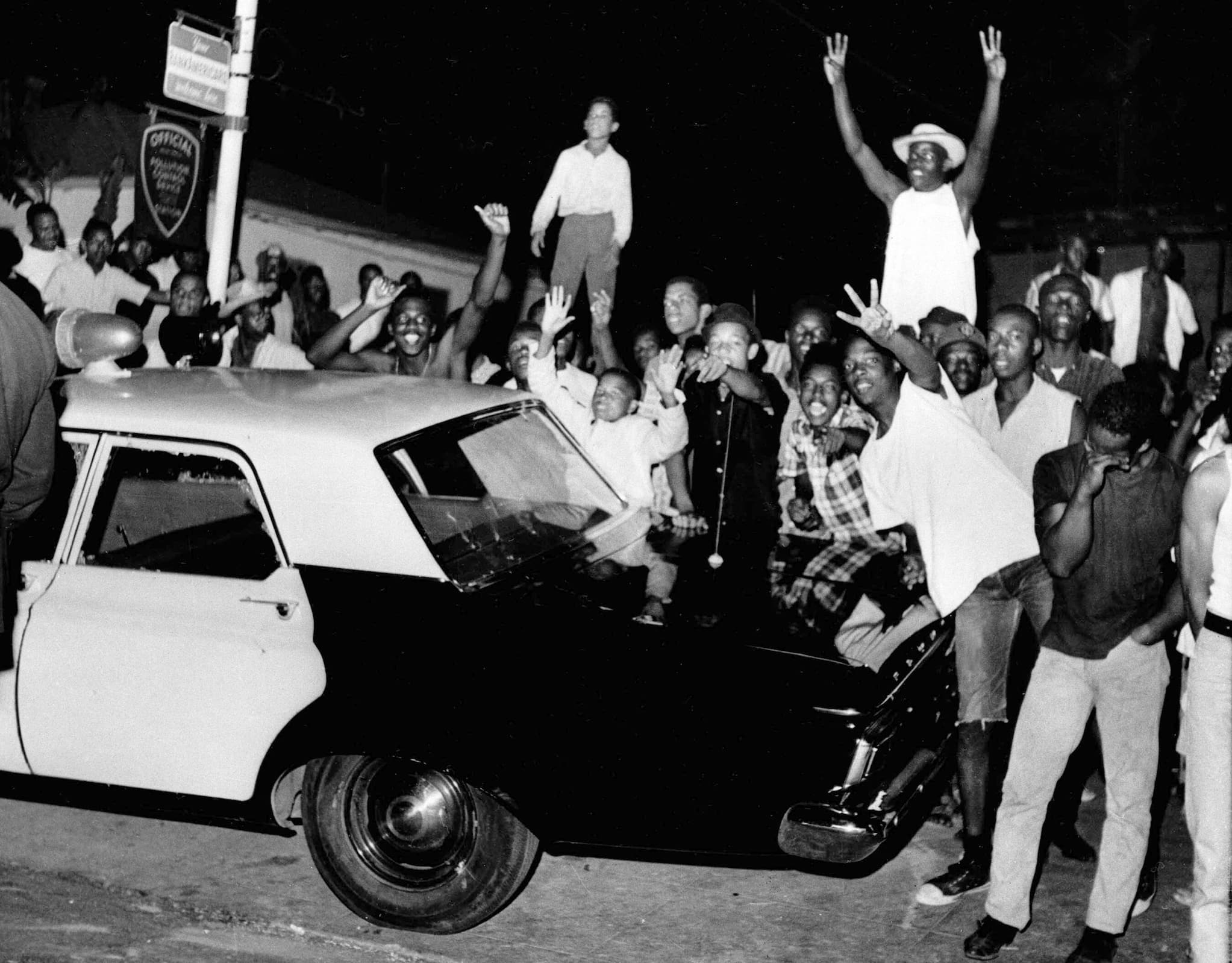
Image 48.03.02 — Demonstrators swarm a police car in Watts on August 12, 1965, during six days of civil unrest after a routine traffic stop of a young Black motorist turned violent.
Tensions exploded in 1965 when a routine traffic stop in Watts ended in violence. The Watts Uprising, lasting six days, left thirty-four people dead, more than a thousand injured, and caused forty million dollars in damages. Dr. Martin Luther King Jr. visited shortly after, blaming “economic deprivation, racial isolation, inadequate housing, and general despair” for the unrest.
These problems ran deep. In the 1980s, President Reagan’s “War on Drugs” with the Anti-Drug Abuse Act of 1986 led to harsher penalties for minor offenses, disproportionately affecting Black communities. Although the vast majority of drug users were white, Black suspects accounted for the bulk of arrests. Crack cocaine—cheaper and more potent than powdered cocaine—created a “crack epidemic,” but the penalties for possession and sale fell far heavier on Black Angelenos. LAPD’s Operation Hammer, featuring armored tanks and battering rams, made matters worse, increasing resentment and fear among Black residents.
“People ask why Black people don’t trust (public) institutions,” explained Roland G. Fryer, an economics professor. “We have watched how we’ve treated opioids—as a health concern. But crack (cocaine) was, ‘lock them up and throw away the key.’”
The Beating
King’s attempt to flee from the police led to a fifteen-minute chase, ending shortly after midnight at Foothill Boulevard and Osborne Street. Several LAPD squad cars joined the scene. Officers included Laurence Powell, Timothy Wind, Theodore Briseno, and Stacey Koon. The atmosphere was tense; King seemed confused and didn’t comply with orders, prompting California Highway Patrol (CHP) officer Melanie Singer to pull her gun.
Sergeant Koon, believing King was a threat—possibly on the powerful and illegal drug called PCP (phencyclidine)—ordered officers to swarm and subdue him. In reality, King was not high on PCP; tests only found traces of marijuana and a slightly elevated alcohol level under the legal limit.
The officers’ efforts to force King into submission grew violent. King described feeling a hard kick to his head and said, “My face got rearranged.” Koon stunned him twice with a taser, each time sending fifty thousand volts through his body. King tried to rise as officers pounded him with batons. Powell, Briseno, and Wind struck King’s joints, limbs, and back repeatedly, following Koon’s shouted orders.
By the end, King lay weak, bloodied, and soaked in his own urine, having endured fifty-six baton strikes. In King’s words, “I looked around for a safe place to run, to get out of there, but they were all around me. There was nothing I could do.”
But someone was watching.
The Videotape
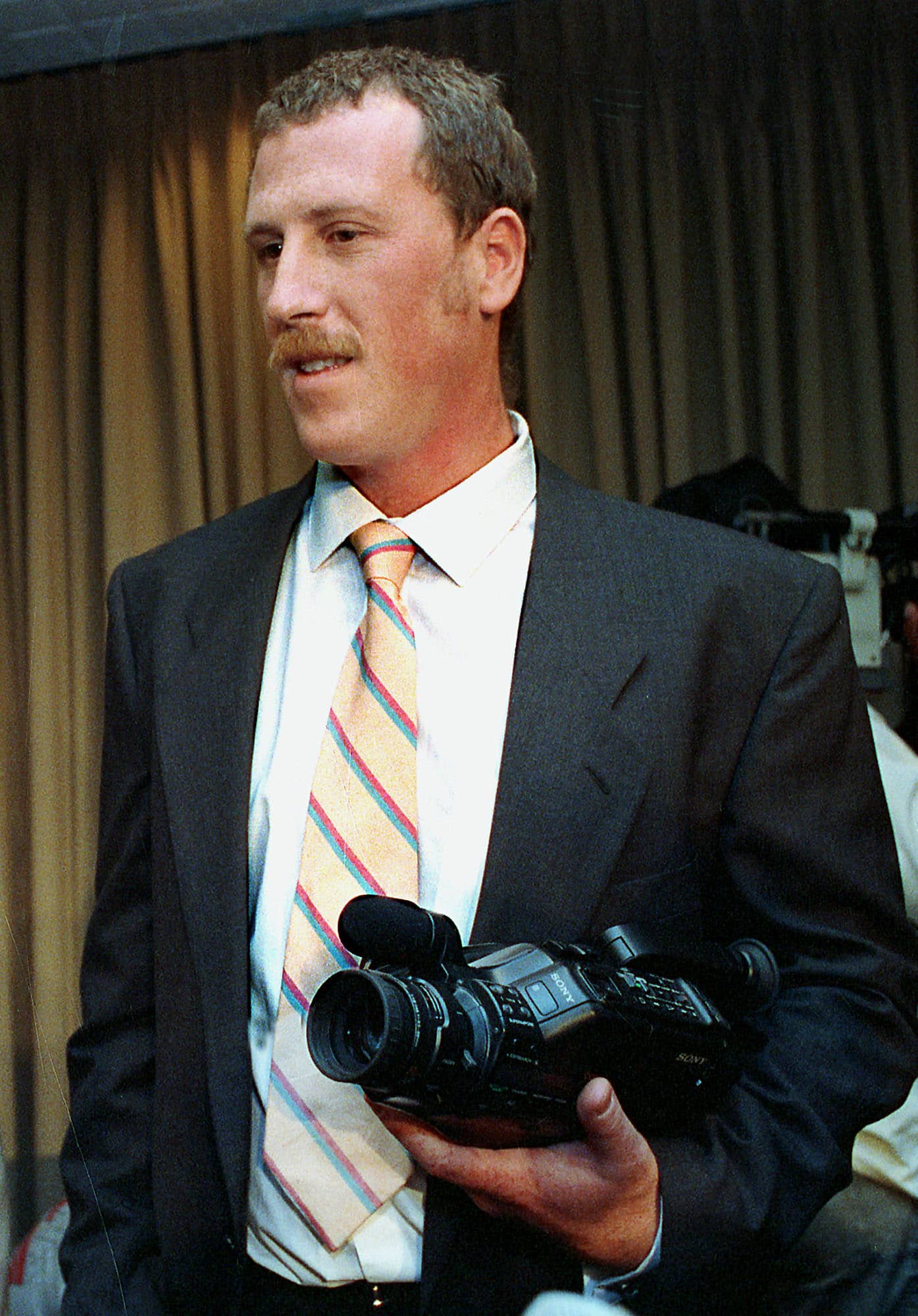
Image 48.03.03 — George Holliday, at a press conference on March 28, 1991, holds the camcorder he used to film the LAPD beating of Rodney Glen King.
George Holliday was obsessed with his new video camera. The thirty-one-year-old plumber had just bought the Sony Video8 Handycam as a Valentine’s Day gift for his wife. “When you have the new camera, new toy, you’re filming everything—whatever’s happening around you,” Holliday said. At 12:45 a.m. on Sunday, March 3, 1991, police sirens and a helicopter woke up the Hollidays. George filmed the beating from his balcony.
On Monday, March 4, Holliday called the local police station to inquire about what he had witnessed. To his frustration, the switchboard operator would not give him any information. Holliday decided to share his videotape with the local KTLA Channel 5 news station. The TV news station interviewed Holliday and aired the videotape live on their 10:00 p.m. broadcast.
“That’s when everything blew up,” Holliday remembered.
Soon, the tape aired on local news and then CNN. The footage shocked viewers nationwide. Reporters swarmed Holliday’s apartment, and the couple had to change their phone number to escape attention. Police officers were stunned. For Black Angelenos, the reaction was different. “Many of us…were almost relieved,” said Karen Bass, then a social worker and later LA’s first Black female mayor. “Finally it was on camera! And the world was gonna be able to see, and we would finally be able to hold police officers accountable.”
Five doctors treated King for a broken leg, shattered cheekbone, fractured eye socket, a broken skull, and nerve damage. The injuries raised deep concern that some might be permanent. LAPD’s Internal Affairs Division launched an investigation, interviewing dozens of witnesses and police on duty. King reported hearing racist slurs during the attack, but officers denied it. California Highway Patrol officer Melanie Singer, present that night, said King had tried to obey. He “did not aggressively kick or punch,” she testified. “He was merely trying to get away.”
With the videotape as evidence, a grand jury indicted Koon, Powell, Wind, and Briseno for assault and use of excessive force. When the trial began in February 1992, according to most polls, the majority of people in Los Angeles assumed the LAPD would be found guilty.
They were wrong.
The Court Trial
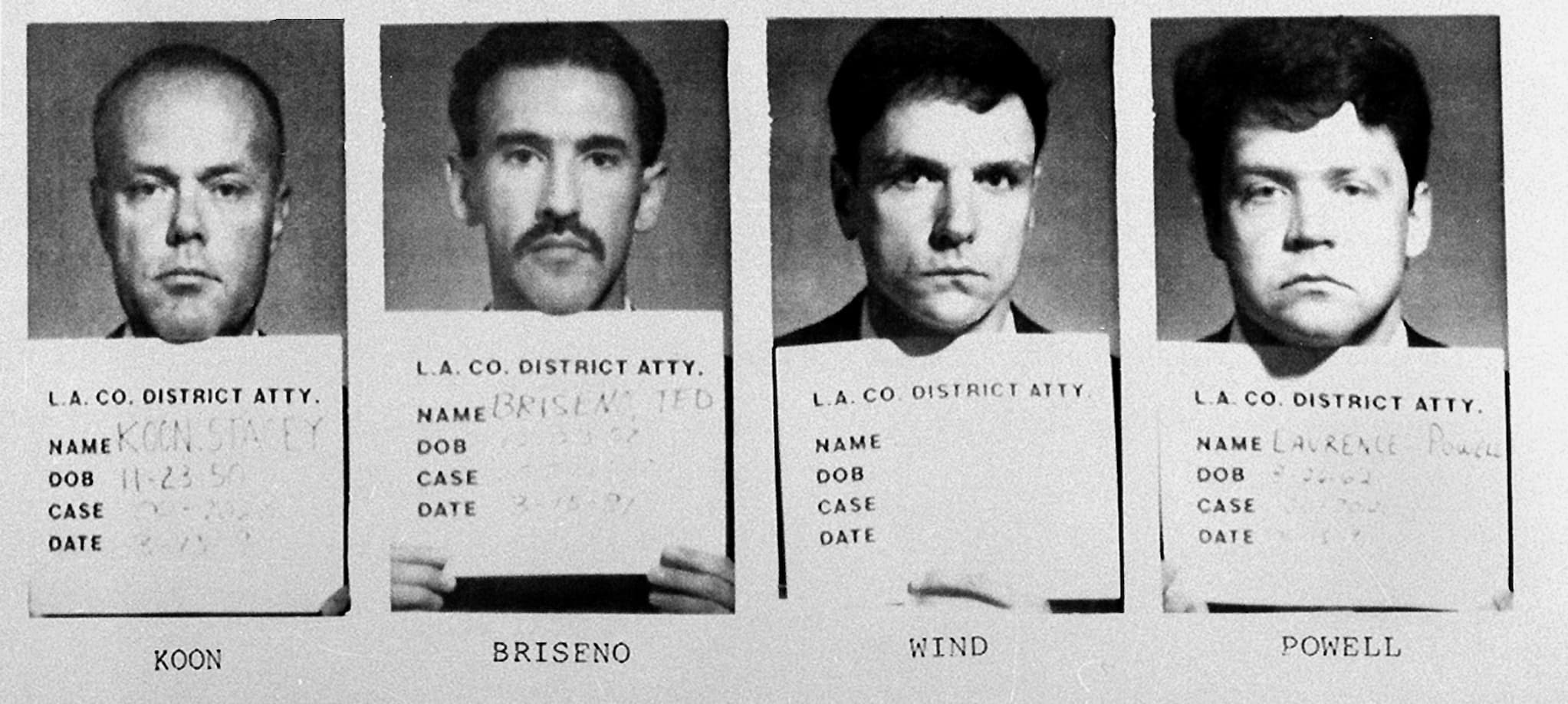
Image 48.03.04 — March 14, 1991, mug shots of (left to right) LAPD sergeant Stacey Koon and officers Theodore Briseno, Timothy Wind, and Laurence Powell, after they were indicted on charges of excessive force, assault, and more in the 1991 beating of Rodney King.
In February 1992, the trial began: The People of the State of California v. Laurence Powell, Timothy E. Wind, Theodore Briseno, and Stacey Koon. Four officers faced charges of assault and excessive force; Koon and Powell were also accused of filing false reports. If convicted, they would serve up to eight years in prison.
Defense attorneys argued that the media frenzy and “political climate” in LA would prevent a fair trial, so the proceedings were moved to Simi Valley—a mostly white suburb and home to many LAPD families. The jury ended up mostly white as well, echoing concerns about the fairness of the proceedings. The media packed the courthouse.
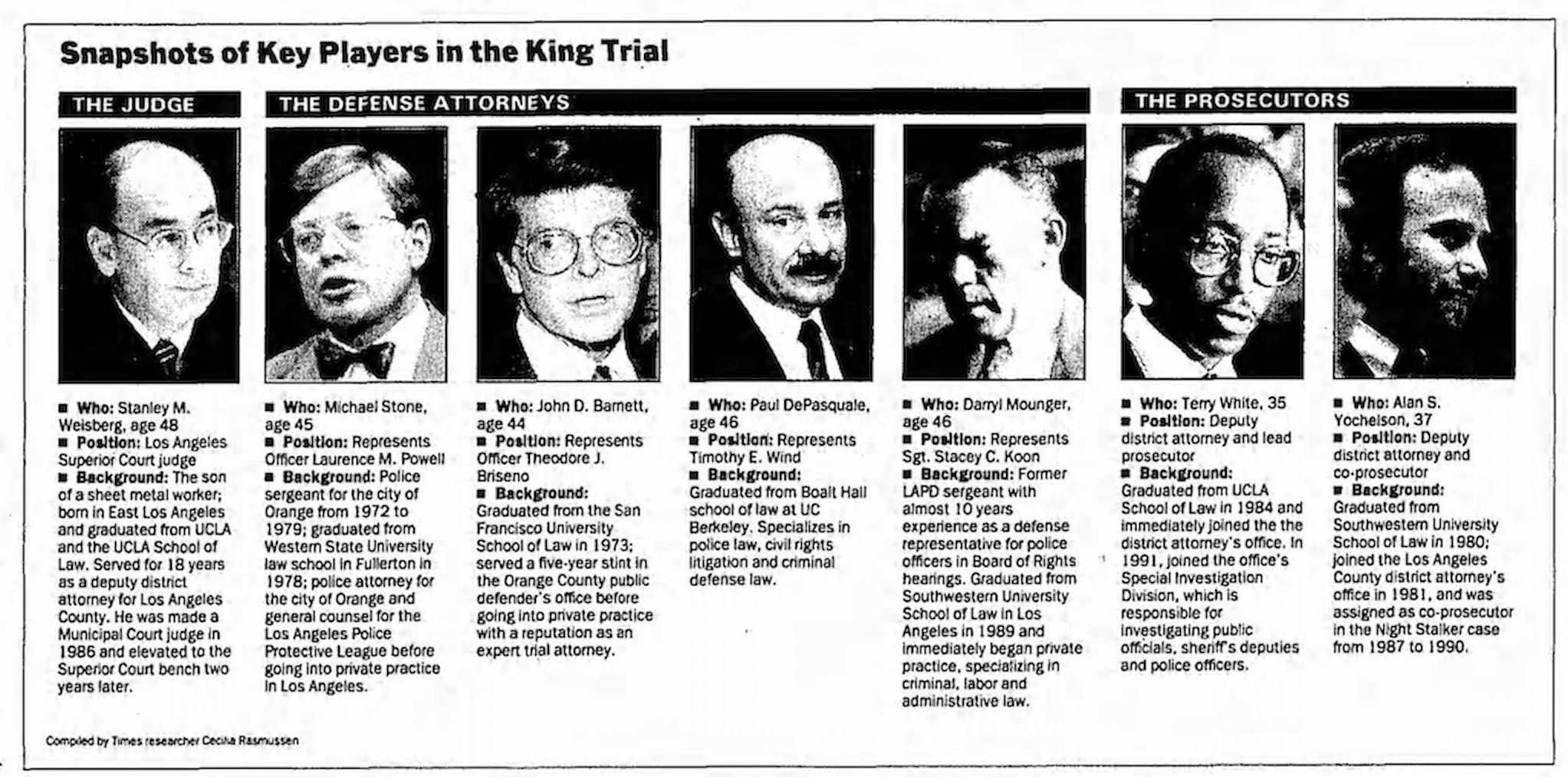
Text 48.03.05 — Judge Stanley Weisberg presided over the LAPD beating trial of Rodney King with prosecutors Terry White and Alan Yochelson, and LAPD defense attorneys Michael Stone, John Barnett, Paul DePasquale, and Darryl Mounger.
Prosecutors presented the beating as unjustifiable brutality: “Whatever Rodney King was, or whatever Rodney King did, it did not justify what you saw on this videotape,” said deputy district attorney Terry White. King had followed instructions, prosecutors argued, only trying to run—not attack officers.
Defense attorneys painted King as a “violent felon” resisting arrest. Officers, they claimed, were following protocol to control “erratic behavior.” “The only person who was in charge of this incident was Rodney Glen King,” argued one defense lawyer.
Over two months, fifty-four witnesses spoke, but King did not testify. “You have a videotape in this case which shows impartially, without bias, what happened that night,” explained White.
The famous tape was played five times for the jury, disturbing many. Despite King being unarmed and outnumbered, officers insisted they were the ones fearing for their lives. Koon described King as “very buffed out,” and repeated his suspicion about PCP, despite lab results disproving drug use.
LAPD officer Briseno tried to distance himself, saying he tried to stop the others. Defense and prosecution debated the officers’ motives, actions, and training.
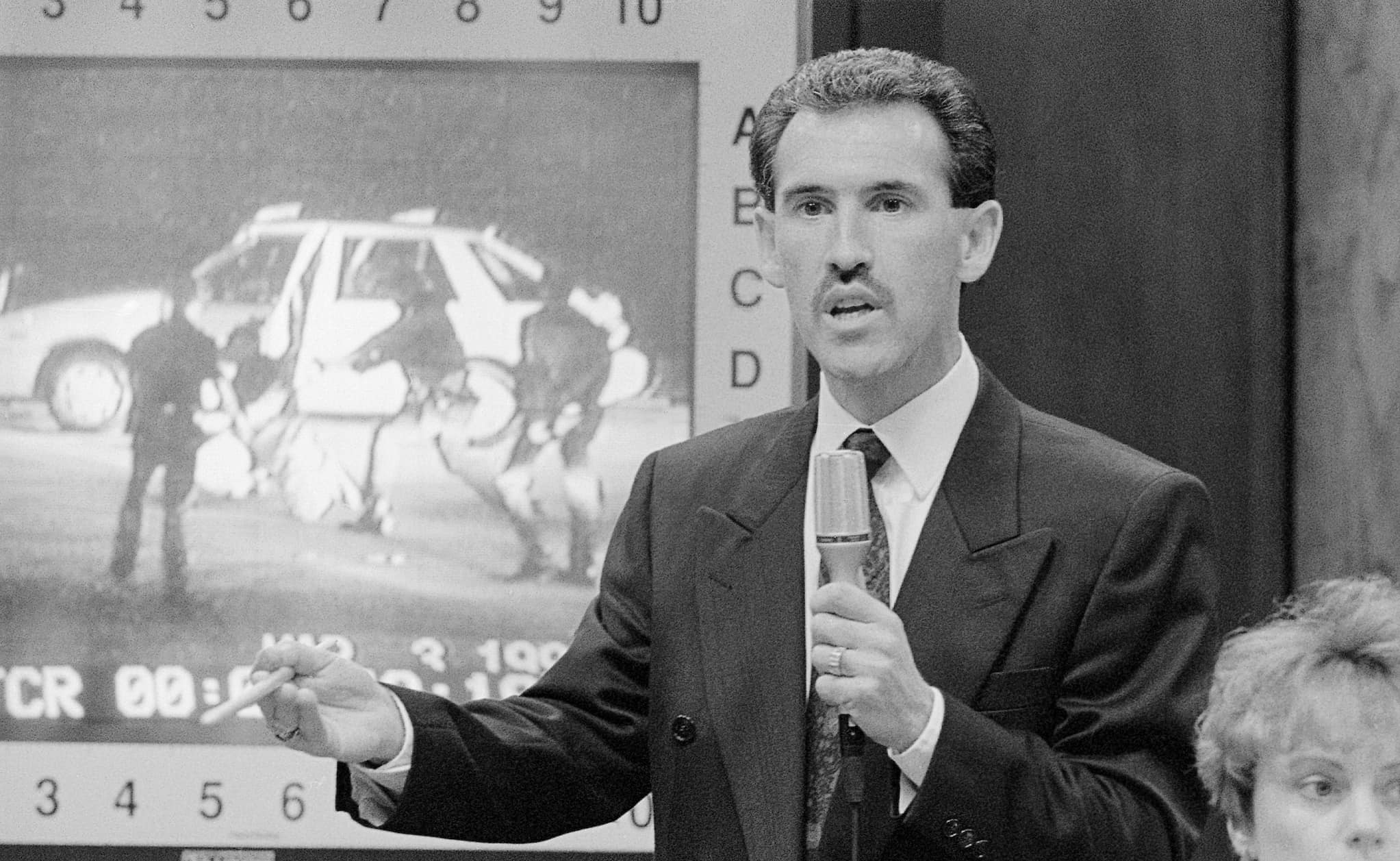
Image 48.03.06 — On April 3, 1992, LAPD officer Theodore Briseno testified in court that he was trying to de-escalate the situation and stop the other officers’ baton blows.
The Role of Race and Language
Though lawyers avoided the topic of race directly, it hovered over the courtroom. The officers used animal imagery, calling King a “lizard,” “dog,” and a “bear.” One compared King’s movements to a monster from a horror film. Officer Powell even joked later, “Oops, I haven’t beaten anyone this bad in a long time.” Nurses overheard officers joking about the beating, comparing it to a baseball game, saying, “We hit quite a few home runs.”
A chilling detail emerged: earlier that night, Powell had called a domestic dispute—referring to a Black family—as “right out of Gorillas in the Mist,” the title of a movie about gorillas in Africa.
Los Angeles Mayor Tom Bradley called out these “bigoted remarks,” insisting that the King beating wasn’t an isolated incident but part of a dangerous trend in the police department.
Closing Arguments
In closing arguments, prosecutor Terry White condemned the racist language and “cover-up” by Sergeant Koon. He urged the jury to remember that the police must treat suspects like human beings. The tape, White said, was clear evidence: “They continued to hit him and hit him and hit him. And you’ve got to at some point say, ‘Enough is enough!’” As for the “thin blue line,” White asked, “what kind of world would you have without cops? Well, I ask, what kind of world would we have when cops do not follow the law?”
The defense, meanwhile, insisted the tape was not reliable and asked the jury to stand in the officers’ shoes, empathizing with their split-second fear. “These are not RoboCops. They hurt [and] they bleed and they die, just like everybody else,” said Powell’s attorney Michael Stone.
On April 23, 1992, Judge Weisberg instructed the jurors, “reach a just verdict, regardless of the consequences.” The city waited anxiously. Opinion polls and even police leaders expected convictions. But not everyone in Black Los Angeles was optimistic; lessons from the Watts Uprising loomed large.
Anticipating trouble, LAPD Chief Daryl Gates set aside a million dollars for overtime, while community groups organized Operation Cool Response—volunteers ready to keep peace when the verdict dropped.
The Verdict: Outrage and Aftermath
On April 29, 1992, the jury returned:
- Powell: Not guilty
- Wind: Not guilty
- Briseno: Not guilty
- Koon: Not guilty
The jury was deadlocked eight to four only on one charge of “excessive force,” but reached “not guilty” verdicts on all other counts.
It only took a few minutes for the jury to announce all their verdicts. And it only took a few hours before Los Angeles exploded.
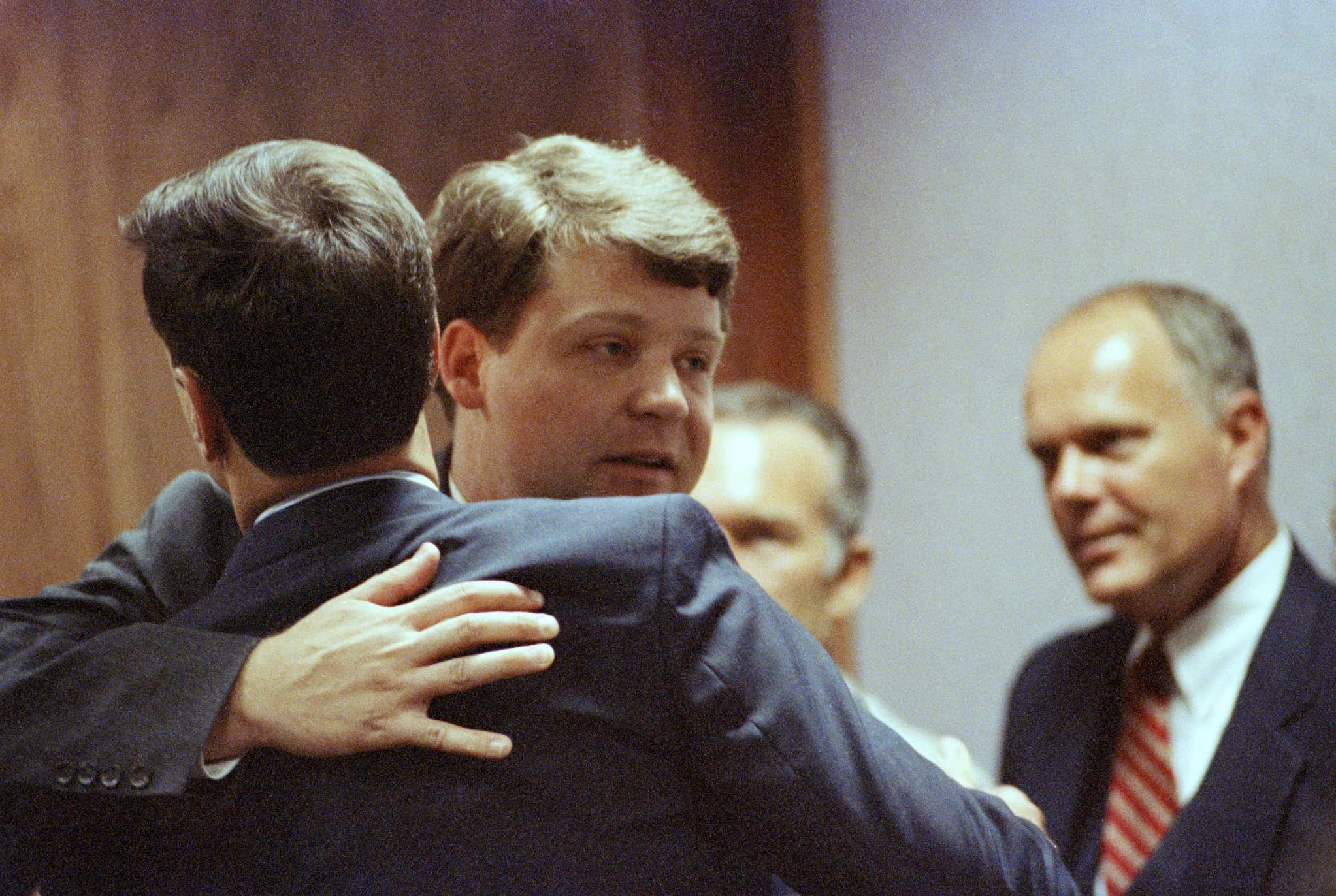
Image 48.03.07 — “Not guilty.” LAPD officer Laurence Powell hugs Timothy Wind, with Sergeant Stacey Koon smiling in the background, after hearing the April 29, 1992, jury acquittal of all four officers (including Theodore Briseno) in the beating case of Rodney King.
Reverend Dr. Cecil L. “Chip” Murray called for calm. He reminded people about the devastation after the 1965 Watts Uprising “If you’re gonna burn something down, don’t burn down the house of the victims, brother! Burn it down by voting! Burn it down by standing with us!”
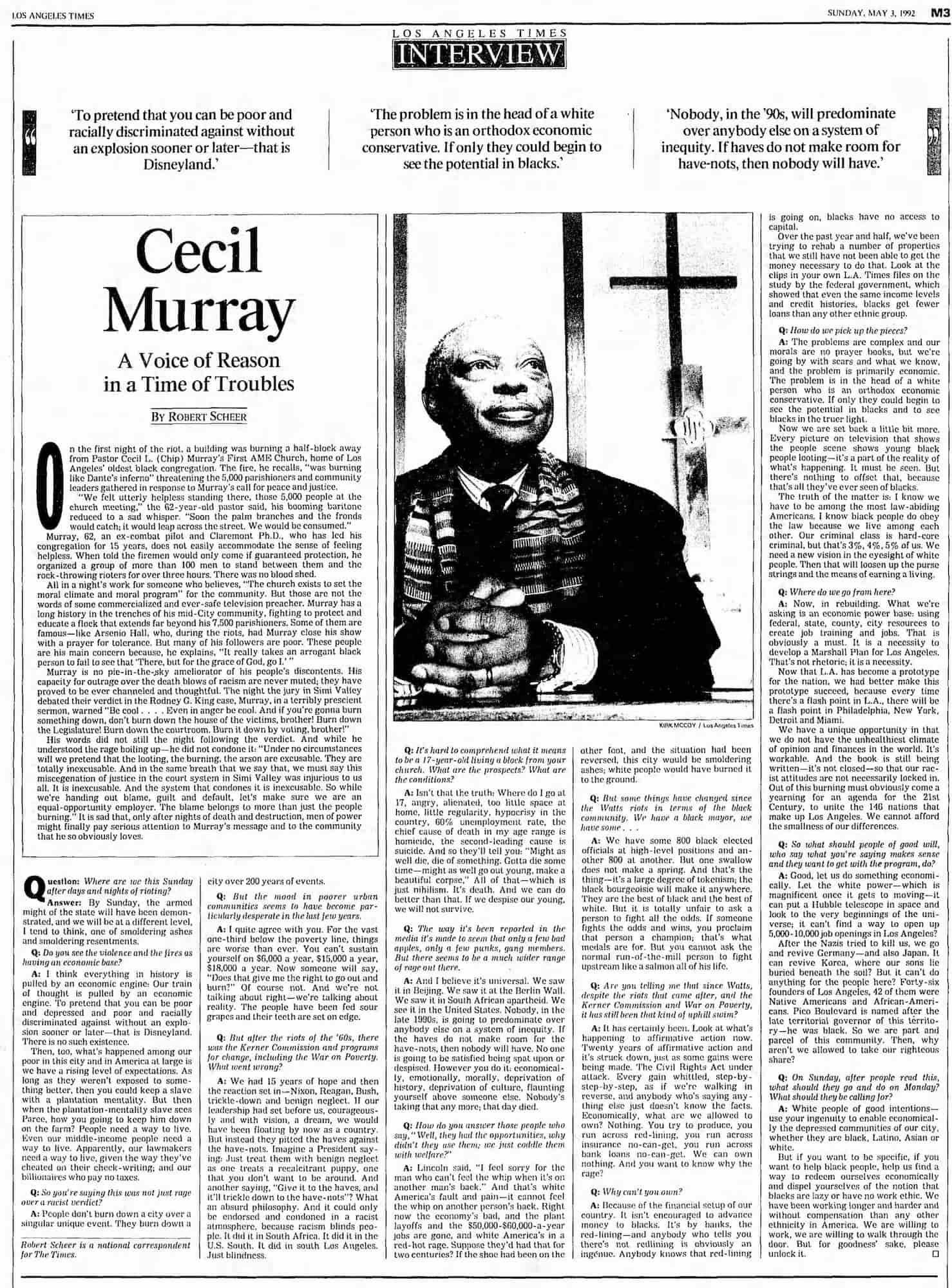
Text 48.03.08 — Reverend Dr. Cecil Murray of the First African Methodist Episcopal (AME) Church of Los Angeles, along with community leaders and volunteers, set up “Operation Cool Response” to keep the peace during the LAPD beating trial of Rodney King.
The King verdict shocked people nationwide and inspired days of unrest—just as the Watts Uprising had decades earlier, showing the connection between both events: a community tired of injustice, fueled by decades of troubled police-community relations.
The Legacy
The Rodney King beating and trial exposed deep problems within the LAPD. The video forced Americans—and people across the globe—to confront issues of race, justice, and police accountability. It demonstrated how one incident, captured on tape, can spark enormous change.
The questions raised by King’s experience remain relevant today. Who gets justice, and why? How can police serve communities fairly? And what happens when a city’s history catches up to its present?
In the story of Rodney King, those questions are answered with painful clarity. His name remains a symbol—a reminder of the risks faced by ordinary people, the power of public witness, and the long struggle for equality and civil rights in America.
Glossary terms in this module
1965 Watts Uprising Where it’s used
Between August 11 and 16, 1965, civil unrest broke out in the Watts neighborhood of South Los Angeles. Sparked by a traffic stop of Marquette Frye for drunk driving, it escalated from an exchange of words to physical force that attracted a crowd in the neighborhood where police/community relations were poor.
Anti-Drug Abuse Act of 1986 Where it’s used
This law created harsher sentences for drug offenses as part of the “War on Drugs,” which disproportionately affected Black communities given heightened police presence and higher arrest rates by police.
parole Where it’s used
Supervised release from prison that is monitored by the courts through the Probation Department. Sometimes granted before the end of a prison term for good time while inside. The goal is successful re-entry into community after prison. Often, there are requirements that may include restitution, completion of certain programs in half-way houses, and regular reporting requirements to a Probation Officer. A new offense after being placed on parole can lead to a direct return to prison.