





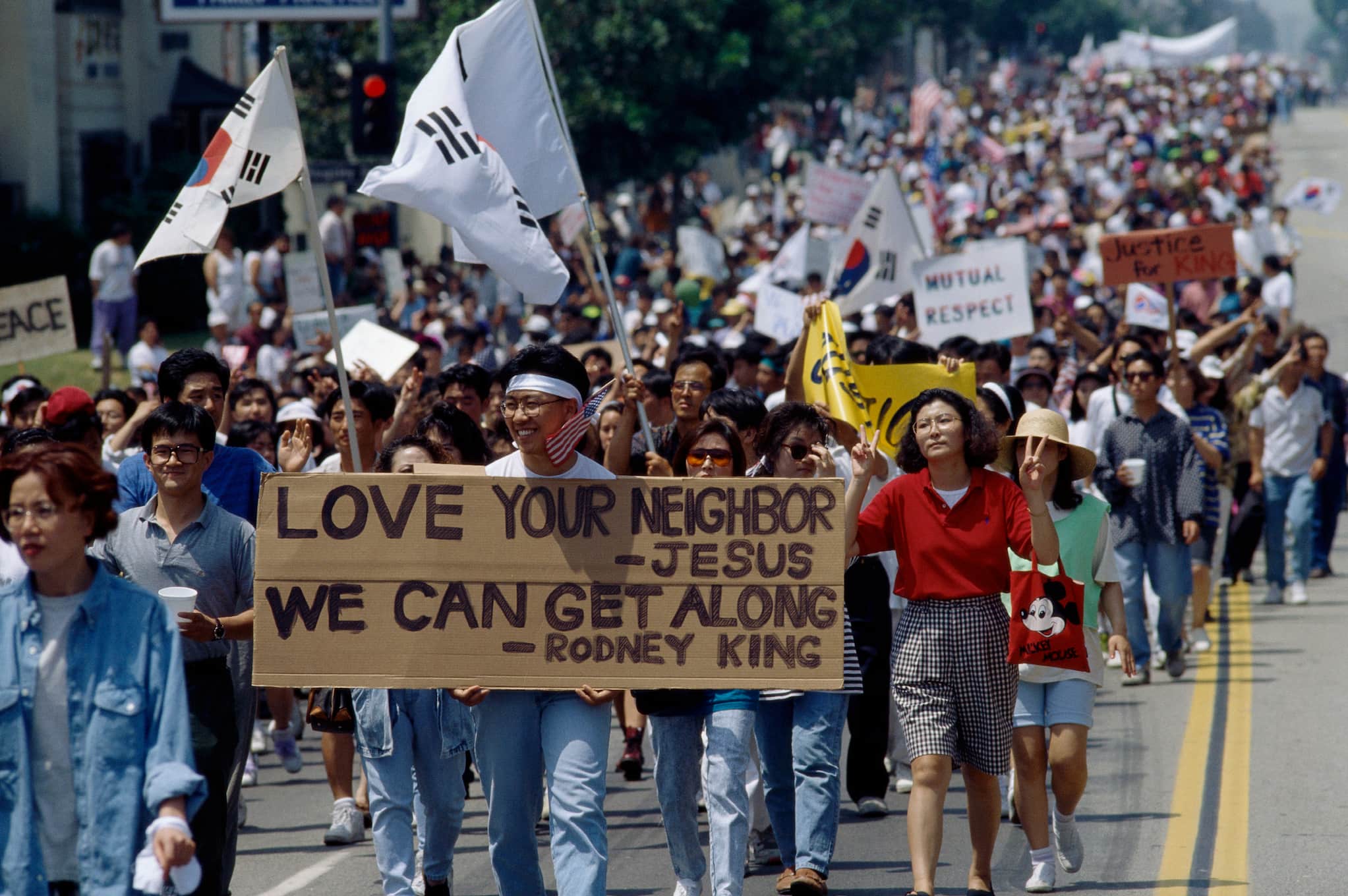
Module 5: “Can We All Get Along?”
Is the 1992 Los Angeles civil unrest relevant to today and has there been progress since?
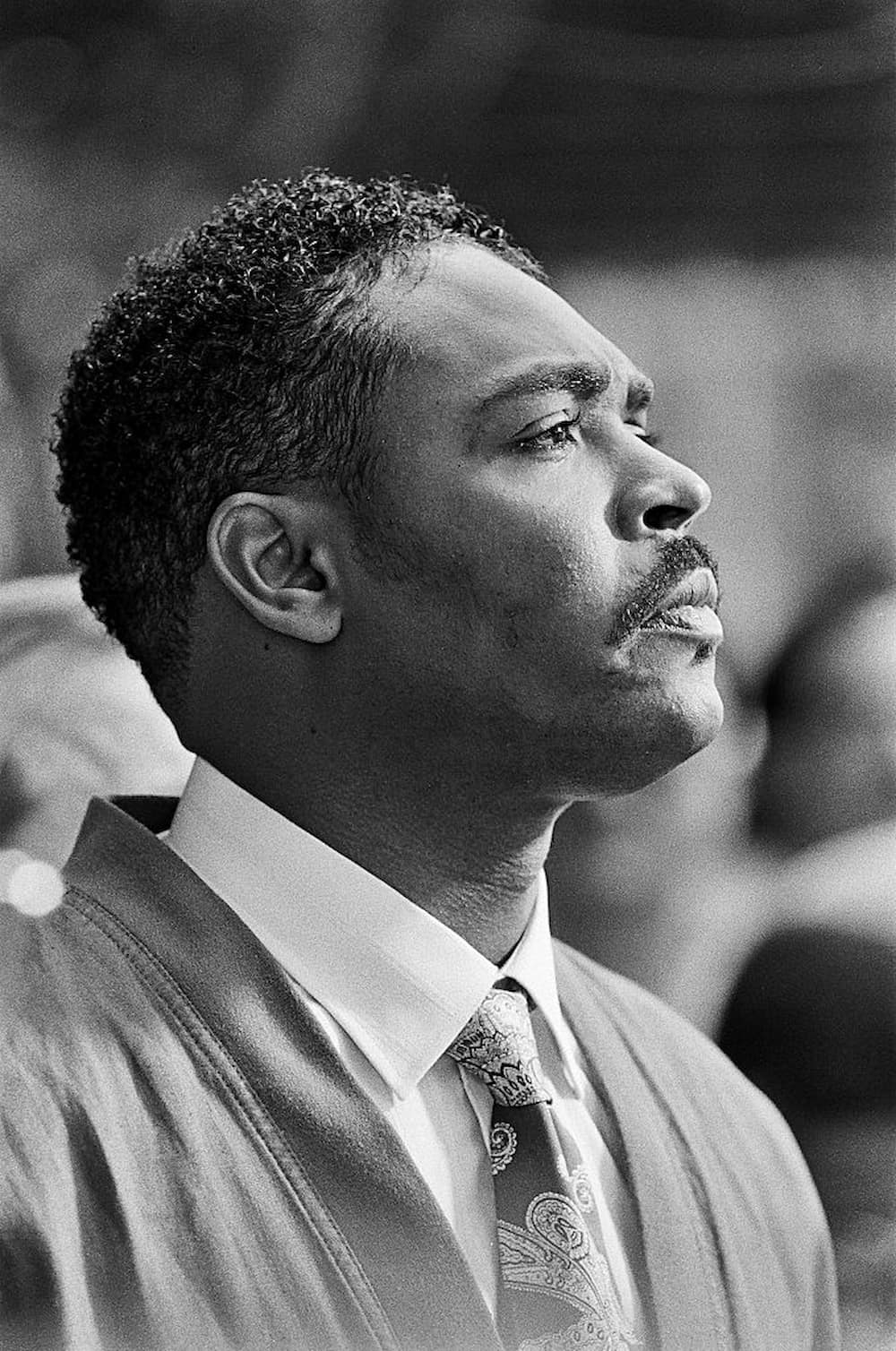
Image 48.05.01 — During a press conference on May 1, 1992, Rodney King chose to speak from his heart instead of reading an official statement prepared by his attorneys. “Can we all get along?” he asked.
“You’ve got to say something.”
For the past two days, Rodney Glen King had been in seclusion, devastated by the violence sweeping across Los Angeles.
Especially in Koreatown. “I felt very sorry for all those business owners,” he said. “They were just innocent people working hard to make money and take care of themselves and their families. They definitely got the worst of it.”
On Friday, May 1, 1992, his civil attorney Steven Lerman called to encourage him to speak out. King agreed to deliver a statement at a live press conference in Beverly Hills. Reporters, TV crews, and news helicopters swarmed the area.
King tearfully expressed his horror over the violence. He was especially upset by the photo of a dead and bloodied “slain sentry” published in The Los Angeles Times earlier that morning.
“We’ve got to quit,” he said. “I can understand being upset, for the first two hours after the verdict. But to go on—to keep going on like this and to see this security guard shot on the ground, it’s just not right. It’s just not right because those people will never go home to their families again.”
That “security guard” in The Los Angeles Times photo King mentioned would later turn out to be Edward Jae Song Lee. King ended his speech with a plea to everyone.
“People, I just want to say, can we all get along?” King said. “Can we get along? Can we stop making it horrible for the older people and the kids? We’ll get our justice. They’ve won the battle, but they haven’t won the war. I mean, we’re all stuck here for a while. Let’s try to work it out. Let’s try to beat it. Let’s try to work it out.”
This module discusses the aftermath of the 1992 Los Angeles Uprising and its effects on the Black and Korean communities. It encourages us to think about the role of the media and the impact of “Sa I Gu” in defining “Korean American,” particularly among Korean immigrants in Los Angeles and beyond.
What was Rodney King’s role during the 1992 Los Angeles Uprising? Did he ever find justice?
How has media coverage of the 1992 Los Angeles Uprising changed over the years, especially with regards to its portrayal of the Korean American and Black communities?
What is the deeper meaning and origin behind the Korean phrase “Sa I Gu” used to describe the 1992 Los Angeles Uprising?
“We Want Peace”

Image 48.05.02 — Thirty thousand Korean Americans attended a May 2, 1992, Koreatown peace rally holding signs supporting Rodney King and condemning racism. This was the largest gathering of Korean Americans ever in the country, inspiring a future generation of activists and politicians.
When Radio Korea broadcast an announcement that a peace rally would be held in Koreatown on Saturday, May 2, they had no idea that more than thirty thousand Korean Americans of all ages would show up. It was the largest Korean American protest in US history.
Protesters carried signs written in English and Korean: “Why Are Korean Americans the Fall Guys for All Social Injustice?” “Stop Making Us Scapegoats.” “No Racism, No Violence.” “Mutual Respect.” “Justice for King.”
Korean American community leaders, military veterans, and a speaker from the South Korean National Assembly delivered speeches asking for peace and understanding. Afterward, Edward Jae Song Lee’s family led the march through Koreatown. Diverse marchers carried brooms and garbage bags to sweep up the broken glass and debris. Restaurant owners handed out plates of food. Black and Latino marchers carried Korean flags in solidarity.
“We want justice! We want peace!” the crowd shouted. They sang Korean folk songs and “We Shall Overcome.”
“We Are Being Scapegoated”
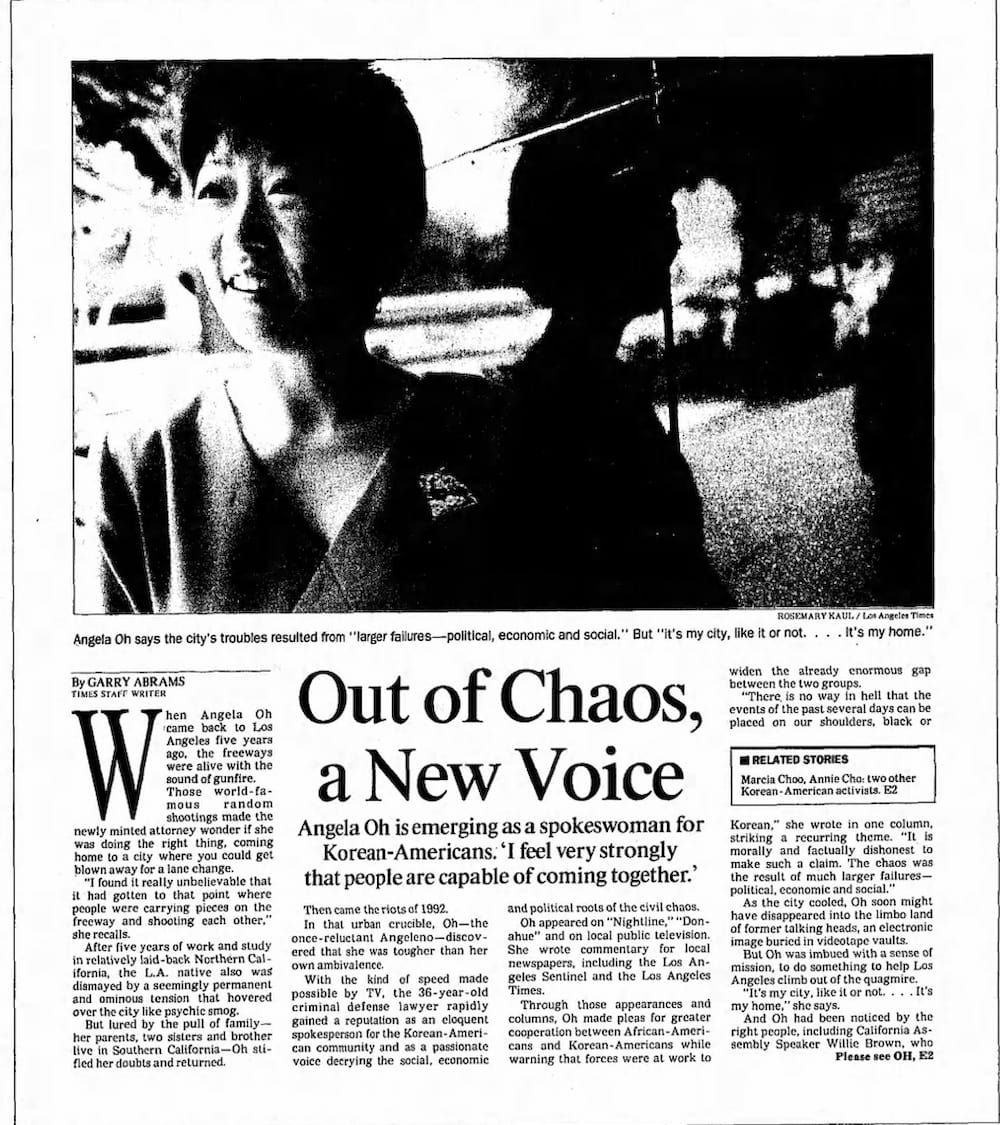
Text 48.05.04 — On May 6, 1992, thirty-six-year-old criminal defense attorney Angela Oh gained national prominence as the voice of the Korean American community after her ground-breaking Nightline interview with ABC news anchor Ted Koppel about the Los Angeles Uprising.
On Wednesday, May 6, a prominent national news program finally presented the Korean American point of view.
Angela Oh, the thirty-six-year-old criminal defense attorney who had spoken out during the Soon Ja Du and Latasha Harlins shooting case, appeared in an interview with anchor Ted Koppel on ABC’s Nightline.
“In the aftermath of the Los Angeles riots, another color of rage,” Koppel said. “Tonight, we’ll hear from a group that was a target of the violence: Korean Americans.”
Koppel asked Oh about the alleged conflict between the Korean American and Black communities. “You must have heard it again and again from Black citizens in that community. ‘They just don’t get it. We’ve been here for hundreds of years, these Koreans are the ones who are here for a few years or a generation or two, if there’s a culture gap, let them learn our culture.’ To which you say what?”
“To which I say, that is exactly what the goals are of most immigrants that come to this country,” Oh replied, explaining that Korean immigrant families did have the intention of assimilating into America. But the expectation that Korean immigrants must assimilate overnight was “extremely unfair and extremely unrealistic.”
Oh emphasized the importance of solidarity for all communities. “My Korean American brethren, and my Black brothers and sisters, my Native American brothers and sisters, my Latino brothers and sisters, we feel no hatred innately for one another. This is a myth that’s being created by the press. We aren’t victims. Make no mistake. Korean Americans do not view themselves as victims. We are being scapegoated. We know it.”
“At the time, I was carrying a lot of anger, so my energy was coming from a place of intensity and passion,” Oh said. “I was upset over the unnecessary destruction of a lot of immigrant lives and livelihoods. I was ready to meet that moment.”
“We Lost Our Son”
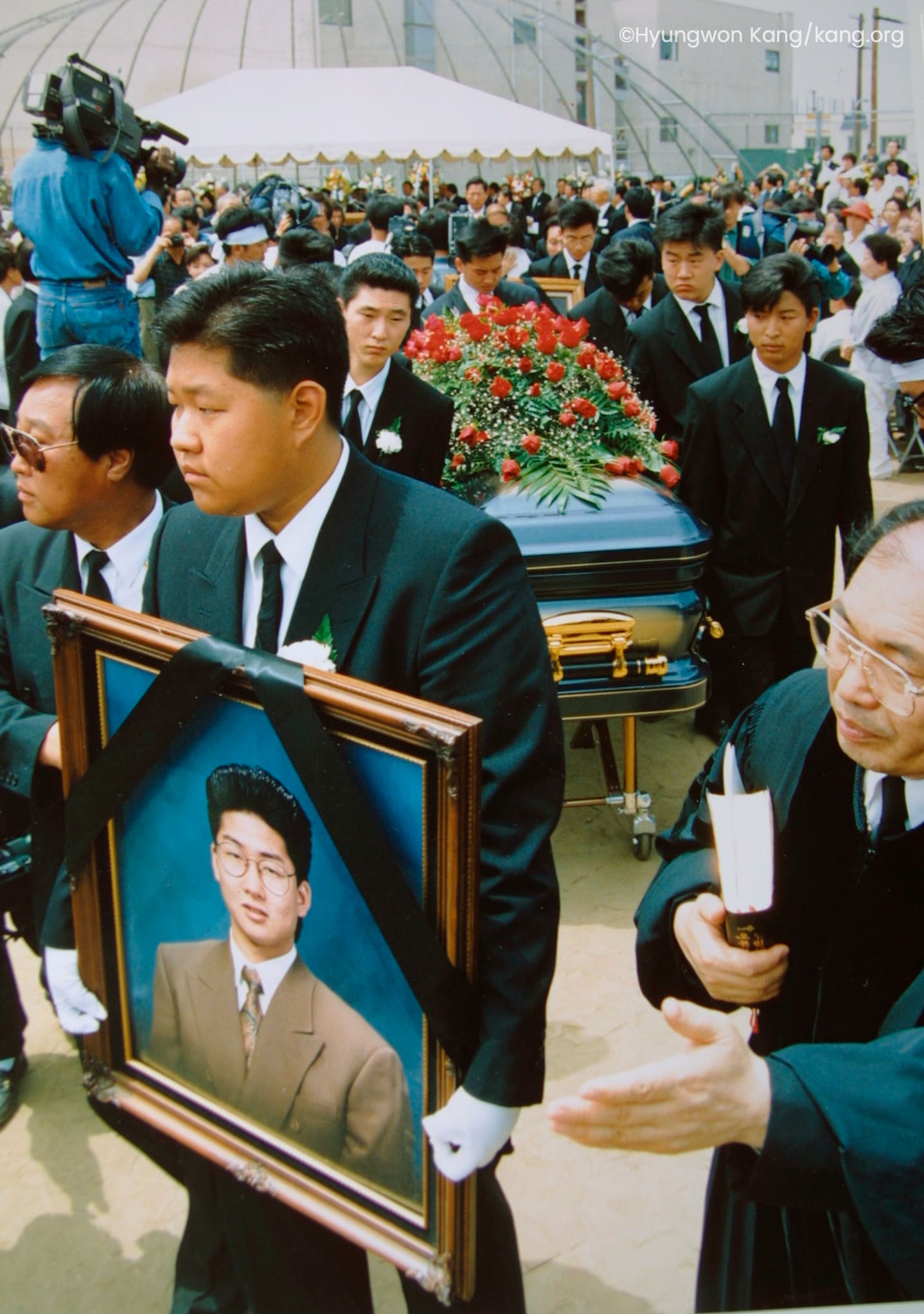
Image 48.05.05 — Edward Jae Song Lee’s coffin follows a young pallbearer carrying his portrait as family and friends head to his final resting place at the Forest Lawn Memorial Park cemetery in the Hollywood Hills.
On the same day Angela Oh spoke out for the Korean American community on ABC’s Nightline, Edward Jae Song Lee was laid to rest. Five thousand people attended Edward Jae Song Lee’s funeral in Koreatown, which was covered by hundreds of international TV news crews and included speeches by both American and Korean government officials and community leaders. Eddie’s friends served as his pallbearers for the burial service at the Forest Lawn Memorial Park cemetery in the Hollywood Hills.
His mother was the first to toss a ceremonial handful of dirt over his casket. “How can I sprinkle dirt on your body?” she wept in Korean. “Don’t you feel cold down there?” One of the Korean pastors comforted Jung Hui, telling her, “He is gone. But his spirit lives within us forever.”
At that moment, Jung Hui remembered how her son had picked up the bowl of noodles during his traditional Korean doljabi first-birthday fortune-telling ceremony. The noodles symbolized long life. She realized his fortune had come true. Edward Jae Song Lee’s name would live on forever.
“I Was at Peace With the Verdict”
“I was just trying to stay alive, sir.”
At 1:30 p.m. on Tuesday, March 9, 1993, Rodney Glen King took the stand to testify against the four Los Angeles Police Department officers who had beaten him two years earlier in a second trial. At this trial, a federal grand jury indicted all four officers for violating Rodney King’s civil rights. Theodore Briseno, Laurence Powell, and Timothy Wind were charged with “willfully and intentionally using unreasonable force under color of law” and Sergeant Stacey Koon for “willfully permitting and failing to take action to stop the assault,” thus depriving King of his constitutional rights.
This case was tried at the US District Court in Downtown Los Angeles. The jury was more diverse. Of the twelve jurors, nine were white, two were Black, and one was Latino. King testified that he heard racial epithets during the beating. He said he had seen George Holliday’s video of his beating about ten times. “It makes me sick to my stomach to see it,” he said. King’s appearance at the trial was important not only for the jury but also for the world to learn what happened that night from King’s point of view.
“I was finally able to tell my story,” King said. “It felt good to finally represent myself and use my voice.”
But this time, there was no uprising. The jury delivered their verdicts: Stacey C. Koon and Laurence M. Powell: guilty. Timothy E. Wind and Theodore J. Briseno: not guilty.
On April 17, 1993, the jury delivered their verdicts on whether the four LAPD police officers had violated King’s civil rights. Los Angeles held its breath. Gun sales had doubled in Koreatown during the federal trial proceedings, and the new LAPD police chief Willie Williams planned to deploy 7,800 police officers in case civil unrest broke out. President Bill Clinton also pledged 1.7 million dollars to pay for overtime for Los Angeles’s law enforcement.
Koon and Powell were sentenced to thirty months in prison. Koon, released in 1995, published his memoir and still lives in California. Powell also resides in California, but no longer talks publicly about the trial. As for Wind and Briseno, while they were acquitted, LAPD fired both officers shortly after the federal civil rights trial. Both men eventually moved out of California and no longer speak publicly.
Most importantly, for Rodney King, he believed “justice was half-served.” While King did not prevail in the first criminal case in state court, two of the four officers were indicted in the federal trial on civil rights violations. “But I was at peace after the verdict,” he said after the second trial.
One year later, there was a third and final trial on behalf of Rodney Glen King— a civil suit against the LAPD seeking compensation for medical bills, psychological suffering, and loss of income resulting from the beating. On April 19, 1994, the jury decided the case in King’s favor and awarded him 3,816,535 dollars.
“I would like it to end,” Rodney Glen King announced to the public. “No one wins here in this type of situation.”
Rodney King continued to battle alcoholism and substance abuse for most of his life. He eventually got engaged again and was on the path to recovery when he died of an accidental drowning in his backyard swimming pool on June 17, 2012. He was only forty-seven years old.
Before his death, King wrote a “forgiveness letter” to the officers who beat him as part of his rehab therapy: “I need to forgive the officers who beat me the way they did because being angry with them is not helping me. The police officers that did that to me must have personal problems, and all I can do is forgive them and put them in my prayers.”
“Our Reckoning with Racism”
In 2020, Black Lives Matter protests swept the country due to the killing of truck driver and security guard George Perry Floyd Jr. by a Minnesota police officer. Simultaneously, a campaign to “Stop AAPI Hate” was also gaining traction with the sharp rise in anti-Asian hate crimes during the COVID-19 pandemic lockdowns.
As a result, The Los Angeles Times did much soul-searching about its own inconsistent history of reporting fairly on communities of color. On September 27, 2020, the newspaper published a front-page apology for its decades of biased reporting.
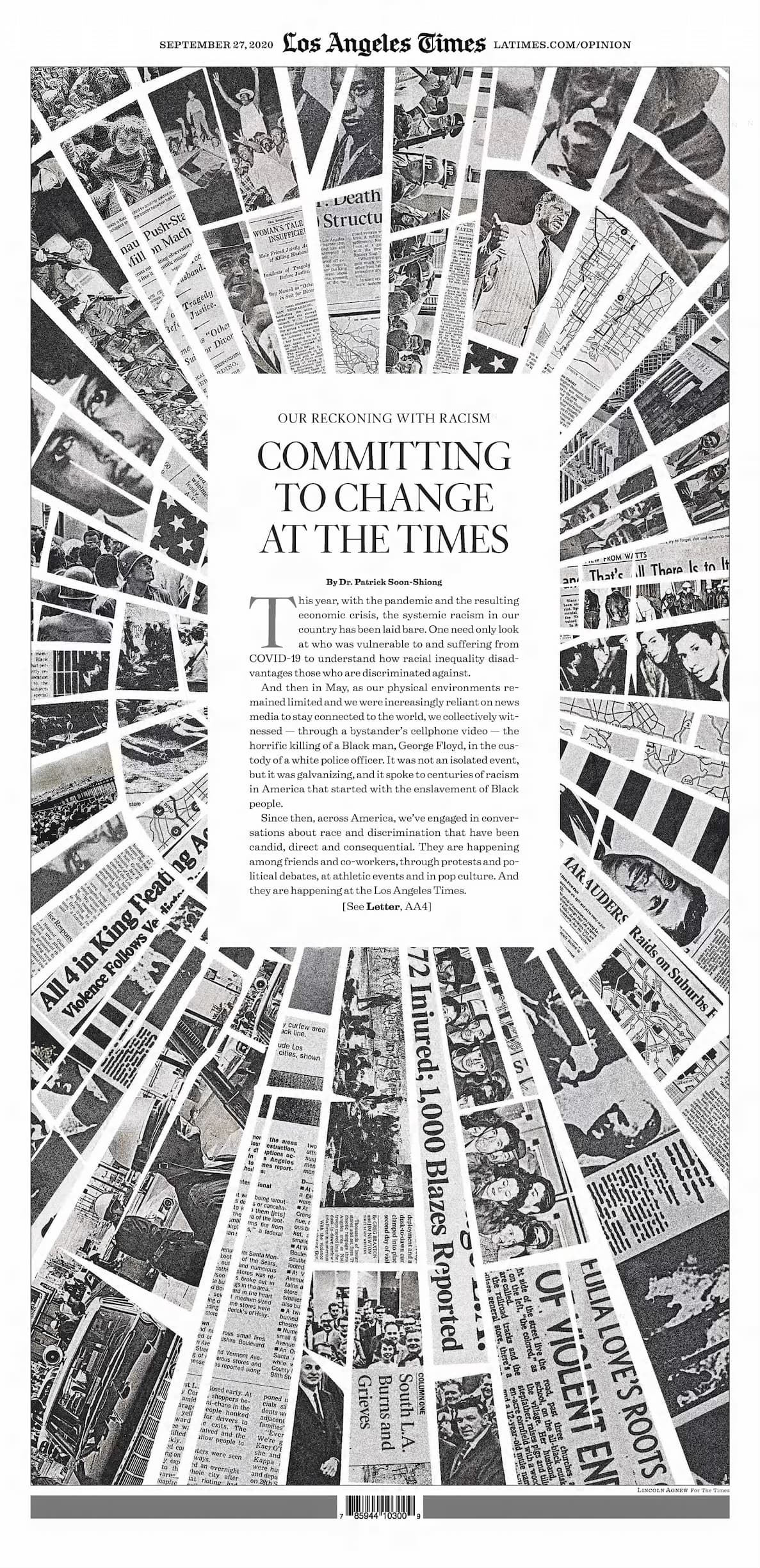
Text 48.05.06 — During 2020’s Black Lives Matter and Stop AAPI Hate protests, The Los Angeles Times editorial board published an apology for its history of biased reporting, including the 1992 Los Angeles uprising, vowing to improve coverage and hire more diverse staffers.
“Our nation now faces a long-delayed reckoning with systemic racism,” its editorial board wrote. Since it began in 1881, the newspaper had been “deeply rooted in white supremacy.” By not hiring a more diverse and equitable newsroom, they had created a “lonely place for journalists of color.” The newspaper preferred telling stories “largely for and about white people.”
And despite winning a Pulitzer Prize for its “balanced, comprehensive, penetrating coverage” of the 1992 Los Angeles Uprising, The Los Angeles Times apologized for inflaming tensions between the Black and Korean American communities, which, in part, resulted in the disproportionate damage in Koreatown during the 1992 civil unrest. “[The Times] sensationalized Black-Korean conflict.”
The Los Angeles Times pledged to be more accountable and to increase its staff diversity. “On behalf of this institution, we apologize for the Times’ history of racism. We owe it to our readers to do better, and we vow to do so.”
Sa I Gu
The Los Angeles Riots. The Los Angeles Rebellion. The Los Angeles Civil Unrest. The Los Angeles Uprising.
What are we supposed to call what happened in Los Angeles in 1992? For a long time, people often referred to the uprising as the “LA Riots.” “A riot is the language of the unheard,” said Dr. Martin Luther King. But over the years, the term riots has sometimes been used to downplay justified protests as meaningless violence, from newspapers describing the 1965 Watts Uprising as a “Negro riot” to former President Donald Trump denigrating the Black Lives Matter movement as “looters, criminals and rioters” in 2020.
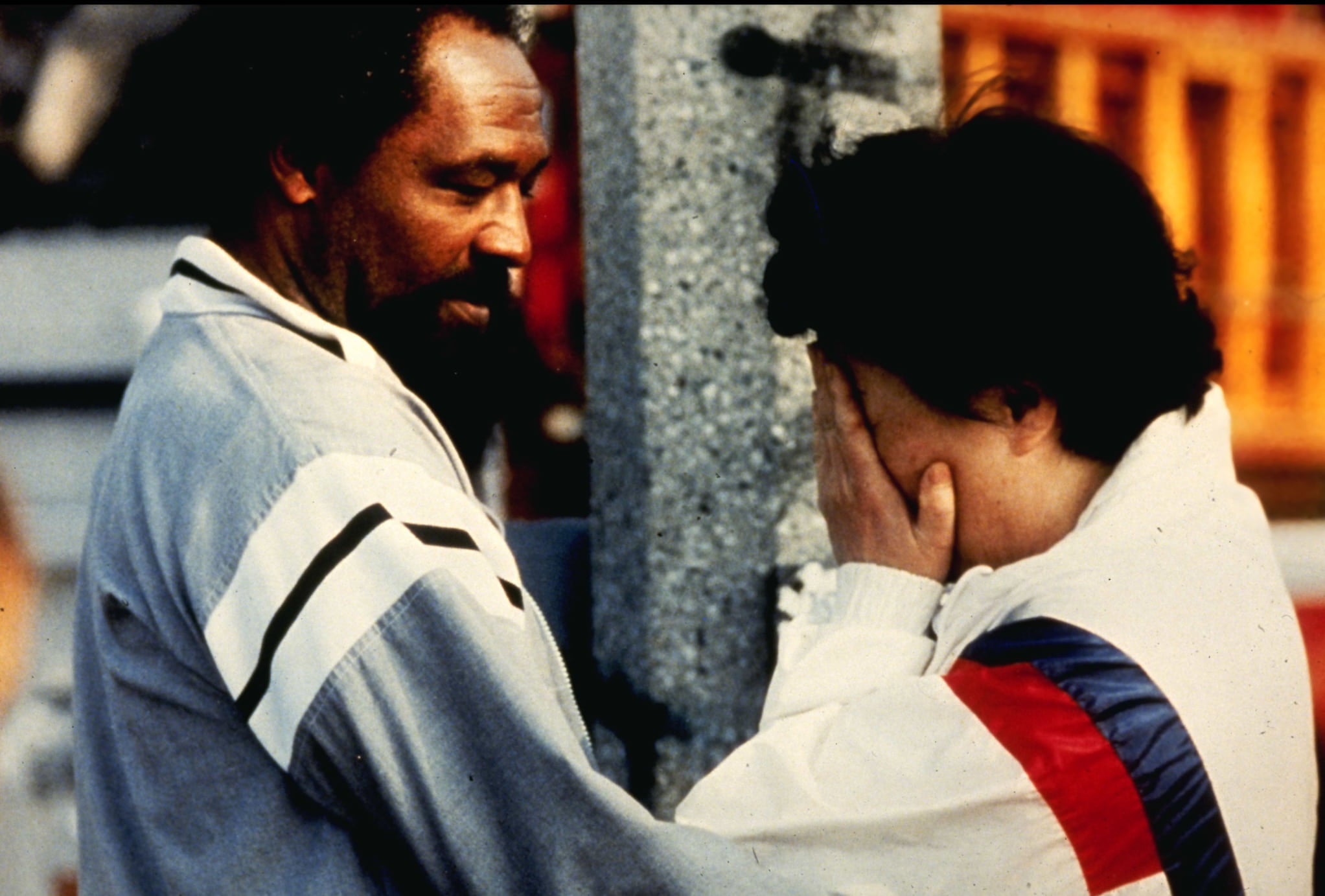
Image 48.05.07 — A man comforts a distraught store owner after her store is destroyed, one of the many displays of compassion and comfort among residents during the civil unrest.
Today, the 1992 Los Angeles civil unrest is usually referred to as an “uprising.” UC Riverside professor and original Black-Korean Alliance member Edward Taehan Chang said that the terms “rebellion” and “uprising” can imply that all Korean Americans played a role in systemic racism back in 1992, when many were equally victims of it. So Korean Americans have given their own name to the 1992 Los Angeles civil unrest: Sa I Gu.
In English, Sa I Gu means 4-2-9, referring to the first day of civil unrest—April 29. Koreans have traditionally referred to the date of the historical event to name it. For example, the Korean War is referred to as Yuk Ee Oh, or 6-2-5, referring to the day the war began on June 25, 1950.
Sa I Gu is now considered a political movement and the day that a “Korean American” identity was born, particularly among post-1965 immigrants. It also inspired the first generation of elected Korean American politicians. In 1992, Jay Kim of California became the first Korean American elected to the US House of Representatives. However, he would not be the only one. In 2021, for the first time in history, four Korean Americans were sworn into Congress: Young Kim and Michelle Park Steel of California, Andy Kim of New Jersey, and Marilyn Strickland of Washington, who is also the first member of Congress of both Black and Korean heritage.
“Korean immigrants realized if we want to stay and live and work in America, we have to become part of the United States and take ownership,” Edward Chang explained. “We are no longer guests. We are no longer just immigrants. A majority of Korean immigrants didn’t really embrace the term ‘Korean American’ until after the Los Angeles civil unrest in 1992. Sa I Gu was the birth of a new Korean American identity.”
Over twenty-five years later in 2020, the videotaped killing of George Perry Floyd Jr. in broad daylight on the streets of Minneapolis, Minnesota, was a public reminder to the nation that disregard for Black life by people and systems persisted. The Black Lives Matter Movement gained broad support, not only across the country but around the world. Black Lives Matter rallies were also held in Korea. From anti-Black racism arising from the segregated white and Black American troops during the Korean War, to the use of Blackface in the early years of K- pop in the 1990s, which was later denounced, there was a huge reckoning in Korea about why Black lives must—and should always—matter.
There is no literal translation in the Korean language of the English phrase “Black Lives Matter.” So Koreans created this phrase instead: “Heukinui Sangmyeongeun Sojoonghada,” translated as “Black lives are precious.” The process of reckoning still faces everyone American about racial equality and justice. The conditions that led to the Los Angeles Uprising remain: segregation, prejudice and bias, inequality of wealth and opportunity, unemployment, proliferation of guns, police abuse of power, food deserts, and disinvestments in urban areas. Part of the reckoning process means addressing these and other root problems so that everyone can thrive.
Veteran journalist K. W. Lee believes this new generation of Korean Americans dedicated to solidarity are the “children of Sa I Gu.” He never forgot the sight of more than thirty thousand Korean Americans marching for peace in Koreatown on May 6, 1992, after the Los Angeles Uprising.
“That’s when I was reborn again,” Lee said. He began to cry. “I became Korean American.”
Glossary terms in this module
1965 Watts Uprising Where it’s used
Between August 11 and 16, 1965, civil unrest broke out in the Watts neighborhood of South Los Angeles. Sparked by a traffic stop of Marquette Frye for drunk driving, it escalated from an exchange of words to physical force that attracted a crowd in the neighborhood where police/community relations were poor.
food desert Where it’s used
A neighborhood that lacks nearby access to affordable and quality groceries.
scapegoat Where it’s used
A set of people who are wrongly assigned blame for a problem, typically those whose social status makes them vulnerable to violence and makes addressing or correcting the error very challenging.
solidarity Where it’s used
A political, cultural, and collective stance that recognizes the mutual responsibility and support that is necessary to achieve change. Solidarity taps into the power in numbers and considers the collective interests of communities.
uprising Where it’s used
A collective fight against an oppressive system of injustice. The term “uprising” is one of several labels used in place of the word “riot” to describe civil unrest in response to a felt injustice. Several other terms were used to describe this event, including civil disturbance, rebellion, implosion, riot, war zone. The label a person uses can reveal one’s understanding of what took place.


