





Epilogue: The Birth of Korean America and the Future

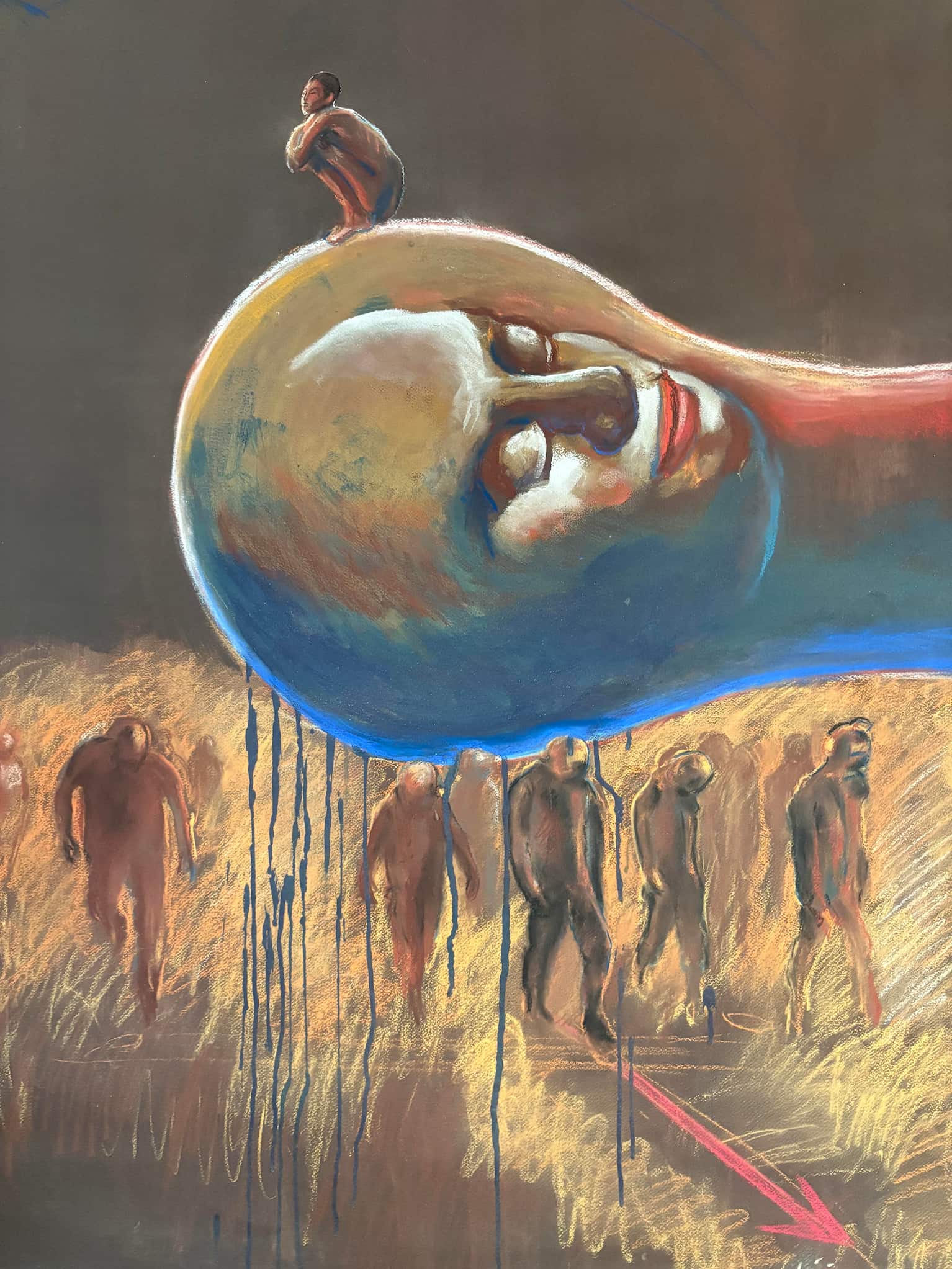
Image 48.06.01 — Pastel by Ming Tu.
April 29, 1992, was the day that Korean America was born. Among some, it is a controversial statement because there were generations who arrived in this country before that moment in time, but the political consciousness of Korean Americans was raised in that moment. I know, because I traveled across the continent for at least three years afterward, meeting with communities traumatized by what happened in Los Angeles, California, to Korean immigrant families whose livelihoods were destroyed. Even from thousands of miles away from Los Angeles, Korean community members felt fear and sadness that brought them to tears.
Sa I Gu was the day that shined a bright light on a community that had been in this country since the early 1900’s, working to build new lives and give back to a new society. Yet it was a community which was unseen and certainly not understood until all of Los Angeles entered the fire to witness Korean Americans becoming a part of this country’s history—as scapegoats. All immigrants have to know that fire is a part of passage into America. In this case, the fire was literal, not a metaphor.
After thirty-plus years living beyond the 1992 implosion in Los Angeles, when not-guilty verdicts were returned following the trial of the Los Angeles Police Department officers involved in the beating of Rodney King, the question remains, “Can we all get along… can we stop making it hard for the older people… and the kids…?”
In reflecting on the question in 2025, the answer remains equivocal. At the moment of this writing, it doesn’t appear we can get along. It doesn’t appear that justice prevails in many courts and tribunals across the country. It doesn’t seem like the effort to rebuild, reconcile, and re-establish lives with purpose has worked. The days of burning, looting, and vandalism of 1992 seem to be heading our way again as divisions in politics have poisoned our relations both at home and in countries across the world.
Current conditions in American society are devastating for non-European immigrants. Foreign students, international workers, and families in diverse areas experience anxiety and fear as anti-immigrant rhetoric, policies, and practices are being promoted by the federal government. Koreans felt it in Georgia as recently as in September 2025 when an immigration raid was executed at a Hyundai plant.
While Korean American history has been documented in the work of scholars, journalists, filmmakers, and artists contributing to the diverse and rich fabric of societies that have become a part of this nation, these contributions have done little to bring Koreans closer into the heart of America. The vast majority of Koreans remain mostly separate from non-Korean society. Today, because of the prevalence of churches and evangelical Christian mission work, the advances in telecommunications, technology, and ability to travel, many people of Korean ancestry are able to live comfortably, never engaging outside of their ethnic community, never needing to learn English other than the basics of “hello” or “thank you”, and never wanting for any product or service or work because the community can offer it all without ever leaving the Koreatowns that have grown across the continent.
Since 1992, here is what seems to have happened: The crisis hit Los Angeles with massive destruction and chaos—just as one might have predicted given the conditions at the time when police brutality, economic recession, poor media coverage of growing tensions on the ground, and money in politics grew to prioritize central city development and neglect the economically disadvantaged neighborhoods south of the 10 freeway. Disaster struck and it spared no part of Los Angeles – physically for some, but psychically for all.
Then, there was a concerted and sincere effort to “rebuild” Los Angeles. This is the natural instinct of human beings, to seek to repair and stabilize. The trauma that cut across the entire city brought forth that instinct. People wanted to get back to some form of normalcy and the instinct to do so was strong. It was reflexive in response to the deep cuts into the consciousness of Los Angeles. It seemed like everyone in the city was, in their own way, working toward building better relations and recognizing the suffering among those who had been invisible—not just Koreans, but the poor in one of the richest cities in the nation. There was deep collective self-reflection in the world of media—what did they miss and how did they fail to see what was happening?
Communities like the Korean immigrant community realized that they lived in a parallel universe. In fact, many other groups had the same realization. They were in close physical proximity, but emotionally and psychologically distant and separate from one another. After the crisis, people came together in dialogues in English and other languages to try and understand the reasons for the tragedy and to grieve over losses of lives and livelihoods. There were partnerships between different community groups and organizations that had been estranged before April 29, realizing that they may have contributed to the temperature and tensions that were growing in Los Angeles.
People were trying to get along as best as they knew.
As a second generation Korean American, born and raised in Los Angeles, trained in the law, and practiced in the criminal courts, I found myself in a position to voice what I knew: things were far more complicated, complex, and chronic than what was being reported initially in the media. The analyses of why and how became the subject of numerous conferences, publications, and recommendations made in the years that followed.
The conditions that led to 1992 were a product of chronic problems related mostly to poverty. There was no attention to the need for affordable housing and a lack of employment opportunities for those who wanted to work–as there was a recession going on that no one would acknowledge. The police/community relations were at an all-time low because the LAPD police chief didn’t take the role his agency was playing in creating distrust seriously. It also didn’t help that he viewed the poor as a problem, mostly ignoring the notion of being there “to protect and to serve” in communities where protection and service was needed the most.
Shifting demographics had put mostly Black and immigrant communities at odds in competing for jobs, housing, and education. The shift created a need for new strategies—no one in civic leadership was paying attention it seemed. It was as if the lessons of the Watts riots were completely lost. We had to suffer again in order to understand.
That the city had to burn for five days in order for officials to pay attention, for lives and livelihoods to be lost, and for historic physical damage to be done before people could recognize the degradation and suffering was truly tragic. That suffering included the grief of families whose children died, one billion dollars of physical damage, and much more in psychic and emotional trauma to see what was obvious for many years in Los Angeles: our lives were deeply interconnected, and we all were responsible for the damage that was done–we were caught in our survival and scarcity mindsets, much like today.
We need to flip things when they seem insurmountable and do exactly the opposite of what seems to be the prudent thing. Instead of surrendering to scarcity, we move towards generosity and care for one another. The sooner we recognize this as the way, the better our chances might be to prevent violence and destruction again. Today we all know that the one thing that is constant, that requires our adaptability and creativity is change.
The story of Sa I Gu represents conditions that led to disaster. Those conditions exist today in Los Angeles – with new faces occupying old institutions and using old practices and principles. What we know is that redistribution of resources and diversifying leadership faces to include former grass roots leaders is not enough. The persistence of habits and conventions that brought us to these times contributes to failing to adapt and meet change as it is happening. Consciousness and awareness of our mutual needs and interests in a city must grow into new systems and practices that try something different in governance. Habits however, die hard both for individuals as well as communities.
The spark that threw Los Angeles into chaos consisted of disappointments and tragedies suffered over generations up to April 29, 1992. The legal system, with its limitations to tell a full story to a jury, failed to return a finding of guilt among law enforcement officers who almost beat a man to death. The reaction to the shock was superficial in many ways. Why superficial? Because no one ever seriously asked or reflected on why Los Angeles didn’t care to hold to account the others who stood around and watched the beating. Isn’t the omission to act as grave as the commission of the physical act? Most people are guilty of an omission to act, often because they don’t want to “get involved,” but by bearing witness to such violence they are already involved. By failing to act, they are essentially contributing to the harm inflicted. The horror witnessed across the globe was the culmination of both institutional and individual failings. The trial of the police officers represented a mirror, held up to our individual and collective failings.
Again, it bears repeating: the reality is that we are all inextricably interconnected to one another in today’s world. Our future depends upon our ability to recognize our common humanity and beyond that–our connection to this very planet that sustains all life.
The “devil is in the details” is a true saying. People drawn to the details of science, planning, building, financing, organizing, documenting, and creating a vision for the whole are needed. Fundamentally, each one must find their way to realizing that in today’s world, we can no longer remain in our separateness. We have the capacity to hold both: the individual and the collective. We must cultivate that capacity to act individually as though the world depends on the individual choices we make.
Actually, acting in this way is nothing new. While each one must find the path that opens for them to do this, there are some general principles that everyone can follow: to be fearless in seeing the suffering, to be realistic about the limitations of our self-identities as defined by race, ethnicity, class, faith traditions, gender, sexual orientations–all things that have served to divide rather than deepen our relations and understandings of one another, and, to let go. Let go of suspicion, doubt, and delusion. Allow generosity and compassion to lead in times when the definition of success is changing.
Today, we can let go of the past by recognizing that the past is always with us in the present. We can see that the future is also with us in the present because the choices we make will produce what’s next: a reality that promises peace or more conflict. This means that the central lesson out of April 29, 1992, is that we should share and support one another using our full inheritances, not just the material but the wisdom that has come through generations. For Korean Americans, we must know that our families are from an ancient people, living in the complexity of modern life in a country that proclaims its commitment to building a great society. While we are not there yet, we must keep moving toward that possibility, and Korean Americans must be a part of that movement.
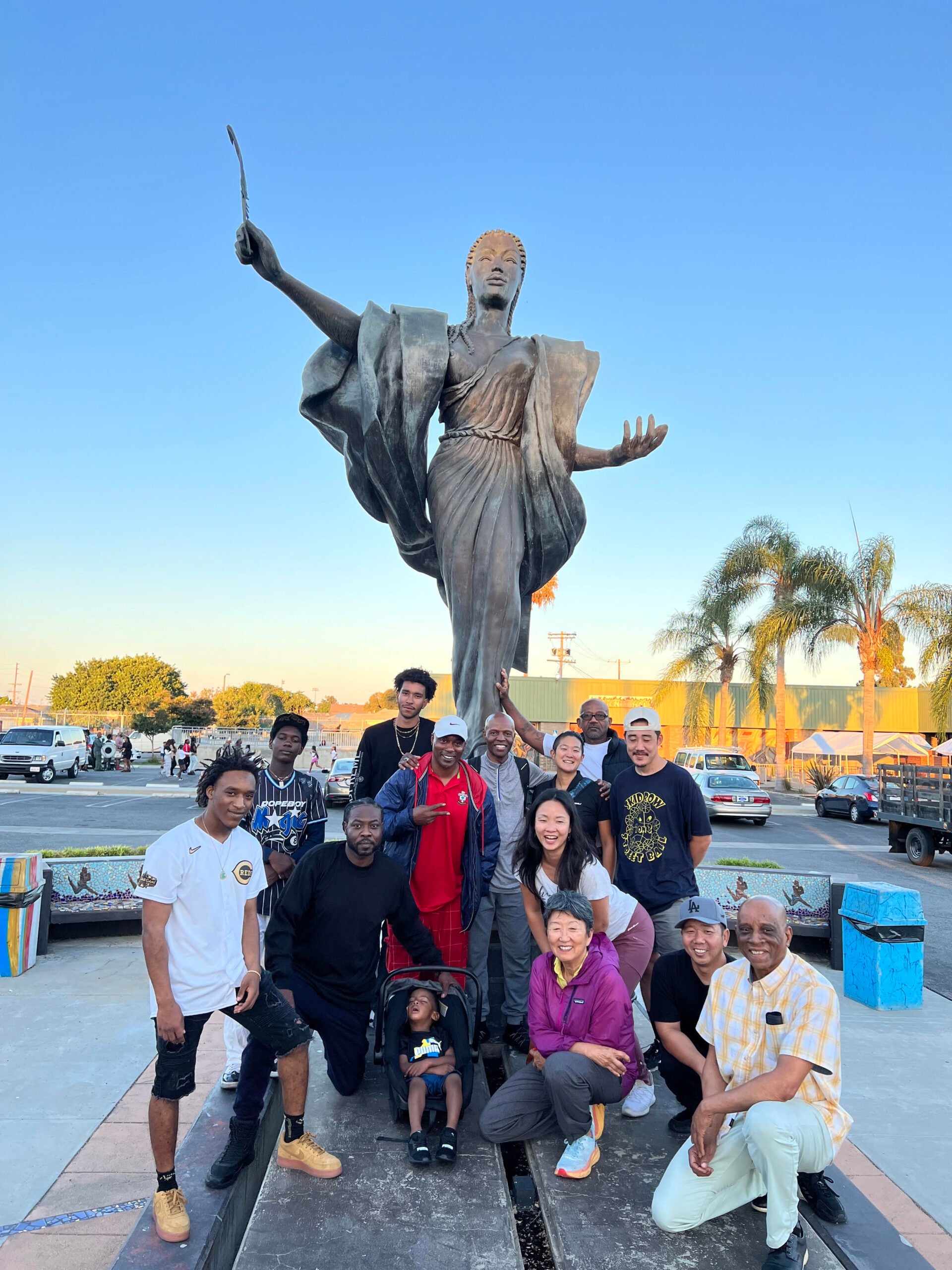
Image 48.06.02 — The LA Race Praxis Network poses at the Mother of Humanity statue at the Watts Labor and Community Center in Los Angeles, 2024. The network is a group that has been doing healing and service together since the killing of George Floyd and anti-Asian hate incidents during the COVID-19 pandemic.