





Aerial view of a myriad of bomb craters pockmarking lush farmland in Cambodia. Most craters are filled with water. A few are covered in vegetation.
Module 2: Decolonization and the Cold War
Did Cambodian Americans attain justice for the harms of war and genocide?
I was warned by the French
Before they left Kampuchea in a hurry
Come with us they said but like my only friend Rithisal
I chose not to abandon
in such cowardly fashion
Rithisal young historian says
why the Powers do nothing to end this experiment
first began with American president orders from menu
campaign breakfast lunch dinner
snack on Ho Chi Minh Trail Kampuchea after independence
not land
for wars Khmer Rouge in power threatens
Phnom Penh evacuate now
the city will be bombed I say quiet Rithisal not so loud
– Monica Sok, excerpted from “The Radio Host Goes into Hiding,” A Nail the Evening Hangs On 1
In the poem “The Radio Host Goes into Hiding,” Cambodian American poet Monica Sok speaks in the imagined voice of a radio host. Through the unnamed host and their friend, the young historian Rithisal, Sok offers a first-person experience of historical events. Connecting the radio host’s experiences of violence to the geopolitical conditions that gave rise to the Khmer Rouge, the poem illustrates the transnational dimensions of Cambodian history during the Cold War in Southeast Asia.
This module addresses the topics of decolonization and the Cold War. We will explore the meanings of international law relating to war and its consequences after World War II. We also will learn about modern Cambodian history in its larger historical context during the Cold War to help us understand the global conditions that produce mass violence.
What was the Cold War?
What did US intervention in Cambodia look like?
How did geopolitical violence affect Cambodia and Cambodians?
Proxy War
Most Americans understand the Cold War as the historical period between the end of World War II and fall of the Soviet Union. On March 12, 1947 President Harry S. Truman announced what would become the basis of the United States’ Cold War policy in Europe and globally. Truman stated: “It must be the policy of the US to support free peoples who are resisting attempted subjugation by armed minorities or by outside pressures.”
With the stated goal of containing the expansion of the Soviet bloc, the Truman Doctrine ushered in a new political understanding of the world in the twentieth century. Viewing Soviet Communist influence as a threat to international peace and US national security, the US divided the world into two opposing camps. This dualistic understanding enabled American military interventions across the globe, and devastating consequences in Southeast Asia and Cambodia.
World War II and a New International Order
World War II brought about global devastation. Europe, Asia, and Africa saw mass casualties and the decimation of entire cities. A total estimated seventy to eighty-five million people perished. The Soviet Union suffered the largest loss of life, about 26.6 million deaths, while China reported twenty million dead.
The war marked the development and use of aerial warfare (including area bombing) on an unprecedented scale. These new technologies of mass destruction, including the B-29 bomber, napalm, firebombing, and the atomic bomb, were used in terror-bombing campaigns on civilian populations. For instance, in addition to the atomic bombing of Hiroshima and Nagasaki in Japan, the US destroyed more than sixty Japanese cities through area bombing in the final year of WWII. Describing the firebombing of Tokyo on March 9–10, 1945, the US Strategic Bombing Survey concluded:
Probably more persons lost their lives by fire at Tokyo in a 6-hour period than at any time in the history of man. People died from extreme heat, from oxygen asphyxiation, from being trampled beneath the feet of stampeding crowds, and from drowning. The largest number of victims were the most vulnerable: women, children and the elderly. 2
Such area bombing campaigns were conducted to reduce cities to rubble, kill civilian inhabitants, and demolish the morale of the population under siege.
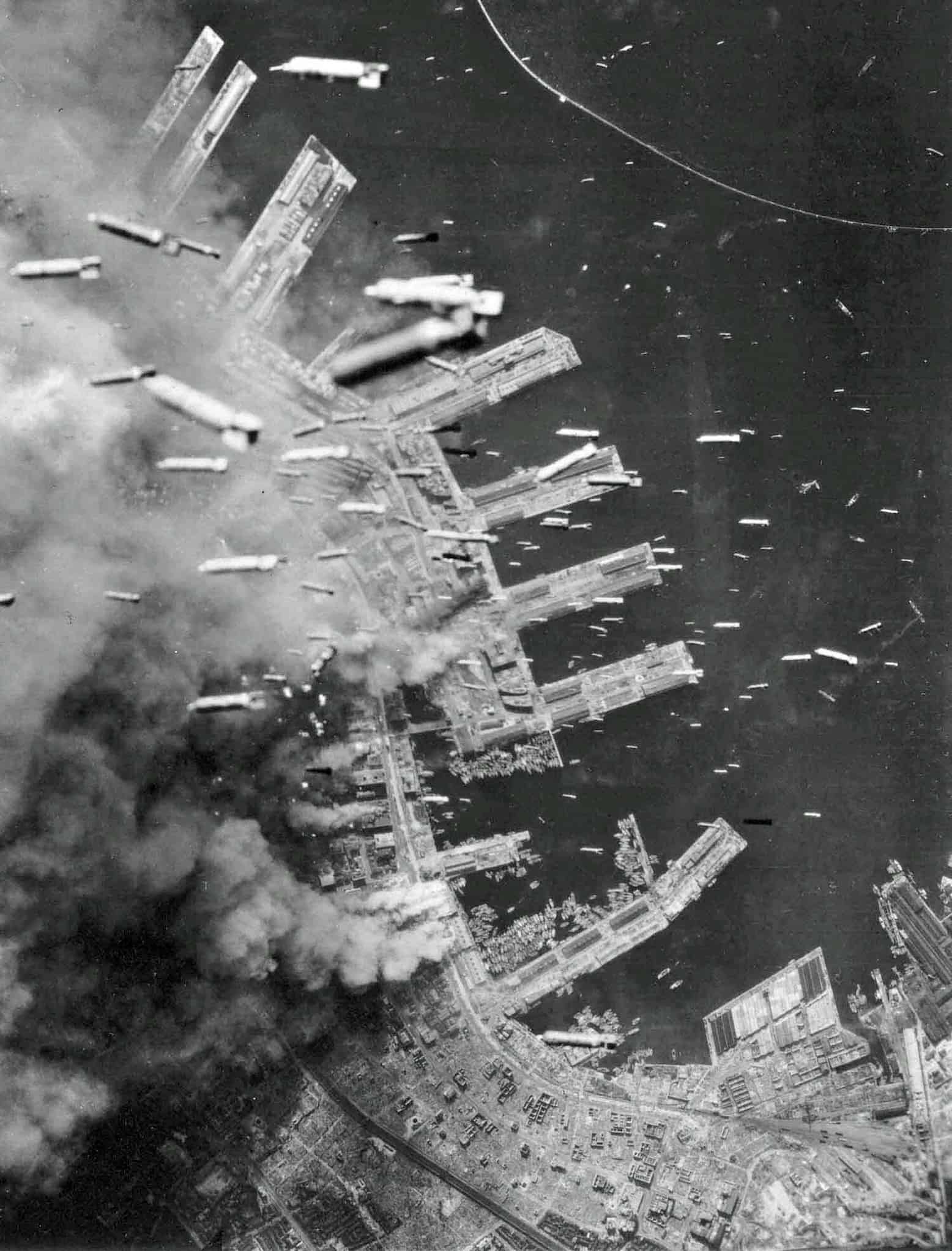
Image 08.02.01 — Taken from above on June 4, 1945, the image captures the dropping of incendiary bombs from American B-29 Superfortresses onto the burning city of Kobe, Japan.
The end of WWII saw the emergence of a new world order. Producing nearly two-thirds of all munitions used by Allied forces, the US emerged as an economic powerhouse and global superpower. The United Nations was created to maintain international peace and security, and to prevent future world wars. After the war, earlier international laws relating to the initiation and conduct of war were revised, and a series of international tribunals produced our modern laws of war.
Additionally, the International Military Tribunal in Nuremberg, Germany, formally inaugurated the body of law known as “international criminal law.” The Nuremberg Principles set guidelines for determining punishable crimes under international law. Individual leaders of Nazi Germany were put on trial for war crimes, crimes against humanity, and crimes against peace. After WWII, the Geneva Accords updated the rights of noncombatants (those not engaged in fighting during armed conflict) and expanded protections for civilians.
Decolonization and the First Indochina War
The end of World War II was accompanied by decolonization movements in Africa and Asia, and signaled European colonialism’s undoing. Colonialism is the process by which imperial nations establish domination of foreign territories that are often overseas. Decolonization can take many forms. In geopolitical terms, it is a movement to establish independence for previously colonized territories from their respective colonial centers.
In Southeast Asia, decolonization began during WWII. The Japanese overthrew Western empires and occupied much of Southeast Asia, with uneven consequences and levels of violence. As the tide turned against the Japanese empire in the Pacific War, anticolonial nationalist leaders like Ho Chi Minh of Vietnam, and Sukarno of Indonesia, declared independence before the return of European colonial powers. Ho Chi Minh and his organization, the Viet Minh (League for the Independence of Vietnam), had become allies to the US in the last months of the war against Japan. On September 2, 1945 Ho Chi Minh declared Vietnam’s independence in a speech that drew from the American Declaration of Independence.
Very soon, however, it became clear that European powers would not relinquish their colonial rule in the region without a fight. In Indonesia, the Dutch fought a bloody war to prevent Indonesian independence. And in Vietnam, Cambodia, and Laos, the French fought to take back their former colony of Indochina—known in the West as the First Indochina War, and in Vietnam as the War of Resistance Against the French.
The French war in Indochina was largely funded by the US who believed that all forms of Communism stemmed from the Soviet Union, and that all leftist movements in Southeast Asia were naïve to the “Communist menace.” This inflexible thinking produced a consistent pattern of US interference in Southeast Asia, including its support for the overthrow or assassination of national leaders.
In Thailand, for instance, the US abandoned its initial support of wartime ally Pridi Phanomyong and his democratic Free Thai government. Viewing Pridi as too sympathetic to the Viet Minh and therefore not sufficiently anticommunist, the US supported a 1947 military coup that replaced Pridi with Marshal Phibun Songkhram, a Japanese ally during WWII.
Seeking to make Thailand the “anticommunist center in Asia,” 3 the US spent hundreds of millions of dollars arming and expanding the brutal authoritarian Phibun regime. This destruction of democratic rule, and the installation of military governance, would have far-reaching effects. Thailand has had more military coups than any other country in modern history, with thirteen successful ones out of a total of twenty-two.
Vietnam and the Second Indochina War
After the Viet Minh and its anticolonial allies defeated the French at the Battle of Dien Bien Phu, the Geneva Accords were signed in July 1954. In Geneva, Switzerland, Vietnamese delegations pushed for full independence and insisted that Vietnam not be partitioned. Ultimately, Vietnam was divided at the seventeenth parallel with the stipulation that a general election would be held to determine the country’s future and question of reunification. The Geneva Accords also did the following:
- Established the removal of French troops
- Affirmed the political independence of Vietnam, Laos, and Cambodia
- Prohibited outside interference in the internal affairs of those countries
The Viet Minh took control of North Vietnam, and the US took on financial and military support of South Vietnam. The Geneva Accords stated that North Vietnam and South Vietnam should consult in preparation for the elections scheduled for 1956. However, South Vietnamese Prime Minister Ngo Dinh Diem, with US support, stated that because his government had not signed the agreements, he was not bound to do so. Instead of working with North Vietnam to prepare for the elections, Diem doubled down on repression and escalated efforts to hunt down Communists and others critical of his rule.
The Second Indochina War (1955–1975), known as the Vietnam War in the US, would result in the loss of millions of lives in North and South Vietnam, Laos, and Cambodia. The war would popularize the term “collateral damage,” referring to damage “alongside” or “parallel to” an intended target, and justifying the mass number of civilian casualties killed in US air raids. In North Vietnam, bombing raids also virtually destroyed all civilian infrastructure, including bridges, dams, power plants, and factories. In addition to bombs, American planes dropped napalm, white phosphorus, and chemical defoliants and herbicides like the infamous Agent Orange.
In 1968 Richard Nixon won the US presidency while running on a platform of exiting Vietnam “with honor.” The Nixon Doctrine, misleadingly called “Vietnamization,” resulted in the withdrawal of US ground troops from Vietnam alongside the intensification of bombing over Cambodia. Although US bombing had been taking place inside Cambodia’s borders since 1964, Nixon’s authorization of the first of many carpet bombing campaigns, the intense bombing of an area, would result in unforeseen consequences for the neutral, non-aligned nation.
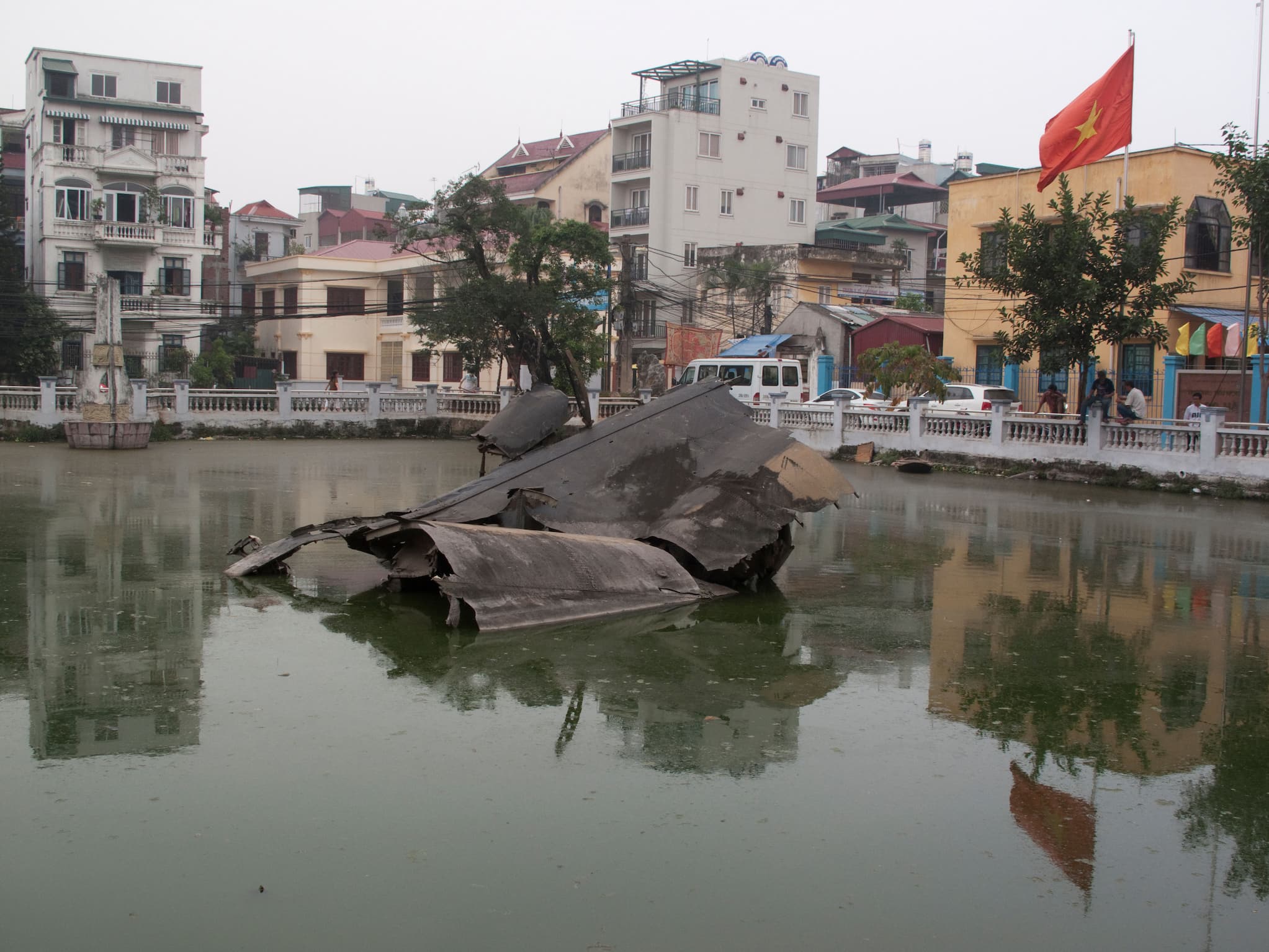
Image 08.02.03 — The wreckage of an American B-52 bomber, shot down during the Vietnam War on December 27, 1972, can be seen in Hữu Tiệp Lake in the Ngọc Hà neighborhood of Hanoi, Vietnam.
United States Bombing of Cambodia
On August 6, 1973, an American B-52 bomber mistakenly dropped its load on the Cambodian river town of Neak Leung, killing at least 137 Cambodians and wounding 268 more. Many newspapers of the time dubbed the destruction of Neak Leung as “the worst bombing error of the Indochina war.” 4 The bombing took place less than ten days before the US Congress put an end to Nixon’s bombing of Cambodia, capping off nearly a decade of American air raids against the politically neutral country.
In 2000 the US government released classified Air Force data on American bombings in Cambodia, Laos, and Vietnam. Although the new data established an earlier start date than what was previously known, local Cambodian accounts provide evidence that the bombings began as early as 1964. Documents referred to these early aerial attacks as “incursions” when the attacks were not denied outright. The US denied any responsibility for the harm of its military campaigns and obscured the human impact of wartime violence.
For instance, the destruction of Chantrea Village, located about five to six kilometers from the Vietnam–Cambodia border, is captured in an issue of the Documentation Center of Cambodia’s magazine Searching for the Truth. In it, Daek Det, a farmer whose family home burned in the fires of napalm dropped from US fighter planes in 1964, was interviewed. Two of Det’s brothers died from their injuries, while his elder sister was horribly burned. He stated that, “After her wounds had healed, both arms were stuck to her body at the armpits, making even such simple tasks as showering difficult. Her arms and hands were rendered almost useless.” 5
These testimonies illustrate the human costs obscured by the language of “collateral damage.”
Carpet bombing began in earnest in Cambodia with the election of Richard Nixon. Operation Menu—consisting of six missions named “Breakfast,” “Lunch,” “Snack,” “Dinner,” “Supper,” and “Dessert”—was a covert US bombing campaign. This was followed immediately by Operation Freedom Deal, which suspended prior limits on US attacks to within thirty miles of the Vietnam border and a kilometer of any village.
Thousands of US air strikes were on targets recorded as “Unknown” or “Unidentified.” Although they remain unprosecuted, these carpet bombing campaigns are considered war crimes under international law.
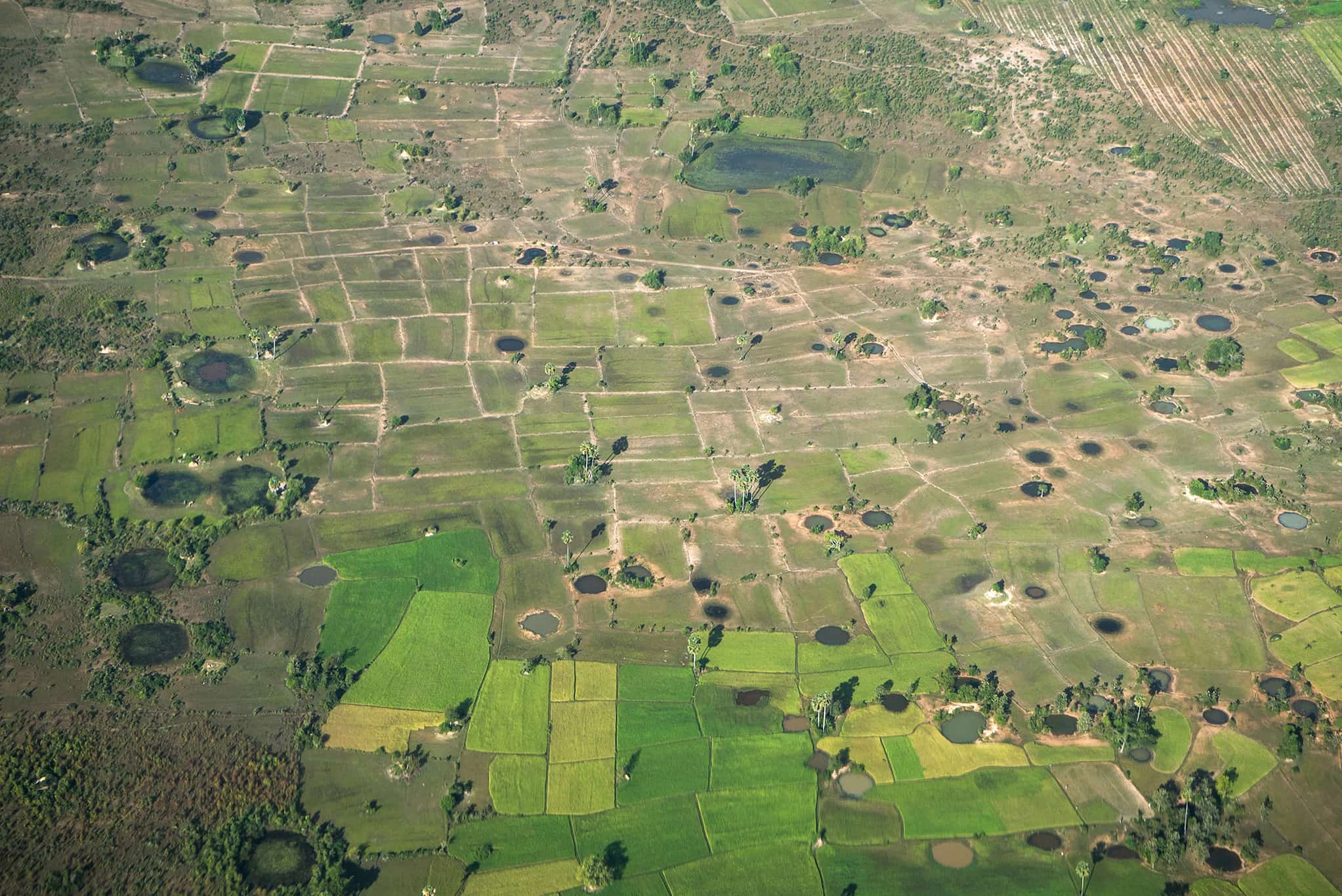
Image 08.02.04 — An overhead view of bomb craters from the US aerial bombardment in the 1960s and 1970s marking the fields in Kandal Province, Cambodia.
In 1973, US Congress legislated a halt to the bombing of Cambodia, but the damage had already been done. Operation Freedom Deal pushed the war into Cambodia’s interior, destroyed civilian infrastructure, killed hundreds of thousands, and displaced millions of Cambodians. The bombing of Cambodian villages and significant civilian casualties became recruitment propaganda for what had been, until then, a minor insurgent force called the Khmer Rouge.
Chhit Do, a former Khmer Rouge officer, described to journalist Bruce Palling how the bombing was used to recruit peasants to the Khmer Rouge cause:
Every time after there had been bombing, they would take the people to see the craters, to see how big and deep the craters were, to see how the earth had been gouged out and scorched… the ordinary people… sometimes literally shit in their pants when the big bombs and shells came… their minds just froze up and they would wander around mute for three or four days. Terrified and half crazy, the people were ready to believe what they were told. 6
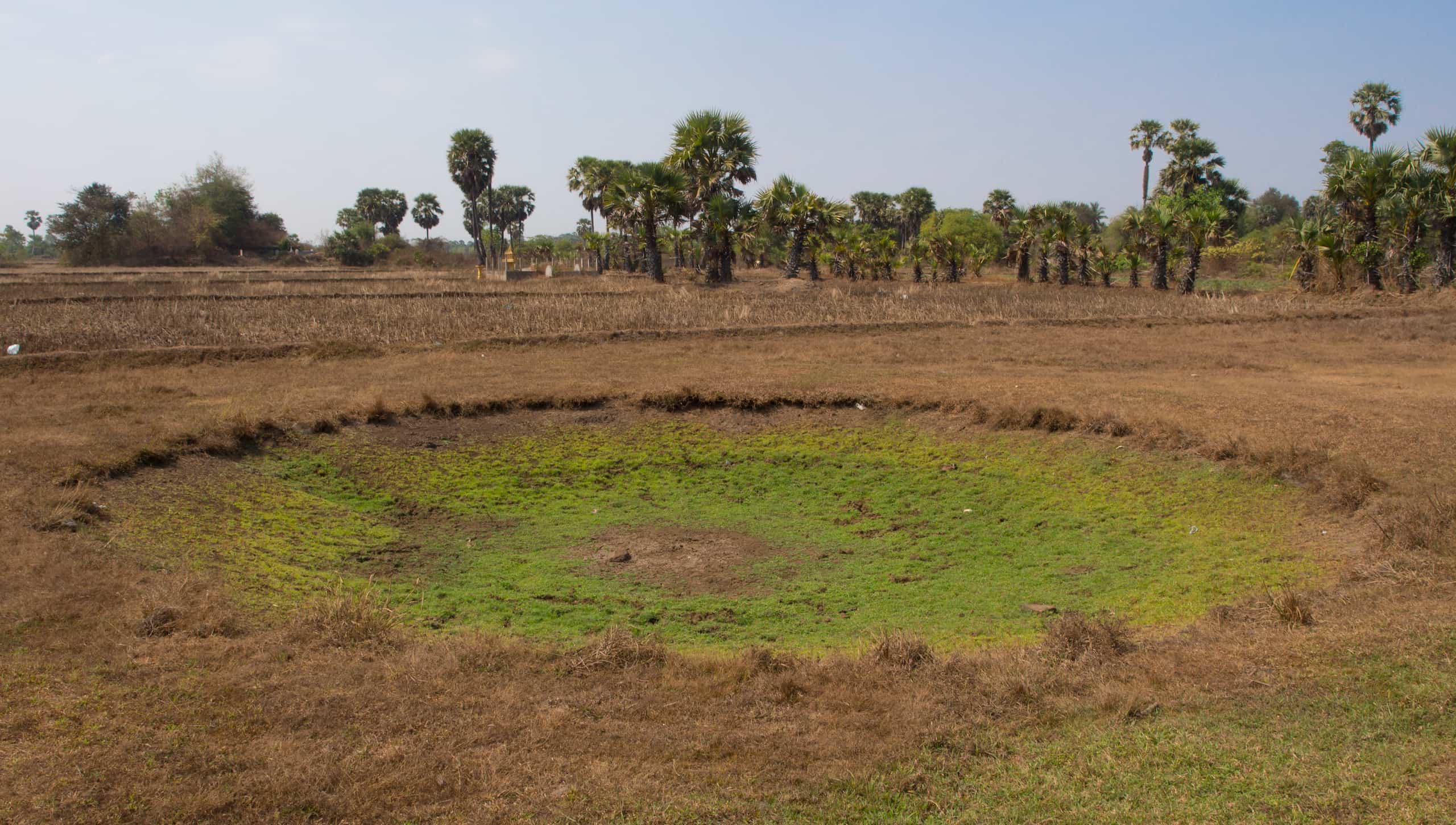
Image 08.02.05 — A bomb crater in Kampong Cham Province, Cambodia, photographed in 2014.
Do added, “Sometimes the bombs fell and hit little children, and their fathers would be all for the Khmer Rouge…” In the Cambodian countryside, the bombing campaigns fueled rage against the pro-US Lon Nol government, and propelled the population to join and support the opposing Khmer Rouge with unanticipated and disastrous consequences.
Glossary terms in this module
colonialism Where it’s used
When one country takes partial or complete control over another country economically and politically, exploiting its natural resources for profit. The colonizer forces their beliefs and way of life onto the colonized.
decolonization Where it’s used
The process by which a place reaches a full measure of self-government and independence from the colonizing country.
Khmer Rouge Where it’s used
Also known as the Communist Party of Kampuchea, the Khmer Rouge party was led by Pol Pot and ruled over Cambodia from 1975 to 1979. During this time, the Khmer Rouge renamed the country Democratic Kampuchea, and enacted a totalitarian regime responsible for the Cambodian Holocaust.
The Cold War Where it’s used
Beginning at the end of World War II and ending with the fall of the Soviet Union in 1989, the Cold War was a period of indirect war and rivalry between the United States and Soviet Union (USSR), and their allies. Though there was no direct fighting between the US and USSR, their rivalry brought forth numerous proxy wars in various regions, particularly in East and Southeast Asia. Typically characterized through arms races and the prevention of communism, the Cold War can also be understood as a global phenomenon that affected countries around the world, with significant consequences for decolonizing countries in Asia.
transnational Where it’s used
Extending beyond national borders and countries.
Endnotes
1 Monica Sok, “The Radio Host Goes into Hiding,” in A Nail the Evening Hangs On (Copper Canyon Press, 2020), 8.
Monica Sok, excerpts “The Radio Host Goes into Hiding,” from A Nail the Evening Hangs On. Copyright © 2020 by Monica Sok. Used with the permission of The Permissions Company, LLC on behalf of Copper Canyon Press, coppercanyonpress.org. All rights reserved.
2 Mark Selden, “Bombs Bursting in Air: State and Citizen Responses to the US Firebombing and Atomic Bombing of Japan,” Asia-Pacific Journal: Japan Focus 12, issue 3, no. 4 (2014): 3.
3 Kevin Hewison, “Black Site: The Cold War and the Shaping of Thailand’s Politics,” Journal of Contemporary Asia 50, no. 4 (2020): 554.
4 Lina Chhun, “‘Sometime American Can. . . Make Mistake Too. . .’ Contested Memory, Documentary Registers, and Cambodian/American Histories of Violence,” Amerasia Journal 42, no.2 (2016): 161.
5 Chhun, “Contested Memory,” 161.
6 Ben Kiernan and Taylor Owen, “Roots of U.S. Troubles in Afghanistan: Civilian Bombing Casualties and the Cambodian Precedent,” The Asia-Pacific Journal: Japan Focus 8:26, no. 4 (2010): 9.