





Art piece of a statue with a skull head wearing a soldier’s helmet and a dress made out of a military parachute displayed in a gallery.
Module 5: Transnational Connections and Intergenerational Legacies
Did Cambodian Americans attain justice for the harms of war and genocide?
There’s a moment I remember, when my sister and I first interviewed our grandmother over a decade ago. I had this list of open-ended questions, including one down at the very bottom regarding identity… If you could say something to the next generation about what it means to be Cambodian, what would you say?
I still remember my grandmother’s blank look in response, her stare….
At the time, I read this moment as one of miscommunication, as a moment “lost in translation.” That I didn’t question this… until much, much later reflected… a deep… attachment to… Western notions… not so easily translated into Khmer, my grandmother’s native tongue. In what I initially read as my grandmother’s “confusion” and subsequent refusal to answer in the way I thought I desired of her at the time, my grandmother articulated something I did not yet have the words for. Through her look of silence, she challenged me to imagine… a different path towards knowledge and knowing.
– Lina Chhun, Walking with the Ghost 1
This module opens with this reflection to highlight what it might mean to rethink the familiar and to question some of our own assumptions. When I (the chapter author) first conducted an oral history interview with my grandmother, I wanted to end by asking her to give her thoughts on responsibility and justice for violence. I also wanted to know what my grandmother thought was most important to understanding “Cambodian identity.”
At the time, I did not question the meaning of any of these concepts, especially “justice” and “identity.” Having grown up in the United States as a Cambodian American, I had assumed that we shared the same understanding. My grandmother’s refusal to provide an answer all those years ago marked a moment of reflection for me. It pushed me to think differently, to think more closely and expansively about the social and cultural contexts that inform our knowledge about ourselves and the world.
This module explores how violence connects to institutional, individual, and collective responses to harm, focusing on the transnational dimensions of memory and justice. Emphasizing the role of the past in shaping the present and future, the module highlights transnational relationships and intergenerational experiences. We examine how Cambodians and Cambodian Americans have responded to war, genocide, and injustice, and how their cultural production engages with experiences of violence in the context of larger global histories.
How have Cambodians and Cambodian Americans responded to the legacies of war and genocide?
What are the possibilities and limits of the law in movements for justice?
How does Cambodian American memory work reflect transnational histories and more expansive understandings of justice?
Asian/Pacific Islander Youth Promoting Advocacy and Leadership
You wage war on my country,
Now I’m called a refugee.
We are here with our demands,
Join us now and take a stand.
Deportation is a crime,
When we already did our time,
Immigrants are not to blame,
George Bush should be ashamed!
– AYPAL chant, Kwon, “Deporting Cambodian Refugees” 2
From 2002 to 2004, the Asian/Pacific Islander Youth Promoting Advocacy and Leadership (AYPAL), a youth activist group based in Oakland, California, led a campaign to build greater awareness of, and put an end to, the deportation of Cambodian Americans. In their activism against deportation, AYPAL youth held anti-deportation events, such as a conference to raise community awareness that included hearing from generations of family members directly affected by deportation.
AYPAL also connected the issue of unjust Cambodian deportation to larger questions relating to labor, immigration, and incarceration, and built a wider coalitional base that went beyond youth organizations. Through their justice work, and reflected in the chant members sung during anti-deportation events, AYPAL drew attention to the transnational conditions that produced Cambodian refugees and Cambodian American communities.
In 1996 President Bill Clinton signed a series of immigration laws, including the Illegal Immigration Reform and Immigrant Responsibility Act (IIRIRA). The act greatly expanded the conditions for deportation, both broadly, and for lawful permanent residents (LPRs) in particular. The IIRIRA specifically:
- Reduced the prison sentence length triggering deportation from five or more years to one year
- Redefined “aggravated felony” to include nonserious crimes such as misdemeanors
- Applied the law retroactively
- Required mandatory detention without bail or due process for all immigrants or refugees facing deportation
The law allowed no flexibility, denying case-by-case reviews that considered the severity or consequence of a crime. Deportation could result from minor violations such as urinating in public, bouncing a check, or subway fare evasion. Even those who accepted a plea deal, were never incarcerated, or served less than a year, could still be deported. Under the IIRIRA, deportation was based on the maximum possible sentence, not time served. With no repatriation (return of someone to their country) agreement with Cambodia at the time, many Cambodian Americans with felony records could now be detained indefinitely.
Kim Ho Ma, a Cambodian refugee, spent a year and a half in a detention center after being directly transferred from the prison where he had served his sentence. In the year 2000, Ma challenged the legality of indefinite detention, and in the case of Kim Ho Ma v. Reno, the US Supreme Court ruled on his behalf, stating that such indefinite detentions were unconstitutional. However, the George W. Bush administration secured a repatriation agreement in 2002 by pressuring Cambodia, resulting in Ma being deported seven months later. Ma’s case reflects both the possibility and limit of the law in struggles for justice. His story is one of three featured in the 2005 documentary Sentenced Home.
Loeun Lun, a refugee also featured in Sentenced Home, fled Cambodia as a baby and grew up in a housing project in Tacoma, Washington. As a teen Lun shot a gun in the air at a shopping mall while being pursued by a group of armed boys. No one was hurt, and he pled guilty to assault charges and served eleven months. After his release he turned things around, got married and had two daughters. At his naturalization interview for citizenship Lun was arrested and later deported. His experiences, along with those of Kim Ho Ma and Many Uch, provide a human dimension to the deportation story, one that is typically lost in rigid anti-immigration and law-and-order narratives. Sentenced Home connects the personal history of the child refugee to a history of US bombing and inadequate American government resettlement policies.
Institutional Documentation and Official Memory
Cold War politics, including Chinese and US support for the Khmer Rouge at the United Nations, delayed international action against the Khmer Rouge regime until 1994. In the 1980s US Secretary of State George Shultz opposed investigations into the Khmer Rouge’s crimes. The fall of the Soviet Union and shift toward humanitarian intervention in the 1990s, however, jointly increased the global awareness of genocide.
In April 1994, US Congress passed the Cambodian Genocide Justice Act, making it national policy to prosecute the Khmer Rouge leaders. The state department funded legal studies and Yale University’s Cambodian Genocide Program to collect historical evidence. Efforts to form a tribunal faced disputes over jurisdiction, timeframes, and charges. In 2001 the Extraordinary Chambers in the Courts of Cambodia (ECCC) was established, with consideration of crimes limited to the period between April 17, 1975, and January 6, 1979.
The Cambodian Genocide Justice Act also established programs of research relating to the Cambodian Holocaust. In addition to Yale University’s Cambodian Genocide Program, the Documentation Center of Cambodia (DC-Cam) opened as a field office of the Yale program and became an independent nongovernmental organization. DC-Cam is the primary archival institution in Cambodia dedicated to the documentation of the Democratic Kampuchea period and contains the world’s largest repository of primary documents from this time.
Accountability and Cambodian American Memory Work
Scholar James E. Young uses the term “memory work” to discuss the contribution of monuments and memorials to representations of loss in Holocaust memorialization debates. Contrary to what we might believe, Young argues that monuments, and memorials more broadly, can produce the forgetting they claim to counter. Memorialization is never neutral, and state-sponsored and official forms of memory often produce dominant narratives of history and experience. These dominant narratives obscure alternative histories and transnational interconnections.
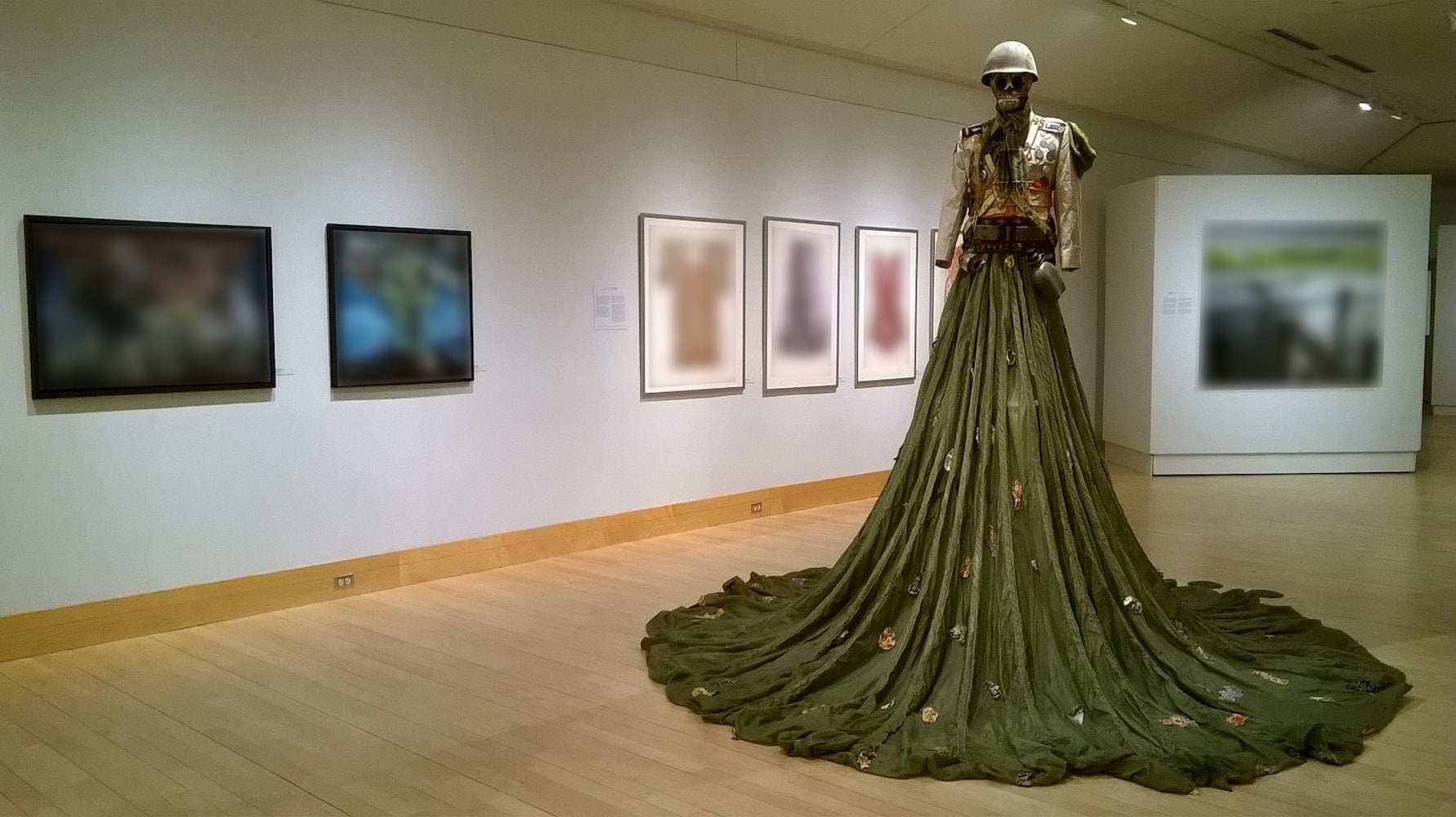
Image 08.05.02 — Leang Seckon is a leading member of the Cambodian contemporary art scene. His Flowering Parachute Skirt (2012) is constructed from mixed materials, including a military parachute that fell onto his village during the US bombings of Cambodia.
In the case of Cambodia, state-sponsored institutional memory has encouraged a certain historical narrative of tragedy and trauma. This narrative treats the history of the Cambodian Holocaust, and the production of the Cambodian refugee, as separate from the global Cold War, and from US interventions in Southeast Asia. With its narrow scope of reference tied to criminal prosecution of individuals, the Khmer Rouge tribunal offers a limited measure of justice and accountability, and functions to reproduce this official “history.”
Moving away from the law and other frameworks that separate Cambodian American history from transnational causes of violence, Cambodian Americans have created their own forms of public memory that address lingering histories and intergenerational legacies. The earliest Cambodian American cultural production came in the form of memoirs, written by first-generation refugees who had survived the Cambodian Holocaust. Some of these testimonial narratives, like Loung Ung’s First They Killed My Father (2000), have been translated into film and have reached broader audiences.
A new generation of Cambodian Americans—those who came as child refugees, were born in border camps, or born in the diaspora in asylum countries—are also engaging in their own memory work. Through cultural production in the forms of poetry (like that of poet Monica Sok), short stories (like those of Anthony Veasna So), art, film, and more, these new-generation Cambodian Americans are challenging representations of Cambodian and Cambodian American history as “curse,” “tragedy,” or “decline.” Cambodian American cultural producers draw historical connections, grapple with the meanings and experiences of intergenerational legacies of violence, and enable more expansive visions of justice.
More to explore
Video
01:56
Representing Transnational Histories
1700% Project: Mistaken for Muslim is a collaboration between Muslim Khmer artist Anida Yoeu Ali and filmmaker Masahiro Sugano. Produced in 2011, the project’s “1700%” is the exponential percentage increase of hate crimes against those read as Arab or Muslim in the US since the events of September 11, 2001.
Anida Yoeu Ali, a Cambodian American spoken-word artist-activist born in 1974 in Battambang, Cambodia, came to the US as a refugee in the early 1980s. Ali also identifies as a first-generation Muslim Khmer woman raised in Chicago. She is a co-founder of Studio Revolt, an artist-run media lab, through which she has collaboratively produced performance projects, art installations, video and films. Her installation and performance works investigate the political, psychological, and spiritual dimensions of transnational experience, drawing our attention to shared histories of injustice and using art as one avenue for reflection and accountability.
Ali’s Studio Revolt collaboration, “My Asian Americana,” features scenes with Cambodian Americans who articulate what “my Asian Americana” means to them—“Thanksgiving,” “Saturday morning cartoons,” “my mom’s home cooking,” “my nieces and nephews running around.” The video ends with some Cambodian Americans stating: “I am an American, and I can go home,” and others stating: “I am an exiled American, and I can’t go home.” The video illustrates the effects of an unjust deportation policy that sends those that have done their time “back” to a country they have little to no knowledge of. In “1700% Project: Mistaken for Muslim,” Ali positions Cambodian American history as one of many that haunt events of violence that occur today, connecting hate crimes against Muslims to long-standing legacies of violence.
In 2017, Ali was strip-searched and detained by immigration officials during a trip to Palestine. She discovered her artwork, The Red Chador, missing from her luggage upon arrival in the US. In response, Ali memorialized The Red Chador with an online eulogy to make a statement about the rise of global Islamophobia.
Transnational Approach to Cambodian American History
Why is a transnational approach to Cambodian American history important? It would be too simplistic to reduce the story of Cambodian Americans to just that of war, genocide, and suffering. Their story is also one of survival, struggle, ingenuity, and shared community, alongside experiences of pain and loss. Cambodian Americans are not solely defined by war and genocide, but an understanding of Cambodian American experiences of historical violence can help us think through more sustainable solutions for harm.
War and military violence continue to produce instability, mass displacement, and loss of life around the world. Militarism—the saturation of civilian life with military values and the valorization of armed forces—has become synonymous with our understanding of global security. But militarized violence has a long history, and the global reach of the United States through overseas military base is largely a post-World War II phenomenon.
Aerial conflict and bombardment have become the main means of waging high-tech warfare in increasingly unequal circumstances, with these technologies producing ever-greater distance between those who kill and those targeted for killing.
What does this then do to our understanding of ourselves, our relationship to the world, and our understanding of violence and harm? As our world becomes more highly connected through communications and media technology, and further disconnected from human consideration in the use of deadly weapons, how should we understand justice?
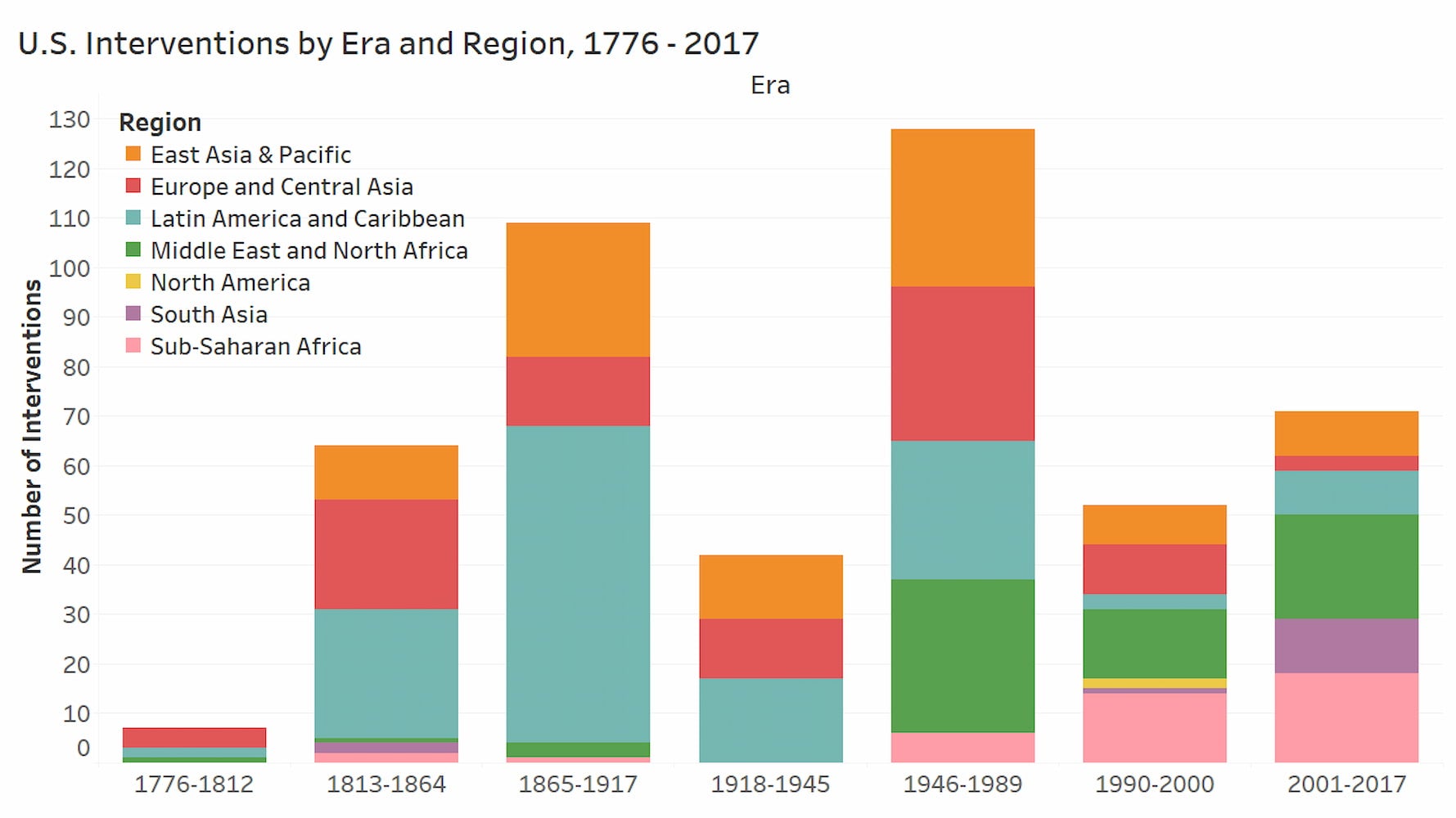
Image 08.05.06 — This graph from the Fletcher School of Law and Diplomacy at Tufts University illustrates the number of US interventions by period and region. Since 1776, the US has undertaken over five hundred international military interventions, with the largest number taking place during the Cold War.
My (the author’s) grandmother was a devout Theravada Buddhist. Some of my most vivid childhood memories involve my grandmother in daily prayer, twice a day, in the morning and evening. In the years since her passing and subsequent wake in 2022, I oftentimes find myself thinking more deeply about the lessons I only now realize she quietly taught me.
My grandmother’s experience of herself as part of the world was not a matter of claiming an identity. What she honored was the practice of shared rituals that reflected the mutual obligations we have to each other. My grandmother’s everyday practice of Theravada Buddhism included an understanding that being human involved living in a world shaped by action. Moral conduct requires responsibility and mindfulness about social relationships and the anticipated consequences of one’s actions. The individual can only exist in relationship with and to others, and the actions of self and others are deeply interconnected. The set of actions taken by a person has the potential to produce the conditions that lead to the destruction or survival of others.
The stories of my grandmother’s life shared by mourners of all generations at her wake opened a small window into what I sense now were many lives lived by my grandmother. It is likely I will never fully understand the extent or meaning of the many acts of mutual care and mutual struggle that were recounted by those whose lives were intimately intertwined with my grandmother’s. In the face of anticipated violence, however, the memories shared at my grandmother’s wake that day reflect how people still find ways to engage in the ethics of reciprocal obligation and to build extensive networks based on these relationships. The generational lessons here are invaluable, and they might contribute to our ability to imagine and create more just and sustainable worlds.
Transnational Cambodian American history asks us to refuse the tendency to distance ourselves, and the impulse to deny the ways our lives are lived, in relation to one another. Thinking about world history transnationally challenges the idea of Cambodian history as a tragedy or “sideshow” to a larger war. The Cambodian American experience, which began fifty years ago, eight thousand miles across the Pacific Ocean, teaches us important lessons about the conditions that produce mass violence, about the human dimension of refugee migrations, and about the value of lives as people continue to live and respond to political violence, insecurity, and injustice.
Glossary terms in this module
deportation Where it’s used
The formal removal of someone from a country.
diaspora Where it’s used
The dispersal, movement, migration, or scattering of a people from their established or ancestral homeland.
displacement Where it’s used
A situation where people are forced to leave their homes or native countries, typically under circumstances such as avoiding armed conflict, violence, or natural disasters.
genocide Where it’s used
A term combining the Greek genos, meaning “race,” and the Latin cīda, meaning “killer” or “act of killing.” It refers to a set of actions taken with intent to produce the destruction in whole or in part of a national, racial, ethnic, or religious group.
Khmer Rouge Where it’s used
Also known as the Communist Party of Kampuchea, the Khmer Rouge party was led by Pol Pot and ruled over Cambodia from 1975 to 1979. During this time, the Khmer Rouge renamed the country Democratic Kampuchea, and enacted a totalitarian regime responsible for the Cambodian Holocaust.
memory work Where it’s used
The process by which an event, person, or situation is remembered through the work of individuals, organizations, or institutions.
refugee Where it’s used
Someone, or a group of people who have been forced to flee their native country due to war, violence, or persecution, and are unable or not willing to return.
resettlement Where it’s used
The transferring of refugees from an asylum country to another state, where they are ultimately given permanent residence.
The Cambodian Holocaust Where it’s used
The period of state violence perpetuated by the Khmer Rouge government of Cambodia, led by Pol Pot, from 1975 to 1979. During this time, up to two million Cambodians died from the effects of starvation, disease, illness, torture, or murder.
The Cold War Where it’s used
Beginning at the end of World War II and ending with the fall of the Soviet Union in 1989, the Cold War was a period of indirect war and rivalry between the United States and Soviet Union (USSR), and their allies. Though there was no direct fighting between the US and USSR, their rivalry brought forth numerous proxy wars in various regions, particularly in East and Southeast Asia. Typically characterized through arms races and the prevention of communism, the Cold War can also be understood as a global phenomenon that affected countries around the world, with significant consequences for decolonizing countries in Asia.
transnational Where it’s used
Extending beyond national borders and countries.
Endnotes
1 Lina Chhun, “Walking with the Ghost: Silences, Memory, and Cambodian American Histories of Violence,” (unpublished manuscript, June 5, 2024), typescript.
2 Soo Ah Kwon, “Deporting Cambodian Refugees: Youth Activism, State Reform, and Imperial Statecraft,” positions: asia critique 20, no. 3 (2012): 749.