




A man takes a selfie in front of the parade in Cambodia Town. Confetti fills the air above the paraders dressed in brightly colored attire.
Module 4: Refugee Resettlement and Diaspora
Did Cambodian Americans attain justice for the harms of war and genocide?
Dear loom, dear box skeleton,
special ordered and
handcrafted from wood,
you rest on the floor
and wait for her
to sit down with you
and together weave
fabrics for weddings
between lovers and warriors,
the survivors, surviving.
– Monica Sok, excerpted from “Ode to the Loom,” A Nail the Evening Hangs On 1
Cambodian American poet Monica Sok opens her collection A Nail the Evening Hangs On with a dedication to her grandmother: “for Bun Em”. In the poems, Sok’s descriptions of the relationship between her and her grandmother, a master weaver, and their loom, illustrate the thread that connects the refugee’s life before displacement and life after resettlement in the diaspora. A diaspora refers to any group that has been dispersed outside its traditional homeland, especially involuntarily. “Diaspora” can also be used to discuss the transnational movements of people that align with historical, social, and economic events.
This module addresses the topics of refugee resettlement and diaspora, and explores the experiences of the Cambodian diaspora in the United States. We learn about refugee experiences of displacement and resettlement, and understand the historical and legal conditions that produced the Cambodian refugee and the Cambodian American.
What is a “refugee” and what are some of the conditions that produce refugees?
What is “diaspora,” especially for Cambodian Americans?
What experiences define resettlement for Cambodian communities in the United States?
Defining Cambodian Refugees
In 1951 the United Nations adopted the Convention Relating to the Status of Refugees to respond to the thousands of refugees fleeing Europe after World War II. The Convention established a universal definition of refugee status, outlined obligations of asylum-granting nations, and defined the scope and framework for the Office of the United Nations High Commissioner for Refugees (UNHCR).
According to UNHCR, refugees are defined as individuals who cross national borders to escape persecution in their home countries. By crossing into another country, their status shifts from “internally displaced people” to “refugees.” At this point, they can apply for asylum, either in the country entered or to a third country.
In 1967 within the context of the global Cold War, the United Nations Protocol on the Status of Refugees expanded the previous convention to include recently decolonized countries. In the 1960s and 1970s, those fleeing Communist regimes were often granted refugee status while those displaced by US-allied regimes were not. This distinction reflects the limits of refugee status as a legal category, similar to the limits of genocide when defined under international law discussed in the previous module.
Similarly, the narrow definition and interpretation of refugee status under the law obscures the conditions that produce mass displacement of populations and transnational refugee migrations in the first place. One example is the mass displacement of people from Cambodia’s countryside to its cities in the 1960s and 1970s because of US bombing campaigns.
In a 1971 survey, 60 percent of Cambodian refugees said US bombing was the main reason for their displacement. According to a US Senate subcommittee, war created over three million refugees out of a total Cambodian population of seven million. At least half were displaced in 1973 alone during the height of the US bombing campaigns.
War and military violence continue to produce displacement around the globe, creating both internal refugees and those who qualify for legal refugee status. According to a 2021 study conducted by the Watson Institute for International and Public Affairs at Brown University, the bulk of wars waged after 2001, post 9/11, displaced at least thirty-eight million people in Afghanistan, Pakistan, Iraq, Libya, Syria, Yemen, Somalia, and the Philippines.
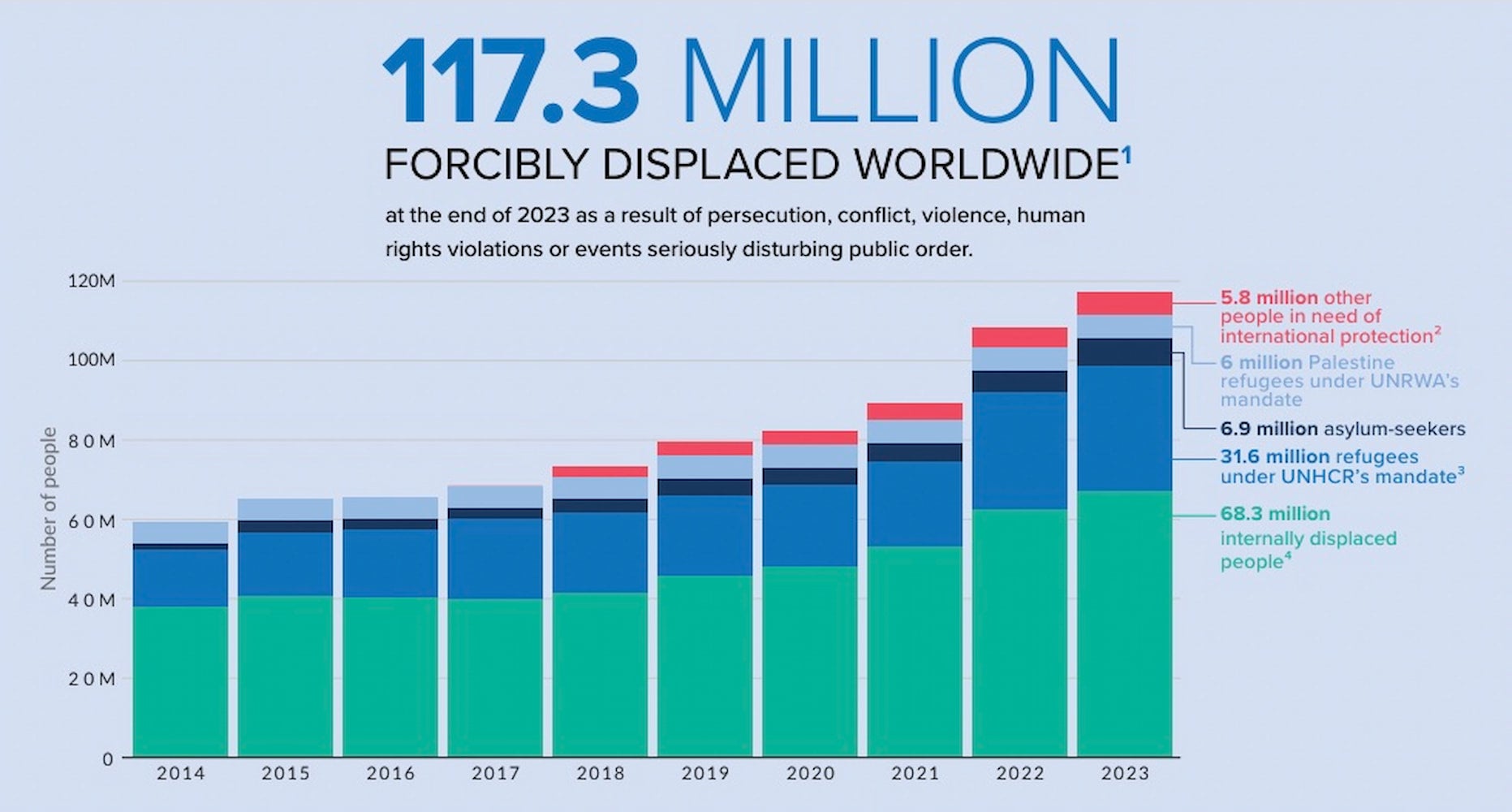
Image 08.04.01 — UNHCR’s Global Trends report presents the latest official statistics on forcibly displaced people worldwide, including refugees, asylum seekers, and internally displaced and stateless people. The graph illustrates the massive increase since 2014, and identifies displaced populations by their respective legal categories.
The Aftermath of War and Genocide
On January 7, 1979 Vietnamese troops launched an assault and took Phnom Penh, overthrowing the Khmer Rouge government in Cambodia. The People’s Republic of Kampuchea was established under Vietnamese occupation and led by Khmer Rouge officers that had defected to Vietnam during the Cambodian genocide. In 1989 Vietnamese troops withdrew from the country, and the People’s Republic of Kampuchea was renamed the State of Cambodia.
When Vietnam ousted the Khmer Rouge, most of the world responded according to their respective Cold War positions. China, the US, and its allies refused to recognize the new Cambodian government. The Khmer Rouge held onto Cambodia’s seat at the United Nations for another fourteen years. China provided Khmer Rouge forces with a hundred million dollars in weapons per year with US support, while the US provided international aid to the Khmer Rouge through their ally Thailand. A decade-long international embargo against the People’s Republic of Kampuchea added to already deteriorating conditions in a country that had just emerged from civil war and genocide. In 1979 the situation in Cambodia was dire due to the looming threat of starvation and widespread malnutrition among the populace.
At that time, the Khmer Rouge were driven to the Thai border by Vietnamese forces. Many took hostages as they retreated, and thousands of villagers were taken into the forests of western Cambodia at gunpoint. Meanwhile, ongoing fighting between the Khmer Rouge and Vietnamese provided cover for Cambodians fleeing to the Thai border area. Many died along the way from exhaustion, illness, hunger, bullets, and land mines. Ra Pronh described the perilous journey to scholar Eric Tang:
Eventually our only choice was to cross into Thailand to stay alive. But some of us were more scared of the Thai soldiers. They can kill us, too. But there was no choice. We had to cross because the situation was so bad in Cambodia. 2
From the perspective of the Thai government in 1979, fleeing people were not “genuine refugees” and were considered “illegal immigrants” when they crossed the border into Thailand. Displaced people were preyed upon by Khmer Rouge and Thai soldiers, who oftentimes pushed fleeing people back into Cambodia.
In June 1979 Thai soldiers massacred thousands of people at Mount Dangrek, forcing Cambodian asylum seekers at gunpoint into a borderline ravine riddled with land mines. This led to an international outcry. Thai authorities responded by instituting an open door policy for a brief window of time to allow Cambodians entry to Thailand, and crossing over into UNHCR camps. For the internally displaced people who remained behind, Cambodia survived a decade of foreign occupation, international isolation, and civil war before UN intervention and eventual democratic transition signaling the formal defeat of the Khmer Rouge in the 1990s.
Holding Centers and UNHCR Refugee Camps
Once across the Thai border, refugees entered camps jointly administered by the UNHCR and the Thai government. Here they would submit their application to a third and final country of asylum. Application success or failure depended on whether an asylum seeker could successfully prove to third-country officials, such as US Immigration and Naturalization Service (INS) officers, that they had experienced persecution according to at least one of five criteria:
- Race
- Religion
- Nationality
- Membership in a particular social group
- Political opinion
The largest UNHCR border camp was established at Khao-I-Dang. Cambodian Canadian scholar Y-Dang Troeung writes:
Designed for semi-permanent settlement, KID [Khao-I-Dang] is remembered by Cambodian refugees and humanitarian workers as a place marked by intervals of both joy and excruciating loss. My mother and father recall the prisonlike enclosure of the camp, the lack of water, the interminable boredom of camp life, and the stories about the rape of Cambodian women and girls by Thai soldiers. 3
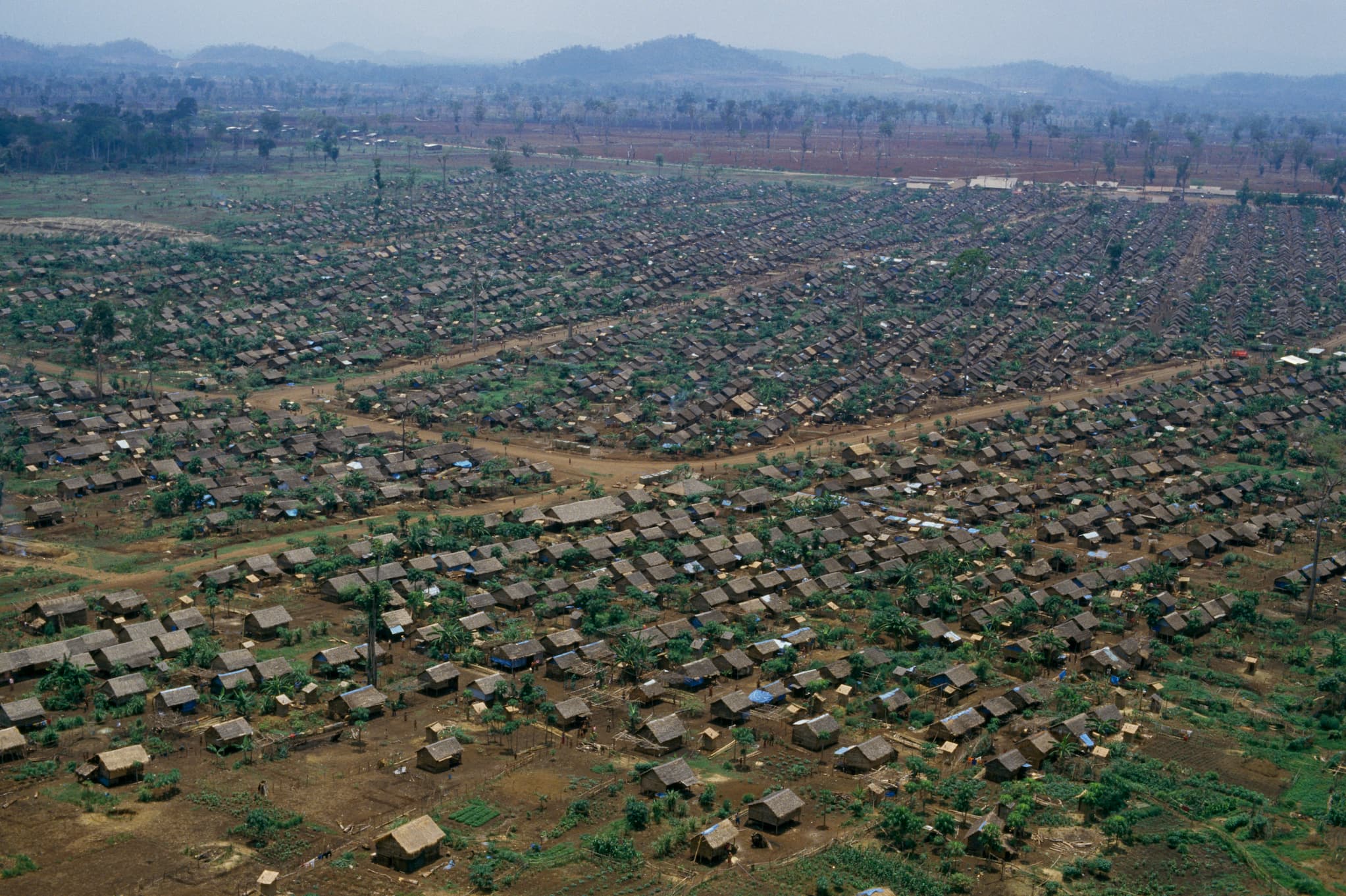
Image 08.04.02 — Khao-I-Dang refugee camp opened in 1979 on the Thailand–Cambodia border after the fall of the Khmer Rouge. At its height, the camp sheltered nearly 140,000 refugees. After closing in 1993, it has since reopened as an educational center.
Operated by the UNHCR and the Thai army, Khao-I-Dang was a semipermanent settlement refugee camp with extensive aid and health agencies, including American aid agencies run by church groups. Surrounded by barbed wire and armed military guards, many refugees were victimized by the Thai soldiers who were supposed to protect them.
Between 1983 and 1985 the US accepted fifty thousand of the half-million Cambodian refugees who fled the border. Immigration and Naturalization Service officers screened applicants at Khao-I-Dang; those approved were sent to processing centers in Indonesia or the Philippines for language and cultural orientation classes.
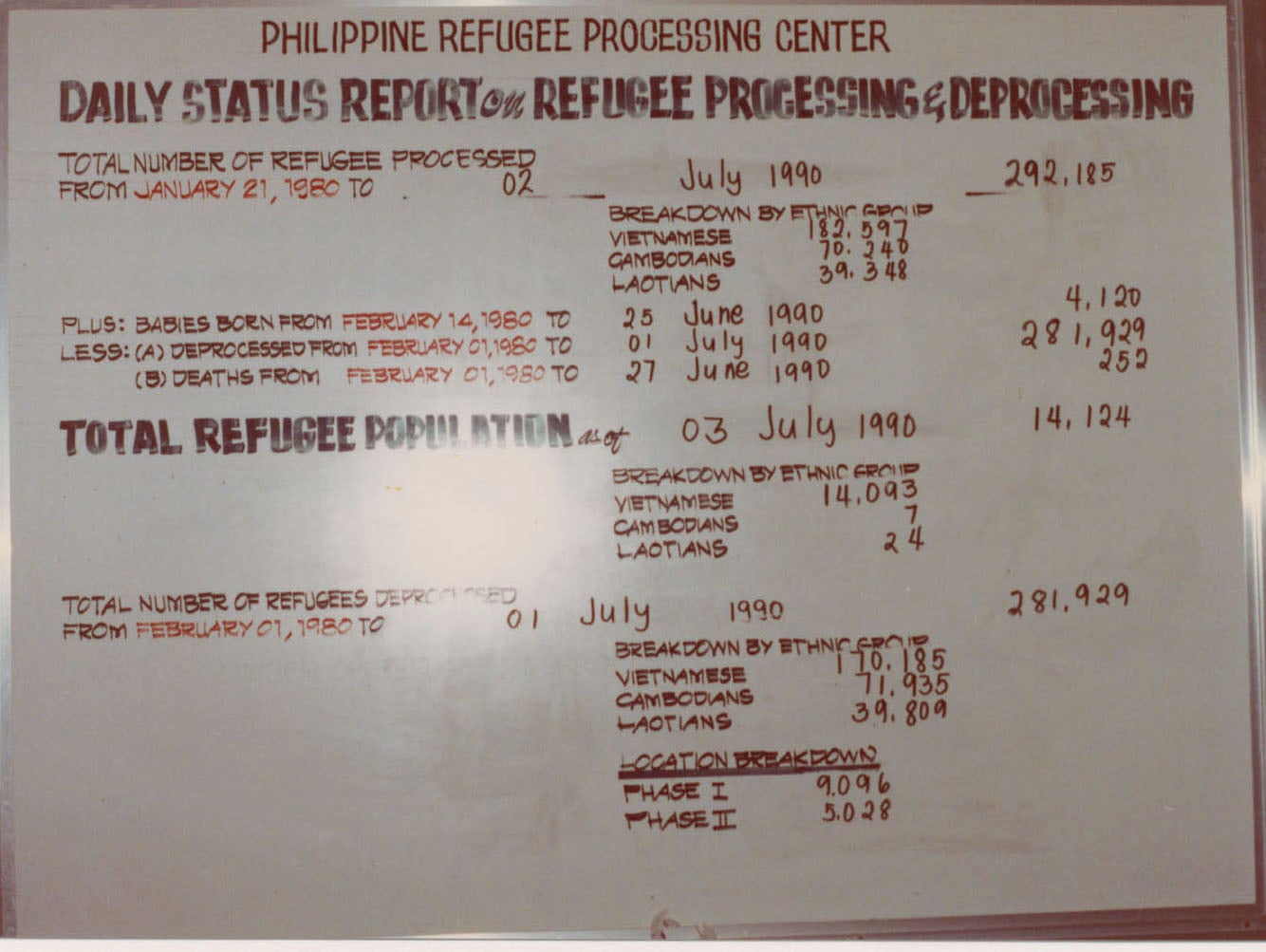
Image 08.04.03 — The Philippine Refugee Processing Center (PRPC) opened in 1980 and prepared Vietnamese, Cambodian, and Laotian refugees for immigration to resettlement nations, primarily the US. The processing center closed in the early 1990s.
Resettlement and the 1980 Refugee Act
On March 17, 1980 President Jimmy Carter signed the Refugee Act into law, arguing that the US had a moral and political obligation to Southeast Asian refugees who faced common persecution by Communist governments that US forces had failed to defeat. The act increased immigration quotas for displaced mainland Southeast Asians, and established an Office of Refugee Resettlement (ORR) to oversee the resettlement process. Between 1975 and 1994, 150,000 Cambodian refugees were resettled in the US, with asylum granted to nearly one million from wars in Vietnam, Cambodia, and Laos.
Cambodian refugees entered the country with an I-94 document that gave them the right to enter, live, and work in the US, and adjusted their legal status from refugees to permanent residents. After a few years they could apply to become citizens. However some refugees arrived in the US without knowing the citizenship process, or given incorrect information from sponsorship groups. Anthropologist Jennifer A. Zelnick quoted an interlocutor named Hoeur as saying:
The church people said don’t worry about citizenship. You don’t need to apply for citizenship. After 10 years, if you did good, then you will [become] a citizen directly. That’s why I didn’t worry about it. 4
The misconception that refugees did not have to apply for citizenship because it would be granted automatically would come to have significant impacts on the lives of many Cambodian Americans.
Southeast Asian refugees arrived in the US amid a shift in domestic policy from collective support to individual responsibility. The Reagan administration vowed to reduce government aid, with public sentiment turning against the “boat people,” and affecting their resettlement and reception.
More to explore
Image
Generational Differences
In the short story “Generational Differences” from his anthology Afterparties: Stories (2021), Anthony Veasna So speaks in the voice of a mother addressing her son. The mother reflects on the first time her son encountered tragedy, when discovery of an old photograph from 1989 triggered memories of a violent event.
Cambodian American Communities
We were the only kids in our neighborhood, basically the only Cambodians in general, to make it as far as Stanford, and my sister was intent on maximizing this potential. She kept the two of us elevated in a stratosphere of legible success, with internships and research opportunities—anything to prevent us from falling to our old lives, to the poverty shackling almost 30 percent of Cambodian Americans, a statistic that she readily cited in her job interviews, making sure to note that it was more than twice the national rate.
– Anthony Veasno So, “Human Development,” Afterparties: Stories 5
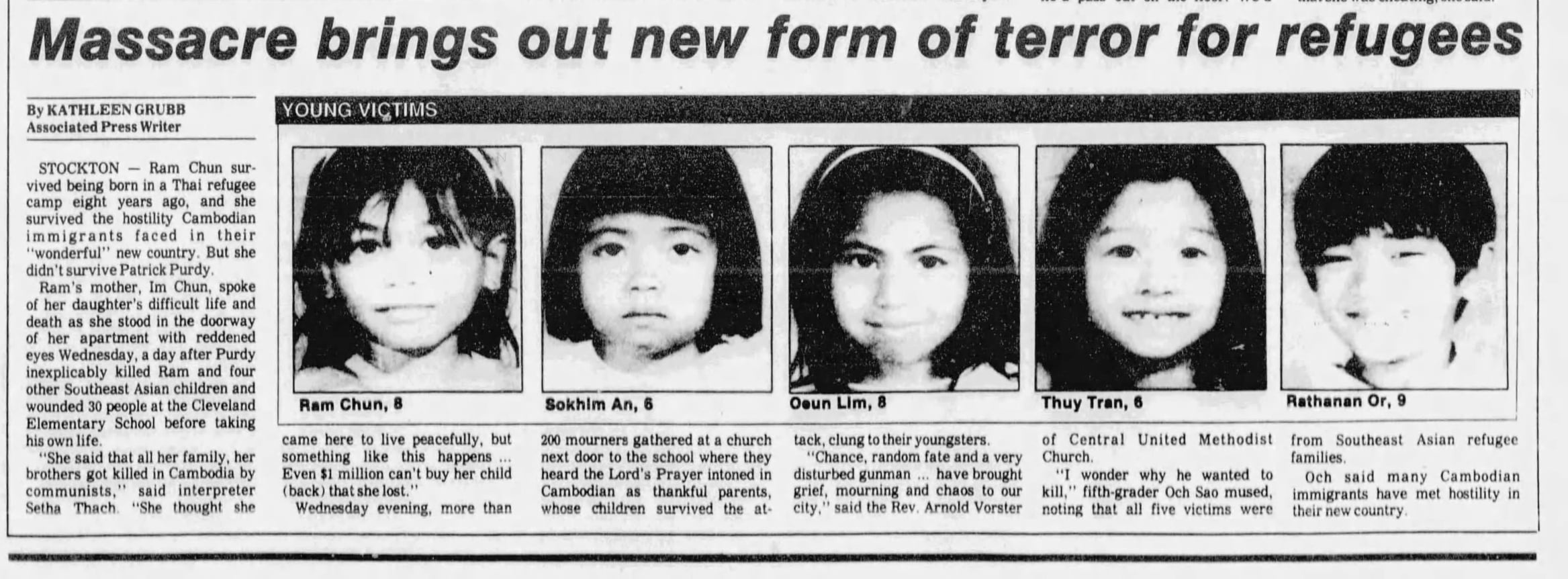
In the 1980s and 1990s record numbers of immigrants arrived in the US, but Cambodians and other Southeast Asian refugees were disproportionately resettled in large numbers in poor urban areas. About 55 percent of Cambodians were resettled in inner cities with high poverty, unemployment, and crime. One study found that about 30 percent of the one million Southeast Asians who were resettled in the US received welfare a decade later.
Among the Cambodians and Laotians on welfare in California, this number reached 77 percent. Many Cambodian refugees worked several jobs, with women often doing low-paid garment piecework. In 2019 approximately 55 percent of Cambodians and Cambodian Americans in the US had no more than a high school education, and 13 percent lived in poverty, with the highest numbers among those under the age of eighteen (18 percent) and those over sixty-five (also 18 percent).
Robust Cambodian American communities grew in Long Beach and Stockton, California; Seattle, Washington; and Lowell, Massachusetts. By 2019, there were approximately 339,000 people of Cambodian descent living in the US. The largest concentration was in Southern California, followed by Boston, Massachusetts; Seattle, Washington; Philadelphia, Pennsylvania; and Stockton, California.
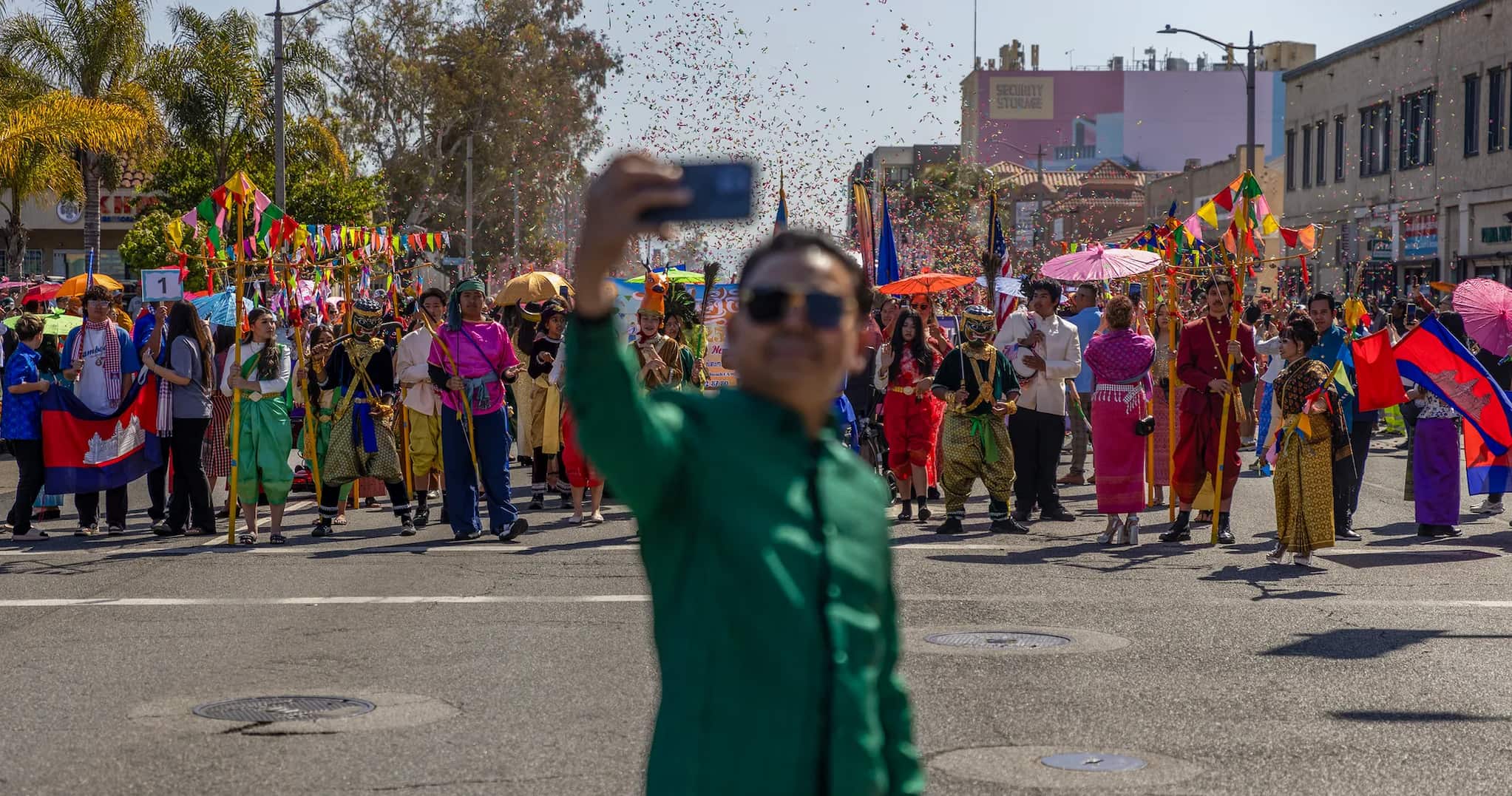
Image 08.04.05a — The start of the seventeenth annual Cambodia Town Parade in Long Beach, California. Long Beach has the largest concentration of residents of Cambodian descent outside of Cambodia.

Despite high poverty and unemployment rates, Cambodian refugees and their descendants have created spaces of community through organizing and extended kinship networks. Cambodian Buddhist temples serve as centers of civic and social life. Khmer belief blends the practice of Theravada Buddhism with earlier spiritual influences, such as animism. Theravada, meaning “the way of the elders,” is one of two main schools of Buddhism—currently estimated to be the faith of about 90 percent of Cambodia. In Stockton, Cambodian refugees founded Wat Dhammaram, home to ninety large statues that depict the story of the Buddha’s life and is the site of the city’s annual Cambodian New Year Festival each April.
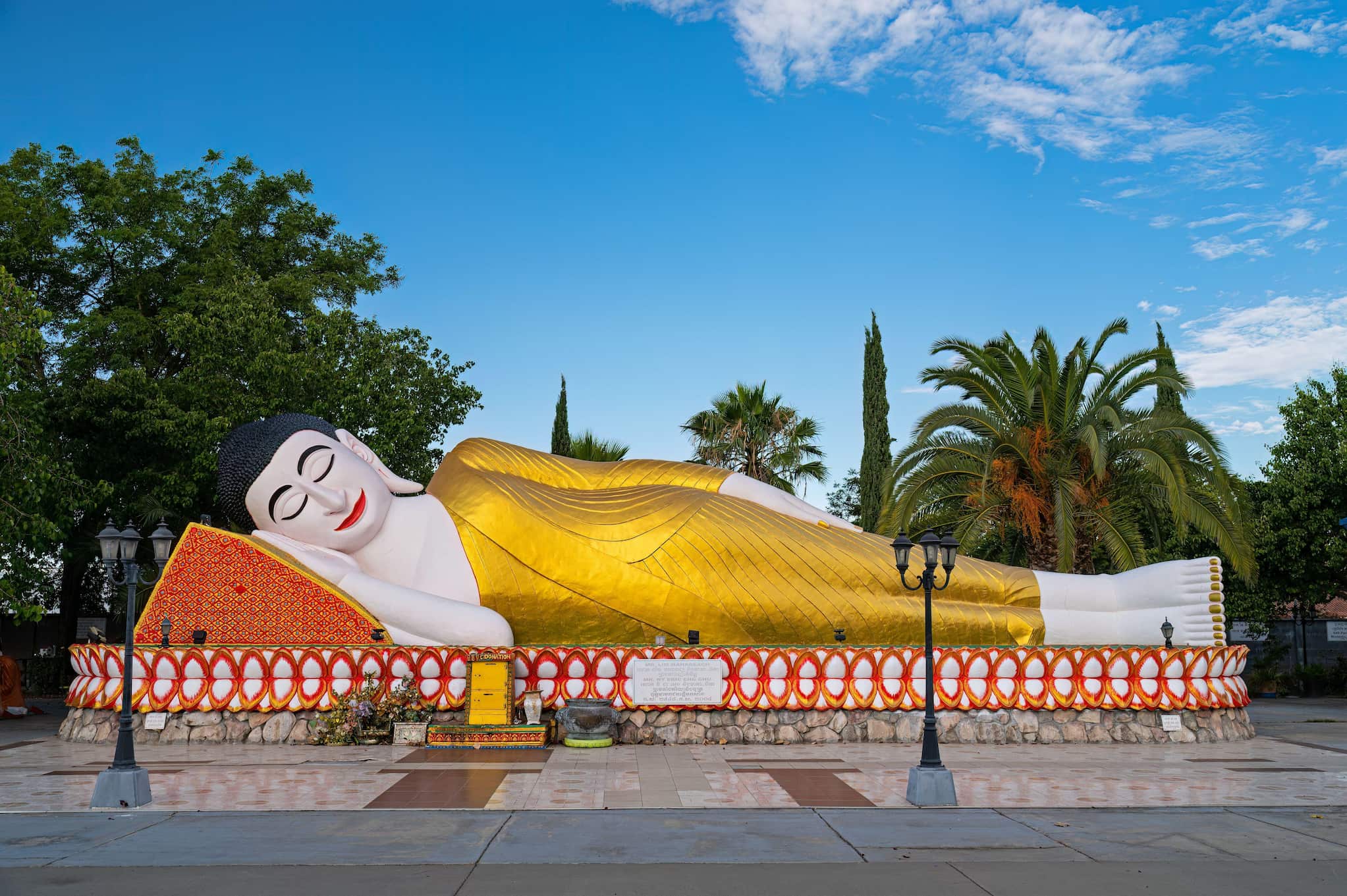
Image 08.04.06 — A sculpture of a fifty-foot reclining Buddha is one of several large statues on the grounds of the Cambodian Buddhist Temple (Wat Dhammararam) in Stockton, California.
Beyond congregating at Buddhist temples, Cambodian communities also engage in informal economic activities, such as selling papaya salad and beef sticks at Stockton’s Angel Cruz Park. They use informal financial networks to start small businesses including autobody or donut shops. Lacking credit history, many Cambodian refugees were unable to secure traditional bank loans and so they pooled their savings in a rotating credit system called “thong thing” in Khmer.
Meeting monthly, these lending circles awarded loans based on various criteria with recipients repaying the group over time. Through such communal practices, Cambodian Americans have adapted to challenging resettlement conditions upon their arrival and built strong diaspora communities since then.
Glossary terms in this module
diaspora Where it’s used
The dispersal, movement, migration, or scattering of a people from their established or ancestral homeland.
displacement Where it’s used
A situation where people are forced to leave their homes or native countries, typically under circumstances such as avoiding armed conflict, violence, or natural disasters.
genocide Where it’s used
A term combining the Greek genos, meaning “race,” and the Latin cīda, meaning “killer” or “act of killing.” It refers to a set of actions taken with intent to produce the destruction in whole or in part of a national, racial, ethnic, or religious group.
Khmer Rouge Where it’s used
Also known as the Communist Party of Kampuchea, the Khmer Rouge party was led by Pol Pot and ruled over Cambodia from 1975 to 1979. During this time, the Khmer Rouge renamed the country Democratic Kampuchea, and enacted a totalitarian regime responsible for the Cambodian Holocaust.
refugee Where it’s used
Someone, or a group of people who have been forced to flee their native country due to war, violence, or persecution, and are unable or not willing to return.
resettlement Where it’s used
The transferring of refugees from an asylum country to another state, where they are ultimately given permanent residence.
transnational Where it’s used
Extending beyond national borders and countries.
Endnotes
1 Monica Sok, “Ode to the Loom,” A Nail the Evening Hangs On (Copper Canyon Press, 2020), 45.
Monica Sok, excerpts from “Ode to the Loom” from A Nail the Evening Hangs On. Copyright © 2020 by Monica Sok. Used with the permission of The Permissions Company, LLC on behalf of Copper Canyon Press, coppercanyonpress.org. All rights reserved.
2 Eric Tang, Unsettled: Cambodian Refugees in the NYC Hyperghetto (Temple University Press, 2015), 46.
3 Y-Dang Troeung, Refugee Lifeworlds: The Aftermath of the Cold War in Cambodia (Temple University Press, 2022): xxi.
4 Jennifer A. Zelnick, ”Suspicious Citizenship, Bureaucratic Coordination, and the Deportation of Cambodian American Refugees,” PoLAR: Political and Legal Anthropology Review 44, no. 2 (2021): 274.
5 Anthony Veasna So, “Human Development,” in Afterparties: Stories (HarperCollins Publishers, 2021), 163.