





Module 1: Introduction: The Many Faces of Empire
Have US wars forced Asian American and Pacific Islander communities to become who they are, or have these communities defined themselves on their own terms?
Empire building is a system in which one nation or authority expands power through control of land, military force, and economic influence over another. Whether this control is direct or indirect control, the imperial apparatus can shape the social conditions and cultural settings where empire building occurs. Michael Hardt and Antonio Negri argue that at the beginning of the twenty-first century, empire took the form of a global, borderless system with no center of power. Understanding the different meanings of empire helps explain how empire building for Asian Americans and Pacific Islanders may be understood as both large-scale global processes and personal, lived experiences across generations.
Indeed, empires and empire building projects continue to shape life for Asian Americans and Pacific Islanders in the United States today, whether in the territories of the Pacific Rim, including Hawaiʻi, Puerto Rico, Guåhan (Guam), and American Sāmoa, or the countless American military bases located in Asia operating under extraterritoriality and SOFA (Status of Forces Agreements). Empire is also evident in the manner in which society has normalized and justified histories of conquest and colonization.
In this module, we explore the development of modern empire and its histories, as well as the specific history of US colonization throughout North America and the Asia Pacific region.
What is an empire?
How did the competition of empires lead to both the conquest of foreign and native lands as well as mass migration?
How is public support for empire building and war generated and what is the impact?
Characteristics of Different Phases of Modern Empire
The word “empire” can feel abstract. Thinking about popular movies such as Star Wars: Episode V – The Empire Strikes Back (1980) or historical references to the Roman Empire may make the term more concrete. Empires have shaped our world in countless ways, from creating trading routes, expanding the variety of goods people could buy and use, and spreading new ideas and religions. The way empires function has also shifted dramatically since the beginning of European colonization in the Americas.
The table below outlines different phases of modern empire:
|
1500–1800 CE |
Age of European exploration and mercantilism: system of colonizing land for financial gain for the imperial country |
|---|---|
|
1800–1898 CE |
American colonization across the North American continent: fueled industrialization, which led to greater conquest out of the need for access to markets, natural resources, and labor |
|
1898–1945 CE |
The implementation of colonial governments in new US colonies |
|
1945–Present |
Living in the legacies of empire, including nuclear testing, the establishment of military bases, and wars, etc. |
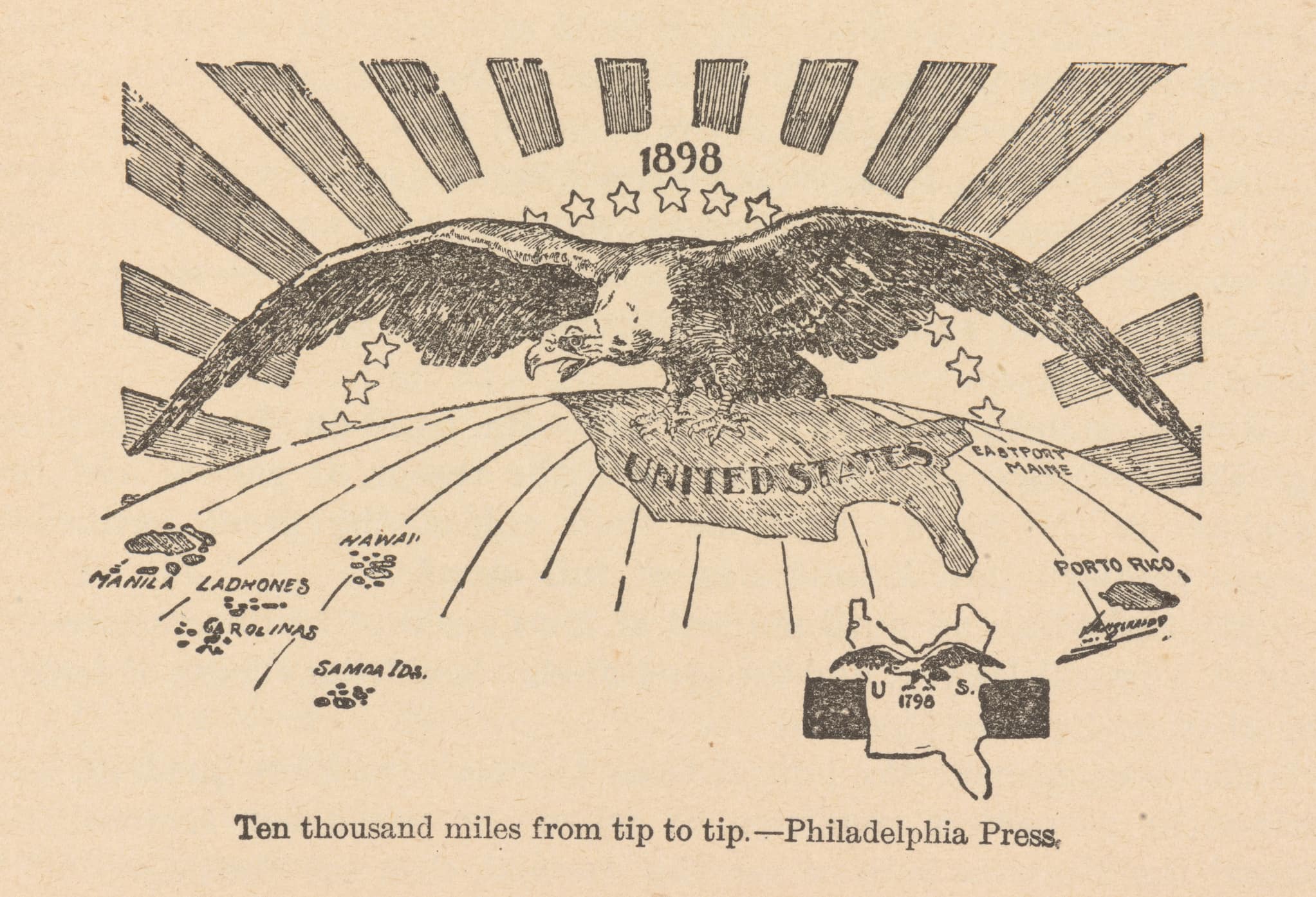
Image 05.01.01 — By juxtaposing the map with the impressive reach of the eagle, the cartoonist gestures towards a central theme in defining empire—territorial expansion.
In order to understand how the US operates as an empire, we can look to the way Indian writer and activist Arundhati Roy understands it. In her book, An Ordinary Person’s Guide to Empire, Roy describes empire as the “obscene accumulation of power [that] greatly [increases] distance between those who make the decisions and those who have to suffer them.” This suggests that empire is not only about expanding territory, but also unequal relations between those in power and those who are governed by their decisions. These power imbalances often shape people’s lives for generations and influence how governments develop over time.
Although the terms are not exactly the same, the workings of an empire involve conquering new lands and officially making them part of the empire—a process known as colonization. Colonizers include administrators and managers of the colony, the military officials and soldiers controlling the colony, and the settlers on the colony. The project incorporates a large range of people including administrators, teachers, public health workers, business people, journalists, and even cartoonists who play a role in managing, policing, and justifying colonization.
Justifications for US Conquest and Colonization
The justifications for becoming an empire lie in roots as deep as the founding of the United States itself. Following the Louisiana Purchase of 1804, the Manifest Destiny ideology helped Americans justify Westward expansion. For believers in Manifest Destiny, expansion was a divine God-given duty to spread “civilization” westward across the continent. This ideology helped the US rationalize their colonization of Indigenous lands that was contested and challenged throughout the early periods of US history.
The Mexican-American War (1846–1848), for example, added vast amounts of territory to the US. Debates over the expansion of slavery into those territories would plunge the nation into violence and, ultimately, the American Civil War (1861–1865). Meanwhile, the Plains Wars were a series of wars against Indigenous nations in the Plains states and Midwest that resulted in the dispossession of land from Indigenous peoples to expand American settlement even farther West.
Imperialists of the nineteenth century repackaged their efforts as “Benevolent Assimilation.” This ideology suggested that the American empire was justified due to its capacity to spread Western civilization to colonized people seen as fundamentally savage, and uncivilized.

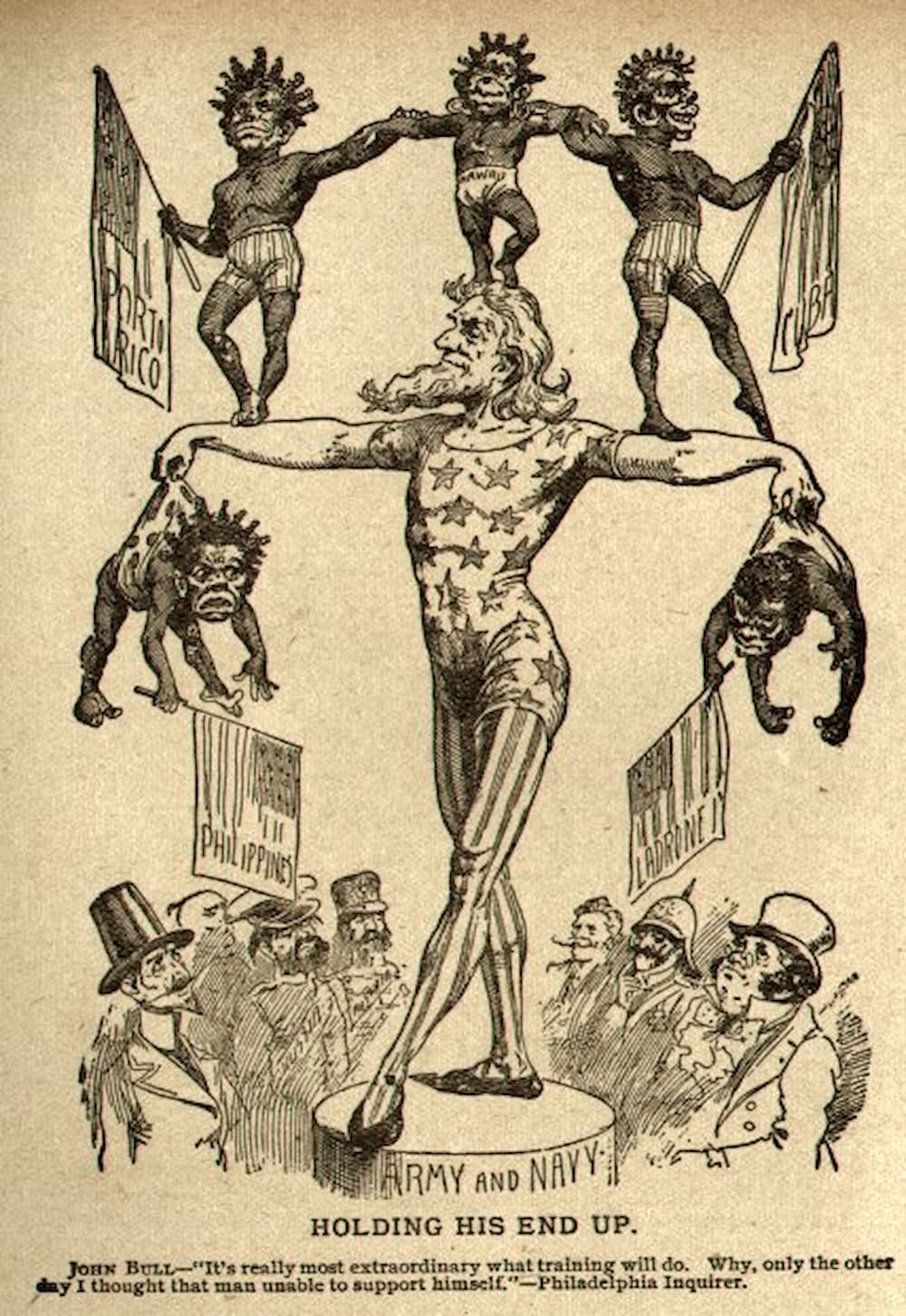
Image 05.01.03 — This cartoon from 1899 illustrates how empire can be defined through unequal relationships between the colonizers and the colonized: Uncle Sam “holds up” barbaric-looking figures representing conquered territories: “Porto” Rico, Cuba, the Philippines, and the Ladrone Islands (Guam).
“We Are Here, Because You Were There”: How Empire Creates Migration
A common refrain when discussing the history of empires is, “We are here, because you were there.” This is in reference to the phenomenon that migration often becomes an unanticipated byproduct of empire building. As the history of Asian Americans and Pacific Islanders demonstrates, labor shortages often pull workers from its colonies, often catalyzing a trans-Pacific migration. Conversely, displaced and dispossessed Asians and Pacific Islanders seek life in the metropole (the colonizing country) after wars, while military exercises and operations deplete the lands, infrastructure, and resources, leaving many in abject poverty.
After the Philippine-American War (1899–1902), for example, Filipinos came to Hawaiʻi to work on plantations, or to the West Coast of the continental US to work as seasonal laborers in canaries, orchards, and other parts of the agricultural industries. The first wave of Korean migration to the US also began around the turn of the century when Christian missionaries and private businessmen helped mediate the sending of some seven thousand laborers in 1903 to Hawaiian sugar plantations.
Fifty years later, the US formally granted the Philippines independence, but showed few signs of relinquishing other colonial territories. If anything, in the context of the Cold War (1945-1991) and the fight against Communism, the US redoubled its presence in Asia, fighting wars in Korea and Southeast Asia. Therefore, migration to the US also became a necessary means of escaping the ravages of those wars. Also almost fifteen years later, the Korean War (1950–1953) was a civil war that resulted in over three million deaths and the country’s division between the Communist North and US-allied South. The fallout from the devastation of war set up the conditions for migration to the US. A second wave of Korean immigrants came to the US, consisting of women married to US soldiers, children orphaned by war, and people fleeing subsequent economic hardships.
In the second half of the twentieth century, the story of refugees from Vietnam, Laos, and Cambodia arrived in record numbers as involuntary migrants forced to flee their home countries in Southeast Asia. After the US withdrew its troops from the region following its devastating loss in the Vietnam War in 1975, this migration was characterized by a diverse outflow of refugees that spanned over twenty years. Some, particularly from Vietnam, had connections to the US military or possessed enough capital to leave immediately after the American withdrawal. Others escaped Communist persecution and forced reeducation or labor camps by pooling resources and setting sail on overloaded and dilapidated boats, hoping to find refuge in the US and elsewhere.
Meanwhile, Cambodia was locked in a vicious genocidal war led by a Communist faction known as the Khmer Rouge. Due to America’s carpet bombing (intense bombing) of Cambodia in their violent attempt to destabilize the North Vietnamese Vietcong (People’s Liberation Armed Forces), the Khmer Rouge gained support from a war-weary Cambodian public. They subjected people to mass torture, famine, and death, carrying out a genocide. The infamous “killing fields” refers to the mass graves in Cambodia where the Khmer Rouge buried victims.
Lastly, the Hmong, an ethnic group who came mainly from Laos, faced violent retaliation from the victorious Communist government, the Pathet Lao (Lao People’s Liberation Army), stemming from their disloyalty by siding with the US during what is known as the Secret War of Laos. By aiding the US Central Intelligence Agency (CIA), the Hmong became targets for mass killing, and their only option was to flee.
Pacific Islanders occupy a unique space in the history of American empire due to conquest and ongoing colonization of their home nations. That is, the two intertwined forces of settler-colonialism and militarization of the Islands and atolls, including as nuclear testing sites, has resulted in a continuous stream of outmigration from the Pacific Rim to the mainland US. Settler-colonialism involves the conquest and occupation of land at the hands of settlers not Indigenous to a space. Militarization is the use of the space to advance the dominance of the colonizing power with the tools of military power. Both require a vast amount of land and resources.
Pacific Islanders, therefore, often face dire circumstances due to the degradation of their own land and forced removal, leaving many dispossessed of their resources. Additionally, when economic or political opportunities favor the settler-colonists or military establishment, Indigenous people must migrate to find avenues for economic sustenance and upward mobility elsewhere—often, again, in the continental US. The presence of large communities of Native Hawaiians, CHamorus, Samoans, and Tongans in places such as Utah and Missouri is a testament to the untenable or unaffordable conditions created in their homelands due to the US empire.
Conclusion
Empire is a system of conquest that takes many forms: the colonization of land, the racialization of its people, the Christianizing through missions, and the justification for the violence and war. The project to build and expand an empire arises from multiple factors, both global and domestic, including desires for economic and geopolitical dominance, as well as cultural ideologies about race.
Glossary terms in this module
Cold War Where it’s used
The Cold War, lasting from the end of World War II in 1945 to the collapse of the Soviet Union in 1991, was a global conflict of ideology and influence between the United States and the Soviet Union, and their allies. Although the two superpowers never fought directly, their rivalry fueled numerous proxy wars—especially in East and Southeast Asia—and shaped global politics, particularly affecting decolonizing nations in Asia.
colonization Where it’s used
The act and process in which an external group or country brings a region and its Indigenous people under its domination and control, subordinating them politically, economically, and culturally.
Communism Where it’s used
Developed by Karl Marx in 1848, Communism is a political economic system and ideology where property and the means of production are owned collectively in a classless society.
empire Where it’s used
A group of countries or regions under the political rule of one single country or person. The ruling country typically exercises power over a territory by using military force, economic pressure, and political control to colonize and govern foreign lands for its own benefit.
Manifest Destiny Where it’s used
The nineteenth century belief that the United States had a divine right and destiny for westward expansion across North America. This belief was used to justify American colonialism and the dispossession of Native Americans and other Indigenous peoples of their lands.
settler-colonialism Where it’s used
A form of colonization in which settlers establish a permanent society on Indigenous land by displacing Indigenous peoples and sovereignties, often through violence, forced removal, and assimilation, and in many cases involving genocidal practices.