





A U.S. soldier searches an Afghan man with raised arms. Another U.S. soldier and a boy stand next to them. Another man on a motorbike awaits his turn.
Module 6: American Wars in the SWANA Region
Have US wars forced Asian American and Pacific Islander communities to become who they are, or have these communities defined themselves on their own terms?
Since the late 1970s, the United States has been increasingly involved in the SWANA (Southwest Asia and North Africa) Region. This involvement has taken the form of military intervention, material aid to prevent Communist and Soviet influence, sanctions on countries that defy US interests, foreign policy intended to secure American access to natural resources, and economic assistance intended to build diplomatic ties with countries the United States sees as strategic allies.
While the specifics vary drastically based on historical and geopolitical context, US foreign policy and military intervention has impacted countries including Afghanistan, Iraq, Iran, Yemen, Somalia, Sudan, Pakistan, Saudi Arabia, Kuwait, Libya, Syria, Palestine, Lebanon, Jordan, and Egypt.
This module dives into the histories of US involvement in Afghanistan and Iraq in order to understand how war becomes a tool of empire building.
What does the American presence in the Southwest Asia and North Africa (SWANA) region since the 1980s reveal about the contemporary relationship between war and empire?
Why is the Gulf War a significant moment for the United States?
How does the United States maintain a global empire without going to war or engaging in traditional forms of colonization?
Soviet-Afghan War
For centuries, many ethnic groups have made the mountains, valleys, and deserts of modern-day Afghanistan their home. While the people of this sprawling mountainous land have a long history of fighting off foreign invasion, its story of contemporary war and Western intervention begins in the 1970s with the Soviet-Afghan War.
In the late 1970s, a power struggle emerged between the Communist government of Afghanistan (Democratic Republic of Afghanistan) and their opposition, the mujahideen. Throughout 1979, the Communist factions of the Afghan government appealed to the Soviet Union for support in fighting off the mujahideen. In December 1979, the Soviet Union sent troops to Afghanistan, fearing for the stability of the Communist government. The war that ensued lasted for nine years and warped the question of Afghan self-determination into a struggle between Soviet and American global power. Just as the Soviets fought against the collapse of Afghanistan’s Communist government, the United States poured its resources into ensuring Afghanistan would fall under the purview of global capitalism and by extension, American global power.
The Soviet-Afghan War is sometimes referred to as the Soviet Vietnam because of the Soviet army’s low morale and its prolonged, ultimately unsuccessful efforts to counter the mujahideen’s guerilla tactics. Even after Soviet troops left, bloodshed continued in Afghanistan. The open wounds left behind in the aftermath of the Soviet-Afghan War led to a civil war in which several mujahideen factions continued to fight for control of Kabul, the capital.
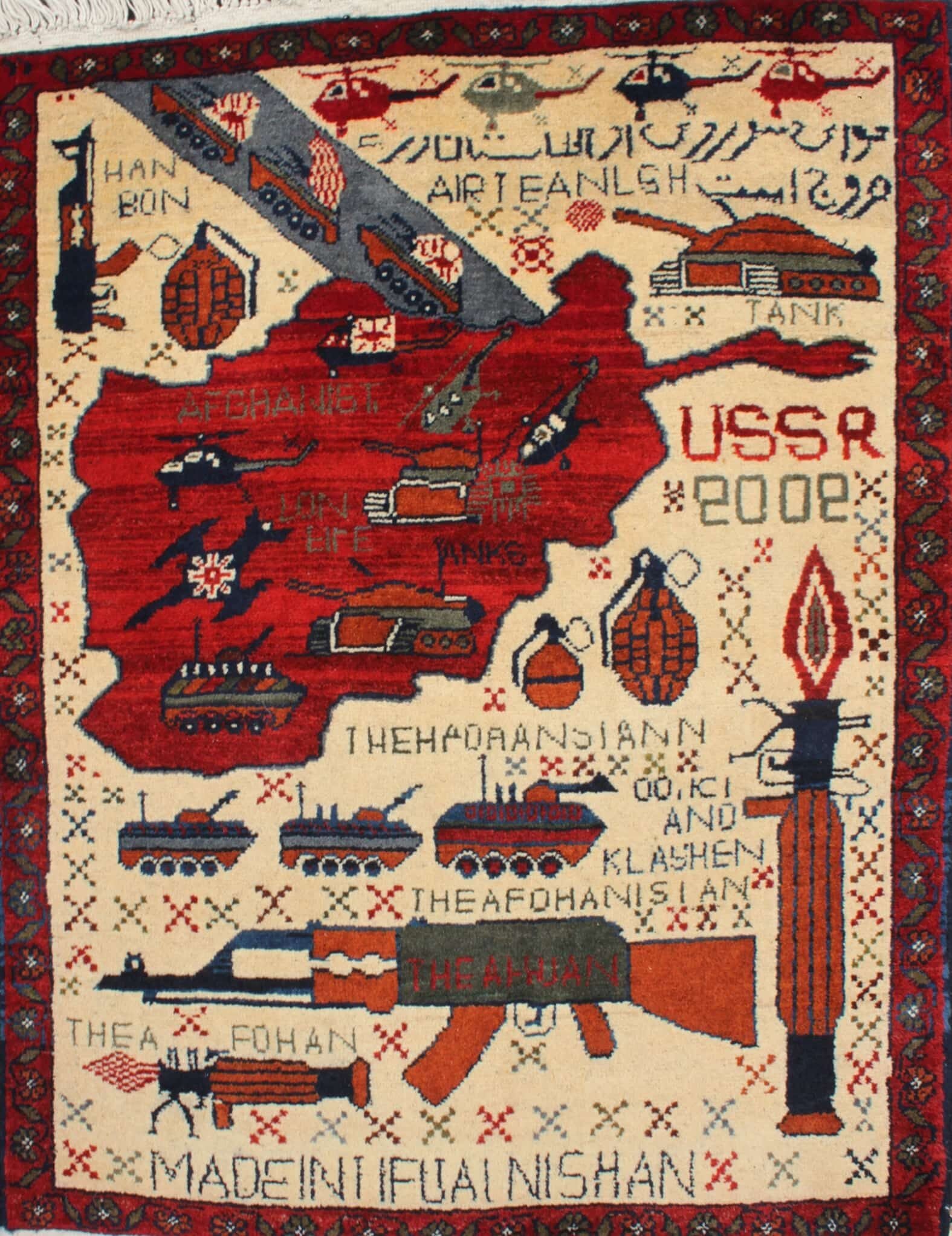
Image 05.06.01 — This rug depicting the exodus of Soviet troops from Afghanistan is an example of a war rug. War rugs have become increasingly popular in Afghanistan since the 1970s as a way for traditional artisans to process the impact of war.
The US arming and financing of mujahideen fighters is perhaps the most enduring legacy of the Soviet-Afghan War and distinctive for its scale. From 1979 to 1992, under a covert operation called Operation Cyclone, the Central Intelligence Agency (CIA) supplied the mujahideen with billions of dollars in aid, as well as state of the art weapons and military training, with support also coming from China, Pakistan, England, and Saudi Arabia.
Since Operation Cyclone was a covert program, most details of the CIA’s activities were withheld from the American public with limited public scrutiny. Pouring money and supplies into the mujahideen led to the eventual collapse of the Soviet-backed Democratic Republic of Afghanistan in 1992, and ultimately helped end the viability of a Communist government there.
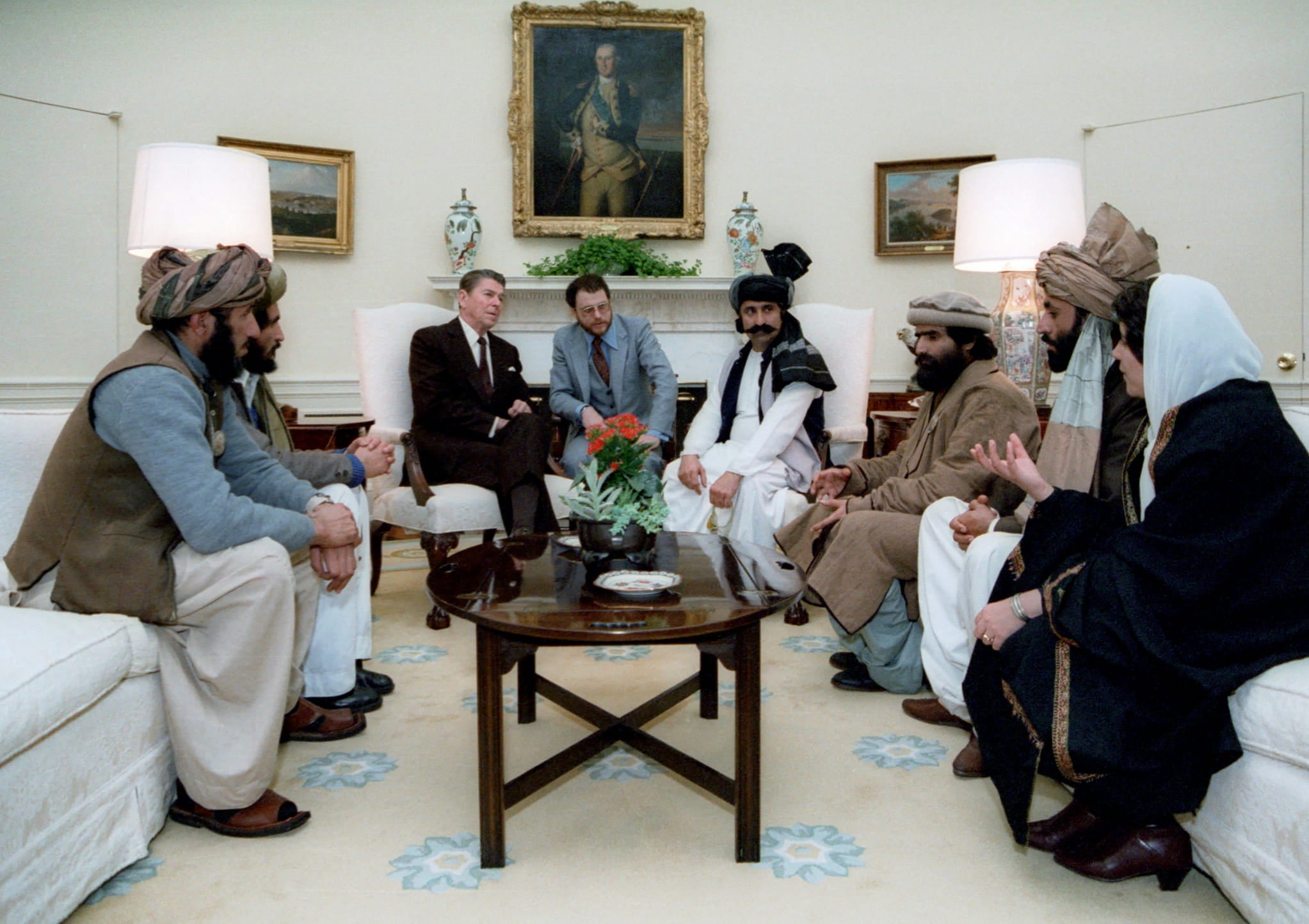
Image 05.06.02 — President Ronald Reagan (third from left) meeting with mujahideen in the Oval Office in 1983. Under a covert operation called Operation Cyclone, the CIA supplied the mujahideen with billions of dollars in aid, as well as state of the art weapons and military training.
Post-9/11
While many Americans are unfamiliar with Operation Cyclone, its consequences changed our world forever in 2001. Factions of the Afghan mujahideen, armed and trained to fight Communist control, contributed to the rise of the Taliban. Separately but in parallel, al-Qaeda also emerged, becoming the fundamentalist group responsible for the attacks on the United States on September 11, 2001, otherwise known as 9/11.
Osama bin Laden, the man who claimed responsibility for 9/11, left Saudi Arabia to support the mujahideen after the Soviet invasion in 1979. Throughout the 1980s, bin Laden leveraged his wealthy background to fundraise for the mujahideen. In 1988 he helped start al-Qaeda.
In response to the 9/11 attacks, the United States invaded Afghanistan on October 7, 2001, under the name Operation Enduring Freedom to fight the Taliban regime that sheltered al-Qaeda. The irony is that both the Taliban and al-Qaeda had roots in the broader mujahideen era that the US had funded and supported throughout the 1980s and as late as 1992. The war in Afghanistan was part of the larger War on Terror, declared by the US, which lasted from 2001 to 2021. It is widely considered the longest war fought by American troops abroad.
In addition to leaving the people of Afghanistan vulnerable to renewed Taliban authoritarianism after the 2021 troop withdrawal, the history of US intervention in Afghanistan helped create key conditions for the contemporary War on Terror. By funding and arming anti-Soviet mujahideen factions–some that overlapped with groups like the Taliban and al-Qaeda—and later declaring them threats to national security—the United States created a legal framework to detain non-state actors anywhere in the world. Since the War on Terror began in 2001, the United States has launched drone strikes in Pakistan, Somalia, Yemen, Syria, and Sudan, in addition to countries the US is explicitly at war with.
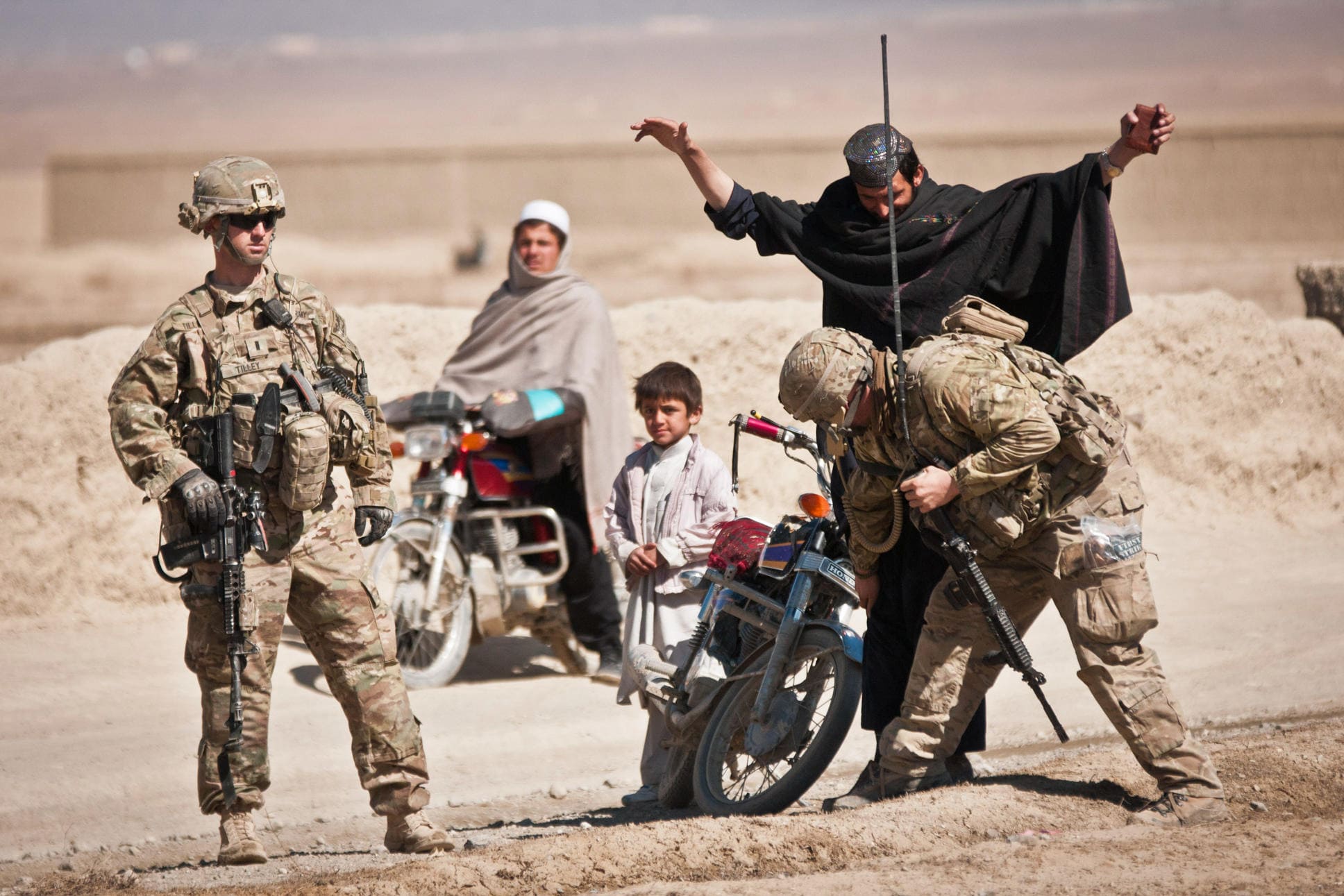
Image 05.06.04 — US and Afghan forces conduct checkpoint operations near COP Yosef Khel in 2012. Officially, the war in Afghanistan that was part of the larger War on Terror lasted from 2001 to 2021. It is considered the longest war fought by American troops abroad.
Iraq
The land and people that make up modern-day Iraq have a centuries-long history, going as far back as ancient Mesopotamia, commonly referred to as the “cradle of civilization.” Like much of the SWANA region, the nation-state of Iraq was forged in the first half of the twentieth century.
Similar to Afghanistan, the history of US intervention in Iraq developed as a foreign policy strategy to ensure favorable conditions for American interests in the region. Shortly after Saddam Hussein succeeded former President Ahmed Hassan al-Bakr in July 1979, Iraq invaded Iran after a long history of tensions and border disputes. The consequent Iran-Iraq War lasted for eight years. Despite mass casualties and damage to both economies, the war was ultimately inconclusive, as a ceasefire brokered by the United Nations stipulated a return to pre-war borders of both nations.
During these eight years, the United States supported Hussein’s government by providing them with economic aid, weapons, technology, and more. The US, along with other countries including China, the Soviet Union, France, and several Arab states, was motivated by a desire to curb Iran’s regional influence. While the US was not explicitly at war through this period of Iraqi history, the geopolitical and economic consequences of the Iran-Iraq war set the conditions for Iraq’s invasion of Kuwait and, consequently, the Gulf War in 1990.
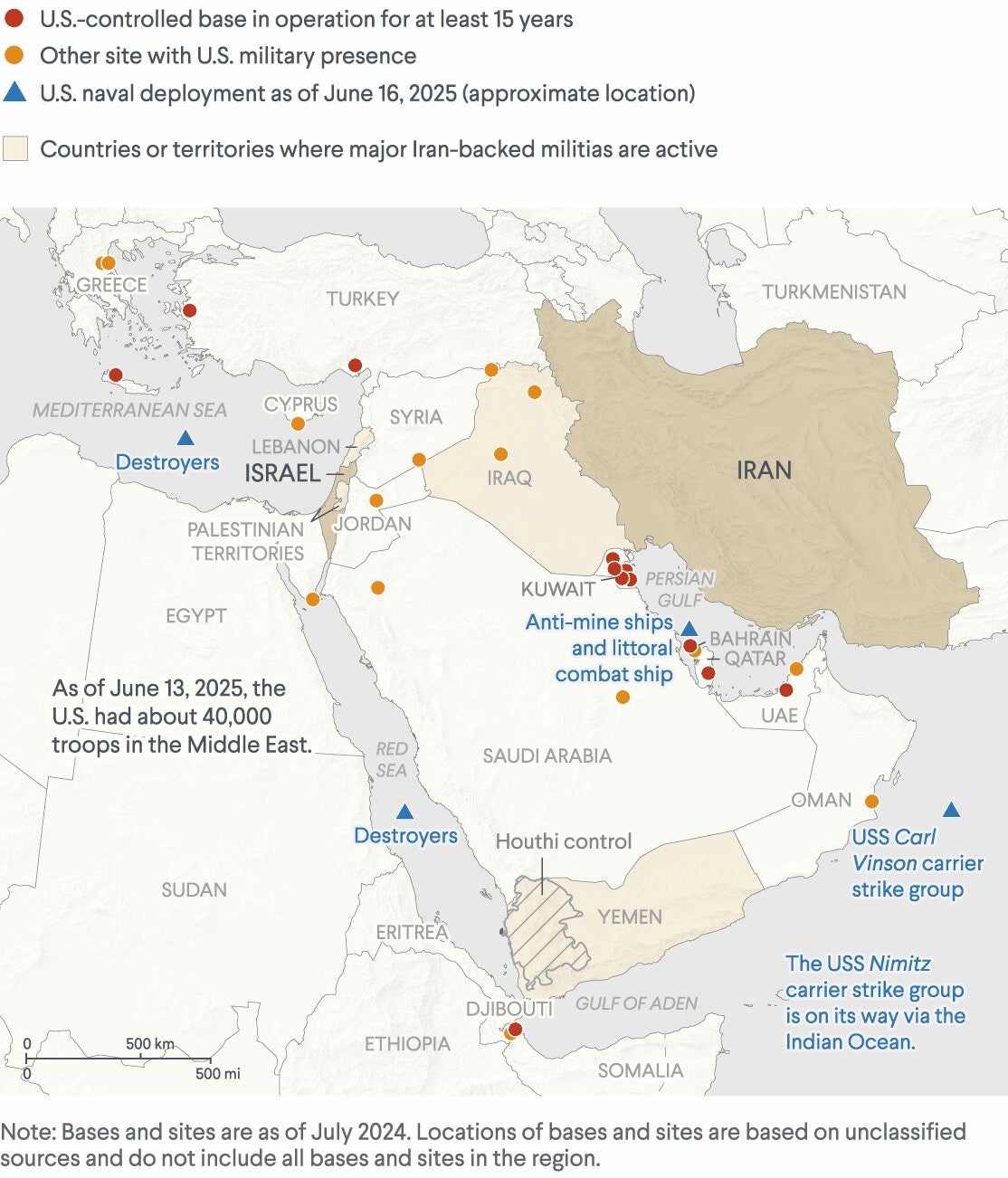
Image 05.06.05 — This map created by the Council on Foreign Relations breaks down US military presence in the Middle East as of 2025. The expansion of this presence is one of the Gulf War’s lasting legacies.
Invasion of Kuwait and the Gulf War
The Iraqi invasion of Kuwait began on August 2, 1990. While the exact reasons are disputed, scholars generally agree that Saddam Hussein’s decision to invade Kuwait was born out of economic desperation, disputes over oil, and territorial ambitions following the devastation of the Iran-Iraq War.
In addition to the estimated fourteen billion dollars in loans that Iraq owed Kuwait, Iraqi leaders saw Kuwait’s growing oil economy as a threat to its own oil-dependent recovery. Additionally, Hussein claimed that Kuwait was rightfully a part of Iraq and had only become a separate state due to earlier British interference.
The invasion was met with global condemnation. The US and the international community issued Iraq with an ultimatum, demanding the withdrawal of all its troops by January 15, 1991. When Iraq refused, the US led a coalition of forces to attack Iraqi forces in Kuwait starting on January 16, 1991.
One of the lasting legacies of the Gulf War is Operation Desert Storm. Officially beginning on January 17, 1991, Desert Storm involved a massive aerial bombing campaign, followed by a ground invasion that only lasted only one hundred hours. Desert Storm marked the beginning of a new normal in US military presence in the SWANA region. The display of advanced US military weaponry marked the evolution of “high tech” warfare.
In addition to using modern technology that allowed coalition forces to fight a short but intense campaign with contemporary warfare tactics, the Gulf War ushered in a new stage in the United States’ relationship with Saudi Arabia, including strengthened diplomatic ties and the stationing of substantial US forces and facilities there. The liberation of Kuwait from Iraqi forces marked a new era in which the United States’ influence in the Gulf and SWANA region became more deeply entrenched and widely recognized.
Invasion of Iraq
In the aftermath of the Gulf War, the US and a number of other countries placed sanctions on Iraq. In addition to preventing it from acquiring new weapons, these sanctions decimated the Iraqi economy. Often, countries are sanctioned for engaging in activities that violate international law and to pressure them to comply. Unfortunately, these sanctions often hit the most vulnerable people in a country the hardest. Throughout the 1990s, Iraq’s economy continued to deteriorate as Saddam Hussein remained in power.
It was in this context of years of destabilization and autocratic rule that the United States led an invasion on Iraq in 2003.
Following the attacks of 9/11 and the invasion of Afghanistan, the Bush administration alleged that Hussein was supporting al-Qaeda, as well as harboring and developing weapons of mass destruction. These claims faced global criticism and were ultimately shown to be unfounded by the 9/11 Commission in 2004. Despite the public outcry against the invasion of Iraq, the US led its allies in a large-scale military invasion, under the name Operation Iraqi Freedom, beginning on March 20, 2003. Hussein’s government collapsed soon after, leaving a power vacuum that led to intense violence, including fighting between Iraq’s Shia majority and Sunni minority.
The unrest led to an expanded American military presence, culminating in the second Gulf War (also called the Iraq War), which lasted until 2011. While the war officially ended, American military presence persists. The tumult left behind by the War on Terror has caused mass displacement and instability, creating space for terrorist groups such as ISIS to grow. Much like with the war in Afghanistan, we are still witnessing the long-term impacts of the invasion of Iraq.
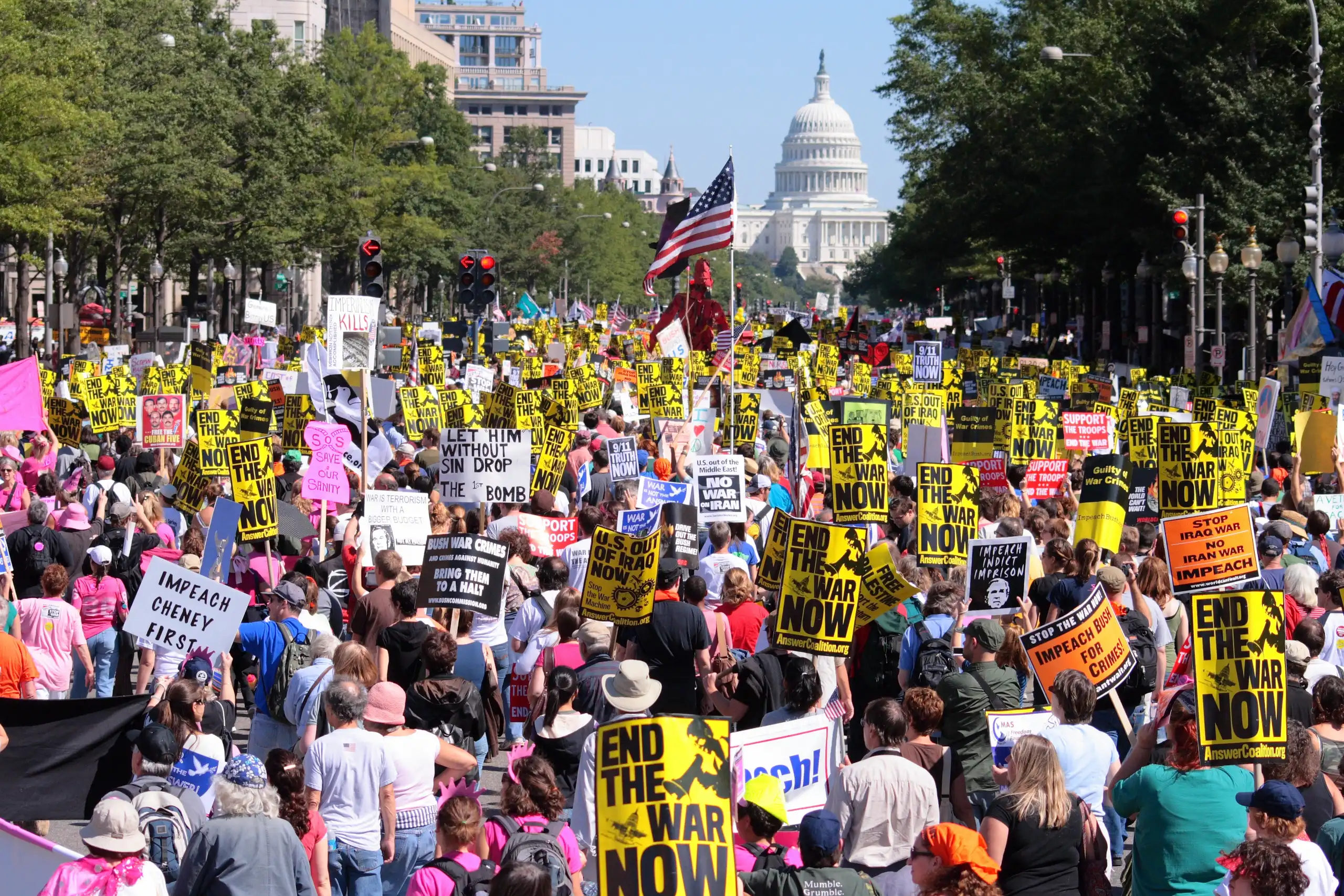
Image 05.06.06 — This image is just one example of the widespread anti-war protests that took place before and during the Invasion of Iraq. The war was met with global criticism.
Expanded Strategy
Since the end of the Cold War in 1991, the US empire has increasingly relied on economic systems of control, rather than older forms of empire building. While this method appears more peaceful, it still comes at a hefty price for those who find themselves on the other side of American priorities. For example, the United States has provided hundreds of billions of dollars in mostly military‑related aid to Israel since its inception, with estimates reaching roughly three hundred billion dollars when adjusted for inflation. This support has significantly underwritten Israel’s military operations since 1948, including actions in Palestine, Lebanon, Syria, and most recently Iran in 2025. Additionally, the US continues to maintain its power in the SWANA region through the strategic placement of military bases. American military bases in Bahrain, Egypt, Iraq, Jordan, Kuwait, Qatar, Saudi Arabia, and the United Arab Emirates, for example, continue to ensure US influence in the region.
Conclusion
From Manifest Destiny to the colonization of the Philippines to the contemporary presence of American military bases in the SWANA region, war has been a central tool of empire building for the United States. While the tactics shift with changing technology and geopolitical priorities, the underlying theme of maintaining dominance over global markets remains constant.
In addition to war being used as an empire-building tool abroad, it also leads to more migration by impacted communities to the United States. For example, the War on Terror led to a sharp increase in the amount of Afghan immigrants in the United States. In turn, these immigrants face surveillance and political repression caused by the same War on Terror that pushed them to leave their homes in the first place.
Understanding the global landscape of American wars is necessary in order to understand how race and migration shift in the United States. Just as anti-Japanese sentiment led to Japanese incarceration during World War II, the increased Islamophobia spurred by 9/11 has led to the policing, surveillance, and political repression of Muslim, Arab, and South Asian communities. In our ever-changing world, the global and local converge through war, empire, and migration.
Glossary terms in this module
capitalism Where it’s used
An economic system where the means of production, such as land, factories, and resources, are privately owned by individuals or corporations with the goal of generating profit, and in which goods and services are produced with labor purchased in exchange for wages. Under capitalism, economic power and wealth tend to concentrate among those who own capital, contributing to persistent social class divisions and inequalities.
Cold War Where it’s used
The Cold War, lasting from the end of World War II in 1945 to the collapse of the Soviet Union in 1991, was a global conflict of ideology and influence between the United States and the Soviet Union, and their allies. Although the two superpowers never fought directly, their rivalry fueled numerous proxy wars—especially in East and Southeast Asia—and shaped global politics, particularly affecting decolonizing nations in Asia.
colonization Where it’s used
The act and process in which an external group or country brings a region and its Indigenous people under its domination and control, subordinating them politically, economically, and culturally.
empire Where it’s used
A group of countries or regions under the political rule of one single country or person. The ruling country typically exercises power over a territory by using military force, economic pressure, and political control to colonize and govern foreign lands for its own benefit.
Manifest Destiny Where it’s used
The nineteenth century belief that the United States had a divine right and destiny for westward expansion across North America. This belief was used to justify American colonialism and the dispossession of Native Americans and other indigenous peoples of their lands.
nation-state Where it’s used
A sovereign country formed with defined borders whose political authority is claimed in the name of a nation, among a population that sees itself as sharing a common identity (for example, through language, culture, history, or ethnicity), even though not all inhabitants necessarily share the same traits. Its formation is often shaped by war, colonialism, and continuous disputes over political territories or national identities.
sanctions Where it’s used
Economic and political penalties enacted on one or more countries to challenge a country’s actions and force a change in behavior. Sanctions include trade embargoes, import/export limits, travel bans, arms embargoes, and expelling diplomats.
9/11 Where it’s used
Commonly refers to the attacks carried out by the al-Qaeda organization in the United States on September 11, 2001, on the World Trade Center in New York City and the Pentagon in Arlington, Virginia. Nearly three thousand were killed, including an estimated 2,600 Americans.