





A group of Vietnamese refugees wade through knee deep sea water. They carry no belongings.
Module 5: Vietnam War
Have US wars forced Asian American and Pacific Islander communities to become who they are, or have these communities defined themselves on their own terms?
We often think of peace as the absence of war, that if powerful countries would reduce their weapons arsenals, we would have peace…To work for peace is to uproot war from ourselves and from the hearts of men and women.
– Thich Nhat Hanh, anti-war activist monk 1
Nowadays, Kim Luu-Ng is a busy woman, many decades and a world apart from the Vietnam War. She runs her own law firm that specializes in immigration and citizenship cases. Her work is dedicated to protecting people from human trafficking or political violence, inspired from her own experience as a refugee in the US. The daughter of a South Vietnamese soldier who faced torture, life after the war became untenable.
Her family weighed the risks and set out on a harrowing journey on the seas that took them from Vietnam to a refugee camp in Hong Kong, to Kentucky, and eventually to Los Angeles, California, where she learned to live with the ghosts of war and create a meaningful life for herself dedicated to public service. Her story is one of countless others of the dislocations caused by foreign policy designed to entrench American influence in Southeast Asia during the Cold War era.
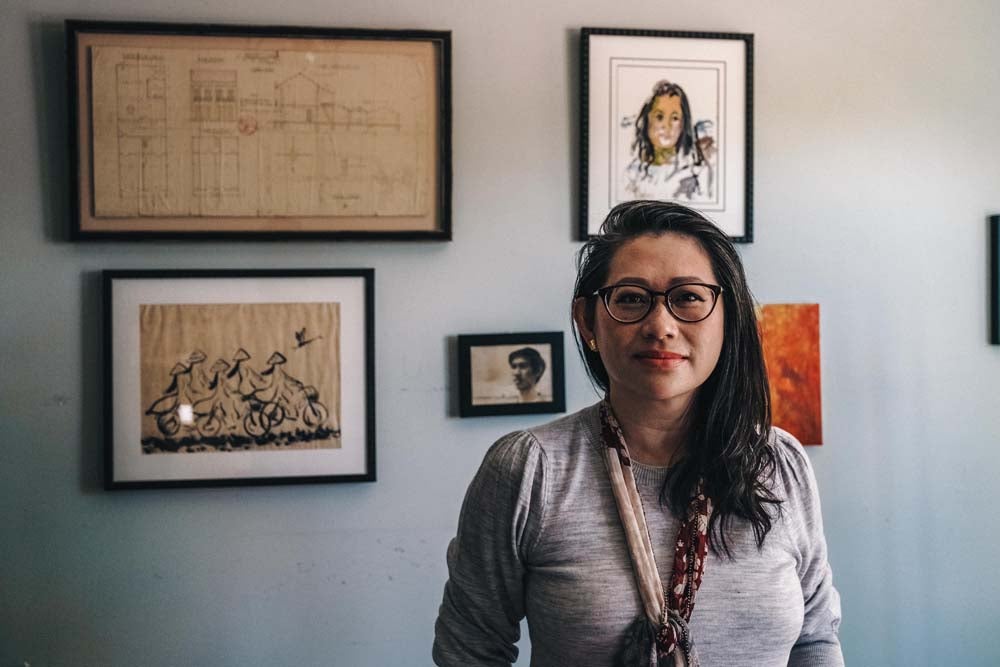
Image 05.05.01 — Now a Los Angeles-based immigration attorney protecting others from human trafficking and political violence, Kim Luu-Ng fled South Vietnam as a young child with her family. Their refugee journey took them from Vietnam to Hong Kong, Kentucky, and, eventually, California.
This module looks at the larger global context of the Vietnam War, as well as its long-term impact on Vietnamese and Cambodian refugees who moved to the United States to escape the violence of war.
How did Cold War geopolitics justify the United States presence in Southeast Asia?
How did America’s wars in Southeast Asia lead to refugee migration?
What did the debates over refugee resettlement reveal about domestic racial politics?
Vietnam, Laos, and Cambodia
World War II hastened and emboldened independence movements in Southeast Asia; efforts by colonized people to break the shackles of colonial rule proliferated. This was the case in the French colony of Indochina that comprised the present-day nations of Vietnam, Laos, and Cambodia. For generations the people of those Southeast Asian nations resisted foreign rule, and by the start of the Cold War, France sought to relinquish their colonies. But the new nations faced a quandary: would they be governed by regimes sympathetic to the US and Western Europe, or to the Soviet Union (USSR)? Or would they pledge their allegiance to a growing “non-aligned-movement” (nations who sought to not align themselves with the US or USSR)?
The “Domino Theory”
In order to ensure American dominance in the Southeast Asian region, US president Dwight D. Eisenhower dispatched military advisors to South Vietnam a year after the Geneva Conference divided the nation into a Communist North and pro-West South. Their actions were guided by the “domino theory”—the belief that if one country falls to Communism, its neighbors would soon follow. This set into motion the United States’ involvement with ongoing civil wars across the former French colonies in Indochina. The US fought a brutal, multipronged war against Communist forces using carpet bombing (wide and intense bombing) and chemical warfare. These actions wrought untold hardship, destruction, and dislocation.
Even after the US withdrew from continental Southeast Asia in 1975, the punitive rule of victorious Communist governments created further suffering. In Cambodia, the Khmer Rouge, a fanatical group of guerilla fighters who sought to restore the country to its agrarian glory, oversaw the mass removal of city dwellers to the countryside and expected them to work in labor camps.
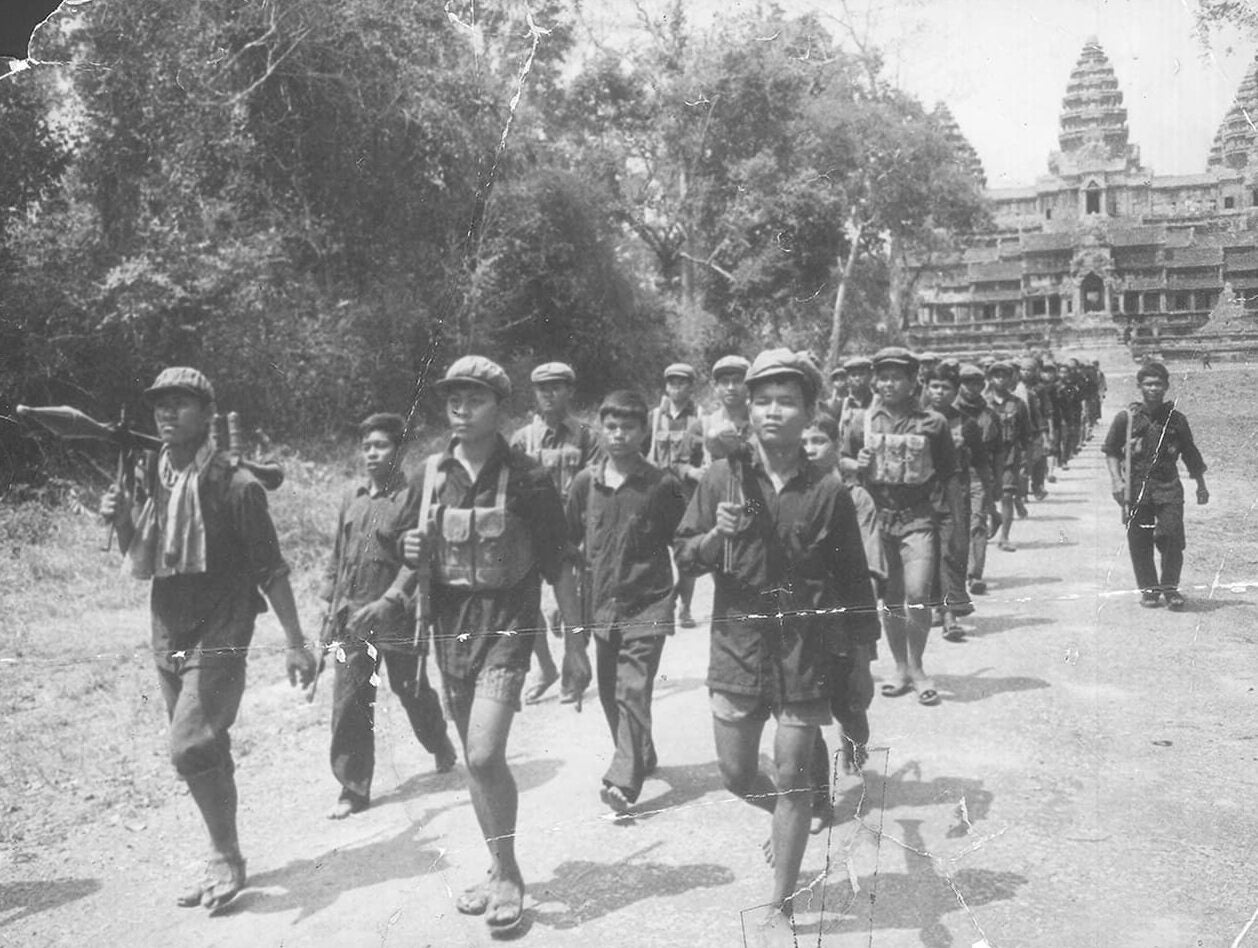
Image 05.05.02 — Khmer Rouge soldiers marching at Angkor Wat. The Communist Party of Kampuchea espoused a radical agrarian nationalist ideology and was responsible for the Cambodian genocide that killed up to two million people between 1975-1979.
The new regime used genocide to enforce their grim hold on the country. Various individuals were targeted including Buddhist monks, intellectuals, anyone considered to possess ties to the West, Cambodians of Chinese descent and, significantly, the Cham people. Descendants of the Champa empire, the Muslim Cham are an ethnic and religious minority in Cambodia whom the Khmer Rouge sought—but failed—to completely eliminate. In neighboring Laos, the new ruling government targeted the Indigenous Hmong peoples for retribution over their support for the United States.
In Vietnam, people with connections to the previous government in the South were forced into “re-education” camps where they endured torture and indoctrination. Taken together, these forces laid the foundation for the next major wave of Asian migration to the United States that took place from the 1970s to the 1990s.
We Are Here Because You Were There
On the other side of the Pacific, Americans debated the fate of Southeast Asian refugees—immigrants involuntarily dislocated due to violence or persecution. Many politicians and everyday Americans recognized the humanitarian responsibility the US bore to assist its allies for whom death and persecution were almost inevitable. Some recognized that the origins of the refugee crisis lay in America’s own interests in Southeast Asia a generation earlier. Others felt that welcoming and resettling refugees could bolster America’s image as a benevolent country on the global stage during the Cold War.
However, critics of resettlement–the process of refugees given permanent residence in an asylum country–argued that refugees would drain the country’s social services and imperil an economy that was already fragile due to a period of stagflation (inflation, slow economic growth, and high unemployment rates). Reflective of longtime nativist rhetoric, some critics held that refugees would not assimilate into the fabric of society and bring crime to America’s cities instead. Others saw refugees as embodied reminders of America’s inglorious loss in Vietnam and wanted nothing to do with them.
Restless Seas, Uneasy Resettlement
The first wave of this immigration from Southeast Asia was largely composed of individuals who, during the immediate withdrawal of US armed forces from Vietnam, secured passage due to their connections to the US military, the South Vietnamese government, or other sources of wealth. Chinese Vietnamese, who historically comprised the business-owning class and thus conflicted with the new Communist regime, were also a part of this wave.
Subsequent waves of refugees who came to the US during the 1980s and 1990s were far more diverse in terms of their ethnic and economic backgrounds. Often maligned as the “boat people,” this cohort of refugees traversed the seas of Southeast Asia hoping to land in refugee camps in places such as the Philippines or Thailand, and eventually find a new home in Europe, Australia, or the United States.
Eventually, the US federal government, sometimes acting with global agencies like the United Nations or local non-profit organizations, crafted an architecture of refugee resettlement. Ultimately, resettlement policy reflected competing views of humanitarianism and xenophobia. The government aimed to disperse refugees across the United States in areas with few to no existing Asian American, let alone Southeast Asian, communities.
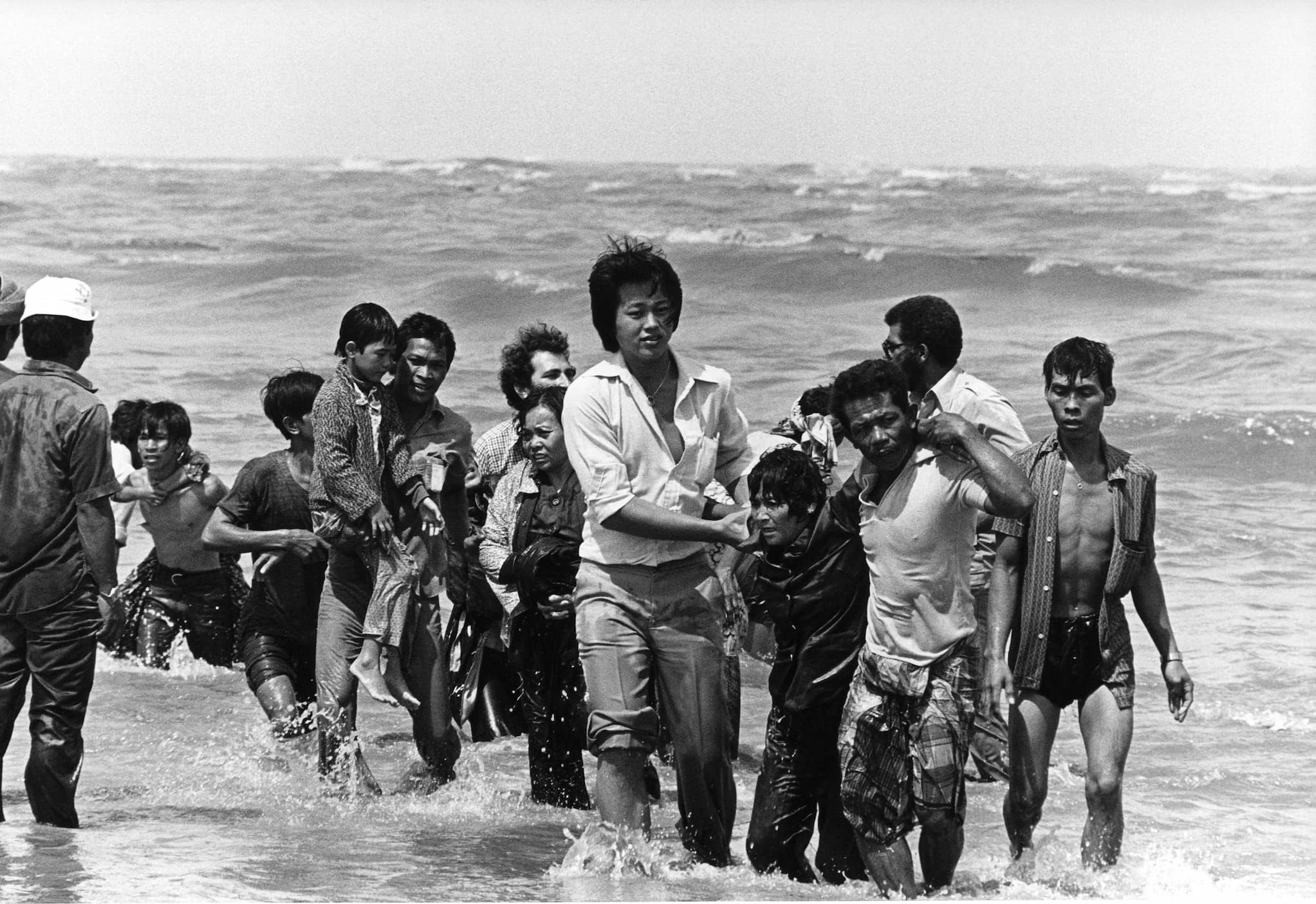
Image 05.05.03a — In the years following the Fall of Saigon, many refugees left Vietnam in unseaworthy and overcrowded boats. This image shows a group of refugees arriving in Malaysia in December 1978 after their boat sank meters from shore.

Image 05.05.03b — This political cartoon from The St. Louis Post-Dispatch (c. 1964) demonstrates a simplistic view of Vietnamese refugees. The problematic depiction echoes government and media narratives from this time that perpetuate stereotypes of Vietnamese refugees as a burden to American society.


Kim Luu-Ng’s family is representative of the confluence of these different factors. Her family was able to leave the refugee camp when a Catholic family—working with one of the many religious organizations that sponsored refugee families—facilitated their migration to Louisville, Kentucky, in 1979.
Reclaiming Identities in the History of War and Peace
The US’s refugee relocation plan sought to foster assimilation but often harmed refugee groups that ended up isolated from their communities and lacking support. Refugees were often resettled into urban economically disinvested areas where avenues for upward mobility for its residents of color were already highly restricted. Nevertheless, refugees created communities for themselves and, despite the government’s efforts to scatter them, migrated internally to join family and co-ethnics and formed diverse communities in places such as Orange County or Long Beach in Southern California. Not necessarily wanting to convert to Catholicism as their sponsors had hoped, Luu-Ng’s family took another risk when they boarded a cross-country bus headed for Los Angeles, California, in 1982. With the families they met at a Vietnamese Buddhist temple, they were able to put down roots.
Even though refugees built communities and institutions, mainstream news media and scholarly reporting often reduced them to hollow images that focused more on America’s role in the refugee crisis than portraying their actual lived realities. Popular images of women and children spilling out of dilapidated boats or huddled in refugee camps tugged at the heartstrings of many Americans. Similarly, photos of refugees visibly expressing their gratitude for America’s generosity in providing a safe haven resonated deeply. Within a few years, mainstream news publications rushed to portray the children of refugees as a kind of “model minority,” a group that overcame incredible odds to achieve material success in their adopted homeland.
This image of “good” refugees portrayed them as victims of a war waged by fiendish Communists, who were generously rescued by the US government and welcomed by a kind public. This narrative served to excuse America’s role in creating the conditions that caused the refugee crisis in the first place. It did more to promote the belief in the possibility of achieving the American Dream than to accurately explain the lives of the thousands of Southeast Asians who came to the US after the war, and the transgenerational trauma they endured.
Far from experiencing the allure of American benevolence after settling in the US, Luu-Ng recalled how, “My father only fought in a war for one year, but the battle lasted throughout his life.” He was “fiercely anti-Communist,” she remembered, “and was willing to give up his life, as well as the lives of his children, his elderly mother, and my mother for a life without repression, starvation, corruption, and he always said to me that he would rather die than see me and my sister forced to survive and sell our bodies.” Though she was only a small child when she landed on America’s shores, she remarked that “I’ve lived with the consequences and the legacy of that [Vietnam] War.” 2
Members from this wartime diaspora, however, have reclaimed their histories. Artistic expression has been a particularly important space where Southeast Asian Americans have corrected American mainstream images of refugees. Kimsom Kheoum, an activist with the grassroots Cambodian American organization, Khmer Girls in Action (KGA), wrote the following poem:
“Refugee”
I went through hell when I was born
I nearly died five times.
As a toddler I received a third degree burn from
a pot of rice that was cooking
My Cambodian name is Sok Chei.
There are pictures of me topless and in my underwear.
I never had a pleasant look on my face in those pictures.
Soldiers often walked through my birth town.
Gun shots and cries fill the air.
My families were thin, so thin you could see their rib cages.
When we fled we ran a lot.
I don’t think we took any of our things with us.
My family was packed in a truck.
My mom and dad were given many papers to hold on to.
Pictures were taken.
My dad had to hold me a sign with the
ID number assigned to me.
Our fingerprints were taken.
Then we were taken to a place with lots of flies.
That became our new home.
I would like to say I remembered the experience. But I don’t.
My memories are based on pictures, documents and stories my family told me.
I am a refugee. 3
Text 05.05.04
Kheoum’s poem captures the trauma caused by the Khmer Rouge regime, whose ascent was made possible by America’s wars in the region. It attests to the violence that touched the lives of Cambodians, regardless of age, and the feeling of dislocation to a new land where one’s identity was reduced to an identification number. However, as KGA member Tiffany Min points out in her poem, Southeast Asians, especially Southeast Asian women, refuse to be defined by the physical and emotional injuries of the past:
Women
They say women are weak
That they can’t defend themselves That they are wrong
Don’t misunderstand
That we are strong
Strong enough to take care of Ourselves
And big enough to rule our lives
We live in a shadow
But, we don’t hide ourselves
We struggle, we survive 4
Text 05.05.05
For Ysa Le, amplifying the stories of Vietnamese Americans has been her mission in establishing the Vietnamese American Arts and Letters Association (VAALA) in 1991. She says:
Specifically as a Vietnamese American, I think in the aftermath of the [Vietnam] War, the portrayal of Vietnam and Vietnamese people has been narrowed to “the war” by the mainstream media. Many of the artwork created by the mainstream artists would only focus on their own stories, leaving the Vietnamese people in the background with no voices of their own. All this would create [an] urge for community art organizers to present a diversity of stories from our own experience. Our diversity, in turn, would enrich the American experience and history. 5
Conclusion
These collective stories illustrate both the human cost of America’s wars in Southeast Asia and the expression of human agency in grappling with the legacies of dislocation and involuntary migration. The US’ presence in Southeast Asia began as a result of nearly a century of involvement in Asia, emboldened by the domino theory and a desire to stem the tide of Communism. Yet the experiences of the women voiced in this chapter demonstrate how they may be shaped by war but refuse to be defined by it.
Glossary terms in this module
Cold War Where it’s used
The Cold War, lasting from the end of World War II in 1945 to the collapse of the Soviet Union in 1991, was a global conflict of ideology and influence between the United States and the Soviet Union, and their allies. Although the two superpowers never fought directly, their rivalry fueled numerous proxy wars—especially in East and Southeast Asia—and shaped global politics, particularly affecting decolonizing nations in Asia.
Communism Where it’s used
Developed by Karl Marx in 1848, Communism is a political economic system and ideology where property and the means of production are owned collectively in a classless society.
empire Where it’s used
A group of countries or regions under the political rule of one single country or person. The ruling country typically exercises power over a territory by using military force, economic pressure, and political control to colonize and govern foreign lands for its own benefit.
non-aligned movement Where it’s used
Founded in 1961, it formed as an international alliance of mostly developing countries that chose not to formally align with any major power bloc, such as the United States or Soviet Union, particularly during the Cold War. It sought to promote independence, cooperation, peace and equality among nations.
Endnotes
1 Thích Nhất Hạnh, “Looking Deeply,” Living Buddha, Living Christ (Riverhead Books, 1995).
2 Linda Trinh Vo, “‘Defiant Daughters’: The Resilience and Resistance of 1.5-Generation Vietnamese American Women,” in Our Voices, Our Histories: Asian American and Pacific Islander Women, edited by Shirley Hune and Gail M. Nomura (New York University Press, 2020), 209.