





A couple of dock workers lean against a post on the dock. A military ship floats in the background.
Module 5: Case Study: Indonesian Sailors During World War II
To what extent are the histories and memories of colonialism part and parcel of Asian American and Pacific Islander identity?
Serving as a case study for the histories and ideas explored in this chapter, this final module introduces a little-known chapter of Asian American history—the Indonesian sailors who fought to remain in the United States in the late 1940s amid the backdrop of World War II (WWII) and Indonesia’s battle for independence. The story of these sailors, composed of Muslims who were eventually deported after a series of court cases that reached the US Supreme Court, underscores how Indonesian American history needs to be addressed in a US global context, including the political role the US has played on a global stage.
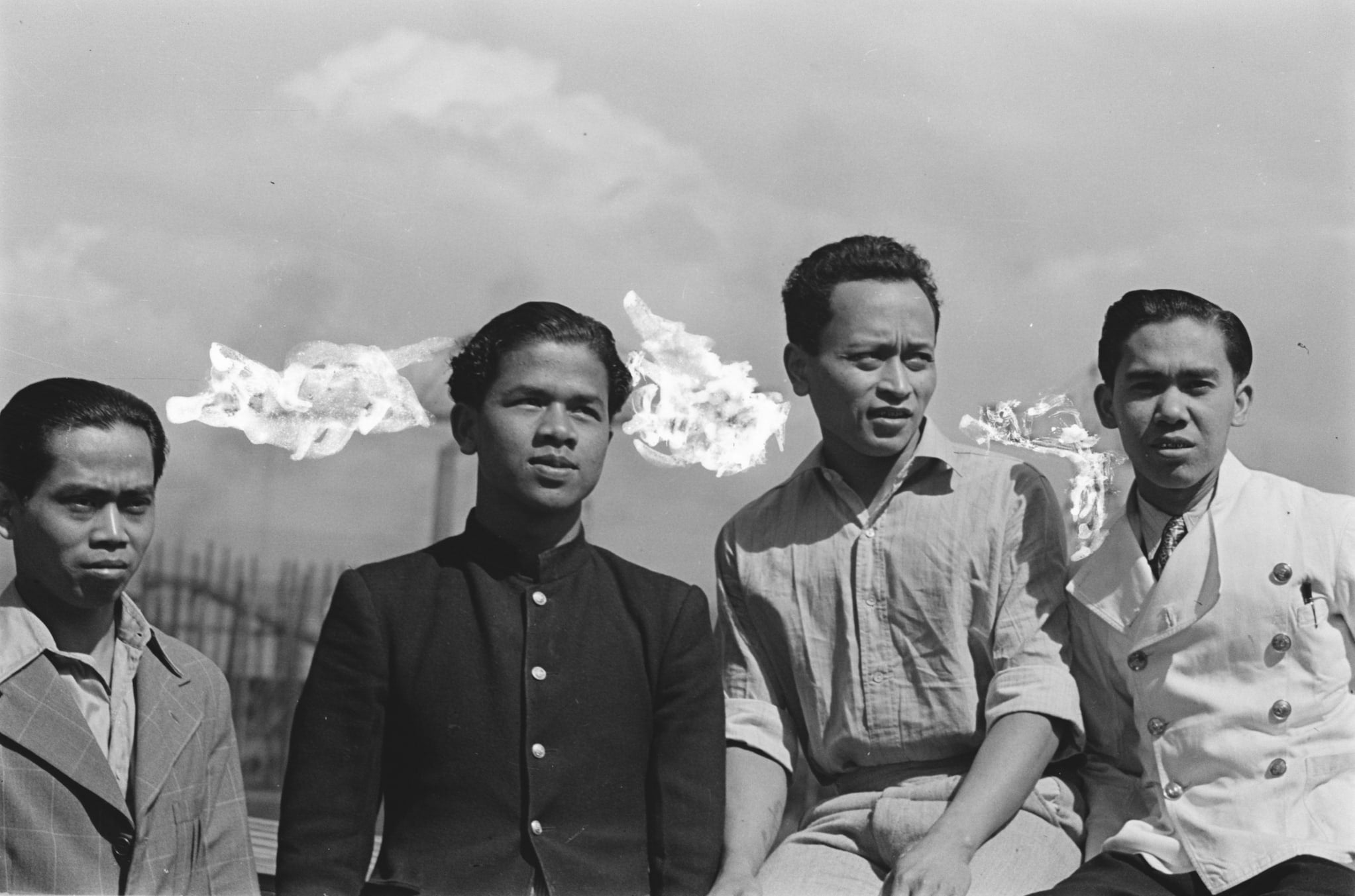
Image 03.05.01a — Indonesian merchant seamen during World War II. Because they are wearing more formal clothing, it is likely that this picture was taken during their leisure time.
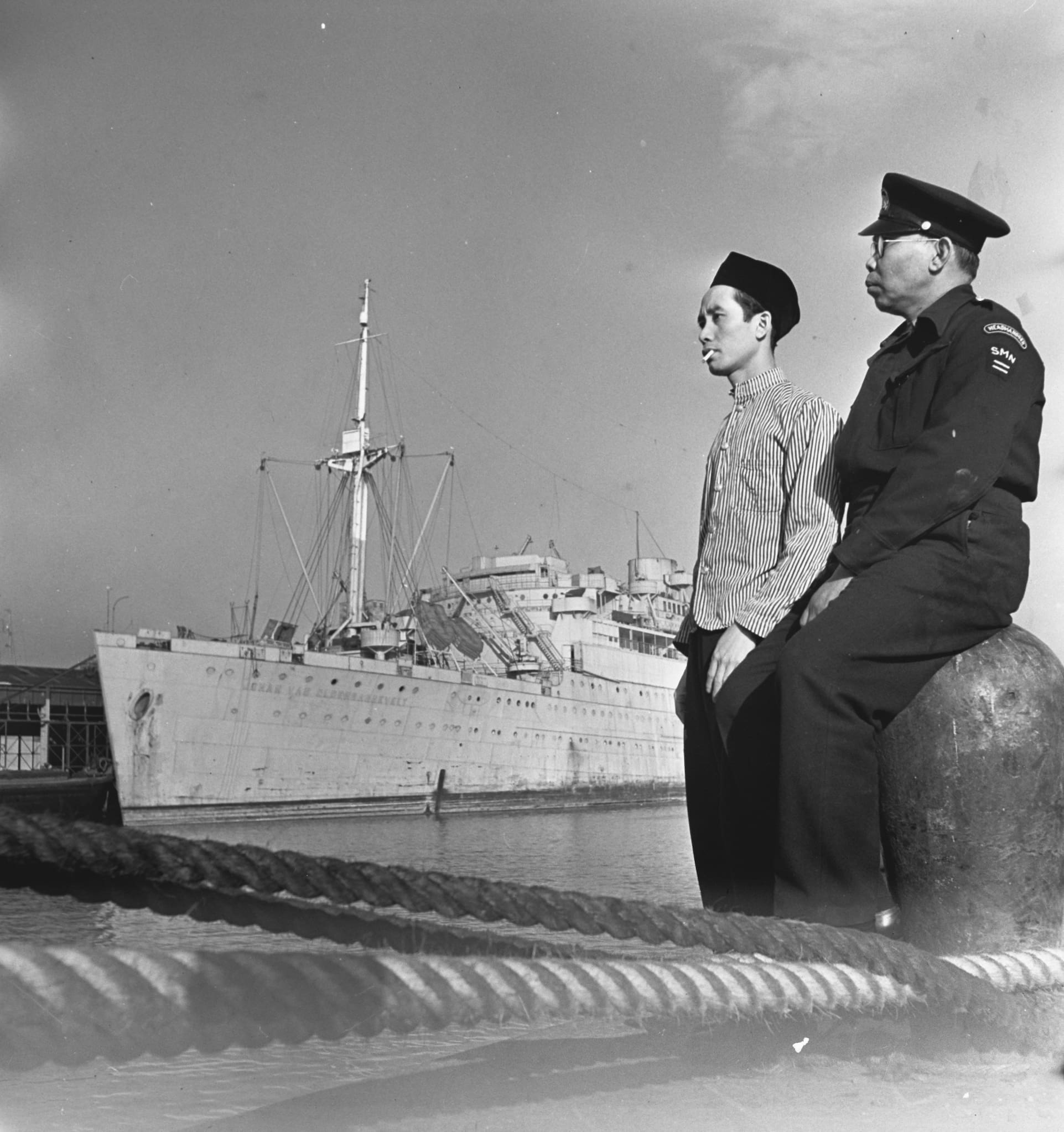
Image 03.05.01b — Two Indonesian maritime workers and the Dutch ship they worked on in the background during World War II.


Coming from the largest archipelago nation in the world, Indonesian maritime workers have historically played a significant role in the country’s economy. A critical part of Indonesian American history formed when Indonesian maritime laborers arrived in the US during WWII, which was also a time when Indonesians were fighting for their independence from the Netherlands. The story of the Indonesian seamen arriving to and petitioning for asylum in the United States in 1945 forms a landmark moment in the history of Indonesians in the US. This module explores their story in order to illustrate how court records and government documentation provide a glimpse into the early history of Indonesian Americans.
Why are maritime workers such an important group of laborers to analyze in order to address Indonesian American history?
Why did these maritime workers protest while laboring on British and Dutch ships during Indonesia’s struggle for independence?
How can the legal battles of these maritime workers be seen as a form of resistance?
Migration and Protest
Beginning in the 1920s, several groups of Indonesian sailors came to the US after abandoning their ships while docked in various ports. The onset of WWII greatly expanded America’s Indonesian population, especially in New York City. During the war years, some four hundred more Indonesians arrived on British or Dutch ships and stayed mainly in seamen’s hostels. Feeling mistreated, they actively protested their condition.
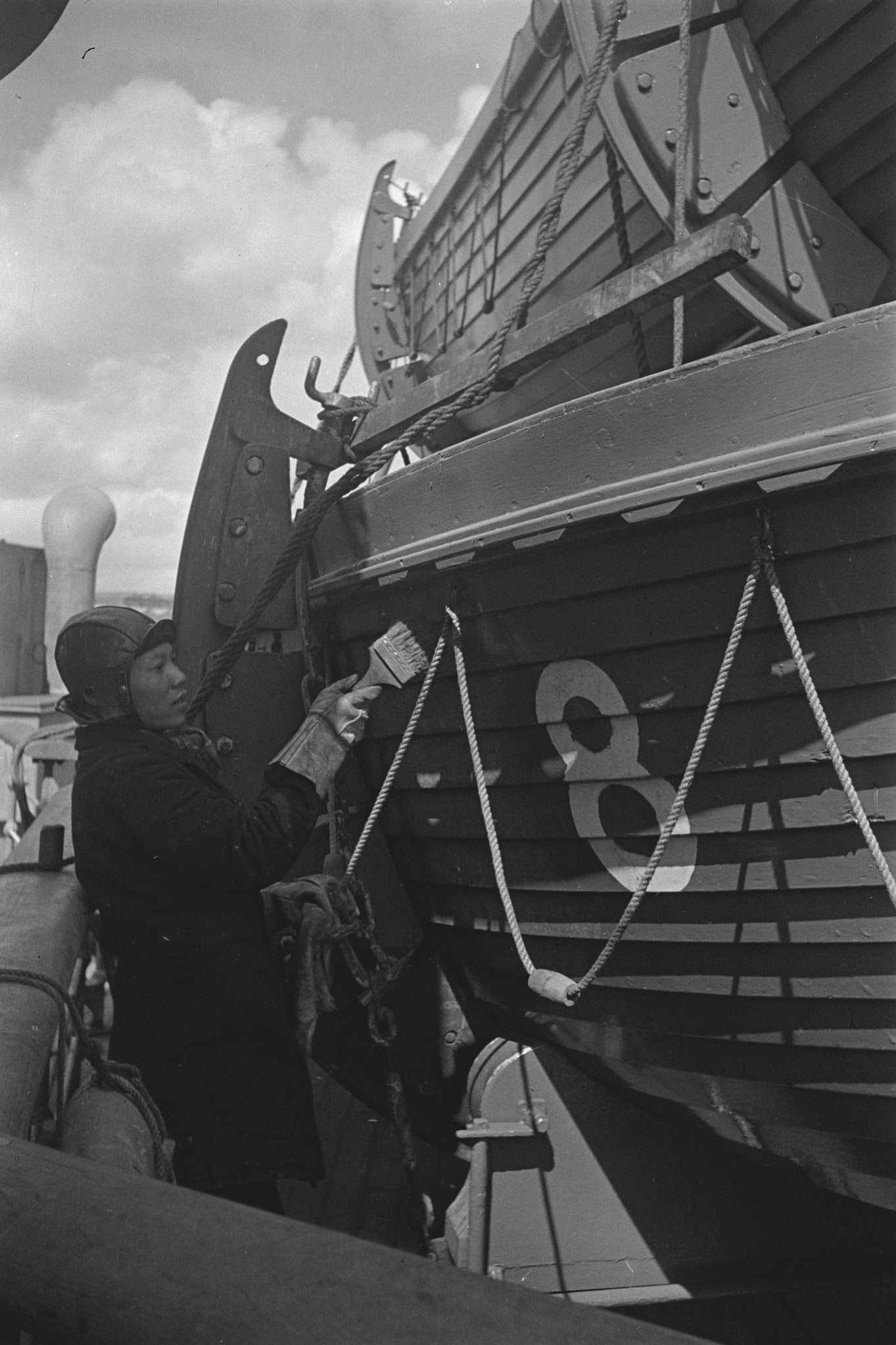
Image 03.05.02 — An Indonesian sailor at work maintaining a ship. These photos represent the importance of Indonesians as workers in the global economy, as well as the value of the maritime industry worldwide.
In 1943, Indonesian seamen in New York City and San Francisco, California, staged walkouts over unequal wages. They claimed that in order to obtain shore leave, Indonesians had been coerced by Dutch shipowners into signing contracts that fixed their base pay at seventeen dollars per month, and that the contracts were drafted in Dutch, a language only a few of the seamen understood. In response to the walkouts, two hundred sailors in New York were incarcerated at Ellis Island, while forty more who walked out in San Francisco were incarcerated at the Sharp Park detention camp, then later deported. To help resolve these conflicts, the Dutch Central Transport Workers Union established a West Coast branch.
Following Indonesia’s declaration of independence on August 17, 1945, Indonesian seamen serving in the Dutch Navy and the merchant marines began jumping ship in ports around the world, notably Australia and India, in protest. Many seamen feared they would be forced to load armaments for Dutch ships going to Indonesia, or be drafted to fight their fellow countrymen. Hundreds more Indonesian sailors landed in the US and sought asylum.
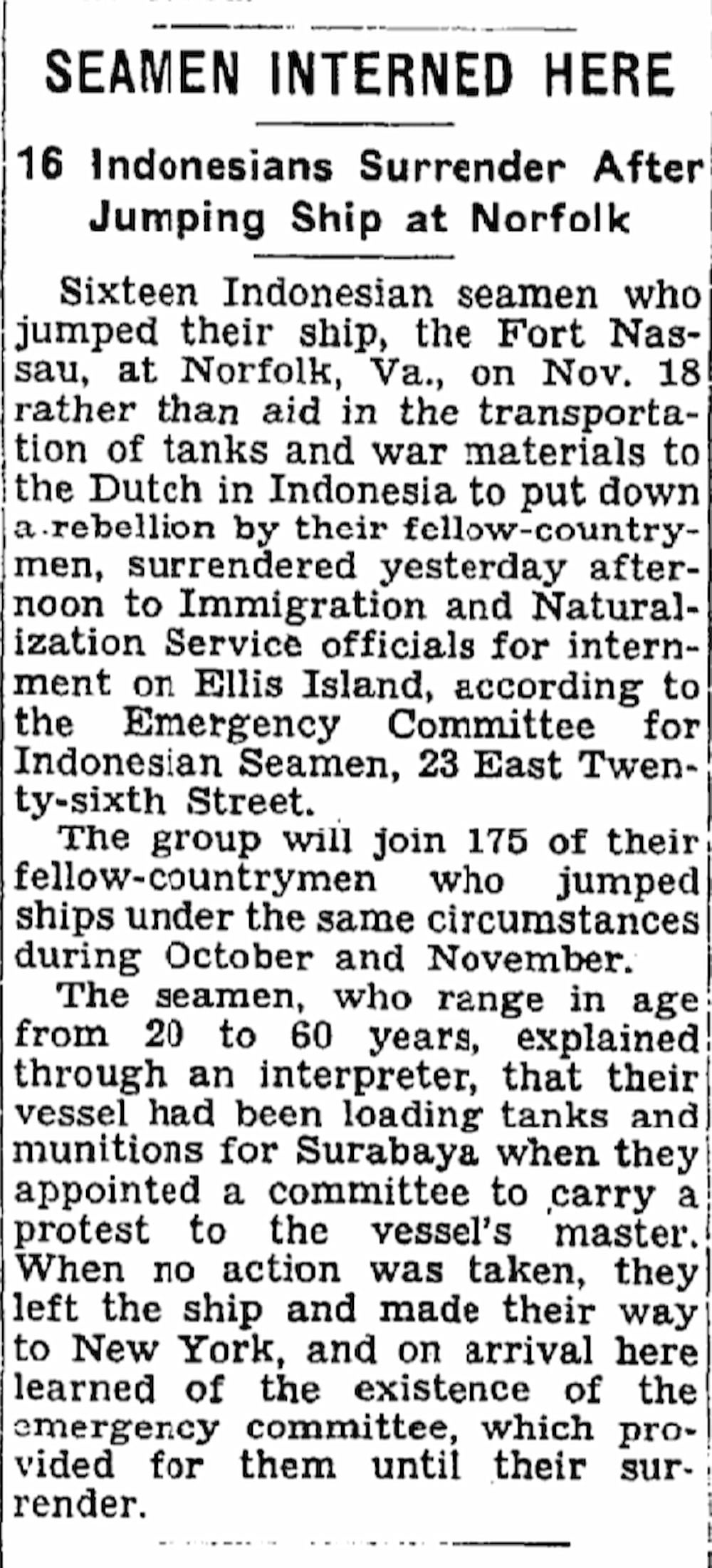
Text 03.05.03 — This New York Times article from December 21, 1945, chronicles the Indonesian maritime workers who refused to work on ships transporting weapons and other armaments to suppress resistance against Dutch colonizers in Indonesia.
On October 19, 1945, ninety seamen walked off five ships in New York. Seamen from four more ships in Albany, New York, and Baltimore, Maryland, soon joined them, bringing the total number to 177. Sixteen more seamen walked off a munitions ship, the Fort Nassau, in Norfolk, Virginia.
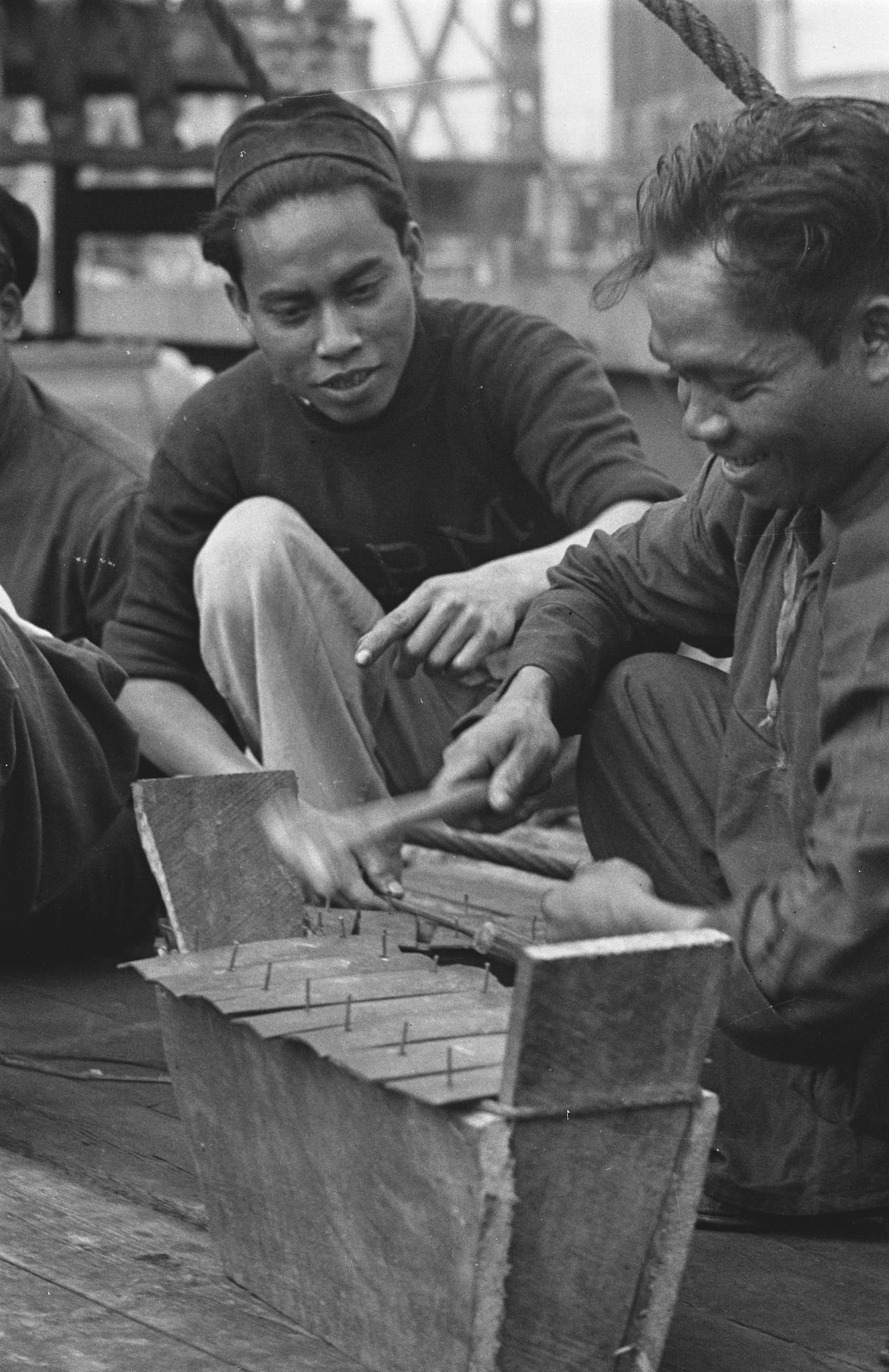
Image 03.05.04 — This gamelan instrument, likely made out of discarded materials from the ship, demonstrates the cultural practices of maritime workers in recreating objects that would remind them of their home in Indonesia.
Community Mobilization
Existing Indonesian communities, especially in New York, mobilized in support of the refugees. Immigrant intellectual Johannes (John) Andu organized the Indonesian League of America (also known as the Indonesian Club of America), which lobbied to aid the seamen. Charles Bidien founded the Indonesian Association of America and began editing a monthly magazine called the Indonesian Review. The two allied groups assisted the refugees, with help from the National Maritime Union, a seamen’s union.
African American union leader Ferdinand Smith found the refugees lodging at the Harlem Salvation Army USO Center, a wartime servicemen’s canteen operated for Black Americans. They helped organize the Emergency Committee for Indonesian Seamen to raise money for them. The committee organized rallies and a letter-writing campaign on behalf of the refugees. Its treasurer was the famed activist Dr. W. E. B. DuBois, who invited Andu to write about Indonesia for the NAACP magazine, The Crisis. Roger Daniels, a teenage journalist at the time, proposed that the Indonesian strikers assemble outside the Dutch consulate at Rockefeller Center and wear traditional costumes during the protest to help generate publicity for their cause.
In December 1945, one hundred more sailors from several Dutch ships docked on the West Coast—the Japara in San Francisco Harbor, and the Manoeran, Tabinta, and Poleau Laut in San Pedro, California—and walked off their ships. They were interned at Terminal Island naval station. Lari Bogk, a representative of the Free Indonesia Committee, urged that the arrested seamen be either released or deported to a port controlled by the Indonesian Republic.
Legal Battles
By the end of 1945, all the refugees surrendered themselves to the US Immigration and Naturalization Service (INS), and were held at Ellis Island in New York City and Terminal Island in Los Angeles, California. Under the prevailing Asian exclusion laws, these refugees had no way to obtain legal residence and had technically broken the law by overstaying the ninety-day period granted to sailors. During the spring of 1946, the US Justice Department moved to deport these seamen—about 220 in total—and ordered them to be transferred to San Francisco and held at Sharp Park for deportation on June 11th. Harold Sawyer, an attorney for the Congress of Industrial Organizations (CIO), a federation of unions, went to court to stop the INS from proceeding with the deportations.
Alongside Sawyer stepped up Leo Gallagher, a lawyer with the left-leaning Civil Rights Congress and the Los Angeles chapter chairman of the American Committee for a Free Indonesia. Sawyer and Gallagher declared that the seamen were political refugees and should be granted asylum. Because the sailors refused to sail on British and Dutch ships carrying arms to suppress the revolt in Indonesia, their attorneys claimed, they faced persecution and potential execution as traitors if deported to Java, which remained under Dutch military control.
In June 1946, the case of Soewapadji v. Wixon was tried in San Francisco before Federal Judge Michael Roche. On June 13, 1946, Roche ruled that the refugees should be deported. Sawyer then appealed to the US Court of Appeals for the 9th Circuit for both the New York and San Francisco detainees.
While their petitions were being considered by the appellate court, immigration officials debated on what to do with both the Indonesians in New York and their counterparts from the West Coast. Officials tried legal maneuvers to expedite deportation, such as securing passage for the sailors, but a dispute with a shipping company ended this option.
Ultimately officials sent the beleaguered sailors for internment at a Justice Department camp in Crystal City, Texas, where Japanese American families were already confined during WWII. Sawyer submitted a petition to keep the sailors in San Francisco, within the jurisdiction of the 9th Circuit Court, however, his petition was rejected and the sailors left on trains from San Francisco for Crystal City on July 26th. Joined by guards and Mexican deportees, they arrived on July 30, 1946.
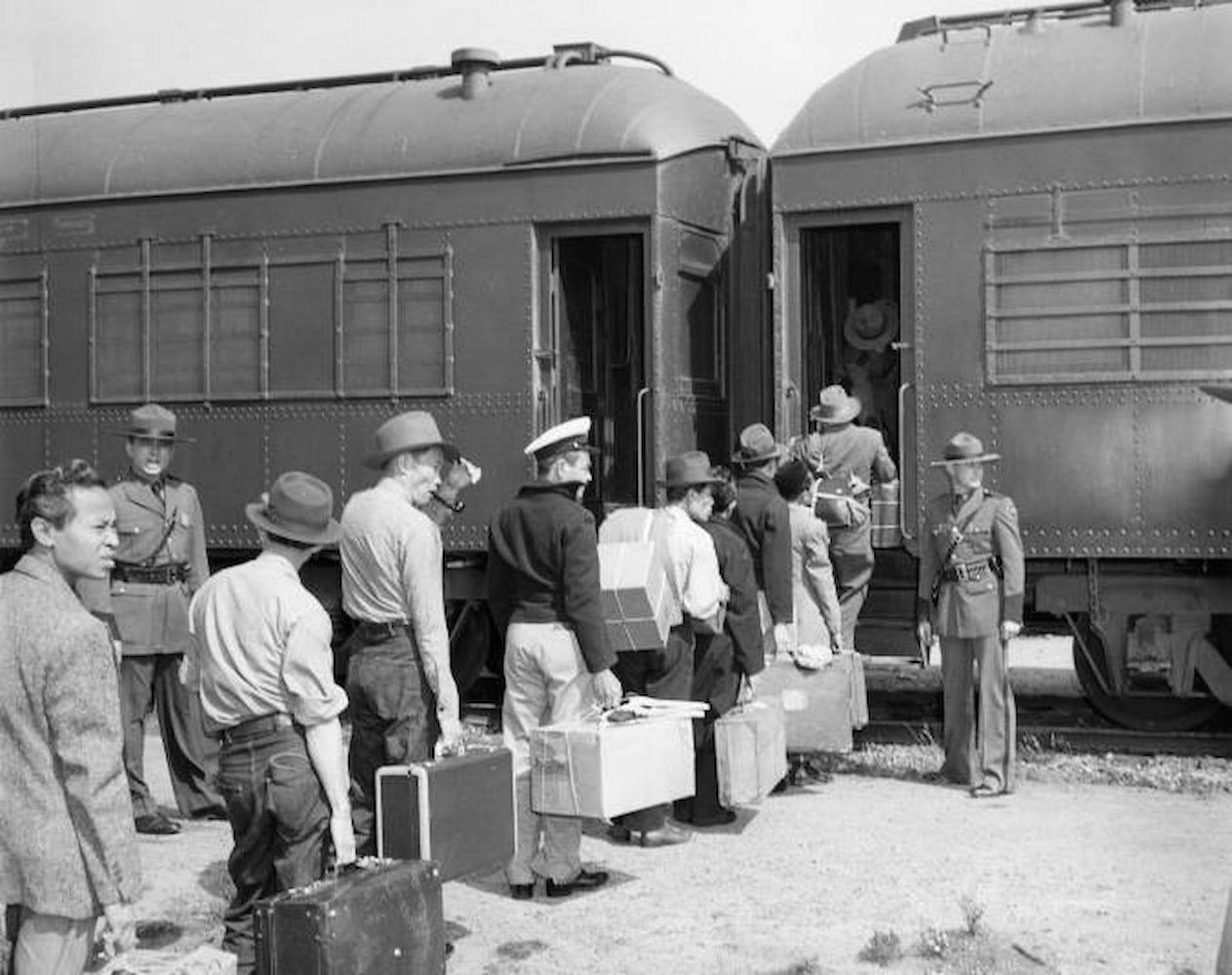
Image 03.05.05 — In this 1947 photograph, Indonesian maritime workers carry their possessions for their train ride to a detention facility in Crystal City, Texas.
During their stay at Crystal City, the Indonesian seamen had very little interaction with Japanese American inmates awaiting repatriation. However, Japanese American activist Edison Uno did recall the presence of the sailors during his time at Crystal City, noting both their standout presence in the camp and aloofness from the other inmates:
[After V-J Day] more than 300 new residents were shipped in…. This was a group of Indonesian sailors that were taken off a Dutch ship that landed in New York…. Only a few could speak sufficient English, so the sailors designated a spokesman for the group in any negotiations with camp authorities or other inmates. These sailors were not allowed to mingle with other groups in the camp. Yet, due to their Muslim religion, diet, and their cultural differences they were quite content to be left alone. Their imprisonment was a solitary one, they had very little recreation or work to keep them occupied. Their only pleasure seemed to be watching American movies, which they could not understand; however, they always enjoyed the westerns and, as I recall, became quite boisterous over typical Hollywood love scenes. 1
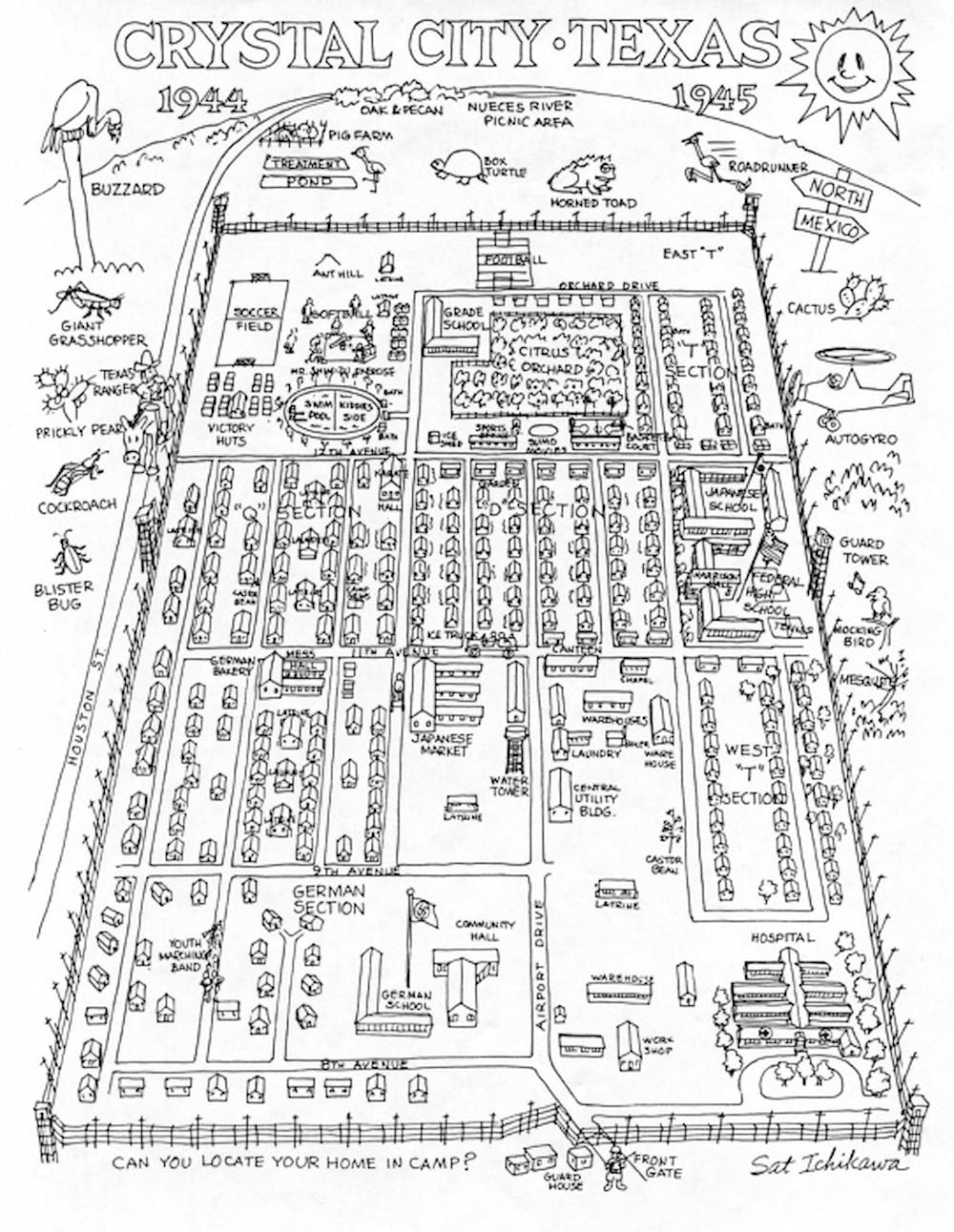
Image 03.05.06 — Indonesian maritime workers were incarcerated alongside Japanese Americans during World War II in Crystal City, Texas, and were ultimately deported to Indonesia. Their important history represents an early chapter of Asian immigrants in the United States, many of whom were likely Muslim.
On September 13, 1946, the 9th Circuit upheld the district court’s deportation order. The CIO lawyers then appealed to the US Supreme Court. They reminded the Court that the United States, like Indonesia, was a republic born out of revolution, and asked the Court either to permit the men to stay in the US, or if deported, to be sent to an area controlled by the forces of the Indonesian Republic and not the Dutch.
Deportation
On December 17, 1946, the US Supreme Court declined to review the seamen’s appeal. On March 7, 1947, two hundred and forty-six Indonesian sailors, fearing for their lives, were shipped off to Indonesia on the ship the Marine Adder.
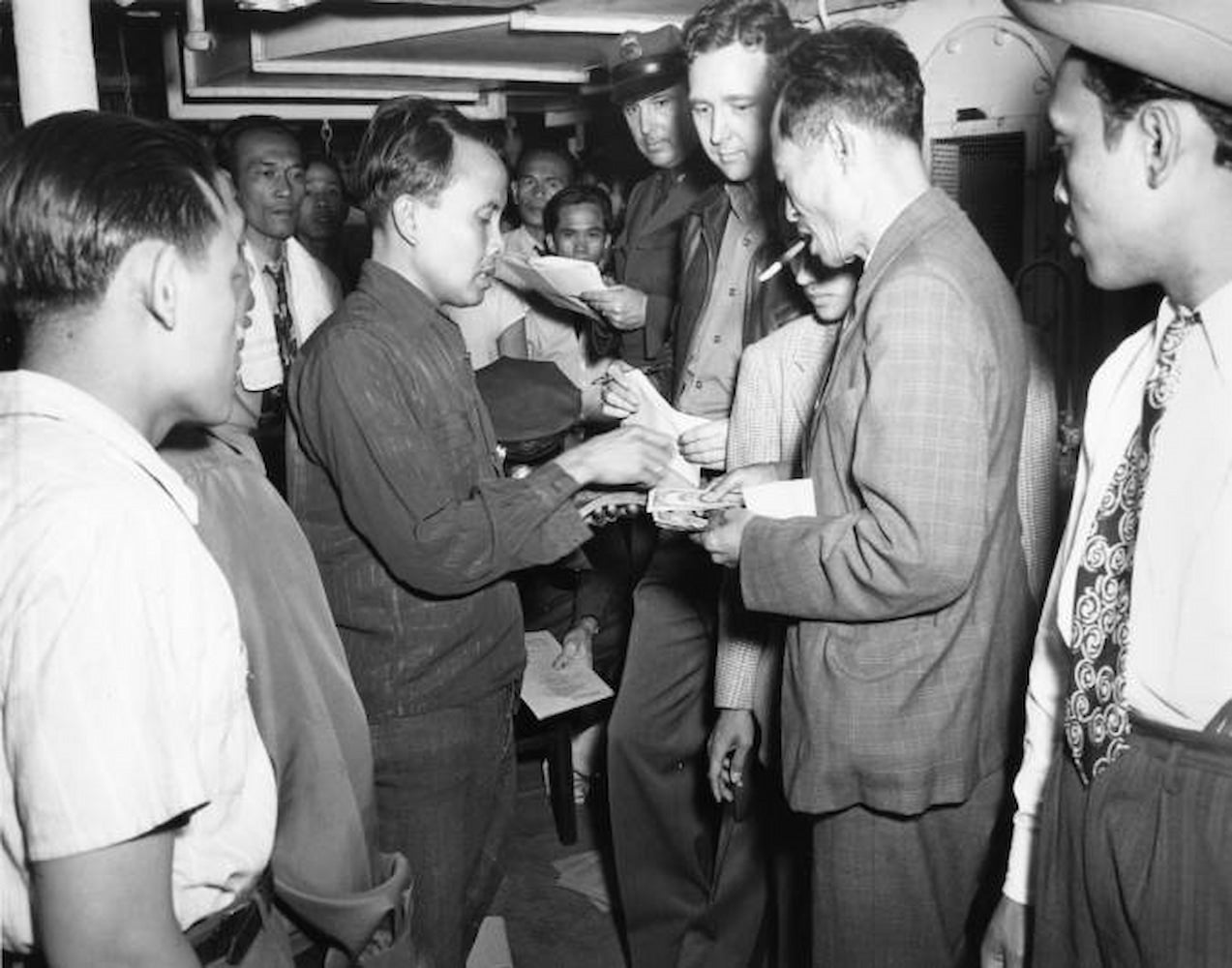
Image 03.05.07 — Indonesian workers exchanged currency while undergoing deportation from San Francisco, California, to Jakarta, Indonesia (then called Batavia, Dutch East Indies).
On April 3, 1947, the sailors arrived at the Dutch-controlled Batavia (now known as Jakarta). A Dutch-language Indonesian newspaper, Nieuwe Courant, reported the sailors’ arrival at a Dutch Red Cross station in Java, from which they were taken by train across Republican lines. Further research is still needed to uncover the story of what happened to the seamen after they arrived back in Indonesia.
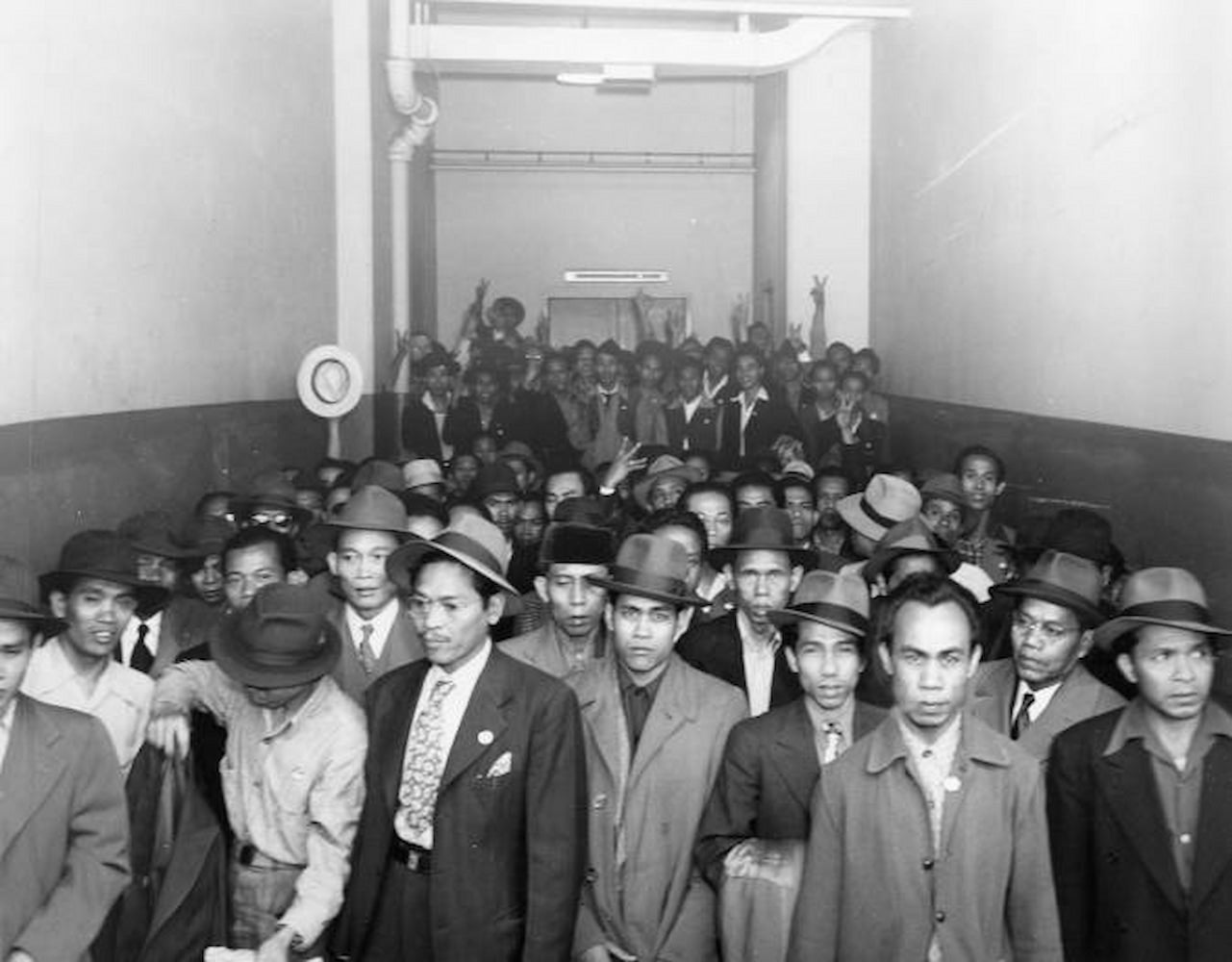
Image 03.05.08 — An archival collection undertaken as a part of the California State University Japanese American Digitization Project shows the transport of the Indonesian maritime workers to Crystal City, Texas, where Japanese Americans were also being incarcerated during World War II.
Significance of Maritime Workers’ History
The case of the Indonesian sailors represents not only an important moment in Indonesian American history, but also US immigration history generally. Indonesians were the first case of refugees after WWII seeking asylum on the grounds of well-founded fear of persecution back home. The time they spent in the custody of the INS at Ellis Island, Terminal Island, and at Crystal City, represents the first case of mass internment of Muslims by the US government. This later foreshadows the recent surveillance that Arab and Muslim Americans underwent in the months and years following the 9/11 attacks.
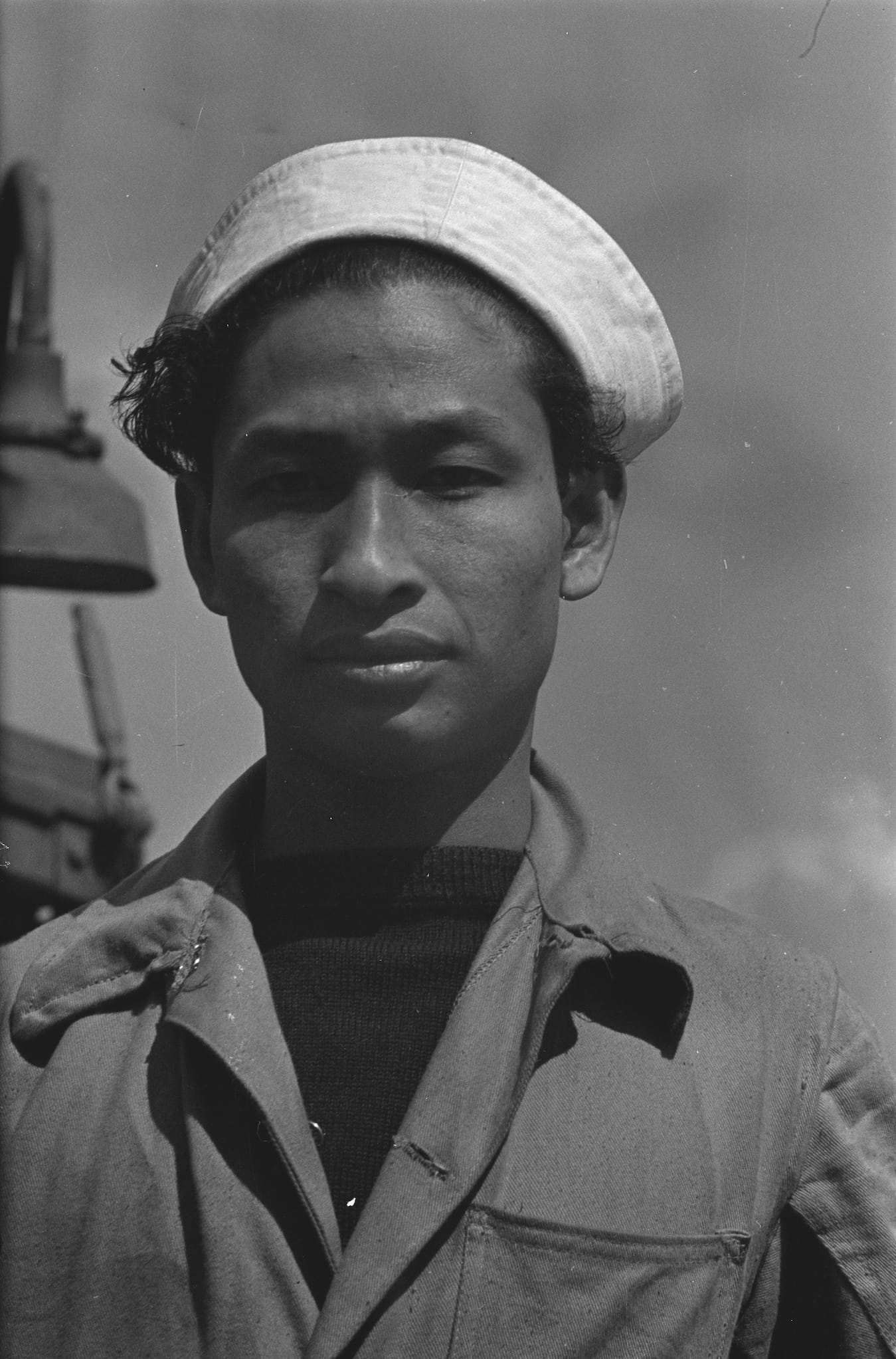
Image 03.05.09 — An Indonesian sailor during World War II. The trial of the detained sailors set the stage for future refugee cases in the US.
The Indonesian War of Independence was the first war of decolonization after WWII, with Indonesia gaining official recognition as an independent nation in 1949. As such, the trial of the detained sailors is likewise notable for setting the stage for future refugee cases, such as in the 1970s with Vietnamese “boat people” following the Fall of Saigon in the Vietnam War. Although the story of Indonesian Americans has long been neglected by scholars, this module sheds a small light to their presence in the US and their legacy in American immigration history.
Glossary terms in this module
refugee Where it’s used
Someone, or a group of people who have been forced to flee their native country due to war, violence, or persecution, and are unable to return.
Endnotes
1 Greg Robinson, “The Great Unknown and the Unknown Great: The Incarceration of Indonesians in the United States: An Untold Story,” Nichi Bei Weekly, January 8, 2015.