


[highlights]

[share_highlights]

[notes]

[share_notes]

[bookmark]

[share_bookmark]

[read_aloud]

Coming Soon!

This chapter is under development.

Return to Table of Contents

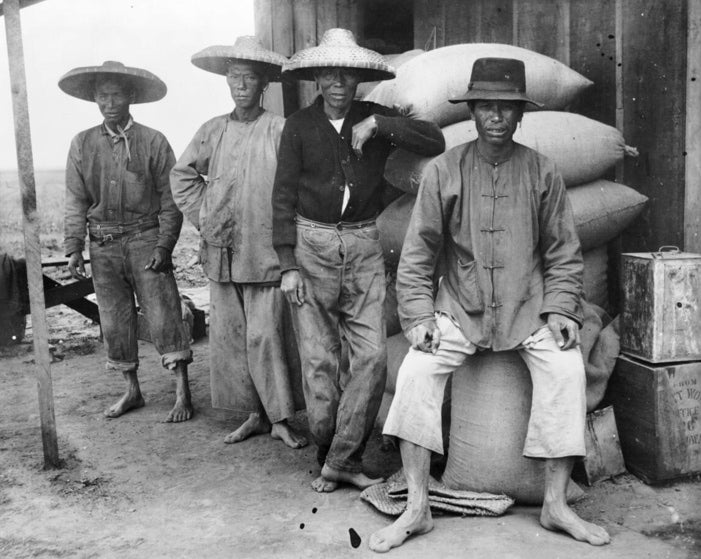
Four barefoot Chinese field hands wearing a mix of shanku and western clothing, with straw hats loiter in front of stacked sacks of harvested grains.

Module 3: Chinese American Community Formation: The First Generation

Is it possible to be both Chinese and American?copy section URL to clipboard

100/100

After the Central Pacific Railroad was completed in 1869, 10,000 Chinese railroad workers no longer had jobs. Some returned to China, others found railroad work outside of California, and the remaining found jobs in agriculture or manufacturing. In 1870, there were 63,000 Chinese people in the US, with roughly 75 percent living in rural areas, where such jobs were abundant.

How did early Chinese immigrants form American communities and maintain their connections to family back in China?

Why did Chinatowns first emerge around the US?

What jobs did early Chinese immigrants take up and how did it affect how they were perceived in the US?


Foundations and Futures Logo

The Asian American Studies Center acknowledges the Gabrielino/Tongva peoples as the traditional land caretakers of Tovaangar (Los Angeles basin, So. Channel Islands) and pay our respects to the honuukvetam (ancestors), ‘ahiihirom (elders), and ‘eyoohiinkem (relatives/relations) past, present, and emerging.

© 2025 UCLA Asian American Studies Center

UCLA Institute of American Cultures Asian American Studies Center logo
Read Aloud
Notes
Highlighter
Accessibility
Translate