





Module 3: Chinese American Community Formation: The First Generation
Is it possible to be both Chinese and American?
After the Central Pacific Railroad was completed in 1869, ten thousand Chinese railroad workers no longer had jobs. Some returned to China, others found railroad work outside of California, and the remaining found jobs in agriculture or manufacturing. In 1870, there were 63,000 Chinese people in the US, with roughly 75 percent living in rural areas, where such jobs were abundant.
How did early Chinese immigrants form American communities and maintain their connections to family back in China?
Why did Chinatowns first emerge around the US?
What jobs did early Chinese immigrants take up and how did it affect how they were perceived in the US?
Chinese Immigrants and the Rise of Intensive Agriculture
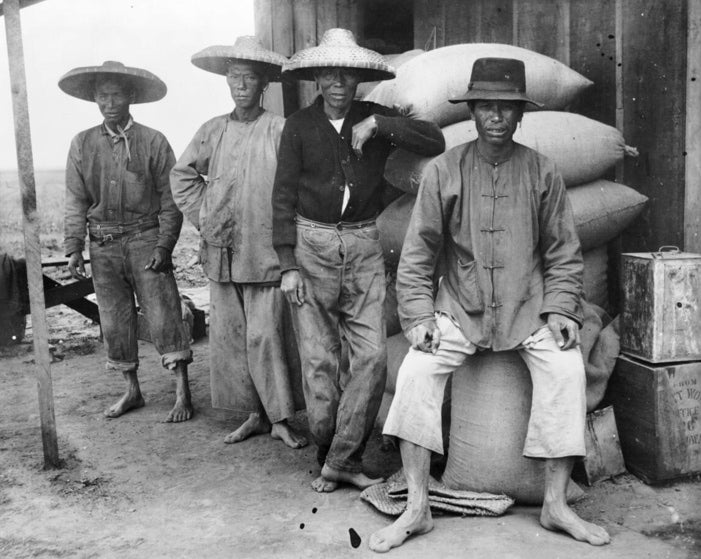
The Transcontinental Railroad expanded California’s agricultural sector because crops could be transported to the rest of the nation faster and cheaper than before. This created more opportunities for work. Chinese workers contributed to California agriculture in the 1860s to the 1880s, including wheat production. By 1870, significant numbers of Chinese farm laborers worked in the counties of Sacramento and San Joaquin, finding jobs as truck gardeners, tenant farmers, farm laborers, and merchants. The agricultural sector flourished during this period.
As California’s agricultural industry further developed in the 1880s, farmers soon transitioned from wheat to specialty crops such as fruits, vegetables, and nuts. Growing specialty crops required manual farm labor that machines and agricultural technology could not do. Chinese workers built roads, cleared land, planted seeds, pruned plants, and harvested crops. In addition to this backbreaking labor, knowing how to grow each crop required significant knowledge and skill. With this economic boom came a cultural shift. White growers began to see fruit growing and family farming as a superior way of life. They saw themselves as independent, self-reliant farmers who worked the land with their own hard work. They concealed the fact that their success was actually dependent on Chinese labor.
To further obscure the key role that Chinese workers played in the agricultural industry, white growers segregated work by race and crop in places like the Santa Clara Valley. They boasted their own work in the more profitable, less labor-intensive orchard fruits and diminished the work of growing berries, vegetables, and garden seed—work that Chinese people did, in addition to farming orchard fruits. Chinese workers were involved in nearly every aspect of agricultural production.
In this module, we explore how the first generations of Chinese immigrants made their living and formed communities in the United States at the turn of the twentieth century. This module focuses on Chinese communities in California and the West where the majority of Chinese immigrants lived at the time.

Image 09.03.01 — Four Chinese field hands, ca. 1898. By the 1880s, Chinese field workers were involved in nearly every aspect of California’s agricultural production.
Urban Laborers
Factory work was another popular employment path for Chinese immigrants after the completion of the transcontinental railroad. Thousands of Chinese people went to San Francisco where manufacturing work was abundant because of the Civil War and the Gold Rush. The Civil War closed off the West from manufactured goods, so capitalists in San Francisco used the money they earned in gold mining to build more factories in the West. Many former railroad workers found employment in factories after the completion of the Transcontinental Railroad. In the 1870s, Chinese workers were almost half the manufacturing labor force in the city.
The factories they worked in handled shoes, wool, cigars and tobacco, and sewing—low-wage industries. Companies employed Chinese people to do the most labor-intensive, least desirable jobs for the lowest wages. White women earned between 1.25 dollars and 1.50 dollars a day and white men earned 2.50 dollars a day, while Chinese people earned 95 cents to 1.50 dollars a day.
Many Chinese men in California found an alternative to factory work by running their own business, such as laundries. By 1870, Chinese laundry workers were 72 percent of all laundry workers in the state. In China, women mainly did the washing, but Chinese men had picked up the skill upon resettling in the United States as an economic opportunity. Laundries did not require much money to start; anyone starting a laundry business simply needed a stove, trough, drying room, and a sign advertising their services. Workers did not have to speak much English.
Moreover, laundries provided the opportunity to work independently. Anti-Chinese rhetoric, however, soon stereotyped Chinese men as doing “women’s work,” perpetuating racist beliefs that they were weak and inferior.
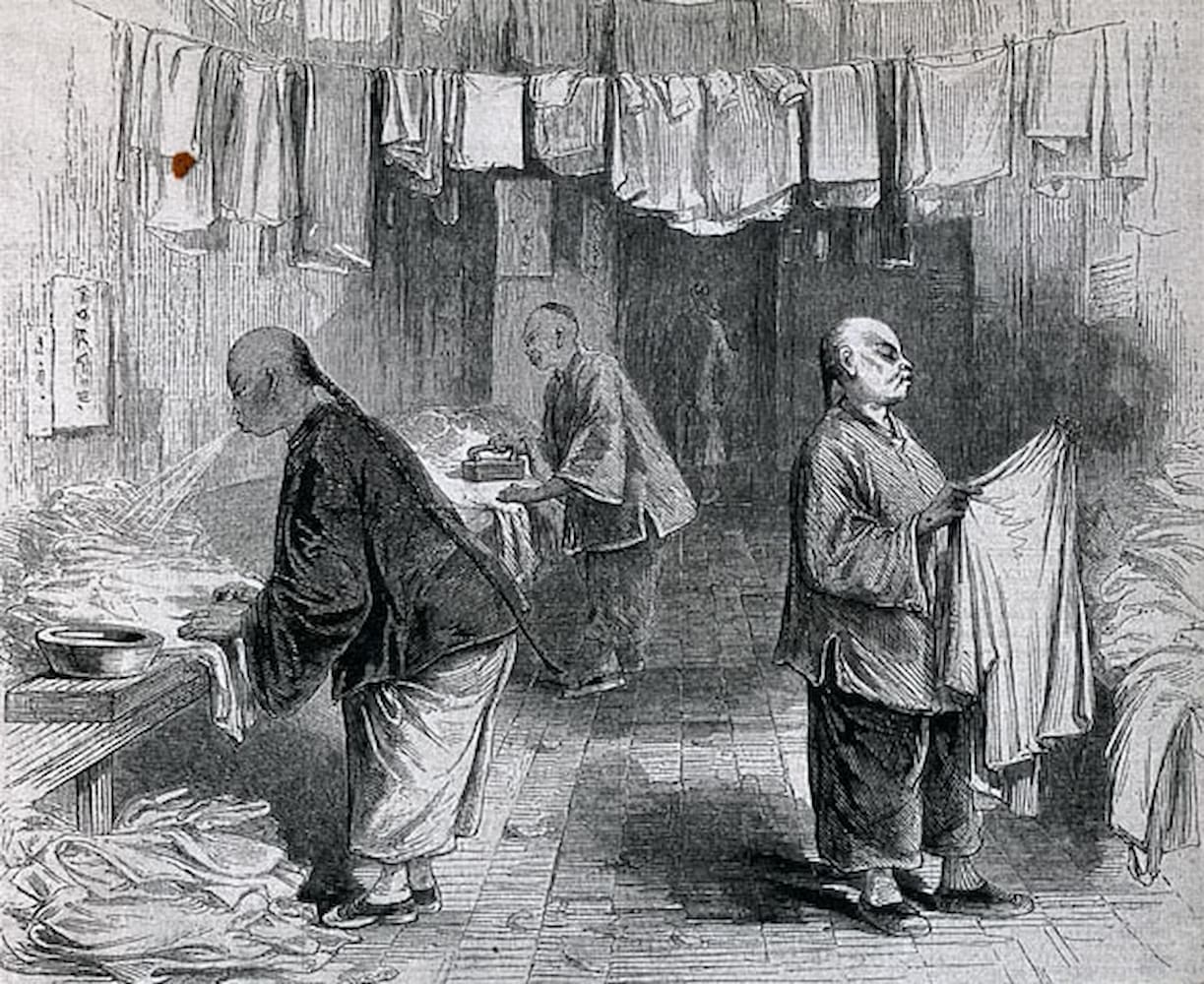
Image 09.03.02 — By 1870, Chinese made up 72 percent of all laundry workers in California. While owning a laundry allowed Chinese immigrants to run their own business, Chinese men were stereotyped with anti-Chinese rhetoric as doing “women’s work.”
Immigrant Women’s Experiences
Racist rhetoric against Chinese people often focused on gender norms. White Europeans held ideas about proper “masculine” and “feminine” behavior and applied other stereotypes about race and gender to Chinese women. Chinese immigrants did not easily fit these Euroamerican cultural ideals. The gender imbalance of Chinese immigrant men and women influenced these stereotypes.
In 1852, when nearly twelve thousand Chinese immigrants arrived in the United States, only seven were women; in 1870, there were 4,566 women and 63,199 men. White people stereotyped Chinese men as weak and unmasculine, and viewed Chinese women as indecent “prostitutes.” Some Chinese women were trafficked into the sex industry and other forced labor in the US. Some women decided to earn income doing sex work depending on the resources available to them at the time.
In earlier periods, Chinese women did not immigrate to the US as much as Chinese men. Part of this is due to traditional Chinese gender norms, in which “decent” women remained in the homes of their in-laws—a tradition which discouraged migration. However, war, poverty, and instability in mid-nineteenth century China created the conditions for human trafficking and led to a greater population of Chinese women coming to the US. Women and girls who were kidnapped, sold into slavery, and brought to the United States against their will were forced to work as prostitutes. These women and girls were required to work for a certain number of years to pay back the cost of their food and passage. During those years, they received no wages.
The story of Xin Jin is an example of a Chinese woman who was trafficked into the sex industry in the United States. A contract dating 1886 shows Xin Jin working at Tan Fu’s brothel, which required her to work for four years and six months to pay back the cost of food and passage from China. The brothel would extend Xin Jin’s contract if she got sick, became pregnant, or was otherwise unable to work.
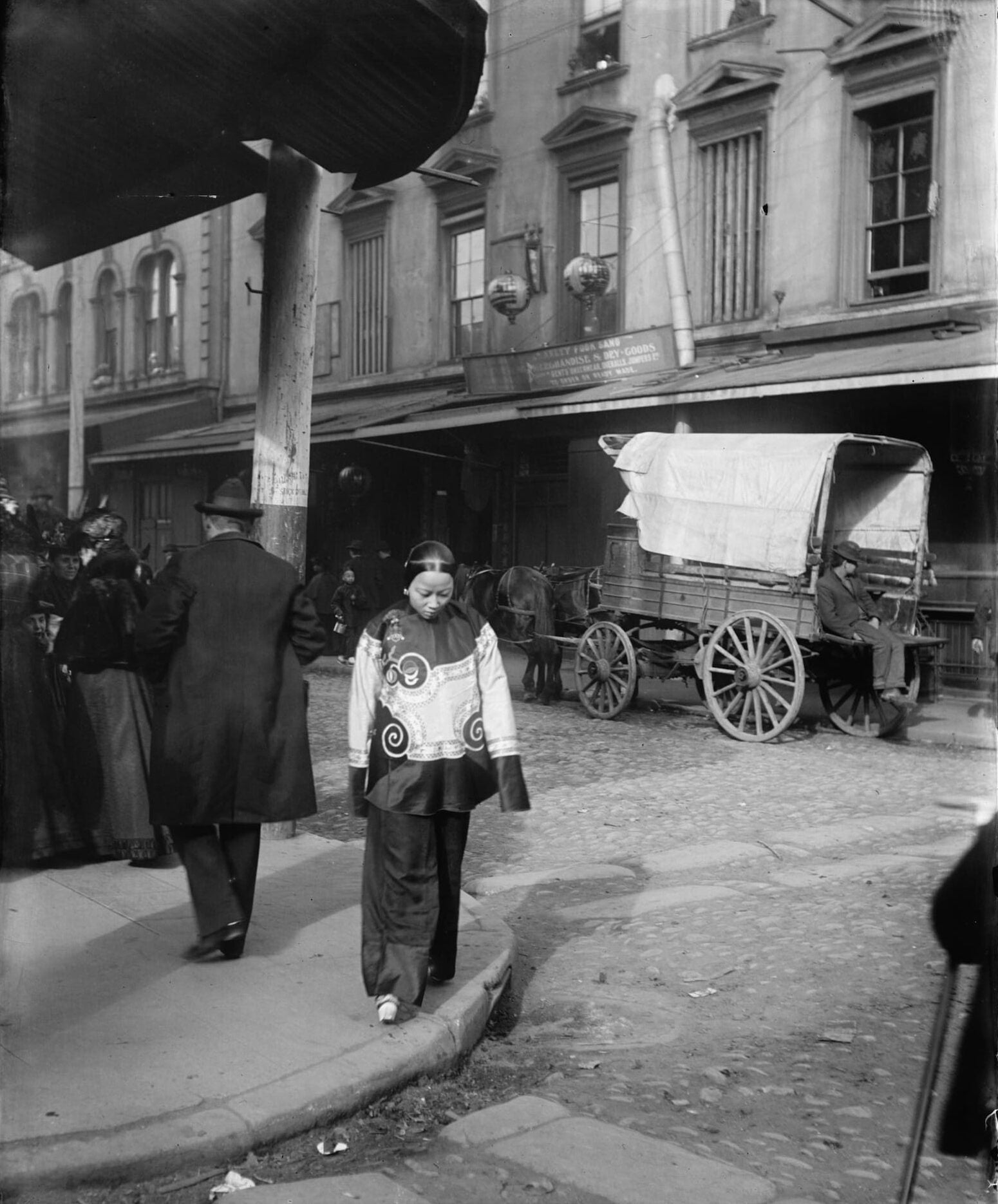
Image 09.03.03 — A young woman in holiday attire in San Francisco Chinatown, c.1895–1906. Few Chinese women lived in the US in the nineteenth century, many of whom were trafficked into the sex work industry.
Between 1870 and 1880, there were more Chinese sex workers in California than those from other races and nationalities. Chinese women did sex work in mining outposts, railroad camps, agricultural villages, and Chinatowns. They worked in high class brothels and low-class “cribs”—small, street-level compartments with doors with screened windows. These small rooms faced dim alleys and served a racially mixed clientele. On average, the workers took in revenues of 38 cents per customer and saw seven per day. At a time when their earnings could be as high as 850 dollars per year, brothel owners and pimps paid only about 96 dollars per year to cover their cost of living. Most of the sex workers lived in conditions of sexual slavery and were treated cruelly, with few managing to leave this work or gain more power in their positions.
Some Chinese women sex workers used the resources available to them to change their lives, with some able to leave the trade. Some left through marriage, as Chinese men could buy a woman’s contract from a brothel owner. Others found refuge with Protestant missionaries who staged rescues and opened mission homes. While Chinese women did not have total freedom in these homes, they had opportunities to learn English and meet Christian Chinese bachelors.
Some Chinese women became pimps and sex traffickers themselves. One of the first Chinese women to arrive in San Francisco was Ah Choi (or Ah Toy) who built her wealth in sex work. She eventually saved enough money to open her own brothel, using the American legal system to protect her business interests. Ah Choi became well-known to the wider public, even informing journalists when she was retiring in 1857.
In 1875, the United States passed its first immigration law that targeted a specific country. Intending to stop the flow of Chinese women coming to the US, the Page Act prohibited the immigration of “undesirables,” including sex workers. Some Chinese women used this restrictive immigration law as protection. For example, when a ship carrying two sex trafficking victims, Chen Liang-shih and Lin Yu-Shih, docked in San Francisco, they cried out to authorities that they had been kidnapped and sold into sexual slavery.
The Making of Chinatowns
As the Chinese population grew in the late nineteenth and early twentieth centuries, Chinatowns formed in cities like San Francisco, Sacramento, and Stockton. These were important locations for trade during the Gold Rush and afterward remained important in the agricultural industry. By 1900, almost half of California’s Chinese population lived in San Francisco and the Bay Area, with the clusters they lived in becoming Chinatowns.
Although Chinatowns often formed as a result of segregation and violence by exclusionary groups, they were sites of resistance, community building, and resource sharing. These small ethnic enclaves had groups that structured the community, helped to control neighborhood affairs, and offered social services and employment support.
Chinese immigrants remained economically and emotionally connected to their homeland and culture in Chinatowns and shifted cultural norms to fit the needs of their local community. For example, although traditional Confucian hierarchies placed scholars, farmers, and artisans above merchants in China, Chinese merchants in the United States became powerful civic leaders.
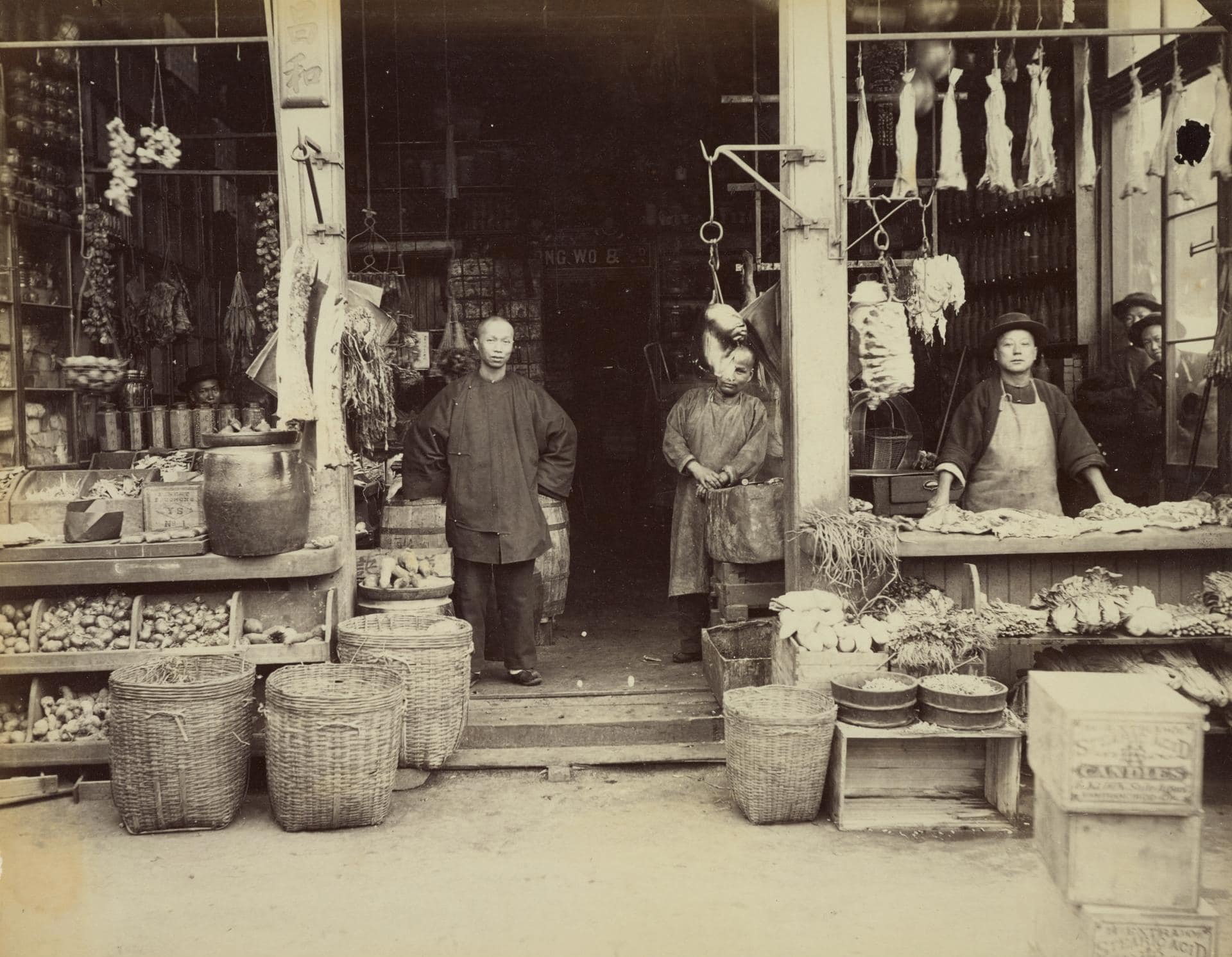
Image 09.03.04 — This undated photograph depicts a vendor standing before a Chinese grocery store in San Francisco Chinatown around the turn of the twentieth century.
Chinatown merchants created community associations in the US based on the huiguan system in China. The first huiguans in San Francisco were known as the Chinese Six Companies, or the Chinese Consolidated Benevolent Association. Merchants led these huiguans, which can be understood as mutual aid groups. These associations helped new Chinese immigrants find work, settled conflicts between community members, and communicated to non-Chinese speakers about employment, law, social services, education, and other things community members needed. In many instances, they acted as the spokespeople for the Chinese in San Francisco.
Tongs were another type of group that were important to the internal organization of US Chinatowns. Some tongs were crime networks that grew out of secret societies in Guangdong Province, China. In the US, tongs offered extralegal protection services and controlled opium dens, gambling halls, and brothels. Other tongs were associated with smaller family groups and offered loans and other resources to immigrant members.
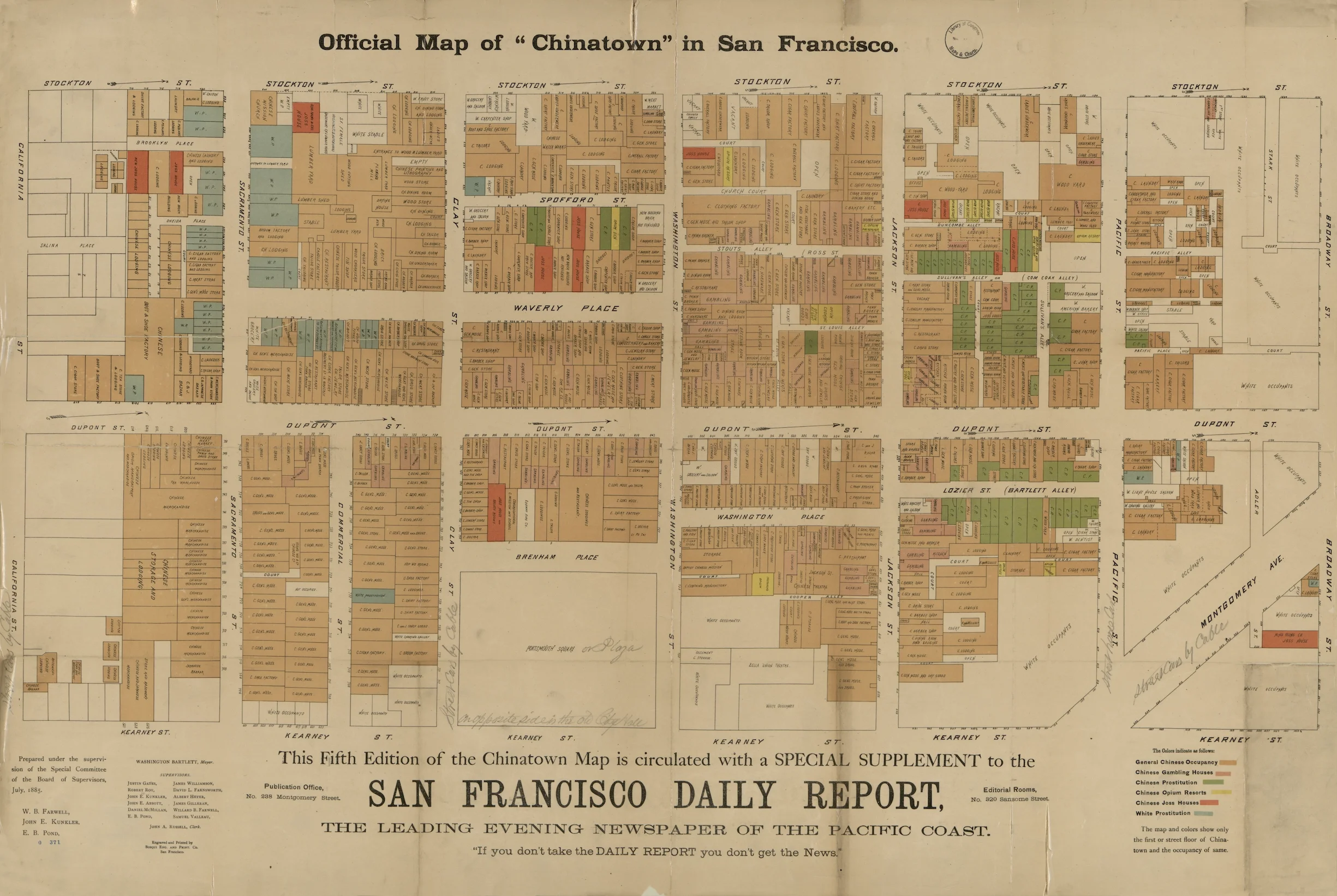
Image 09.03.05 — An “Official Map of San Francisco Chinatown” from 1885 shows names of owners, businesses, “Chinese occupancy,” “Chinese gambling houses,” and “White occupants.”
Towards Exclusion: Anti-Chinese Racism in the 1870s
Chinatowns became important hubs for Chinese immigrants to live and find work, but the ethnic enclaves were also a result of increasing discrimination and exclusion. In the late nineteenth and early twentieth centuries, the United States experienced an economic downturn and waves of epidemic diseases. White workers blamed Chinese immigrants for their lack of employment, physically attacking Chinese people, sometimes in mobs. City ordinances designated zones where Chinese people were allowed to live and work, which cities often justified as actions to help limit the spread of disease.
In this period, Chinese people experienced an increase in racist violence. Anti-immigrant groups saw them as economic threats who took jobs away from non-Chinese. Chinese workers encountered violent white mobs in gold mines and farms. (White mobs also attacked Indigenous, African American, and Latino communities.) Negative rumors about Chinese people spread and sent mobs into a violent panic.
In 1871, a falsehood circulated that Chinese people in Los Angeles were killing white people and hiding gold under their businesses. In a horrific event that became known as the Chinese Massacre of 1871, a mob of five hundred white and Latino men lynched and killed eighteen Chinese men. Around the same time, San Francisco’s Chinese population also experienced spontaneous attacks.
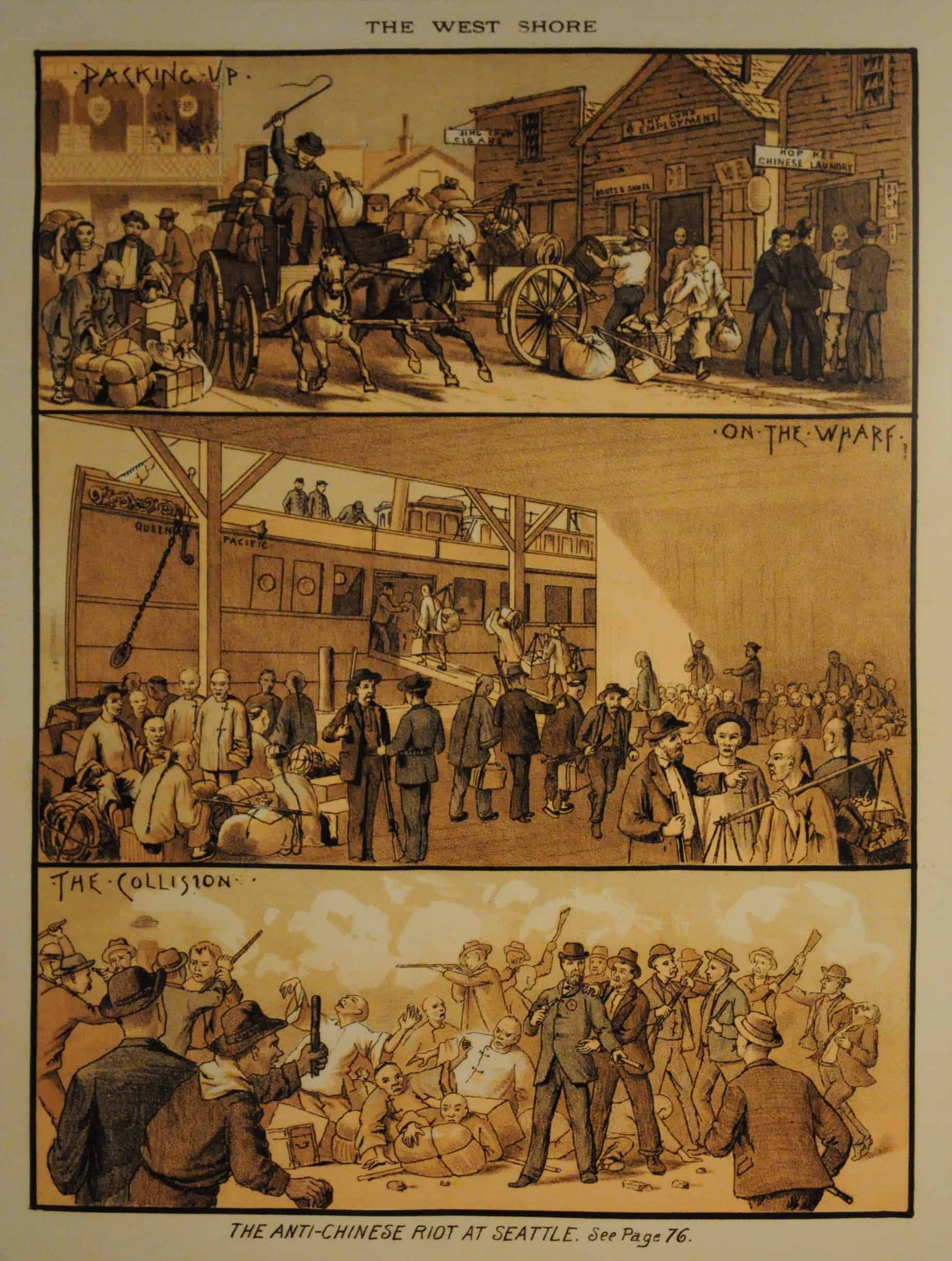
Image 09.03.06 — Artist’s conception of the 1886 anti-Chinese riot in Seattle. The three panels are titled (top to bottom) “Packing Up,” “On the Wharf,” and “The Collision.”
Although local governments recognized the increase in anti-Chinese racism, they did little to protect Chinese immigrants. Instead, they enabled oppressive and discriminatory policies and excluded Chinese populations from wider society. For example, San Francisco passed the 1870 Cubic Air Ordinance, requiring every adult to reside in five hundred cubic feet of living space or pay a fine. While this policy was described as a public health measure, especially in a period of epidemic disease, the only people fined were residents of Chinatown—where crowded tenements were often immigrants’ only option for living, due to racial discrimination that prevented them from living in other areas. Instead of aiding residents by funding or organizing suitable living conditions, the city fined Chinese people and arrested them when they were unable to pay the fees.
Other city ordinances placed restrictions on certain trades in which Chinese people often worked. The Sidewalk Ordinance of 1870 banned peddlers from using baskets hanging from shoulder poles, targeting Chinese people, who carried their bundles this way. The Laundry Ordinance of 1873 required laundry workers to use horses and wagons for delivery. Those who did not had to pay an extra tax, placing an undue burden on smaller Chinese businesses. The overall effect of these local policies was to discourage Chinese people from making a home in the United States.
These small city ordinances paved the way for bigger, national laws discriminating against Chinese people. However, despite their exclusion and segregation into Chinatowns, Chinese communities continued to take root and grow.
Glossary terms in this module
Central Pacific Railroad Where it’s used
The first railroad to connect California to the rest of the US. Thousands of Chinese laborers were employed at very low wages and subjected to harsh working conditions to construct the most dangerous parts of the railroad.
huiguan Where it’s used
Also referred to as clan or voluntary associations, these groups organized Chinese immigrants connected by a common family name, region, or dialect. Huiguans in US Chinatowns offered services to local community members.
human trafficking Where it’s used
The act of transporting a person using threats or coercion with the purpose of exploitation. A key part of trafficking is the lack of control the individual has in being transported and making decisions. Human trafficking can take forms beyond sexual exploitation, such as forced labor.
Page Act of 1875 Where it’s used
Considered the US’s first restrictive federal immigration law, the act restricted immigration from Asia, specially targeting Chinese women among others, including anyone considered “undesirable,” such as prostitutes and convicted criminals.
segregation Where it’s used
The system and/or act of separating a group of people from others based on race, ethnicity, or other identity categories. Chinatowns were formed because cities created laws that restricted where Chinese people were allowed to live and work.
Tongs Where it’s used
While often identified as street gangs and commonly associated with criminal activity, these groups offered protection and private law enforcement to Chinese immigrants at a time when municipal police did not.