





Two white men and a Chinese man in suits are seated at the table processing immigration papers as a group of Chinese women crowd around them.
Module 4: Living in the Era of Chinese Exclusion
Is it possible to be both Chinese and American?
In this module, we will examine the origins of Chinese exclusion in the late nineteenth century and then focus on its social and cultural effects into the twentieth century.
Anti-Chinese racism led to local ordinances that restricted Chinese peoples’ living conditions and ability to work. At the turn of the twentieth century, the white working-class, wanting to retain access to wealth, security, and employment for themselves, influenced national politics to further exclude Chinese people and restrict Chinese immigration.
This module focuses on the Chinese exclusion era, spanning from 1882 to 1943. This era defined and reinforced stereotypes of Chinese people as permanent foreigners who endangered the nation. The Chinese exclusion era had an immense impact on society and culture in the United States.
What was Chinese exclusion and how did Chinese immigrants protest it?
What were the social and cultural effects of Chinese exclusion on immigrant communities?
How did Chinese immigrants find ways around exclusion laws?
Establishing and Enforcing Chinese Exclusion
Labor unions played a major role in establishing laws prohibiting Chinese immigration and other restrictive laws. The white working class were often members of labor unions that had the support of political parties. For example, the Workingmen’s Party of California was a political party formed in 1877. The Workingmen’s Party of California’s primary platform was eliminating Chinese immigrant labor. These organizations often focused on Chinese laborers as competition. They used Chinese people as a scapegoat to distract from broader issues in the industrial sector, such as corporate greed and unsafe working conditions. Executives, managers, and company owners saw investors as more important than workers, whom they considered “unskilled” and easily replaceable.
With few outlets for their frustrations, the white working class blamed Chinese people for the economic and social instability they experienced. At the time, the Chinese population had few pathways for legal defense. They were 4 percent of the immigrant population, even in California, where Chinese workers were most numerous, and they could not vote. Politicians listened to the concerns of white labor unions. Rather than reforming the poor working conditions and exploitative practices of the powerful industrial sector, politicians found it easier to blame and exclude Chinese workers.
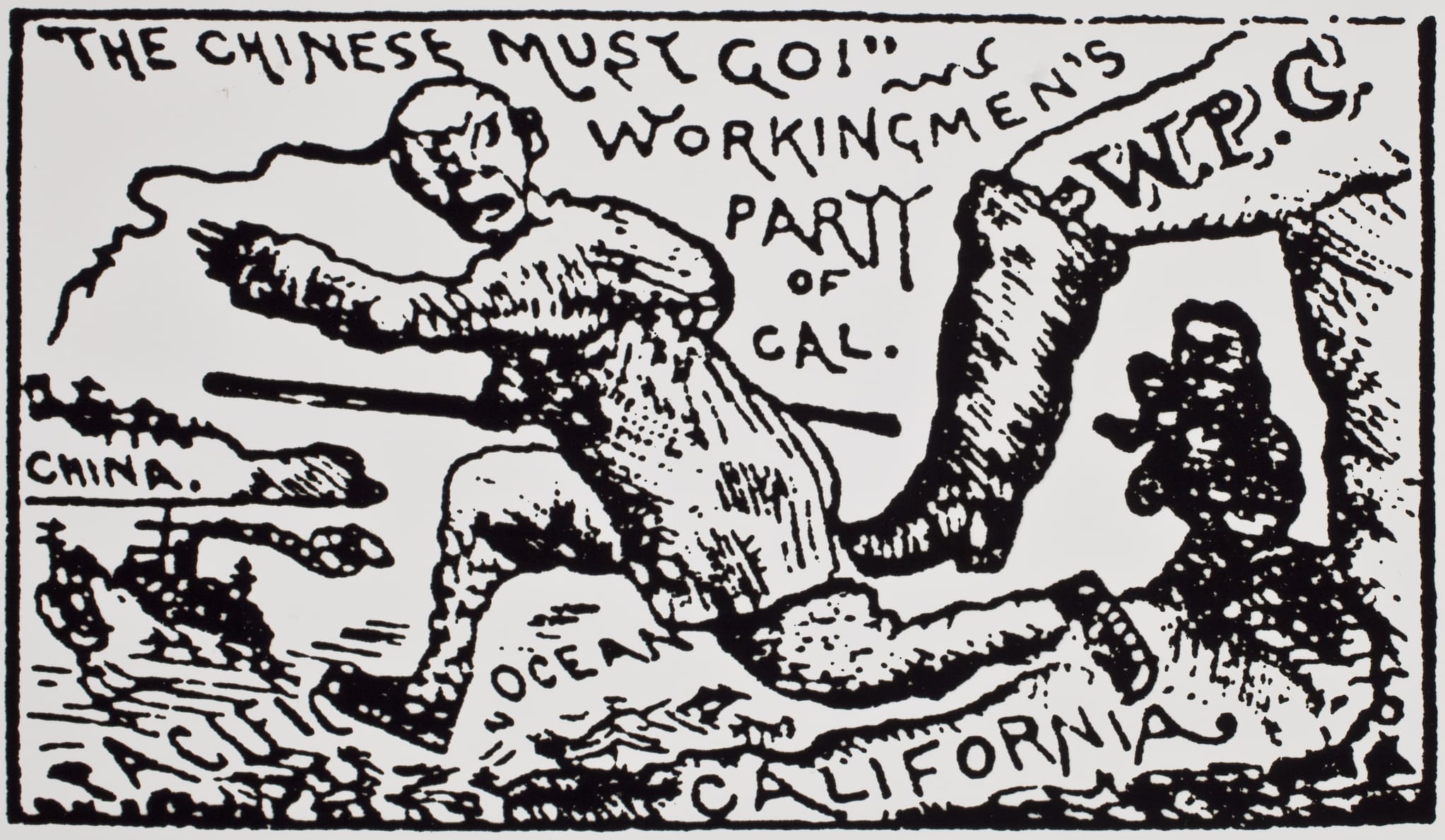
Image 09.04.01 — A political cartoon for the Workingmen’s Party of Guerneville, California, 1879 featured the phrase “The Chinese Must Go!”
To slow down the influx of labor competition, the United States passed one of the first laws restricting Chinese immigration in 1882. The Chinese Exclusion Act banned Chinese laborers from immigrating to the United States for ten years. Additionally, Chinese people already in the United States could not obtain citizenship as a result of this law.
For the first ten years of the Chinese Exclusion Act, authorities did not have a standardized system for applying the law and enforcing the restrictions. It was also unclear if the restrictions would be permanent. Then in 1892, Congress passed the Geary Act to renew the law and increase enforcement. The passage of these Chinese exclusion laws contributed to the increase in xenophobia, or anti-immigrant sentiment, in the early twentieth century. At the same time, governmental regulation of immigration became more centralized, organized, and expansive.
The Chinese Exclusion Act changed immigrants’ experiences of arrival to the US. Prior to 1882, there were few requirements for entry and authorities to enforce policies; Chinese immigrants simply walked off the boat that brought them to American shores. Some states regulated migration across their borders, but for the most part, filling major labor shortages was more important than policing immigration. After the Chinese Exclusion Act, overseas ships arriving in American ports were met by a corps of uniformed immigration officials. Non-Chinese passengers disembarked after a cursory examination, but immigration officials detained all Chinese passengers for further questioning and investigation.
Angel Island
From 1882 to 1910, immigration inspectors patrolled San Francisco’s ports, detaining Chinese arrivals in a two-story wooden shed at the Pacific Mail and Steamship Company dock. Concerns over the safety and increasing numbers of arrivals led to its closure, but immigration authorities then established a larger detention center called Angel Island in 1910.
For three decades, authorities sent Chinese immigrants to Angel Island Immigration Station, where they underwent invasive medical examinations. They were required to take off their clothes, and then someone inspected their teeth, hair, bones, and other parts of their bodies. Officials searched their belongings, sometimes confiscating personal letters. Although immigrants from other countries went through Angel Island, over 70 percent of the population was Chinese, who also had the longest confinements.
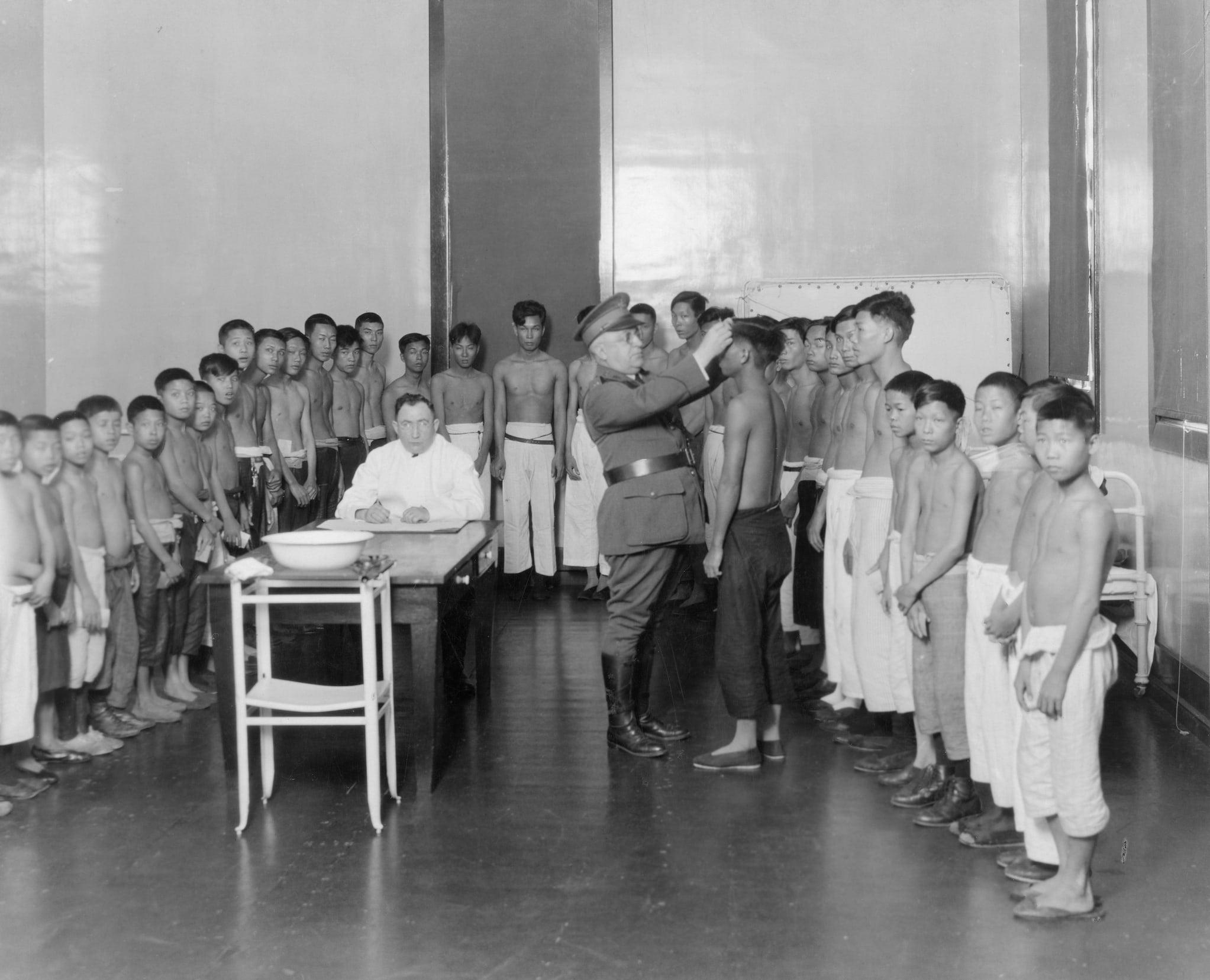
Image 09.04.02 — A medical examination of Chinese immigrants at Angel Island Immigration Station. These exams were extremely physically invasive, and personal belongings such as letters were often confiscated.
Immigrants detained at Angel Island stayed in overcrowded, poorly ventilated rooms with rows of metal bunk beds set two feet apart. The center was a prison, with barbed-wire fences, guards, and wire mesh over windows to prevent escape. Law Shee Low, a Chinese immigrant who had been detained for ten days in 1922, described the anxiety she and the other women at the detention center felt. “Mostly, we just sat there and waited out the days, staring out the window. We hardly even chatted,” she said. “Everyone just worried about not being able to land.” 1 Low and others at the detention barracks had reason to worry. Inspection authorities sought out “excludable” conditions to prevent the admission of Chinese immigrants. Many applicants were considered ineligible, unless they could prove otherwise.

Image 09.04.03a — Angel Island Immigration Station. From 1882 to 1910, Chinese immigrating to San Francisco, California, were detained at Angel Island while hoping to gain entry to the United States.
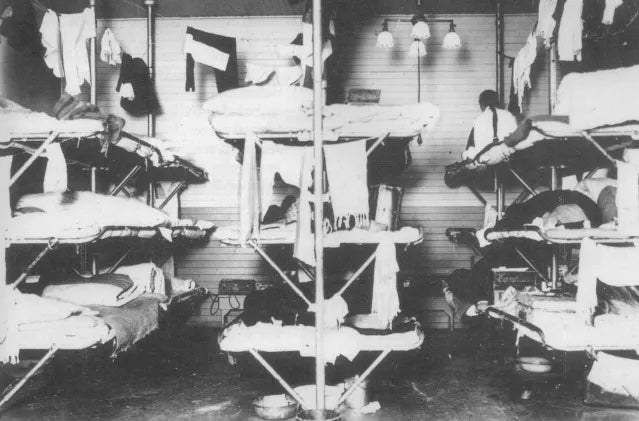
Image 09.04.03b — A Chinese men’s dormitory on Angel Island, 1910. Detained immigrants stayed in overcrowded, poorly ventilated rooms with rows of metal bunk beds set two feet apart.


Exclusion laws allowed for some non-laborer immigrants to enter, but people needed to provide substantial proof, sometimes before they even landed on US shores. For example, merchants had to provide detailed documents about their business activities and white American witnesses to testify for them. Officials also examined Chinese immigrants’ hands because calluses were evidence of manual labor, and thus proof of false documents if they claimed to be merchants. Chinese women had a more difficult time proving their identities. Since most entered as wives and daughters of Chinese citizens, they first had to prove that their husbands or fathers were allowed entry though their professions. Then the women had to prove they had real relationships to these men.
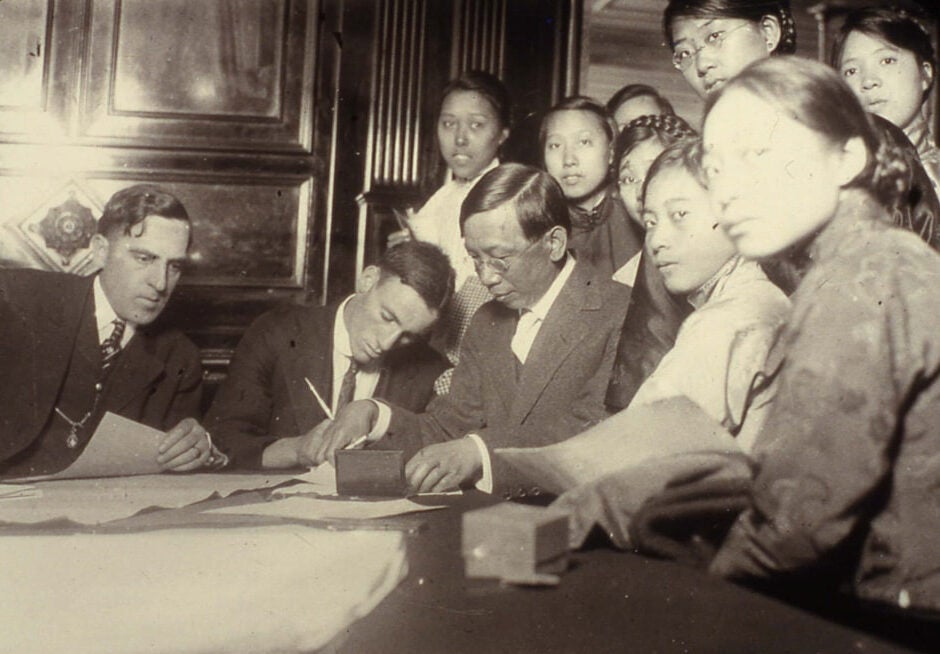
Image 09.04.04 — Officials processing paperwork, Angel Island. Chinese exclusion laws allowed some non-laborer immigrants to enter the United States, but required substantial proof and documents.
By the 1920s, Chinese immigrants also commonly applied as US citizens upon their arrival at Angel Island. Some Chinese immigrants utilized a loophole created by the 1906 San Francisco Earthquake and Fire to gain citizenship since there were little to no legal pathways to citizenship for Asian immigrants at this time. The disaster destroyed 80 percent of San Francisco, causing fires throughout the city and turning city hall to ash. The fires destroyed public records, including citizenship papers. Thus, some Chinese immigrants falsely claimed they were American-born and therefore US citizens by birth, knowing there were no records to disprove them. Moreover, many lied and stated they had children born in China, as children of US citizens automatically qualified for citizenship. Those who entered by these means were known as “paper sons,” people who gained entry by falsely claiming to be Chinese-born children of legal residents of the United States.
A “paper son” named Mr. Yuen described this common tactic. “You tell the immigration officer, ‘I have been in China three years, I have three sons, these are their birthdays, the names and so forth.’” 2 Those who falsely stated they had children could then sell these documents to buyers who wanted to gain entry to the United States.
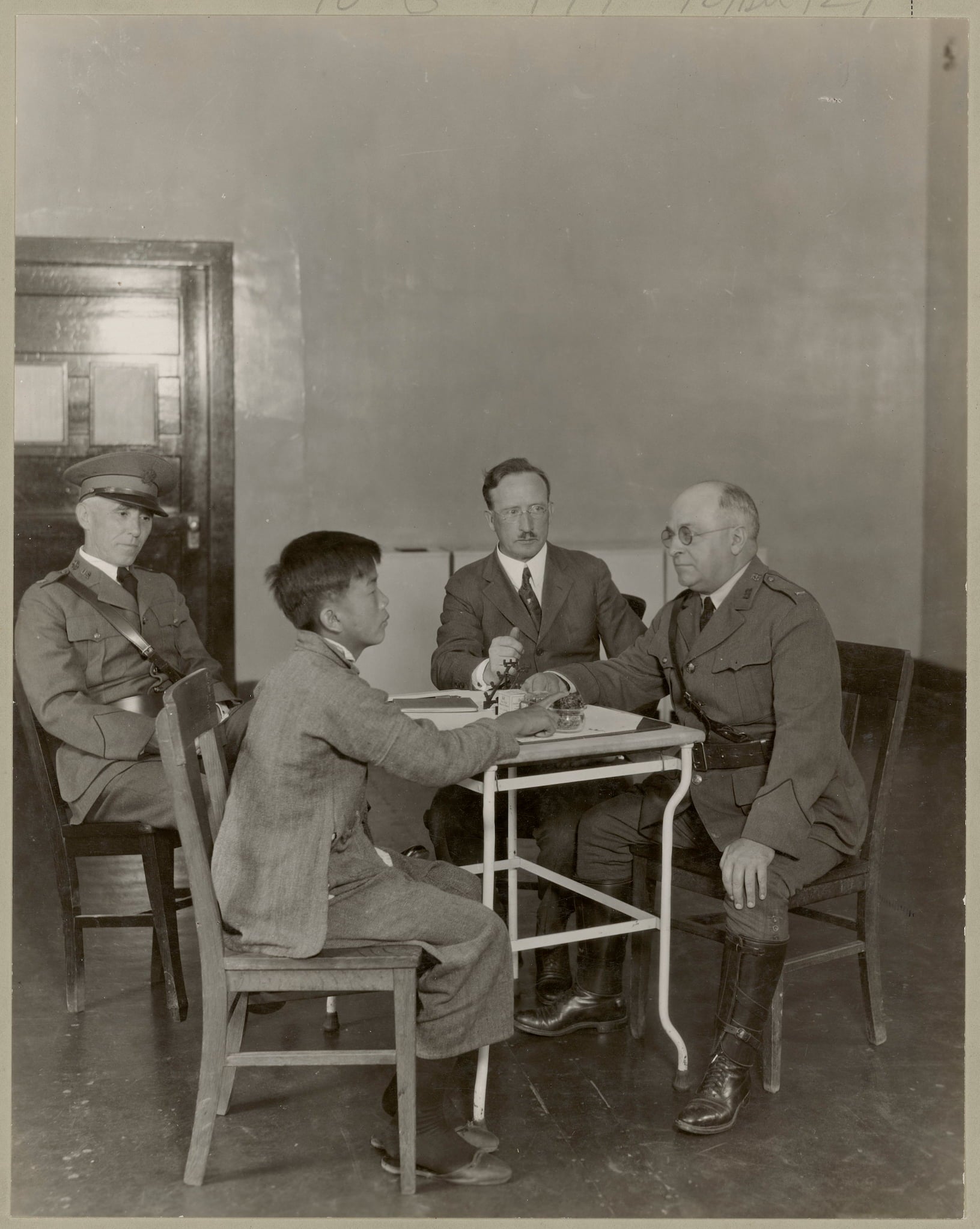
Image 09.04.05 — Chinese applicant at interrogation, Angel Island, 1923. Officials often suspected fraudulent applications and questioned immigrants about specific details related to families or villages to detect false stories.
Nevertheless, “paper sons” were not guaranteed admission to the United States. Due to the high volume of Chinese people applying to enter as citizens or sons of citizens, US officials suspected fraud. They interrogated Chinese immigrants about details related to their families and villages in China. Some of the questions were very specific; for example, they asked about the number of steps leading to the front of their house or the number of houses in the village. The officers would ask the applicant’s relatives the same questions, looking for differences in answers.
A man who was detained in 1921 emphasized the unfairness of the questions. “Who counts the number of steps in front of their house? And even if you counted them, who knows whether your father will give the same answer? I could say forty and my father could say thirty…. They interrogated my brother and my father—that’s three people who have to agree. Even real sons could fail.” 3 Some transcripts were hundreds of pages, indicating long hours of interrogation. Any discrepancy in answers could result in deportation. Some officials even suspected immigrants had memorized correct answers, since the “paper sons” system led to coaching businesses and books, which some immigrants studied from prior to interrogations.
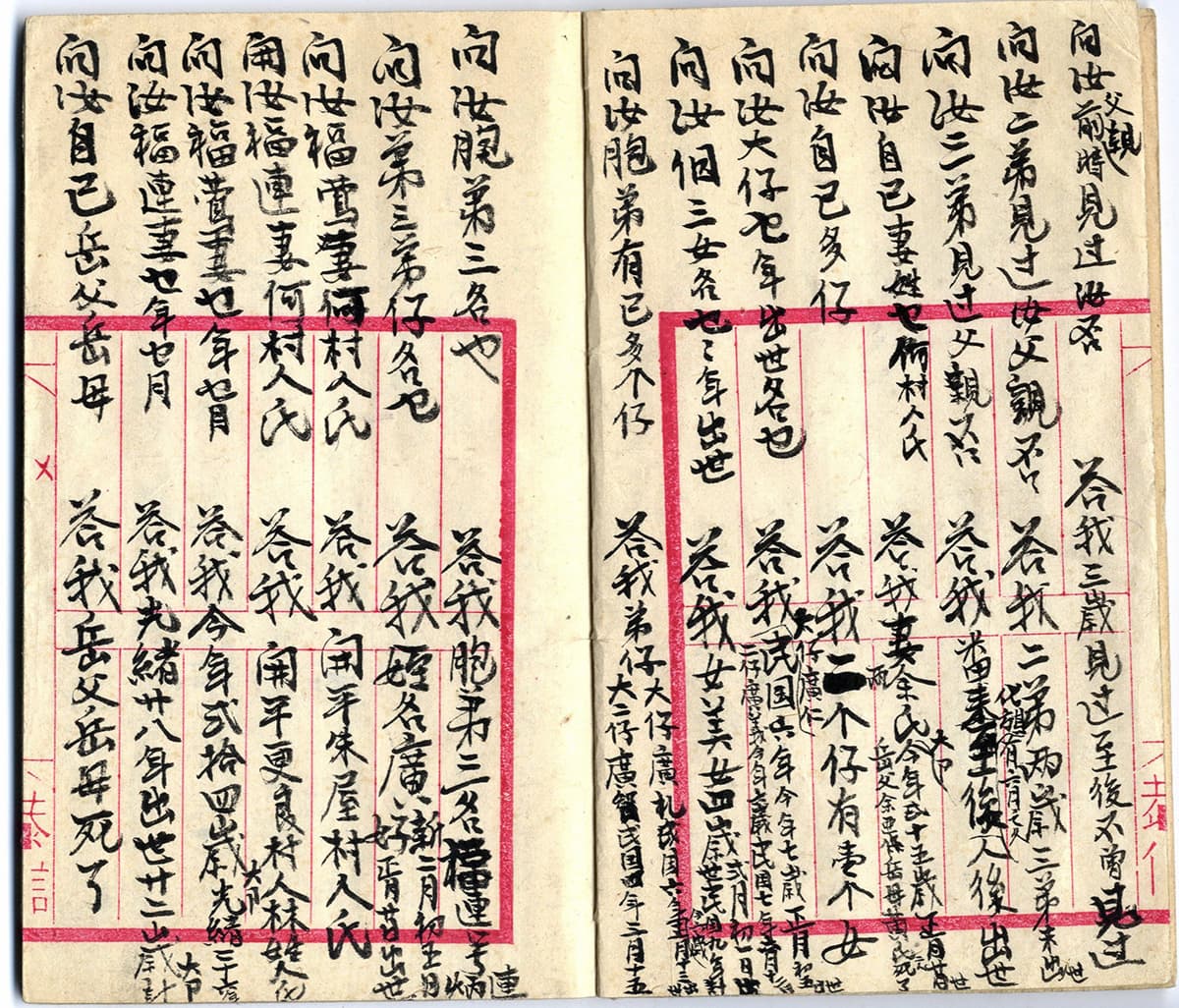
Image 09.04.06 — A study aid or coaching guide to successfully pass through US immigration interrogation from the 1920s found among the papers of Fook Wing Chung.
Some of the Chinese people detained on Angel Island expressed their anger, sadness, and frustration through poetry they wrote on barrack walls. They painted the poems in black ink or carved Chinese characters with knives. Many poems conveyed resentment at being confined on Angel Island and despair that China was too weak to intervene on the immigrants’ behalf. Others spoke of family members left behind and regrets about going into debt for their voyage. Though most of the poets likely only had an elementary school level education, they emulated the style of classical Chinese poetry and made references to Chinese historical heroes and legends. Maintenance workers later painted over the writing on the walls, covering it with putty.
However, the poems were not erased. The Angel Island Immigration Station ended its operations in 1940, but in 1970 the carved inscriptions were rediscovered. This led to a movement to preserve the poems and Angel Island as a historical landmark, which still exists today as an educational center. More than two hundred poems by Chinese immigrants have been documented, and many are still visible in the detention barracks today. The poems are a remarkable record of the interior lives of Chinese immigrants and their emerging cultural identity in the US.

Image 09.04.07 — Chinese detainees on Angel Island painted and carved poems of despair on barracks walls. More than two hundred of them are still visible today.
Legacies of Exclusion
Congress and local governments later relaxed or repealed various immigration laws, but restriction and exclusion had long-lasting effects on Chinese communities. For the Chinese population in the United States, legal status did not protect them from discriminatory actions. New immigrants and native-born Chinese Americans were under constant suspicion. Many felt they had to prove their patriotism and right to remain on American soil.
The exclusion era also affected how Chinese immigrants related to each other and remained connected to China. Chinese immigrants became dependent on one another. Not only did family members and fellow villagers help each other with jobs, but they also educated each other. They passed along information and documentation needed to navigate the complex bureaucratic process. Chinese immigrants shared coaching papers that helped new arrivals respond to interrogations and created the “paper son” system. Chinese merchants, physicians, and religious leaders wrote letters, forged documents, and provided protection for Chinese immigrants. With Chinese people in the US working with people in China, a transnational network developed.
Despite this connection, Chinese immigrants found it difficult to return to China. Men who returned to China and struggled with cultural changes had difficulty reconnecting with their wives and children. Family and gender roles began to change too. Chinese wives whose husbands moved abroad found themselves with more autonomy and control over their children. These shifts in family size, structure, and traditions created challenges for transnational families.
Restriction laws legally barred Chinese people from entering the United States and discouraged many from trying to emigrate. However, Chinese exclusion laws never stopped Chinese communities in the United States from existing, as some were determined to resist restrictions and push back against discriminatory immigration laws. Although Chinese exclusion laws would eventually be repealed, they became a blueprint for future immigration restrictions and border control policies that discriminate against other Asian groups and Latin American arrivals in the US.
Glossary terms in this module
Chinese Exclusion Act of 1882 Where it’s used
Considered the first significant piece of legislation to restrict immigration into the United States, this federal law prohibited the immigration of Chinese laborers for ten years.
paper sons Where it’s used
People who gained entry into the US by falsely claiming to be Chinese-born children of legal US residents. The paper son system created a pathway for immigrants into the US during a time of exclusion.
scapegoat Where it’s used
A set of people who are wrongly assigned blame for a problem, typically those whose social status makes them vulnerable to violence and makes addressing or correcting the error very challenging.
transnational Where it’s used
Crossing international borders, typically referring to institutions or social and cultural practices.
xenophobia Where it’s used
The fear or hatred of foreigners or people who are perceived to be from other countries.