



Module 3: The International Ladies’ Garment Workers’ Union (ILGWU)
Did the collective action of New York City Chinatown’s Chinese American garment workers positively change their working conditions and their lives?
Workers band together in unions to fight for their collective needs at work: better wages, fair hours, health insurance, workplace safety, and other concerns. Unions help workers achieve fair treatment in the unequal power relationship with their boss. As the Chinatown garment industry grew in the 1960s and 1970s, Chinese garment workers in New York joined a union that protected garment workers, the International Ladies’ Garment Workers’ Union (ILGWU).
As a self-described “union of immigrants,” the ILGWU knew the importance of outreach to the garment workers in New York City’s Chinatown. The ILGWU organized the Chinatown factories through incentives to Chinese employers, such as brokering connections between employers and unionized manufacturing brands, and outreach to workers. Worker outreach included offering English language classes, writing newsletters in Chinese, giving news stories to the local Chinese press, and providing education about benefits such as health insurance.
There were 1,500 Chinese members in the local ILGWU chapters by 1968, and this increased to 6,000 in 1974. By 1982, there were about 20,000 members, and the New York Chinatown workers made up one-third of the workers in Manhattan’s outerwear industry. The union experiences transformed the workers, and in turn, the Chinese immigrants who joined the ILGWU made an impact on the union, and advocated for the union to represent their needs and concerns through the industry’s rapid changes. This module focuses on the ILGWU and how Chinese immigrant workers joined the union and shaped its history and direction.
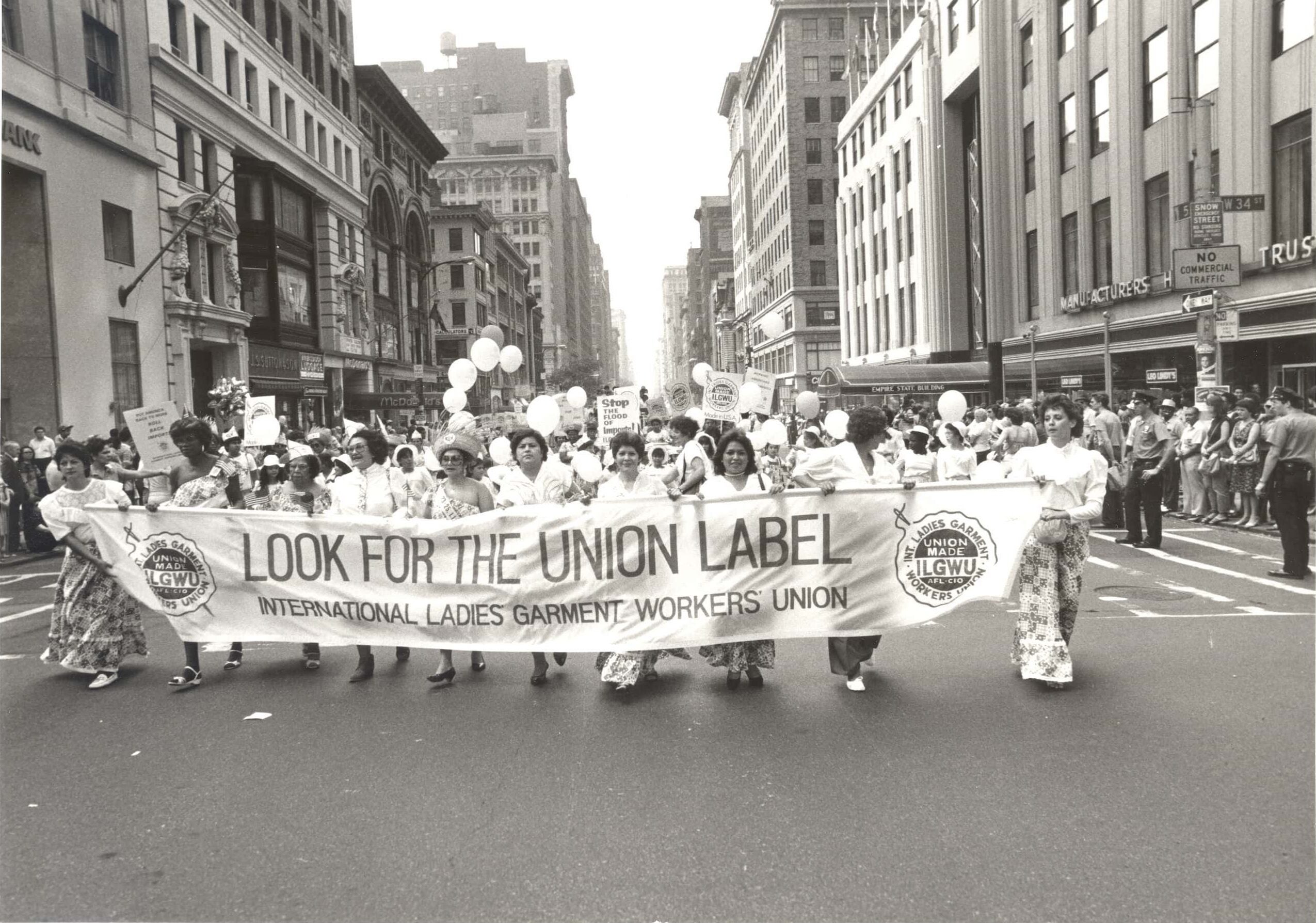
Image 47.03.01 — A multiracial group of ILGWU members participate in the Labor Day Parade. The group proudly holds a banner in support of the union as they march on Fifth Avenue, New York, New York.
Created date, created by Name, Title Italicized. Credit line indicating where the image is from. Metadata ↗
What is the role of a union and what made the ILGWU distinct?
How and why did Chinese immigrant women workers bring their collective voice and sense of solidarity to the union?
How did ILGWU union culture (social unionism) align with the Chinese community/family culture of the workers?