





White American couple are seated in portrait studio with their children. Their three daughters stand behind them, while the mother holds young son, an adopted Korean boy.
Module 3: Adoptees
Have their ongoing ties with Korea impacted the lives of Korean Americans?
Because of missing information in their files, many Korean adoptees grew up in the United States believing that they were orphans found abandoned near a police station in infancy. Adoptees have also been told that they should be grateful for their adoptions to the United States, even as some entered families who were unkind, or where they faced poor or abusive treatment.
In adulthood, a number of adoptees have discovered that the narratives they had accepted as true were actually filled with lies. Some returned to South Korea and gained access to their adoption files. Some were able to reunite with their biological families and learn more about the real stories behind their adoptions. Through the process of uncovering the truth, some adoptees also discovered that their adoptive parents failed to naturalize them as US citizens, making them at risk of deportation.
This module explores the history of Korean transnational adoption, the growth of adoptee communities, and adoptees’ contributions to film, memoir, and other media that share the diversity of adoptee experiences.
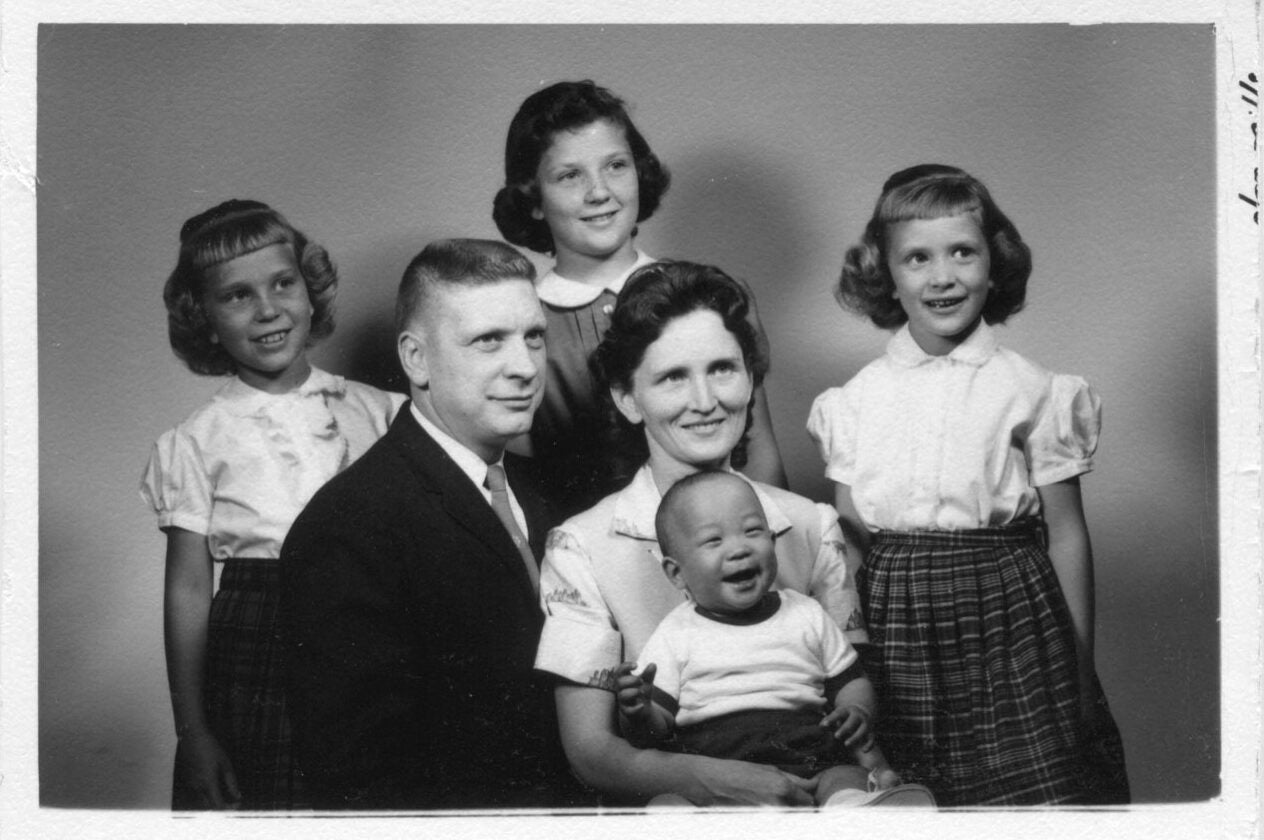
Image 14.03.01 — More than two hundred thousand Korean children have been adopted into other countries since the end of the Korean War in 1953, with roughly two-thirds of these children arriving in the United States.
Why has Korean adoption continued for more than seventy years?
How have adult adoptees connected and formed communities with one another?
How have adoptees challenged narratives of adoption as rescue?
An Overview of Korean Transnational Adoptions
In the US, adoptees represent an estimated one in ten Korean Americans. Despite this significant number, the complex experiences of adoptees have often been overlooked in the histories of Korean immigration to the United States. More than two hundred thousand Korean children have been adopted into other countries since the end of the Korean War in 1953, with roughly two-thirds of these children arriving in the United States. This type of adoption, which involves the adoption of children from one country to another, is known as transnational adoption. Other countries with high numbers of Korean adoptees include Sweden, Denmark, the Netherlands, France, and Australia.
The majority of these adoptions are also transracial adoptions, a term which refers to the placement of children from one racial group into families of another race. For Korean adoptees, the primary adopters have been white parents.
Adopted people more than likely have heard a version of the expressions, “You’re so lucky that you were adopted” and “You should be grateful for your adoption.” They may have been told by a family member, friend, or even a stranger that they would have suffered in their country of origin or with their birth family if it were not for their adoption. These comments are not unique to the estimated one in ten Korean Americans who are adopted from Korea to the United States. Rather, these are expressions that the majority of adopted people have heard. In the case of those adopted from Korea, these expressions are associated with the idea that adoption is a child-saving effort. The history of Korean transnational adoptions, however, is multilayered and should not be reduced simply to acts of goodwill.
The Korean adoption industry began after the Korean War (1950–1953) as an outgrowth from sponsorship programs spearheaded by humanitarian aid organizations. These organizations encouraged readers of magazines (such as Life and Reader’s Digest) to sponsor Korean “war waifs,” a term that referred to children orphaned as a result of war. During this postwar period, there was a small percentage of mixed-race children with Korean mothers and foreign-born fathers, many of whom were white or Black servicemen from the United Nations Command, a group of combined military forces led by the US.
These children encountered societal stigma in Korea due to their multiracial identity and were seen as illegitimate if their parents were unmarried. Various laws also prevented multiracial Korean children from gaining Korean citizenship. Under the Nationality Act of 1948 in Korea, citizenship followed paternity, and multiracial children of Korean women could not obtain citizenship, until the revised law was enacted in 1998. In addition, Korea’s family law had considered men as the heads of their households and their family registries. This prevented women from accessing certain legal, economic, and social rights (including establishing their children’s legitimacy) until the system was revised in 1990 and later abolished.
Adoption as Child Rescue
In the United States, more people began to perceive transnational adoptions as a child-saving effort, beyond financial sponsorship. A key figure in shaping everyday Americans’ perceptions of Korean adoption was Harry Holt. He and his wife, Bertha, established the Holt Adoption Program (HAP) after viewing the documentary Other Sheep created by World Vision, a Christian organization that provided aid and led evangelical programs in Korea and China. Moved by the film, which depicted the struggles of mixed-race children and orphans in postwar South Korea, the Holts sponsored and later adopted eight mixed-race children in 1955. Prior to the establishment of HAP, however, Harry Holt lacked child welfare experience. Instead, his philosophy was guided by the belief that “good Christians” would become good adoptive parents.
Media platforms frequently cast Holt in a positive light and described his jovial demeanor and religiosity. Newspapers emphasized the number of orphans he was airlifting out of Korea and his ability to facilitate “mass adoption[s].” 1 Universal Newsreels, which were news stories that screened for the public at movie theaters, heralded Holt for his “goodwill and love” in coordinating adoptions during the holidays. 2 These newsreels also portrayed Holt as a “kindly godfather” figure who rescued orphans from postwar Korea and gave them homes in the US. 3 Holt’s charismatic presence and plainspokenness made him appealing to everyday Americans, who began to see adopting children from Korea as an exciting way to be part of US democracy.
A number of prospective adoptive parents wrote to adoption agencies proclaiming their interest to formally adopt the children they had financially sponsored. In these inquiries, individuals often included their child’s sponsorship case number, name, orphanage, and even birth date.
This was the case of documentary filmmaker Deann Borshay Liem, an adoptee who entered the United States in 1966. Prior to her adoption, the Borshay family had been sponsoring Cha Jung Hee, an orphan at the Sun Duck Orphanage, by sending monthly letters, fifteen dollar donations, and miscellaneous clothing. An orphanage social worker responded on the child’s behalf, and her adoptive parents decided they wanted to adopt Cha Jung Hee. In response, however, the orphanage instead sent Deann Borshay Liem under Cha Jung Hee’s name, switching her identity during the adoption process.
This is just one example of the complex experiences of Korean adoptees. The stigma that mixed-race children and war orphans faced, Korean families’ economic precarity, and the expected relinquishment of their children generated the conditions for the initial adoptions of this period.
More to explore
Video
01:52
Filmmaker Deann Borshay Liem
Emmy Award-winning documentary filmmaker Deann Borshay Liem’s trio of Korean adoption documentaries highlights not only her adoption story, but those of other monoracial and mixed-race adoptees. First Person Plural (2000) highlights her reunion with her biological family and notes that her Korean family sought to retrieve her from the orphanage only to find out she was sent for adoption.
The Growth of the Adoption Industry
Korea’s adoption industry grew in the following decades, as the nation did not develop strong financial or social support programs for child welfare and family preservation. Although many multiracial children were sent abroad through earlier adoption programs, the adoptions of monoracial Korean children began to outpace their multiracial peers by the end of the 1960s. In 1980 the total government budget in Korea allocated for child welfare was 0.06 percent. The 1980s also marked the highest number of transnational adoptions of Korean children, peaking in 1985 as 8,837 children were sent abroad.
When the nation hosted the 1988 Summer Olympic games, Western news outlets, including The New York Times criticized South Korea that its largest exports were children, with one article headline provocatively asserting: “Babies for Export: And Now the Painful Questions.” 4 These criticisms echoed the North Korean government’s ridicule of its southern neighbor for sending children abroad for adoption in the 1970s.
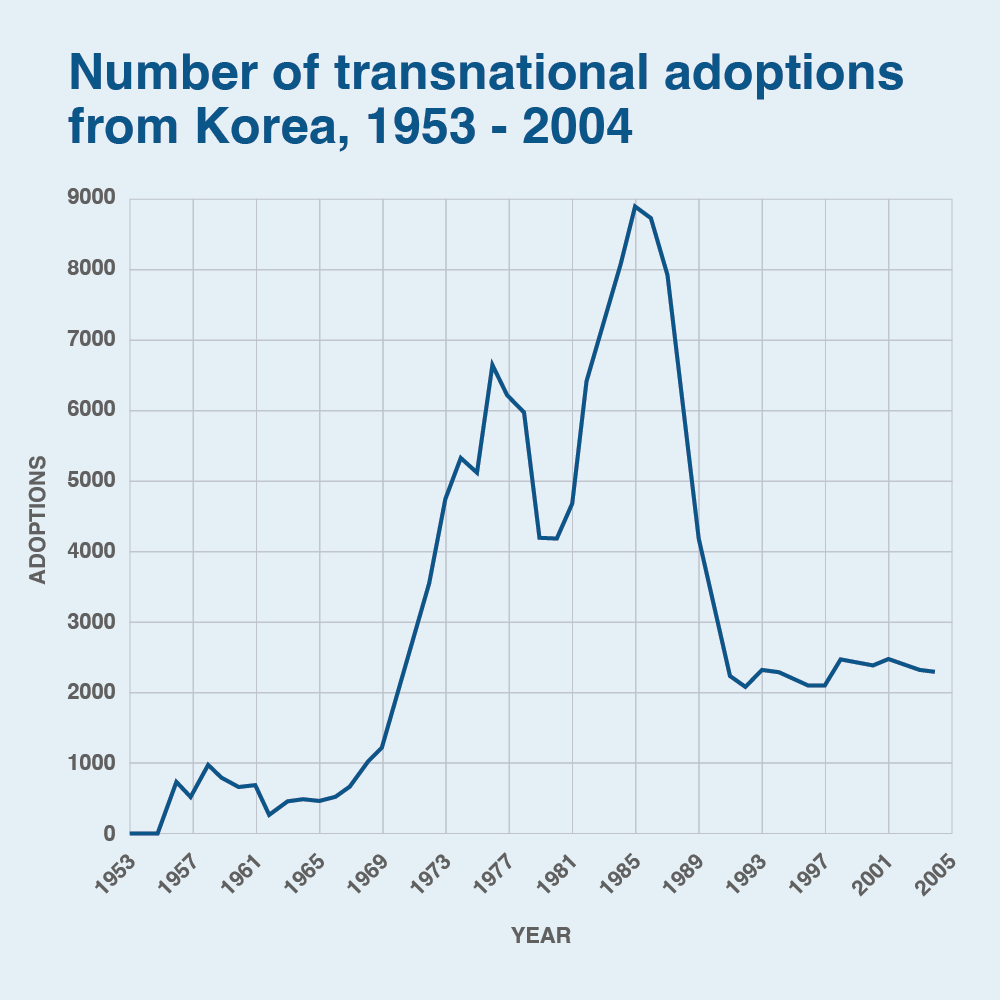
Image 14.03.04 — This graph features the number of transnational adoptions from Korea from its origins in 1953 through 2004. Korean transnational adoption is still ongoing into 2025. Data from Ministry of Health and Welfare, Republic of Korea.
Citizenship and Adoptee Rights in the US
In addition to the complex conditions that led to their adoptions, transnational adoptees were subject to an unclear legal system affecting their citizenship in the US. The Refugee Relief Act of 1953 had permitted families to adopt up to two refugee orphans through a limited number of immigrant visas. Later, a 1961 amendment to the Immigration and Nationality Act allowed adoptees to enter the US through categories separate from existing immigration legislation. According to professors and researchers Eleana J. Kim and Kim Park Nelson, “Under the 1961 legislation, a foreign-born adopted child’s legal status shifted across federal immigration categories of ‘eligible orphan,’ ‘immediate relative,’ ‘legal permanent resident,’ and if naturalized, ‘US citizen’.” 5
Naturalization as a US citizen did not occur simultaneously with adoption finalization however; one could occur without the other happening. And prior to 1978, adoptive parents had to wait two years between adoption finalization before applying for the child’s citizenship. These various statuses and systems meant that children could be legally adopted without gaining naturalization if their adoptive parents failed to follow procedures for the children’s adoption and citizenship paperwork. In addition, adoption agencies and government officials did not follow up with families to ensure all children adopted into the United States gained citizenship.
Cases of non-US citizen adoptees entered the spotlight at the close of the twentieth century, as they became more vulnerable to deportation. One law that heavily affected adoptees without citizenship was the Illegal Immigration Reform and Immigrant Responsibility Act of 1996. This law “increased importance on the removal of immigrants with criminal records” and “defined more crimes as deportable offenses and thereby rendered more people deportable.” 6 It also made misdemeanors and minor offenses punishable by deportation. As a result of these initial adoptee deportations, the US government eventually passed the Child Citizenship Act of 2000 (CCA). The CCA streamlined adoptees’ path to naturalized citizenship if they entered the US on IR-3 or IH-3 visas, both of which signify the adoption was finalized abroad. Those who entered on IR-4 or IH-4 visas would be considered permanent residents until adoption finalization occurred in the United States.
Children entering through other categories, such as humanitarian parole, also fell outside the CCA’s streamlined path to citizenship. The experiences of deported adoptees and undocumented adoptees underscore the links between transnational adopted people and other immigrants entering the United States. This particular link that aligns adoptees with other immigrants is visible in the activism of Adoptees for Justice, a transnational adoptee advocacy group formed in November 2018.
US-based adoptees have continued organizing together to support undocumented adoptees. This includes working with US legislators to sponsor the Adoptee Citizenship Act (ACA), which would provide retroactive citizenship to adoptees. The ACA would ensure that children who are adopted by US citizens but fall outside CCA eligibility can gain US citizenship and have the same rights as a non-adopted, biologically-related child of US citizens. The ACA would also protect adoptees from deportation. The ACA was introduced in Congress in 2015 and reintroduced in later years, with the latest version in 2024. As of 2025 it has not yet received a hearing, however, and groups like Adoptees for Justice continually advocate for the bill’s passage.
Building Adoptee Communities
In the 1990s, Korean adoptees gathered together and connected through their shared experiences. Prior to the growth of social networking websites, early adoptee communities often formed through newspaper advertisements and later, as internet access increased, through email lists. Minnesota Adopted Koreans, which formed in 1991 and operated throughout the 1990s, is considered the first formal Korean adult adoptee organization in the US. AK Connection in Minneapolis, Minnesota, was established in 2001. The organizations Also-Known-As in New York and Asian Adult Adoptees of Washington were both established in 1996 and remain the two longest operating adoptee-led organizations in the nation. The Association of Korean Adoptees San Francisco and Boston Korean Adoptees formed in 1997 and 1998, respectively.
In 1997, adoptees were invited to share their experiences on a panel at the Global Korean Network conference in Los Angeles, California. Then in 1999, the Gathering of the First Generation of Adult Korean Adoptees was held in Washington, DC, and became broadly cited as the first coming together of transnational adoptees worldwide. The same year, the Korean Adoptee Adoptive Family Network held their first national conference for adoptees, adoptive parents, and families.
Korean American adoptees continued building global connections in the twenty-first century. The second international gathering of adult Korean adoptees took place in 2001 in Oslo, Norway, and the third gathering occurred three years later in Seoul, South Korea. The network of International Korean Adoptees Associations (IKAA) formed in 2004 to continue building global relationships among adoptees. IKAA has sponsored triennial gatherings in Seoul since 2007, including their most recent event in 2023.
The start of the twenty-first century also saw the establishment of Adult Korean Adoptees of Portland (2001); Adoption Links, DC (2002); Korean Adoptees of Hawaiʻi (2006); and Korean Adoptees of Chicago (2008), as well as the continued growth of adoptee-led organizations. Adult adoptees actively formed connections with one another, and the rapid development of internet technologies made communication among adoptees easier through websites and apps such as Facebook, X (formerly known as Twitter), Instagram, TikTok, and BlueSky.
Meaningful growth and discussion among these communities has also led to a social awareness theory known as adoptee consciousness. Developed by Susan F. Branco, JaeRan Kim, Grace Newton, Stephanie Kripa Cooper-Lewter, and Paula O’Loughlin in 2022, the Adoptee Consciousness Model explores various touchstones—status quo, rupture, dissonance, expansiveness, forgiveness, and activism—in an adoptees’ understanding of adoption and their identity.
These touchstones represent points in an adoptee’s journey of experiencing disconnects between what they’ve been told about adoption and the reality of their lived experiences. The Adoptee Consciousness Model explains how adoptees may move back and forth from the status quo of dominant, affirmative narratives (i.e., “You should be grateful for your adoption”) to the rupture of these ideas (e.g., learning that their adoption history was inaccurate), and to an expansive understanding of multiple perspectives. It suggests that adoptees can go through this non-linear, spiral process multiple times in their lives, and their shared awareness helps create a sense of solidarity within their communities.
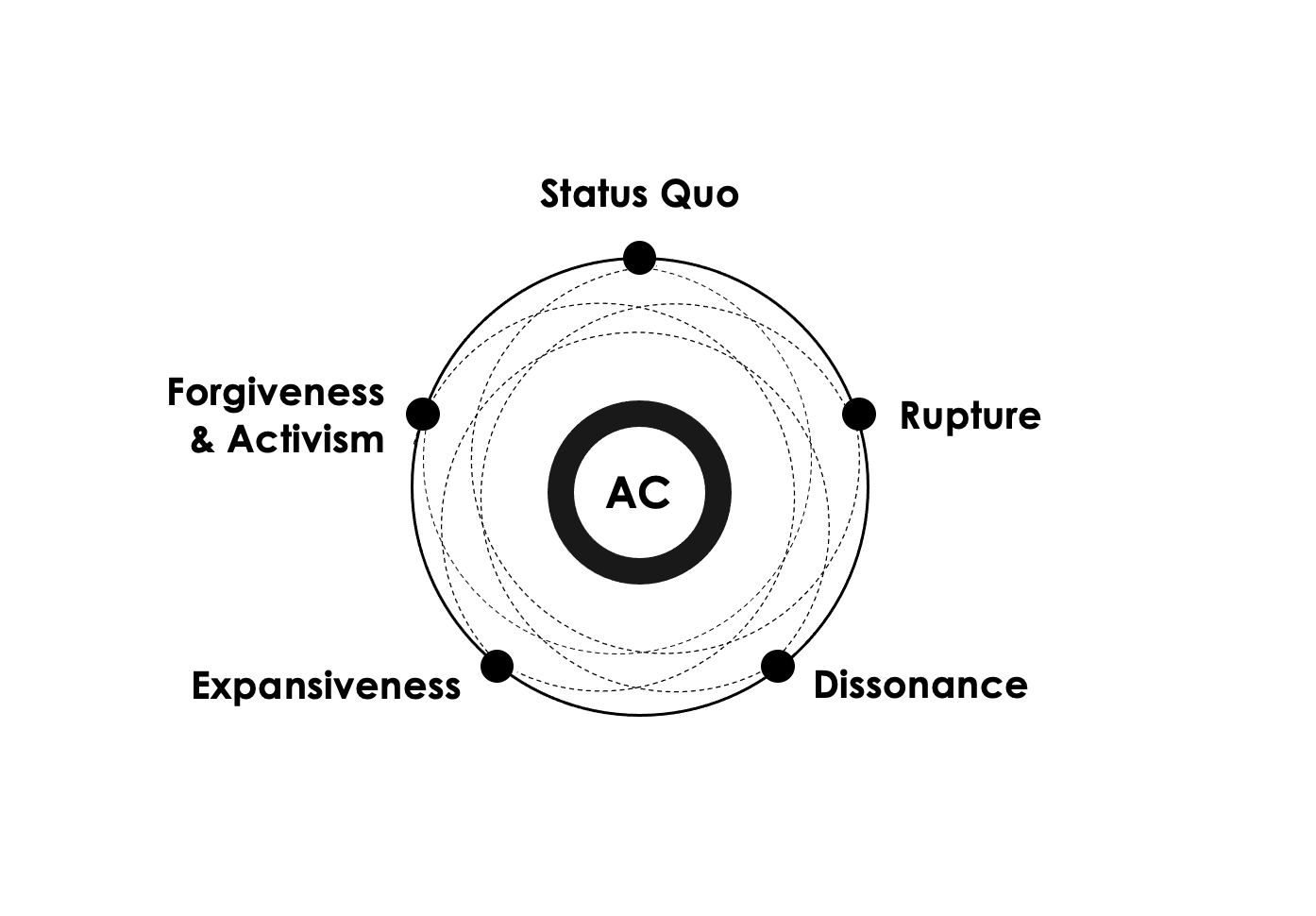
Image 14.03.05 — Developed by Susan F. Branco, JaeRan Kim, Grace Newton, Stephanie Kripa Cooper-Lewter, and Paula O’Loughlin, the Adoptee Consciousness Model reflects the touchstones in an adoptee’s journey. It contrasts a linear model of “adoption is the best option” to questioning adoption processes.
Creating New Narratives
The Korean adoptee community crosses national borders. In addition to members’ adoption to multiple countries, Korean adoptees have created and forged ties globally. Much of their efforts have been directed in Korea as adoptees have been returning to the country since the 1980s.
This includes the efforts of Global Overseas Adoptees’ Link (G.O.A.’L.), an organization in Korea that provides services to adoptees seeking information about their birth families and reconnecting with their identity. In 1999, G.O.A.’L. advocated for adoptees’ inclusion in the Overseas Koreans Act, which allowed adoptees to reside in Korea under the country’s F-4 visa. Adoptee activism in Korea has also resulted in adoptees’ access to dual Korean citizenship. Adoptees were consulted as part of the revisions to Korea’s 2012 Special Adoption Act, which encouraged domestic adoptions and aimed to improve child welfare and family support programs. Transnational networks have strengthened adoptee activism and help us further understand the global adoptee community and its breadth.
Adoptees today return to Korea through sponsored government or adoption agency programs such as motherland tours, study abroad programs, vacations with their adoptive families or chosen families, or attendance at the triennial IKAA gatherings. A small segment of adoptees have pursued searching for their birth families, but the majority are unsuccessful due to inconsistencies in their files, including missing or false information about birth dates, cities, or parents. Other avenues adoptees have used to find birth relatives include direct-to-consumer DNA genetic testing and Korean television programs that facilitated family reunions.
In March 2025, the Korean government’s Truth and Reconciliation Commission released a report acknowledging the fraud and abuse in the nation’s adoption program at the conclusion of a nearly three-year investigation into 367 complaints. That commission recognized human rights violations in fifty-six of the submitted cases. This recognition alongside Associated Press/PBS Frontline fall of 2024 reporting of adoption corruption underscores the inconsistencies and violence Adoption Studies scholars and adoptee activists have noted for more than two decades.
Adoptees’ experiences are diverse, and those that have shared their stories have challenged the dominant narratives of adoption as child-saving and rescue. The turn of the twenty-first century has seen adoptee filmmakers offering more complex tales of adoptee communities, including their own journeys returning to Korea, and the search for and reunion with their birth families. Some of these personal stories are told in the following documentary films: Jennifer Arndt-Johns’s Crossing Chasms (1998), Tammy Chu’s Searching for Go-Hyang (1998), Nathan Adolfson’s Passing Through (1999), and Deann Borshay Liem’s First Person Plural (2000).
The publication of adoptee-authored essays and memoirs also coincided at this time. The groundbreaking anthologies Seeds from a Silent Tree (1997) and Voices from Another Place (1999) feature a wide range of Korean adoptee perspectives. In addition, the following memoirs offer new insights into the effects of transnational adoption in the lives of Korean adoptees: The Unforgotten War by Thomas Park Clement (1998), Ten Thousand Sorrows by Elizabeth Kim (2000), A Single Square Picture by Katy Robinson (2002), The Language of Blood by Jane Jeong Trenka (2003), and Twins Found in a Box by Janine Vance (2003).
Listen to
Three Dreams of Korea: Notes on Adoption
Audio 14.03.06 — An audio version of “Three Dreams of Korea: Notes on Adoption,” by Lee Herrick, California Poet Laureate (2022–2023).
As the twenty-first century progresses, adoptees have continued telling their nuanced stories. In the past, writings by Korean adoptees were sometimes excluded from Asian American literary spaces. Today, however, their work is celebrated for offering valuable perspectives into Asian American and Korean American history. Contemporary adoptee writers include poet and professor Jennifer Kwon Dobbs, California Poet Laureate Lee Herrick, poet Sun Yung Shin, novelist Matthew Salesses, poet Julayne Lee, and poet and translator Marci Calabretta Cancio-Bello.
More recently, films including John Sanvidge’s Finding Seoul (2011), Glenn Morey’s Side by Side (2018), Nam Holtz’s Found in Korea (2019) have contributed to a growing body of adoptee documentaries. Tammy Chu and Deann Borshay Liem also released subsequent films, including Resilience (2009), In the Matter of Cha Jung Hee (2010), and Geographies of Kinship (2019).
In 2024, Korean American adoptee and filmmaker Jota Mun premiered Between Goodbyes, which captures the experiences of queer Dutch Korean adoptee Mieke Murkes. The film explores the relationship between Murkes and her birth family but goes beyond their initial reunion to show the long-term struggles of keeping in touch. Other documentaries chronicling the voices of European Korean adoptees include In-Soo Radstake’s Made in Korea (2006), Jun Jung-sik’s animated film Approved for Adoption (2012), and Sun Hee Engelstoft’s Forget Me Not (2019).
Korean American adoptees and theater artists have also shared their complex journeys onstage, such as in the critically acclaimed one-woman productions How to Be a Korean Woman by Sun Mee Chomet, Yellow Dress by Marissa Lichwick, and Homeful by Amy Mihyang Ginther. Other plays by adoptees, such as Middle Brother by Eric Sharp and Hello, My Name Is… by Debra Kim Sivigny, capture the nuances of adoptee kinship and community.
Korean adoptees based around the world are also connecting and sharing their stories through podcasts including Adapted Podcast, The Janchi Show, Labor of Love: A Podcast for BIPOC Adoptees Navigating Parenthood, Adoptees On, and Adopted Feels.
In offering multiple perspectives through film, literature, and other media, adoptees continually disrupt notions of adoption as a child-saving effort or fairy tale. Their personal stories have helped uncover practices of malfeasance and fraud, as well as humanize birth families. For example, some adoptees have learned how Korean families had sought to keep their children, despite their ultimate relinquishment into the adoption system. In addition, adoptees’ experiences of racism and abuse in the US and other countries challenge the idea that adoption was always the best option for them.
Collectively, adoptee-authored and produced narratives seek to reshape dominant but incomplete narratives on adoption by showing that orphanages, adoption agencies, and governments should be held accountable for their roles in the continuance of transnational adoption.
Glossary terms in this module
citizenship Where it’s used
The legal status of being a member or inhabitant of a country, in which a person gives allegiance to the government in exchange for rights and protections. This status is granted to certain individuals, either through birth or naturalization.
deportation Where it’s used
The expulsion of a person or community from one nation or territory, often because the individuals are seen as unlawful residents. Deportation efforts have historically been fueled by xenophobia and societal ideas of belonging and exclusion.
transnational adoption Where it’s used
The adoption of a child across national borders from one nation to another nation.
Endnotes
1 “Adopter of 8 Koreans Off to Get 200 More,” New York Times, March 26, 1956; “Yank Flies 76 Orphans from Korea to U. S,” Chicago Daily Tribune, March 4, 1957, sec. Part 1; “54 U. S. Couples Reach Korea to Get Orphans,” Chicago Tribune (1963-1996), November 26, 1963, sec. 2.
2 “Universal Newsreel Volume 30, Release 98,” Released December 2, 1957, https://catalog.archives.gov/id/234274145.
3 “Universal Newsreels Volume 29, Release 67,” Released August 16, 1956, https://catalog.archives.gov/id/234274010; “Universal Newsreels Volume 29, Release 103,” Released December 20, 1956, https://catalog.archives.gov/id/234274046.
4 “Universal Newsreels Volume 29, Release 67,” Released August 16, 1956, https://catalog.archives.gov/id/234274010; “Universal Newsreels Volume 29, Release 103,” Released December 20, 1956, https://catalog.archives.gov/id/234274046.
5 Eleana J. Kim and Kim Park Nelson, “‘Natural Born Aliens’: Transnational Adoptees and US Citizenship,” Adoption & Culture 7, no. 2 (2019): 263.
6 Kim and Park Nelson, “‘Natural Born Aliens,’” 266.