





Crowd of people in outdoor gathering. People hold signs calling for healing between the Korean and African American community.
Module 4: Post-1965 Korean America and 1992 Los Angeles
Have their ongoing ties with Korea impacted the lives of Korean Americans?
The Immigration and Nationality Act of 1965, also known as the Hart-Celler Act, transformed Korean America. Before the act passed, fewer than ten thousand Koreans lived in the US. This number dramatically increased during the 1970s and 1980s, when Koreans were among the largest immigrant groups arriving each year. The law also changed the dominant class and educational backgrounds of Koreans coming to the US, as the majority were professionals who gained entry in the 1970s under the act’s skilled labor provisions.
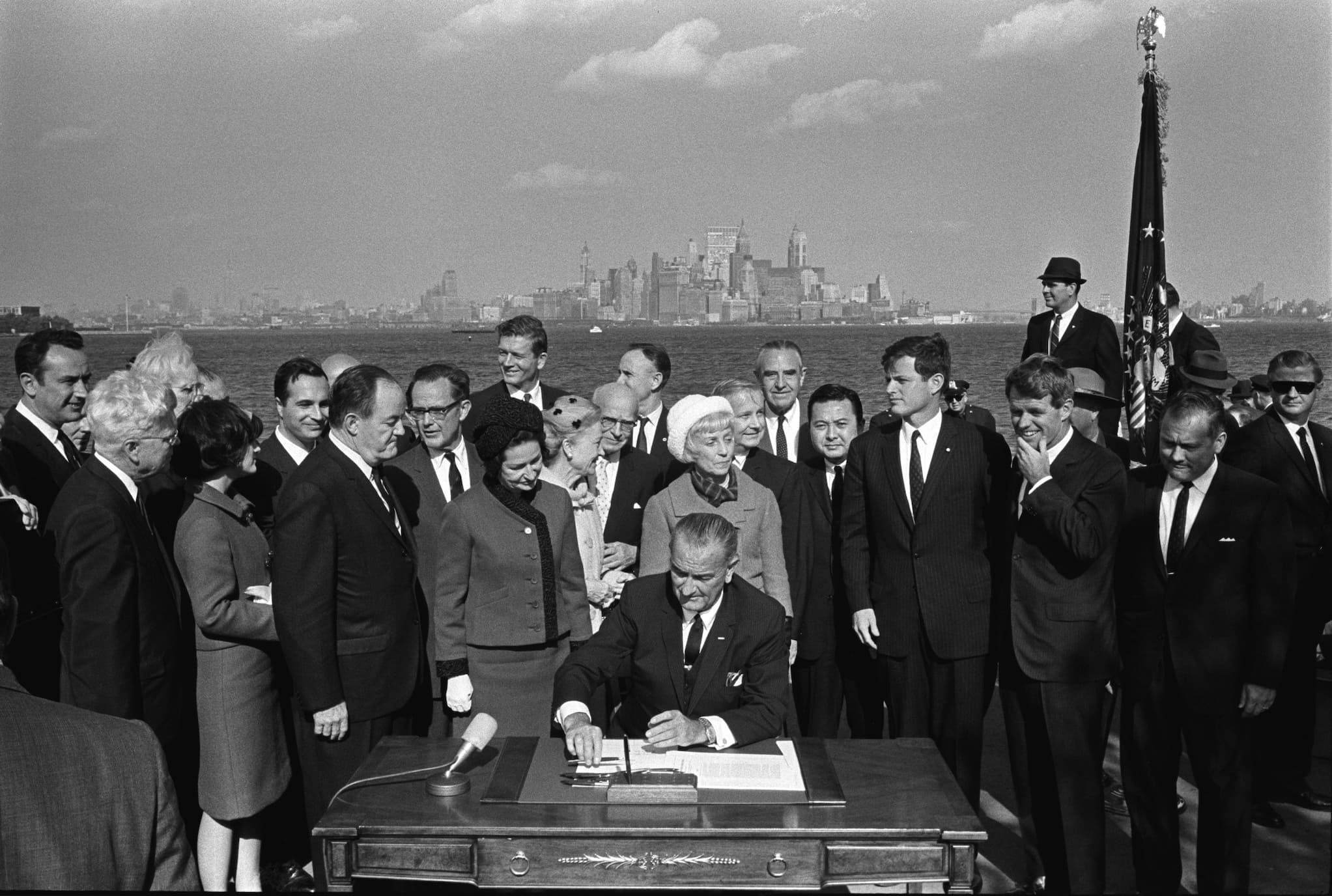
Image 14.04.01 — President Lyndon B. Johnson signs the 1965 Immigration, or Hart-Celler, Act at Ellis Island, New York. This law dramatically increased Korean immigration between 1970s and 1980s, altering the dominant class and educational background of the population.
As the Korean American population rapidly grew, many turned to small business ownership to make a living. Korean Americans opened groceries, gas stations, liquor stores, and other family-run businesses in Black and Brown communities and neighborhoods. For various reasons, this ignited resentment and interracial tensions among the different ethnic groups, which resulted in altercations, boycotts, and a six-day uprising in Los Angeles, California, in 1992. Korean Americans remember this event as Sa I Gu, which means 4-2-9 in Korean, signifying the first day of the uprising (April 29).
This module is an overview of the unprecedented effects of the Immigration and Nationality Act of 1965 on the Korean American community, the events and histories that led to the Los Angeles Uprising, and the aftermath of this event.
How did the 1965 Immigration Act transform Korean American communities?
How did the media play a part in creating harmful depictions of Korean Americans that led to the devastation of Sa I Gu?
What are some of the legacies of Sa I Gu?
Immigration and Nationality Act of 1965
The immigration system created by the 1965 law allowed Koreans to enter the US in large numbers, but limited what they could do and where they could work. The act was designed to meet the United States’ economic needs without creating competition for white workers.
For example, medical professionals made up a sizable number of Korean migrants. Between 1966 and 1979, more than thirteen thousand doctors, nurses, and pharmacists left South Korea for the United States, and their career placements—approved by the updated immigration law—were strategic. Immigrant medical professionals filled labor shortages that native-born medical professionals did not want. They worked in low-paying jobs in crowded city hospitals, government facilities, and rural parts of the country, which were far from urban Korean American communities. This pattern of labor migration was replicated in other fields too, such as engineering. Other post-1965 immigrant communities faced similar circumstances.
Anticipating limits to their professional advancement, many Korean immigrants turned to small business ownership, even though many had professional training in other industries. Language barriers made traditional career pathways difficult in the US, from taking licensing exams to completing job interviews and employment applications, as well as facing racism in the job market. Although operating a small business had many downsides—strenuous manual labor, long hours, and losses or danger in neighborhoods with substantial crime rates—many decided the potential rewards justified the risks.
By the mid-1980s, Koreans were one of the immigrant groups with the highest rates of self-employment, with as many as one-third owning or operating a small business. Korean small businesses were a common sight in low-income, majority-Black and Brown neighborhoods like South Los Angeles and Brooklyn, New York. These small businesses often supported entire extended families and were critical to the livelihood of the immigrants who ran them, as well as the many non-family members they employed.
Susie Min and her family’s experience resembled many other Korean immigration stories of the time. Min was educated as a nurse in South Korea and planned to pursue nursing after she obtained her visa to the United States. Her husband saw greater opportunities in small business ownership, however, so they opened a small family-run grocery store in Brooklyn in 1979. The couple resided with their children in New Jersey, but for six years, Min and her husband alternated going home to the children and sleeping in the apartment above the store so they could work sixteen-hour days. They found some relief when additional family members immigrated and helped ease the workload. The grocery, now a delicatessen, continues to support multiple members of Susie Min’s extended family more than four decades later.
Interracial Conflict
As the number of Korean businesses grew, conflict also increased between Korean storekeepers and local Black residents in New York, Los Angeles, and other cities. By the late 1980s and early 1990s, perceptions of Black-Korean conflict had become a national narrative visible in popular culture. For example, Spike Lee’s film Do the Right Thing (1989) featured scenes that portrayed tensions between Korean business owners and Black locals, and in the 1991 song “Black Korea,” rapper Ice Cube warned that if Korean storekeepers continued discriminating against Black customers, their businesses would be boycotted and even burned.
These examples in pop culture can be understood as a reaction to, and reflection of, real-life incidents and their reporting by mainstream news media. In 1990 local Black communities in Brooklyn staged an eighteen-month boycott of two Korean-owned produce stores after a physical altercation between a Black customer of Haitian descent and a Korean storekeeper, who had accused the customer of stealing. It became known as the Red Apple Boycott and attracted media attention across the country, as politicians and community activists in and outside of New York weighed in on who was to blame.
During the 1980s in Los Angeles, nineteen Korean storekeepers were killed, primarily by Black perpetrators, with most of the incidents occurring during robberies. In 1991 alone, Koreatown saw an alarming surge in violence, including forty-eight murders and over 2,500 robberies.
The story of Latasha Harlins also became a key event leading up to Sa I Gu. On the morning of March 16, 1991, Soon Ja Du, the Korean store owner of Empire Liquor Market in South Los Angeles, shot and killed Harlins, a fifteen-year old Black girl. During the trial, Du testified that the shooting was in self-defense, believing her life was in danger, and that Harlins had been shoplifting. However, two witnesses, as well as the store’s security camera video, contradicted her statements. Police later confirmed there was no shoplifting attempt. Moreover, Du had shot Harlins in the back of the head as Harlins turned to leave the store, casting doubt on the claim of self-defense. While a jury found Du guilty of voluntary manslaughter, which would have required up to sixteen years in prison, Judge Joyce Karlin gave Du probation, community service, and a fine instead.
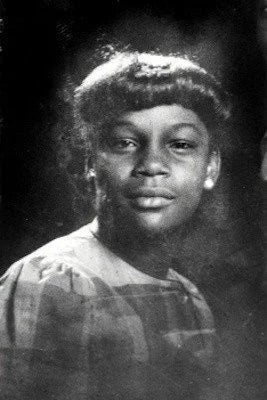
Image 14.04.03a — Latasha Harlins, a fifteen-year-old Black girl whose tragic shooting by a Korean American storekeeper in 1991 became a catalyst for racial tension and protests in Los Angeles, California. She has been memorialized in films, murals, literature, and more.
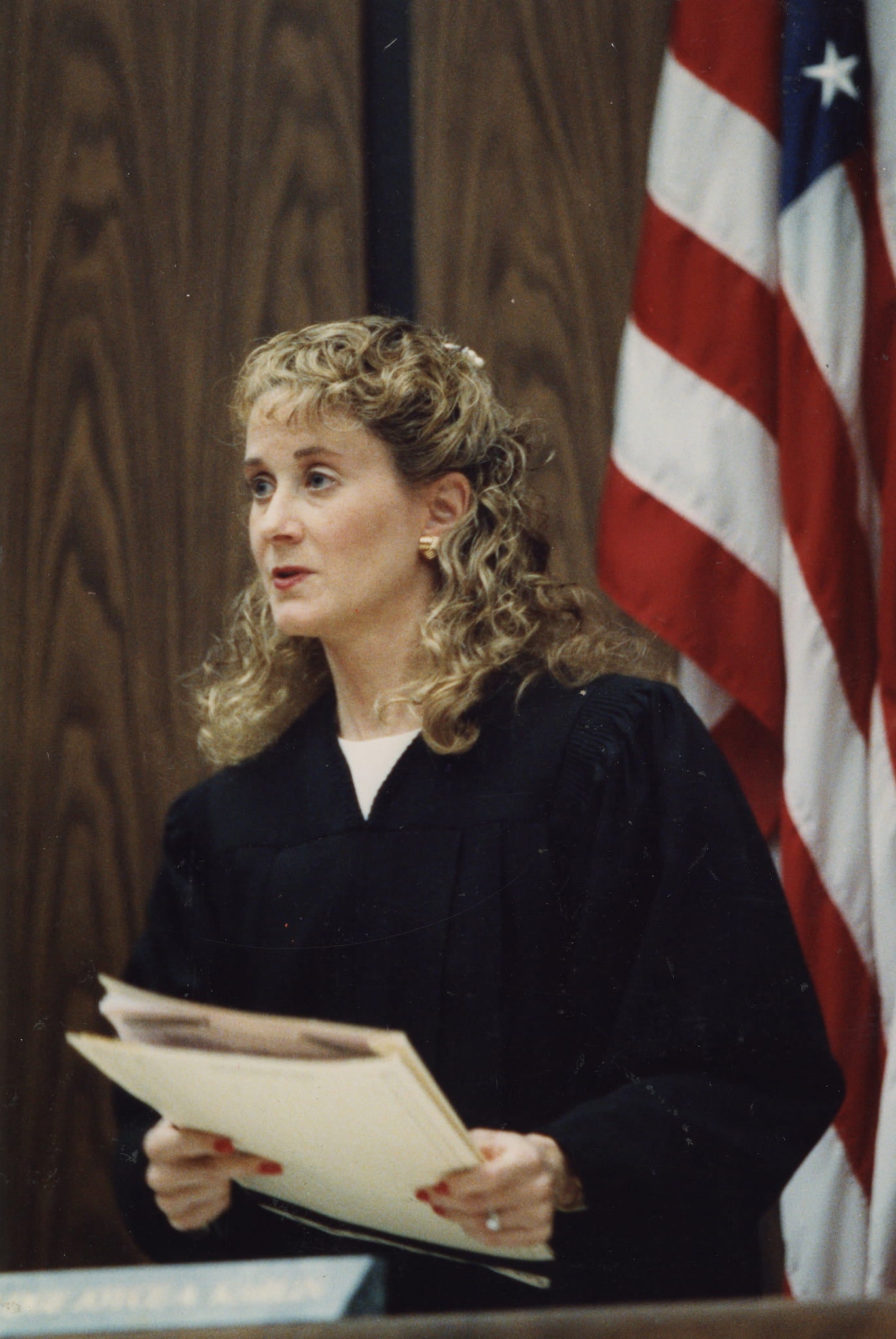
Image 14.04.03b — Judge Joyce Karlin, who controversially sentenced Korean storekeeper Soon Ja Du to probation after her conviction for the voluntary manslaughter of Latasha Harlins, sparked widespread anger in Black communities.
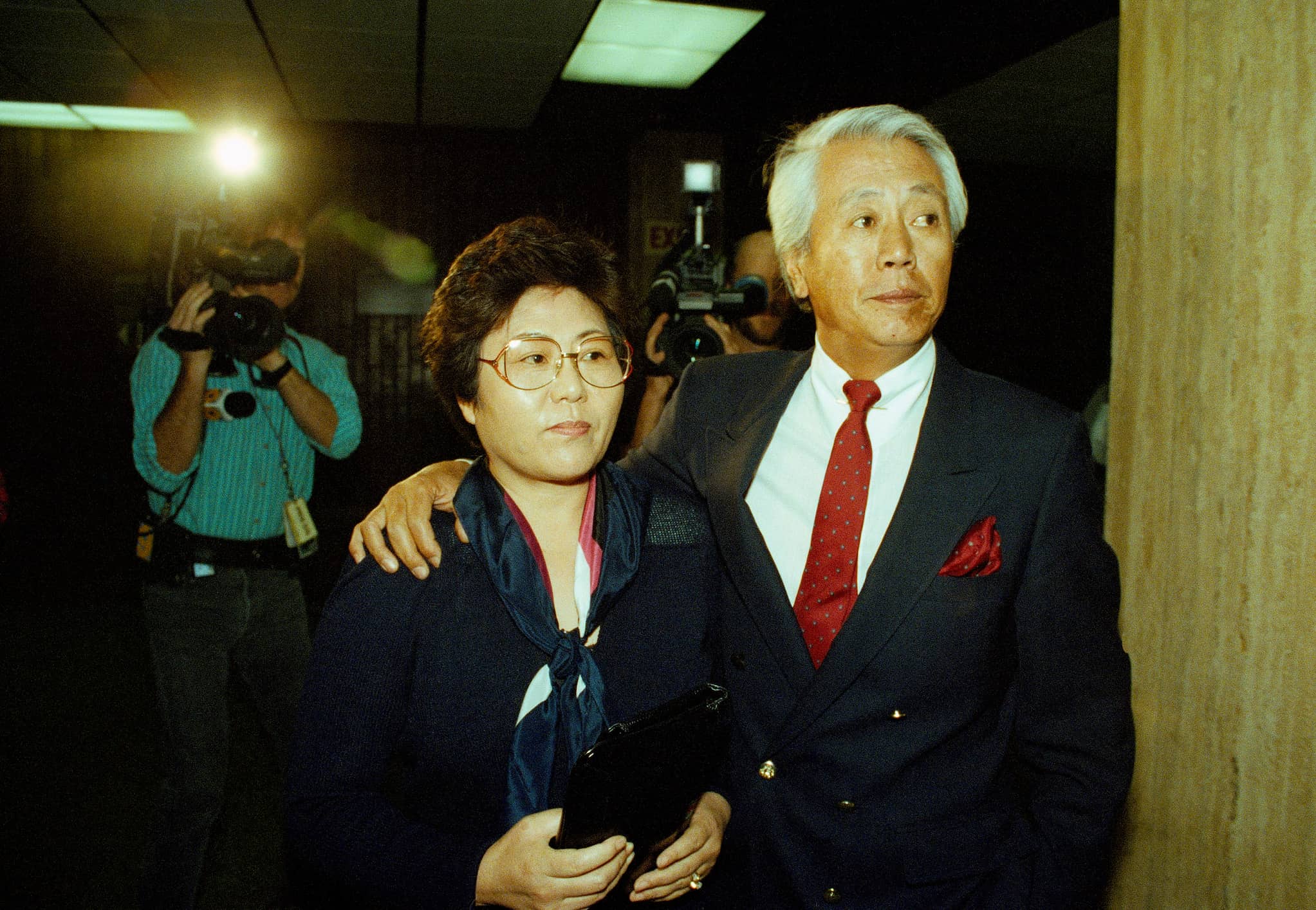
Image 14.04.03c — Soon Ja Du, the Korean storekeeper whose shooting of Latasha Harlins ignited protests and heightened racial tension between Korean storekeepers and Black communities in Los Angeles, California.



The judge’s decision sparked protests and anger among Black communities. This resentment and increasing racial conflicts contributed to the 1992 Los Angeles Uprising. The Uprising began after the acquittal of four white police officers who had violently beat Rodney King, a Black man, during a traffic stop. Many were angered by the jury’s decision and protested and rioted in different areas of Los Angeles for six days. It was often impossible for people to separate the Latasha Harlins and Rodney King cases, especially Los Angeles residents. Local news media played videos from the two cases on a loop, making them inseparable in many people’s minds. When protests and violence began over the injustice of the King case, many Black and Brown Angelenos also saw Koreans as part of the problem for a variety of reasons. For example, state liquor licensing policies allowed for the concentration of liquor stores in low-income neighborhoods, cultural differences led customers to feel disrespected by some owners, and bank redlining made it difficult for local residents to start businesses in the affected area. Some vented their anger and frustration on Korean-owned stores.
Some stores with “Black-owned” or “Latino-owned” signs were spared during the riots, underscoring the role of racial resentment in the targeting of Korean stores. Amid the violence, Korean store owners across South Los Angeles and neighboring Koreatown appealed to the Los Angeles Police Department for protection, but received none. Many instead resorted to community-based communication and mutual aid. Radio Korea, a local Korean-language station, became a lifeline for many storekeepers and workers, alerting them to sites of violence and where to find resources for mutual aid and protection.
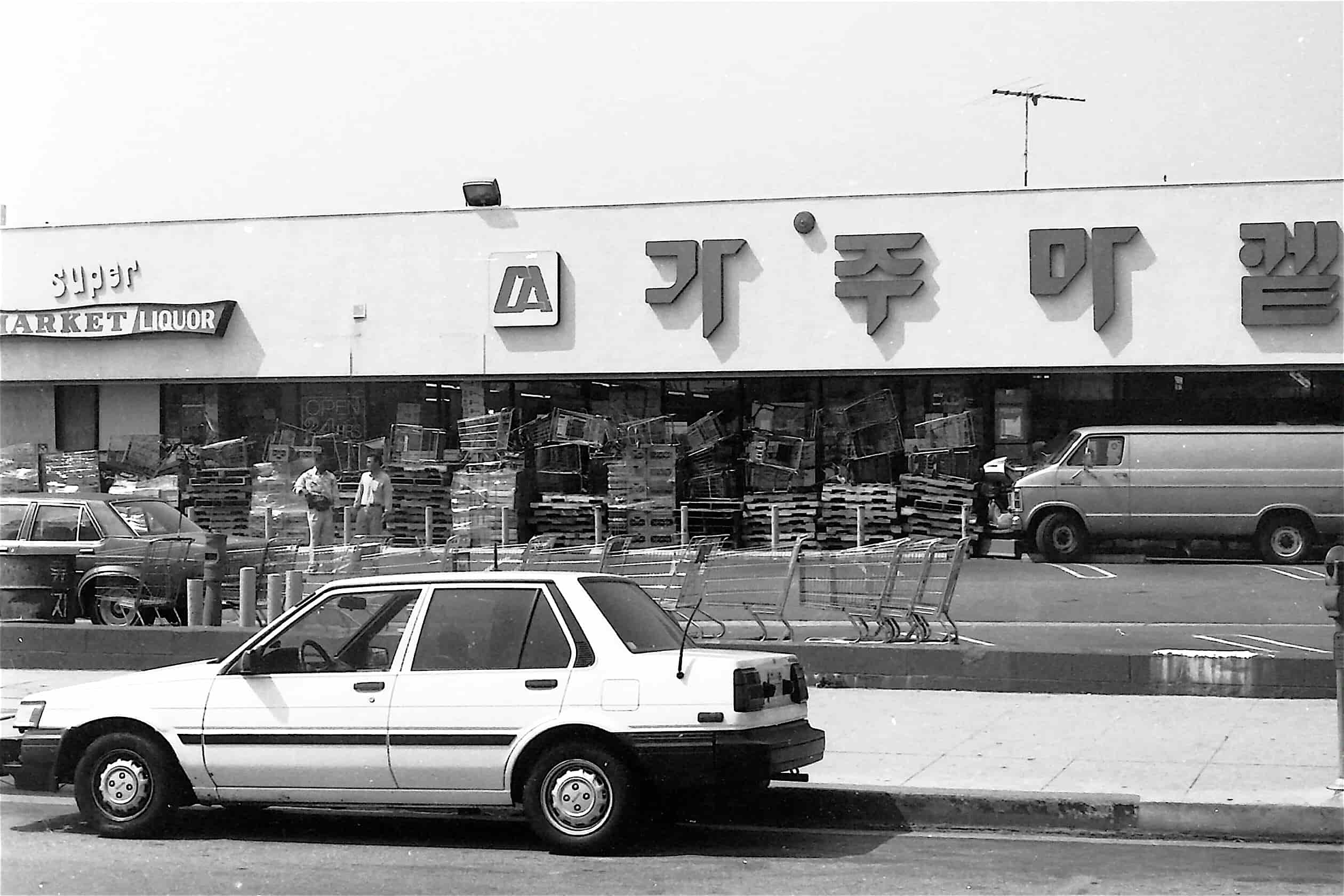
Image 14.04.04 — Many Black and Brown Angelenos also saw Koreans as part of the problem. Some vented their anger and frustration on Korean-owned stores. In this image, Korean store owners barricade their store to protect their livelihoods.
The Aftermath of Sa I Gu
Many community members have described the events of 1992 as a wake-up call, a moment when Korean Americans, historically marginalized, were suddenly thrust into the center of the stories dominating US mainstream media. But most journalists and white newsrooms had little knowledge of or connections to Korean immigrant communities. One result of Sa I Gu was distorted media coverage of Korean Americans that substituted substance with sensationalism. TV news outlets and newspapers like CNN and the Los Angeles Times broadcasted and published images of middle-aged Korean men holding rifles on store rooftops and watching for intruders during the Uprising, photos which contributed to the public’s perception of Korean storekeepers as dangerous vigilantes in a lawless city.
Lacking business insurance, these storekeepers believed protecting their business was a rational choice. Mainstream news platforms did not report that the Los Angeles Police Department had ignored their calls for assistance, or the fact that compulsory military service in South Korea meant that most of these immigrant men had formal firearm training. Much of this was instead covered by Asian American journalists at the English-language edition of The Korea Times.
Immediately following the events of 1992, Korean Americans argued that their community needed stronger political and media representation to ensure they could never be misrepresented or distorted in this way again. Although many Koreans became disillusioned at their prospects in the US after Sa I Gu and left the country, other Korean immigrants in Southern California turned to greater engagement in political spaces and local organizations.
The push for mainstream representation and political clout shifted generational dynamics. Historically, Korean community leaders were first-generation immigrants whose limited English skills were a barrier in forging ties with American politicians and institutions with political power. As a result, Korean American voices had been absent from mainstream media narratives. After Sa I Gu, second-generation and 1.5 generation (those who had immigrated to the US as children) Korean Americans with greater English facility took on more visible and active roles in voicing the interests of their community in mainstream, white-led media. These leaders included community activists and academics such as Angela E. Oh, Roy Hong, Marcia Choo, and Bong Hwan Kim.
On ABC’s news program Nightline, Angela E. Oh expressed the concerns of the Korean immigrants often ignored and overlooked by mainstream media accounts of the 1992 Uprisings. Oh also asserted that the Uprising was a result of larger political, economic, and social systems, rather than the fault of Black and Korean communities. In the same year, the Korean American Journalists Association lobbied for an end to biased and ill-informed reporting on the Korean immigrant community by the Los Angeles Times. The newspaper later hired K. Connie Kang, a Korean-speaking reporter. Kang wrote for the Times until 2008 and is considered one of the first Korean American women reporters in the United States.

Image 14.04.05 — K. Connie Kang (left) was a pioneering Korean American journalist, and the first Los Angeles Times reporter of Korean descent.
First-generation Korean immigrants also seized upon the disruptions and aftermath of Sa I Gu to enter mainstream politics. Perhaps the best known was Jay Kim, a businessman who used debates over how to rebuild South Los Angeles to become the first Korean American congressman in US history. Elected in November 1992, former congressman Kim represented parts of Los Angeles County and Orange County. He promised to incarcerate those involved in Sa I Gu and to deport as many “illegals” as possible. Kim sponsored legislation to strip undocumented immigrants of eligibility for public assistance and to strengthen deportation—even though these measures negatively impacted the Korean American community. Nonetheless, his election marked a change in the Korean American community, as their focus on Korean homeland politics shifted toward Korean American representation and engagement in US politics and society.
Conclusion
Over thirty years later, Sa I Gu continues to occupy an ambivalent but important place in the history of Korean America. Both the destruction and the government’s failure to prevent or meaningfully address it left many Korean Americans disillusioned and disappointed at their prospects in their adopted country. Some left the United States, never to return. Those who stayed generally felt Sa I Gu demonstrated the need to build political clout and invest more deeply in mainstream institutions, both for their own protection and for the sake of their children’s futures in America.
As professor Edward T. Chang explained, “Prior to 1992, Korean immigrants considered themselves Korean. But after 1992, they began to call themselves Korean Americans.” 1 They started understanding their shared identity as Korean Americans, whose future lay in the US, not in Asia. In the words of journalist K. W. Lee, “Korean Americans were born out of the ashes of the Los Angeles Riots.” 2
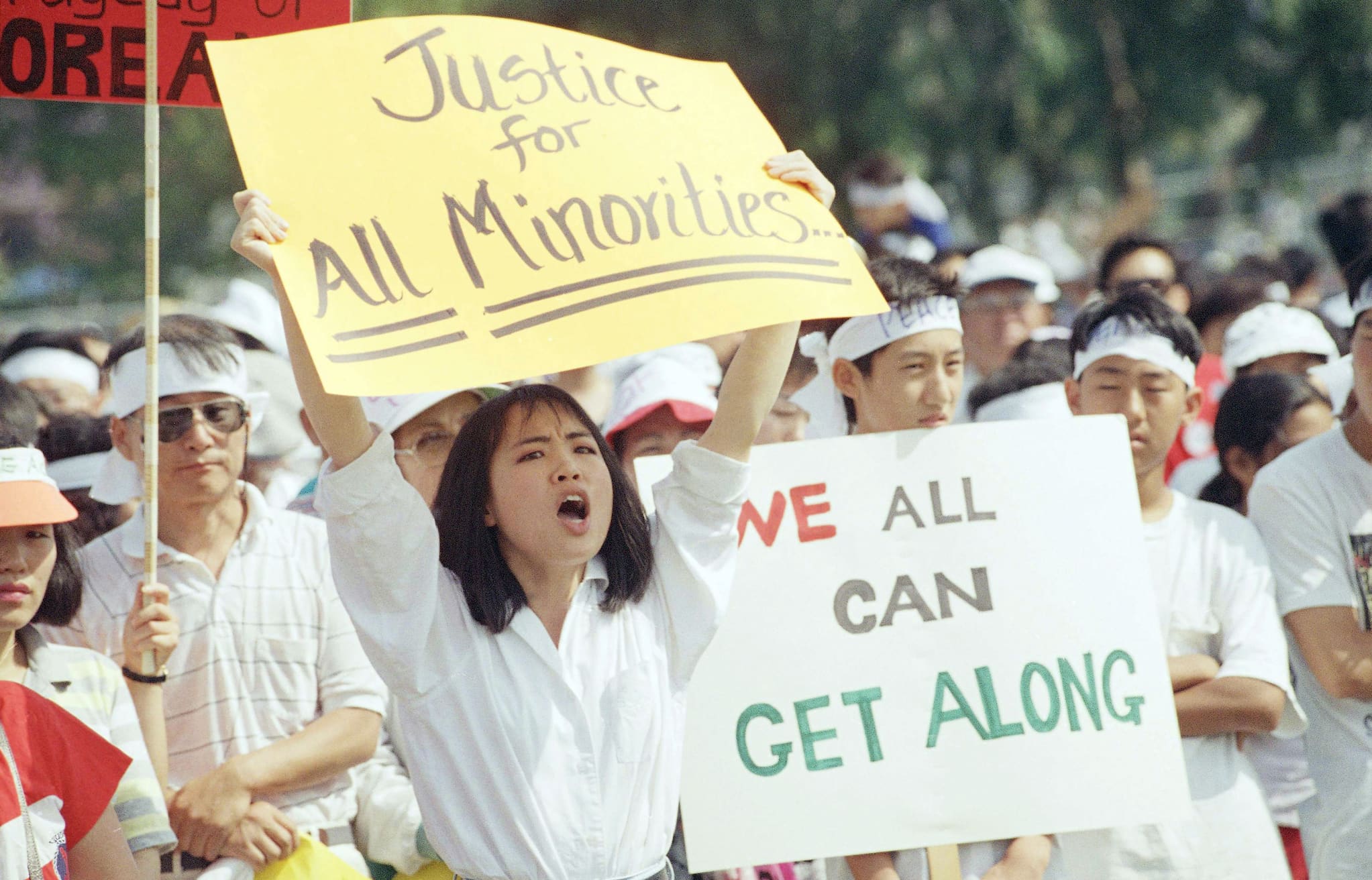
Image 14.04.06 — Protesters at a rally on May 2, 1992, march for racial solidarity between Korean and Black Americans in Los Angeles, California.
Glossary terms in this module
deportation Where it’s used
The expulsion of a person or community from one nation or territory, often because the individuals are seen as unlawful residents. Deportation efforts have historically been fueled by xenophobia and societal ideas of belonging and exclusion.
Immigration and Nationality Act of 1965 Where it’s used
This act, also known as the Hart-Celler Act, officially ended the era of Asian Exclusion and created an immigration system based on family relationships and job skills. The law significantly changed the demographics of Asian immigrants.
Sa I Gu Where it’s used
4/29 (or April 29) in Korean; Korean Americans use this term to refer to the 1992 Los Angeles Uprisings.
Endnotes
1 Edward T. Chang, “How Koreatown Rose From The Ashes Of L.A. Riots,” interview by Karen Grigsby Bates, NPR News, April 27, 2012, https://www.npr.org/2012/04/27/151524921/.
2 Edward J. W. Park, “From an Ethnic Island to a Transnational Bubble: A Reflection on Korean Americans in Los Angeles,” Amerasia Journal 38, no. 1 (2012): 44.