





Painting of Ka’anapali, Maui. Kānaka ʻŌiwi bring in their catch and wa’a kaulua while a wa’a heads out. Behind them are poi fields, rainbow, and hale.
Module 2: Ea Hawaiʻi: Kānaka ʻŌiwi Governance
Can we learn from Kānaka ʻŌiwi and the practice of aloha to understand sovereignty among Indigenous peoples around the world?
Source Darkness: First Era of Life in the Islands (Kumulipo: Ka Wā Akahi)
ʻO ke au i kahuli wela ka honua
ʻO ke au i kahuli lole ka lani
ʻO ke au i kū kaʻi aka ka lā
E hoʻomālamalama i ka mālama
ʻO ke au o Makaliʻi ka pō
ʻO ka walewale hoʻokumu honua ia
ʻO ke kumu o ka lipo, i lipo ai
ʻO ke kumu o ka Po, i po ai
ʻO ka lipolipo, ʻo ka lipolipo
ʻO ka lipo o ka lā, ʻo ka lipo o ka pō
Pō wale hoʻi
Hānau ka pō
Hānau Kumulipo i ka pō, he kane
Hānau Pōʻele i ka pō, he wahine.
When space turned around, the earth heated
When space turned over, the sky reversed
When the sun appeared standing in shadows
To cause light to make bright the moon,
When the Pleiades are small eyes in the night,
From the source in the slime was the earth formed
From the source in the dark was darkness formed
From the source in the night was night formed
From the depths of the darkness, darkness so deep
Darkness of day, darkness of night
Of night alone
Did night give birth
Born was Kumulipo in the night, a male
Born was Pōʻele in the night, a female. 1
Totaling 2,102 lines, this famous genealogy chant, known as “Kumulipo,” traces the evolution of natural life forces in the Hawaiian Islands out of the depths of darkness. It begins with the creation of corals, seaweeds, and shellfish. These are followed by the plants of the forest, fish, insects, birds, and the various elemental forces of nature personified as akua (deities). It culminates in the succession of chiefs who ruled the islands of Hawaiʻi. All of these stages of life lead up to the birth of the High Chief Ka-ʻi-ʻi-mamao (also known as Lonoikamakahiki), an ancestor of the last two rulers of the Hawaiian Kingdom, King Kalākaua and his sister Queen Liliʻuoklani. This lineage firmly grounds their right to govern Hawaiʻi, the islands from which they descend. This module explores the role of genealogies among Kānaka ʻŌiwi and the nation of Hawaiʻi and the United States’ part in illegally annexing Hawaiʻi.
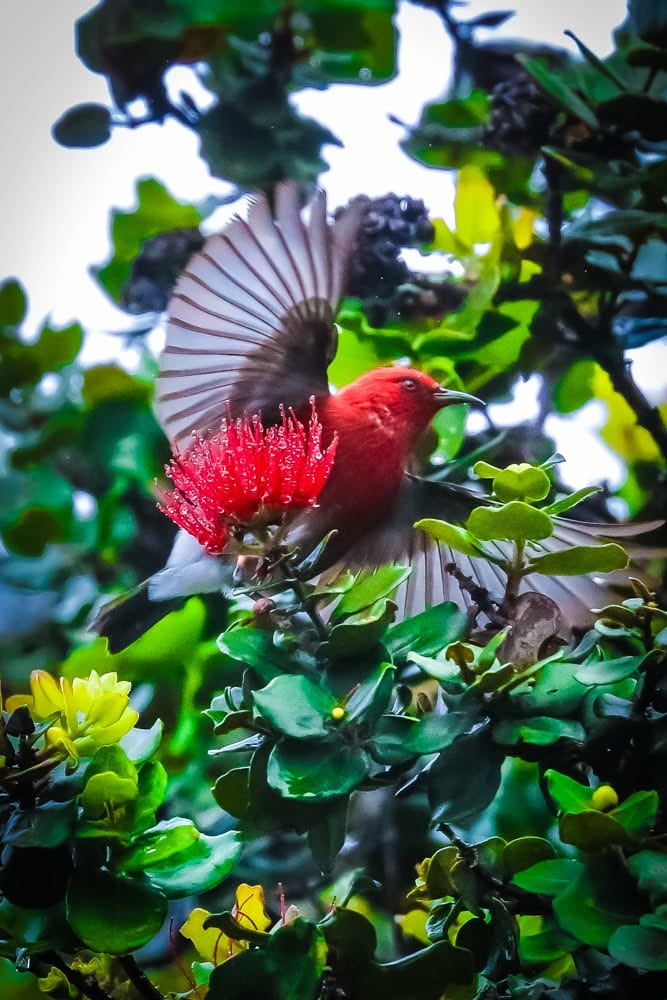
Image 22.02.01 — Multiple species of ʻŌhiʻa trees thrive in native rainforests throughout the islands. With its honeycreeper beak, the ʻIʻiwi feed off ʻŌhiʻa lehua blossoms (pictured). Unfortunately, ʻIʻiwi and other native birds are threatened by avian malaria spread by mosquitoes.
The Kumulipo is also an excellent example of how Hawaiian scientific knowledge about the natural world of the Hawaiian islands was passed down orally, through mele and oli, from one generation to the next until they were written and translated. According to University of Hawaiʻi-Mānoa Hawaiian Studies professor, Dr. Lilikalā Kameʻeleihiwa, within the Kumulipo we learn about the eight hundred generations of ancestors who lived before the Polynesian chiefs and priests navigated north across the ocean to the Hawaiian Islands from Tahiti and the Marquesas. There are at least one hundred generations of ancestors who lived in Hawaiʻi up through Queen Liliʻuokalani.
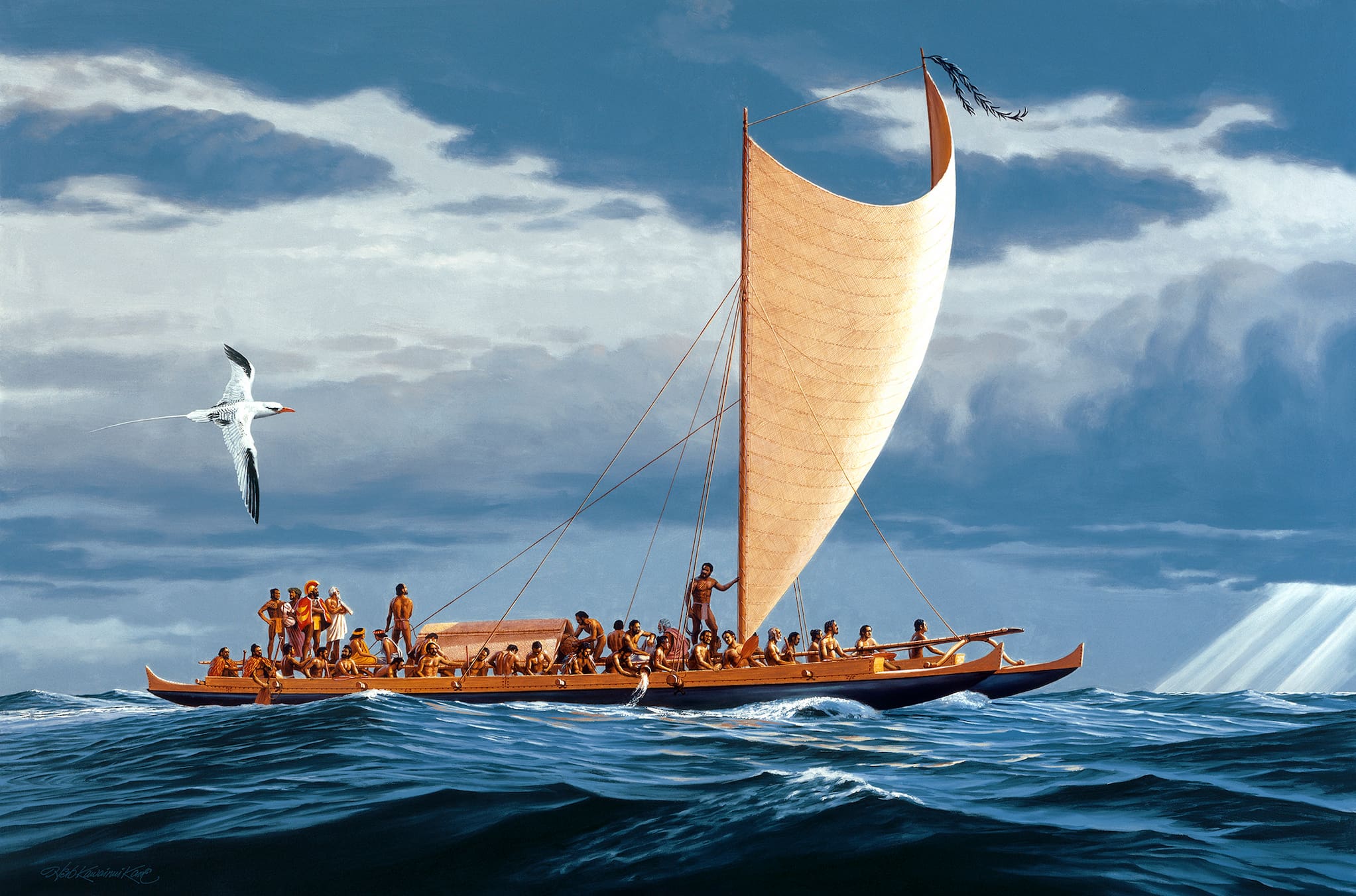
Image 22.02.02 — ʻŌiwi artist Herb Kāne’s rendering of a waʻa kaulua double-hulled voyaging canoe carries chiefly Polynesian families to Hawaiʻi. Kāne famously designed the modern day Hōkūleʻa double-hulled voyaging canoe that has carried Kānaka ʻŌiwi throughout Polynesia and around the world.
What is the role of genealogies in connecting Kānaka ʻŌiwi identities to each other and to the Hawaiian nation?
How do the stages of Kānaka ʻŌiwi governance, or ea, lay the foundation for ʻŌiwi self-governance?
What evidence and pathways are available to Kānaka ʻŌiwi to show that Hawaiʻi was not legally annexed by the United States?
Moʻokūʻauhau: Hawaiʻi Lineages
From the Kumulipo we learn of major lineages who settled Hawaiʻi: the Palikū, the ʻOlolo, the Kumuhonua, and the Kumuuli. Of these clans, the Kumulipo teaches us that the Palikū is the oldest, beginning in Hawaiʻi around 600 BCE. This is determined by counting back from Queen Liliʻuokalani in 1893 and using twenty years per generation. This and other genealogical chants of Hawaiʻi’s chiefs justify its governance by the ruling chiefs as descendants of the natural life forces and the islands themselves.
The genealogies place the ancestors of Kānaka ʻŌiwi from Tahiti and the Marquesas perhaps as early as 600 BCE, while archaeologists place the early settlements between 300 CE and 600 CE. Ethnographer E.S. Craighill Handy and ʻŌiwi scholar Mary Kawena Pukui describe the early landscapes:
For generations the small, slowly growing population clustered around shore sites near streams that supplied them with water. Such sites are best for inshore fishing. When they had acquired taro, they no doubt rapidly cleared away the jungle along the streams to make room for taro patches, and there was a beginning of terraced flats that could be irrigated directly from the stream. 2
As the families expanded from generation to generation, the cultivation of the landscape expanded through irrigation and aquaculture engineering supervised by emergent chiefs.
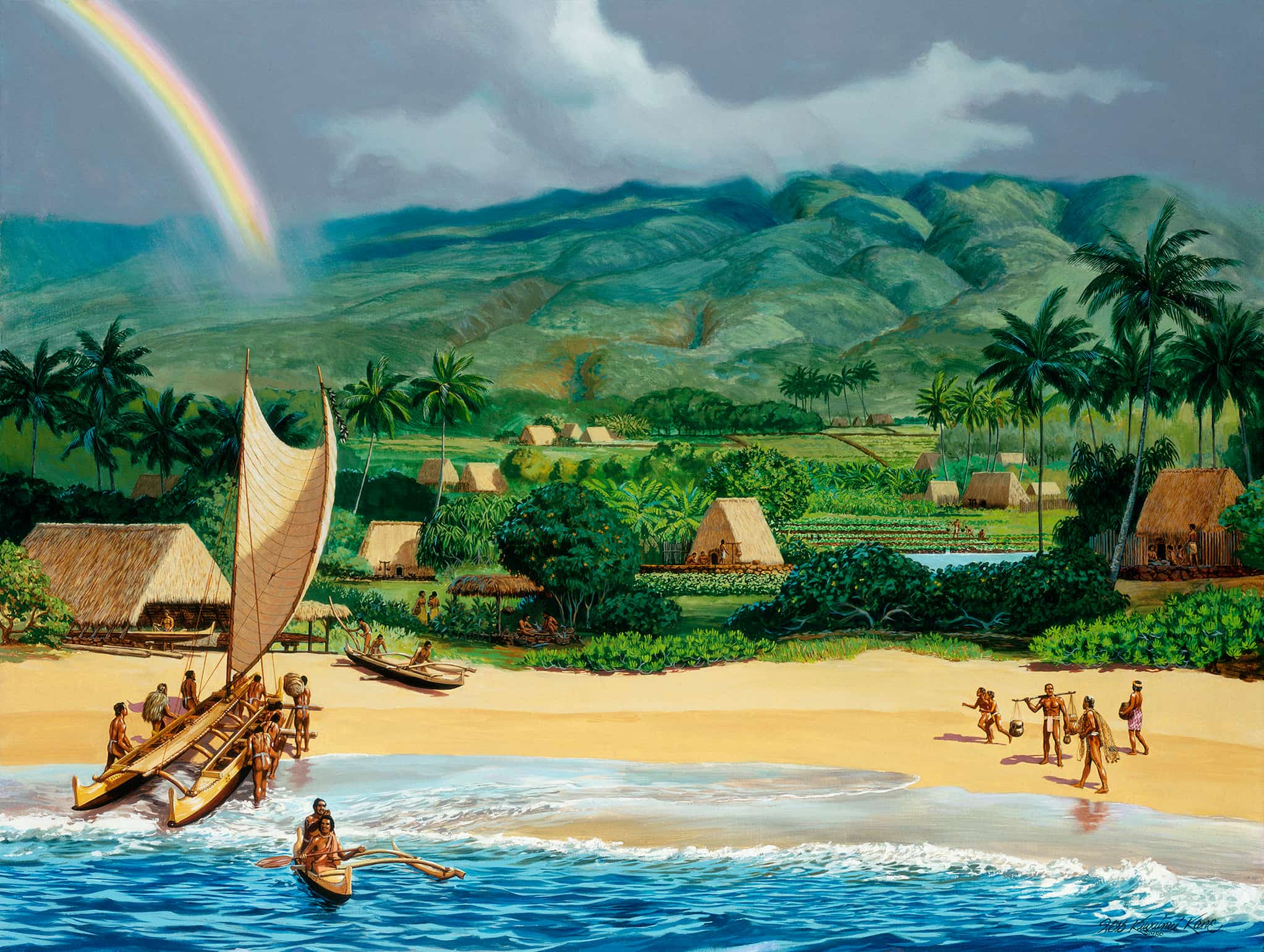
Image 22.02.03 — Herb Kāne’s illustration of a seaside kauhale, or ʻŌiwi family compound, at Kaʻanapali, Maui, adjacent to Lahaina. The painting features taro pond fields, fishing canoes, and other native domestic plants.
Ruling Chiefs and Hawaiʻi Governance
Sovereignty is the supreme power or authority to govern. The ʻŌiwi word for sovereignty is “Ea” which also means “Life” and “Breath.” Not only do these multiple meanings signify that the sovereign authority to govern is as essential to the survival of a people as breathing is to life, it also signifies that the sovereignty of Hawaiʻi is rooted in the progression of life in the Hawaiian islands, and enhanced by chiefs who exert their rule over space and through time.
Around 1000–1200 CE, the ʻŌiwi social system reached a critical turning point when a sizeable and rapidly expanding population occupied all of the districts on all of the islands. Ruling chiefs emerged in each district and established stewardship over the land. They took on the responsibility of organizing the makaʻāinana (common people) in the construction of irrigation networks, food systems, and aquaculture fishponds. This intensified the production of food and basic necessities to sustain the rapidly expanding population.
Later, one of the key developments that occurred in 1120–1225 CE was the creation of an ʻaha aliʻi, or council of the district chiefs, on each island to sustainably manage the island as a whole, rather than district-by-district. Eventually, around 1500 CE, each island council of chiefs appointed an Aliʻi Nui (High Chief) as an island ruler. The islands then began to be ruled as four individual chiefdoms: (1) Niʻihau and Kauaʻi, (2) Oʻahu, (3) Maui Nui including Māui, Lānaʻi, Kahoʻolawe and Molokaʻi, and (4) Hawaiʻi. This continued from 1500 CE to 1810 when King Kamehameha I united all of the islands under a central government.
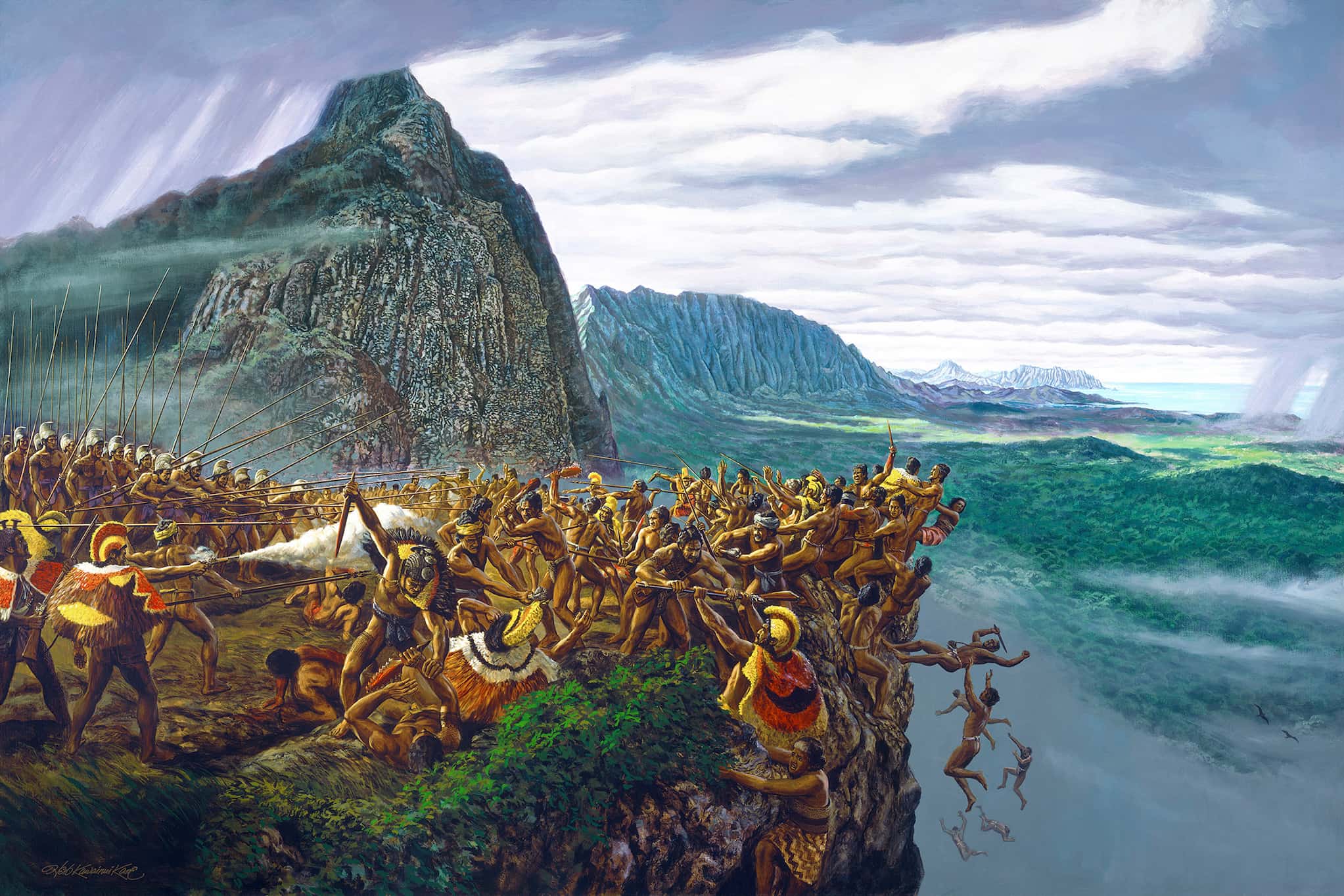
Image 22.02.04 — This painting by Herb Kāne depicts Kamehameha I’s victory in the battle of Nuʻuanu in 1795. After this battle, Kamehameha controlled all of the islands except Kauaʻi and Niʻihau, which he ultimately gained control over in 1810.
The Formation and Seizure of the Hawaiʻi Monarchy
In 1839—40, King Kamehameha III established a constitutional monarchy that ruled Hawaiʻi until 1893. In 1842-43 the United States, Great Britain and France recognized the independence of Hawaiʻi. Recognition by other European and Pacific countries and Japan followed. November 28, 1843, the day that Great Britain and France signed the treaties recognizing Hawaiʻiʻs independence, was declared Lā Kūokoʻa or Hawaiʻi Independence Day, and annually celebrated by the Hawaiian Kingdom and constitutional monarchy until 1893. The celebration of Lā Kūʻokoʻa as a significant holiday has recently been revived in Hawaiʻi.
In 1893, as noted in a US Congressional Joint Resolution of Apology, “the United States Minister assigned to the sovereign and independent Kingdom of Hawaii conspired with a small group of non-Hawaiian residents of the Kingdom of Hawaii, including citizens of the United States, to overthrow the Indigenous and lawful Government of Hawaiʻi.” 3 On January 16, 1893, the US minister landed 162 US marines, each carrying eighty rounds of ammunition, one gatling gun and one 37-millimeter revolving gun, to threaten Queen Liliʻuokalani.
Supported by this US military invasion, the conspirators proclaimed themselves to be the Provisional Government for Hawaiʻi the following day. Out of concern for her people, the Queen yielded her authority: “Now to avoid any collision of armed forces, and perhaps the loss of life, I do this under protest and impelled by said force yield my authority until such time as the Government of the United States shall, upon facts being presented to it, undo the action of its representatives and reinstate me in the authority which I claim as the Constitutional Sovereign of the Hawaiian Islands.” 4
President Grover Cleveland reported to the US Congress, that the invasion was an undeclared act of war and that “a substantial wrong has thus been done which a due regard for our national character as well as the rights of the injured people requires we should endeavor to repair.” 5 He recommended the restoration of Queen Liliʻuokalani as monarch. However, the US Congress supported the Provisional Government. Unable to get the support of President Cleveland for annexation, within a year of the invasion, the illegal Provisional Government declared themselves to be the Republic of Hawaiʻi. William McKinley became the US president in 1896 after Cleveland.
In 1897, President McKinley introduced a treaty of annexation for passage by the US Senate, requiring a two-thirds majority vote. The Ahahui Aloha ʻĀina (The Hawaiian Patriotic League) collected 21,000 signatures on petitions against the treaty, and the Hui Kālaʻāina (Hawaiian Political Association) collected 17,000 signatures on a second petition that also called for the restoration of the Queen. Queen Liliʻuokalani and a delegation from Hawaiʻi presented the petitions to the US Senate and were able to convince enough senators to defeat the treaty.
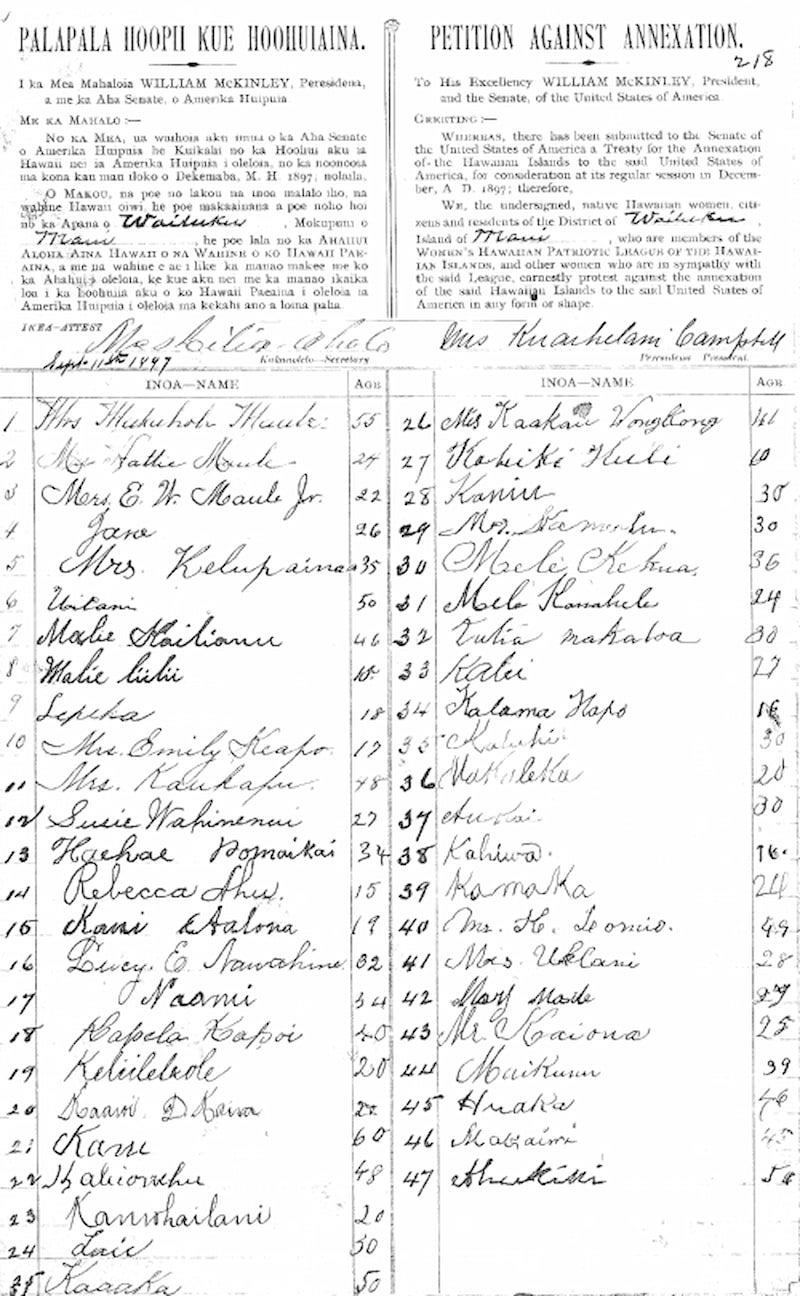
Text 22.02.05 — One page excerpt of Maui’s Kūʻē Petitions against annexation. The author’s great-grandmother, Mrs. Kaakau WongKong, is the twenty-sixth signature. With 21,000 signatures, Queen Liliʻuokalani and a delegation from Hawaiʻi convinced enough US Senators to vote against the 1897 Treaty of Annexation.
When the US entered the Spanish-American War, it used Hawaiʻi as a strategic location for military bases to stage the war in the Spanish colonies in the Pacific—the Philippines and Guåhan (Guam). Congress passed the Newlands Joint Resolution of Annexation on July 7, 1898 to secure Hawaiʻi as a military outpost. The constitutionality of annexing a territory by a joint resolution instead of a treaty was hotly debated in Congress at the time, and is the foundation today for challenging whether Hawaiʻi was legally annexed or is still an independent nation that is being occupied by the US.
American Colonization and Hawaiian Persistence
Hawaiʻi was governed as an incorporated territory of the US from 1900 through 1959 until it became an official state. During the Territorial Era, Kānaka ʻŌiwi continued to decline in the percentage of the resident population, although still comprising the majority of the registered voters through 1930. They actively participated in territorial politics and competed for the governance of Hawaiʻi against the oligarchy of American businessmen and planters who controlled the territorial government and economy.
At the same time, Kānaka ʻŌiwi recognized the need to organize new political, civic, and benevolent organizations to provide for their well-being and to protect ʻŌiwi lands, rights and Aliʻi (chiefly) trust assets. These organizations fulfilled some of the basic functions of governance for Kānaka ʻŌiwi. Under the framework of US law, the US Executive and the Congress governed Hawaiʻi as a colony, increasing the number of military bases in the islands, prohibited the speaking of ʻŌlelo Hawaiʻi (Hawaiian language) on school campuses, demeaned Hawaiian culture and promoted the American culture, and ruled Hawaiʻi through an elite white American oligarchy.
Hawaiian Homelands Trust
During this period, the US adopted a special political and trust relationship with Kānaka ʻŌiwi by setting up the Hawaiian Home Lands Trust (under the Hawaiian Homes Commission Act) in 1921. This trust reserved two hundred thousand acres of the lands of the Hawaiian Kingdom and constitutional monarchy for Kānaka ʻŌiwi of 50 percent or more ancestry to live on and homestead.
At statehood, under the Admission Act, the State of Hawaiʻi was mandated to manage this trust for Kānaka ʻŌiwi. Unfortunately, both the Territory and State of Hawaiʻi governments mismanaged these lands. As of June 1988, only 17.5 percent of the lands were distributed to Kānaka ʻOiwi. In 1990 there were still nineteen thousand beneficiaries of the trust waiting to receive a land award, and by 2020 that had increased to forty-four thousand.
Lands were instead leased to non-Hawaiians to generate revenue for the trust and thousands of acres were turned over to other government agencies for parks, airports, schools, sewage treatment plants and landfills. The military also took over Hawaiian Homelands at Lualualei on Oʻahu, Manā on Kauaʻi and Pohakuloa on Hawaiʻi. Kānaka ʻŌiwi filed a civil suit against the State of Hawaiʻi for negligence and mismanagement. As a result, the State made a settlement payment to the Department of Hawaiian Homelands of 600 million dollars (30 million dollars a year over twenty years) and returned 59,324 acres to the Department, an indication of the magnitude of the mismanagement.
Kānaka ʻŌiwi Constitutional Rights and US Apology
In 1978, the State held a constitutional convention and several amendments important to Kānaka ʻŌiwi culture and rights were incorporated into the Hawaiʻi state constitution. Hawaiian is now an official language of Hawaiʻi; the study of Hawaiian culture, history, and language is promoted in the public schools; and traditional and customary rights of Kānaka ‘Ōiwi are protected. Amendments also established that, with the general public, Native Hawaiians are one of two beneficiaries of the public trust lands (the national lands of the Hawaiian Kingdom), and an Office of Hawaiian Affairs was created.
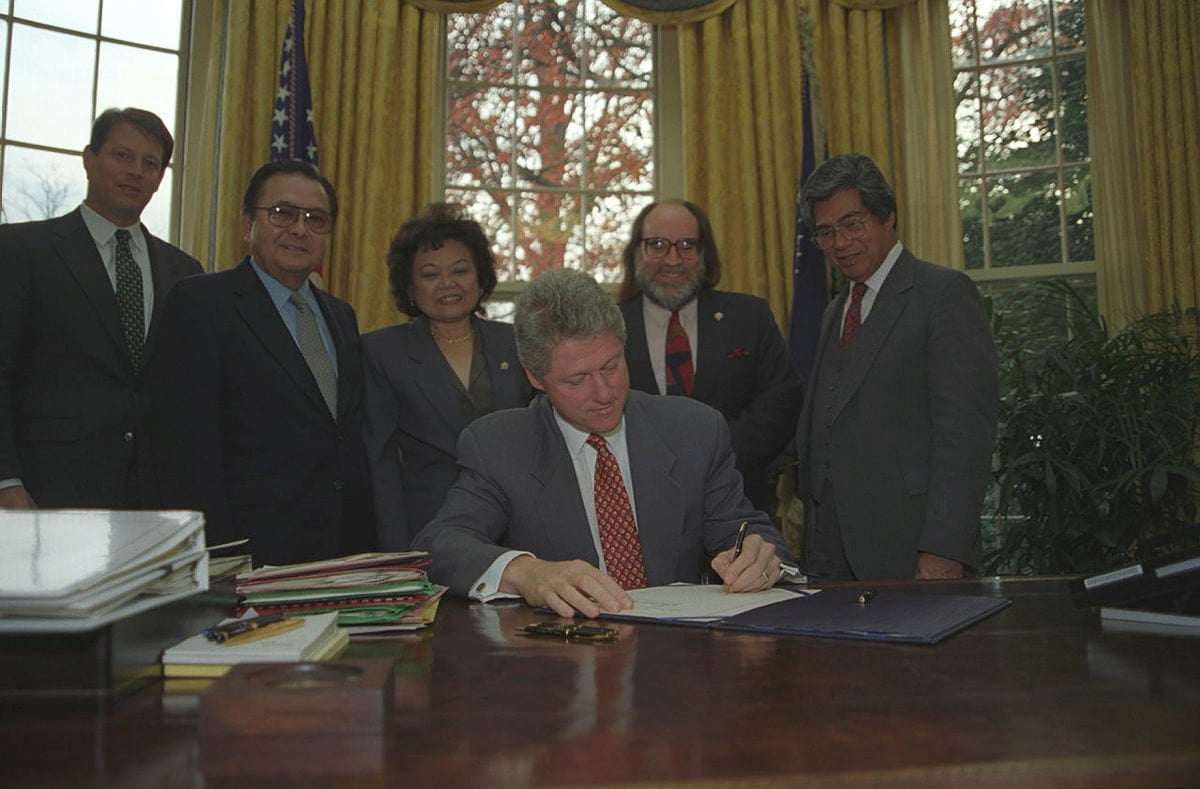
Image 22.02.06 — President Bill Clinton signs the Apology Law in the presence of Vice President Al Gore (far left) and the Hawaiʻi congressional delegation (left to right): Senator Daniel K. Inouye, Congresswoman Patsy Mink, Congressman Neil Abercrombie, and Senator Daniel Akaka.
In 1993, on the one hundred year anniversary of the overthrow, the US Congress and President Bill Clinton offered an apology “to Native Hawaiians on behalf of the people of the United States for the overthrow of the Kingdom of Hawaiʻi on January 17, 1893, with the participation of agents and citizens of the United States and the deprivation of the rights of Native Hawaiians to self-determination.” 6
The apology opened a process of reconciliation between the United States and Kānaka ʻŌiwi. This reconciliation is reflected in laws that include Native Hawaiians in the recognition Native American rights, such as the American Indian Freedom of Religion Act, the Native American Graves Protection and Repatriation Act, and legislation that provides funding for education, health care, and housing.
Glossary terms in this module
annexation Where it’s used
The forceful takeover of a territory or country to become part of another country.
constitutional monarchy Where it’s used
A system of government in which a monarchy (King/Queen) shares power with a constitutionally organized government.
genealogy Where it’s used
A line of descent that traces back to an ancestor.
occupied/occupation Where it’s used
The act of taking control of a territory, region, or state through military means.
oligarchy Where it’s used
A small group of people that control a territory, region, or state.
self-determination Where it’s used
The right of a people to freely determine their political status and freely pursue their economic, social, and cultural development without external interference. This right is recognized by the United Nations and is an important aspect of human rights.
sovereignty Where it’s used
The ability of a country or a people to have independent freedom of action, such as making its own laws and rules, without external interference. For Indigenous peoples, sovereignty means having control of their lands and way of life, free from colonial control.
stewardship Where it’s used
A duty to provide sustainable management of lands by using Indigenous practices.
treaty Where it’s used
An agreement or arrangement made by negotiation, formally signed by both parties, and usually legally approved by the state.