





Frank Tape sitting in his black Kissel automobile. in a field of foliage and trees.
Module 4: The Strange Career of a Chinese Interpreter
Can one family’s assertion of their civil rights become a “victory” for an entire community?
Frank Tape’s career as an immigration interpreter was unusual from the start. He had won the approval of Inspector James Dunn at the World’s Fair of 1904, not because he excelled at interpreting, but because of his work as an undercover informant. In 1908, the Washington, DC, headquarters of the US Immigration Bureau assigned Tape to be the interpreter for Richard Taylor, a special agent investigating the smuggling of Chinese migrants across the Mexican border. At his next assignment in Seattle, Washington, Frank Tape used his stint on the border to promote his reputation. But Tape also sought status and personal wealth through corrupt practices, ultimately leading to criminal charges and his dismissal from the bureau.
This module uses Frank Tape’s background as an immigration interpreter to explore the darker side of the immigrant broker’s experience, including how brokers gained social and financial success at the expense of oppressing and extorting others. It also shows how immigrants themselves often sought the help of Chinese immigration interpreters, sometimes naively, and sometimes through bribery.
How did Frank Tape further his parents’ goal of aspiring toward inclusion in white society?
How did Frank Tape’s attempts to fully assimilate lead both to his ascension as well as his downfall?
How did Chinese people respond to unjust exclusion laws?
Seattle Investigator
In September 1908, Frank Tape reported to the Seattle District Office, his next assignment with the Immigration Bureau. The city was a major port in transpacific migration. Thousands of people from China, Japan, and India arrived there every year. The Seattle district also processed documents for immigrants arriving by land and monitored the US-Canada border for Chinese smuggling.
Frank Tape arrived in Seattle boasting that he had just come from a special undercover assignment on the Mexican border and that he had direct ties to Washington, DC. Although his job as a Chinese interpreter was a conventional one, he maneuvered himself into the role of investigator by offering to take on Chinese smuggling cases that the inspectors could not solve. In one case, he uncovered an operation run by one of Seattle’s wealthiest Chinese residents, Ah King, who used his merchant business as a front for forty-four “partners” who took turns bringing in their “sons.” Ah King also reportedly opened the Chinese Village attraction at the 1909 Alaska-Yukon-Pacific Exposition in Seattle to bring in unauthorized immigrants, similar to the scheme at the World’s Fair of 1904 in St. Louis.
Frank Tape established himself in Seattle’s Chinatown as a government man, a position of social importance in the community. People knew him as a successful interpreter and did not know that he worked undercover; that would have destroyed his reputation. Tape also used his status and connections to invest in contracting Chinese workers for seasonal work in the Alaskan fish canneries, another type of brokering.
Among white people, Tape presented himself as white. He lived in a white section of town, drove a fancy car, and wore expensive suits. In the 1910 Census, he even reported his race as white. In 1911, he began living with a white woman, Lena Sutherland, a divorcée originally from Pennsylvania. In Seattle’s polite society, some people disapproved of interracial relationships; but others conceded that he had come closer than any Chinese in achieving acceptance by white society.
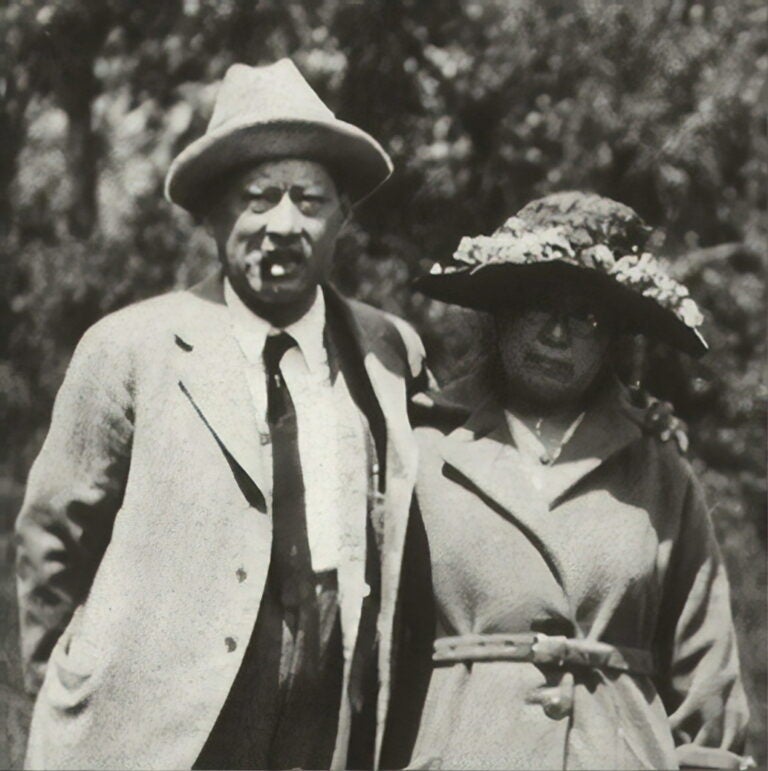
Image 37.04.01a — Frank Tape and his mother, Mary, on an outing in April 1922.

Image 37.04.01b — Frank Tape in his Kissel, Seattle, circa 1911.
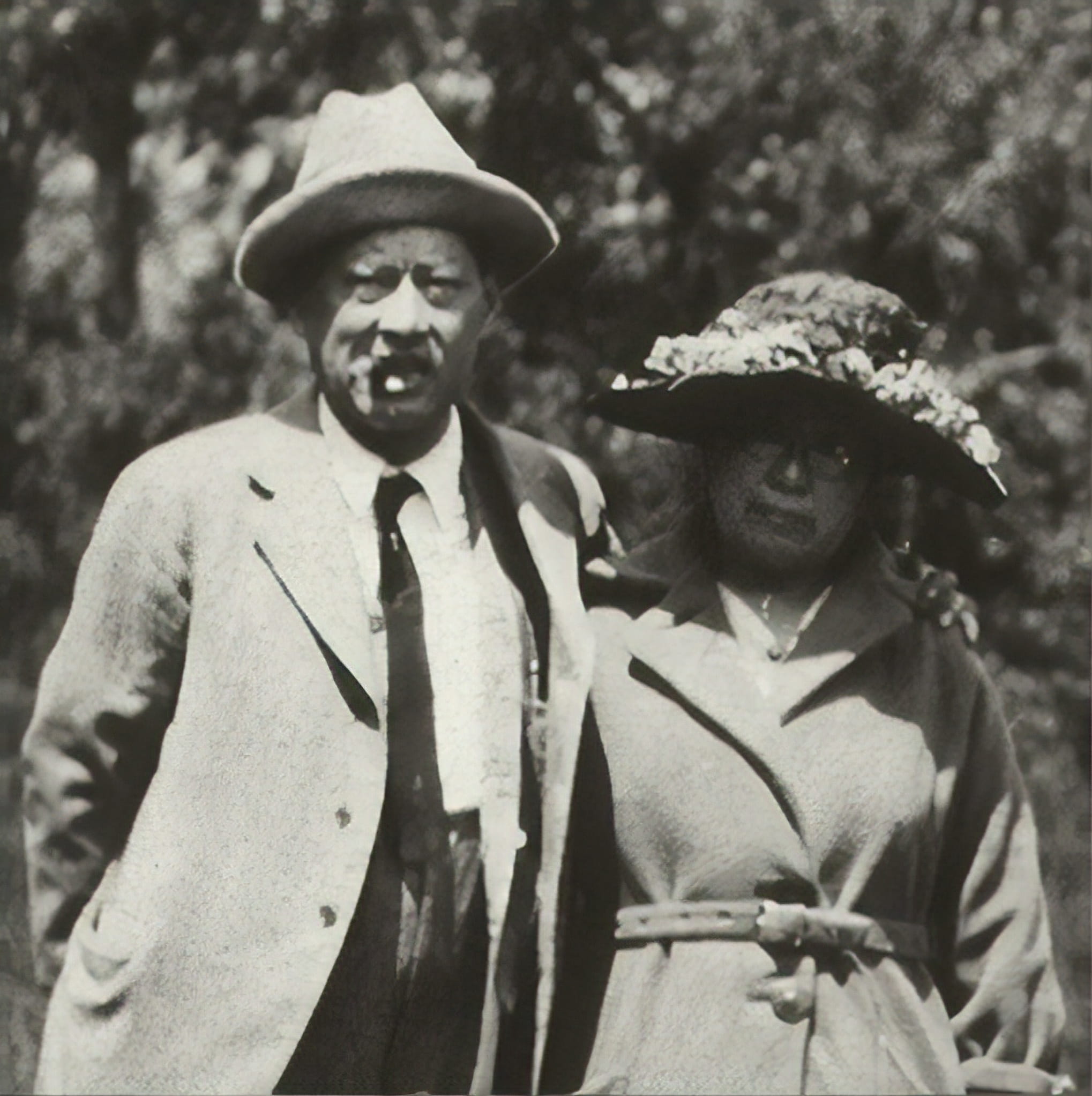

Frank Tape’s unusual lifestyle prompted both resentment and suspicion among his colleagues. Within a year of his arrival in Seattle, Tape’s coworkers began to raise questions about him especially after he took up residence with Lena Sutherland. Tape’s lifestyle became even more extravagant, from employing a chauffeur and maid to going on hunting and fishing trips. Sutherland spent heavily on clothes and jewelry. And so many wondered, how did a government salary support such expensive habits?
When Henry White took office as Seattle’s new commissioner of immigration in 1913, he launched a secret investigation into Frank Tape’s finances. Bank statements revealed that the couple, who married in 1912, was spending upwards of 8,000 dollars a year (worth 200,000 dollars today).
Tape was also questioned by the Walsh Commission, a federal body appointed by Congress to investigate labor conditions and what they called “Asiatic smuggling”—under the presumption that Chinese labor in the US undermined white labor. The commission was particularly interested in Frank Tape’s racial identity. According to official records, the commission asked, “What is Tape’s race?” and “Full, half, or quarter?” 1, reflecting the stereotypes held by many whites that a person who is Chinese could not possibly be “American.” They also questioned the financial and moral standing of his white wife. Richard Taylor, his former colleague at the Secret Service, defended Tape as a friend and a trustworthy investigator. But this was not enough to deter the case that was building against Tape.
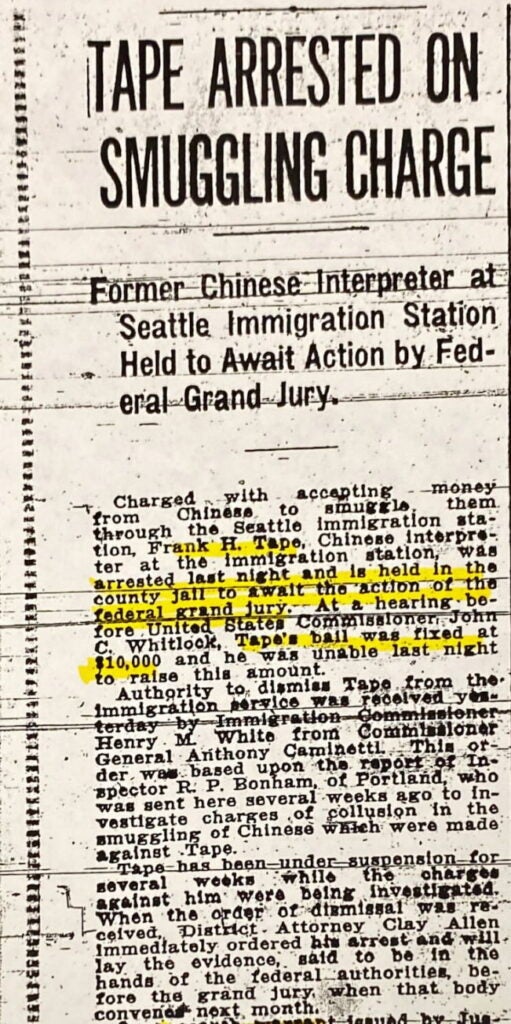
Text 37.04.02a — Article “Former Chinese Interpreter at Seattle Immigration Station Held to Await Action by Federal Grand Jury” from the Seattle Times reports Frank Tape’s arrest for allegedly accepting bribes from Chinese migrants for entry into the country.
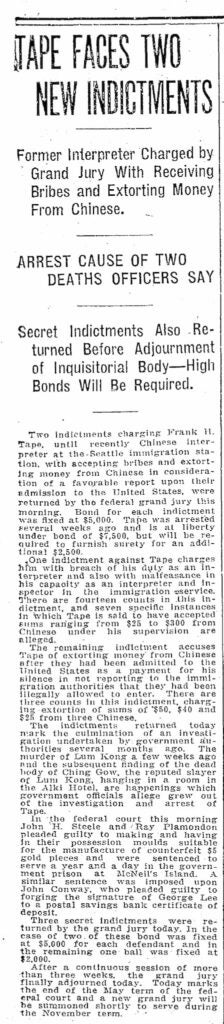
Text 37.04.02b — The Seattle Times announces the indictments brought against Frank Tape for extorting and receiving bribes from Chinese laborers applying to enter the United States.
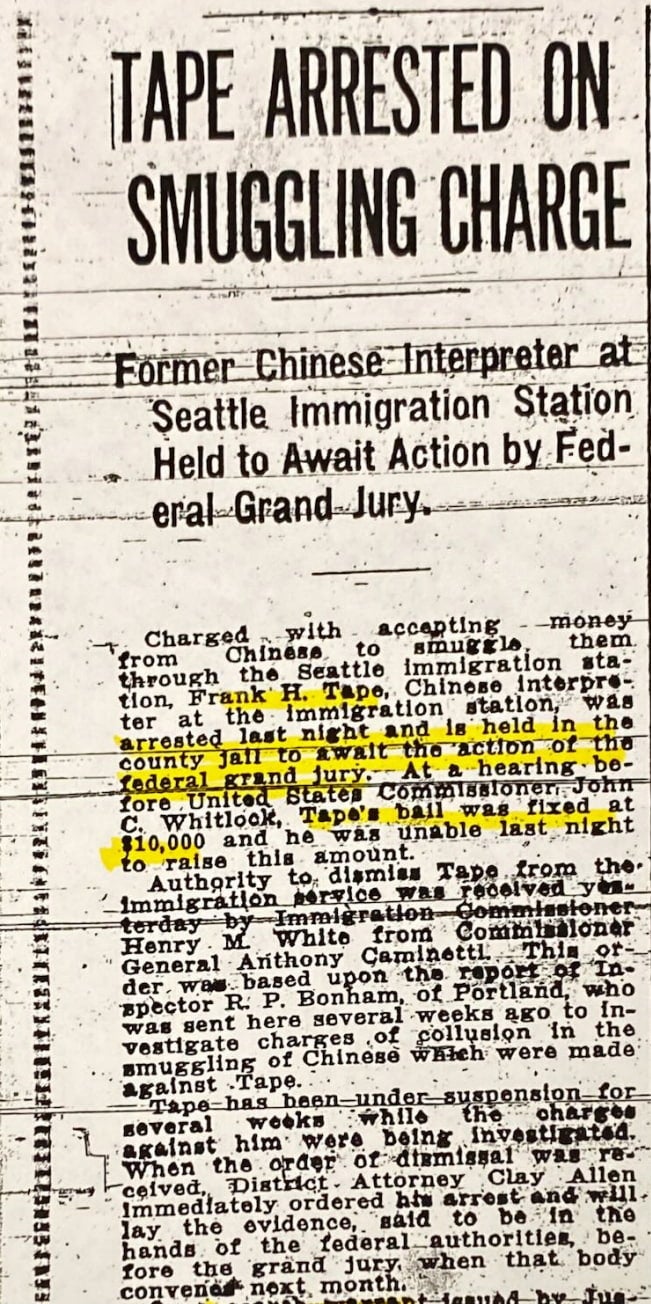

Immigration Commissioner White’s inquiry concluded with an eighty-one page report that included Tape’s bank statements and testimonies from several dozen witnesses, Chinese and white. It concluded that Frank Tape operated an extensive extortion racket and was possibly expanding his network to Mexico. He was dismissed from his position with the bureau and then arrested by the US attorney on criminal charges related to extortion in Chinese immigration cases.
Frank Tape on Trial
The public eagerly consumed stories about the investigations and trial of Frank Tape. After all, the cases combined themes that Americans found endlessly fascinating: corrupt government officials, Chinese criminality, and interracial relationships. Tape was first tried for breach of duty, malfeasance, extortion, and bribery in immigration cases; and in a second case, for conspiracy to intimidate witnesses involved in the initial trial.
The government’s cases against Tape weakened when its chief witness, Lum Kong, was shot dead in Chinatown just days before the trial opened. Lum Kong was a local man who had reported Frank Tape to the bureau after Tape pressured him for money to process an immigration case for Kong’s nephew. Rumor was that another man named Ching Kow was hired to kill Lum Kong—to eliminate him as a witness and intimidate the other witnesses on the Tape case. But Ching Kow himself was found dead a few weeks later, hanging from a doorframe in a Chinatown boarding house. Although Ching Kow’s death appeared suspicious, police ruled it a suicide and closed his and Lum Kong’s case. Without clear evidence against Tape, the juries in both cases found him not guilty in 1914.
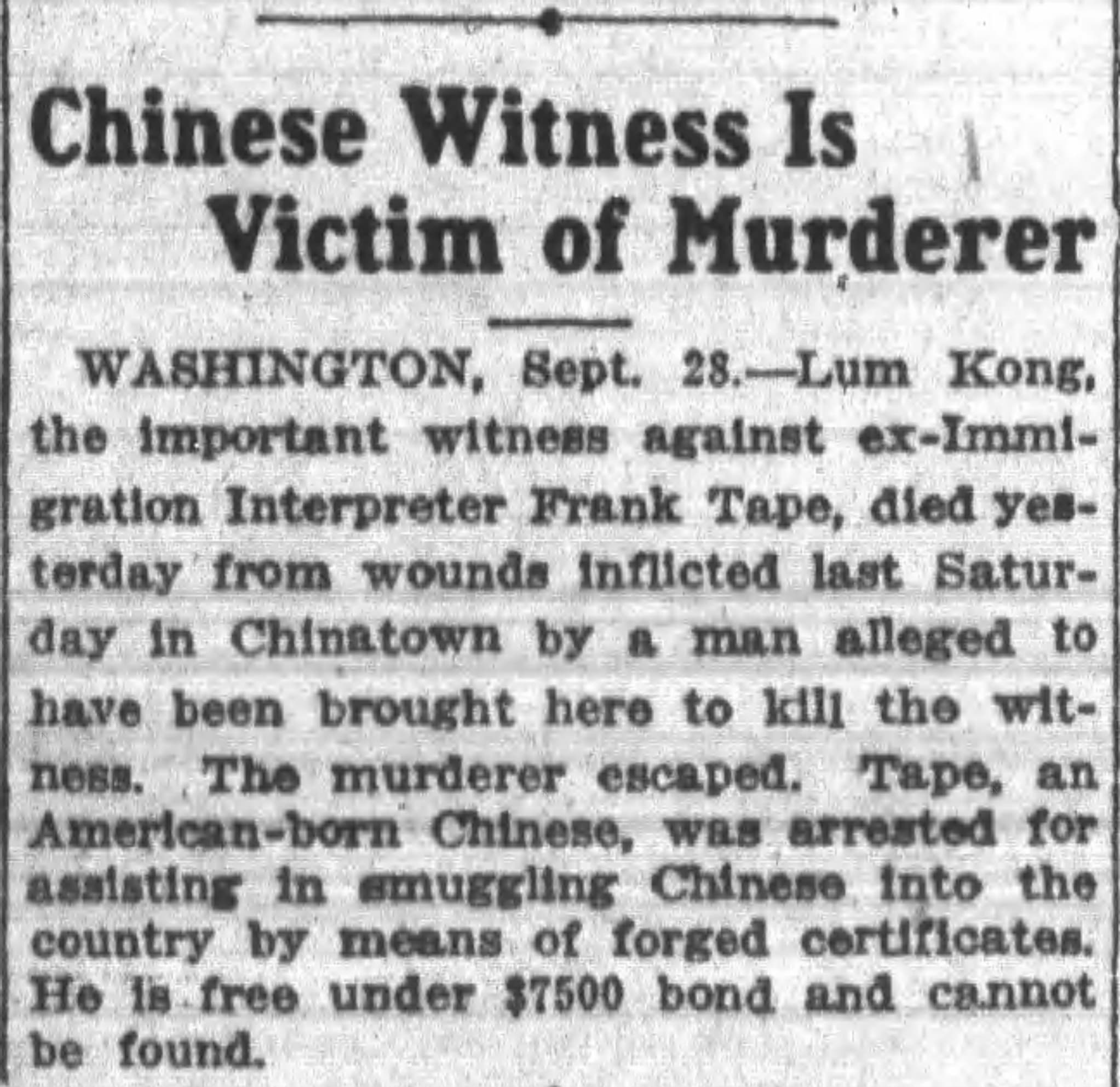
Text 37.04.03a — The Oakland Tribune announces Lum Kong’s tragic passing. Kong died from wounds inflicted during the shooting.

Text 37.04.03b — Three months after the murder of Lum Kong, Frank Tape is found “not guilty” of accepting bribes.


Frank Tape was off the hook—but he was without a job and his reputation was in shambles. He had no money and Lena Sutherland, who he later divorced, disappeared from the scene. Frank Tape packed it in and returned to his parents’ home in Berkeley.
There is a certain pattern to Frank Tape’s career. In many instances, he was a zealous enforcer of the Chinese exclusion laws, pursuing smugglers and migrants as an immigration agent. But there is considerable evidence that Tape also extorted money from Chinese immigrants, whether they abided by immigration legislation or not. These practices appear paradoxical—partnering with the government to investigate Chinese immigrants and also bribing them to ensure their entry. Both, however, point toward Tape’s desire for power and social status, as well as a certain disregard for immigrants, whether on behalf of the government’s exclusion laws or for his own personal gain.
Not all Chinese immigration interpreters were corrupt, and most employees of the bureau were not on the take. Frank Tape’s brother-in-law, Herman Lowe, served as an interpreter in Seattle’s Portland district for decades without any taint or rumors of corruption. A fellow interpreter in Seattle was Quan Foy, whose business practices were the opposite of Tape’s. Quan Foy was quiet, unassuming, and uninterested in investigative work. His superiors considered him loyal and reliable.
Corruption at Angel Island
It is important to remember that the systems of processing Chinese immigration cases, both legally and through covert means, extended beyond the work of interpreters. A few years after Frank Tape’s trial, a major scandal took place at Angel Island, located in California’s San Francisco Bay, the largest port of entry for Chinese immigrants.
The Angel Island Immigration Station had been built in 1910 in an effort to isolate arriving Chinese migrants from their relatives or their representatives from family associations, who would usually provide the new immigrants with information to help pass the interview process. But Angel Island could not be completely contained—the station’s staff, officers, and food supplies had to be ferried to the island every day.
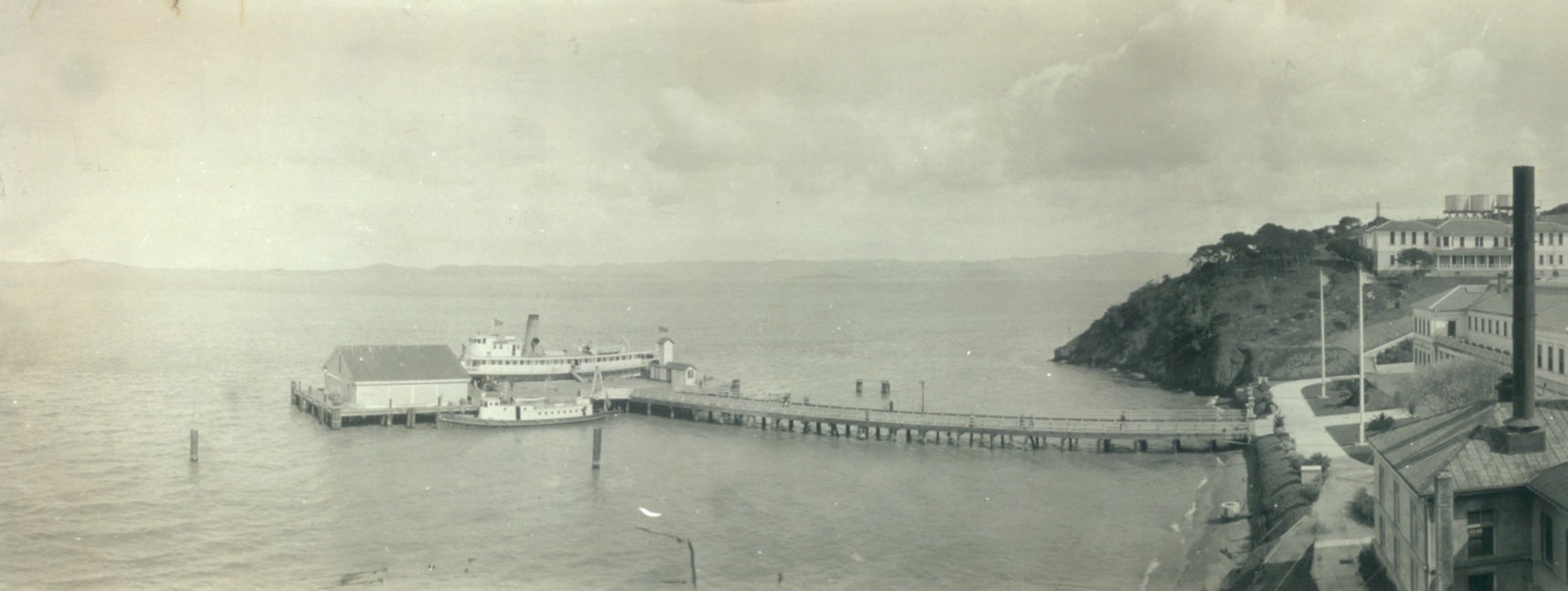
Image 37.04.04 — Immigration station on Angel Island in the San Francisco Bay, circa 1915.
In 1917, a major investigation of Angel Island Immigration Station found an extensive system of manipulation and theft of documents, extortion of money from immigrants, and fraud in applicants’ examinations. This underground system was estimated to bring in 100,000 dollars per year (worth 1.6 dollars million today), and involved the station’s clerks, stenographers, typists, watchmen, inspectors, and interpreters—as well as outside law firms, brokers, photographers, and counterfeiters—and only a few were Chinese. As an immigrant broker in San Francisco, Joseph Tape was not suspected of any wrongdoing. But Edward Park, the brother-in-law of Joseph’s daughter Emily, who worked as an interpreter, was among those fired. Fifteen people were indicted on charges of conspiring to mutilate government records to land immigrants illegally.
People in San Francisco’s Chinatown were overjoyed to learn of the dismissals and indictments. As one person wrote to the bureau, “You have done a great justice to our Chinese peoples. That is, you have made a clean sweep oust all the crooks, and grafters, which is in Angel Island.” 2 For the immigrants arriving, the oppression of the exclusion laws was compounded by the burden of having to pay bribes to get through the system—even if they were legally eligible for admission.
Many in the Chinese community believed that the exclusion laws themselves were unjust and immoral—how does this impact our understanding of what was “honest” or “corrupt” at the time? Most Chinese did not consider it morally wrong to enter the country, even if they knew it was against the law. Immigrants often expected the Chinese interpreters to help them, either because they believed their families in the US had paid them off or because they simply assumed they could trust another Chinese person. As seen in these corruption cases, however, immigrants could make no assumptions about a Chinese interpreter’s loyalties.
The scandals at Angel Island reveal a dense web of practices and transactions that complicated the administration of the Chinese exclusion laws. Contrary to the heightened, racialized publicity surrounding Chinese immigration cases in news media, corrupt business practices were not a problem solely among Chinese workers. In the Angel Island case, white brokers and lawyers made the most money, while Chinese brokers were the small fry, earning a modest cut lower down the chain. Still, these bribes and extorted funds gave Chinese brokers access to a more comfortable life that remained out of reach for the vast majority of Chinese Americans in the twentieth century. In this way, the murky moral world created by the Chinese exclusion laws led to the experiences of brokers like Frank Tape as “in-between” figures of class and racial identity.
Glossary terms in this module
Angel Island Where it’s used
Located in the San Francisco Bay, this island served as the primary immigration port for the West Coast of the United States from 1910 to 1940.
extort/extortion Where it’s used
A criminal offense; when someone uses violence, threats, intimidation, or pressure to force another person to give them money or benefits.
immigrant broker Where it’s used
A person who coordinates between government agencies or companies and the immigrant community they work with. Immigrant brokers often hold significant power because they possess the language and connections to communicate between the two parties.