





Dressed casually, wrestlers Leati Joseph Anoaʻi, known as Roman Reigns (left), and Dwayne “The Rock” Johnson (right) pose together at WrestleMania.
Module 5: The Samoan Dynasty: Samoans in Sports
Have Samoans benefitted from their “enduring friendship” with the United States?
Fanene Leifi Pita Maivia, later known as Peter Maivia, was born in American Sāmoa in 1937. At twenty years old, he moved to New Zealand to begin his career in competitive wrestling. He quickly rose to fame, winning the New Zealand Heavyweight Championship in his first year of training there and prevailed in subsequent competitions in the Pacific and Hawaiʻi. He proudly wore his peʻa, the customary Samoan tattoo from the waist to the knees, and often displayed Samoan and Polynesian symbols and costumes in the ring.
Maivia and his longtime best friend, Reverend Amituanaʻi Anoaʻi were so close that they declared themselves “blood brothers” and combined their family lines. This deep bond between the two families became known in the industry as the “Samoan Dynasty,” and their involvement with professional wrestling continues to this day.
Although Maivia died of cancer at age forty-five, he left a long legacy of wrestlers. He trained Anoaʻi’s sons Afa and Sika, who became the tag team called The Wild Samoans and competed in the World Wrestling Federation (now known as World Wrestling Entertainment or WWE) until the late 1990s. Maivia’s grandson, Dwayne “The Rock” Johnson, also started his career as a WWE wrestler.
This module considers the prominence of Samoans in sports, particularly wrestling and football, and the pervasive stereotypes of Samoans as “savages” and “warriors.” We discuss the harm of stereotypes and the different ways Samoans challenge us to expand our understanding of Samoan identity and sports representation.
What is the Samoan Dynasty? And how did so many Samoans end up in the World Wrestling Entertainment (WWE)?
Why are there so many Samoans in sports, namely wrestling and football?
How has the number of Samoans in sports and entertainment impacted the community?
Tropes Rooted in Colonization
In 1976, Sports Illustrated journalist Richard W. Johnson noted the upsurge in Samoan representation in football. “What is coming on is a swarm of Polynesian warriors—not your run-of-the-reef, gin mill flamethrowers, but strong, fierce men, six to seven feet tall, who seem to have stepped into the twentieth century from some secret museum of oceanic antiquities.” 1
Long-standing racial and gendered stereotypes of Samoan men as “noble savages” assume they are primitive, lack intelligence, and only have physical prowess. These tropes have circulated since colonization, created by western men who characterized themselves by contrast as “cultured,” intelligent, and controlled—not driven by primal emotions.
In professional wrestling, Samoan wrestlers in the WWE have used aspects of Samoan culture—and sometimes stereotypes—as part of their characters’ storylines, framed as “good versus bad guy” feuds between individual wrestlers or factions. As part of their performance, some Samoan wrestlers wear or showcase traditional garments or tattoos. Others have also taken harmful tropes and put them center stage. Early wrestling teams such as the Wild Samoans and the Headshrinkers, and wrestler Umaga, drew explicitly on the stereotype of Samoans as primitive savages.
Samoan storylines that focus on family and bloodlines, or ideas that wrestling is in Samoan blood, correlate to the trope that Samoans are naturally athletic, physical, and large. This idea of natural athleticism can seem positive at first glance; however it is also tied to harmful stereotypes that Samoans are “savage” or possess a “warrior gene.”
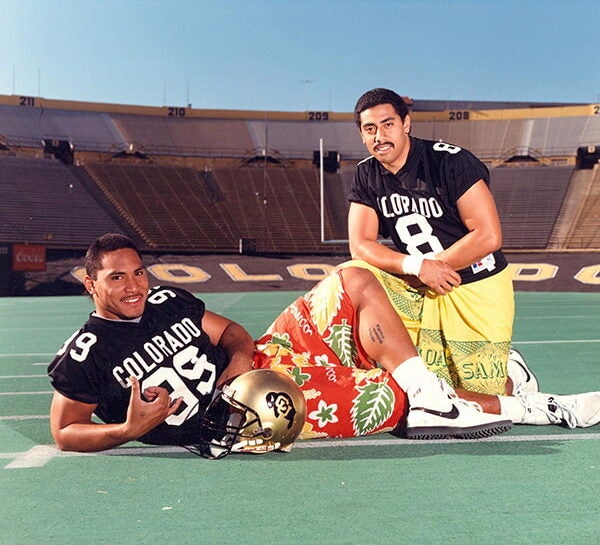
Image 24.05.01 — Tutuila-born Okland Salavaʻe (left) attended Colorado University with Sal Aunese (right). Salavaʻe coached Tafuna High in American Sāmoa to several championships. Aunese, who led Colorado’s resurgence in the late 1980s, died from cancer at age 21.
Samoan scholar Lisa Uperesa has noted this in football where, “Samoan players have often been depicted as the ‘embodiment of primal, savage warriorhood’ in a way that enhances their football stock.” 2 Linking a personality trait to something biological is a typical method of creating a racist stereotype. Stereotypes about Samoan men as being “naturally” athletic are similar to the ways African American men are sometimes stereotyped.
Uperesa notes the tenuous relationship Samoan and African American athletes have to sports. There is a common emphasis that Samoan and Black bodies are large and physical, and that both are often recruited into football and wrestling. Careers in these sports can offer a pathway out of poverty for many Samoan and Black people.
The Changing Samoan Dynasty
The Samoan Dynasty began when the Anoaʻi and Maivia families combined and created, what was considered, the greatest family in professional wrestling. This prestigious and generations-long lineage has seen, and guided, changes in the wrestling world.
When Lia Maivia first met her husband, Peter, she did not know much about wrestling. Thinking her husband’s work was pure fighting and not a mixture of sports, choreography, entertainment, and performance, she interrupted one of Peter’s matches to flog his opponent with her shoe. Lia quickly learned more about Peter’s work and became a leader in the wrestling world in her own right, becoming one of the first women sports-entertainment promoters. She built the foundation for the Samoan Dynasty to grow, and for greater representation in wrestling.
After Peter’s death in 1982, Lia led Polynesian Pro Wrestling. One of her biggest accomplishments as a promoter was in 1985 when she took charge of A Hot Summer Night, a wrestling event in Hawaiʻi that featured famous WWE wrestlers including Andre the Giant and Rocky Johnson (the Maivias’ son-in-law). It was one of the most popular wrestling events in Hawaiʻi, attracting an audience of over ten thousand.
Although the Samoan Dynasty wrestlers in the 1980s and 90s were beholden to the WWE’s reliance on racist tropes, there have been many shifts in recent years, thanks in part to the presence of Samoans in wrestling. Since the early 2000s, there has been much more consideration for the health and well-being of its performers. For example, WWE wrestlers used to intentionally harm themselves to produce blood for entertainment; this is a much less common practice today. Alongside this change has been a reduction of racist stereotypes.
Today, prominent WWE wrestlers in the Samoan Dynasty include Roman Reigns, The Usos and Solo Sikoa, who rely less on “savage” tropes. Wrestlers like Reigns proudly display their Samoan tattoos and wear ula fala (necklace of pandanus seeds) more as a tribute and form of cultural education than as a costume.
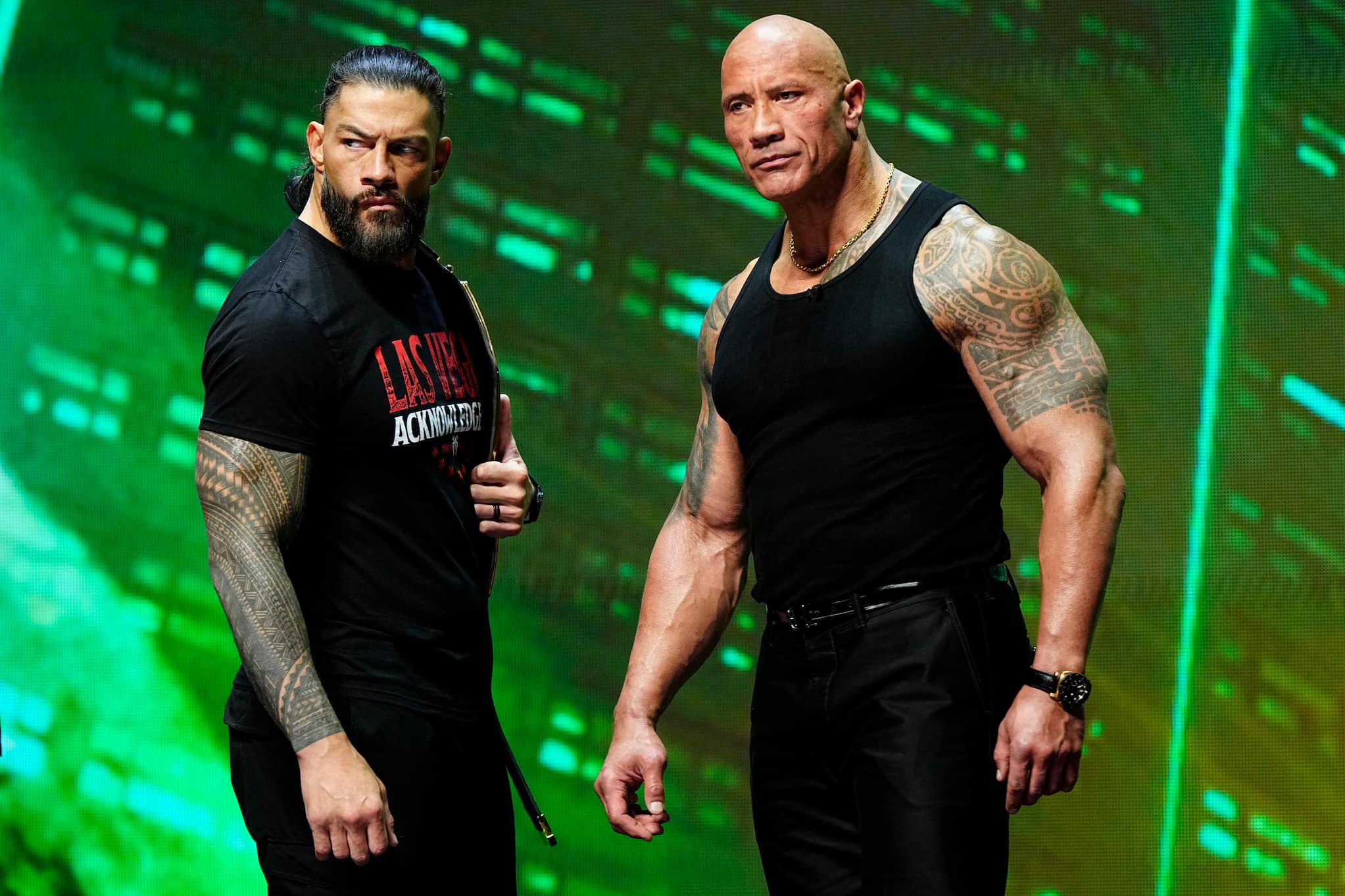
Image 24.05.03 — The Bloodline’s Roman Reigns (left) with Dwayne “The Rock” Johnson (right) at the 40th annual WrestleMania. Both have Samoan cultural tattoos on their arms.
Samoans have long played a big role in professional wrestling with figures like Lia and Peter Maivia bringing the sport to wider audiences in Hawaiʻi and the continental United States. Although their representation in wrestling has not always been ideal, many Samoan wrestlers have fought—literally and figuratively—to change that.
Reflection Question
Who is a sports figure or figure in entertainment that has had an impact on you?
More Than Sports
The idea of the “Samoan savage” and “warrior gene” limit the full range of what it means to be Samoan. Many Samoan college students express frustration about peoples’ limited expectations of them. For example, some assume they already play sports, or that the only reason they are in college is because of sports; inferring they lack intelligence.
Furthermore, the harmful stereotype of savagery can lead to deadly consequences, particularly for those who find themselves face-to-face with higher authorities. In these encounters, size and physicality are assumed to be threatening, and has been used as justification for police to react violently.
In a study of Samoan high school girls it was noted that they often did not receive the same messaging or have role models like boys did. In recent years, there has been greater representation of Samoan women in sports, such as discus thrower Laulaga Tausaga-Collins. However, the youth in the study also commented they still feel the pressure to marry or give birth to the next NFL star. Samoan media personality Drew Afualo has discussed the lack of Samoan women role models on her podcast The Comment Section.
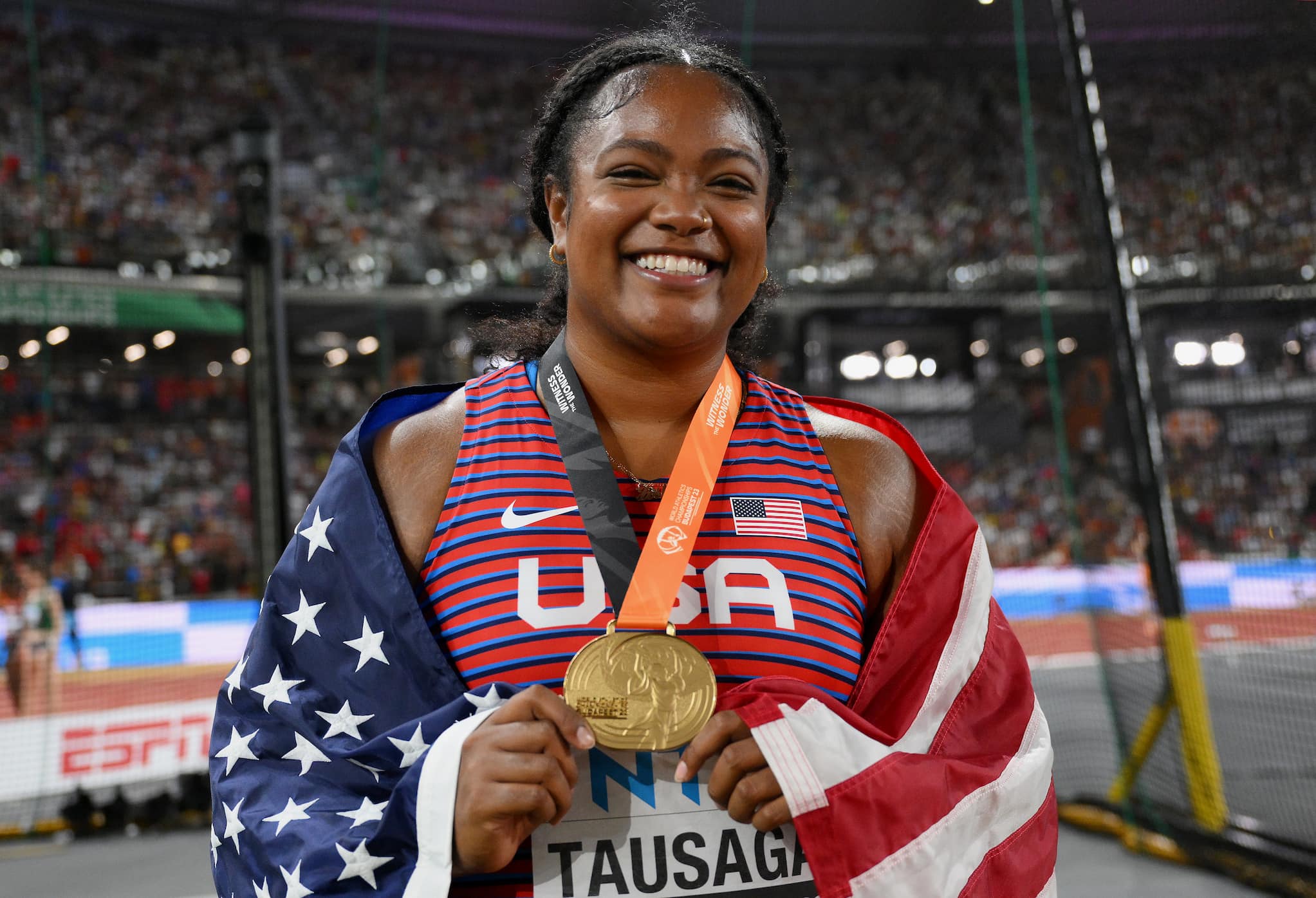
Image 24.05.05 — Laulauga Tausaga-Collins wins Team USA’s first gold medal at the Women’s Discus Throw Final at the 2023 World Athletics Championships in Budapest, Hungary.
Reflection Question
Have you or someone you know had to deal with unreasonable expectations because of stereotypes?
More to explore
Video
00:23
Unexpected Samoans and the Super Bowl
Jordan Malaita and Juju Smith Schuster played against each other for Super Bowl LVII. A less expected place to see Samoans gracing the Super Bowl stage is the halftime show. In 2020, Samoan choreographer Parris Goebel choreographed for Jennifer Lopez in her show with Shakira and in 2023 she choreographed Rihanna’s show, bringing with her a range of Pacific dancers.
Representation matters, and the lack of Samoan women and non-binary representation can have damaging impacts on young Samoan people who do not see themselves represented. This imbalance in representation centers the role of men. This male-centric view is very different from the inherent value placed on all genders within the reciprocal Indigenous Samoan context of faʻasāmoa.
Sports can offer different pathways for socio-economic mobility, a venue to share elements of faʻasāmoa, and challenge us to think about the racial and gendered elements of sporting success. While sporting success should be celebrated, it is also important to view it as just one part of a wider range of Samoan possibilities.
Glossary terms in this module
colonization Where it’s used
The act in which a group or country brings a region and its Indigenous people under its domination and control.
Indigenous Where it’s used
Refers to someone or something that originates from a region, predating colonialism.
stereotype Where it’s used
Generalized beliefs about a group of people based on one characteristic. Typically, stereotypes perpetuate harmful discourse about groups of people and are rooted in incorrect, and often racist beliefs.