





Five Samoan American men crouch in front of eleven others to celebrate winning a basketball tournament. A trophy sits at front center of the group.
Module 6: Social Issues in the Diaspora and Youth Activism
Have Samoans benefitted from their “enduring friendship” with the United States?
“…In the fourth grade is when I really started messing up in school,” a young Samoan woman in Carson, California admitted to a group of peers in the 1970s. Her issues with the school system persisted through the years of her education. She says that later on, “I didn’t want to go to school and when I [went] back to school, I’d hear the teachers getting on my back and I didn’t want that, so I didn’t want to go. Then, I didn’t want to go home.”
During that time, young Samoan activists in Carson, California connected the struggles of their peers with a broader youth and student-led movement for civil rights, ethnic studies, and social justice. They created Omai Faʻatasi, meaning “come together” or “unite,” and organized together, creating self-funded community programs such as health fairs, food co-ops, history lessons, and a continuing high school.
Since the 1950s many Samoans moved to the United States or “Stateside”. They took the malaga, or journey, to secure their own and their families’ futures. While Samoans were able to build community through churches and civic clubs, the socio-economic realities that many found themselves in were often harsh.
In this module we will explore those realities, looking at poverty, education, health and racial discrimination, as well as the important role of Samoan youth activism from the 1970s to today. Youth activists stand as symbols of Samoan resiliency, advocating for their communities and demanding social justice that everyone deserves.
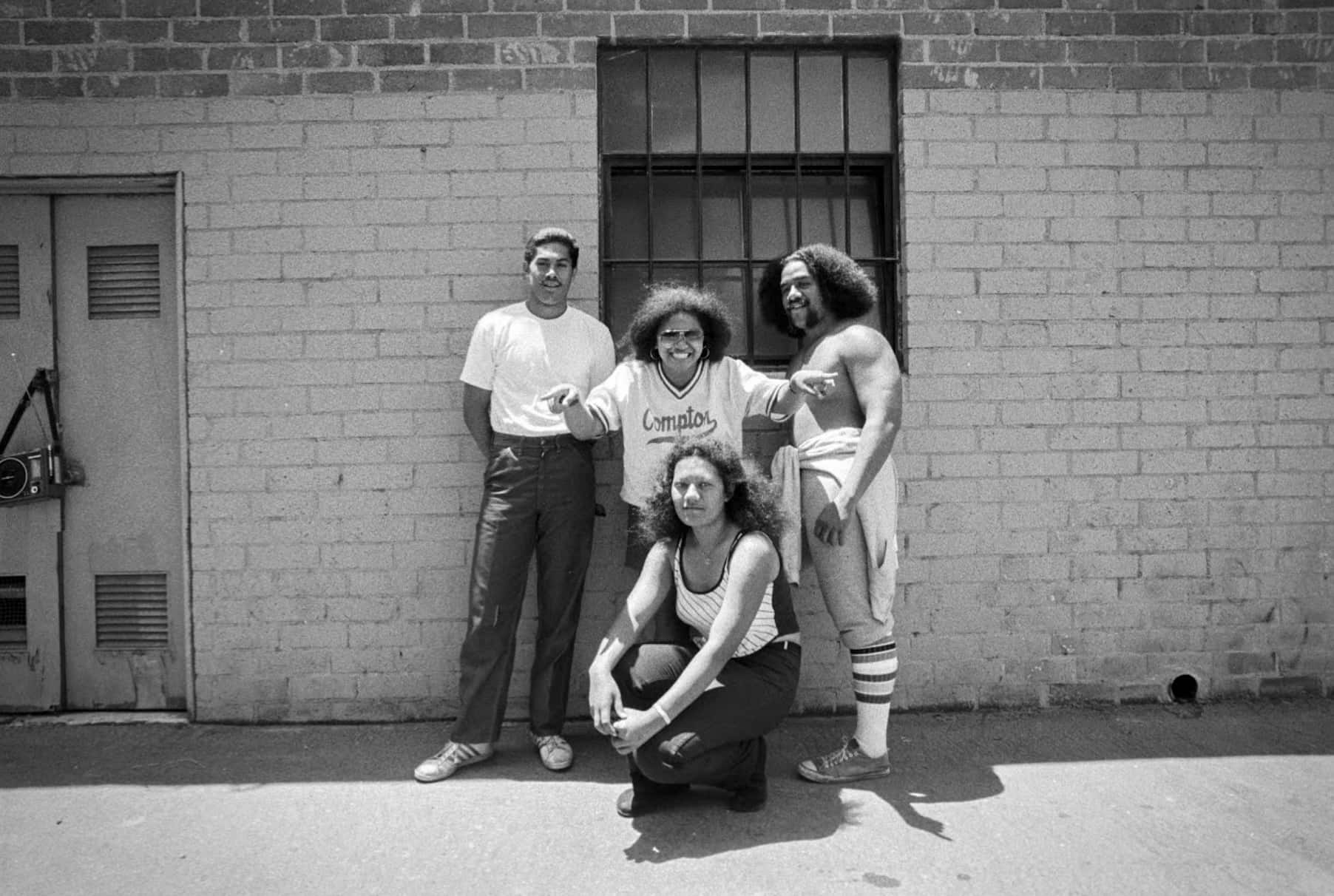
Image 24.06.01a — Samoan American youth development group Omai Faʻatasi staff and volunteers pose outside their headquarters in Carson, California, in the 1970s.
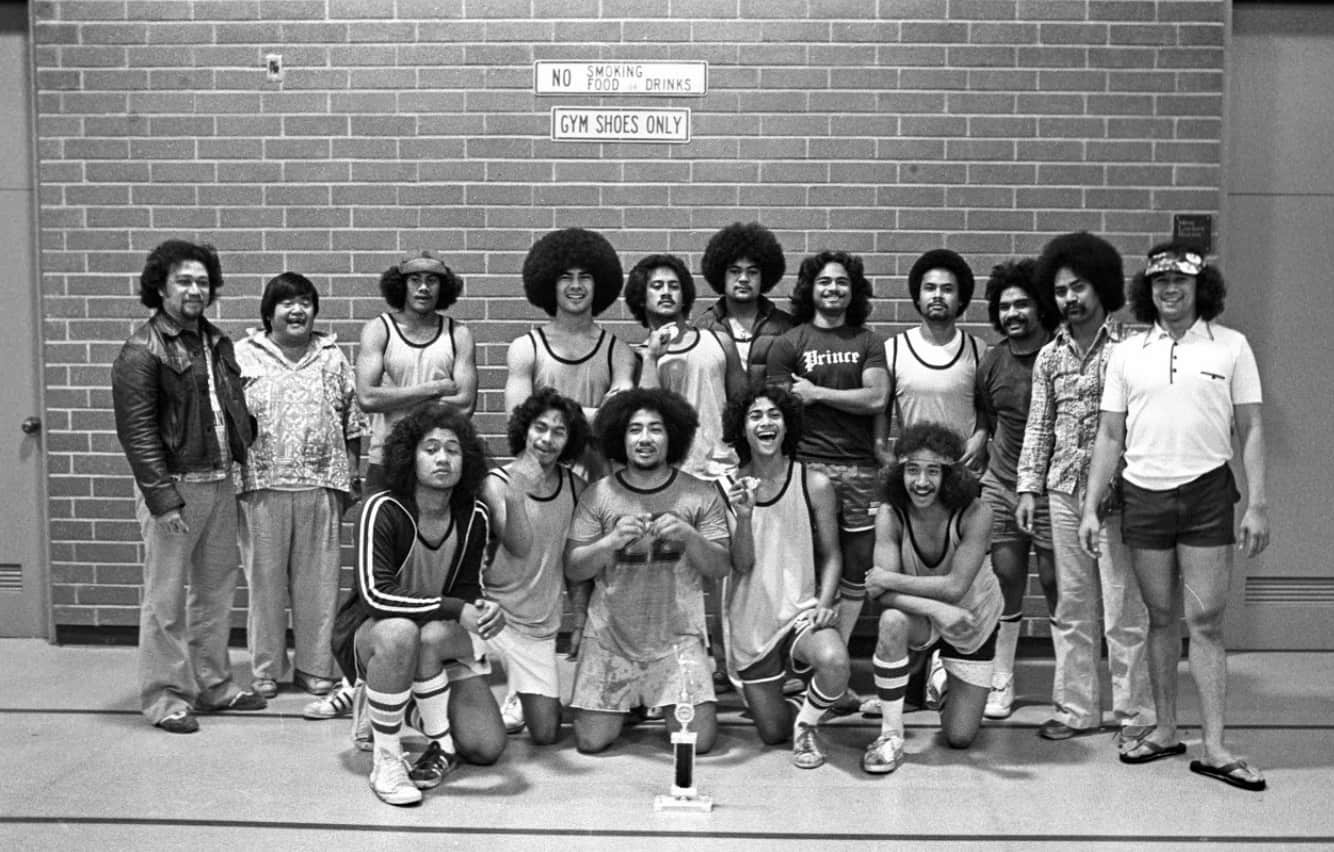
Image 24.06.01b — Omai Faʻatasi members celebrate a win at a men’s basketball tournament. Working with local high schools and storefronts helped keep Omai’s clients engaged in the community.


What are the social realities of Samoans in diaspora?
What is the role of youth activists like those in Omai Faʻatasi in Samoan social justice?
How have the lived experiences of Samoans changed over time?
Stateside Realities
While living stateside promised more employment and educational opportunities than remaining in the Pacific, the reality was and continues to be difficult. Stateside Samoans faced challenges with high rates of poverty, incarceration, mortality rates, and educational barriers.
As of 2019, over half of households in American Sāmoa lived below the poverty line, with a median household income of $28,352. Like other Pacific Islander communities, Samoans face high unemployment rates. This was felt most profoundly during the 2007-2008 Global Financial Crisis. The number of Pacific people living in poverty increased dramatically. Poverty, low income, and low home ownership rates created a precarious, unstable position for Samoans and other Pacific people.
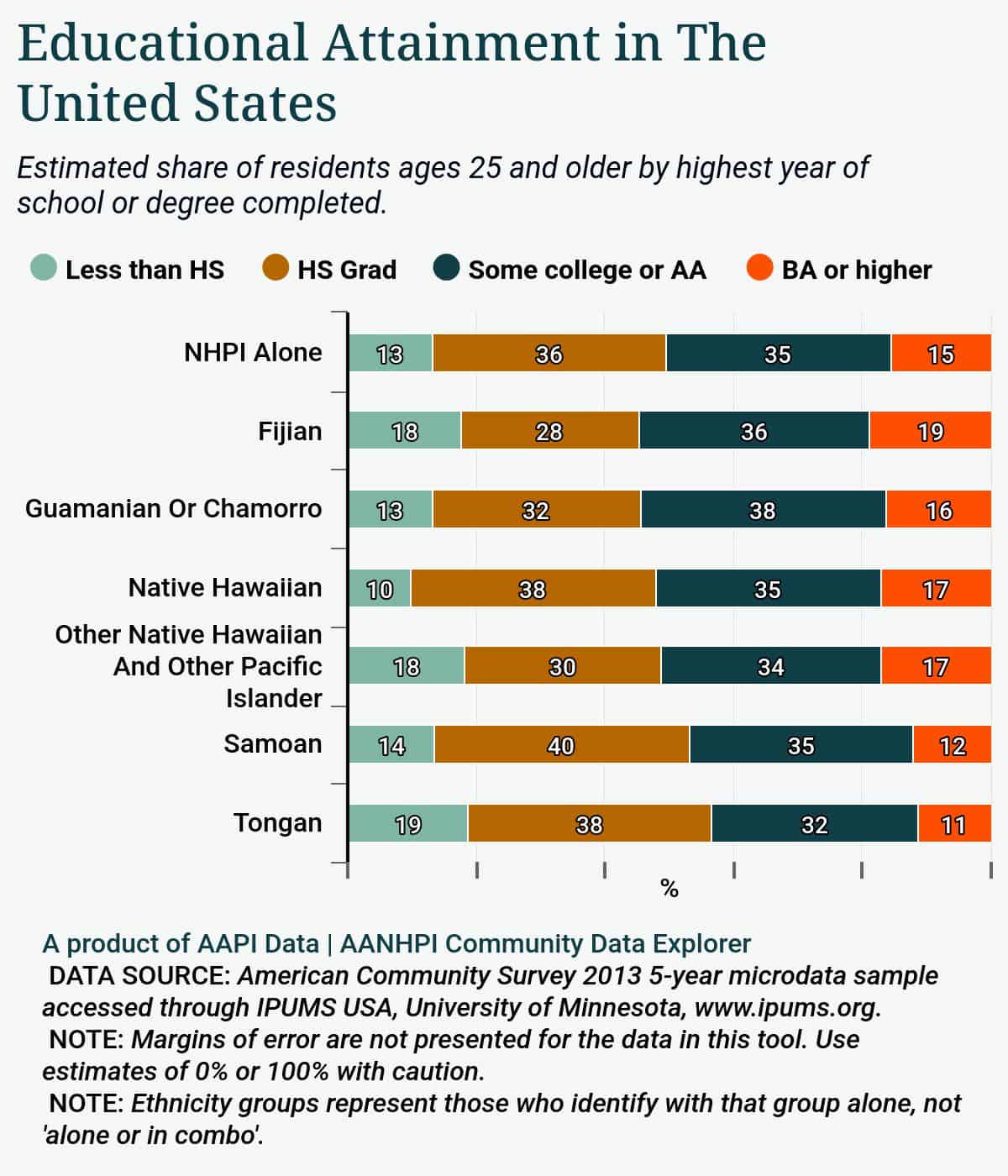
Image 24.06.02 — 2013 Educational Attainment in the United States across Samoan, Fijian, CHamoru, Tongan, Native Hawaiian, and other groups.
Additionally, higher education is a concern for Samoans. College attendance remains low for all Pacific communities, with data showing only 47 percent of the Pacific population had attended college, which is lower than the 54.9 percent of the total US population. When looking at Pacific Island group-specific data, we see that 57.9 percent of Samoans have not enrolled in any postsecondary education. Additionally, while a number of Pacific Islanders and Samoans do attend college, a significant proportion of Samoans (58.1 percent) leave without earning a college degree.
Pacific Islanders are also disproportionately incarcerated, especially in California. While the state’s total Pacific population grew 29 percent between 2000 and 2010, the total Pacific prison population grew 192 percent over the same decade. In cities like Oakland, California, Samoan men had the highest youth arrest rate after African American men at 140 per one thousand.
Since the 1970s, some young Samoans have joined gangs and embraced the street gang lifestyle, with many noting poverty as a leading factor. The Sons of Samoa, a gang based in west Long Beach, California, was the focus of French filmmaker Jean-Pierre Gorin’s film My Crasy Life (1991). The film, which was part observational documentary and part fiction, explored the intersections of gang life, faʻasāmoa, and making a home in Long Beach for these young men.
More to explore
Video
01:50
Sons of Samoa
The Sons of Samoa is a street gang based in Long Beach, California, affiliated with the Crips gang. As migrants or children of migrants, they are no strangers to the harsh realities faced by the young Black and Latinx men around them. As a form of community and survival, they established their own street gang with other Samoan and Pacific friends, cousins and neighbors.
These social and economic factors impact health as well. In California, Native Hawaiians and Pacific Islanders have high mortality rates, second only to African Americans. The leading causes of death include heart disease, cancer and, increasingly, suicide. Some researchers have noted that social issues faced by Samoan communities, such as poverty and unemployment, lead to substance abuse and depression, which then lead to suicide and other mental health issues.
One nurse who ran a mental health workshop with Samoan youth commented that she was surprised when half of the youth acknowledged having suicidal thoughts. Similarly, another provider stated, “I did not realize how many ten year olds and sixteen year olds have contemplated suicide…” 1
Financial stress, youth gang involvement, and the lack of intergenerational understanding were all noted as contributing to poor mental health among young Samoans. Samoans were less likely to have health insurance and so may not have access to necessary health care, leading to poor mental and physical health outcomes. Finally, the US health system is not always socially aware, and the perceived lack of culturally responsive providers serves as yet another barrier to access.
The Taulaulelei Brothers
Samoan people also face racism in their stateside experiences. Pacific communities have long been concerned about law enforcement discriminating against them and using excessive force. In the Samoan islands where Samoans are the majority population, race is not so much a factor. In contrast, racial discrimination in the United States has long been present, from the strategic erasure of Native Americans to African chattel slavery. While Samoans are Indigenous people, here in the US they have historically experienced a racialization similar to African Americans based on phenotype. This includes police brutality and is exemplified in the deaths of the Taulaulelei brothers.
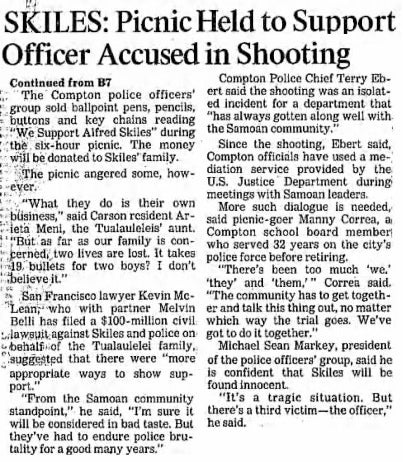
Text 24.06.04 — Los Angeles Times newspaper clipping from November 17, 1991, covers a picnic held to support Officer Skiles in the Taulaulelei case. This clipping shows the language used at the time to talk about the case, the Samoan community, and the police.
One evening in February 1991, Pouvi Taulaulelei, thirty-four, and his brother, Italia, twenty-two, were shot and killed by police in their Compton, California, driveway. Police came to the house responding to a call about domestic violence involving Pouvi and his wife, Julie. Pouvi had driven off with the couple’s children. Officer Alfred Skiles was present when Pouvi returned with the children sleeping in his car. As Pouvi pulled into the driveway, Italia came out of the house, and Officer Skiles locked Julie in the back seat of the police car. Officer Skiles went to the side of the house to confront Pouvi, and the last thing Julie heard was the word “kneel.” A third brother, who watched from the house, reported that the brothers were unarmed and knelt. Officer Skiles shot them twenty times, claiming the brothers tried to attack him. Autopsy results showed that the bullets were found in the front and back of the bodies, in the limbs and heads, and that the shots did not appear to have been fired at close range. All these factors discredited the officer’s claim.
Four hundred community members protested outside Compton City Hall to demand a criminal investigation. Some dressed in lavalavas and sang Samoan hymns about love and peace, carrying signs that read, “Who Will Protect Us” and “20 Times Equals Murder.” Pouvi’s son, who was seven at the time, carried a sign that said, “My Daddy Knelt. Why 20 Bullets.” Samoan students from El Camino College in Carson also came to show support for Italia, a scholarship student, linebacker on the football team, and founder of the college’s Pacific Islanders Club.
Officer Skiles’ trial for voluntary manslaughter began on April 27, 1992. During the trial, Skiles’ attorney used racist stereotypes of Samoans to cast the brothers as dangerous. Describing the brothers as “beefy,” he told the jury, “You would be scared to have these two big Samoans coming at you.” 2 The attorney was implying Skiles’ actions were justified because Samoans seemed threatening.
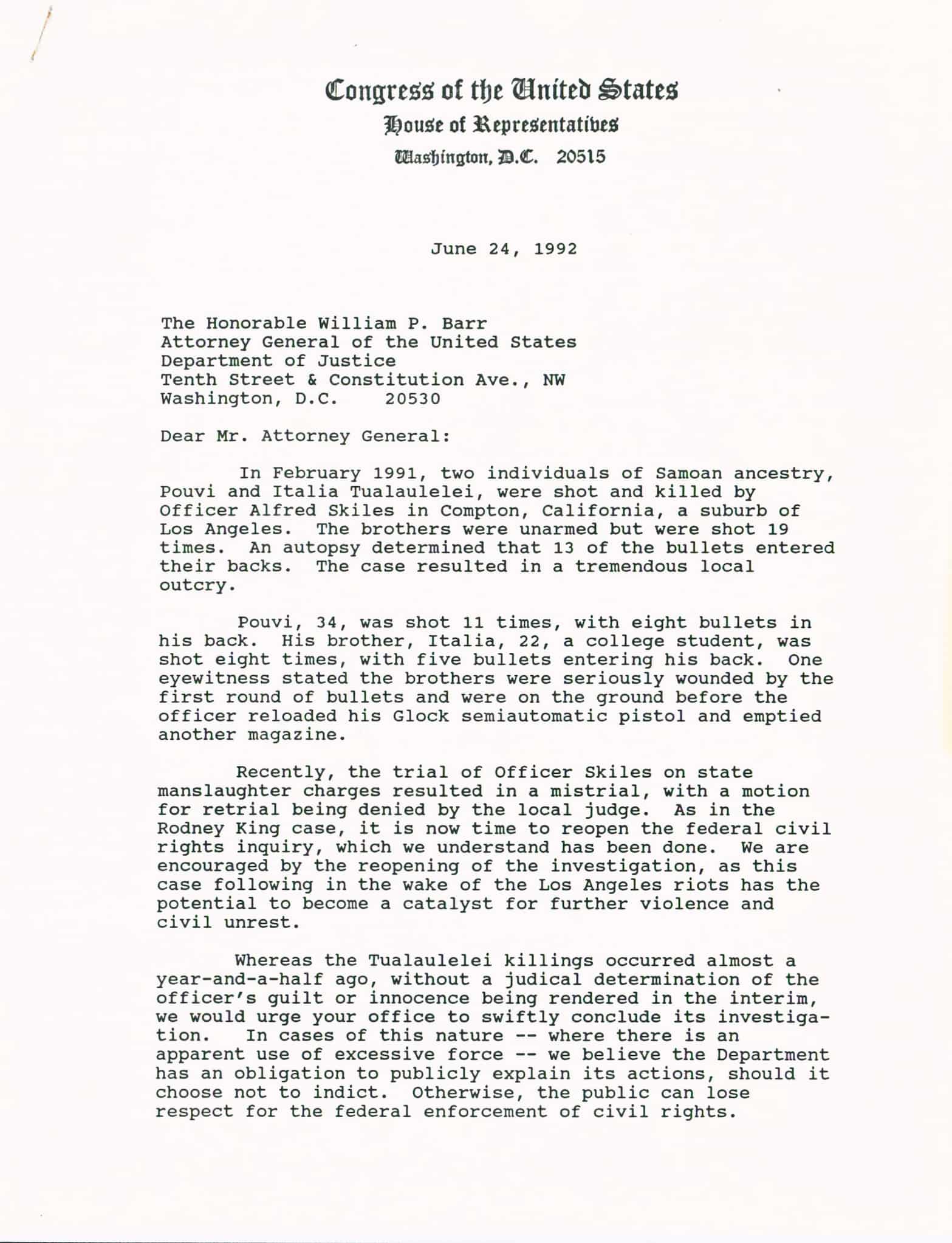
Text 24.06.05 — A 1992 letter drafted by members of Congress raises the death of the Taulaulelei brothers as a civil rights issue. The signature of Eni F. H. Faleomavaega, American Sāmoa’s non-voting delegate to the House of Representatives, is on the second page.
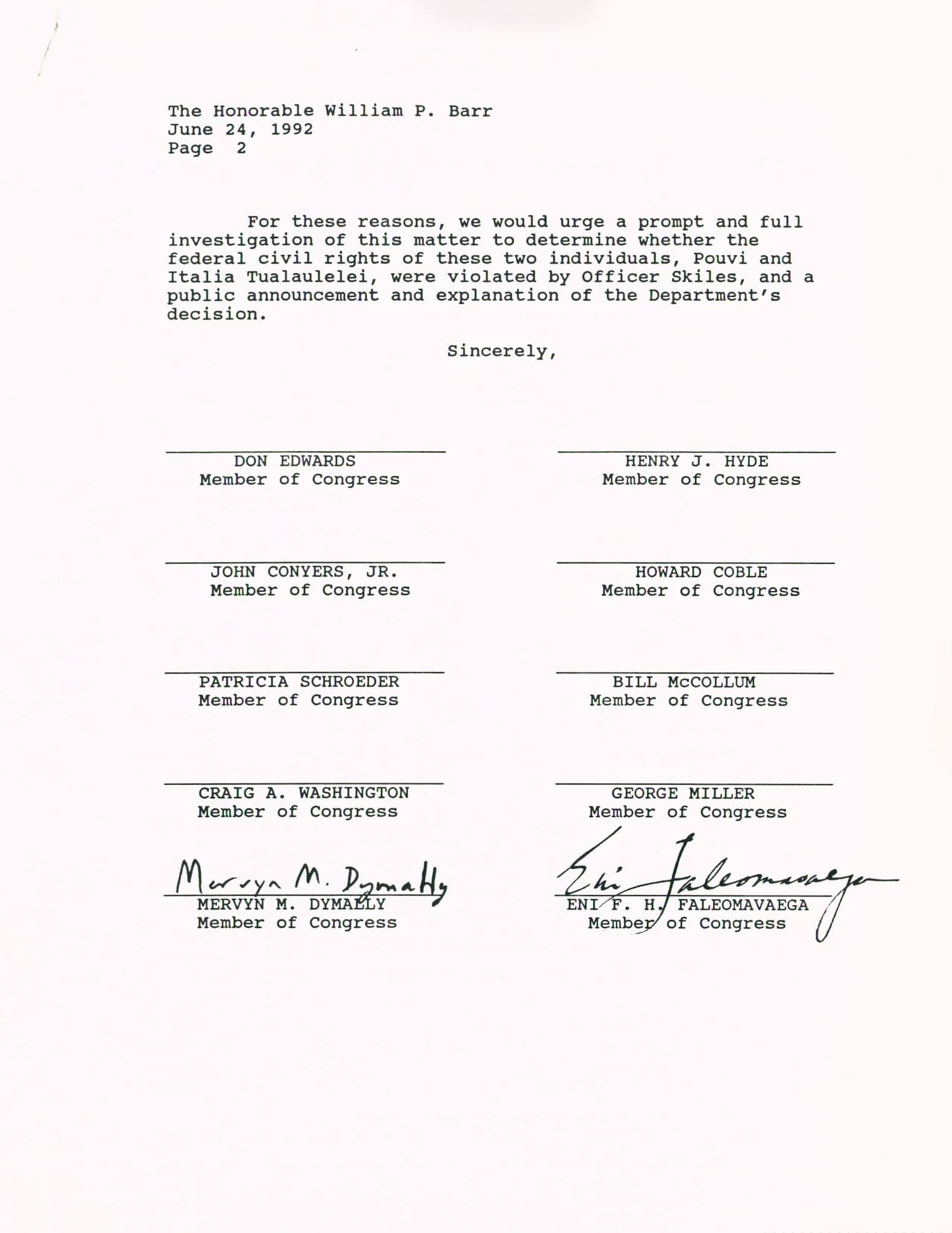
Text 24.06.05 — A 1992 letter drafted by members of Congress raises the death of the Taulaulelei brothers as a civil rights issue. The signature of Eni F. H. Faleomavaega, American Sāmoa’s non-voting delegate to the House of Representatives, is on the second page.


On the second day of the trial, Los Angeles erupted in uprisings over the acquittal of LA police officers for the beating of a Black man named Rodney King. The mass protest interrupted the Skiles trial, but also highlighted a trend of the LA police using excessive force on certain communities. In the end, like the officers in the King case, Skiles was cleared of all charges.
Generational Shifts and Youth Activism
Samoan youth activism has played a significant part in resisting the conditions faced by the community. While older generations of Samoan migrants tended to be less politically vocal, and were seen as being grateful for their new homes, young activists connected their struggles stateside to other struggles.
Omai Faʻatasi was an early youth activist group and development center that formed in Carson, California, in the 1960s when young people, including Simi Potasi, wanted to build a sense of identity, embrace faʻasāmoa, and also achieve social justice. Refusing to accept the struggles with poverty, violence, and educational attainment in their community, they created educational programs, job training, history classes, health care resources, food co-ops, substance abuse programs, and more. Motivated by civil rights groups at the time, they also helped Pacific youth navigate the legal system. By the end of the 1970s the center no longer had a permanent home, but its legacy lives on in the film Omai Faʻatasi: Samoa mo Samoa (1978) by Takashi Fujii.
The case of the Taulaulelei brothers galvanized youth activism again in the 1990s. In 1991, Samoan activists, most of whom were raised in the US, protested when the city of Carson refused to rename Winfield Scott Park for the late Harry T. Foisia, an important Samoan community member known for his volunteer work with local Samoan youth.
Advocating for recognition of the role Samoan people played in addressing the challenges they faced in Southern California was seen as a cultural shift. At the time, Samoan political figure David Barrett Cohen commented that, “Every immigrant community takes a generation or two to get involved in the political system…. What you are seeing here is an awakening of the Samoan community.” Although the park was not renamed after Harry T. Foisia, thirty years later, the community celebrated when the city renamed it after the late James Foisia, Harry’s brother.
The younger generation continues to make up a significant segment of the Samoan population. With social media expanding audiences, we see young Samoans like Drew Afualo and Terisa Siagatonu speaking out on racism, invisibility, gender, representation, and, of growing significance, climate change. While the grandparents and parents of today’s young Samoan people faced harsh stateside realities (that continues to exist within Samoan communities), young people refuse to settle, demanding more from the “enduring friendship.”
Just as earlier generations of Samoan people were influential in social justice movements from the ‘60s to the ‘90s, their spirit of speaking out and demanding better continues to thrive. The future of Samoan life will continue to rest in the hands and contributions of young people as they move toward social justice within the United States.
Glossary terms in this module
Indigenous Where it’s used
Refers to someone or something that originates from a region, predating colonialism.
stereotype Where it’s used
Generalized beliefs about a group of people based on one characteristic. Typically, stereotypes perpetuate harmful discourse about groups of people and are rooted in incorrect, and often racist beliefs.
Endnotes
1 Ann-Marie Yamada, Dorothy Etimani S. Vaivao, and Andrew M. Subica, “Addressing Mental Health Challenges of Samoan Americans in Southern California: Perspectives of Samoan Community Providers,” Asian American Journal of Psychology 10, no. 3 (2019): 227–38.
2 Kathy Yep, “The Power of the Collective Voice,” in Asian American Policy Review: Volume IV Political Empowerment in the Asian Pacific American Community (John F. Kennedy School of Government, Harvard University, 2009), 39.