




Samoan American Liz sits on the hood of a car while holding her baby. Her cousin Vaisola sits next to her and leans over to see the baby.
Module 3: Toloa or Eagle: Flights of Migration
Have Samoans benefitted from their “enduring friendship” with the United States?
Before Captain Jordan Scanlan enlisted in the military in 2010, he had many family and friends across different military bases. As a young man in American Sāmoa, he knew he wanted to join the Army. “It was a common thing we say on the island, you know there are only two ways to get off the rock,” Scanlan said. “You are either going to be in the NFL or you are going to join the military.” 1
Samoan migration to the continental United States, or to Hawaiʻi and Alaska, occurred in big numbers starting in the 1950s. About a third of islanders moved off American Sāmoa by 1960, and by 1972 about five hundred people left every year. At the time, Samoans already living in Hawaiʻi and California outnumbered those still in American Sāmoa by almost two to one.
Many see this as a quest to achieve the “American Dream,” a belief that within America, anyone can achieve success because of the values placed on freedom, equality, and hard work. For migrant communities, moving to the so-called “Land of Opportunity” is a chance to increase socioeconomic mobility by enhancing one’s social status and income. For many on the archipelago of Sāmoa, such mobility could only be achieved by leaving home.
Chasing the American Dream is made possible for Samoans because, as US nationals from an US territory, they can freely migrate to the US despite not being granted US birthright citizenship. In this module, we discuss where Samoans migrate to, why they migrate, and their realities when they get there.
Reflection Questions
Why would someone leave their homeland?
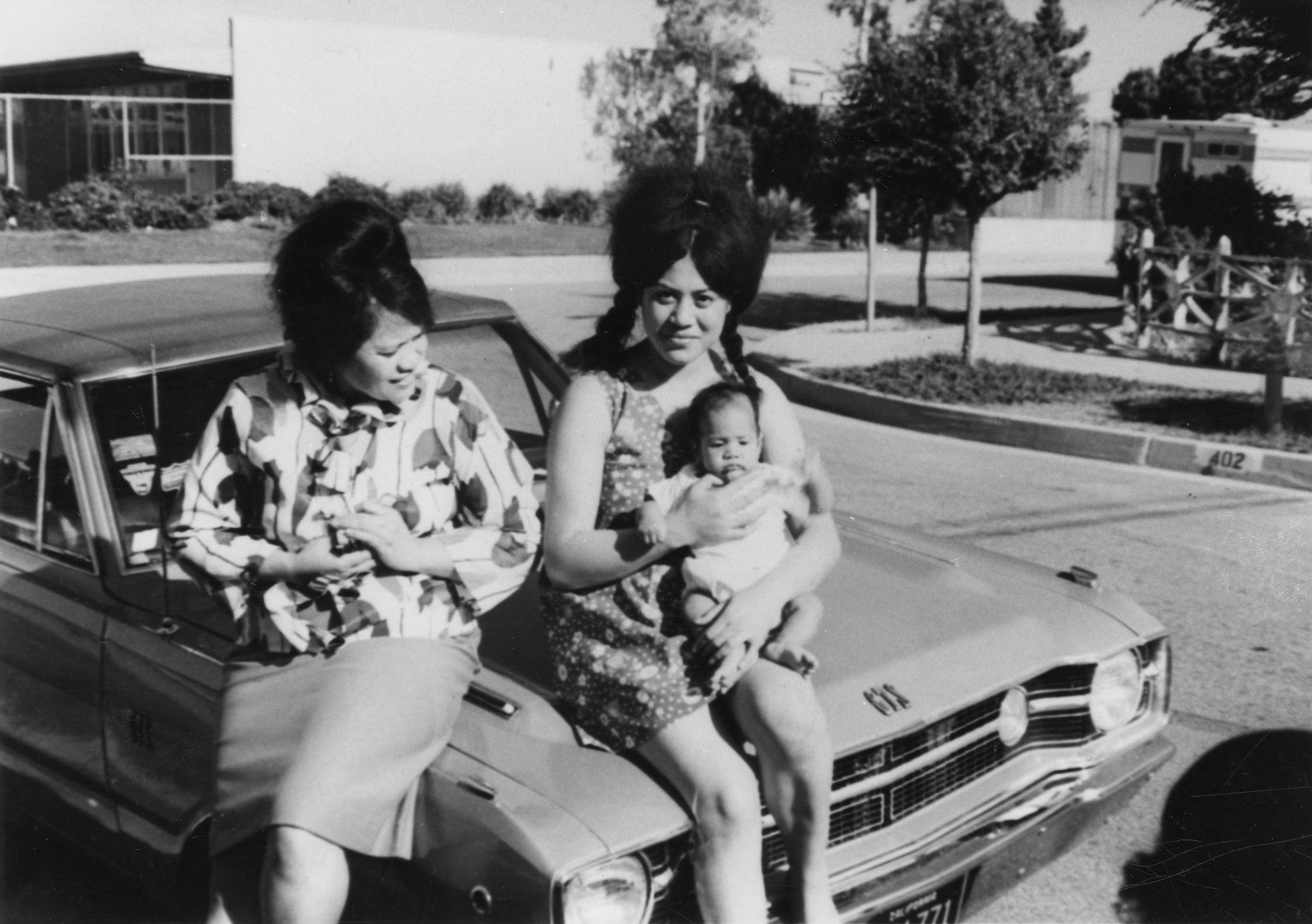
Image 24.03.01 — Liz (right) with her son and her cousin, Vaisola (left), sit on a car on Archibald Street in Carson, California, 1971. A significant number of Samoans continue to live in Carson.
Why do Samoans migrate to the US and where do they go?
How do Samoans build and organize communally in the diaspora?
What role do dominant narratives about the American Dream play in Samoan migration? And has reality lived up to those dreams?
“Travel-Happy” Samoans
Migration is often discussed through ideas like globalization, which is the spread or flow of economies, cultures, and populations across the globe, as well as push and pull factors that influence people’s decisions to leave one place to go to another. However, it is important to also think about Samoan travel as an aspect of culture itself, guided by faʻasāmoa.
Alagaupu (proverbs) are found all throughout Samoan language, stories, and cosmology. They are often revered for the deep meaning that they hold within faʻasāmoa. One Samoan alagaupu reads, “E lele le toloa ʻae maʻau i le vai,” which translates to “The toloa bird flies all over but always returns to the water.” This proverb emphasizes multidirectional travels and the importance of returning home.
Samoan scholar Sa‘iliemanu Lilomaiava-Doktor writes about Samoan travel and returns, encouraging us to think about migration through the Samoan word malaga, meaning travel and movement. It also implies a sense of going back and forth. Samoan historian Toesulusulu Damon Salesa has written about the place of mobility in Samoan contexts, describing Samoans as “travel-happy.” 2
Before the colonization of the Samoan islands, Samoans would travel across various networks of trade and intermarriage. Salesa describes this Pacific maritime world as a network of Native seas within an Indigenous Ocean. Today, we still see the travel-happy nature of Samoans globally, with more living outside of both Sāmoa and American Sāmoa. Rather than following the ala, or pathways, of the pre-colonial Indigenous Pacific, their routes have been rewired along colonial lines where new diaspora communities take hold.
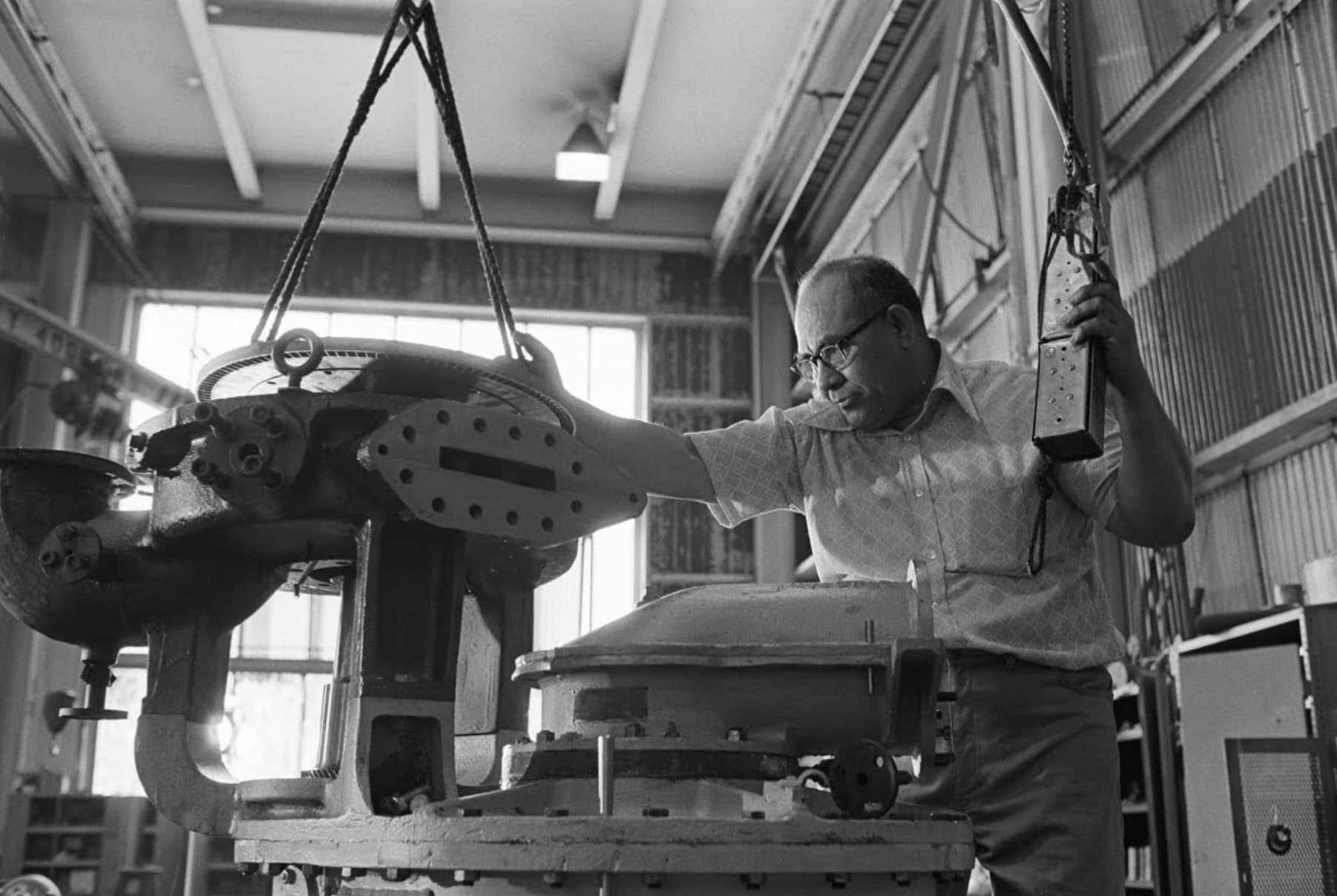
Image 24.03.02 — Lagofaʻatasi Sialoa, a Samoan American shipbuilder and minister manufactures precision parts for a ship’s engine, 1972. In the decades following World War II, many Samoans who served with the US Navy found work at Long Beach Naval Shipyard in California.
New Opportunities and the American Dream
Samoan migration off island occurred in big numbers from the 1950s. It was estimated that one-third of islanders had moved off American Sāmoa by 1960. By 1972 it was estimated that American Samoans residing in Hawaiʻi and California outnumbered those still in American Sāmoa by almost two to one. The nickname for the United States as the Land of Opportunity was built on the belief in the potential of increasing one’s social status and income. For migrant communities, physical mobility was connected to the belief in socioeconomic mobility and the American Dream. This was something believed to be achieved state-side, not on the archipelago of Sāmoa.
As Captain Jordan Scanlan noted at the start of the module, the US military and professional football are two common migration pathways for contemporary Samoans, specifically men. These careers offer opportunities for recruits and their families; however, they are also high stakes career pathways.
As a pathway to a future career, the military offers college education through the Reserve Officers’ Training Corps (ROTC). Several colleges have ROTC programs that recruit from American Samoan high schools. For many, military service provides more income than the limited employment opportunities that exist on the archipelago.
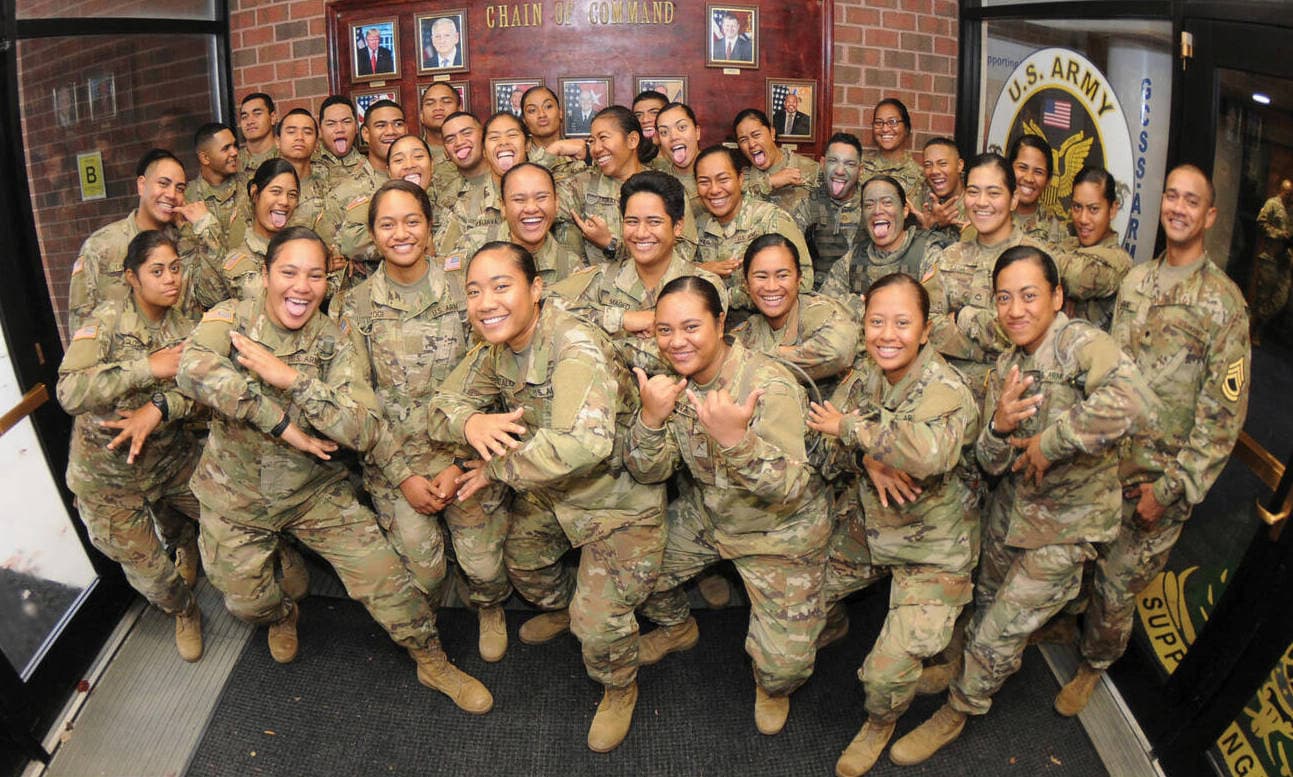
Image 24.03.03 — Members of a Samoan family in military training at Fort Lee, Virginia. At the time of this photo, forty-one family members hailing from Poloa, a village west of Pago Pago, train together in the US Army, c. 2017.
Much like the ROTC, college sports are also an important way for Samoans to access college, where they are underrepresented. The pathway to the NFL (National Football League) is through collegiate football, so many young Samoan men seek out football scholarships. American Sāmoa has been dubbed “football island” 3 because Samoan men are highly represented in football—particularly the NFL.
Samoan scholar Lisa Uperesa has described this type of sport migration as the “Polynesian Pipeline”—a common pathway that brings Samoan athletes from American Sāmoa to Hawaiʻi and the continental US to play football at the collegiate and professional levels. Beginning in the 1930s, the pipeline was fully established by the 1970s. By the 1990s, scouting and recruiting directly from American Sāmoa began. Samoan football coach Keith Uperesa reminds us of the need for opportunities for young Samoans. He notes, “Football is a passion, it’s not a priority. Getting off the island is a priority, and football is a way to do it.” 4
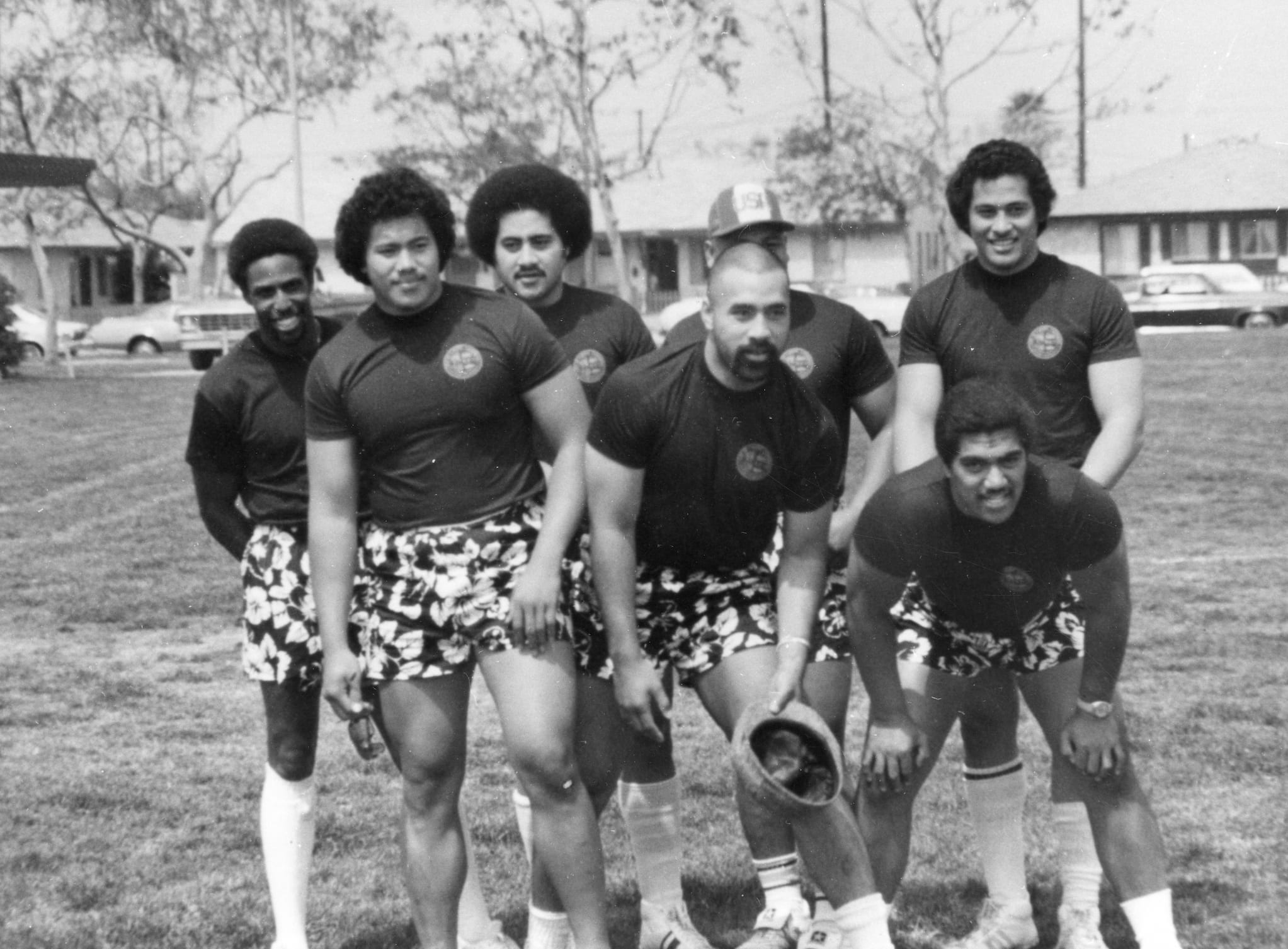
Image 24.03.04 — A 1975 group portrait of the Samoan American athletic club, “Samoan Athletes in Action,” at Scott Park in Carson, California. The park was renamed Foisia Park in 2018, almost thirty years after the Samoan community initially advocated for the city to rename the park.
Building Diasporic Communities
While military and football migration pipelines are prominent, they are not the only reasons people migrate. People also migrate to take up other employment opportunities, to be closer to family, or because they desire American amenities. Malaga happens every day between Sāmoa and the United States for a variety of reasons.
For as long as Samoans have been moving to the US, they have been creating homes and building communities in cities like Honolulu, Hawaiʻi; Los Angeles, California; Salt Lake City, Utah; and Anchorage, Alaska. Samoan communities in the diaspora are intergenerational, combining those who migrated and those who were born in the US. Each group has their own unique Samoan experience.
A significant number of Samoans settled in Carson, a city in Los Angeles County. Samoan migration to Carson began after the closure of the US Naval Station Tutuila in Pago Pago. One person who migrated during this time is Tuiofu Foisia, who served in the US Navy and was transferred to Long Beach. In 1956, he moved to Carson, became an ordained minister, and established the First Samoan Congregational Christian Church.
Samoan migration to Carson was so significant that by the 1980s, an Office of Samoan Affairs opened up, as well as many more Samoan churches and food establishments. In 1991, Carson’s Samoan community came together to advocate for the city to recognize their contributions. When Harry T. Foisia, Tuiofu’s son, a longtime city worker and community leader revered for his work with troubled youth, died at the age of thirty-nine, the Samoan community urged the city to honor his legacy by renaming Winfield Scott Park in his honor.
Although their campaign was unsuccessful, the Carson City Council later renamed the park after Harry’s brother, James M. Foisia, a community activist and Senior Recreation Center Supervisor of the park. Today, James M. Foisia Park represents a place of Samoan diaspora in Carson, and home to the annual Samoan Heritage Day Festival.
More to explore
Image
Samoan Heritage Day Festival
Since 1986, the annual Samoan Heritage Day Festival has celebrated Samoan populations in the city of Carson, California. Held in June, the festival draws out the long established community within the city, raises the flags of both Sāmoa and American Sāmoa, and continues with singing, dancing, and food. Recently the festival has been headlined by Samoan musical acts such as Tenelle. This celebration is one of the longest held celebrations and recognitions of Samoan communities in the US.
Samoan language churches are a prominent mode of community building. From the 1950s Samoan churches of all denominations began opening across California. Today, significant numbers of Samoan churches can be found in Carson, Long Beach, Compton, Sacramento, and the San Francisco Bay Area.
Additionally, many Samoans call Anchorage, Alaska home due to the military base there and employment opportunities on the railroad and tuna canneries. While the cold weather and long distance make this a surprising place for Samoans to migrate to, a stable Samoan community exists to welcome them. Samoan churches and civic groups like the Samoan Tribal Council of Alaska and the Alaska Samoan Community Corporation, underlie the importance of community in making diasporic homes. Samoan is the third most common language spoken at home in the Anchorage School District and proof of the importance and perseverance of faʻasāmoa for Samoans in Alaska.
The importance of culture is symbolized through the toloa bird in the proverb discussed in this module. The toloa always finds its way back to the water. Water can be thought of as moments of cultural grounding through church, civic groups, or even a favorite cultural meal. While not everyone will be able to physically return to the Samoan islands often, they continue to find symbolic ways to make and return home, even while seeking out opportunities to achieve the American Dream.
Glossary terms in this module
American Dream Where it’s used
The ideal that the United States is the land of opportunity where anyone can attain a successful and prosperous life, regardless of background or socio-economic status.
colonization Where it’s used
The act in which a group or country brings a region and its Indigenous people under its domination and control.
diaspora Where it’s used
The dispersal, movement, migration, or scattering of a people from their established or ancestral homeland.
Indigenous Where it’s used
Refers to someone or something that originates from a region, predating colonialism.
Endnotes
1 Tracey Leong, “American Samoans’ strong military tradition,” KIRO 7 News, May 27, 2021, https://www.kiro7.com/news/local/american-samoans-strong-military-tradition/N3JHJOPOSVECFLYDH4VWWXINPA/.
2 Damon Salesa, “‘Travel-Happy’ Sāmoa: Colonialism, Samoan Migration and a ‘Brown Pacific,’” in An Indigenous Ocean: Pacific Essays ( Bridget Williams Books, 2023), 293–310.