




Uniformed Fita Fita Guardsmen stand on the Naval station dock in Tutuila, Amerika Sāmoa, as they prepare lines for the coming USS Trenton warship.
Module 2: Friends or Foes: Making American Sāmoa
Have Samoans benefitted from their “enduring friendship” with the United States?
Captain Soosoo Taulelei, an officer in the Pennsylvania Air National Guard, expresses great pride in his profession:
“I don my uniform with pride and grit and know that I’m not just representing myself, but my family both past and present and every other Samoan service member before me who fought to pave the way so that my family could come to this great nation and live in free pursuit of happiness for generations to come.” 1
American Samoans enlist in the US military at a higher per capita rate than any other state or territory. For many proud military families, enlisting is part of continuing the family business. With that comes immense pride in serving both their Samoan and American identities.
However, as we learn more about the colonial and military histories we can also see that the connection between the US military and American Sāmoa is complicated. Military recruiters often exploit the stereotype of the “Samoan warrior” when there are other reasons why Samoans enlist at high rates. For some, it is seen as “the only option” to get off the rock and seek greater career and economic opportunities for themselves and their families.
In this module, we will learn about the military history that transformed part of the Samoan islands into the US territory of American Sāmoa. We will consider this history and the complex “enduring friendship” between American Sāmoa and the United States.
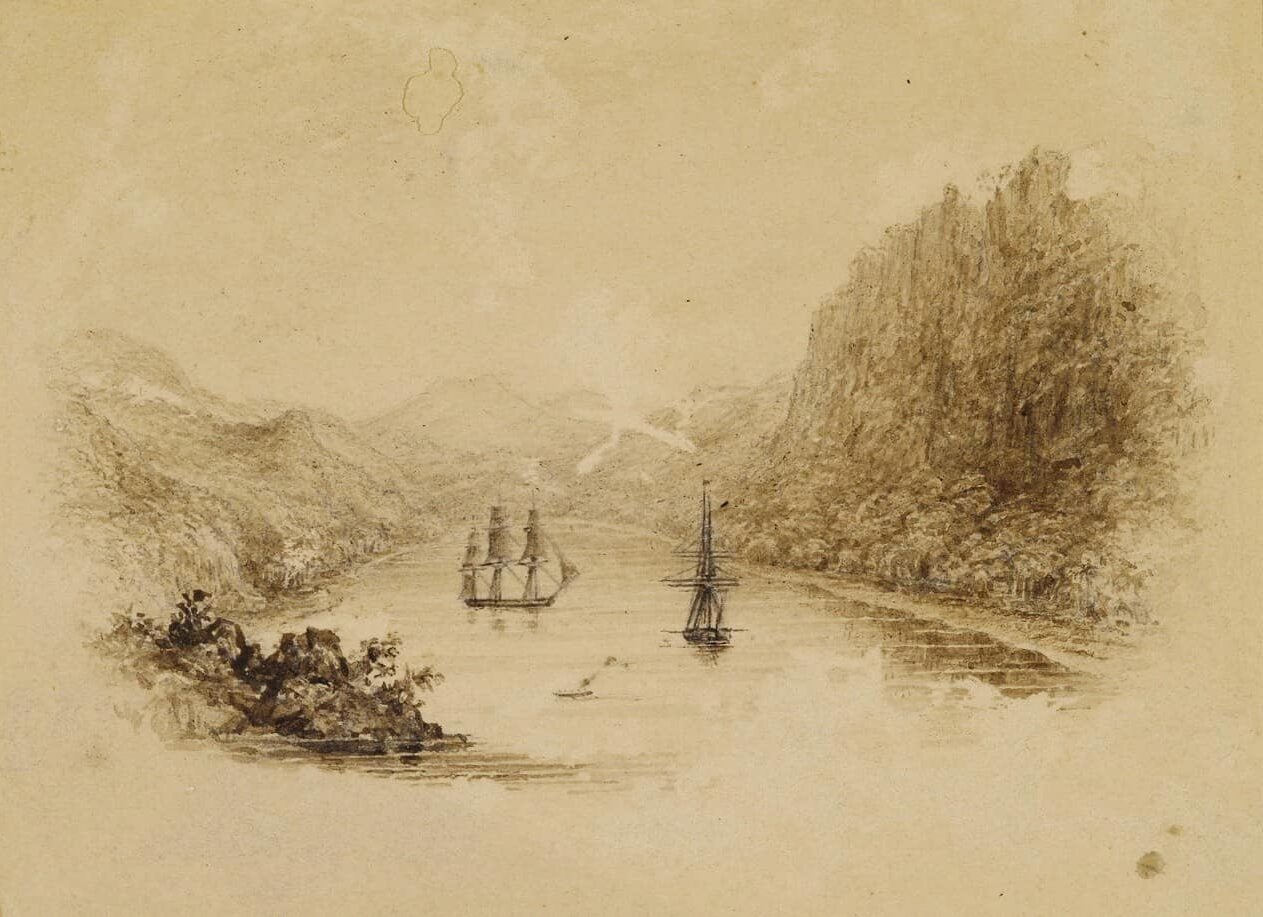
Image 24.02.01 — Drawing of Pago Pago harbor on Tutuila by Alfred T. Agate, c. 1840. Agate was an artist on the United States Exploring Expedition of 1838–1842 led by Charles Wilkes of the US Navy.
What is the difference between Sāmoa and American Sāmoa?
Why does American Sāmoa have the most enlisted soldiers in the US military per capita?
Why aren’t American Samoans US citizens if they live in a US territory?
Making America Sāmoa
In the eighteenth century, the British, Germans, and Americans saw the Samoan archipelago as a strategic colony for commercial and military purposes. The US Navy made their first official visit to Sāmoa in 1838 and formalized their place a few decades later. In 1878, high chief La Mamea Makalau traveled to Washington, DC, to negotiate the Treaty of Friendship and Commerce with the US.
The treaty guaranteed “perpetual peace and friendship between the Government of the United States and the Government of the Samoan Islands” and also the ability to establish a naval port in Pago Pago, the big city on the island of Tutuila. 2 However, after the treaty was signed, Sāmoa entered a tumultuous period of two civil wars between 1886 and1898.
In Sāmoa, the governance system, or the faʻamatai system, consists of a complex web of chieftains and clans, where villages take care of their own affairs and coexist alongside each other. This is very different to having one single central leader like a president or king. In the late nineteenth century, tensions rose between rival factions.
Various chieftainships began protecting their own interests, influenced by the British, Germans, and Americans. Conflict between various clans broke out, and western powers supported different leaders. While the Germans proclaimed Tupua Tamasese Lealofi II to be king, the British and the Americans recognized Malietoa Laupepa. Many Samoans rebelled against Tupua Tamasese and the German presence in Sāmoa, especially after Malietoa Laupepa was exiled.
More to explore
Image
Malietoa Laupepa
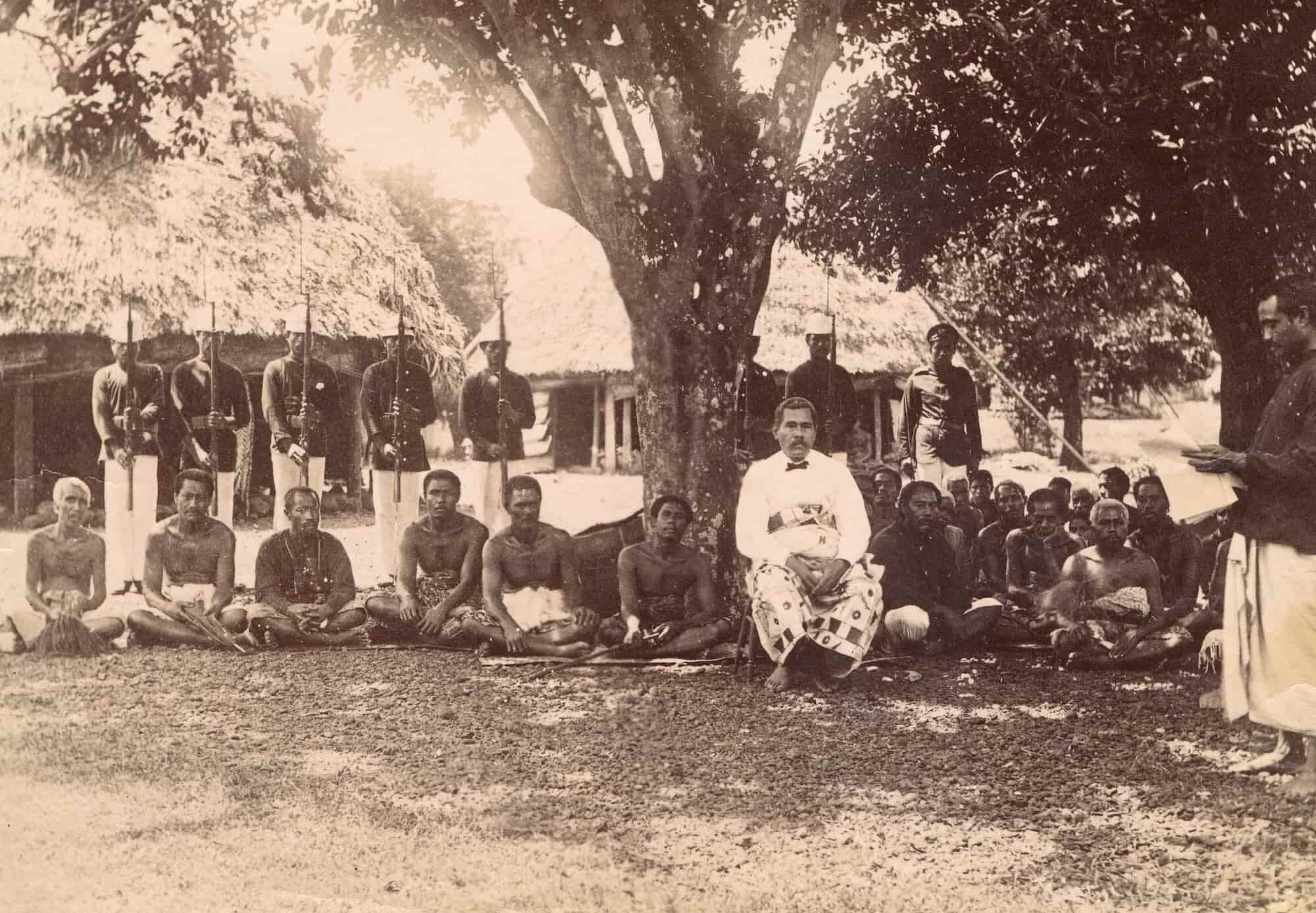
Malietoa Laupepa (1841–1898) received the high ranking title Malietoa in 1880, and went on to become a significant person in the two Samoan civil wars (1886–1898). The Samoan civil wars ended with the 1889 Treaty of Berlin, signed by the British, US, and German governments, recognising Malietoa Laupepa as the king. In this photo, Malietoa Laupepa sits protected by armed guards listening to the translation of the treaty.
Political tensions between the factions continued until 1899 when Britain, Germany, and the US reached an agreement called the Tripartite Convention, reinstating the Malietoa Kingdom held by Malietoa Laupepa’s son, Malietoa Tanumafili I, and officially partitioning the archipelago. Germany received Sāmoa’s islands to the west including the two largest, Upolu and Savaiʻi, while the Americans received the islands to the east. This agreement officially parted the seas, creating the two Sāmoas that still exist today.
There were no Samoans present during these negotiations, and while the agreement could be understood as an act of peacemaking, it also secured the interests of outside global powers in Sāmoa.
US Navy in America Sāmoa
The Treaty of Friendship and Commerce secured US naval interests in American Sāmoa. In 1898, the US began constructing the US Naval Station Tutuila with Benjamin Franklin Tilley, the first Naval Governor, overseeing its construction. Soon after, Tilley created a small militia of Samoans called the Fita Fita Guard—using the Samoan word for “soldier.” Trained by Marine Corps sergeants, the militia were highly regarded by local communities and brought in an important source of income for their families.
Sāmoa’s strategic location came into importance during World War II, when the naval base served as a refueling stop. Hundreds of Samoans were able to volunteer for the Fita Fita Guard, US Navy, or Marine Corps Reserve. As American Sāmoa became more militarized, enlistment and other military employment opportunities arose. This brought significant value to the base and to the military.
When the US Naval Station Tutuila later closed in 1951, the local community felt the economic loss. People stationed there were redeployed to Hawaiʻi, San Francisco, Los Angeles, and San Diego. American Sāmoa’s administration was transferred from the US Navy to the Department of the Interior.

Image 24.02.03a — Fita Fita Guardsmen handling USS Trenton’s lines at Naval Station, Tutuila, American Sāmoa, March 31, 1938.
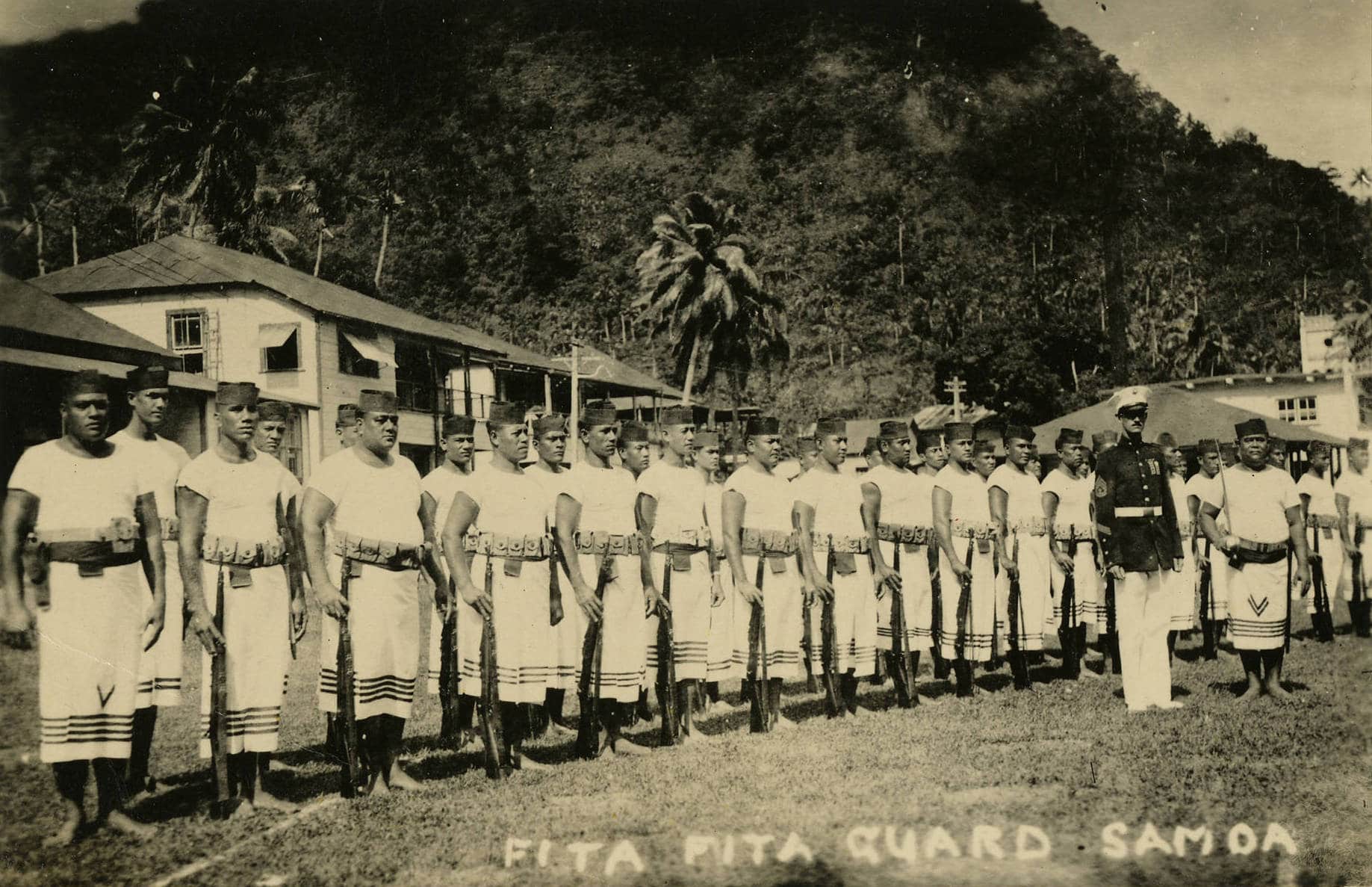
Image 24.02.03b — Fita Fita Guardsmen and US military members in American Sāmoa, c. 1941–1945.
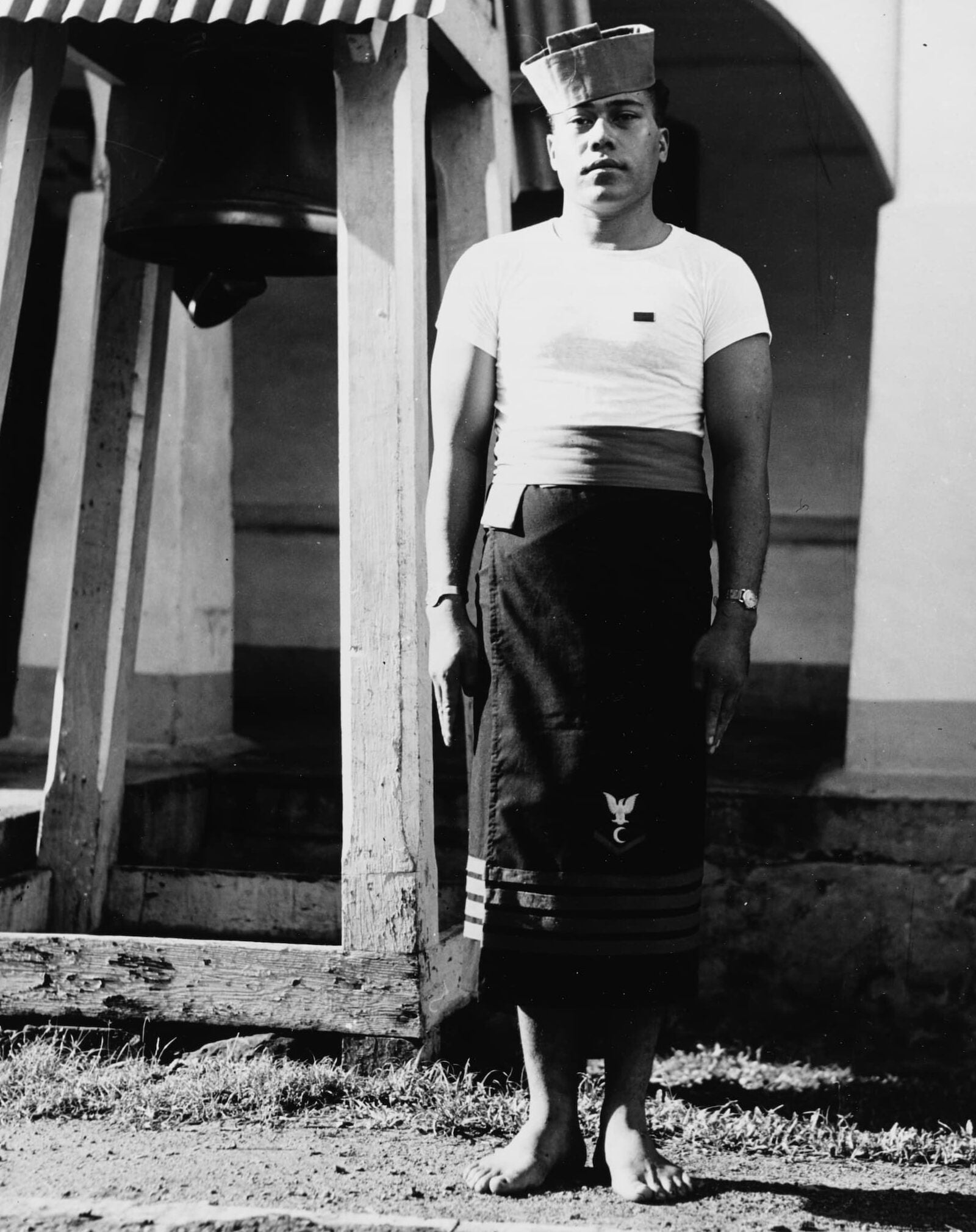
Image 24.02.03c — Officers Cook 3rd Class Forsia, wearing the Fita Fita Guardsman uniform, was the first Samoan to be decorated during World War II. He received the Purple Heart.



Contemporary Militarism
US Naval Station Tutuila’s history reveals the firm place of the military in American Sāmoa and for Samoans today. The benefit of a militarized Sāmoa goes both ways. For the Navy, it was about the strategic use of the deep harbors and geography. For Samoans, the military offered employment and financial and overseas opportunities for higher education and medical services. Today, long after the closing of Tutuila, American Sāmoa still maintains strong ties to the US military as veterans and military families.
Because military recruiters target high school and college campuses, many young Pacific people are introduced to the idea of enlistment early on. They may be enticed by the promise of a decent wage and benefits such as college tuition and other opportunities for a better future. Young Pacific people from American Sāmoa, Hawaiʻi, Guam, the Commonwealth of the Northern Mariana Islands, the Marshall Islands, the Federated States of Micronesia, and Palau enlist for similar reasons: economic necessity, a stepping-stone toward employment and service, university enrollment, as well as pride and duty to family and the United States. American Sāmoa has the highest per capita enlistment rate of any US state or territory.
More to explore
Although enlistment provides opportunities, there are also major risks. Pacific recruits frequently join at lower ranked infantry levels rather than into higher officer ranks. This gives them fewer benefits and opportunities. This also means that Pacific people comprise one of the largest groups per capita to become casualties of war. In Iraq and Afghanistan, Samoans died at a higher rate than troops from anywhere else in the US or its territories.
This was the subject of a poem ‘A Lament in Time of War’ (2005) by Samoan novelist Sia Figiel who is also daughter of Retired Senior Chief Boatswain’s Mate Stanislaus S. Figiel. Despite being from a military family herself, the poem shows a critical perspective of US militarism and American Sāmoa.
Loyalty and Patriotism
Every April 17, American Samoans gather to commemorate the first raising of the US flag on Tutuila. On this day in 1900, the US officially declared sovereignty over the island group. American Sāmoa’s annual Flag Day celebration is organized to demonstrate the continued military commitment and strong sense of Samoan loyalty to the US. It is one of America Sāmoa’s largest annual celebrations and celebrants fly both the flags of the US and America Sāmoa.
We can think about this loyalty and patriotism through the concept of American exceptionalism, which is the belief that America is a unique and special superpower that stands for and protects freedom and opportunity. This creates a sense of pride for many Samoans, who feel they are part of the best military and country in the world.
Where does this belief in “exceptionalism” come from? The US presence in Sāmoa has always claimed to be conscious of protecting the Indigenous culture. Governor Tilley and early US Navy regulations announced that Samoan customs would be preserved as long as they did not conflict with the laws or needs of the US concerning the naval station and that any changes would involve consultation with the Samoan chiefs and people.
So while the making of American Sāmoa instilled a deep loyalty to the US, it did so by recognizing the importance of faʻasāmoa and the faʻamatai system. This protection of Samoan sovereignty and culture is illustrated in the American Sāmoa flag. Based on ideas submitted by the Samoan people, the flag consists of an American bald eagle holding the fue (fly whisk) and the uatogi (war club). These symbols of faʻasāmoa are being protected by the American eagle, a symbol for the US.
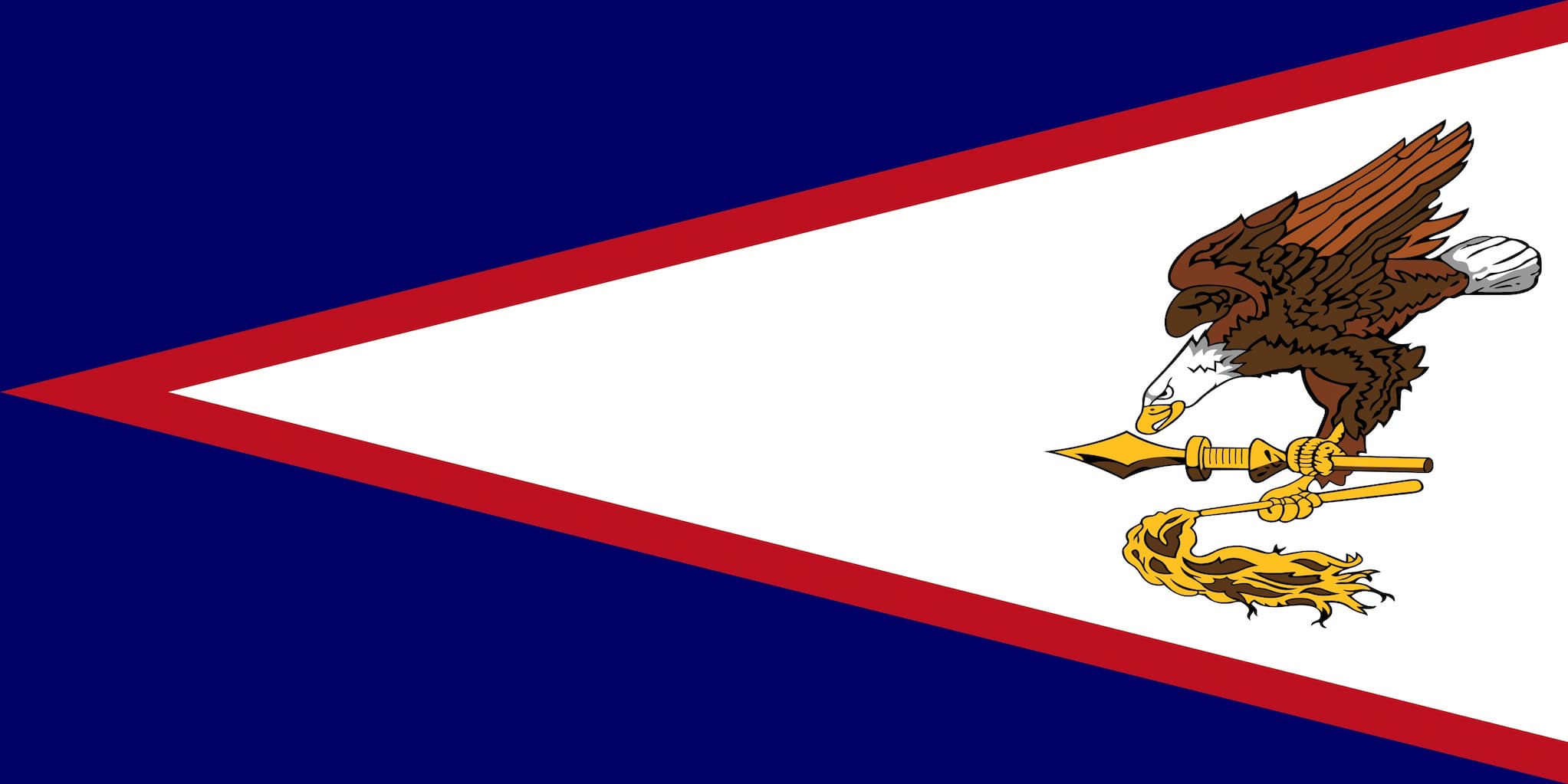
Image 24.02.04a — The flag of American Sāmoa with American and Samoan cultural symbols: the bald eagle, the fue, and the uatogi.
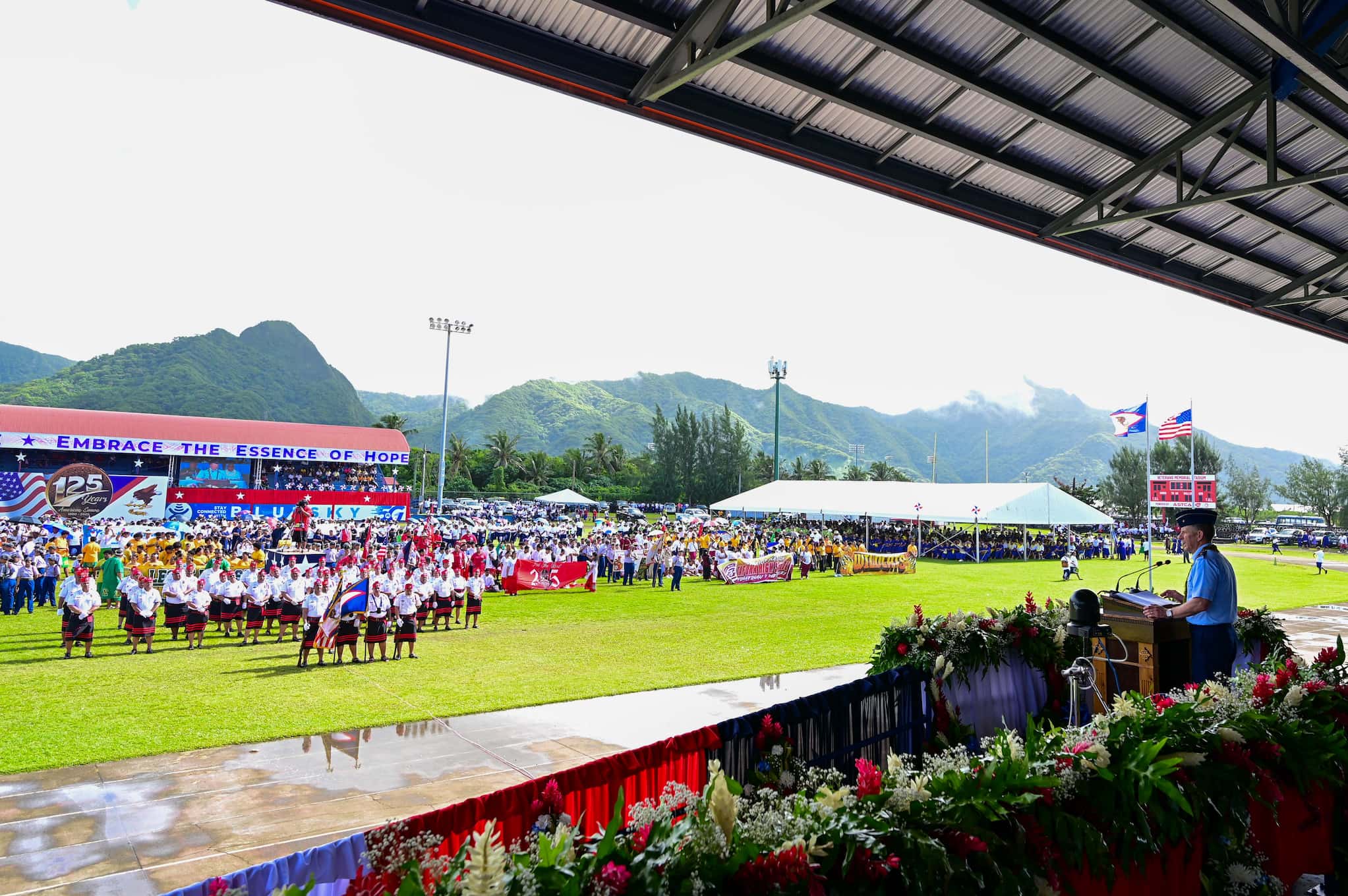
Image 24.02.04b — The US military addresses the audience at the 125th American Sāmoa Flag Day celebration in Pago Pago. The flags of American Sāmoa and the US are raised together (right).


Friendship
From the Treaty of Friendship and Commerce, to the American eagle protecting the Samoan fue and uatogi on the flag, the relationship between Sāmoa and the United States has always centered on friendship. American Samoans, however, are not US citizens but instead US nationals, which makes them the only US territory without US birthright citizenship. This is a pressing issue for many Samoans who feel they have given so much to the US through their commitment to the military, and yet have no citizenship or a say in federal elections in return.
Some see the restrictions of being US nationals as equivalent to being second-class citizens; a group with inferior rights to others in the same society. Still, others argue that any other relationship to the US could endanger faʻasāmoa, customary land rights, and the protections afforded through their friendship thus far.
Pacific and legal scholar Line-Noue Memea Kruse studies this complicated relationship. She notes that many argue that the Treaty of Enduring Friendship has created the conditions of an “inferior citizenship.” However, this “partial membership” has protected Samoan traditions and customary institutions. Moreover, she writes that “full application of the US constitution would unravel the existing protections for communal land tenure, or land that is owned and used by a group of people rather than individually, which is founded upon race and chiefly (nobility) title system.” 3 And so, not all American Samoans advocate for full US citizenship rights.
Any friendship includes commitments and compromises, and the relationship between the US and Samoans is full of both. The result is a history that is complex and layered, and is still being negotiated by Samoans today.
Glossary terms in this module
Indigenous Where it’s used
Refers to someone or something that originates from a region, predating colonialism.
sovereignty Where it’s used
The ability of a country to have independent freedom of action, such as making its own laws and rules without external interference. For Indigenous peoples, sovereignty means having control of their lands and way of life, free from colonial control.
Treaty of Friendship and Commerce Where it’s used
Signed in 1878 between high chief La Mamea Makalau and the US, this treaty assured friendship between the US and Samoan governments and secured US naval interests in Samoa through the establishment of a naval base in the city Pago Pago.
Endnotes
1 “Military service ‘part of our makeup as a warrior people,’” Reserve and National Guard Magazine, June 10, 2022.
2 “Treaty of Friendship and Commerce between the United States and the Samoan Islands”, January 17, 1878, as reproduced in Sylvia Masterman, The Origins of International Rivalry in Samoa: 1845–1884 (George Allen & Unwin, 1934), 214.
3 Line-Noue Memea Kruse, The Pacific Insular Case of American Sāmoa: Land Rights and Law
in Unincorporated US Territories (Palgrave Macmillan, 2018).