





Pamphlet features photos of politicians Patsy Mink, Spark Matsunaga, Daniel Inouye, and Hubert Humphrey with their names written below.
Module 4: From Pariahs to “Model Minorities” (1945–1970s)
Why did many Japanese Americans retain a strong sense of ethnic identity and community after being in the United States for multiple generations?
As Japanese Americans slowly rebuilt lives and communities after the traumatic events of World War II, Japanese Americans came to be seen in a more positive light in the two decades after the war. But was that necessarily a good thing?
This module is mostly about how that transformation took place in the context of the Cold War and calls for equal rights for African Americans. It also explores the varying fate of Japanese Americans who were not incarcerated during the war.
How and why did the public perception of Japanese Americans change so quickly in the decade after the war?
How was the “model minority” stereotype harmful to Japanese Americans and other communities of color?
How did community attitudes toward wartime incarceration start to change?
Non-Incarcerated Japanese Americans
Though mostly spared the mass removal and incarceration of their kin on the continent, Japanese Americans in Hawaiʻi still felt the effects of the war. The martial law government continued to arrest and detain small numbers of local Japanese through the war years, which reminded the rest that they could be next.
As a result, Japanese language schools and other cultural institutions were shut down. Japanese in Hawaiʻi began referring to themselves as “Americans of Japanese Ancestry,” or AJAs, and Japanese words were erased from both personal and business names. For instance, the Nippu Jiji newspaper becoming the Hawaii Times, and the Asahi baseball team becoming the “Athletics.” Although only about two thousand AJAs were incarcerated, a similar number from over twenty areas throughout the islands that were deemed too close to military sites, were prohibited from accessing their homes or businesses, but not detained.
Between 20,000 and 35,000, Nisei lived in Japan during World War II. While some, like Buddy Uno, had moved there permanently and given up their American citizenship, most were working or going to school temporarily, and ended up stranded there when war broke out and transit between Japan and the US stopped. Ironically, they faced many of the same issues that Japanese Americans in the US faced, but in reverse.
Because they were American, their loyalty to Japan was under constant question, which limited their ability to work. As the war dragged on, and conditions in Japan deteriorated, some came to be resented by Japanese family members both for being American and for being extra mouths to feed. A good number ended up working in jobs that took advantage of their English language ability, but that also put them in peril. With limited job prospects, Iva Toguri d’Aquino, for instance, became an English language radio announcer for a Radio Tokyo program aimed at lowering the morale of the Allied military.
Though she did her best to mitigate and even sabotage the effort, she was singled out for prosecution after the war and convicted of treason. Years later, she received a presidential pardon. Additionally, because a disproportionate number of Japanese Americans came from Hiroshima, there were perhaps three to four thousand Nisei in Hiroshima in 1941, some of whom became victims of the atomic bomb that ended the war.
Starting Anew
Prior to 1945, Japanese Americans who obtained the necessary permissions—which included verified employment or school enrollment and a place to live, as well as passing various security clearances—were allowed to leave the War Relocation Authority (WRA) concentration camps, but were not allowed to return to the West Coast restricted area. This had the effect of introducing Japanese Americans to parts of the country other than the West Coast, where the vast majority had lived before the war.
Although the WRA cautioned those leaving camp not to congregate in large groups and to integrate themselves into mainstream communities, Japanese American communities inevitably began to form in some cities outside the coast, including Denver, Colorado, and Chicago, Illinois. The latter became the most popular destination for Japanese Americans leaving camp in this period, with its Nikkei (Japanese American) population going from four hundred before the war to an estimated twenty thousand by 1946–1947. Although many eventually returned to the West Coast, Japanese American communities still exist in Chicago and other cities outside the West Coast as a result of wartime policies and migration.
About one-third of the incarcerees had left the WRA camps by the start of 1945. This meant that two-thirds, about eighty thousand, were still in the camps and would have to leave by the end of the year when the WRA pledged to close them. Many who remained didn’t want to leave, particularly elderly Issei who had lost their assets and livelihoods and were too old to start over, and young families with children, many of whose fathers were serving in the army.
The rise of anti-Japanese hate groups that opposed their return, and that threatened violence, further suppressed many remaining incarcerees’ desire to leave. The WRA did all that it could to encourage people to leave, but in the end, it had to evict thousands of unwilling incarcerees. The WRA gave each incarceree twenty-five dollars and put them on trains back to where they had been picked up from. All of the WRA camps, except one, were closed by the end of November 1945. The segregation center at Tule Lake, where over five thousand Nisei renounced their US citizenship, and from where some four thousand were deported to Japan, closed in March 1946.
George Uno remained in an Immigration and Naturalization Services (INS) detention facility in Crystal City, Texas, until September 1947. His youngest son, Edison, stayed with him there until the fall 1946. Edison would later tell people that he had been detained for 1,647 days and was the last American citizen to be released.
In the end just about half of those in the WRA concentration camps returned to the West Coast, and half resettled elsewhere, although many of the latter eventually moved back to the coast over the next few years. Those who returned, came back to a very different place from the one they had left. The growth of war industry jobs in West Coast cities brought many people from other parts of the country west—an estimated 1.1 million coming to the West Coast states in 1944 alone.
Many of the new arrivals were African Americans or Mexican Americans, who, facing the same type of housing discrimination that Japanese Americans had faced, moved into areas where Japanese Americans had once lived. Thus, Japanese Americans returned to cities facing severe housing shortages, on top of any anti-Japanese discrimination. The situation grew so dire in Los Angeles that the WRA, along with the Federal Public Housing Authority, built temporary housing camps for returning Japanese Americans. These housing camps looked strikingly like the concentration camps they had just left. Buddhist churches and Japanese Christian churches turned into short-term housing. In rural areas in particular, numerous terrorist incidents greeted returnees, from arson fires to shots fired into homes.
The end of the war also saw the first new immigrants in decades, as special dispensation was made to allow some forty-five thousand Japanese war brides to come to the US with their GI husbands, some of whom were themselves Nisei.
Changing Views and New Opportunities
Attitudes towards Japanese Americans changed dramatically in the years after the war. Much of that was due to the highly publicized heroism of the Nisei soldiers, as well as Japan’s transformation into a valuable ally to the US in the fight against Communism. Reckonings over the horrors of the Holocaust, and of the United States’ treatment of African Americans in the context of America’s now-undisputed leadership of the “First World,” also opened the door for reexamining the treatment of Asian Americans.
One milestone was the defeat of California Proposition 15, which would have incorporated the alien land laws into the state constitution, in the November 1946 election, the first time an anti-Asian ballot initiative was defeated in California. Legal challenges made the alien land laws unenforceable, and in 1948 Congress passed the Japanese American Evacuation Claims Act, which provided token compensation for losses suffered due to the forced removal.
Finally, in 1952, Congress passed the McCarran-Walter Act, which ended the ban on Issei naturalization. Thousands of Issei became naturalized American citizens in succeeding years. Despite his lengthy wartime incarceration, George Uno was one of them, finally becoming a US citizen in 1954.
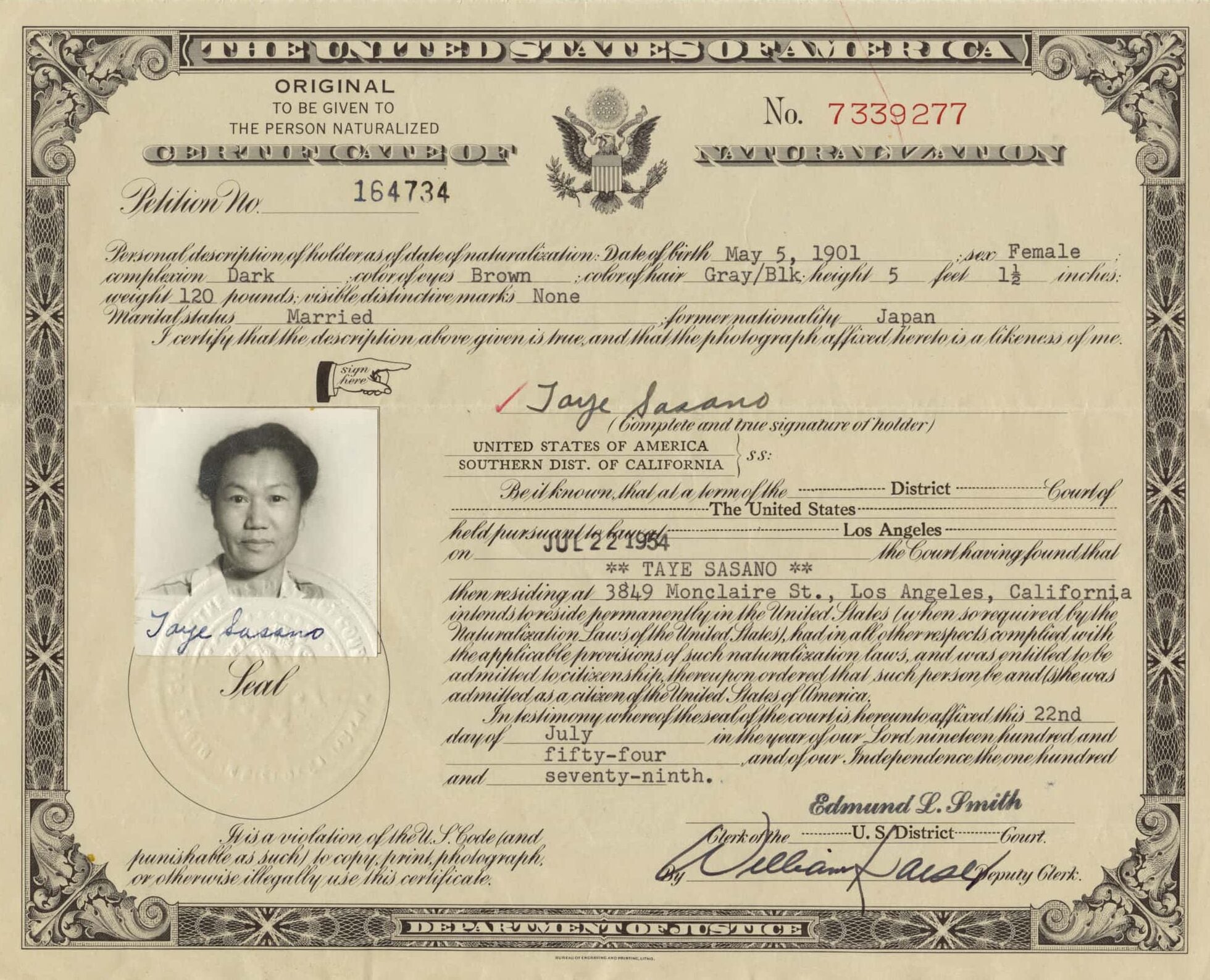
Image 13.04.02 — Taye Sasano was one of thousands of Issei who applied for and received naturalized citizenship after the passing of the McCarran-Walter Act in 1952.
Returning Nisei veterans in Hawaiʻi helped to transform politics in the territory. Having fought for their country, the veterans were no longer willing to settle for second class status. Still making up 37 percent of Hawaiʻi’s population in 1950, Japanese Americans also formed coalitions with other ethnic groups within the Democratic Party. In what was dubbed the “Revolution of 1954,” they took control of local politics.
Political figures such as Senator Daniel K. Inouye, Congresswoman Patsy Takemoto Mink, and Governor George Ariyoshi remained influential for decades, their influence growing nationally with Hawaiʻi’s admission as the fiftieth state in 1959.
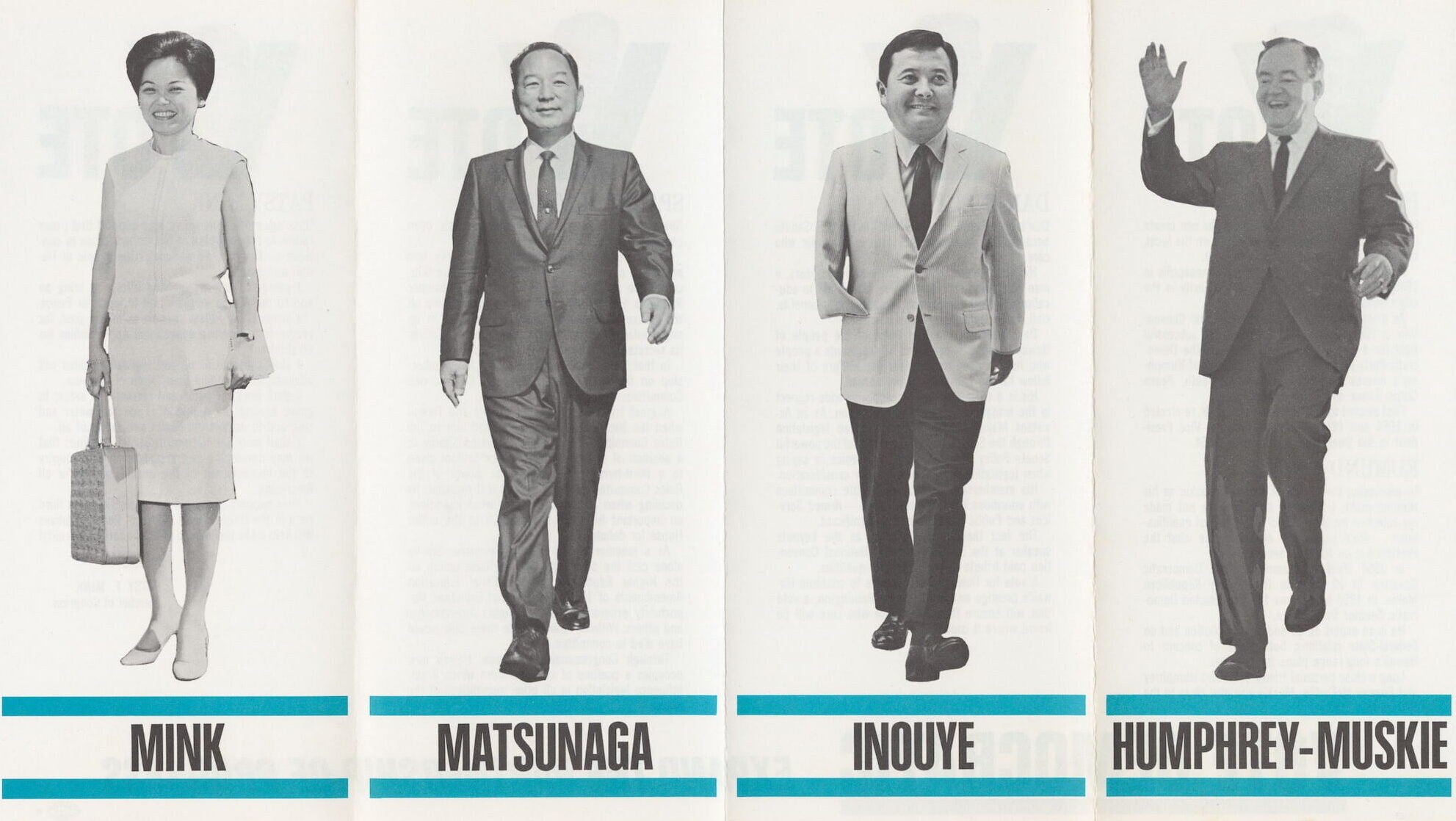
Image 13.04.03 — Japanese Americans in the Democratic Party became dominant figures in Hawaiʻi politics after Hawaiʻi became a state in 1959. This 1968 campaign pamphlet for Hawaiʻi Democratic Party candidates highlights Patsy Mink, Spark Matsunaga, Daniel Inouye, and Hubert Humphrey (sharing a ticket with Edmund Muskie).
Japanese American communities on the continent slowly rebuilt, but they took different forms from before the war. As housing restrictions eased, more Japanese Americans began to move out of central cities, and suburban Japanese American clusters, such as Gardena, California, formed. The heavily agricultural ethnic economy began to diversify. By 1960, only about 20 percent of Japanese Americans in the West Coast states worked in agriculture, half of the number before the war. Occupational barriers slowly eased as well.
In 1952, John Aiso was appointed a Los Angeles Municipal Court judge, the first Japanese American to hold a judicial post in the continental US. Stanley Uno, the sixth of the Uno children and a World War II veteran, became the first Nisei member of the Los Angeles Police Department.
“Model Minorities” in a New Era
By the 1960s, Japanese Americans, along with Chinese Americans, had come to be viewed as “model minorities” through widely read articles in publications, such as the New York Times Magazine and U.S. News and World Report. These articles cited these groups’ high educational levels and income, and low rates of crime, despite having been subjected to substantial racial discrimination. While some Japanese Americans embraced this characterization, others pointed out problems with it.
For one thing, it was only partially true. Cited statistics were cherry picked; Japanese Americans did have more years of schooling than white Americans based on 1960 Census data, for instance, but they had lower incomes despite that advantage. The “success story” narrative also left out the stories of Issei and Nisei whose lives had been destroyed by the incarceration, or the psychological cost of a single-minded focus on mainstream “success.”
Perhaps more critically, such characterizations drove a wedge between Asian Americans and other “problem minorities,” as the New York Times Magazine article referred to African Americans and other people of color. This stereotype also used Asian Americans to blunt claims about systemic racism, suggesting that they were able to attain equality with whites without any assistance from the government.
Sansei, third-generation Japanese Americans—whose age range almost perfectly aligns with the baby boomer generation—came of age in the 1960s and 1970s. Their upbringing reflects the changes in the Japanese American community after the war. Given the dispersion of the population, spurred by the wartime incarceration, as well as postwar movement out of Little Tokyos, Sansei typically grew up in more diverse communities, often alongside African Americans and other people of color.
With many Nisei anxious to put the war years behind them, Sansei typically grew up with little knowledge of their family’s World War II experience, and they were much less likely than their parents to speak Japanese or to be exposed to Japanese culture. Whereas interracial marriage was rare, and even illegal before the war, interracial dating and marriage spiked among Sansei, approaching 50 percent by 1970. This phenomenon disturbed many Nisei, almost as much as the subset of Sansei who experimented with illegal drugs or who formed youth gangs.
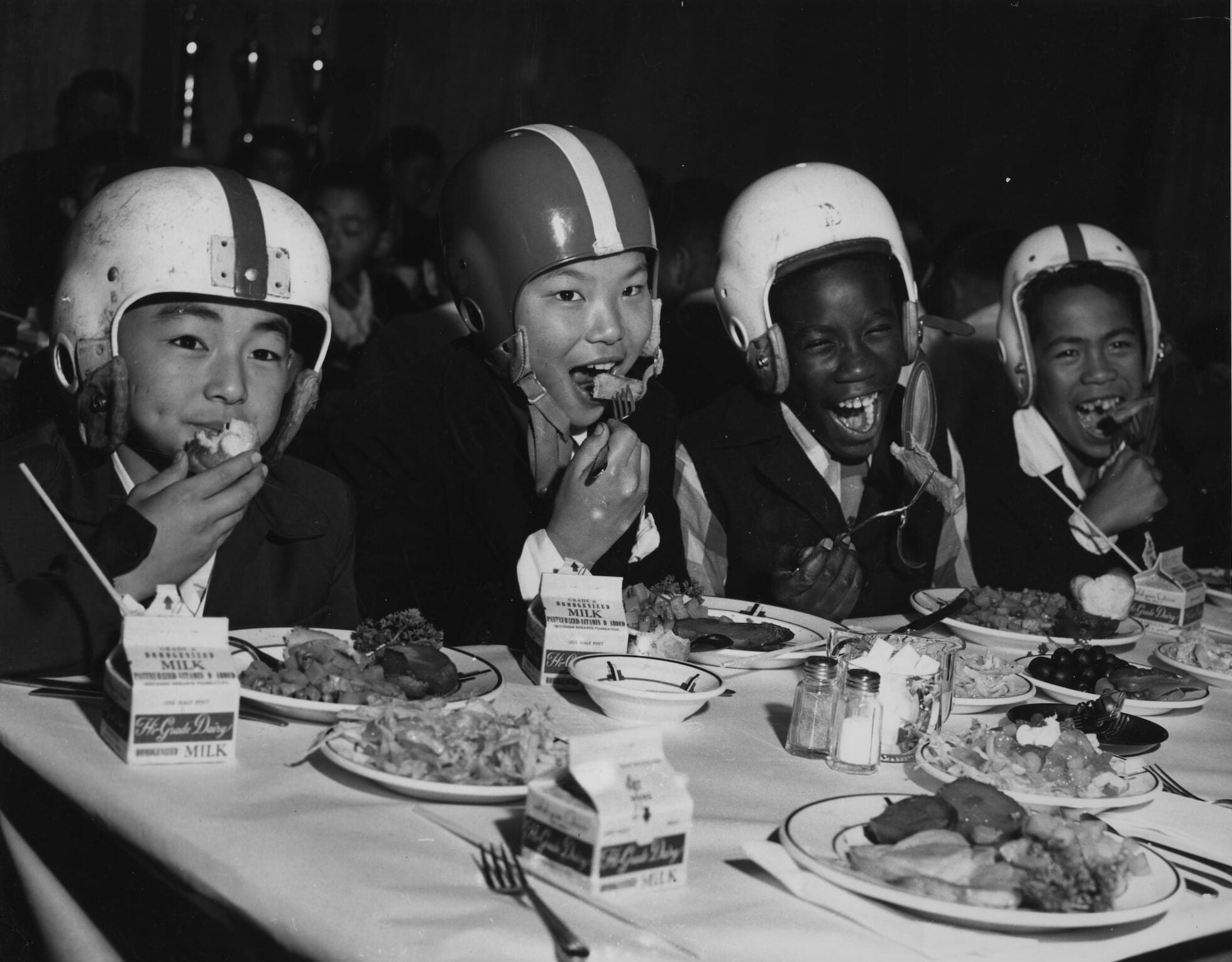
Image 13.04.04a — Many Sansei grew up in multiethnic communities after the war. This image shows a banquet sponsored by the Seattle Nisei Veterans Committee for a youth football team, Seattle, Washington, 1953.
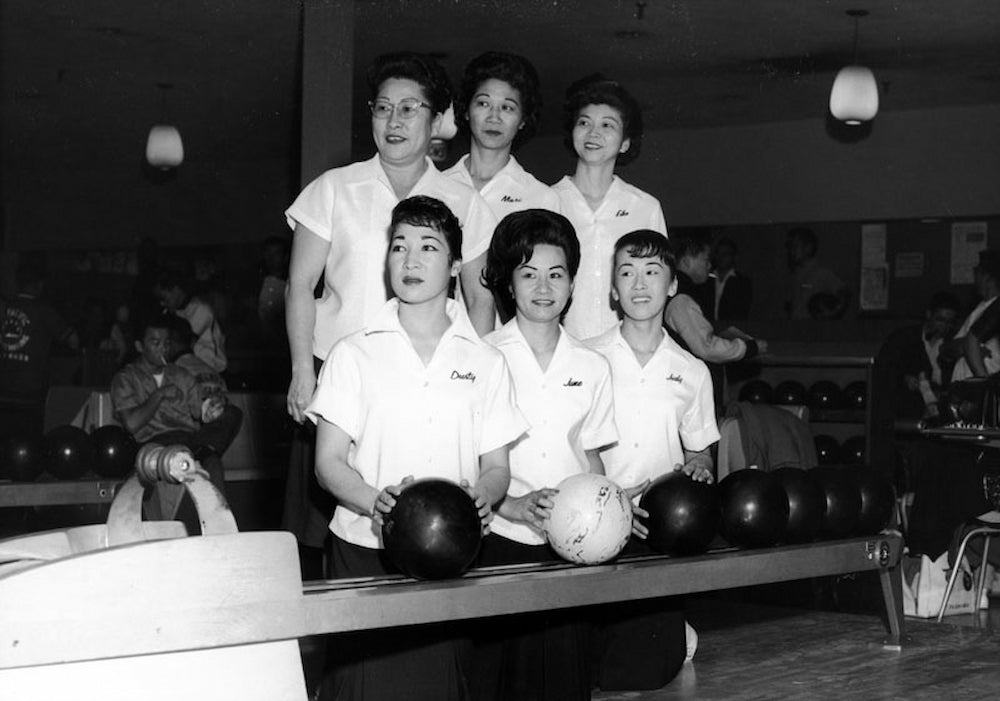
Image 13.04.04b — Embracing American hobbies like bowling became a popular community activity among Nisei and Sansei after World War II. In Los Angeles, California, the women’s team at the Holiday Bowl on Crenshaw Boulevard was no exception.
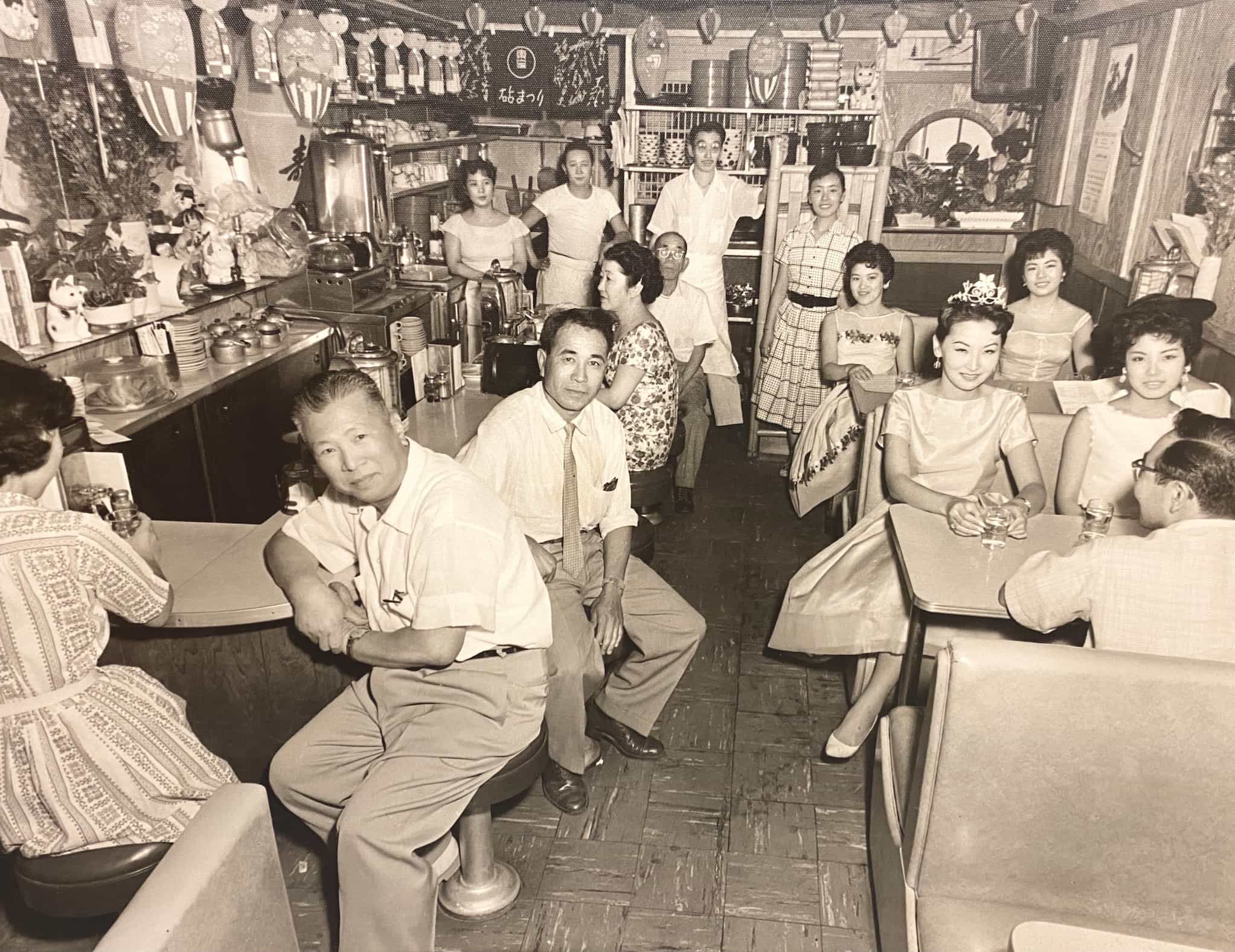
Image 13.04.04c — Despite the forced exclusion of Japanese Americans during World War II, Little Tokyos reemerged in most of the major cities on the West Coast. The turnout for opening day at Koharu restaurant (pictured, c. 1959) showcased strong communities in areas like Los Angeles’s Little Tokyo.

The Immigration Act of 1965 dramatically changed the nature of immigration, largely removing restrictions on immigration from Asia, and leading to greatly increased numbers of immigrants from Asian countries, including Japan. But given the relatively small number of postwar Japanese immigrants relative to other Asian groups, the proportion of Asian Americans who were Japanese Americans shrank. Until 1970, Japanese Americans made up the largest Asian American subgroup. By 1980, Chinese and Filipino Americans had passed them. By 2000, they had also fallen behind Asian Indian Americans, Korean Americans, and Vietnamese Americans.
More to explore
Video
02:55
Nobuko Miyamoto: An Artistic Journey
Growing up in Utah—where her family had resettled out of a concentration camp—and various parts of Los Angeles, California, young JoAnne Miyamoto was enamored of music and dance as a child and studied dance from a young age. She was hired at age fifteen for the movie version of The King and I and later landed a role in the landmark Rodgers and Hammerstein musical Flower Drum Song on Broadway before becoming a successful singer and actor in the 1960s as “JoAnne Miya.”
Glossary terms in this module
alien land laws Where it’s used
Laws enacted by California and other Western states in 1913 and 1920 that banned the purchase of land to noncitizens, specifically targeting Japanese Americans and other Asian immigrants.
martial law Where it’s used
A form of government under military control where constitutional rights are suspended.
naturalization Where it’s used
The process of becoming a citizen for immigrants.
War Relocation Authority (WRA) Where it’s used
The federal agency that managed the imprisonment of Japanese Americans. The word “relocation” inaccurately describes the action as simply moving or relocating to a new home. In reality, Japanese Americans did not have a choice and were forcibly removed from their homes.