




Overhead view of hands holding a white plate with a whole green coconut, a dry brown coconut, and a cut-open coconut half on a wooden table.
Module 2: Cultural Identity, Community Building and Resistance
Have colonialism and migration impacted the way Micronesians maintain their various cultures?
This module explores important cultural practices of Micronesia that connect their traditions with land stewardship in light of the unequal power relations between Micronesia and the United States.
What are some significant cultural practices of Micronesia?
How do Micronesians steward land as island peoples?
How does Micronesian cultural expression and identity resist against empire-building and colonizing forces?
Oral Cultures through Media Production
The US occupation of Micronesia forced people to assimilate and prohibited the traditional practice of oral cultures that helped share knowledge, build community, and pass on language, poetry, songs, and stories from one generation to the next using native languages. Hundreds of words and expressions were lost under colonial rule.
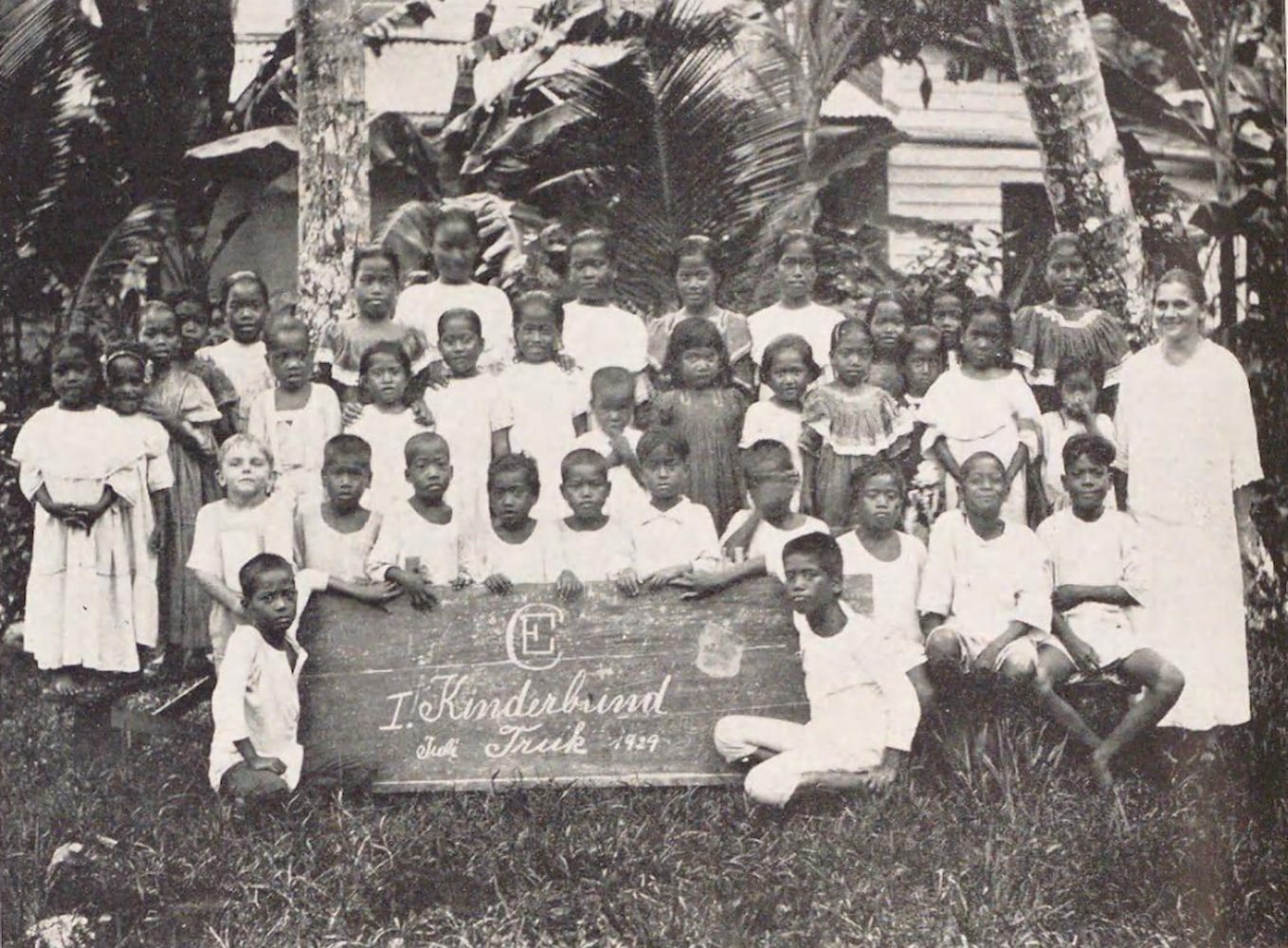
Image 23.02.01 — This Japanese photo album illustrates Micronesia’s complex colonial histories. Prior to US presence through the UN Trusteeship, Chuuk (misnamed “Truk” in the image) was occupied by German and Japanese colonial powers. This Japanese publication “celebrates” Japan’s tenth anniversary of the South Seas Mandate.
In Guåhan (Guam) during the time of the US colonial and military occupation in the mid-twentieth century, the military commanders enforced English-only policies that punished the island’s inhabitants for speaking the Indigenous CHamoru language. By disconnecting the people from their language, oral cultures were disrupted and knowledge pathways were blocked.
Some of the languages of Micronesia include: Carolinian, Chuukese, Kiribati (Gilbertese), Kosraean, Marshallese, Mokilese, Mortlockese, Nauruan, Pááfang, Pingelapese, Pohnpeian, Puluwatese, Satawalese, Sonsorolese, Tobian, Ulitihian, and Woleaian. Present-day efforts to re-learn and speak the Indigenous languages of Micronesia are examples of revitalizing cultural practices that were once banned by policies that resulted in the erasure of traditional ways of knowing and livelihood practices.
One such effort is Nihi Indigenous Media, a Guåhan-based media organization that educates through Indigenous knowledge, stories, and voices to affirm identity through language. Content such as the mini-series Eat with Your Ancestors (2022) and animated film Heroes of Micronesia (2025) connects communities and offers language and other skills so that current and future generations may understand traditional Micronesian culture such as family, recipes, language, and respect for elders. By advocating for oceans and lands, speaking the language, and practicing culture, Nihi Indigenous Media is a valuable resource for Micronesians living beyond the subregion.
Media content also helps connect with wider populations to learn and share the Indigenous languages of Micronesia. Chuukese are a growing population in the continental US. They use the media to teach the Chuukese language and to offer resources. The content shares the language through music covers and reviews, and simple words and phrases help to communicate with other people who want to learn the language and practice oral cultures.
Community and Identity as Resistance
Social identity is an important part of Micronesian culture. Understanding oneself as a member of a larger social group is valued and preferred over individual accomplishments. The family unit lies at the center of social identity and matrilineal connections. For Micronesians living in the US, social groups often provide the connections that maintain these strong family ties. By protecting and sustaining their identity through cultural practices, Micronesians in the US also stand ground against the broader public that may not know who they are and do not consider them Americans.
Still, the US Census and other population surveys do not provide Pacific Islanders with their own distinct identity group. Instead, they are included within the broad category of Asian Americans and Pacific Islanders (AAPI), which makes it difficult to understand the population data about the unique cultural identities of Micronesians, where they are living within the US, and the resources they lack. Several ways of preserving cultural identity and community practice have aided Micronesians residing in the US.
Micronesian matrilineage tradition means women are the contributors to oral traditions and other Indigenous histories, providing strong ties between ancestors and future generations. Yet, the long lived experience with colonialism has imposed a western patriarchal system that disrupts the matrilineal society within Micronesian cultures in the US especially. Maintaining ancestral and matrilineal connections, therefore, is also a form of resistance, as it challenges a dominant society’s values of an individual or group’s identity.
Listen to
Matt Howard reflecting on his childhood in Pohnpei
Audio 23.02.03 — Matt Howard, a filmmaker from Pohnpei and currently based in Hawaiʻi, speaks about his childhood in Pohnpei, touching upon his home island’s matrilineal society and village culture.
Cultural practices through local groups and community-based organizations have helped Micronesians adjust to the categorical erasures and nonrecognition in the US. Micronesian populations in California, for example, sustain their culture and identity as Micronesians while living in the US. Marshallese people moved in large concentrations to Orange County, California, from the 1970s to 1990s. They now make up one of the larger groups of Micronesians in California.
Since 1986, an estimated thirty thousand Marshallese Islanders have immigrated to the US. As a result of the Compact of Free Association (COFA) agreement between the US and the Marshall Islands, migration pathways became available. The Marshallese began to leave for employment, education opportunities, or to escape climate events or poor healthcare. The Marshallese were directly impacted by the US government’s nuclear testing programs in the Marshall Islands that led to a life-long debilitating health crisis for those affected by the military exercises. Health problems were also linked to the US government’s violent program of nuclear testing within the Marshall Islands, particularly in the 1940s and 1950s, with effects lasting across generations to present day.
In the twenty-first century, yet another example of identity as resistance is demonstrated by the Marshallese Youth Organizing Communities (MYOC) in Orange County, California. Founded in 2008, the MYOC is dedicated to advancing culture, education, and health among Marshallese immigrants. Their work to sustain cultural identity and future generations of community leaders provides another example of community advocacy and cultural resistance.
In Springdale, Arkansas, the Marshallese Resource and Education Center (MREC) is a one-stop resource that directly serves Marshallese residents. It is part of the larger Marshallese Educational Initiative (MEI) that helps the population maintain their cultural identity. MEI’s activities and humanities based programming empowers elders and youth to share their Marshallese culture through traditional arts, music, history, and a combined focus on threats of nuclear testing and climate change.
The “Songs of the Atoll Project” helps Marshallese youth maintain close connection with their elders to maintain traditional ways of being and doing while living in diaspora. And the “Marshallese Oral History Project & Digital Music Archive” creates a living archive by collecting songs and personal memories of Marshallese residents, which also connects their identity and stories with global events and justice issues.
Festivals can also serve as a form of expressing identity. Since 2014 in Honolulu, the Celebrate Micronesia Festival has showcased traditional and contemporary art, dance, food, stories, poetry, and music of the peoples with ancestral ties to Micronesia. This festival features live performances and cultural booths to educate and increase awareness about the wide diversity of languages and cultures of Micronesia. It also spotlights groups such as the Marshallese Weaving Woode Jippel that travel to attend the festival and demonstrate their efforts to revive the weaving traditions that have existed for thousands of years. The Remathau Community of Hawaiʻi focuses on justice to address food insecurity and provide community connections among the populations from FSM that currently live in the Hawaiian Islands.
Similarly, the CHamoru Cultural Festival is an annual event in San Diego county, California, that showcases the Indigenous culture of the Mariana Islands. It features seafaring, weaving, and education about political status held in San Diego since 2010. The Micronesian Festival at Navarro College in Corsicana, Texas, is another event that spreads cultural awareness through performances and traditional cultural sharing about the islands.
Conclusion
By expressing their collective identity and community building in resistance to erasure, stereotypes, and assimilationist policies, the peoples of these islands demonstrate what it means to be Micronesian. Part of their cultural belonging in the US is constructed through linguistic, cultural, and political movements that encourage Micronesians to showcase their unique heritage and Indigenous traditions. Yet another part is to maintain such belonging across generations in order to build community and solidarity for those affected by cultural displacement, discrimination, hate, and alienation they may feel through their experiences living in the US. These expressions of identity help to disrupt the influences of US colonialism.
Glossary terms in this module
atoll Where it’s used
A ring-shaped series of islands, coral reefs, or islets surrounding a body water called a lagoon.
colonialism Where it’s used
When one country takes partial or complete control over another country economically and politically, exploiting its natural resources for profit. The colonizer forces their beliefs and way of life onto the colonized.
Chuukese Where it’s used
This term refers to the Indigenous people and language of the Chuuk Islands, it is also the dominant language within the Federated States of Micronesia.
Compact of Free Association (COFA) Where it’s used
A series of treaties between the Federated States of Micronesia, the Republic of Belau (Palau), and the Republic of the Marshall Islands with the US, granting citizens of Micronesia to join the US military without requirements of residency or US citizenship, live and legally work in the US without a visa, and access to social and health programs. In exchange, the US has exclusive access to these islands, and significant military and veto power.
Indigenous Where it’s used
Refers to someone or something that originates from a region, predating colonialism.
land stewardship Where it’s used
The land management and conservation of natural resources in order to maintain ecological processes necessary to preserve and support natural communities.
oral traditions Where it’s used
The knowledge, culture, art, and history that are passed down through speech from one generation to the other.
Pohnpeian Where it’s used
Refers to both the people and language of the Indigenous people of the island of Pohnpei, which is located within the Federated States of Micronesia.
Refaluwasch or Carolinian Where it’s used
Refers to both the language and the Indigenous people of the Caroline Islands, a group that migrated from the Caroline Islands to the Northern Mariana Islands in the nineteenth century.