





Module 4: A History of Exclusion of People With Disabilities
How have Asian American and Pacific Islander communities defined disability and wellness on their own terms?
Disability and race have shaped US laws and public health. In the nineteenth and twentieth centuries, ableism and eugenics motivated local codes, colloquially named “Ugly Laws“, which removed certain “unsightly” bodies from public areas. In the nineteenth century, US immigration laws also barred people classified as “defects” or likely to become a “public charge.” This institutionalized exclusion included those who were deaf, blind, epileptic, “unusually short or tall,” people with mobility impairments, curved spines, hernias, flat or club feet, missing or short limbs, intersexuals, men of “poor physique” or classified as “feminine,” those with intellectual or psychiatric disabilities, and those from certain “undesirable” nations.
Racism and disability are deeply connected. Harm can result from systems that intentionally deny certain groups access to essential resources such as healthcare and safe living conditions. In this view, disability is not only a medical issue but also a social process shaped by unequal treatment. When governments or institutions neglect specific communities, they can create or worsen conditions that lead to disability. This social construction model of disability encourages us to examine how race influences access to health and safety, and this approach also challenges the unfair blaming of Asian American and Pacific Islander communities for broader social problems.
This module offers a history of policies and structural violence that negatively affected and disabled Asian Americans and Pacific Islanders. It focuses on the compulsory segregation of those diagnosed with Hansen’s disease, notable purges, and government-initiated fires targeting Chinatowns in urban centers. The module also highlights events that scapegoated and framed Asian American and Pacific Islander communities as dangerous and responsible for the spreading of disease.
What is the Yellow Peril?
How have Asian American and Pacific Islander communities been stereotyped, targeted, or subject to discriminatory treatment in history, especially during pandemics?
To what extent have stereotypes of Asian American and Pacific Islander bodies as diseased or disabled resulted in government discrimination or policy barriers?
Racial Exclusion Under the Law
Racial exclusion under US law is not new. The Asian American Feminist Collective offers a timeline of public health and racism from 1492 to 2014 which details xenophobic regulations around mobility and migration. This history illustrates racial stereotypes, medical discourses, and public health fears justified the exclusion and elimination of those deemed undesirable, especially immigrants from Asia, Indigenous communities, and poor people of color.
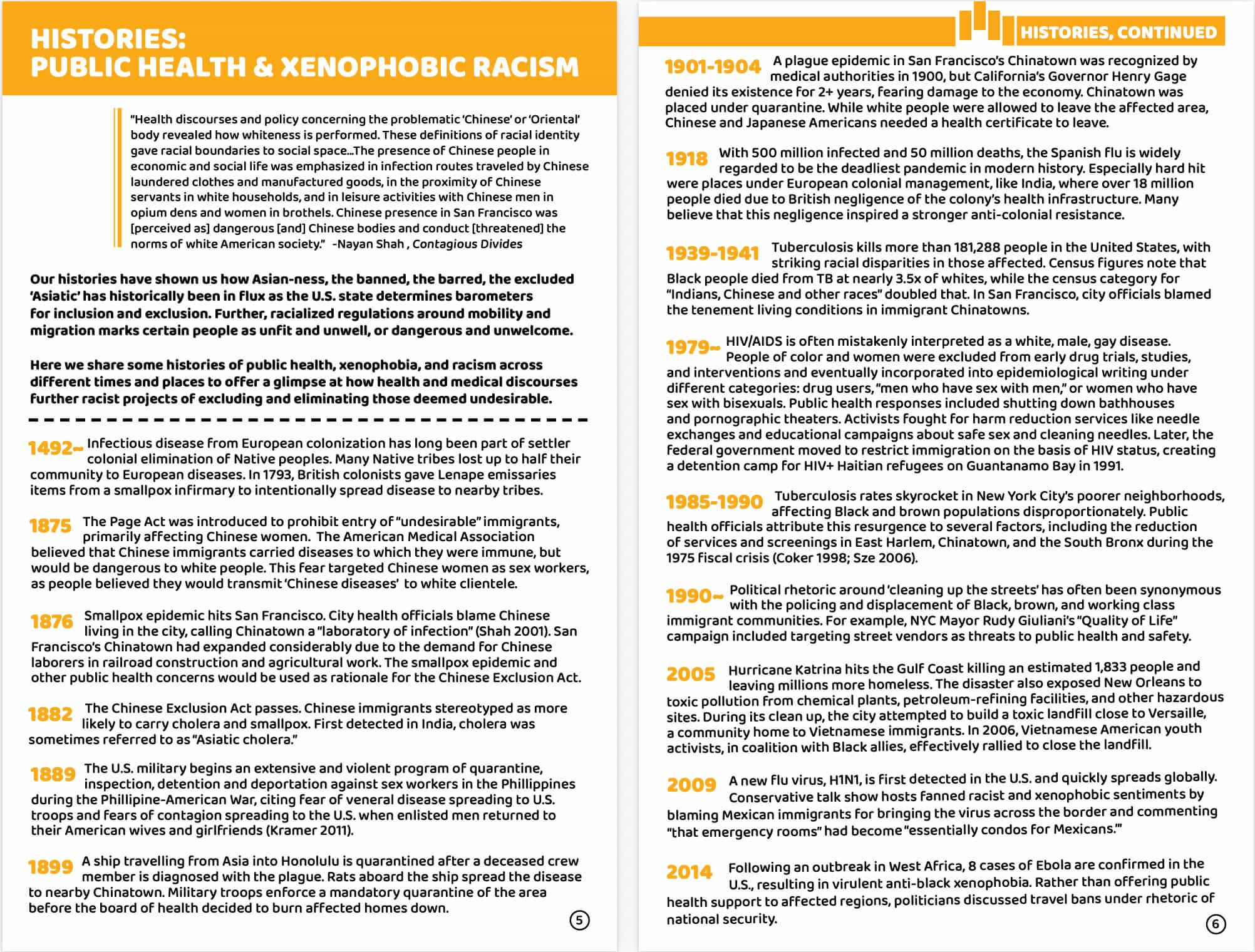
Text 30.04.01 — This timeline from Asian American Feminist Antibodies: Care in the Time of Coronavirus (2020), a digital zine by the Asian American Feminist Collective, maps Asian American and Pacific Islander histories of public health and xenophobic racism from 1492 to 2014.
Popular media warned about the “Asian danger” and the “Yellow Peril” to public health at the end of the nineteenth century and in the early twentieth century. Asian bodies were not only stereotyped as ugly and abnormal, but also represented as vermin, rodents, and toxic carriers of disease, in contrast to the social construction of the idealized US citizen with a white (European or Caucasian), “civilized,” and productively able body.
Intellectuals and legal authorities created taxonomies of difference and racial categories by ranking European, Oceanic, “Asiatic, Oriental, and Mongolian” types. Opponents of Asian immigration used these pseudo-scientific categories to legalize selective discrimination, often with little proof or no evidence. Restrictive covenants and Alien Land laws deemed immigrants from China, Japan, and India politically unfit for residency and citizenship and barred them from property ownership and social benefits in the United States and Canada.
For example, China was repeatedly labeled the “Sick Man of the Far East” in late nineteenth and early twentieth centuries, and in 2020 during the COVID-19 pandemic. While Chinese immigrants were the main targets of discriminatory legislation and anti-Asian stereotyping at the end of the nineteenth century, other Asian Americans and Pacific Islanders have also been mistreated under medical racism.
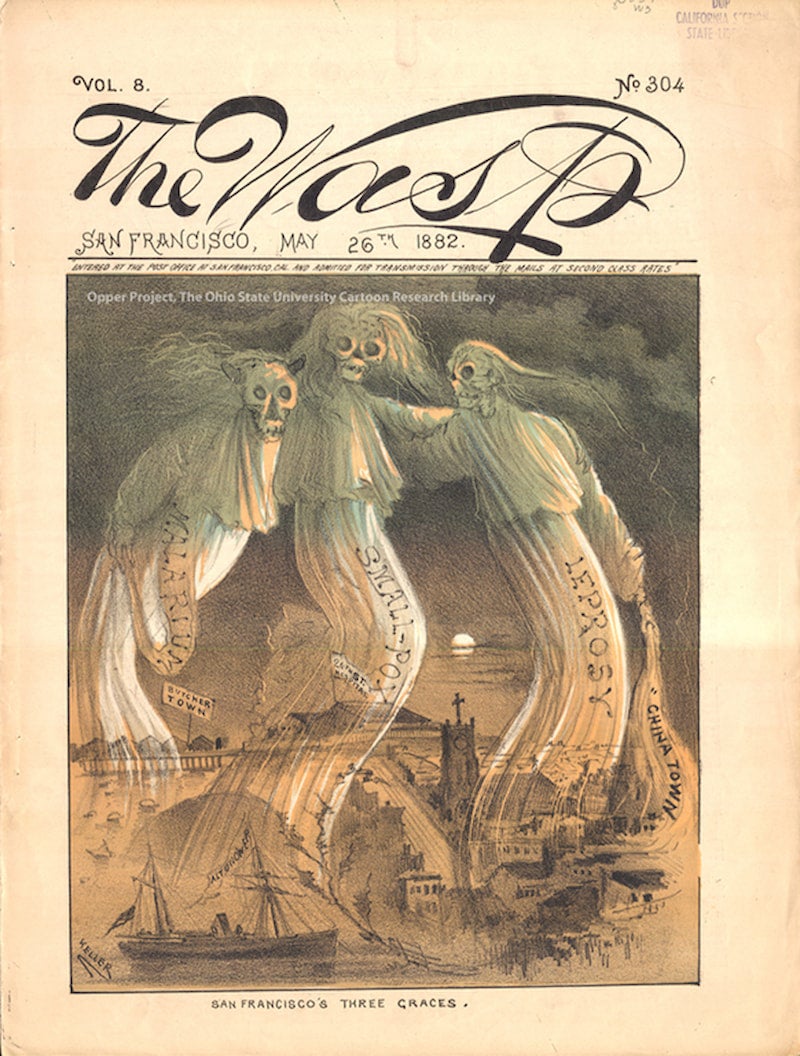
Image 30.04.02 — This cover of The Wasp magazine, published May 26, 1882, illustrates the “three graces” of San Francisco’s Chinatown as “malaria,” “small-pox,” and “leprosy.”
Certain religions and ethnicities were pathologized under colonialism. Britain, France, the US, and Germany categorized Indigenous groups as uncivilized and primitive to justify their takeover of island territories in the Pacific. When the Philippines was a US colony from 1898 to 1946, American officials stereotyped Indigenous populations as unclean and unruly. Health officials referred to Filipinos as “incubators of leprosy” and used outbreaks of cholera to assert that the United States could better provide sanitation and rehabilitation. Highlighting how disability was tied to race and religion, Filipinx scholar Sony Coráñez Bolton examines how American officials also pathologized and criminalized certain Indigenous Muslim populations as irrational and violent.
In the Name of Safety: Forced Segregation of Pacific Islanders
Indigenous communities in the Pacific Islands have been devastated by foreign contact and diseases. After 1778, when British explorer Captain James Cook landed in Hawaiʻi, thousands of Islanders died from imported diseases such as cholera, the bubonic plague, Hansen’s disease (leprosy), smallpox, influenza, and whooping cough. Isolation settlements known as “leper colonies” were established at various locations; the government removed people with Hansen’s disease (then called leprosy) from their families and homes and forced them to live permanently at these sites.
In the Philippines, US colonial administrators instituted the segregation and detention of those with Hansen’s disease to a “Leper Station” established on Culion Island in 1906. Culion became the largest leper settlement in the world, with over 4,400 people between 1914 and 1921. Across the South Pacific, people diagnosed with Hansen’s disease were separated from their families and relocated to isolated settlements established in Tahiti, the Marquesas, and Fiji. Other settlements were also established on Penikese Island off the Massachusetts coast and at the Carville National Leprosarium in Louisiana.
The settlement at Kalawao, later called the Kalaupapa Molokaʻi Leper Colony, was established on the island of Molokaʻi in 1866. Ninety percent of those sent to Kalaupapa were Native Hawaiians, ranging in age from four to 105. More than eight thousand people were exiled to Molokaʻi over a span of 150 years to live in isolation because of their illness.
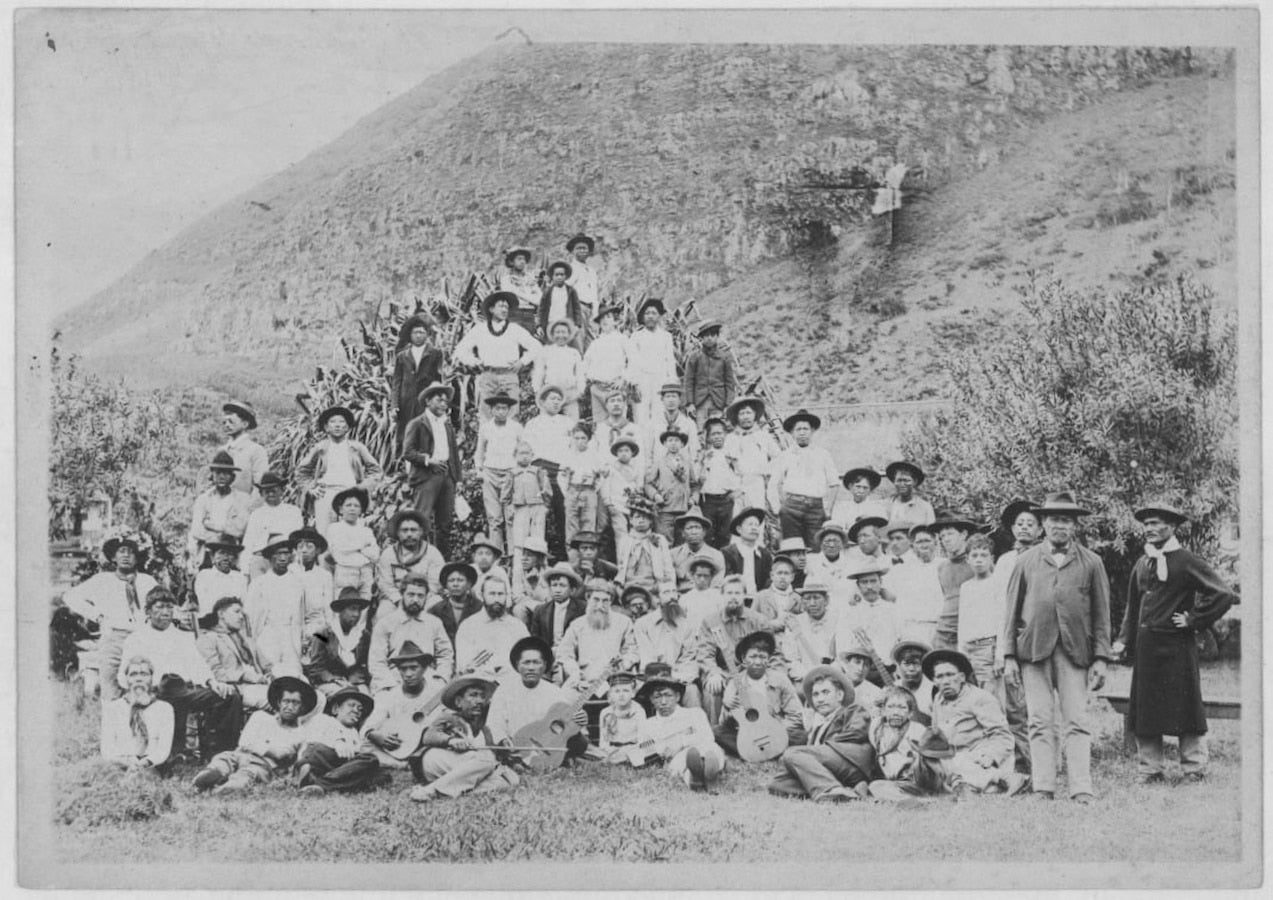
Image 30.04.03 — A photograph of exiled people living in the Kalaupapa Molokaʻi Leper Colony on the island of Molokaʻi, one of the Hawaiian Islands, in 1905. During this time, there were approximately 750 people living on the Kalaupapa peninsula.
Some relatives and close friends (known as kōkua, or “helpers”) accompanied those with Hansen’s disease to Kalaupapa; in the first year, twenty-two kōkua joined the 142 who were sent to Molokaʻi. The exiled created a community with the Kānaka Maoli (Indigenous Hawaiians who had lived on the islands for centuries). People with Hansen’s disease and their kōkua lived alongside and with the kamaʻāina (a colloquial term that refers to both to local residents, or to one born in Hawaiʻi, regardless of ancestral background and time away from the islands). When the US government failed to provide medical care, sufficient food, supplies, and assistance for the displaced, the kamaʻāina helped fill those needs, as a form of mutual aid.
In 1894, kamaʻāina and kānaka maoli of Waikolu Valley were also ordered to leave their ancestral homelands and subjected to forced relocation. Today, the term “leper” is unacceptable in local Native Hawaiian discourse because of its negative associations, and it is critical to also recognize the contributions of kamaʻāina and local Native Hawaiians in the history of Hansen’s disease and Kalaupapa. 1
Those diagnosed with Hansen’s disease were also deprived of fundamental civil liberties: unable to move freely, to vote, to work, or to raise their own children. To prevent further spread of the disease, newborn infants were taken from their parents after 1908, relocated to Oʻahu or Welfareville in Manila, and put up for adoption.
Over six thousand people who died at Kalaupapa lie in unmarked graves. A cure for Hansen’s disease was developed in 1941, and compulsory quarantine ended in 1969. Through sustained activism by surviving family members and local allies, Hawaiʻi’s governor signed a funding bill in 2022 to build a memorial to commemorate the names of the eight thousand people who were quarantined there and to honor the nine hundred years of Indigenous Hawaiian life that predated the establishment of the isolation settlement.
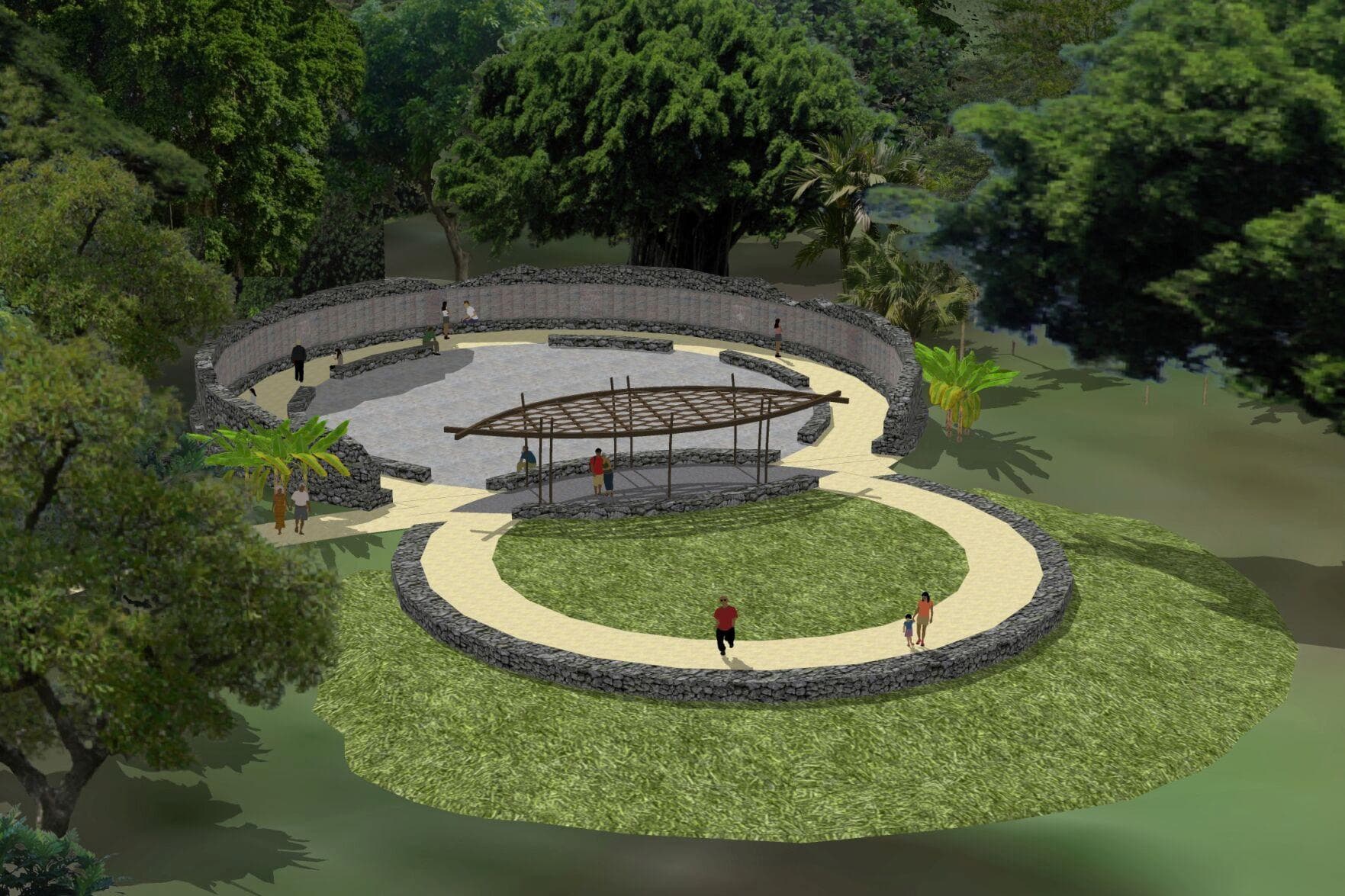
Image 30.04.04 — This proposed memorial designed by Japanese American immigrant architect Hitoshi Hida for Kalaupapa National Historic Park on Molokaʻi, one of the Hawaiian Islands, will commemorate the names of the eight thousand people who were quarantined there.
Infrastructural Abandonment: Chinatown Fires and Purges
In 1885, a Canadian Commissioner reported to the House of Commons that Vancouver’s Chinatown was an infectious ulcer. Local leaders had ignored multiple requests from Chinatown community leaders about the urgent need for sewer and sanitation services in the area. When cholera spread in the 1890s, the Canadian press scapegoated Chinese immigrants as the alien culprits causing the disease. Although no cholera cases were traced from the neighborhood, the Vancouver City Council placed Chinatown under heightened surveillance. No other neighborhood had health conditions blamed on the race of their residents.
At the start of the early twentieth century, the bubonic plague was called an “Asiatic pestilence,” and newspapers suggested that the purging of Chinatowns was overdue. In 1900, a few cases of bubonic plague led to the quarantine of Chinatown residents in Honolulu, Hawaiʻi. Upon the recommendation of physicians, the Board of Health burned buildings to halt further infection, but the fires got out of control and destroyed ten Japanese-owned hotels and several hundred other commercial, religious, and residential buildings. Almost all of Chinatown and a fifth of Honolulu burned down; most of the structures were owned by Asian immigrants and Kānaka Maoli.
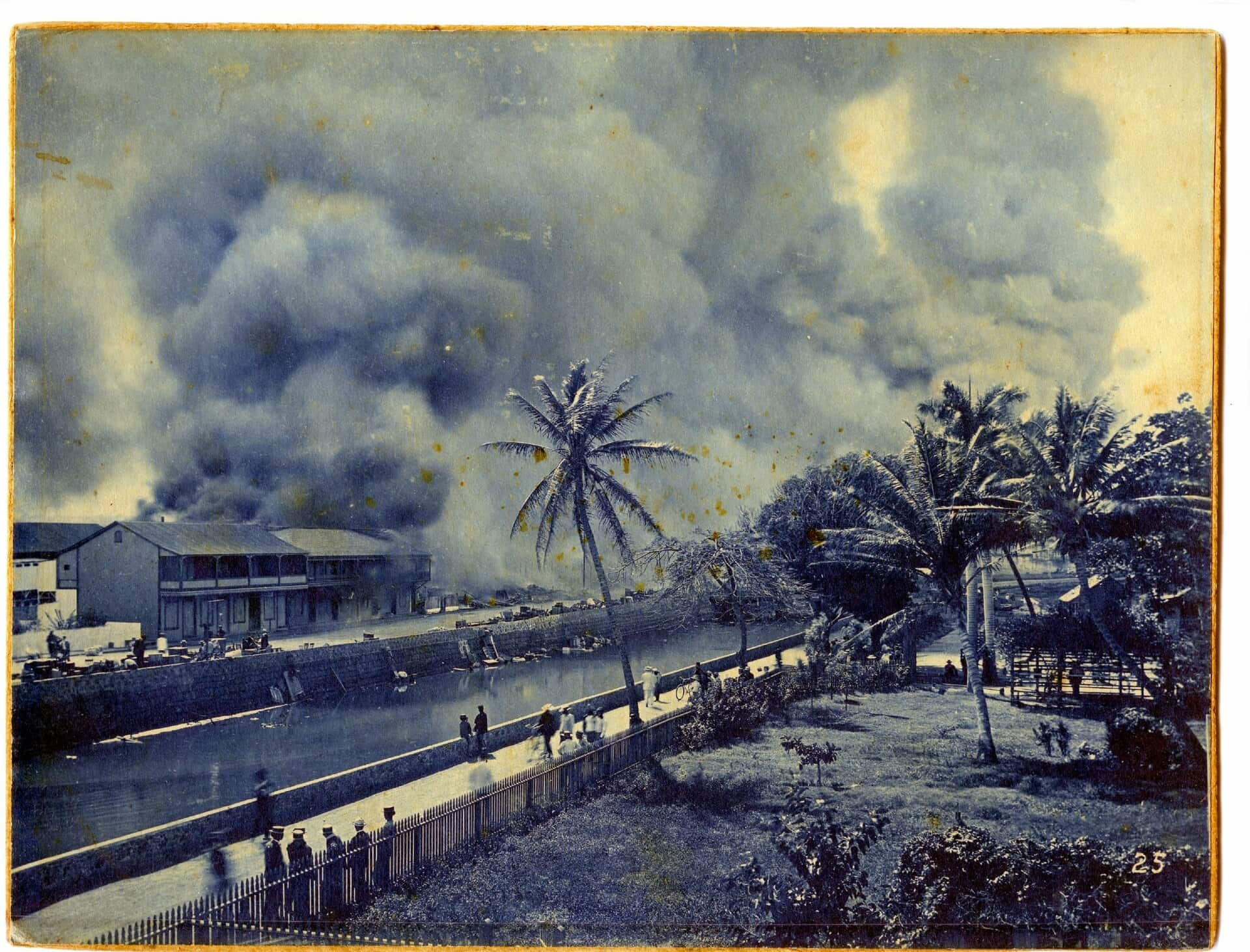
Image 30.04.05 — A photograph of the burning of Honolulu, Hawaiʻi, in 1900. Upon recommendation of physicians, the Board of Health purposely burned buildings to halt the spread of infections. This fire burned down almost all of Chinatown and a fifth of Honolulu.
White residents who were suspected to be infected were allowed to stay in upscale hotels. The Honolulu Independent newspaper asserted that white residents were “honest and cleanly” and not in danger from the plague; one local housewife reassured friends on the mainland that the disease “seldom attacks clean, White people anyway.” 2 When the Honolulu fires destroyed one mixed-race neighborhood, it displaced three thousand Chinese, 1,500 Japanese, and one thousand Kanaka Maoli people. Eight thousand people were not only made homeless, but then publicly stripped and fumigated by health officials and police.
Chinatown residents were put in detention camps as the Board of Health set an additional thirty “controlled fires.” Historian James Mohr classified the 1900 Honolulu Chinatown fires as “the worst civic disaster in Hawaiian history” and “one of the worst disasters ever initiated in the name of public health by American medical officers anywhere. 3
The targeting of areas populated by Asian Americans and Pacific Islanders was also driven by land acquisition and economic competition. In 1885, city officials and several hundred white male residents in Tacoma, Washington, forced over five hundred Chinese residents to leave in an organized expulsion campaign, which was followed by setting fire to all the buildings where Chinese residents had lived and worked. The campaign was dubbed by one participant as the “Tacoma Method,” and white Euro-Americans praised Tacoma as a model to be copied for its “orderly” avoidance of violence.
Tacoma’s Sinophobia was fueled by the local newspaper warning that Chinese people were like rats, swarming in growing numbers and spreading contagion. At a public meeting, Alderman J. E. Burns suggested to the town council that Chinatown should be burned for the sake of health and sanitation.
In contrast to the reputation of the Tacoma Method as “orderly,” one Chinese merchant and Tacoma resident Lum May later testified about the forced expulsion and the psychological harm caused by the armed mob:
When the doors were locked they broke forcibly into the houses, smashing in doors and breaking in windows…. They acted in a rude, boisterous, threatening manner, dragging and kicking the Chinese out of the houses. My wife refused to go and some of the white persons dragged her out. She lost her reason and has ever since been hopelessly insane. 4
Mobs also burned Chinatowns in Reno, Nevada, and in San Francisco, Antioch, Los Angeles, and Anaheim in California. In 1906, city leaders of Santa Ana, California, decided to burn Chinatown because it was considered “a plague hole” filled with “sickening filth” and “a health emergency.” The diagnosis of Wong Woh Ye with leprosy (Hansen’s disease) was considered adequate justification to raze Chinatown. On May 25, over a thousand residents cheered as firefighters set fires to buildings while Wong and other Chinese residents watched, while imprisoned in a pen made from barbed wire.
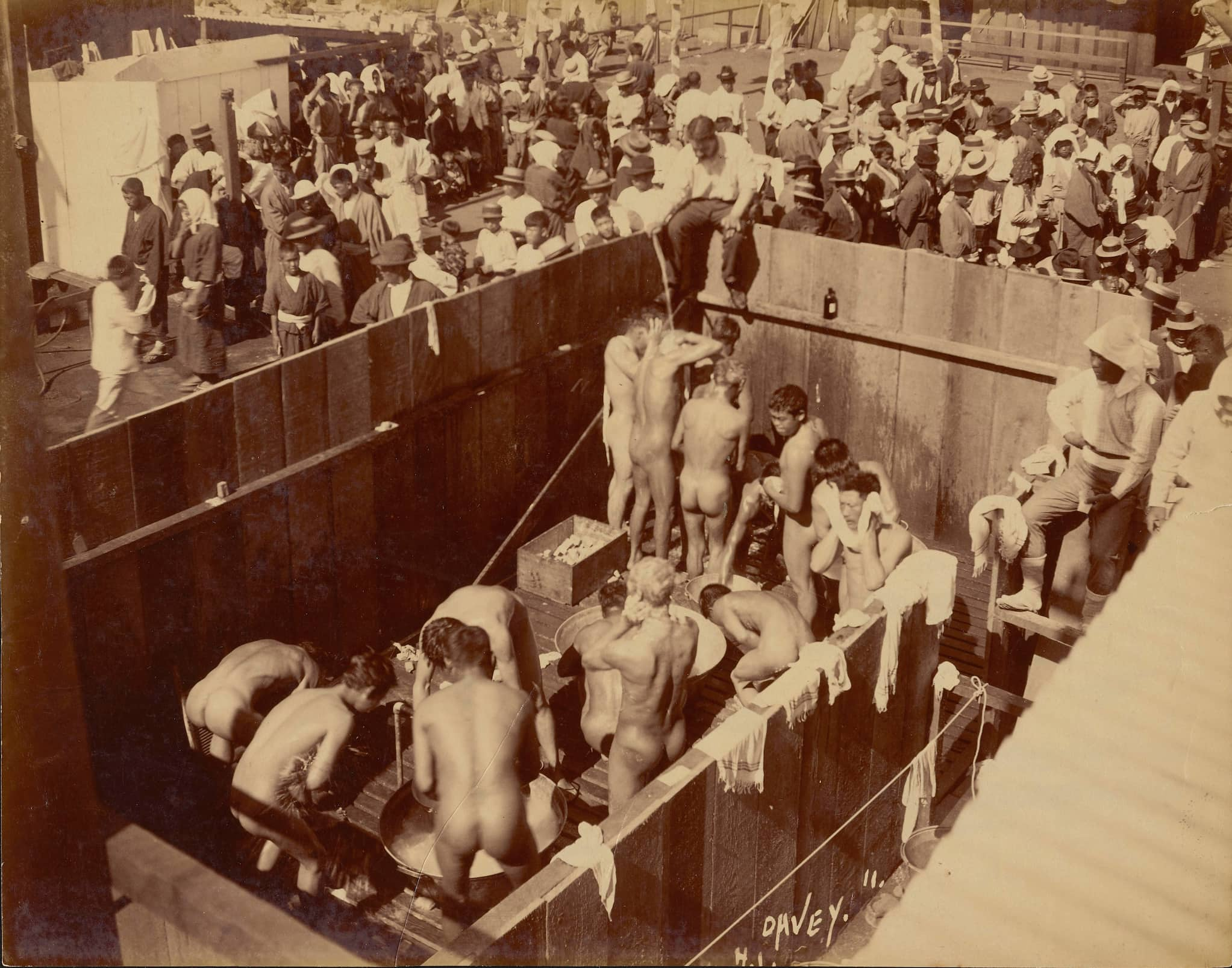
Image 30.04.06a — This photo from 1900 shows Honolulu, Hawaiʻi, residents in a fumigation shower. After the fires, displaced residents were publicly stripped and fumigated by health officials and police.
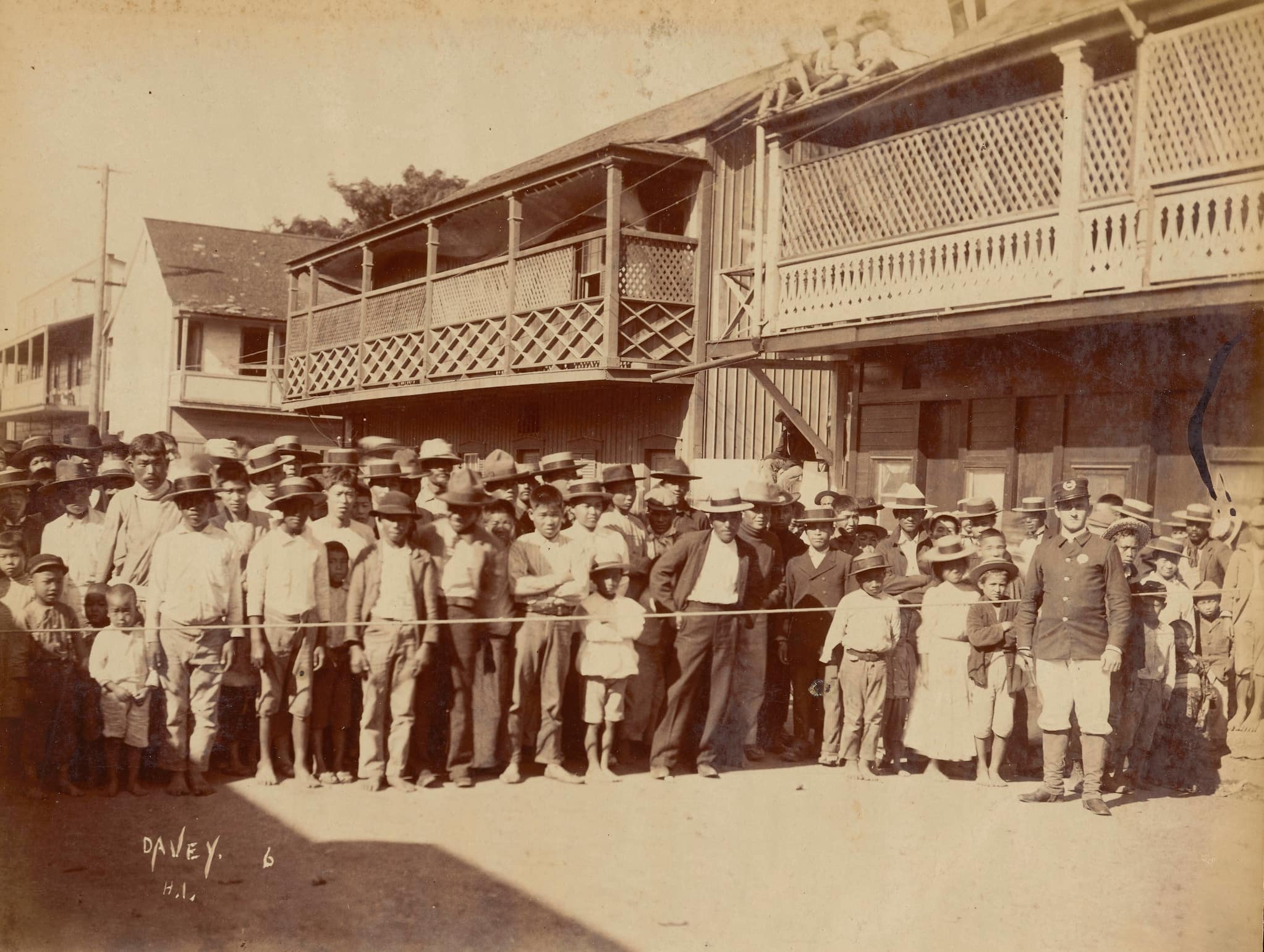
Image 30.04.06b — Chinatown residents cordoned off with rope, monitored by white guards, such as Officer Charles Lambert (right), during the bubonic plague in Honolulu, Hawaiʻi, in 1900.


What set Santa Ana apart was the government’s open role in injustice: “This is the only instance in state history… where this … was civically sponsored by city leaders,” stated historian Dylan Almendral. 5 In 2022, when Santa Ana’s officials formally apologized, Councilman Johnathan Ryan Hernandez admitted that the decision to burn Chinatown “crippled and hurt the Chinese community that helped build this city.” 6 Hernandez’s statement underscores the social construction of disability. Santa Ana’s burning of Chinatown illustrates how disability can be created by legal institutional actions that target certain racial populations.
Conclusion
This history of forced quarantines and Chinatown fires illustrates how governmental actions selectively targeted Asian American and Pacific Islander populations using the language of disease and contagion. Public health policies enabled the forced displacement of two populations, those diagnosed with Hansen’s disease and Kanaka Maoli from their ancestral lands on Molokaʻi, as well as a subsequent loss of human rights for those exiled to Kalaupapa.
The Chinatown fires and purges highlight how racial stereotypes can justify selective violence in the name of “protecting public health.” The government’s active role in burning Chinatowns in Santa Ana, California, Tacoma, Washington, and Honolulu, Hawaiʻi also illustrates how disablement can be socially constructed by government actions and prejudice against populations selected as scapegoats for other agendas or anxieties, such as economic competition or desire for land.
Glossary terms in this module
ableism Where it’s used
Beliefs or practices that discriminate against those with disabilities. It is rooted in socially constructed ideas of normalcy, productivity, desirability, and intelligence that are taught through language, media, policies, and laws.
activism Where it’s used
An action or collective process, such as a strike, march, protest, legislation, or policy campaign by an individual or groups to bring about material, political, and/or ideological changes to the status quo.
disability Where it’s used
Challenges or limitations in physical or cognitive functioning that can be either temporary, permanent, invisible, or visible. How a person experiences these challenges is related to not only individual factors but also social structures, institutions, and government policies.
impairment Where it’s used
A condition of the body or mind that makes it challenging or difficult for a person to do certain activities or to interact with the world around them.
kamaʻāina Where it’s used
Native Hawaiian for “child” (kama) of the “land” (ʻāina), traditional holders of land or one born on the islands. This colloquial term is used to refer both to long-term locals or to one born in Hawaiʻi, regardless of ancestral background and time away from the islands. In English, it is sometimes translated as “local” or “native-born,” but it also involves a sense of belonging and respect for the land.
Kānaka Maoli Where it’s used
Refers to the Indigenous people of Hawaiʻi, or “true people.” This term for “Native Hawaiian” is also used interchangeably with Kanaka ʻŌiwi, although the terms have different translations: kānaka refers to “person” or “people,” while maoli means “real” or “true.” ʻŌiwi refers to being “of the same ancestral bone,” meaning people connected with each other through genealogies tied to the islands.
kōkua Where it’s used
Native Hawaiian for “help” or “aid,” and functions both as a verb (to help) and a noun (a helper, or the act of aid). It encompasses prioritizing others, selfless cooperation, and responsible action. In this chapter, kōkua (a shortened form of “mea kōkua”) refers to non-leprous family members and friends (“helpers”) who chose to accompany their loved ones into exile on Molokaʻi during forced segregation of those with Hansen’s disease.
mutual aid Where it’s used
A voluntary exchange of resources and services, such as people sharing and exchanging resources outside of official state channels or institutions. Different from charity, mutual aid centers on networks of cooperative reciprocity and relations of collective care. It is a form of activism that challenges the shortcomings of state institutions where they fail to keep communities safe.
stereotype Where it’s used
Generalized beliefs about a group of people based on one characteristic. Typically, stereotypes perpetuate harmful discourse about groups of people and are rooted in false and often racist beliefs.
Ugly Laws Where it’s used
An umbrella term, invented in 1975, to refer to various local ordinances which classified certain populations as “terrifying,” and too “disruptive” for the public sphere. Also known as “unsightly beggar ordinances,” Ugly Laws enabled the arrest, incarceration, and forced disappearance of already marginalized people and those with a disability. This late twentieth-century term refers retroactively to discriminatory laws that date back to the European Middle Ages, and were enforced in the United States from the 1800s until the 1970s.
Yellow Peril Where it’s used
Restrictive race-based policies, discrimination and popular anxieties about Asian immigrants and bodies in the late nineteenth and early twentieth centuries. Racist journalism and popular media promoted stereotypes of Asian bodies as sources and spreaders of disease. Political propaganda scapegoated Asians as threats to the United States and justified discriminatory legislation such as the Chinese Exclusion Act. Some connect twenty-first century anti-China rhetoric, anti-Asian violence during the COVID-19 era, and recent alien land laws as contemporary extensions of Yellow Peril.
Endnotes
1 Vicki Luker and Jane Buckingham, “Histories of Leprosy: Subjectivities, Community and Pacific Worlds,” The Journal of Pacific History 52, no. 3 (2017): 265–86.
2 James Mohr, Plague and Fire: Battling Black Death and the 1900 Burning of Honolulu’s Chinatown (Oxford University Press, 2004), 14.
3 Mohr, Plague and Fire, 5.
4 Murray Morgan, Puget’s Sound: A Narrative of Early Tacoma and the Southern Sound, (University of Washington Press, 2018), 315.
5 Roxana Kopetman, “Santa Ana apologizes for 1906 burning of its Chinatown,” Orange County Register, May 24, 2022, https://www.ocregister.com/2022/05/24/santa-ana-apologizes-for-1906-burning-of-its-chinatown/.
6 Kopetman, “Santa Ana apologizes for 1906 burning of its Chinatown.”