




Three rows of Fita Fita guards stand at attention. They hold rifles on a dirt path facing one guard. Buildings and a steep mountain stand behind them.
Module 3: World War II
What do Pacific Islander efforts to protect their cultures and the environment teach us about resilience and sovereignty?
Today, most Americans remember World War II (WWII) as the “good war” against fascism and for democracy. Whereas Germany and Italy represented fascist countries, Australia and the United States symbolised democratic nations. Japan viewed itself as a country “liberating” Asians and Pacific Islanders from Western rule.
For many CHamorus and other Pacific Islanders, however, they do not recall the war in these ways. Instead, they remember a war of racism, violence, and destruction. In fact, most Pacific Islanders did not join the US military or live in California and other parts of the continental US before the war.
How did World War II impact Pacific peoples? Why did Japan and the United States wage war against each other? How did Pacific Islanders ultimately respond to a war not of their own making? How did the war shape their mass migration to California during the 1950s to 1960s? And how did the war’s aftermath affect US military interests in Oceania more generally?
This module explores the history and impact of WWII in Oceania.
Why did Japan and the United States establish military bases in the Pacific Islands?
Why did Japan and the United States wage war with each other?
What challenges and opportunities did Pacific Islanders face during World War II?
The Onset of World War II in Oceania
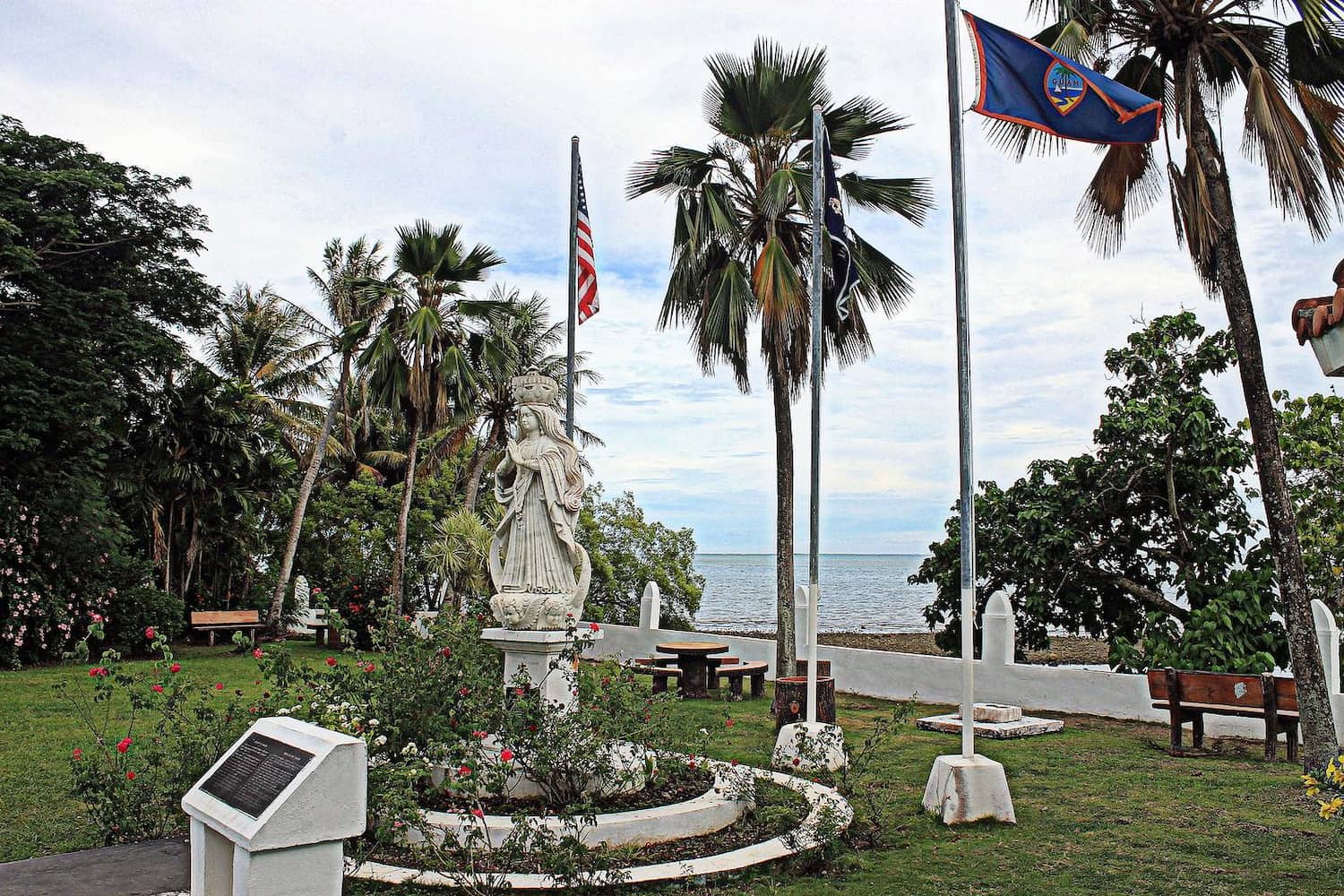
Image 02.03.01 — A marble statue of Santa Marian Kamalen, the patron saint of Guåhan (Guam), in a park in Malesso’, the southernmost village in Guåhan. It is most iconically represented by a revered three-hundred-year-old wooden statue in the Dulce Nombre de Maria Cathedral-Basilica in Hagåtña.
Because the international date line divides the world into different time zones, the outbreak of World War II between Japan and the United States began on December 8th, 1941, in Guåhan (Guam), and on December 7th, 1941, in Oʻahu, Hawaiʻi. Although Guåhan is one day ahead of Oʻahu, the onset of World War II across these islands actually took place at the same time.
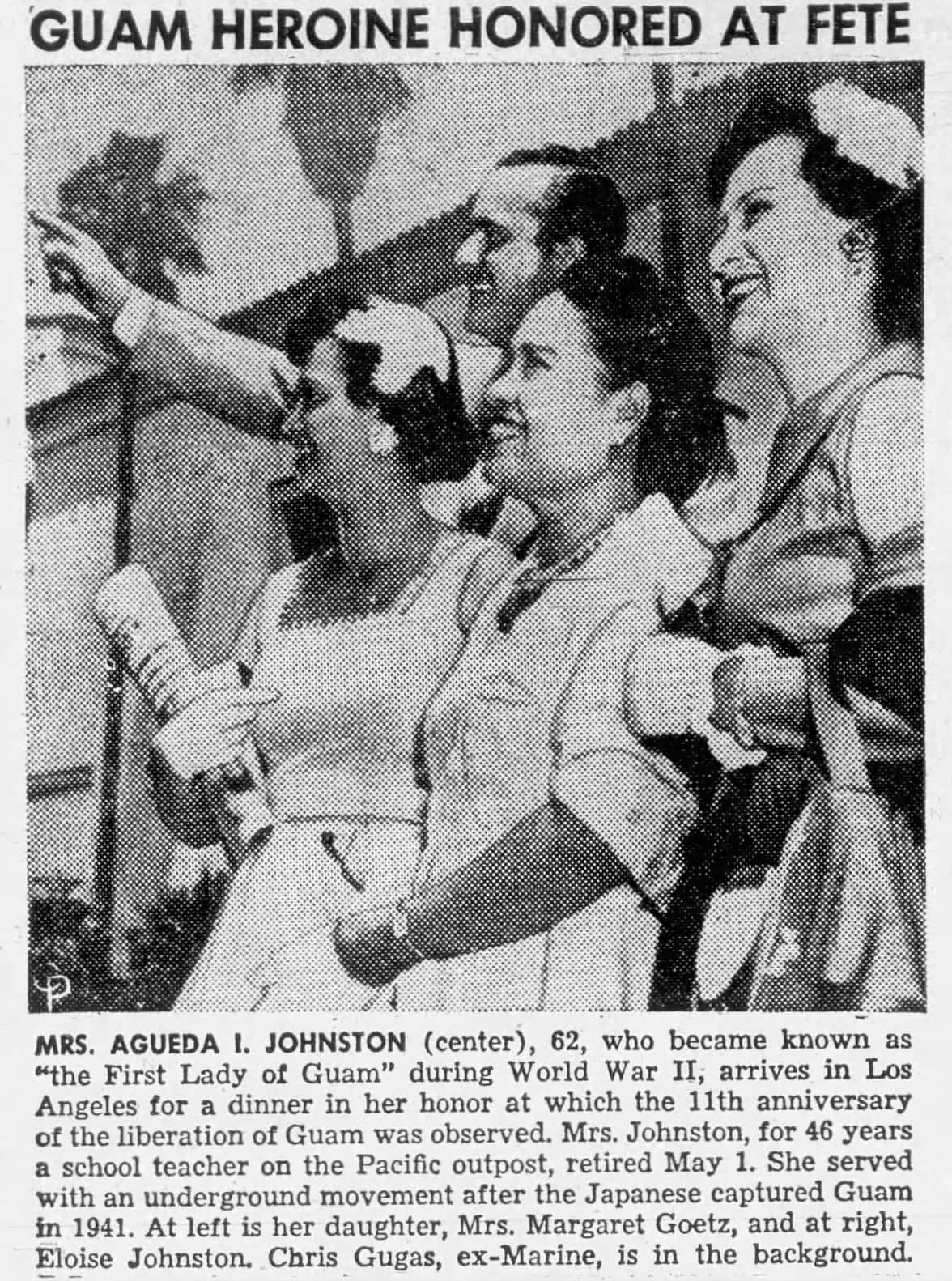
In Guåhan, the CHamoru educator Agueda Iglesias Johnston and her family attended a Catholic mass to honor Santa Marian Kamalen. Shortly thereafter, they heard planes fly above the church, as well as people shouting and panicking about a Japanese military assault. On the same day across the international date line, the Japanese military bombed American military ships in Pearl Harbor (Puʻuloa), a US naval base, on Oʻahu.
Although World War II was already underway in Africa, Asia, and Europe, the war between Japan and the United States did not officially commence until the Japanese military assaults on the US territories of Guåhan, Hawaiʻi, Midway Atoll, the Philippines, and Wake Island, in December 1941. Approximately 3,500 people died from these conflicts, with another 75,000 American and Filipino soldiers captured as prisoners-of-war in the Japanese-occupied Philippines.
Over the next four years, thousands of people suffered and died from a war largely informed by American and Japanese propaganda and racism. The US media, for example, often labeled the Japanese attack on Pearl Harbor as a “surprise.” The media also used the phrase, “Remember Pearl Harbor,” as a rallying call for supporting the US military battles against a “barbaric” Japanese race. Yet the media frequently ignored Native Hawaiian and other Pacific Islander views of the war.
More to explore
Image
The Story of Agueda Iglesias Johnston
As an instructor for the US naval government, Agueda Johnston found joy in teaching English and US history. With her marriage to the former naval officer Lieutenant William Gautier Johnston, she accessed clubs, dance halls, and other spaces that exclusively catered to white American military officials, their dependents, and the CHamoru political elites.
Pacific Islander Perspectives of World War II
CHamoru leaders like Agueda Iglesias Johnston and other Pacific Islander chiefs, clergy, and diplomats had anticipated the onset of World War II. Specifically, Pacific Islander leaders knew about the increasing political tensions between Japan and the United States, as did American and Japanese journalists and politicians. In fact, the US military bases in American Sāmoa, Guåhan, and Hawaiʻi, coupled with the Japanese colonization and militarization of Oceania, promoted genocidal policies, land theft, and military violence.
In other words, WWII further advanced what was already a decades-long process by Japan and the United States to subjugate Pacific Islanders, militarize the Pacific Islands, and secure economic resources for their countries. While Americans and Japanese alike have protested their countries’ military occupations of the Pacific Islands in the twentieth century, the Japanese and American governments often disregarded these criticisms in favor of controlling the peoples and resources of the Pacific. For these reasons, Japan and the US seldom granted Pacific Islanders citizenship, let alone treated them as equal partners in society.
Today, CHamoru families from California celebrate the Feast of Santa Marian Kamalen (Feast of the Immaculate Conception) every year on December 8th to remember the hardship of WWII. Whether living in Carson or Oceanside, they often honor the patron saint of Guåhan by organizing a special mass at a Catholic church. Families also cook large amounts of food for their relatives.
As with other Pacific Islanders in California, many CHamoru families from Guåhan and the Northern Mariana Islands (e.g., Rota, Saipan, and Tinian) also have ties to the US military. CHamorus, Marshallese, Native Hawaiians, Samoans, and others from the Indigenous Pacific now serve in the Air Force, Army, Marine Corps, and Navy. This history, coupled with the number of Pacific Islanders in the US military today, reflects the complex relationship of Pacific Islanders to US military presence and involvement.
The American and Japanese Militarization of Oceania
During the Spanish-American War of 1898, the United States seized the Spanish colonies of Guåhan and the Philippines in the Pacific, and Cuba and Puerto Rico in the Caribbean. The US military also overthrew the Kingdom of Hawaiʻi and annexed it as a US territory, as well as brokered treaties with Germany and Britain to colonize eastern Sāmoa (now known as American Sāmoa). As a result, the US severed Guåhan from its sister islands of the Northern Marianas, much like how Germany and the US divided and ruled Sāmoa as two separate colonial entities.
The United States colonized American Sāmoa, Guåhan, Hawaiʻi, and the Philippines to strengthen its naval fleet and dominate the shipping lanes in Asia and Oceania. The US construction of the Panama Canal in 1914, the American management of sugar plantations in Hawaiʻi, and American trade partnerships with China also provided the economic rationale for American expansionism. The then-prevailing ideas of white racial supremacy and Christian salvation, also described as Manifest Destiny, drove many of the economic, military, and political decisions of policy makers in Washington, DC.
Many white Americans—artists, governors, missionaries, novelists, soldiers, and traders, to name a few— viewed themselves as more civilized, intelligent, and deserving of dominance over the CHamorus, Filipinos, Japanese, Kānaka Maoli (Native Hawaiians), Okinawans, and Samoans they encountered. Likewise, the US government largely saw their invasion and occupation of non-white populations in the Caribbean and the Pacific as “uplifting primitive people,” not as acts of racism or military violence.
By the 1930s, the US government had also condemned Indigenous lands and reefs in American Sāmoa, Guåhan, and Hawaiʻi and remade them into coaling stations, naval bases, and military training grounds. Apra Harbor in Guåhan, Pago Pago Harbor in American Sāmoa, and Pearl Harbor (Puʻuloa) on Oʻahu became economic hubs and military outposts for further US expansion in Oceania and beyond.
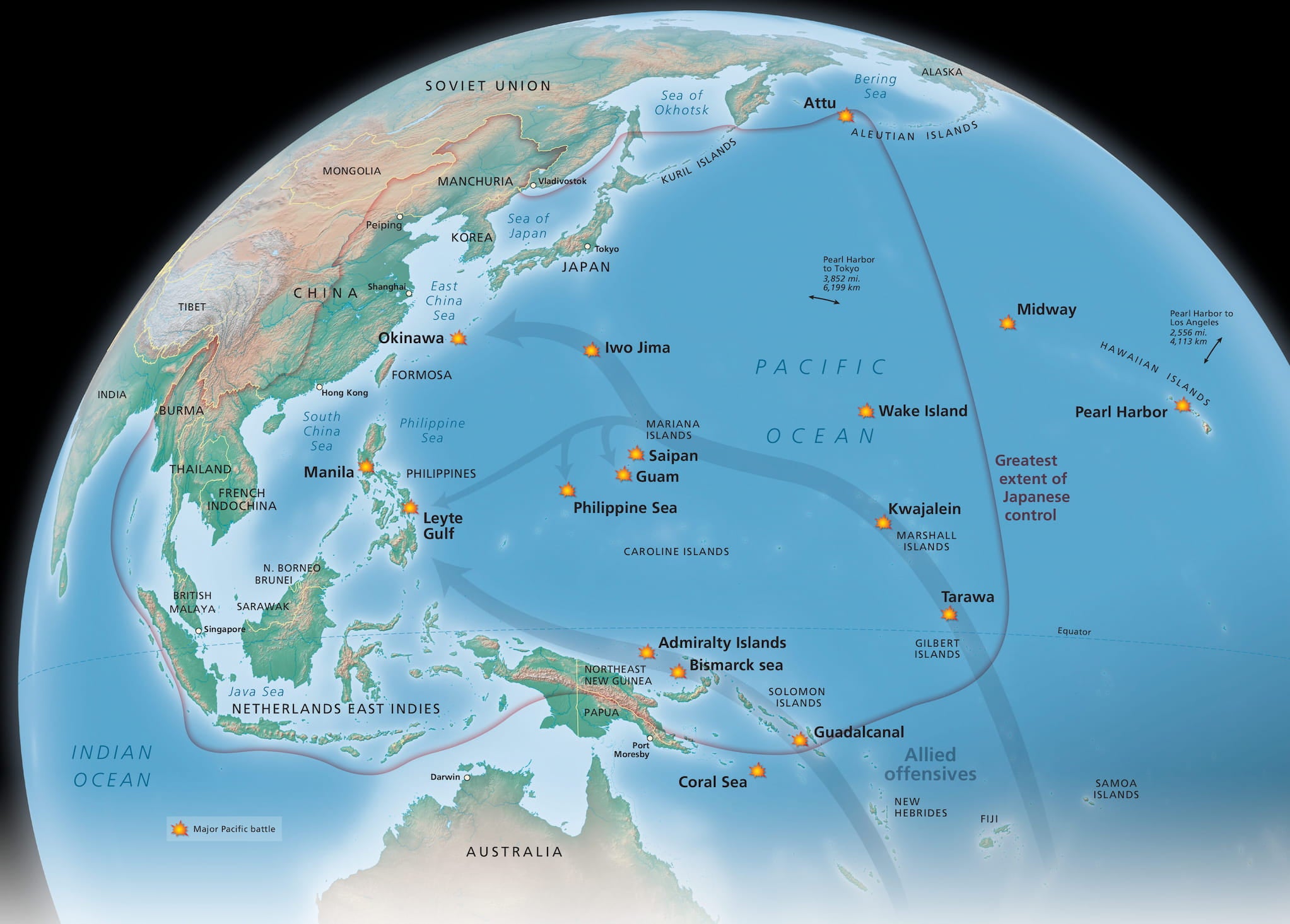
Image 02.03.03 — This map marks the major battles of World War II in the Pacific region with yellow stars. The arrows represent the path of the Allied offensives. The red line identifies the greatest extent of Japan’s control.
Whereas the United States used the Spanish-American War of 1898 to colonize islands in the Caribbean and the Pacific, Japan found in the League of Nations an opportunity to colonize several Pacific Islands that had been ruled by Germany since the late nineteenth century. At the start of World War I in 1914, Japan invaded the German colonies of the Caroline Islands (e.g., Chuuk, Kosrae, Pohnpei, and Yap), the Marshall Islands, the Northern Mariana Islands, and the Palauan Islands.
The League of Nations, the predecessor to the United Nations, determined that Japan should rule the German colonies in order to “modernize” the Pacific Islanders. Japan and the League of Nations however did not receive consent from the Pacific Islander chiefs, clergy, and diplomats. Nor did Japan and the League of Nations consult Pacific Islanders about the political futures that best served their communities.
Instead, Japan established the Nanyō-chō (South Seas Government), with its central office located in Palau. It also developed sugar plantations in Saipan and Tinian, as well as created a phosphate mine in Palau. The Nanyō-chō also recruited thousands of Okinawan and Korean workers for these industries, a process that led to the creation of large Asian settlements.
Japan likewise proclaimed that it had “liberated” Asians and Pacific Islanders from Western colonial rule. In practice, however, Japanese men maintained control over economic, political, and social affairs of the Nanyō-chō, reinforcing their sense of gender and racial superiority over other Asians and Pacific Islanders. Withdrawing from the League of Nations in 1933, the Japanese militarization of Oceania soon became explicit.
Accordingly, Japan began developing military bases and preparing for war with the United States. By the late 1930s, only American Sāmoa, Guåhan, and Hawaiʻi remained US colonies, whereas the Caroline Islands, Marshall Islands, Northern Mariana Islands, and Palauan Islands became Japanese colonies. By the outbreak of World War II in 1941, Japan and the US had divided the Pacific Islands region and its peoples into two colonial spaces.
Pacific Islander Laborers and Soldiers during World War II
The Japanese military controlled the US territory of Guåhan from 1941 to 1944 and maintained its rule over the Caroline Islands, Marshall Islands, and Palauan Islands from 1914 to 1945. Pacific Islanders who experienced Japanese colonialism often viewed the United States as their enemy. Nearly thirty years of Japanese propaganda indoctrinated many Pacific Islanders into believing that Americans were “killers.”
Marshallese men like Handel Dribo and Manke Konol learned the Japanese language and became acculturated in Japanese ways, even though Japan rarely granted citizenship to the Marshallese. Nevertheless, Dribo and Konol proudly constructed barracks and baths for Japanese soldiers in Kwajalein Atoll during World War II. They also performed these activities with Korean workers but were discouraged from fraternizing with them and other Asians. As such, the Japanese military segregated Asians from Pacific Islanders.
The Japanese military also executed individuals believed to be spies, as with the grandparents of the bi-racial Heini family in the Marshall Islands. The Japanese military also tortured and murdered Father Jesus Baza Dueñas, a CHamoru priest from Guåhan, for his perceived loyalties to the US Navy during the war. Elsewhere, the native leaders of Palau and Saipan supported Japan’s war effort against the United States. To them, the Americans began WWII in order to control Asia and Oceania.
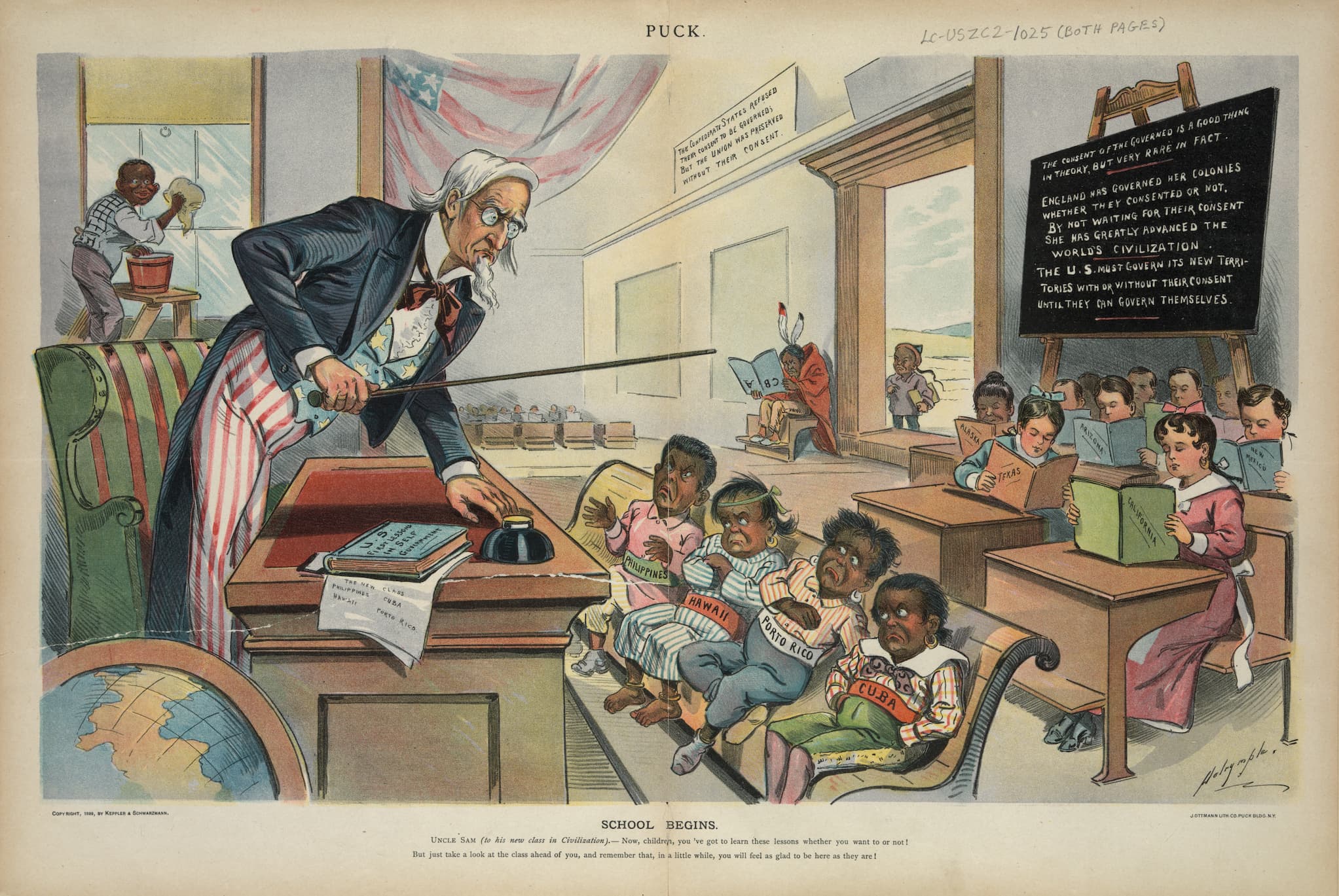
Image 02.03.04a — In the late nineteenth and early twentieth centuries, US media representations of the Caribbean and the Pacific crudely depicted them as uncivilized children in Uncle Sam’s classroom.
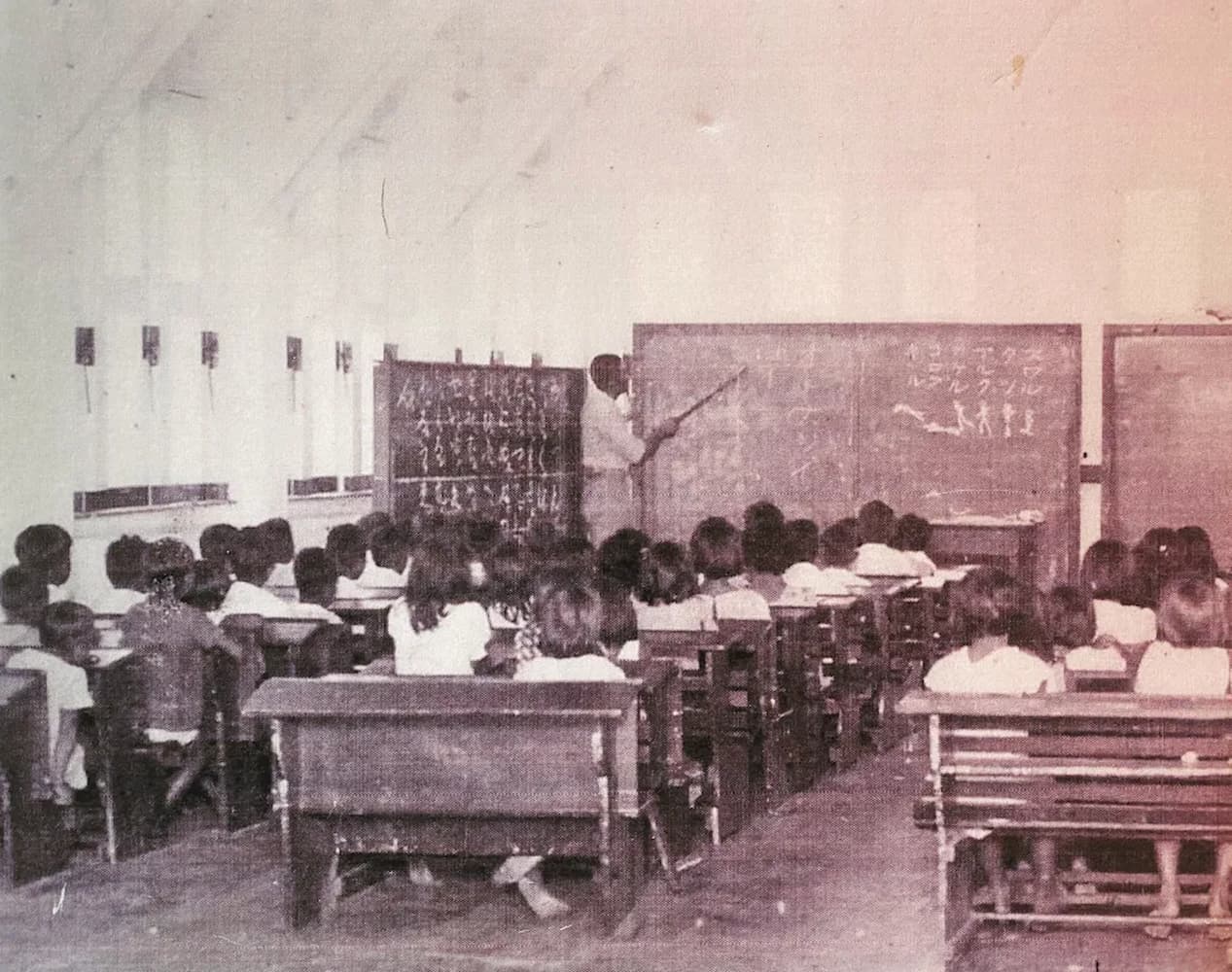
Image 02.03.04b — During World War II, Guåhan (Guam) was occupied by Japanese forces whose war efforts included teaching Japanese culture and language to children. In this image, Japanese characters can be seen written on the chalk boards.


During the war, Pacific Islanders in American Sāmoa, Guåhan, and Hawaiʻi began to align their loyalties to the United States. American propaganda from the 1930s to the 1950s compelled many Pacific Islanders to discriminate against their Japanese neighbors. Pacific Islanders who received elementary and vocational training by the US government and military learned the English language.
Given that the American media and government often represented Japanese nationals and Japanese Americans (many of whom were US citizens) as the “enemy,” many Pacific Islanders also started to adopt racist views of the diverse Japanese communities in Japan, the United States, and elsewhere. Within this wartime context, many community leaders faced difficult situations.
In Guåhan, CHamoru leaders like Agueda Iglesias Johnston operated a beauty salon that served Korean, Japanese, and Pacific Islander “comfort women,” sexual slaves for Japan’s military. Often forced into service as comfort women, Asian and Pacific Islander women seldom found respite from the violence of mass rape, humiliation, and even death. As a mother of daughters, Johnston struggled to balance her obligations to the Japanese military occupiers while simultaneously trying to protect her own family.
Other Pacific Islanders, most notably able-bodied men, participated in the US military in an attempt to reunite with their relatives in Japanese-occupied islands like Guåhan. CHamoru stewards in the US Navy, some of whom were stationed in Pearl Harbor in the 1940s, followed this ideal. Kānaka Maoli men who received their military education from Kamehameha Schools (a private school system established by Princess Bernice Pauahi Bishop) similarly became soldiers to protect their ʻohana (family) in Hawaiʻi.
As cadets they learned the military chain of command, military drills, the demerit system, and other skills that prepared them to become American “warriors.” The CHamorus and Kānaka Maoli also recognized that the US military had racially segregated its personnel, much like how Japan had separated Asian laborers from Pacific Islanders during the war.
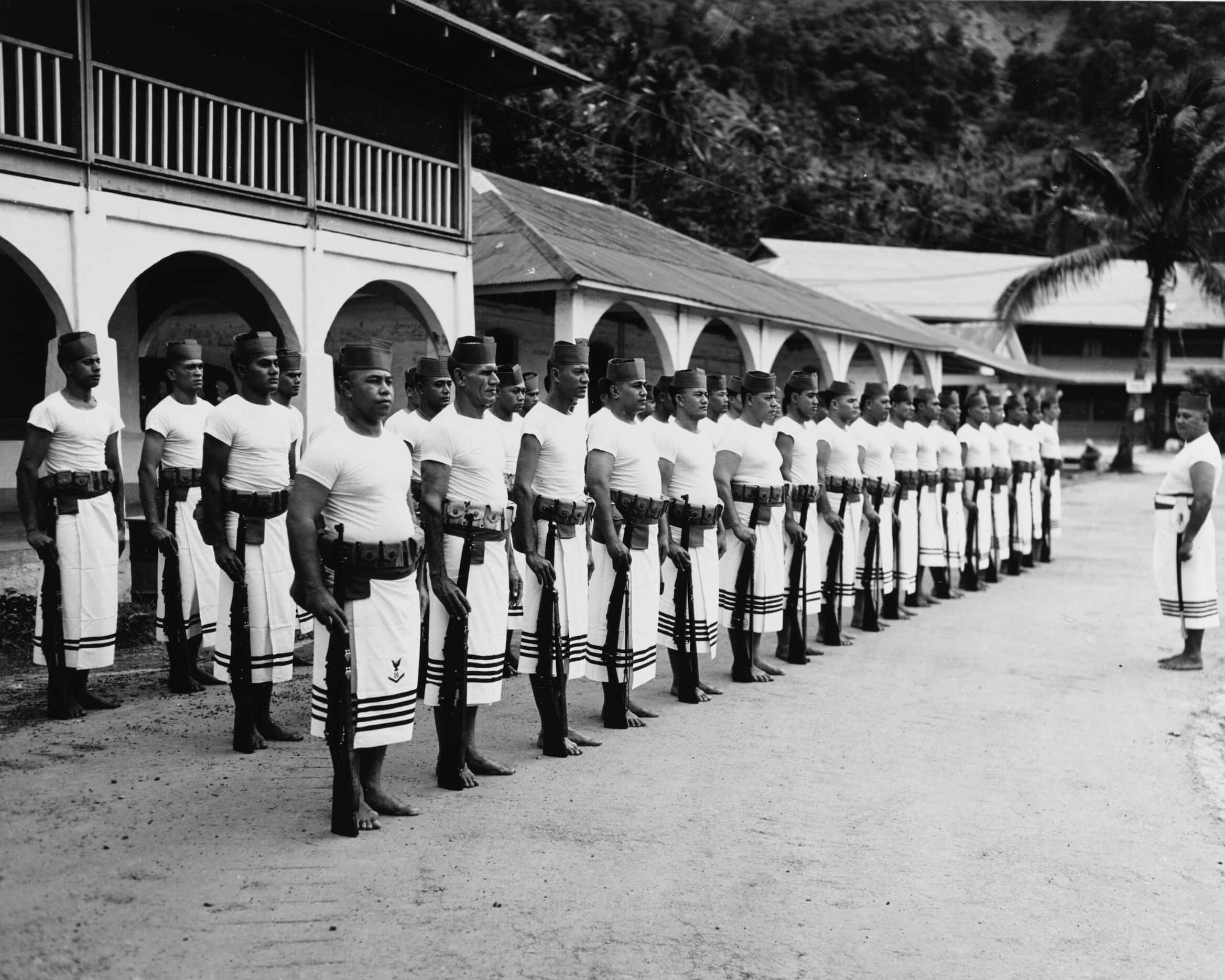
Image 02.03.05 — Originally called the Samoan Naval Militia in 1900, the Fitafita Guard served the US Navy on American Sāmoa (Amerika Sāmoa) until 1951.
In American Sāmoa, the Fitafita, meaning “soldiers” in the Samoan language, served the US Naval Government, the main body of US colonial rule, during WWII. Originally the Navy had instructed the Fitafita to serve in a music band and to work menial jobs. They received lower pay than their white counterparts. Moreover, the US Naval Government restricted them from advancing in any military branch, and the Navy had the ability to discharge any Fitafita at any time during their four years of enlistment.
Despite these racist restrictions, the Fitafita grew in importance as the war progressed. The US Naval Government depended on the Fitafita to communicate their wartime goals to the Samoan chiefs. The chiefs also relied on the Fitafita to convey their concerns to the US Naval Government. By later welcoming chiefs into their ranks, the Fitafita garnered much prestige and status among their community. The Fitafita protected their pastors, chiefs, and extended families in American Sāmoa. As one Fitafita recalled, “Samoans did not know war. But white people, this was their life. Everything they have was because of war.” 1
The Aftermath of World War II
On August 7, 1942, the United States invaded Japanese-occupied Guadalcanal in the Solomon Islands. This effort began the eastward advance of US military forces in Oceania. A few years later, the US dropped nuclear bombs on Hiroshima and Nagasaki in Japan on August 6th and 9th, 1945, respectively. These American nuclear assaults killed thousands of Japanese, Korean, and other Asian residents, and forced Japan to surrender the war though many believed they were close to surrendering without the bomb. The US bombing of Japan represented the only time in human history where a country, the United States, had intentionally waged nuclear warfare against a civilian population.
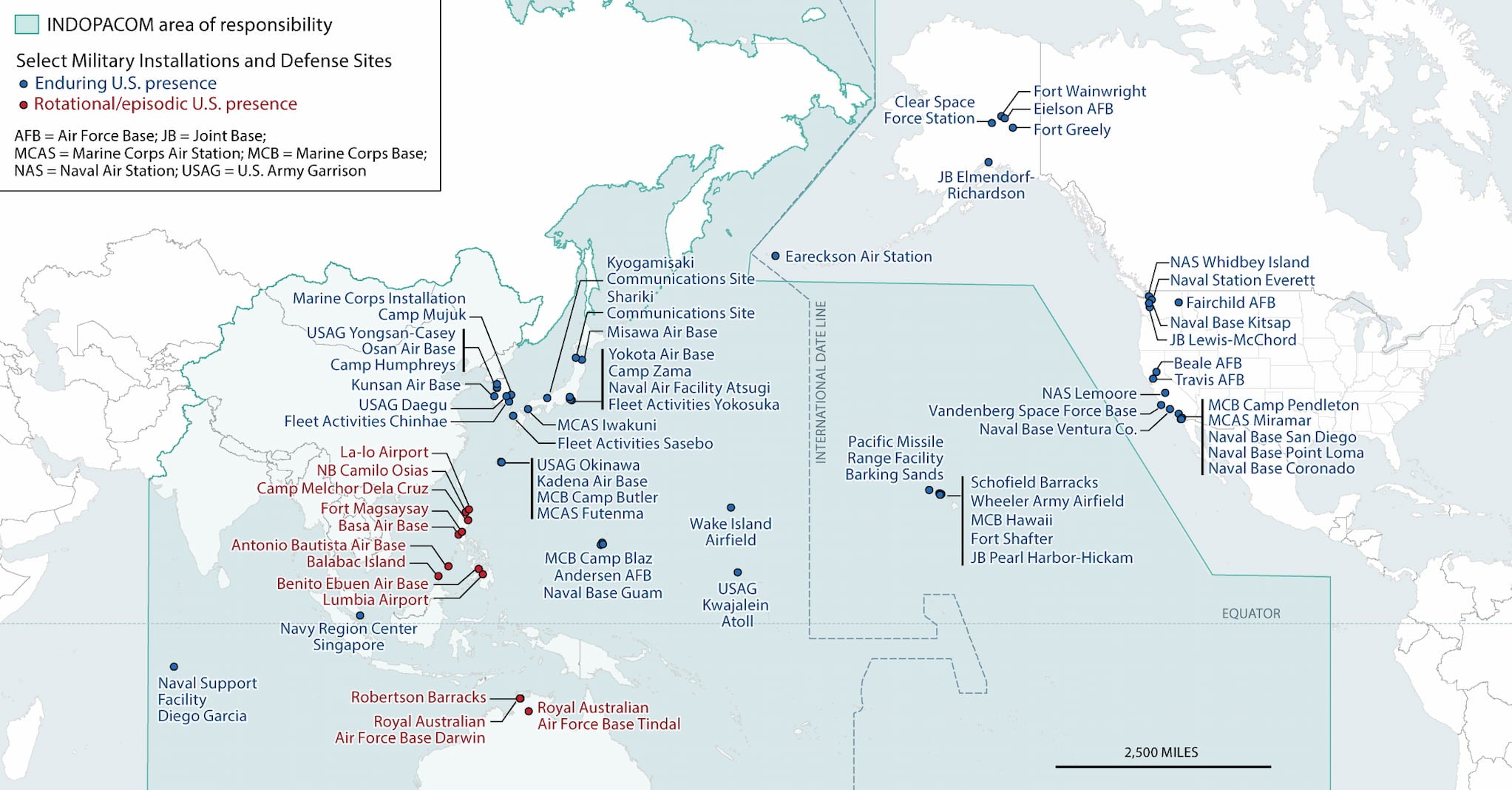
Image 02.03.06 — This map from a 2023 US Congress Report identifies select US military installations and defense sites in the Pacific region.
After World War II, many CHamoru, Native Hawaiian, and Samoan men joined the US military. Whether as stewards for the US Navy or soldiers for the US Army, these young individuals often sought new opportunities for adventure. For example, the Fitafita of American Sāmoa usually traveled to Oʻahu, where they received new orders to relocate to military bases across California. CHamoru and Native Hawaiian men experienced similar circumstances.
The Japanese colonies of the Caroline Islands, Marshall Islands, Northern Mariana Islands, and Palauan Islands eventually fell under the jurisdiction of an United States “trusteeship” with the United Nations from 1947-1986.
Under the “Trust Territory of the Pacific Islands,” these islands became subjected to US colonial governance. When combined with the US territories of American Sāmoa, Guåhan, and Hawaiʻi (which became a state in 1959), the United States had gained a large area of the Pacific region for the purpose of military control and weapons testing. For example, the US detonated sixty-six nuclear bombs in the Marshall Islands, subjecting many Marshallese families to radiation exposure, illness, and death.
Several generations of Pacific Islanders in California now live and work near former US military bases in Carson, Long Beach, Oakland, and San Francisco. But their collective memory of the violence of WWII has not diminished. In fact, more Pacific Islander youth in California and Oceania question the role of the US military, as well as demand greater economic, political, and social autonomy in their home islands and the diaspora.
Conclusion
Understanding World War II from the experiences of Pacific Islanders provides a different perspective beyond the narrative of the war as a fight for democracy and against fascism. Defeat of Nazi Germany and their genocide of Jewish people were also important. And though the imperial legacy of Japan does not receive much attention due to its recasting as a peaceful nation, Japan and the US both share a history of empire-making in Oceania.
The war had heavy consequences for Pacific peoples, including militarization and loss of sovereignty by many Pacific nations. Subsequent economic development also led to the degradation of land and related loss of cultural practices. Many of the Pacific Island states remain allies, territories or a part of the US. As such, they are vulnerable to future global conflicts not of their making.
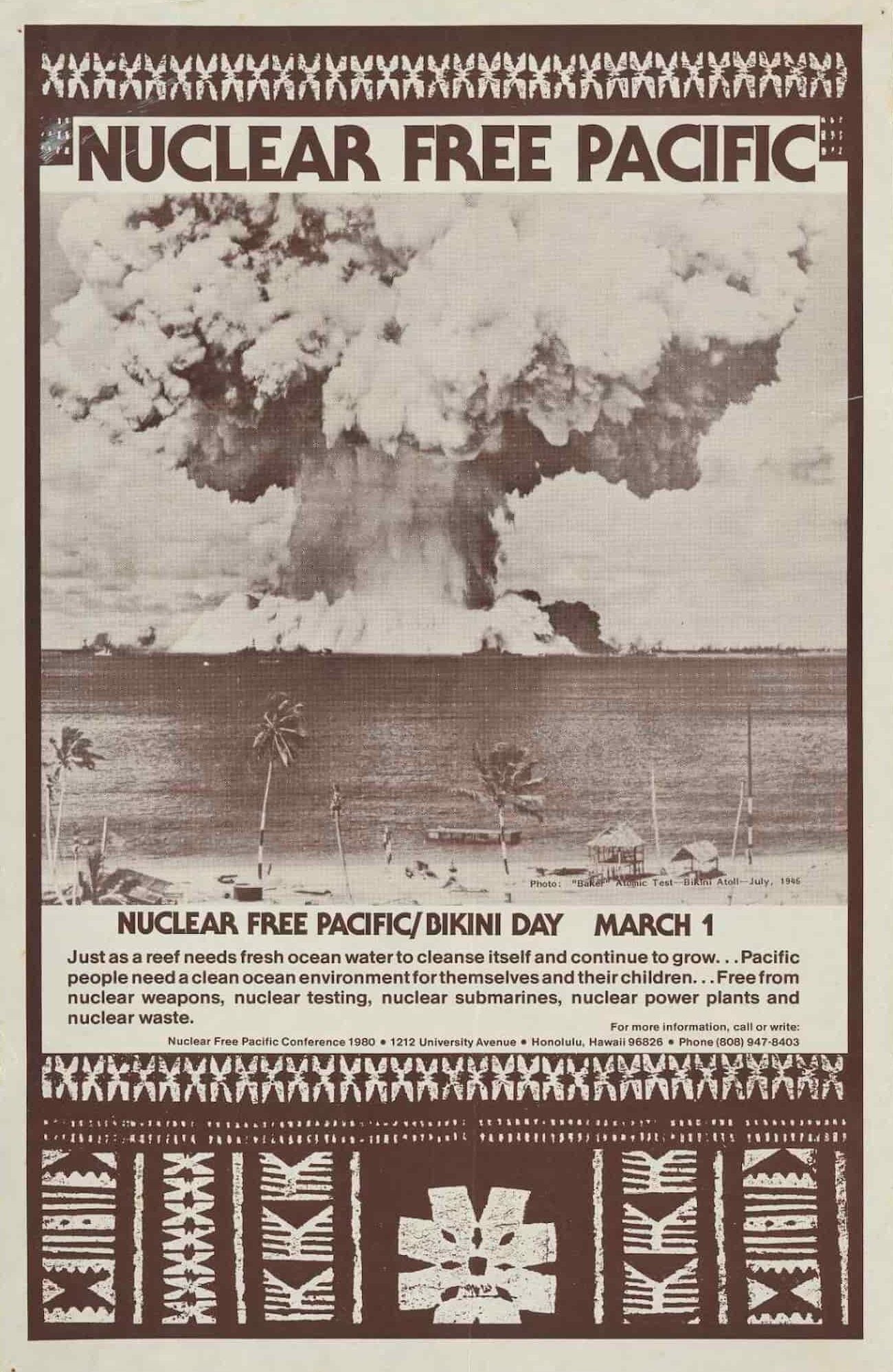
Image 02.03.07 — In the aftermath of World War II, the US detonated nuclear devices on Bikini Atoll in the Marshall Islands from 1946 to 1958, displacing people from their homes. Bikini Atoll remains uninhabitable due to radiation from US nuclear testing.
At the same time, many Pacific peoples continue working to gain control over their lands and their landscapes. For example, Marshallese youth whose families were affected by nuclear testing seek compensation from the United States for the destruction wrought on their lands and physical bodies.
In sum, understanding World War II and its lasting effects provide insights into important political changes across the Pacific, the growth of Pacific communities in the diaspora, and the rising voices of Pacific peoples in current affairs.
Glossary terms in this module
atoll Where it’s used
A ring-shaped series of islands, coral reefs, or islets surrounding a body water called a lagoon.
colonization Where it’s used
The act in which a group or country brings a region and its Indigenous people under its domination and control.
diaspora Where it’s used
The dispersal, movement, migration, or scattering of a people from their established or ancestral homeland.
Indigenous Where it’s used
Refers to someone or something that originates from a region, predating colonialism.
militarization Where it’s used
The process in which a country orders an increase in military presence to organize and prepare for war.
Oceania Where it’s used
A huge geographic region that encompasses Melanesia, Micronesia, Polynesia, and Australia.
Endnotes
1 Faaleava, Toeutu. Fitafita: Samoan Landsmen in the United States Navy, 1900–1951. University of California, Berkeley, 2003.