





Bayon Temple bathed in the light of the setting sun and covered in moss. Two women sit in a doorway and two men sit at the base of the stairs.
Module 1: Temples and Trauma
Did Cambodian Americans attain justice for the harms of war and genocide?
The tourists are here to stroke black-and-white photographs
Of tortured prisoners.
They press closer to look at a picture:
a handcuffed boy
leaning toward them. Walking slow
around the prison,
they crouch in cramped stalls and shut themselves in
to imagine what horrors.
They walk around the metal bed frame,
cover their mouths at rusted chains,
…
They cry. They write on the walls NEVER FORGET
signing their names.
Now they have been here.
They buy books from the souvenir shops
and silk scarves and krama
and handmade purses.
But we come here to look for someone.
– Monica Sok, excerpted from “Tuol Sleng,” A Nail the Evening Hangs On 1
“Tuol Sleng,” a poem from Cambodian American Monica Sok’s debut collection, A Nail the Evening Hangs On, takes place at one of the most infamous torture centers of the genocide committed by the Khmer Rouge regime (1975–1979). In the poem, Sok as the narrator visits the school-turned-prison-turned-dark-tourism site with her nephew Ratanak. Foreign tourists express horror at the grisly scenes of pain and suffering. They vow to “never forget” in the face of systematic mass killing.
The tourists mark off Tuol Sleng as another sightseeing stop on their trip to Cambodia, simultaneously taking in Cambodian culture while distancing themselves from Cambodian history. But for Sok—who, like myself (this chapter’s author), is a daughter of Cambodian Holocaust survivors—and other Cambodian visitors, Tuol Sleng is not just another sightseeing stop. Instead, they visit Tuol Sleng to search for evidence of the missing, for dead family members and unknown relatives.
In this module, we discuss Cambodia’s colonial and postcolonial history, and view how war has shaped the experiences of Cambodian Americans.
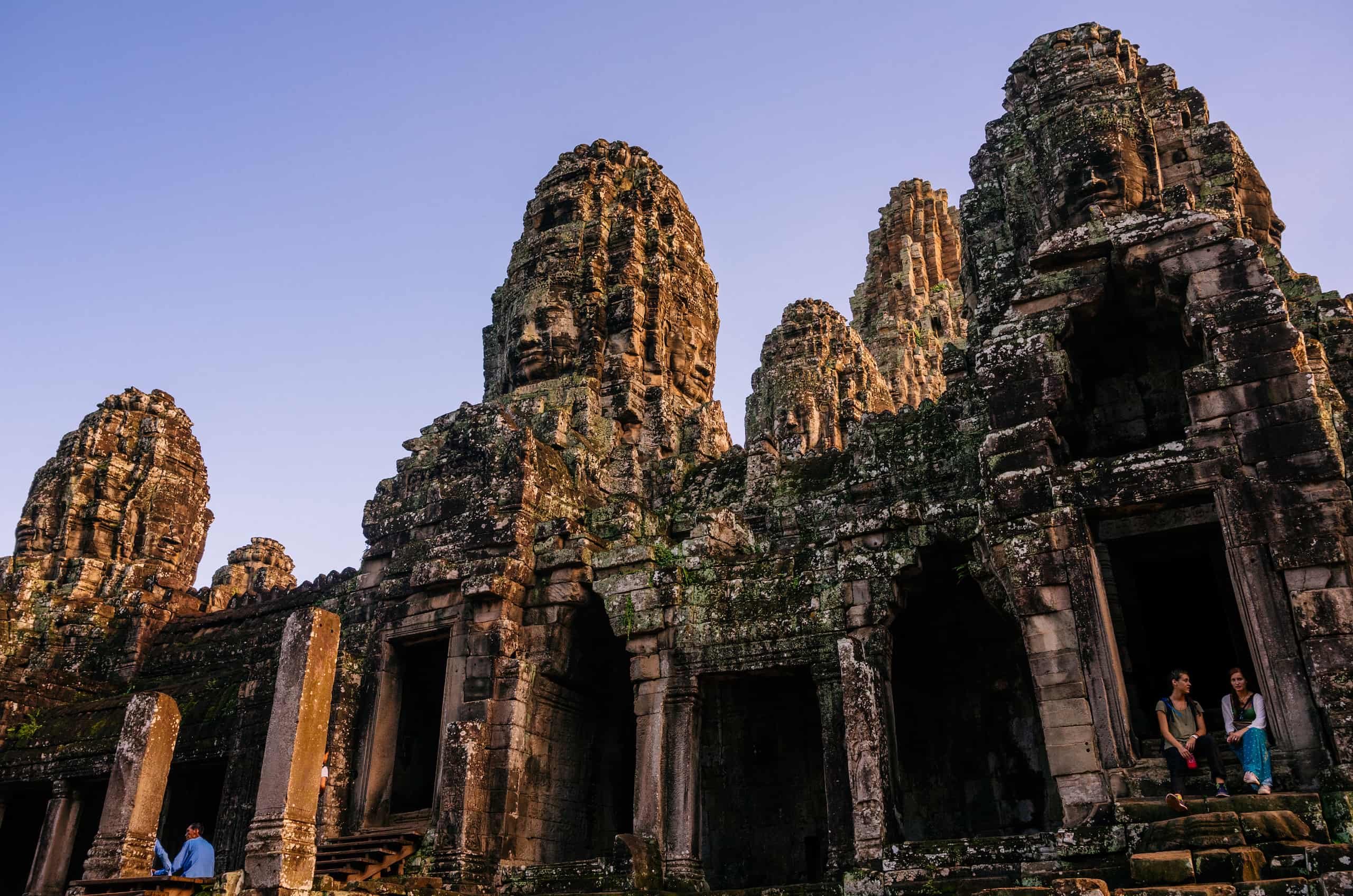
Image 08.01.01 — Bayon Temple was built in the late twelfth or early thirteenth century by King Jayavarman VII and stands at the center of his capital, Angkor Thom, in modern day Siem Reap, Cambodia.
Why has Cambodian history been described as a “tragedy”?
How has war shaped the experience of Cambodian Americans?
How is Cambodian American history transnational?
Imagining Cambodia
What comes to mind when you think of Cambodia? Do you think of impressive temples and monuments marking the capitals of the once-mighty Khmer Empire? Of the majesty of Angkor Wat? Perhaps you imagine black-and-white photographs of the horror-struck faces of prisoners awaiting torture and death? Of collections of skulls on display or of the dark tourism of the Killing Fields? When you think of Cambodia, do you think of decline from the civilizational peak of Angkor to the barbaric genocide of the Khmer Rouge?
These familiar descriptions limit our understanding of Cambodian history, and a story of tragedy, from temples to trauma, limits our understanding of Cambodian Americans in the United States. Yet what if these images of temples and trauma represent more than a story about Cambodia? What if we understand the history and experiences of Cambodian Americans as global and transnational?
A transnational understanding of history moves beyond national borders and boundaries. Thinking transnationally highlights interconnected histories and draws our attention to the effects of the global on the local. This way of thinking gives added context to what we consider to be familiar images, and it challenges us to question our assumptions. Ideas of Angkor as Cambodia’s pinnacle of greatness, and its fall as the beginning of Cambodia’s decline, have their origins in French colonialism, in what was called Indochina (modern-day Cambodia, Laos, and Vietnam).
The establishment of the Tuol Sleng Genocide Museum and initial display of prisoner photographs served to document the Khmer Rouge’s atrocities and justify Vietnam’s 1979 invasion and occupation of Cambodia. And the conditions that produced the Killing Fields and the Cambodian refugees existed in the context of the US war in Vietnam, and the Cold War’s global repercussions.
In this first module we explore the conditions that explain Cambodian Americans’ presence in the US. We come to understand the transnational dimensions of war, militarism, and refugee migrations. We also begin to explore how Cambodian Americans have built communities in the US and how they remember, record, and respond to violence and injustice.
The Khmer Empire and French Colonialism in Indochina
In 1860 while traveling through what is now known as Southeast Asia, the French naturalist Henri Mouhot came upon a fantastic sight, sketching what he thought were the immense ruins of a dead civilization. Framing the abandoned city of Angkor as evidence of a once powerful Khmer Empire, Mouhot encouraged France to add what it called “Cambodge,” derived from the native Khmer name “Kampuchea,” to its “colonial crown” 2 before Britain could claim it.
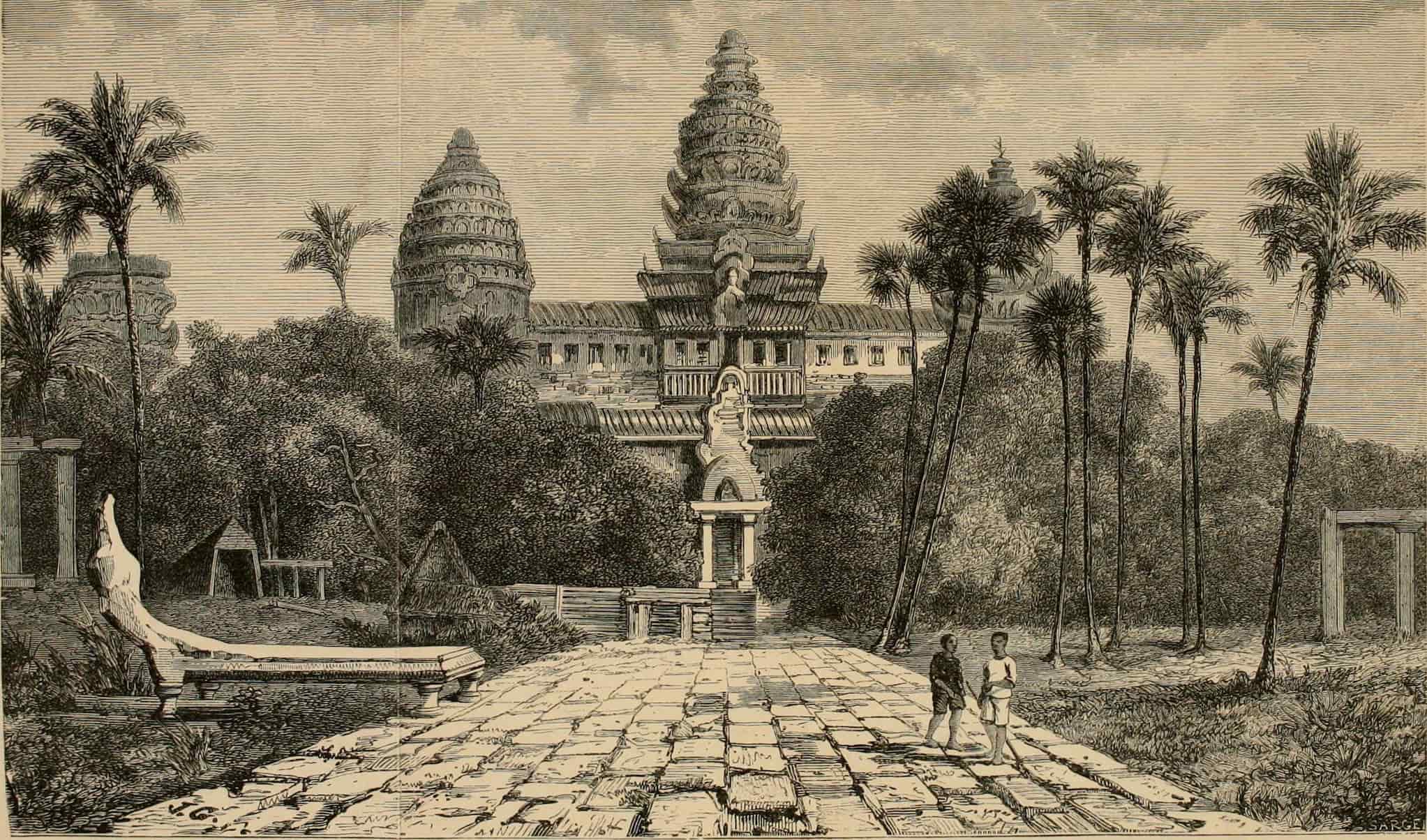
Image 08.01.02 — Henri Mouhot produced several sketches of Angkor during his travels in Southeast Asia. This image of Angkor Wat, circa 1860, included local people. These local people would be removed when Mouhot’s sketches were featured in France’s Tour du Monde.
Although he contracted malaria and died shortly after his tour of Angkor, Mouhot’s findings would live on long after his death. In 1863 portions of Mouhot’s diary were rewritten and published in France’s travel journal Tour du Monde (World Tour), bringing knowledge of Angkor and the Khmer Empire to the European world. According to the French and some historians, the discovery of Angkor would also bring this history back to the Khmers themselves.
The story of Henri Mouhot and the “discovery” of Angkor has long been the predominant starting point in the history of Cambodia. European observers believed that the present-day Khmer population lived in ignorance of their once great civilization before French colonialism. In the late 1860s colonialist Charles Lemire wrote, “The Cambodians have no memory of their past grandeur.” 3 Colonial common sense asserted that the Khmers who built Angkor were a vanished race, one different from the degraded Cambodians who arose after their decline.
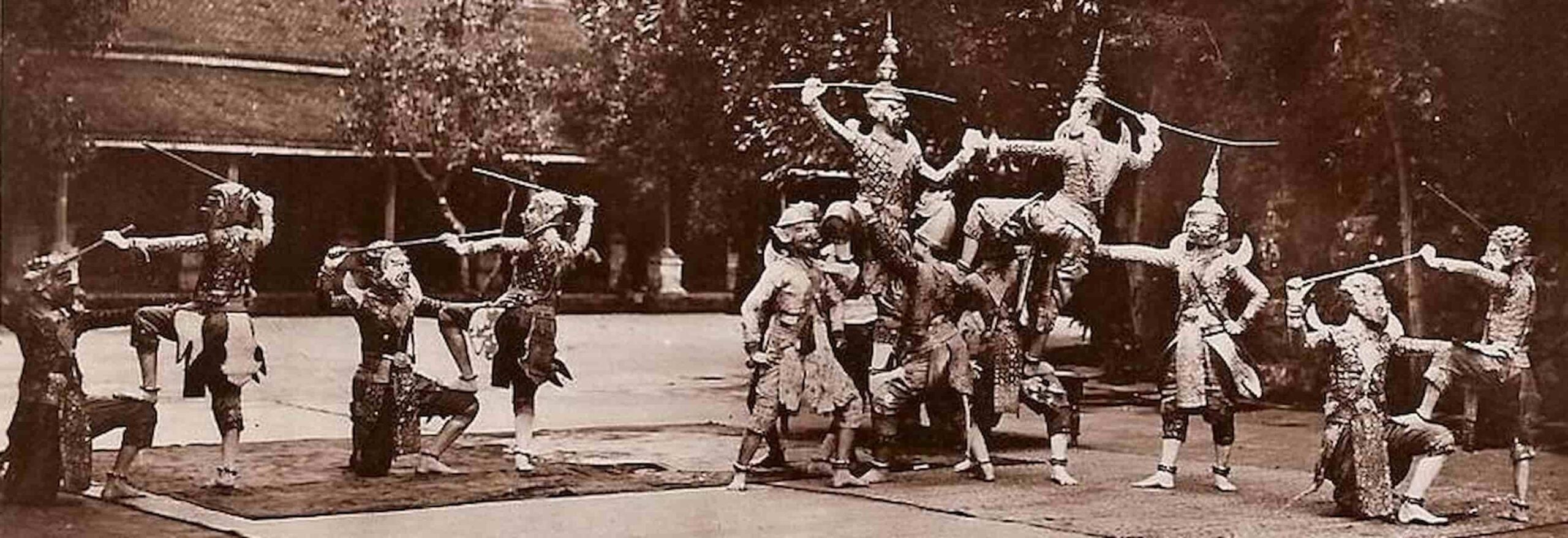
Image 08.01.03 — This image is from a postcard whose exact date of publication is unknown, but likely circa 1904. The image depicts a Lakhon Khol, a traditional masked theater practice, and a performance of the Reamker, the Cambodian epic poem based upon the Ramayana.
The narrative of French “discovery” and “recuperation” of the golden age of the Khmer Empire was largely one of colonial fantasy. Missing from this narrative were the non-European peoples who knew of Angkor before the arrival of the French.
In addition to the team of conscripted Chinese laborers called “coolies” and Thai guides that led Henri Mouhot to “discover” Angkor, Buddhist monks and local people had long made use of the temple complex as part of their religious practices and everyday lives. Although Mouhot included them in his initial sketches, these individuals vanished in Tour du Monde and subsequent representations of Angkor intended for the larger European public.
In 1863 France compelled King Norodom I of Cambodia to sign a Treaty of Protectorate. Under the treaty France pledged to protect the Cambodian monarchy and military against its historical rivals, Vietnam and Siam (the former name of Thailand until 1939), in exchange for administrative power and control over Cambodia’s foreign and trade relations.
After a series of anticolonial rebellions, however, France fully consolidated power over Cambodian affairs, reducing the king’s rule and effectively making Cambodia a colony. Contrary to claims of benevolent French colonial rule, revolts occurred throughout the French colonial era in response to heavy taxation, coerced and unpaid labor on infrastructural projects, and importation of Vietnamese into Cambodia to staff the colonial civil service and to work on French-established rubber plantations.
During World War II Japan occupied Cambodia as part of its conquest of Southeast Asia. Japanese forces overthrew the French administration in Indochina and declared Cambodia, Laos, and Vietnam independent from French rule. But after Japan’s defeat in World War II, the French returned to power. In response, throughout the late 1940s and 1950s, anticolonial Cambodian nationalists rallied for independence while Prince Norodom Sihanouk entered negotiations with France for formal independence. In 1953 Cambodia gained independence from France.
Cold War, Civil War, and the Emergence of the Khmer Rouge
After the end of World War II, the world entered a period known as the Cold War. Regional and global events during this period enabled the Khmer Rouge regime to come to power. During the Vietnam War, many North Vietnamese retreated to sanctuaries in Cambodia. Prince Sihanouk, the head of Cambodia’s constitutional monarchy, adopted a foreign policy of neutrality at the beginning of the war.
In 1965, US President Lyndon B. Johnson ordered the bombing of Cambodia to draw out the North Vietnamese. Prince Sihanouk gives one chilling account of an attack on June 29, 1968, near the Cambodian village of Svay A Ngong:
Two United States military helicopters attacked with machine guns a group of Cambodian peasants, including women and children, who were working the village . . . Fourteen people were killed and four seriously wounded. The thirteen survivors stated that the cigarette-smoking American pilots, flying a few meters from the ground, launched a veritable manhunt during half an hour, methodically shooting down all who tried to flee, including women and children. 4
In 1969, President Johnson’s successor Richard M. Nixon escalated the bombing attacks. On December 9, 1970, after an arguably unsuccessful ground invasion of Cambodia, Nixon met with his national security adviser Henry Kissinger. Five minutes after their conversation, Kissinger called General Alexander Haig with the following message: “[Nixon] wants a massive bombing campaign in Cambodia…. It’s an order, it’s to be done. Anything that flies, on anything that moves. You got that?” 5 Kissinger’s own words counter claims he later made that the bombing of Cambodia was limited and targeted.
Whole Cambodian villages disappeared under the dropping of bombs and napalm. One inhabitant of Chalong Village told historian Ben Kiernan: “Many monasteries were destroyed by bombs. People in our village were furious with the Americans; they did not know why the Americans had bombed them. Seventy people from Chalong joined the fight against Lon Nol after the bombing.” 6 Another Cambodian villager lamented: “The bombers may kill some Communists but they kill everyone else, too.” 7
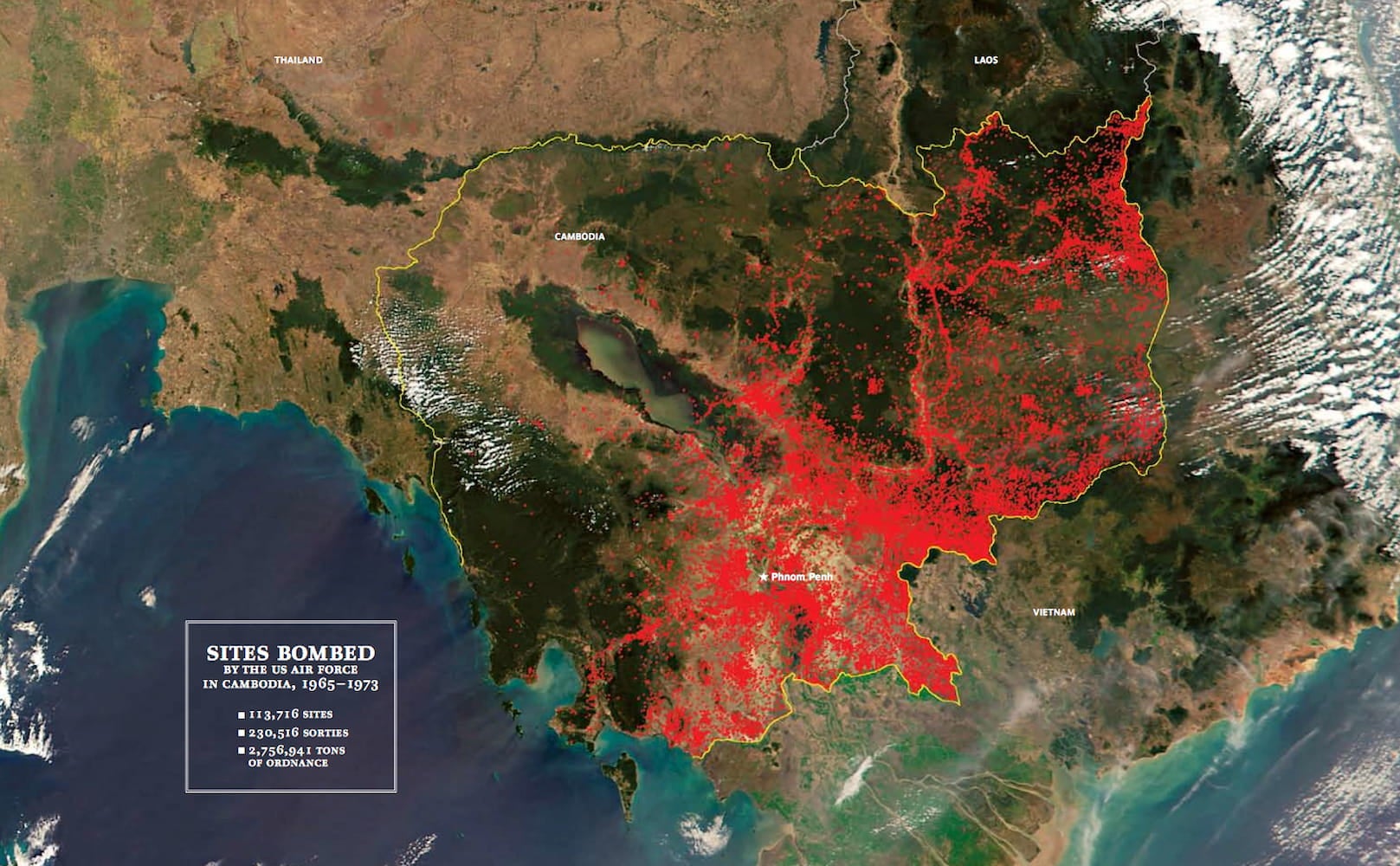
Image 08.01.04 — This map illustrates the extent of US bombings of Cambodia from 1964 to 1975. The US dropped at least five hundred thousand tons of bombs on Cambodia. Each of the red dots in the map depicts a bombing target.
The American bombings throughout Southeast Asia were destructive, but the extent of the damage was not known until President Bill Clinton released new data in the year 2000, showing bombings were more extensive than previously claimed. More bombs were dropped on Cambodia during the Cold War than in the Pacific War during WWII. Data shows up to half a million Cambodians died from American bombings, in a country of about seven million population at the time.
Along with Cambodian deaths, US bombings contributed to driving the North Vietnamese further into Cambodia, and the mass exodus of an estimated two million displaced people from the countryside to the cities. The devastation caused by US bombings also became an effective recruitment tool for a little-known faction of the Cambodian branch of the Communist Party. Rising costs of living, malnutrition and lack of food, and unequal access to opportunities added to the growing discontent of internally displaced refugees. The situation in Cambodia became highly unstable.
While out of the country in 1970, Prince Sihanouk was overthrown in a coup by the pro-US general Lon Nol. This began a five-year civil war in Cambodia. In response to the coup, Sihanouk officially aligned himself with a Khmer Rouge coalition backed by China. Expanding from a force of a few thousand to over two hundred thousand by 1973, the Khmer Rouge was headed by a group of Paris-educated militants, including Pol Pot (whose given name was Saloth Sar). Prince Sihanouk’s alignment with the Khmer Rouge garnered further support for the Communist faction, legitimizing and allowing for the group’s eventual government takeover.
The Cambodian Holocaust
The Khmer Rouge came to power in April 1975 and renamed the country Democratic Kampuchea. When the Khmer Rouge first took over the Cambodian capital, Phnom Penh, many received them as liberators. However upon seizing power, the Khmer Rouge evacuated Cambodia’s people from its cities into the countryside and forced the populace to work in large groups segregated by age and gender. At these rural work camps, the Khmer Rouge separated families and mandated collective eating. Although many people died of starvation as a result of the severe rationing of food, others were able to survive through creative means. In the words of a survivor quoted by Cambodian scholar Khatharya Um: “We were so hungry that we picked some bitter fruits and rolled them in ashes to take some of the bitterness away. Then we put them out to dry or we boiled them.” 8
Major purges took place as Khmer Rouge leaders sought to eliminate any perceived enemies of their revolution. The regime opened secret prisons, including the infamous Tuol Sleng (known as S-21 Prison at the time) in the capital. At Tuol Sleng, close to forty thousand prisoners were interrogated, tortured, and killed, their bodies buried in mass graves. These graves, along with others, came to be known as the “Killing Fields.”
Along with the wholesale destruction of human life, came the loss of cultural and social infrastructure, as Khmer Rouge leaders attempted to return the country to “Year Zero.” Between 1975 to 1979, an estimated one-fifth of the population of Cambodia was decimated in what scholars have called the Cambodian Holocaust (Cambodian Genocide). Within three years, approximately 1.5–2 million Cambodians died from starvation, disease, illness, murder, or torture.
Refugee Resettlement and Cambodian American Communities
Seeking to “reclaim” what they considered Cambodian territory, the Democratic Kampuchea government engaged in a series of military excursions across Vietnamese borders. In response, Vietnam launched a full-scale invasion of Cambodia. On January 7, 1979 the Vietnamese army captured Phnom Penh. Pol Pot and the Khmer Rouge retreated to northwestern Cambodia. In the context of the ongoing Cold War, and the recent defeat of the US by North Vietnam, most of the world considered Communist Vietnam’s invasion of Cambodia a greater atrocity than those committed by the Khmer Rouge regime it overthrew.
Despite having knowledge of Khmer Rouge atrocities, China, the United Kingdom, and the US continued to recognize Pol Pot’s regime as Cambodia’s legitimate government. This enabled the Khmer Rouge to continue to wage war against the newly installed pro-Vietnamese People’s Republic of Kampuchea, and to retain a military presence in Cambodia throughout the 1980s and into the 1990s.
In 1979 hundreds of thousands of Cambodians fled to refugee camps across the Thai border, the largest of which was Khao-I-Dang. Displaced by decades of war and devastated by starvation during the Khmer Rouge’s totalitarian regime, along with famine in the wake of a US embargo on the pro-Vietnamese People’s Republic of Kampuchea, Cambodians risked their lives to escape the political instability and violence in their country. For those fortunate enough to make it to a UNHCR (United Nations High Commissioner for Refugee) camp, survivors went from “internally displaced persons” in Cambodia to “refugees” in Thailand, and now able to apply for resettlement to a third and final country of asylum.
Between 1980 and 1994, 150,000 Cambodian refugees were part of the largest resettlement program in the US’s history, with most Cambodian communities relocated to Long Beach, California, and Lowell, Massachusetts. After the passage of the 1980 Refugee Act, close to one million refugees from the wars in Vietnam, Laos, and Cambodia resettled in the US.
Acclaimed Cambodian dancer, choreographer, and artistic director, Sophiline Cheam Shapiro, reflects on resettlement and the effects of this tumultuous change on her life:
I now live in the United States. One day recently I found myself on a bus contemplating the way that each of the political factions under which I have lived has taught me one thing, only to have the next regime tell me something completely different. This constant change in ideology has left me, and I think my whole generation, confused. We are left to search through the rubble and find some truth for ourselves. 9
Accounting for Histories of Violence and Legacies of War
The Extraordinary Chambers in the Courts of Cambodia (ECCC), also known as the Khmer Rouge Tribunal, was created in 2001 with joint agreement between the Cambodian government and the United Nations. In December 2022, the tribunal concluded after the conviction of three Khmer Rouge leaders: Kaing Guek Eav (known as Duch, commander of S-21 Prison), and Noun Chea and Khieu Samphan, leading members of the secretive Khmer Rouge Standing Committee (or simply “Angkar,” meaning “organization”).
After fifteen years of proceedings and over 330 million dollars spent, the public response to the ECCC has been mixed and oftentimes contentious. For overseas Cambodians and Cambodian Americans who make up the Cambodian diaspora—many of whom participated in or volunteered their time for the tribunal—the ECCC produced an incomplete account of violence that occurred and a narrow vision of justice served.
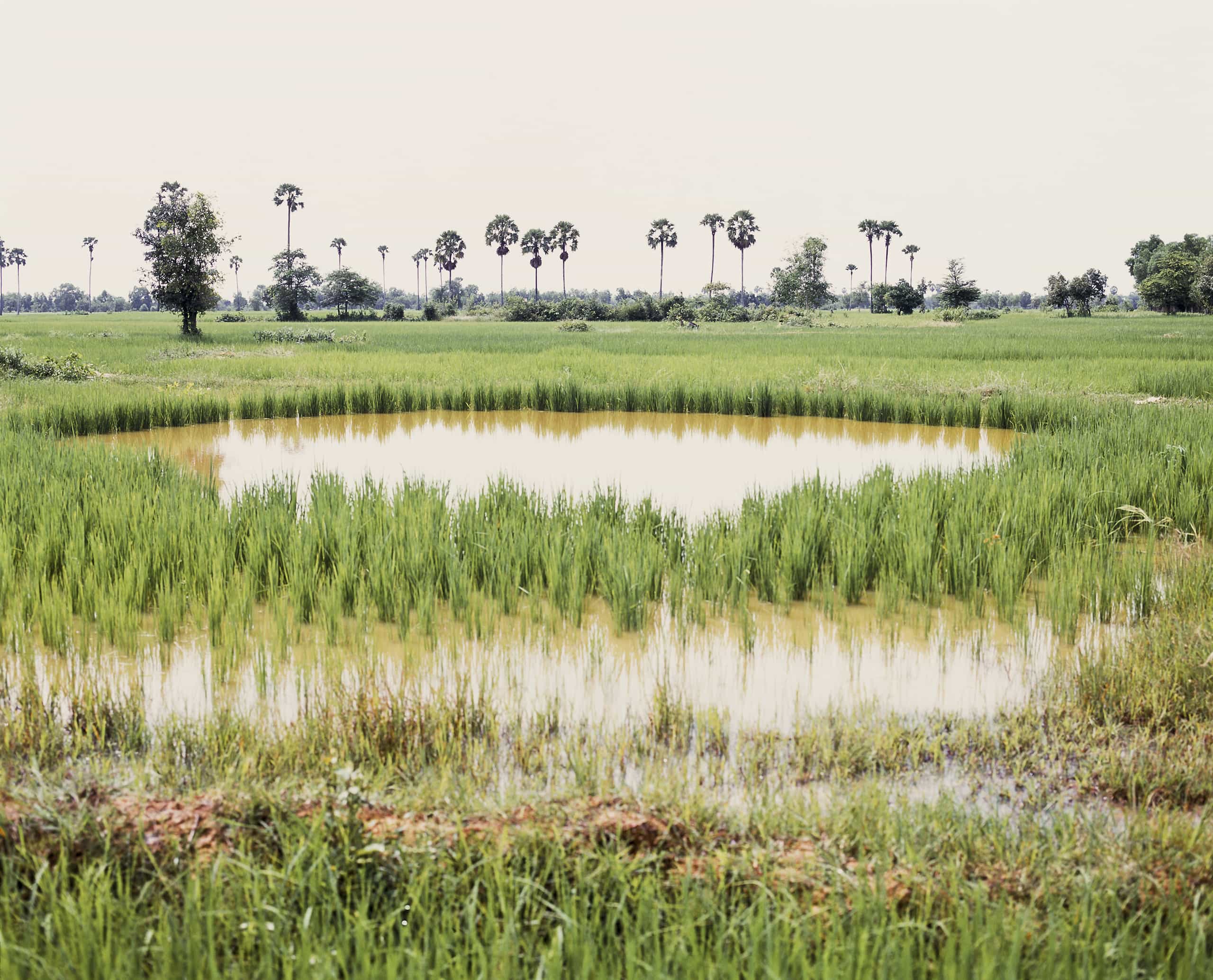
Image 08.01.05 — Takeo (2009) by artist and photographer Vandy Rattana, who lives and works between Phnom Penh, Paris, and Taipei. His Bomb Ponds series consists of several photographs and a film documenting the aftermath of US bombing in Cambodia.
Cambodians and Cambodian Americans have been organizing and pushing for more expansive understandings of memory and justice. The work of Cambodian and Cambodian American artists, performers, poets, and writers challenges the simplistic Cambodian history and experience as defined solely by temples and trauma. Cambodian American poets like Monica Sok, whose “Tuol Sleng” begins this module, confront our tendencies to distance ourselves from the past and from violent histories. Cambodian American cultural producers ask us to think intentionally about how and what we remember; they help us to imagine visions of justice that account for a deeply interconnected world.
Glossary terms in this module
collective eating Where it’s used
One of the defining policies during Khmer Rouge rule in Cambodia, where communal dining halls and the strict rationing of food were introduced to monitor and exert greater control over people’s actions.
colonialism Where it’s used
When one country takes partial or complete control over another country economically and politically, exploiting its natural resources for profit. The colonizer forces their beliefs and way of life onto the colonized.
diaspora Where it’s used
The dispersal, movement, migration, or scattering of a people from their established or ancestral homeland.
genocide Where it’s used
A term combining the Greek genos, meaning “race,” and the Latin cīda, meaning “killer” or “act of killing.” It refers to a set of actions taken with intent to produce the destruction in whole or in part of a national, racial, ethnic, or religious group.
Khmer Rouge Where it’s used
Also known as the Communist Party of Kampuchea, the Khmer Rouge party was led by Pol Pot and ruled over Cambodia from 1975 to 1979. During this time, the Khmer Rouge renamed the country Democratic Kampuchea, and enacted a totalitarian regime responsible for the Cambodian Holocaust.
refugee Where it’s used
Someone, or a group of people who have been forced to flee their native country due to war, violence, or persecution, and are unable or not willing to return.
resettlement Where it’s used
The transferring of refugees from an asylum country to another state, where they are ultimately given permanent residence.
The Cambodian Holocaust Where it’s used
The period of state violence perpetuated by the Khmer Rouge government of Cambodia, led by Pol Pot, from 1975 to 1979. During this time, up to two million Cambodians died from the effects of starvation, disease, illness, torture, or murder.
The Cold War Where it’s used
Beginning at the end of World War II and ending with the fall of the Soviet Union in 1989, the Cold War was a period of indirect war and rivalry between the United States and Soviet Union (USSR), and their allies. Though there was no direct fighting between the US and USSR, their rivalry brought forth numerous proxy wars in various regions, particularly in East and Southeast Asia. Typically characterized through arms races and the prevention of communism, the Cold War can also be understood as a global phenomenon that affected countries around the world, with significant consequences for decolonizing countries in Asia.
transnational Where it’s used
Extending beyond national borders and countries.
Year Zero Where it’s used
Beginning in 1975, this term was popularized by the French writer François Ponchaud to refer to the Khmer Rouge policy of dictating the destruction and replacement of all existing culture and traditions, and the beginning of a new society from scratch.
Endnotes
1 Monica Sok, “Tuol Sleng,” A Nail the Evening Hangs On (Copper Canyon Press, 2020), 29.
Monica Sok, excerpts from “Tuol Sleng,” from A Nail the Evening Hangs On. Copyright © 2020 by Monica Sok. Used with the permission of The Permissions Company, LLC on behalf of Copper Canyon Press, coppercanyonpress.org. All rights reserved.
2 Penny Edwards, Cambodge: The Cultivation of a Nation, 1860–1945 (University of Hawaiʻi Press, 2007).
3 Edwards, Cambodge: The Cultivation of a Nation, 1860–1945, 25.
4 Kenton Clymer, The United States and Cambodia, 1870-1969: From Curiosity to Confrontation (Routledge, 2004), 146.
5 Ben Kiernan and Taylor Owen, “Roots of U.S. Troubles in Afghanistan: Civilian Bombing Casualties and the Cambodian Precedent,” The Asia-Pacific Journal: Japan Focus 8, no. 26 (2010): 5.
6 Ben Kiernan, The Pol Pot Regime: Race, Power, and Genocide in Cambodia under the Khmer Rouge, 1975-79, 3rd ed. (Yale University Press, 2008), 21.
7 Kiernan, The Pol Pot Regime, 21.
8 Khatharya Um, From the Land of Shadows: War, Revolution, and the Making of the Cambodian Diaspora (New York University Press, 2015), 37.
9 Sophiline Cheam Shapiro, “Songs My Enemies Taught Me,” in Children of Cambodia’s Killing Fields: Memoirs by Survivors, eds. Dith Pran and Kim DePaul (Yale University Press, 1997), 4.