





An underwater view of Jellyfish Lake, which is populated with migrating golden mastigias jellyfish as they move above a tree covered in algae.
Module 4: Climate Change in Oceania
What do Pacific Islander efforts to protect their cultures and the environment teach us about resilience and sovereignty?
On September 23, 2014, twenty-six-year-old Kathy Jetñil-Kijiner performed her poem “Dear Matafele Peinem” at the opening ceremony of the United Nations (UN) Climate Summit. Before an audience of world leaders in business, civil society, finance, and government, she discussed efforts to reduce greenhouse gas emissions, advance climate justice, and generate political will for protecting the environment.
Jetñil-Kijiner also talked about how her relatives and friends have been mitigating the impact of climate change in their homeland, the Republic of the Marshall Islands. She called on leaders at the UN to eliminate greenhouse gas emissions (GHGs) worldwide. Pacific Islander communities, many of whom reside in coastal areas, produce less than 0.03 percent of the world’s GHGs. Yet they are on the front lines of the environmental changes being wrought by those emissions.
Today, every Pacific Island country agrees that climate change is harming agriculture, animals, coral reefs, fish, fresh water reservoirs, housing, human health, and the overall environment. This is why climate change remains one of the most compelling issues for Oceania activists, artists, community leaders, educators, diplomats, policy makers, and scientists.
This module explores the impacts of climate change in Oceania, as well as the global leadership of Pacific Islanders protecting the planet against climate change.
What are the demographics, environments, and geographies of Oceania?
What is climate change, and how is it affecting Oceania and the world?
How can Pacific Islander traditions about community relations and the environment mitigate the effects of climate change in Oceania and around the world?
Oceania Demographics, Environments, and Geographies
Approximately twenty-five thousand islands are distributed across Oceania, an extremely diverse and expansive ecological area that covers 28 percent of the globe’s surface. The islands also vary in size, shape, and habitat, with Fiji, Papua New Guinea, and Vanuatu being some of the larger island states. Smaller island states like Nauru, Kiribati, Palau, and Tuvalu are also spread out over vast distances. But unlike the large island states that have greater land masses, some smaller island states have atolls with limited space for agriculture and other sustainable practices. Given that atolls have reefs that rise three to five meters above sea level, they are susceptible to floods and wind damage produced by typhoons. Tropical, temperate, and even sub-Antarctic weather also occur in different areas of Oceania.
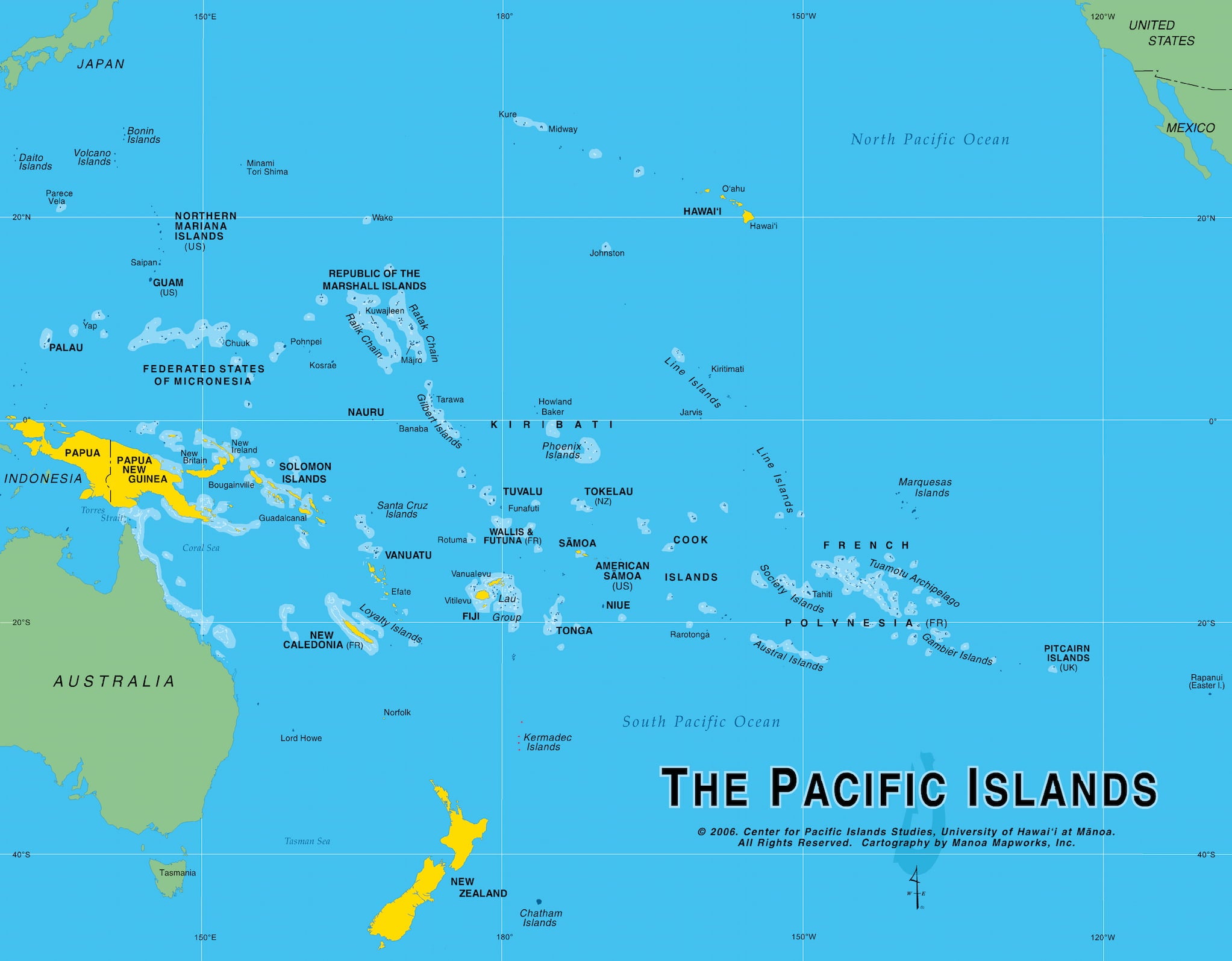
Image 02.04.02 — This map from the Center for Pacific Islands Studies, University of Hawaiʻi at Mānoa highlights the land masses of the smaller and larger island states in Oceania. Reproduced with permission.
While most of the region is warm and humid, winter conditions that produce hail and snow frequently take place in the mountains of Aotearoa New Zealand and Hawaiʻi. Therefore, each environment is unique, with some islands having barrier reefs, dense jungles, freshwater lakes, lagoons, and mangrove swamps. Other islands also encourage urban development, with a few villages transforming into cities over the course of the twentieth century. Volcanic activity is also quite common in Oceania.
With a wide range of environments, unique animals, birds, fish, coral, and plants exist in the region. Indigenous Pacific peoples have a customary respect and reverence for the land and for all living and dead beings (e.g., ancestral spirits). They do not treat animals, coral reefs, forests, mountains, and rivers as only biological or geological entities, but also as departed loved ones, tricksters, and bad spirits.
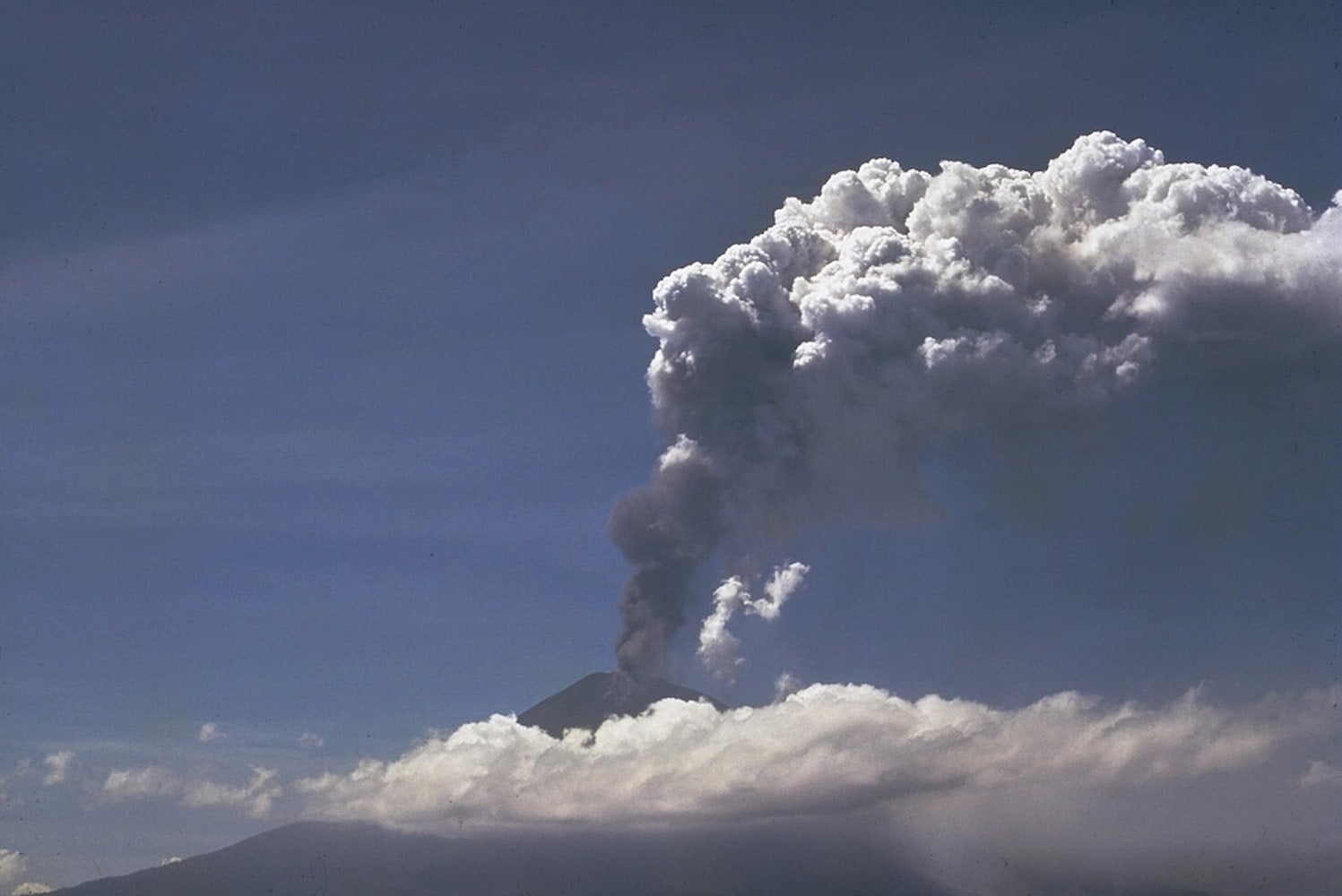
Image 02.04.03a — One-third of the world’s volcanic gasses come from the volcanoes of Melanesia. This 1970 photo features an eruption from Ulawun, an active volcano in Papua New Guinea, with its rising ash plume.
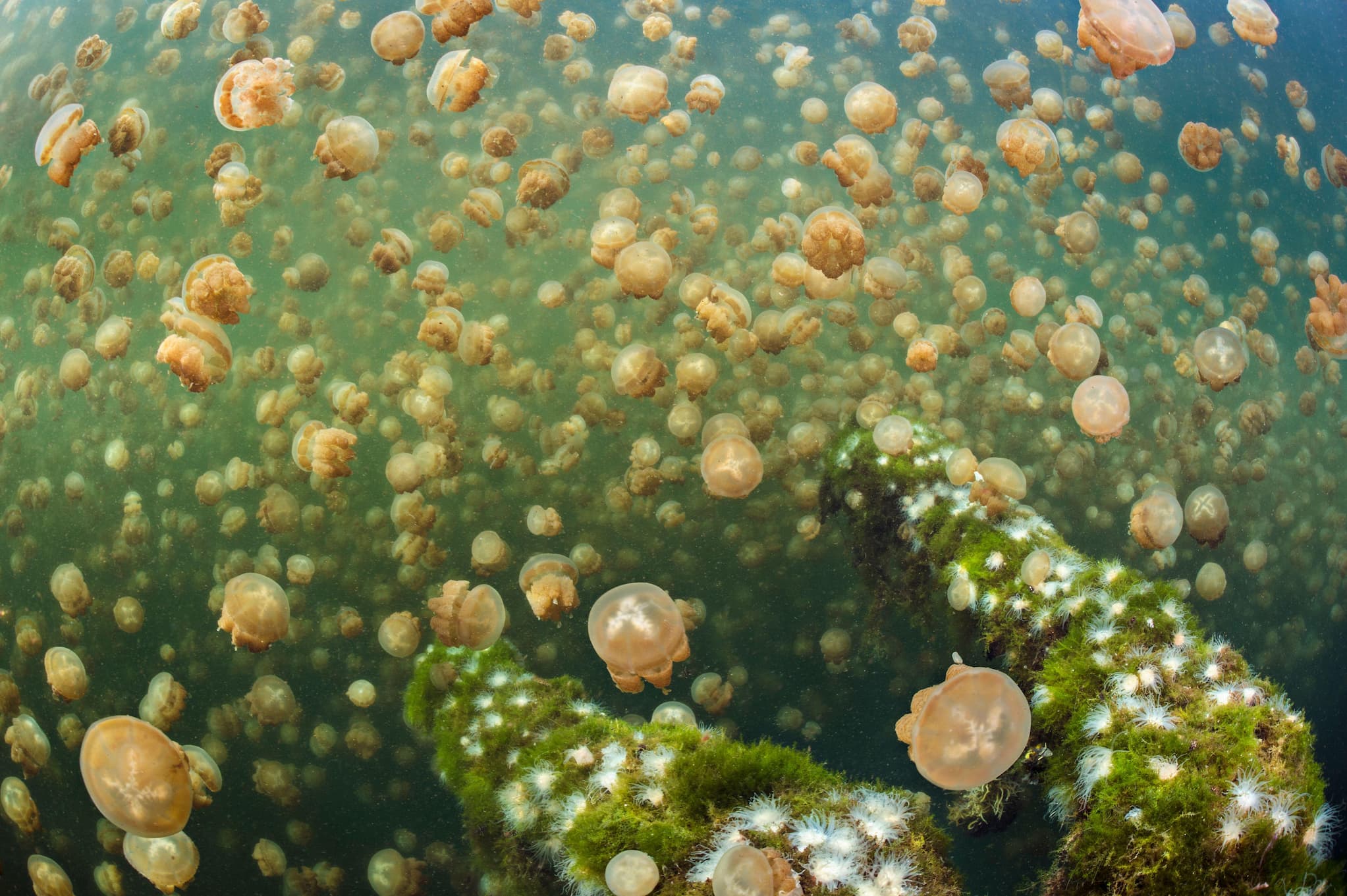
Image 02.04.03b — Millions of golden jellyfish migrate daily across Ongeim’l Tketau, also known as Jellyfish Lake, a marine lake in Palau.


Oceania’s cultural, linguistic, political, and religious makeup is equally diverse, with “Melanesia,” “Micronesia,” and “Polynesia” having been labeled as its three main regions. Micronesia lies north of Melanesia and is the closest Pacific area to East Asia (e.g., Japan). Melanesia sits above Australia, with Papua New Guinea and Indonesia to the west. Fiji, one of the larger island states, is often considered the easternmost side of Melanesia. Polynesia to the west, forms a triangle, with Hawaiʻi as its northernmost point and Aotearoa New Zealand and Rapa Nui (also known as Easter Island) as the other two corners to the southwest and southeast, respectively.
Polynesia includes independent Pacific Island countries like the Kingdom of Tonga and Sāmoa, as well as colonial territories such as the Marquesas, New Caledonia, the Society Islands of France’s Ministère des Outre-Mer (Ministry of Overseas Territories), and Rapa Nui under Chile’s government. Fifteen million people now live in Oceania.
The Science of Climate Change
What is climate change? To understand it we must understand the difference between weather and climate. Weather concerns atmospheric conditions that occur over a few days, like temperature and rainfall. Climate relates to the average pattern of weather at a particular place for thirty years or more. Therefore, climate change takes place over decades, even centuries, as a result of natural processes and human activities. The ancient ice ages that separated the continents represents one long period of natural climate change.
With regard to human activities, scientists have found that the burning of fossil fuels like coal, oil, and natural gas have greatly increased the emissions of greenhouse gasses in the atmosphere. While GHGs naturally appear in the atmosphere where they trap heat coming from the earth, the large-scale introduction of human-made GHGs into the atmosphere is rapidly warming the globe.
As a result, the higher concentration of the main GHGs like carbon dioxide (CO₂), methane (CH₄), and nitrous oxide (N₂O) consequently produces more heat in the atmosphere. Scientists have used the phrase “global warming” to describe the human-induced warming of the planet and the higher cases of precipitation and evaporation in different regions, and at different scales. This means that severe weather patterns—cyclones, erosion, droughts, fires, floods, and sea level rise—are emerging with more frequency and destruction.
Fossil Fuel Industries and Climate Change
Scientific evidence demonstrates that China (26.83 percent), the United States (14.36 percent), and the European Union (9.66 percent) generate the most GHGs globally. In fact, the scientists hired by Exxon, a powerful gas corporation, found that human-made GHGs had begun to harm the environment as early as the 1970s.
Scientists employed by the American Petroleum Institute, the US Chamber of Commerce, and other influential entities arrived at the same conclusions: that is, human-made GHGs warm the atmosphere, cause acid rain, deplete the ozone layer, destroy natural habitats, and harm human health, to name a few findings. In other words, since the 1970s, Exxon and other gas companies, automobile manufacturers, and the coal industry have known about the damaging effects of climate change.
They also realized that their scientific research, if made public, would threaten their sales and invite increased governmental regulations. Favoring immense profit over the health and well-being of people and the environment, these corporations then mounted a secret campaign to provide misleading information about climate change. Initially, they hired scientists from the tobacco industry to produce incorrect “scientific research” that GHGs were clean, safe, and necessary. Having already lied about tobacco not causing cancer, these scientists attempted to do the same about the validity of climate change.
Medical research now disputes the claim that smoking does not cause cancer. As a result, these companies have attempted to remove themselves from public scrutiny. They have also secretly paid third-party entities to fund “climate change deniers.” Today, many companies, especially those in the fossil fuel industry, indirectly employ bloggers, celebrities, lobbyists, radio show personalities, politicians, and others to cast doubt about the reality of climate change. At the same time, numerous environmental activists and organizations have begun to pressure China, the European Union, the US, and other countries to investigate these misinformation campaigns and to leverage the Paris Agreement to reduce the emission of greenhouse gasses globally.
The Paris Agreement
The Paris Agreement, a legally binding international treaty on climate change, responds to these scientific warnings. Formed at the United Nations Conference of the Parties (COP21) in December 2015 and entered in force in November 2016, the agreement calls on countries to limit global warming to well below 2 degrees Celsius, preferably to 1.5 degrees Celsius. In Oceania alone, scientists predict that an increase in the earth’s temperature of 2 degrees Celsius would destroy all of the coral reefs.
Elsewhere, large populations living along the coasts of Bangladesh and the Netherlands may also have to relocate to higher elevations to avoid floods. Recognizing these challenges, 196 countries supported the Paris Agreement agreeing that only a climate neutral world would reduce human-made GHGs by the year 2050.
The Paris Agreement likewise understands that the advocacy, research, legislation, technologies, and employment needed to mitigate and end climate change require enormous financial resources, as well as close cooperation between governments. In this respect, the agreement encourages industrialized countries to offer financial assistance to those that are more vulnerable to climate change.
Pacific Island countries, all of which are currently facing the impacts of climate change, qualify for such financial assistance. With these resources, the Pacific Island countries are able to work together to lessen climate change and create renewable energy (e.g., solar, wind turbines) in both rural and urban areas across the region.
Climate Change in Oceania
Scientific evidence shows that Pacific Island countries only produce a tiny amount of total human-made greenhouse gas emissions. Yet Pacific Island countries have begun to face an increase in cyclones, droughts, ocean acidification, and sea level rise. Take, for instance, the impact of sea level rise and its introduction of large amounts of salt water (and waves) into areas where salt water is not normally found. Because of sea level rise, many Pacific Islander families have lost their homes, fresh water sources, coconut trees, and vegetable farms. The atoll communities of Kiribati, the Marshall Islands, Tokelau, and Tuvalu, including all coastal villages across Oceania, represent the populations most negatively impacted by climate change.
In the early 2000s, the American and European media and non-governmental organizations responded to these environmental challenges by focusing on the impact of climate change in the Carteret Islands in the Autonomous Region of Bougainville. American and European journalists, policy makers, and scientists selected the Carteret Islands because they believed that climate change would soon cause the islands to “disappear” under the ocean. They argued as well that the Carteret Islanders would lose their homeland and soon become “climate refugees.”
According to the United Nations, the term “climate refugees,” people displaced by environmental destruction, does not exist in international law. Nevertheless, media outlets and non-governmental organizations have portrayed the Carteret Islanders as helpless victims and potential climate refugees. As a result, many international reports referenced the Carteret Islands as a tragic case of climate-induced displacement. However, the islands still exist today and the Carteret Islanders continue to call them home even though climate change poses numerous threats to their way of life.
Approaches to Relocation
The Carteret Islands and other Pacific Island countries have been debating the matter of relocating their communities should sea level rise erode more homes and farmlands. Three propositions exist. The first choice would entail the construction of seawalls and other barriers to protect the shorelines from waves. Should these measures fail, the second option would involve the resettlement of villagers from coastal areas to higher elevations like hills and mountains. Both propositions would ensure that villagers live near their ancestral grounds.
The third and least favored preference would relocate villagers from their home country to another nation like Aotearoa New Zealand, Australia, or Fiji. Each option would involve community input and involvement at every stage of the process, as well as require diplomatic negotiations and monetary resources. In each case, the Carteret Islands and other Pacific Island countries would thus welcome the values of respect, cooperation, trust, and reciprocity when discussing and identifying solutions to climate change that affects them.
Pacific Islander Understandings of Climate Change
Outsiders have also begun to listen to and learn from what Pacific Islanders have to say about Christianity and science. Given that Christianity is the dominant religion in Oceania, many Pacific Islanders attend weekly masses and follow Catholic, Methodist, Mormon, and Protestant traditions. Today the Biblical story of Noah plays a vital role in Pacific Islander discussions about climate change.
According to the Old Testament Book of Genesis, Noah constructed a boat to house God’s creations, including animals and birds, and to protect them from a great flood. In return God promised Noah that the earth will never experience another massive flood. A minority of Pacific Islanders thus believe that climate change does not exist since God had promised Noah that no destructive flood would occur again.
A smaller group of Pacific Islanders also believe that climate change is God’s punishment for their sins or religious violations. However, the great majority of Pacific Islanders interpret Noah’s story as a warning from God to protect the earth and its diverse people, animals, and environment from climate change. Many Pacific Islanders now pray for the good health and prosperity of everybody on earth, express their faith in the value of scientific research and public policy discussions, and seek both love and salvation from God.
Pacific Islander youth activists, many of whom practice Christianity, frequently deliver these sentiments to national and international forums. Along with government officials and ministers, they are leading the debates about climate change. The youth-led grassroots organization, 350 Pacific (Pacific Climate Warriors), is one such collective.
With their motto, “We are not drowning, we are fighting,” 350 Pacific calls for the divestment of the fossil fuel industry in the Americas, Asia, Australia, Europe, and North Africa. By divestment, they mean that governments should stop financing the fossil fuel industry. The group also encourages governments to invest their monetary resources in the renewable energy industry (e.g., solar), including the growing electric vehicle industry.
350 Pacific likewise recommends that governments and corporations provide new jobs or retirement packages, health insurance plans, and other benefits for employees of coal, gas, and oil companies. To convey these messages, the group and other Pacific Islander youth activists often dress in traditional attire, organize public protests, participate in climate policy summits, showcase their art and music, and lobby members of government.
Conclusion
When Kathy Jetñil-Kijiner performed her poem at the UN Climate Summit in 2014, she represented the brave girls, women, and future generations of mothers in Oceania fighting for climate justice. The world can thus learn from Pacific Islander leaders like Jetñil-Kijiner who seek to protect the beautiful beaches, forests, mountains, and reefs of Oceania. As she expressed, Marshallese and other Pacific Islanders continue to fight for their homes and to remain in their ancestral homelands. Jetñil-Kijiner reminds us that climate change is a major threat to her people and greater Oceania.
Young leaders like Jetñil-Kijiner encourage countries and corporations to heed the Paris Agreement and to limit global warming to well below 2 degrees Celsius, preferably to 1.5 degrees Celsius. By taking stock of her insights, more artists, filmmakers, journalists, policy makers, and scientists have begun to develop respectful and reciprocal long-term partnerships with the Marshallese and other Pacific Islanders. They are now working together across the arts, churches, government, media, and sciences to end climate change and to create a healthy environment for all generations.
Glossary terms in this module
atoll Where it’s used
A ring-shaped series of islands, coral reefs, or islets surrounding a body water called a lagoon.
climate change Where it’s used
The long-term changes in our average weather patterns that affect regional and global climate. Human activity, particularly the burning of fossil fuels like oil and coal since the 1800s, causes greenhouse gases to trap heat in Earth’s atmosphere which in turn raises Earth’s temperature. Not to be confused with global warming (the long-term heating of Earth’s surface), climate change also encompasses droughts, rising sea levels, severe fires, flooding, and melting polar ice caps, among other natural disasters.
climate justice Where it’s used
A form of environmental justice that recognizes the harmful social, economic, and health effects that climate change causes for impacted communities. Pacific Islanders use Indigenous knowledge to think about and propose solutions for climate justice.
greenhouse gases Where it’s used
Gases such as methane, carbon dioxide, and nitrous oxide that trap heat from the sun around Earth’s surface.
Melanesia Where it’s used
A label given to the geographical region in the Western Pacific and north of Australia, including Papua New Guinea, the Solomon Islands, Vanuatu, New Caledonia, and Fiji.
Micronesia Where it’s used
A label given to the geographical region in the Northwest Pacific and east of the Philippines, including Palau, the Northern Mariana Islands, Guåhan (Guam), the Federated States of Micronesia, Kiribati, and the Marshall Islands.
Oceania Where it’s used
A huge geographic region that encompasses Melanesia, Micronesia, Polynesia, and Australia.
Polynesia Where it’s used
A label given to the large geographical region in the Pacific east of both Melanesia and Micronesia, including Hawaiʻi, Tuvalu, Tokelau, Samoa, the Cook Islands, the Society Islands, the Austral Islands, Mangareva, the Tuamotu Islands, the Marquesas Islands, Tonga, Rapa Nui, and Aotearoa New Zealand.